INTRODUCTION
The family Syngnathidae is represented by two subfamilies: Hippocampinae (seahorses) and Syngnathinae (pipefish). The former includes one genus and about 36 species; the latter contains 51 genera and at least 196 species (Nelson, Reference Nelson2006). Only one species of Hippocampinae has been reported on the Argentine continental shelf: the seahorse Hippocampus patagonicus (Piacentino & Luzzatto, Reference Piacentino and Luzzatto2004). Two species of Syngnathinae have been reported in Argentine waters: the deep-bodied pipefish Leptonotus blainvilleanus (Eydoux & Gervais, Reference Eydoux and Gervais1837), with a distribution as far south as Tierra del Fuego; and the southern pipefish Syngnathus folletti (Herald, Reference Herald1942), which occurs from northern Brazil (near Fortaleza, Ceará) to Uruguay and north of Argentina (Dawson, Reference Dawson and Bolke1982). Syngnathus folletti is a subtropical species found in depths between 10 and 30 m and sporadically at greater depths (83–200 m) which can support large variations in salinity (Figueiredo & Menezes, Reference Figueiredo and Menezes1980), since it has been collected in the Patos Lagoon estuary (Weiss, Reference Weiss1981; Garcia et al., Reference Garcia, Vieira and Winemiller2001, Reference Garcia, Geraldi and Vieira2005), the middle zone of the Mambucaba River estuary (Neves et al., Reference Neves, Teixeira and Araújo2010), as well as in the Río de la Plata estuary (Ruarte et al., Reference Ruarte, Rico and Lucifora2009) and the Ajó River from its headwater to its mouth in Samborombón Bay (36°20′–36°28′S 56°54′–56°59′W), in the nearby Río de la Plata estuary (Solari et al., Reference Solari, García and Jaureguizar2009). We report here the occurrence of S. folletti in the inlet channel (37°44′S 57°25′W) about 1000 m from the mouth of the Mar Chiquita coastal lagoon (Buenos Aires, Argentina). This record constitutes the southernmost report for the species.
MATERIALS AND METHODS
One specimen of Syngnathus folletti was collected on 15 December 2008 by a local fisherman with a 1.70 m diameter, 20-mm mesh size landing net equipped with a 5-mm mesh size cod-end, during the high tide at nightfall. The specimen was frozen for four months before being fixed in 10% formalin, identified and measured to the nearest 0.05 mm with a digital caliper. The specimen is registered in the collection of the Instituto Nacional de Investigación y Desarrollo Pesquero as INIDEP No. 825.
RESULTS
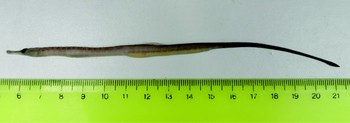
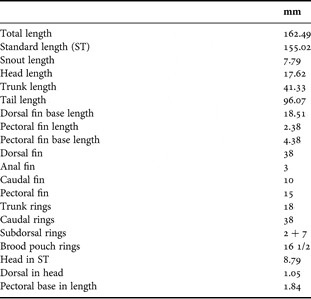
The specimen of Syngnathus folletti was a mature male (Figure 1). Morphometric features and body proportions are summarized in Table 1, and agree with those reported by other authors who described this species (e.g. Herald, Reference Herald1942; Pozzi & Siccardi, Reference Pozzi and Siccardi1948).
Syngnathus folletti, INIDEP 825, lateral view (scale in mm).

Measurements, morphometrics and body proportions of Syngnathus folletti from Mar Chiquita coastal lagoon.

DISCUSSION
The occasional presence of tropical and subtropical teleost fish in Mar Chiquita coastal lagoon has been attributed to the incursion of warm neritic waters to the Argentine continental shelf (Díaz de Astarloa et al., Reference Díaz de Astarloa, Figueroa, Cousseau and Barragán2000; Figueroa et al., Reference Figueroa, Díaz de Astarloa and Cousseau2000; González Castro et al., Reference González Castro, Díaz de Astarloa and Cousseau2006; Blasina et al., Reference Blasina, Delpiani, Bruno, González Castro and Díaz de Astarloa2009) in combination with winds from the oceanic region that allow marine water to enter several kilometres into the inner channel (Reta et al., Reference Reta, Martos, Perillo, Piccolo, Ferrante and Iribarne2001). Lucas et al. (Reference Lucas, Guerrero, Mianzan, Acha and Lasta2005) stated that the Río de la Plata discharge (22,000 m3 s−1) has a weak seasonal signal in discharge volume with a maximum in the winter and a minimum in the summer. In the summer months, prevailing onshore winds force the low salinity signal south and east along the Argentine coast as far as 37°S (Lucas et al., Reference Lucas, Guerrero, Mianzan, Acha and Lasta2005). The weather forecast for December 2008 developed by the Servicio Meteorológico Nacional (Skansi, Reference Skansi2008) showed a scarce rainfall period with negative anomalies and a sea surface temperature of two degrees above average. The low rainfall could reduce the Rio de la Plata discharge and oceanic winds allowed warmer northern waters to approach the coast of Argentina, explaining the increase in sea surface temperature. This unusual atmospheric phenomenon could explain the southernmost distribution of Syngnathus folletti. Garcia & Vieira (Reference Garcia and Vieira1997) and Garcia et al. (Reference Garcia, Geraldi and Vieira2005) showed that Widgeon grass beds seem to be a suitable habitat for the species where S. folletti can feed and reproduce. Mar Chiquita coastal lagoon is characterized by mudflats surrounded by a large cord-grass (Spartina densiflora) area (Fasano et al., Reference Fasano, Hernández, Isla and Schnack1982; Martinetto et al., Reference Martinetto, Ribeiro and Iribarne2007) but not by grass beds. Despite the importance of this coastal lagoon as a refuge and feeding ground for juvenile fish during their critical development stages and also as a stopover site for adult fish along their migratory routes (Cousseau et al., Reference Cousseau, Díaz de Astarloa, Figueroa and Iribarne2001; González Castro et al., Reference González Castro, Díaz de Astarloa, Cousseau, Figueroa, Delpiani, Bruno, Guzonni, Blasina and Deli Antoni2009; Valiñas et al., Reference Valiñas, Acha and Iribarne2010) it seems not to be a suitable environment for S. folletti. This emphasizes that the unusual atmospheric phenomenon could be the cause of the presence of the species.
ACKNOWLEDGEMENTS
The authors would like to thank Miguel Addino for donating the specimen, Gabriela Silvoni from INIDEP who kindly provided relevant literature and Dra. María Berta Cousseau for her valuable suggestions on the earlier version of this manuscript. Daniel O. Bruno and Mariana Addino were supported by scholarships from CONICET.