One notion employed to explain the meaning behind archaeological materials of a ritual nature relates to the idea of collective memory. A number of recent publications have examined the relationship between memory and archaeological remains (Chesson Reference Chesson2001; Van Dyke and Alcock Reference Van Dyke and Alcock2003; Williams Reference Williams2003). Several terms have been used to refer to this phenomenon: collective memory, social memory, collective or social remembering, cultural memory, and group memory. First we discuss operant definitions of these terms, followed by an examination of the general characteristics and theory of social or collective memory in order to establish a basic framework of archaeological correlates that confirm the presence of this phenomenon. Finally, we apply these to two archaeological examples from the sites of Minanha and Zubin, located in west central Belize, and consider the utility of the model for other contexts. Archaeologists have difficulty interpreting the significance of ritual objects, and this paper provides one way to operationalize a model of collective memory to deal with material culture of a ritual nature and contributes a significant new way to understand that material.
THEORETICAL CONSIDERATIONS
Definitions used to refer to collective memory share several common points. These include a discussion of the location of the phenomenon of collective memory in relation to the remembrance of the individual subject; the relationship among memory, history, and identity; and the sense of a present purpose responsible for the active process of memory production (Connerton Reference Connerton1989; Halbwachs Reference Halbwachs and Coser1992; Misztal Reference Misztal2003; Nora Reference Nora1989; Wertsch Reference Wertsch2002). We agree with others in the assertion that the essential components of social memory in archaeology include a diachronic time scale, a group-oriented locus of action, and a specific or desired outcome for the ritual process on the part of the practitioners. Assmann (Reference Assmann1995:126) describes cultural memory as a solution for the preservation of tradition. He defines cultural memory as “a collective concept for all knowledge that directs behavior and experience in the interactive framework of a society and one that obtains through generations in repeated societal practice and initiation” (Assmann Reference Assmann1995:126). Essential to this definition is the idea that cultural memory is something that serves as a repository for cultural tradition. In contrast to other definitions, Assmann emphasizes the conservation of tradition as the main function of cultural memory.
The notion of conservation raises an essential characteristic of any definition of cultural memory: time. Something cannot be classed as belonging to long-term cultural memory, as opposed to everyday or communicative memory, if it does not have a component of longevity on the order of decades, generations, or centuries (Assmann Reference Assmann1995:129). This trait makes archaeological inquiry particularly appropriate for investigations of social memory production because archaeological data tend to encompass a diachronic perspective.
Another irreducible component of any definition of collective memory is that it is shared by a group and that it is constructed or mediated within a social context (Assmann Reference Assmann1995:127; Halbwachs Reference Halbwachs and Coser1992). Collective memory is something that does not exist at the scale of the individual, but rather it is intersubjective—a form of knowledge created and agreed upon by more than one individual, much in the same way that language is (Samuel Reference Samuel1990:6). But the group context is not a singular entity, for there can be many simultaneous groups to which a single individual belongs and thus many competing and parallel groups constructing different pasts as a means of solidifying their identity in the present (Halbwachs Reference Halbwachs and Coser1992). Misztal (Reference Misztal2003:25) demonstrates the importance of the sanction of a group in her definition of collective memory as “the representation of the past, both the past shared by a group and the past that is collectively commemorated, that enacts and gives substance to the group's identity, its present conditions and its vision of the future.” This definition emphasizes that the creation of collective memory is an active process, with group members selecting particular things to remember that are fundamental to their shared group identity. As well, it underlines the importance of the present in the creation of collective memory, suggesting that contemporary motivations are at least partly responsible for the production of group memory.
The creation and manipulation of a usable past is a key element to the creation of collective memory and also to the remembrance of events long past. Hobsbawm (Reference Hobsbawm, Hobsbawm and Ranger1983) labeled the manipulation of a usable past as the invention of tradition. He defined the invention of tradition as “a set of practices, normally governed by overtly or tacitly accepted rules and of a ritual or symbolic nature, which seek to inculcate certain values and norms of behavior by repetition, which automatically implies continuity with the past” (Hobsbawm Reference Hobsbawm, Hobsbawm and Ranger1983:1). Inherent in this definition is both an element of alteration (in which people consciously select particular aspects of a past to emphasize through ritual) and an element of conservation (in which the tradition being replicated in the present is represented as if unchanged). Even if traditions remain unchanged through long periods of time, the present milieu itself is different from all the contexts of the past in which the tradition or remembrance occurred.
The coalescence of a shared group memory also implies that the group has come to a consensus about the group's identity in the past. Participants agree to some statement of underlying truth and use that truth to forge a continued claim about the present and future of the group (Fentress and Wickham Reference Fentress and Wickham1992:25). Additionally, it is the use of the remembered past in the present that serves a particular purpose in the present—often a claim of naturalization or legitimation of authority, a defense of preferential status, or a reassertion of access to resources (Hobsbawm and Ranger Reference Hobsbawm and Ranger1983; Van Dyke and Alcock Reference Van Dyke and Alcock2003).
The process of collective memory requires a mechanism to facilitate the successful operation of both the creation and maintenance of these memories. Wertsch (Reference Wertsch2002:6) suggests that an essential component of collective memory is mediation. Although Wertsch refers to text as the foundation for this mediation, other cultural tools, such as oral narrative or items of material culture, can stand as proxies for written text and serve in the same capacity as mnemonic devices that facilitate the act of remembrance. Elsner (Reference Elsner, Nelson and Olin2003:210) labels a system where objects hold a functional role as signifiers of memory as object-based semiotics, that is, a system where material forms themselves are a culturally based system of communication. The objects serve as a functional tool to facilitate the retention and recall of socially relevant information. The role of objects as mediator is a powerfully different interpretation of material culture than other forms of analysis based on style or appreciation of the piece in isolation from its mnemonic context.
Social memory can operate in different contexts, but one feature common to all mnemonic processes is a spatial component. The technique, known as “the method of loci,” is a cognitive system of remembering that links word, image, or object with a spatial location (Küchler Reference Küchler1987:249). This technique uses a socially and culturally specific spatial mapping to remember more than rote memorization alone can. For the individual, the spatial referent could be chosen at will, but in the case of collective remembering, the group agrees on the associative locale and objects to aid in remembrance. This agreement is constrained by particular social and cultural limitations. Locales and objects are standardized among a cultural group, a feature that is promising for the detection of long-term cultural remembrance through the examination of material remains. The relationship between memory and the spatial location where the remembered event took place is important because there is a great degree of specificity attached to a recollection when it has a spatial referent (Archibald Reference Archibald, Climo and Cattell2002:74). As a shared group activity, social memory is performed. It is a discursive bodily practice that establishes a connection between the act of remembering and the space in which it occurs (Meskell Reference Meskell2004:65).
Küchler (Reference Küchler1987:248) identifies mnemonic processes and the production of history as mutually related processes where both are connected to the attainment and maintenance of power and authority. Both mnemonic processes and the production of history are open to social and historical influence. Thus, the two processes coexist alongside one another—the difference lies only in the social milieu or context of their use. If formal writing and hence control over the recording of history was not accessible, apical elites from lesser sites and marginalized elites could have employed object semiotics or mnemonic processes as an alternate means to acquire and maintain power and legitimacy and to bolster social status through the process of collective remembering.
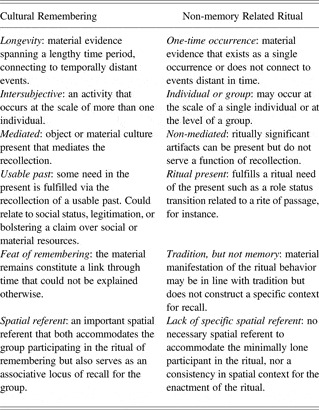
Several definitions and characteristics of collective remembering have been described in the preceding discussion, but we are still left with the task of how to operationalize these phenomena in the material assemblages recovered from archaeological contexts. The material correlates to the process of collective remembering have most of the following traits: temporal longevity, evidence of being shared by a group, presence of one or more object mediators, a present purpose for the creation of a usable past, a feat of remembrance that could not otherwise be explained, a strong spatial referent or location associated with the process, and evidence of the process taking place within a ritual context. One strategy to discern between conscious collective remembering and non-discursive repetitive ritual practices is to compare the characteristics of each through an imposed binary framework that places them in opposition to each other for analytical purposes (Table 1).
A comparison between the material correlates of ritual that relate to cultural remembering and to ritual that does not have a component of cultural memory.

The first characteristic, longevity, relates to the temporal range of the material items. For long-term cultural remembering to occur, there must be material proof that something is remembered over time. Material remains related to rituals that do not reflect cultural remembering might exist in a single time, in a particular moment, or outside of temporal comparisons. The second characteristic, that the remembering occurs at the scale of more than one individual, is a defining feature of collective memory. If the ritual can be enacted by a single individual, it cannot represent collective memory. This is not to say that all group ritual activity is by default an example of collective memory. Most ritual contexts do involve more than one individual, but if the ritual context is one that could entail a single individual such as a private domestic ritual, it can be ruled out as an example of collective remembering. This feature is also linked to the spatial referent for collective remembering—the physical location of the ritual event must be one where the group involved could witness and partake of the ritual. Because of this, it is most likely that rituals associated with conscious collective remembering will not be in private, domestic contexts, but rather in public or semipublic open areas and shrines. In addition, the presence of a spatial referent connects to the mnemonic function or role the physical space has in the recall process. The link with a particular spatial context is not necessary to a ritual that does not involve memory construction. The spatial context could shift or vary if it did not serve as a locus for associative recall. In addition, there must be material items that serve as mediators in the act of collective remembering. The material culture that serves as a mnemonic device or as a reservoir for culturally significant information related to the act of recall needs to be present in the recovered archaeological remains for archaeologists to be able to discuss collective memory. The context of the materials is integral to the role the specific spatial location serves as a locus for the creation of collective memory. In conjunction with the previously discussed material correlates, the material evidence must point to an interpretation that an unusual feat of remembrance occurred. The context of material remains, particularly if they are diachronic in scale, as well as of the spatial location of remains can be used as evidence of the feat of remembrance.
The final aspect of the interpretation of the archaeological correlates of a cultural memory event includes placing the remains within their local, regional, and cultural context to determine the motivation behind the ritual event. The reason for the creation of the connection to the past through a memory event could relate to multiple purposes in the event's present, and a description of the broader events can elucidate what that motivation may have been. The hearkening back to a usable past could have served a multitude of social ends—to bolster status, to legitimate right to rule or access to resources, to legitimate social or occupational position, and to settle land claim or resource disputes, among other things.
ARCHAEOLOGICAL EXAMPLES FROM WEST CENTRAL BELIZE
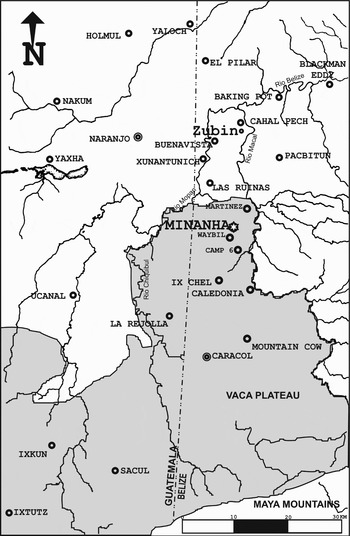
The central lowland Maya sites of Zubin and Minanha in west central Belize contain archaeological examples of the creation and utilization of collective remembering in ritual contexts (Figure 1). We contend that the ritual remains associated with the apical elite at Minanha, recovered during the excavations in association with an E-group style ancestor shrine—Structure 3A—in the site epicenter, fulfill each of the preceding requirements and constitute a cogent example of an instance of the use of cultural memory in ritual as a strategy to maintain legitimacy and control rulership over the polity at a time of particular unrest. The ritual remains associated with two successive burial events in the eastern shrine of the main plaza at the site of Zubin likewise constitute an example of cultural remembering as a means to maintain and define elite group solidarity and identity at a minor site, a satellite of the larger Cahal Pech polity.
Map of west central Belize showing the location of the sites of Minanha and Zubin.

Minanha
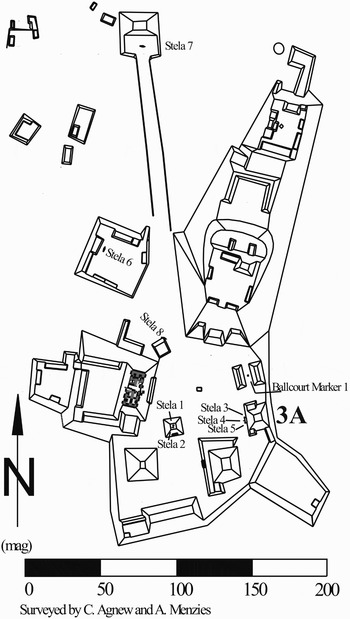
Minanha is a medium-sized major center situated within the north Vaca Plateau of west central Belize (Iannone Reference Iannone, Iannone, Seibert and Gray1999:6). Minanha was once strategically located in an intermediate position between several of the large and important centers of the Classic period (a.d. 250–900), such as Caracol (to the south), Tikal and Naranjo (to the west), and the much smaller Belize Valley centers (to the north). Minanha itself contains a large number and variety of architectural features, both public and private, including a ballcourt, an ancestor shrine, sacbeob or raised causeways, pyramidal structures, range structures, and variety of residences from commoner dwellings to an apical elite palace (Figure 2).
Map of the epicenter of Minanha, Belize.

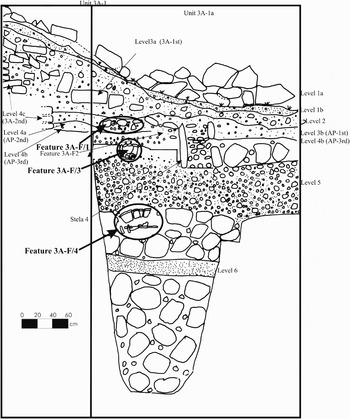
The focus of this investigation is Structure 3A, the eastern ancestor shrine located in Plaza A. There are three stelae monuments in front of Structure 3A. The central of these is a deliberately broken slate stela aligned axially with the building. It is flanked by two limestone monuments that were also deliberately broken. Between the monuments and the building itself is a series of aligned caches (Figure 3).
Profile of the aligned caches in front of Structure 3A.

The first of these (Feature 3A-F/1), sits just atop the penultimate floor within the terminal plaza floor. The feature consisted of a circular alignment of cut stones that enclosed a termination cache. Within the stones was a Belize Red: Belize Variety dish with rattle feet. This vessel had been deliberately smashed at the time of deposition. There were also two halves of two broken granite manos. Finally, there were some raw slate fragments, pottery fragments, and nonformal chert lithics found within the enclosed cache context (Schwake Reference Schwake, Iannone, Seibert and Gray1999:50). This feature was placed at the time of the construction of the terminal phase of architecture (the Late Classic period, which for Minanha dates from a.d. 675 to 810). The offering terminated the use of the penultimate phase of construction, as seen by its placement slightly cutting into the penultimate floor (Schwake Reference Schwake, Iannone, Seibert and Gray1999:50). It is interesting to note that this cache is in what would normally be the expected location for a cache—on the penultimate floor, just in front of the terminal architecture.
Immediately beneath Feature 3A-F/1, within the antepenultimate floor but protruding into the penultimate floor, another cache was located. Designated Feature 3A-F/3, it consists of several pieces of slate lining the hole of the cache enclosure; within this was a large piece of a prismatic obsidian blade, two utilized flakes of pink chert, and two chert eccentric lithics. This cache dates to the Late Classic period (a.d. 675–810), and is both a termination and a dedicatory offering. It can be seen as a termination of the antepenultimate living surface, at the same time it is dedicatory toward the penultimate construction. The fact that there are relatively rare and mostly complete items within the cache further suggests a dedicatory function.
Approximately 80 cm below this, another cache was found (Feature 3A-F/4). This deposit was situated within the dry core fill of the rather thick antepenultimate floor. This fill sat atop a tamped earth layer of claylike soil. The deposit consisted of an inverted, complete, but shattered Sierra Red: Society Hall Variety vessel. This is a Terminal Preclassic ware, thus dating the deposit to approximately a.d. 1–250. Beneath the inverted vessel were the partial remains of an adult individual. The only remains represented were the long bones, the skull, and the teeth. This reflects an intentional deposition of partial remains rather than differential preservation. When human remains form part of a cached deposition, it is almost always because the deposit is dedicatory to something else (Becker Reference Becker, Danien and Sharer1992). Thus, this was also labeled a dedicatory cache.
The material within these three caches, in fact the caches themselves, serve as object mediators for the remembrance of events. These objects create the material link between the first cache event and the subsequent cache events, fulfilling Wertsch's (Reference Wertsch2002) requirement for material intermediaries as integral to occasions of collective remembering.
What is most astonishing about these offerings is that they were separated by about 150 cm of depth and a temporal span ranging between 425 and 750 years, yet they are situated in perfect vertical and horizontal alignment. This is seemingly contradictory, given the expectation that different offerings will be situated in standard locations associated with the architecture of their respective building phases. The pattern of deposition here varies considerably from a simple axial alignment model. The first question that comes to mind is, how did the Minanha Maya remember the precise spatial location of hidden offerings over such a long span of time, seemingly regardless of the immediate architectural constructions? This constitutes a remarkable feat of remembering, one of the traits that serves as a hallmark of long-term cultural recollection. Not only was there a feat of remembrance, but the span of time that stretches between the events also constitutes a scale of diachronic longevity: a span of years that goes far beyond communicative or everyday memory but crosses multiple generations of ritual participants.
The question of how the Minanha Maya accomplished such a feat of remembrance is answerable if the depositions are seen not as independent events, but as linked offering events that form part of a ritual process tied to a very specific spatial location. Our discussion of memory posited spatial location as one of the most important factors in the preservation of long-term cultural memory. The Structure 3A deposits corroborate that requirement by providing a ritually charged public space for experience and remembrance. The nature of the location, a large, open public area, also supports the interpretation that many people witnessed the ritual events associated with the deposition of the caches.
A final intriguing aspect of the Minanha example is the fact that the caches themselves transcend a period of dramatic political change for the center. In brief, at the onset of the eighth century a royal court established itself at Minanha. The material culture and architectural inventory suggest that the rulers of this royal court were elite immigrants, probably from the vicinity of Caracol (Iannone Reference Iannone2005). The upper two caches (3A-F/1 and 3A-F/3) were placed during the reign of this intrusive political body. These caches are important because they suggest that part of the new elite's success in establishing their royal court may stem from the incorporation of local power structures into their governing apparatus. Specifically, an obvious effort was made to link the aforementioned caches with the Terminal Preclassic one (3A-F/4). By doing so, the new elite were able to tap into the traditions and long-term social memory of the Minanha community and thus tie into one of their most powerful portals of communication with the past. Such actions would have undoubtedly provided an important level of legitimacy for the fledgling royal court and provided a reason for them to want to create a usable past via long-term cultural memory.
Zubin
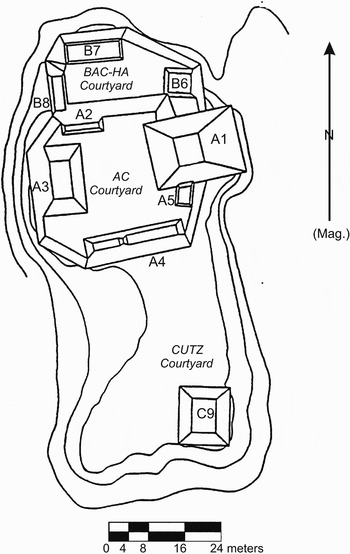
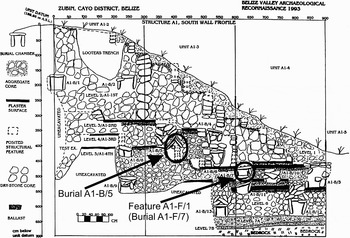
The second example comes from the minor center of Zubin, located in the Belize Valley, roughly 25 km north of Minanha. Zubin is situated on an east-west running limestone ridge, approximately 2 km south of the larger center of Cahal Pech. The Zubin epicenter consists of two well-defined courtyards on the north and a raised platform to the south (Figure 4). Architectural remains include pyramidal, range-type, and other low-lying structures. Of specific interest here are events associated with a cache and two burials in Structure A1. Structure A1 is the eastern pyramidal mound of the restricted Plaza A configuration, and it served as the Zubin community's ancestor shrine (Iannone Reference Iannone and Awe1993). The structure is approximately 9 m in height. In 1993 an 11- × -2 m axial trench was excavated along the buildings primary axis. A series of dedicatory and termination ritual deposits, and several richly furnished graves were recovered in association with various discrete construction episodes (Figure 5).
Map of the Zubin epicenter.

Profile of Structure A1, Zubin, Belize.

During the excavation beneath the basal section of the terminal stairs a large, axially aligned circular cut was revealed. This feature, designated Feature A1-F/1, was a subfloor cache that had been cut into the courtyard surface directly in front of the penultimate building, just prior to construction of the terminal architecture. Within the cache two San Pedro Impressed: San Pedro Variety vessels had been placed lip-to-lip within a large Mount Maloney Black: Mount Maloney Variety vessel. The San Pedro Impressed: San Pedro Variety vessels date to the local Tiger Run Phase (a.d. 600–700), and the Mount Maloney Black: Mount Maloney Variety vessel is characteristic of the Late Facet Spanish Lookout Phase (a.d. 700–875). It is interesting to note that there is a temporal disparity of as much as 175 years between the San Pedro Impressed vessels and the Mount Maloney Black vessel.
Even more intriguing is the fact that as the Feature A1-F/1 material was removed, it became apparent that the cache was actually intrusive into a simple crypt burial, Burial A1-B/7, which had been placed at the time of construction of the penultimate building. Given the preserved remains, the cache vessels had clearly been positioned where the head of the individual should have been. Besides the ceramic offerings, there was one other key artifact associated with this burial: a small jadeite disk bead that was also found in the region of the head. Burial A1-B/7 was originally dated to a.d. 650–750, primarily because of its stratigraphic association with the construction of the penultimate construction, but also given the date for the associated San Pedro Impressed: San Pedro Variety dishes. What seemed anomalous, though, was the presence of the later Mount Maloney Black: Mount Maloney vessel. The excavation of Burial A1-B/5 considerably illuminated this apparent disparity.
Burial A1-B/5 was intrusive into the penultimate phase of architecture, and like Cache A1-F/1, it had been placed in conjunction with the construction of the terminal building. This burial consisted of a relatively large chamber with a rich assemblage of grave goods. For these reasons, the death of the Burial A1-B/5 individual is thought to have spurred the construction events associated with the terminal phase. The abundant grave goods in Burial A1-B/5 include a large Garbutt Creek Red: Paslow Variety bowl, a Sotero Red: Sotero Variety vase, shell and jadeite mosaic inlays, and 155 small jadeite disk beads.
The presence of the small jadeite disk beads in Burial A1-B/5 is integral to the hypothesized connection between this interment, Feature A1-F/1, and Burial A1-B/7. These beads were manufactured from a very distinctive “mottled” jadeite. Color ranges from dark green, blue, white, to translucent, often on the same bead. This mottled jadeite is identical to the solitary bead recovered from Burial A1-B/7. In addition, the Burial A1-B/7 bead is identical in size and shape to those recovered from Burial A1-B/5. Given this key piece of data, a likely scenario is that the death of the individual interred in Burial A1-B/7 spurred the construction of the penultimate building. Original grave goods included the two San Pedro Impressed: San Pedro Variety vessels, and a jadeite disk bead necklace. Some time later, in conjunction with the termination of the penultimate architecture, and the construction of the terminal architecture, Burial A1-B/7 was reopened via the Feature A1-F/1 cache cut. This was a very specific cut, directly to the head and the beads, slightly south of the actual primary axis of the structure. At this time the jadeite beads were removed, except for one; these were exchanged for the Mount Maloney Black: Mount Maloney Variety bowl within which the San Pedro Impressed: San Pedro Variety vessels were then placed within. The skull of the individual interred in Burial A1-B/7 was probably also removed at this time, as it was not discovered within the grave. Subsequently, the jadeite beads obtained through the Feature A1-F/1 re-entry were redeposited within Burial A1-B/5. This scenario suggests that the Zubin residents knew exactly where to dig in order to obtain the beads. Although the time between the two interments does not appear to have been very long (possibly about 50 to 100 years), this example provides a different type of record in material remains to corroborate the importance of group remembrance associated with deposits of a highly charged ritual nature.
The Zubin example is also in accordance with all of the characteristics discussed as necessary indicators of the process of cultural remembering. The Zubin material spans a period of time; it constitutes a feat of remembrance; the context is a group shrine, so the ritual participants were more than one in number; the spatial location of the shrine itself serves as the spatial referent for the event; the ritual is mediated via the material grave goods; and the purpose for the event relates to the group's need to solidify their identity and social status in the Zubin community. That these events took place at this location also reaffirms ancestral ties and serves to legitimate claims for those engaged in the ritual via the ancestor shrine.
DISCUSSION AND CONCLUSION
The Zubin and Minanha data provide examples of the types of micro-event reconstructions that allow insights into the material manifestations of long-term cultural recollection. Both cases involve multiple construction phases through time, and both illustrate an uncanny ability to remember the exact location of ritual deposits over long time spans. What is clear is that communities were quite adept at transferring these ritual maps between multiple generations. It is also apparent that it was important to periodically tie into these features in order to tap into a source of legitimation or confirmation of social position in a hierarchy. The information about the location of the materials is privileged knowledge that could not be claimed by outsiders; it is legitimate knowledge that is physically documented, and this is why it is a powerful attestation of group identity, place, and belonging. In some instances, such as at Minanha, this may have been initiated to provide legitimacy in a time of significant political change when two groups of people were attempting to merge as one. In other cases, such as at Zubin, the brief foray into the past via a cut through a floor into an ancestor's burial may have been far more personal in nature, specific to a small group's identity maintenance project. The motivation for activating social memory and recollection are diverse, but as these cases show, the end result often has material correlates, particularly if we are open to contextualizing our finds in a way that links them to the long-term chain of events.
Our knowledge of ancient Maya ritual practice is significantly increased through the application of this perspective based on theories of collective remembering. Far from being relevant to only the Minanha and Zubin examples, the criteria outlined in this paper can be applied more broadly to the ritual assemblages of other Maya sites, allowing us to understand past ritual behavior in a new way. In the end, the use of collective memory in ritual contexts is a powerful tool that groups used to promote their own visions of a usable past for a particular goal in the present. Archaeologists can access the meaning of these events when an item of material culture was used to mediate the creation of this usable group past. As exemplified in this paper, a concrete list of traits can be applied to the material remains of past ritual events to evaluate whether they constitute an instance of collective memory. This approach is not limited to the two case studies discussed from west central Belize but instead can be applied to many excavated ritual contexts in the Maya area. The continued application of this model will contribute a new way to understand the complexity associated with ritual events in the ancient Maya world.
RESUMEN
Varios trabajos recientes se han ocupado de las relaciones entre memoria y vestigios arqueológicos (Chesson Reference Chesson2001; Van Dyke and Alcock Reference Van Dyke and Alcock2003; Williams Reference Williams2003). En este ensayo se introduce la idea de memoria colectiva o social como una herramienta útil para interpretar las practicas rituales de los antiguos Mayas. Se definen las características teóricas del concepto de memoria colectiva, y se presenta una estrategia practica para aplicar dicha teoría al estudio de materiales arqueológicos. Para que se pueda clasificar un conjunto de materiales arqueológicos como manifestación de memoria colectiva, es necesario que presente evidencia de las siguientes características: duración cronológica, intersubjetividad, usabilidad del pasado, objetos mediadores, referentes espaciales, y la ocurrencia de un acto de memoria significativo. Se analizan dos ejemplos procedentes de los sitios de Minanha y Zubin, en la región centro-occidental de Belice, en términos de su compatibilidad con el modelo teórico propuesto, y se examinan las motivaciones sociales sobre las que se basan estas prácticas. En breve, el caso de Minanha consiste en una serie de caches ubicados en exacta alineación vertical; estos depósitos rituales representan las acciones de las elites dominantes del sitio con el propósito de legitimar su posición de autoridad. En el ejemplo de Zubin, un evento de re-entrada en un entierro también tuvo la función de legitimar el estatus social de las elites del sitio. En ambos casos se pueden identificar los elementos necesarios para la creación de memoria colectiva previamente enumerados. El hecho de que el enfoque propuesto se pueda aplicar a otros conjuntos de materiales arqueológicos que contengan las características de un evento de memoria colectiva, demuestra la validez y aplicabilidad de esta perspectiva.
ACKNOWLEDGEMENTS
We would like to thank the Institute of Archaeology in Belize, especially Drs. Jaime Awe, Allan Moore, and John Morris, as well as Brian Woodye and the late Harriot Topsey, all of whom facilitated the work reported here. The financial assistance of the Social Sciences and Humanities Research Council of Canada, Trent University, and SUNY-Buffalo is gratefully acknowledged. Thanks are due to both the BVAR and SARP crews for all their hard work and, in particular, to the many Belizeans who have worked with us. Thanks also to Charles Golden and Greg Borgstede for their dedication and interest in Maya social memory. We would especially like to thank Ian Hodder for his thoughtful comments and suggestions on an earlier draft of this paper, as well as reviewers Fred Valdez and Marshall Becker. The editorial assistance of Geoffrey Braswell and Tara Carter, as well as several anonymous reviewers, has greatly improved the clarity of this work. Thanks are also extended to Beniamino Volta for providing the Spanish translation. Finally, we wish to dedicate this paper to our good friend, Dr. David “Ciego” Valencio, who worked on both of these excavations with us—as well as many more—over the past 18 years. He will be sorely missed by all.