Introduction
With the growing influence of globalization, views about language and language practices in multilingual contexts have been changing from their being an essential marker of nation-state and heritage identity to becoming a more dynamic and commodified good in the economic market. The deregulated neoliberal market, as part of the capitalist economy, understands human beings, their linguistic skills, and abilities as commodities (Flores Reference Flores2013; Holborow Reference Holborow2015). With economic profit as the driving force, the neoliberal market operates with or without state intervention and is guided by the assumption that privatization of public services and institutions best serves economic growth (Heller Reference Heller2003; Harvey Reference Harvey2005). Recent studies have critically examined how the global dominance of neoliberal political conditions shape language ideologies, policies, and practices as enacted in different conditions and spaces (e.g. Park Reference Park2010; Block, Gray, & Holborow Reference Block, Gray and Holborow2012; Piller & Cho Reference Piller and Cho2013). These and other scholars (e.g. Holborow Reference Holborow2007; Luke, Luke, & Graham Reference Luke, Luke and Graham2007; Phillipson Reference Phillipson2008) not only unravel the symbolic dominance of English as a global language in the neoliberal market, but also contest the ways in which neoliberalism has created language hierarchies, social exclusion, language marginalization, and the commodification of multilingualism, which, they argue, privileges specific languages or language varieties (Kubota Reference Kubota2014).
Taking these concerns together, in this article we look into how two seemingly contradictory neoliberal market spaces—a private school and a tour company—reproduce neoliberal ideology through their multilingual policies and practices in one of the world's ‘developing’ countries, Nepal. Following Harvey (Reference Harvey2005:2), we conceptualize neoliberal ideology as a political economic principle that assumes that ‘human well-being can best be advanced by liberating individual entrepreneurial freedoms and skills within an institutional framework characterized by strong private property rights, free markets and free trade’. After the Structural Adjustment Program (SAP) of the World Bank and International Monetary Fund (IMF) of the 1980s, Nepal embarked on neoliberal economic policies (Rankin Reference Rankin2004). As the country opened up to private investment at the beginning of the 1990s, tourism and private education has emerged as a key market. At the same time, collective ethnolinguistic and indigenous rights movements have gained more currency (Lawoti & Hangen Reference Lawoti and Hangen2013). These movements have strongly pushed forward the agenda of the right to education in one's mother tongue and the right to preserve and promote indigenous languages and cultures (Turin Reference Turin2004). Our analysis focuses on how the ideologies shaping these movements, which seemingly contradict neoliberal ideology, have been appropriated and reproduced in a neoliberal direction in the domains of private education and tourism.
Our focus is particularly on how a private school and a tour company appropriate and reproduce, but do not necessarily challenge, neoliberal ideology in their multilingual policies and practices. While acknowledging the increased ethnolinguistic awareness of minoritized language speakers towards ensuring their linguistic and cultural rights, we argue that such awareness does not explicitly resist neoliberal ideologies and structures; rather they seem to support them both directly and indirectly. In the next section, we discuss neoliberal ideology in language use and in language education.
Neoliberal ideology in language use and language education
Neoliberal ideology in language use and education has interested sociolinguists and critical applied linguists for some time, even if the terms they use for this are different. Fairclough (Reference Fairclough2002) refers to ‘new capitalism’ or ‘late modernity’, after Anthony Giddens, to describe the most recent historical series of radical restructuring of capitalism. As Holborow (Reference Holborow2015:34) argues, neoliberal ideology upholds the view that the market determines human relations and social practices and that behaviors are shaped ‘not by collective institutions and interaction, but by supply and demand, by entrepreneurs and consumer choice, by individual companies and individual people’. This perspective implies that our views about what counts as a ‘legitimate’ language or language practice is determined by its value as economic capital in a free competitive market (Bourdieu Reference Bourdieu1991). Recent studies have discussed how neoliberal ideology has contributed towards the commodification of language or the ‘marketization of language’ (Fairclough Reference Fairclough2002), particularly of English, in multiple domains (see Rubdy & Tan Reference Rubdy and Tan2008; Park Reference Park2010; Duchêne & Heller Reference Duchêne and Heller2012; Price Reference Price2014; Gao Reference Gao2016). These studies show that the neoliberal market privileges English, which impacts on language and communication skills in teaching and training practices. It has also influenced language policy, textbooks, and pedagogical practices in more formal language-education contexts in schools and universities (e.g. Gray Reference Gray2010; Piller & Cho Reference Piller and Cho2013).
Massey (Reference Massey2013:4) argues, however, that the rising domination of the market-based language commodification is critical to the construction of ‘the ideological scaffolding of the common sense’ and to the reproduction of ‘neoliberal hegemony’. Considering neoliberal ideology as hegemonic, Holborow (Reference Holborow2015:15) summarizes how commodification works in the neoliberal regime:
The process of education has been repackaged to attract student-customers; healthcare has been redefined in terms of throughput or profitability; familiarity with information technology, skills in different fields and knowledge in general has been rebranded as human capital; new ideas arising from human creativity and imagination have now become materialized as intellectual property.
Holborow critiques ‘the desire to compress language into the tight confines of commodification as part of a wider political project to naturalize commodification in the interests of maintaining existing social relations’ (Reference Holborow2015:24). To put it differently, reconstituting languages or language practices as commodities reproduces and exacerbates linguistic hierarchies that are deeply rooted in existing sociopolitical and income inequalities (Kubota Reference Kubota2014). For example, scholars (e.g. Luke et al. Reference Luke, Luke and Graham2007; Phillipson Reference Phillipson2008; Ricento Reference Ricento2012) have critically examined how the commodification of English as a global language has given greater socioeconomic and political privilege to the middle classes and to those who have access to greater economic resources. According to this view, neoliberal ideology promotes the unregulated and free market in globalization that influences current and future language policy by giving English the status of a ‘world’ language and, simultaneously, categorizing local varieties and linguistic resources as having less symbolic and economic value (e.g. McCarty Reference McCarty2003; Skutnabb-Kangas & Heugh Reference Skutnabb-Kangas and Heugh2012). Indeed, neoliberalism promotes an unequal distribution of knowledge, power, and resources while imposing the power of the so-called global language, English.
Together these studies present the case that neoliberal ideology has become so pervasive that it shapes both institutional and individual perceptions of language, identities, and social relationships (Mirowski Reference Mirowski2013; Holborow Reference Holborow2015). Our views are close to Flores’ (Reference Flores2013) interpretation of neoliberalism, as both an institutional policy and an idealized individual subject. As an institutional policy, neoliberalism can be understood as ‘the coalescing of institutional forces in support of the free flow of capitalism in ways that benefit transnational corporations and economic elites’ (Reference Flores2013:503). At the individual level, neoliberalism refers to the ‘corporatization of the individual subject’ as the ‘enterprising-self’ (Foucault Reference Foucault2008) who possesses multilingual skills and proficiency as required by the capitalist market.
In this article, we look at how neoliberal ideology has impacted the construction of institutional language policies and the corporatized individual subject in the sociohistorical context of Nepal. Rather than treating neoliberalism in a dichotomous manner as either a challenge or an opportunity for communities, we examine how two neoliberal contexts appropriate neoliberal ideology at both institutional and individual levels. We focus on how discourses of minoritized language rights and multilingualism (both individual and societal) relate to neoliberal ideologies in these spaces. In what follows, we provide the contextual background of the study.
Neoliberalism and multilingualism in education and tourism in nepal
Nepal has now fully embraced the privatization of education, media, and business following the World Bank's structural adjustment program for developing countries that mainly focused on neoliberal reforms and market competitiveness. The structural adjustment programs ambitiously claimed to be able to accelerate economic growth in countries like Nepal by restructuring the economy and reducing state intervention in education and other economic domains. Since its early days, neoliberal agendas of freedom of market and private investment have received uncritical reception both from the state and the institutional stakeholders in Nepal (Regmi Reference Regmi2016). Moreover, the growing presence of transnational companies and nongovernmental organizations in the country has further promoted national development discourses and policies. Such changes have been characterized mostly by the increasing privatized economy and by minimal state regulation in service-providing sectors, such as health and education. Noticeably present with these macro-level sociopolitical changes is the privatization of education by the state and the largely market-driven tourism industry, both of which can be considered as the process and product of the neoliberal economic ideology. Taking this into consideration, we provide a brief overview of the current societal multilingual situation of Nepal and then turn to each domain in greater detail.
The 2011 Census has identified 125 caste/ethnic groups and 123 languages in Nepal. While Nepali, which is spoken by 44.6% of the total population, is explicitly mentioned as the working ‘official language’ of the country in the constitution, English is increasingly making inroads as a de facto working language in many government offices and other national and international nongovernmental organizations (Giri Reference Giri2014). Although the 2015 Constitution recognizes the multilingual, multicultural, and multiethnic identity of Nepal and mentions all of the languages spoken within its territory as ‘national languages’, indigenous languages have not been used as official languages until now. However, there is a growing indigenous activism and pressure towards creating space for indigenous languages in education, mass media, and other domains of language use. Addressing the linguistic inequalities and language right-based discourses, the government has developed a mother-tongue-based multilingual education (MTB-MLE) policy that promotes the use of minoritized languages as the medium of instruction up to grade 3 (see Ministry of Education 2010). Although the policy recognizes the importance of multilingualism for equitable learning, indigenous languages have not received a recognized space in schools, due to the influence of the neoliberal ideology that prioritizes English-Nepali bilingual proficiency as a key to success in both the local and global linguistic markets (Phyak Reference Phyak2013, Reference Phyak2016). Indigenous communities, however, are struggling to create a broader profile for minoritized languages through the mass media, education, and community organizations.
Newars, who are the indigenous people of the Kathmandu Valley, are one of the most active groups in language and culture revitalization and maintenance. Newa: Manka Khala, a Newari ethnic organization, was established in 1979 with the aim of promoting the Newari language, despite the fact that ethnic activism was banned at the time (Maharjan Reference Maharjan2008). Through this organization, the Newars have been collectively resisting the Nepali-only state ideology with a strong sense of ethnolinguistic identity. As the indigenous people of the metropolitan capital city, the Newars, however, are highly influenced by neoliberal ideology that has seen their cultural heritage and language beginning to be repackaged as commodities on the market. Although Newari language teaching was banned until 1990, the commodity value of Newari has been valued in the economic market. For example, the Newari language, cuisine, and fine arts are the major components of the restaurant names, their menus, and tourist stores in Kathmandu.
The state's neoliberal ideology in the post 1990 era, however, has valorized the commodity value of English as a global language, creating a hierarchy of languages in which minoritized languages like Newari remain at the bottom. Following the state's neoliberal structural reforms, a large number of private schools—popularly known as ‘English medium’ and ‘boarding’ schools—have been established with private investments in many parts of the country. These schools extensively focus on the English medium policy and they have become a sapanako byapar ‘dream business’ for the middle-class elites (Caddell Reference Caddell2006). They are successfully marketizing English-medium education as synonymous with providing children with ‘quality education’ and as a characteristic of ‘school effectiveness’ (Carney Reference Carney2003). English-medium instruction has emerged as a source of differentiation between public and private schools and as symbolic capital among students and parents (Liechty Reference Liechty2003; Caddell Reference Caddell2006; Sharma Reference Sharma2012, Reference Sharma2014). As English is promoted as a major commodity through private schools, minoritized languages receive less attention in educational discourses. Although the state seems to recognize voices from the indigenous movements by developing a multilingual policy, its neoliberal ideology to promote privatization of education keeps promoting English as a preferred medium of instruction.
Another emerging space of multilingualism in Nepal is tourism. In the government's policy, tourism has been identified as one of the major potential sectors for providing employment and foreign currency, and thus instrumental for both individual and national economic development. Pilgrimage tourism for the South Asian countries and adventure tourism for Western countries are two major forms of Nepal's tourism industry. Although the tourism industry was particularly vulnerable during the Maoist insurgency (1995–2006), the country has started experiencing greater numbers of tourists after the Comprehensive Peace Accord between the Seven Parties Alliance (SPA) and the then Maoist rebels in 2005.
Language and communication play an important role in tourism in turning places and peoples into easily consumable attractions, providing simplified and historically fixed versions of local culture and heritage. Competence in the native language of tourists is needed to cater to their needs. While the state regulates major tourist policies regarding visa and entry requirements along with the associated financial issues in Nepal, it is the private sector such as the hotels, tour companies, and travel agencies that primarily are responsible for commodifying and packaging Nepali cultures and destinations. With the changing context of private businesses that target tourists as major consumers, tour professionals have to present themselves as competitive and competent in a market where their professional and linguistic skills are considerably valued. Individuals such as tour guides have to be responsible for being a part of the tour company's team, and are expected to meet ‘standard’ requirements about appropriate courtesy, hospitality, and other behaviors in line with the image of the tour company for which they are individually responsible (Gee & Lankshear Reference Gee and Lankshear1995; Cameron Reference Cameron2001). Tour guides can be considered as the linguistic version of the neoliberal subject, that is, individuals as bundles of skills and competences as imagined and required by the neoliberal market. In the context of Nepali tourism, it is the market, not the state, that lays down the language and communication skills that tourism workers need to develop.
Proficiency in English is a major factor in the process of selling language workers in the tourism market. In addition, given the cultural and linguistic proximity of Nepal with India, most Nepali tour guides can also claim language competence in Hindi. Other foreign languages that are in high demand are Chinese, Japanese, German, Spanish, Italian, and French. The flow of Chinese tourists has significantly increased since 2010. Consequently, the number of tourism workers learning Mandarin Chinese is growing because mainland Chinese tourists mostly prefer to speak Chinese. It is also practically easier for the tour companies to offer tour packages in Chinese because most Chinese tourists travel in groups.
These newly emerging neoliberal multilingual spaces and the contested discourses of minoritized languages make Nepal a unique case for a sociolinguistic study. As the sociopolitical changes have opened up spaces for language users to construct both global and local identity discourses, multilingual practices have become a key concern both in politics and Nepali people's lived experiences.
The studies
Appropriating neoliberal ideology in an urban private school
In this section we present one component of Phyak's ongoing critical ethnographic language policy work in the changing sociopolitical context of Nepal (e.g. Phyak Reference Phyak2013). Drawing on engaged language policy (Davis Reference Davis2014), Phyak engages teachers, students, parents, activists, and policy makers in critical dialogue on language policy and ethnolinguistic identity issues in tandem with the increased influence of neoliberalism in Nepal. The data for this study comes from multiple sources: interviews with teachers and parents, promotional materials (e.g. pamphlets and CDs), and field notes from a private school in Kathmandu.
The Modern Newa English School (MNES) is located at Durbar Marga ‘King's Way’, the heart of the capital city, Kathmandu. The objectives of the school, as mentioned in its promotional pamphlets, are: (a) to provide ‘quality education’ through mother language; (b) to make the children, who speak Newari at home, feel easy while learning; (c) to teach the Newari language to non-Newari children and to those who do not speak Newari at home; and (d) to preserve the Newari language within the children's circle effectively in a practical way.
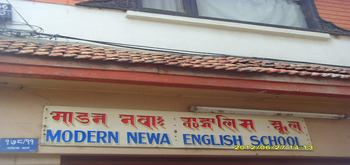
Most students are from the Newari community and speak both Nepali and Newari in all natural conversations. The school also teaches Newari as a subject and focuses on using English as the medium of instruction. Both teachers and students, however, use Newari during their interactions for both inside and outside classroom activities. The name of the school displays a complex juxtaposition of global (English) and local (Newari) language ideologies (see Figure 1). For example, commenting on the school's name, the director of the school argues that while Newa embraces ‘Newari ethnolinguistic identity’, the inclusion of English gives the public an impression that “our school isn't just a Newari school”, but a “private boarding” and “English” school that “also teaches Newari”.
The school signboard in Newari; the Ranjana Script is at the top with English at the bottom. Photo: Prem Phyak.

As Flores (Reference Flores2013) argues in another context, we can note that for MNES multilingualism as a ‘policy ideal’ reproduces a neoliberal ideology; Newari language competence can be seen as part of the larger neoliberal market dominated by Nepali and English. As seen in excerpt (1), the school has produced its promotional materials such as pamphlets, brochures, leaflets, and CDs in three languages—Newari, Nepali, and English. Through these promotional materials, the school defines its institutional identity as a bishishta school ‘special school’, a school with a multilingual policy that, unlike other private schools, accommodates ‘mother tongue’ (Newari) as well. The director of the school is critical about the monolingual ideology and the erasure of minoritized languages in the past and most current educational practices. He is critical about the national official language policy and feels strongly about the importance of maintaining indigenous languages, which he calls ‘mother tongues’. He argues that private schools must teach local ‘mother tongues’. But he acknowledges the English-language dominance in the global market and argues that ‘mother-tongue’ competence must also promote better English language learning. In this sense, the use of Newari in MNES has simultaneously resisted the English-only ideology in Nepal's private schools and served as the key feature of neoliberal private education. The school appropriates the current discourse of ‘mother-tongue education’ that has emerged from ethnic activism and identity politics in Nepal, by showing its commitment to promote ‘quality education’ through the mother-tongue medium.
-
(1) A school dedicated to quality education through mother tongue. (English)
matribhashako madhyambata stariya shikchyako pratibaddata. (Nepali)
ma bhayya stariya shikchya. (Newari)
The director of the school sees himself as an activist in the promotion of the use of ‘mother tongues’ in education. At the same time, he is an ‘entrepreneur’ in the neoliberal educational market. Because he is aware of Newari people's ethnolinguistic and ethnocultural activism, he puts ‘mother tongue’ in his promotional material to show the parents, mostly Newars, that his school is committed towards supporting the community language. This commitment challenges the dominant ideology of ‘quality education’ in Nepal and the assumption that English education is the only way to acquire a high-quality education. The school recognizes the importance of using the home language (Newari) for the learners’ ethnolinguistic and cultural identity (Hornberger Reference Hornberger2002; Skutnabb-Kangas & Heugh Reference Skutnabb-Kangas and Heugh2012). Class observations and interviews with the teachers show very flexible language practices on the part of teachers and students in languages other than English. A mathematics teacher, for example, argues that the use of Newari in the classroom is necessary as children from the lower grades (kindergarten) find it hard to understand instruction both in Nepali and in English. The dynamic language practices inside and outside the classroom go against any fixed boundary between Nepali, Newari, and English and show student and teacher interaction as a meaning-making process through translanguaging (García Reference García2009). Such translingual practices provide an inclusive language ecology in which learners, both Newari and non-Newari speaking children (only few students are non-Newars), can use their own home languages. However, as seen in (2) below with the school director (DT), the school does not explicitly denaturalize the ideological hegemony of English as the language of the neoliberal market.Footnote 1
-
(2) (DT: director; PP: Prem Phyak, the second author)
PP: tapaiko school lai kina English school bhannu bhako?
‘Why do you call your school an English school?’
DT: <laugh> yo chahi aile ko fashion nai chha. Newa matra bhanda yo ta Newari skul matra rahecha bhanne hune. ahile ko private skulharu ma international, private, English medium aadi aadi rakhne fashion nai aayeko cha ni bidyarthi tanna…
‘<laugh> it is the present day fashion. If we just say a Newari school, we can't attract more students. There is a fashion of using the terms such as ‘international’, ‘private’, ‘English medium’ etc. to attract students.’
PP: ani yo ramro ho ta?
‘Is this good?’
DT: hoina. tara English chahi chodinna holani bhanera sodhchan parent haru.
‘No. But parents ask whether or not we leave out teaching English.’
PP: Then?
DT: hoina kaha chodnu ni. hami jhan ramro English padhauchau bhanchu. hami native speaker volunteer pani bolayera English padhauchau, wahaharule pani prasansa garnu huncha.
‘We don't leave it out. We tell them that we teach better English. We invite native speaker volunteers to teach English in our school.’
Although the director is critical about the lack of recognition of ‘mother tongues’ in education, he reproduces the neoliberal ideology of English, which he recognizes as a contemporary ‘fashion’. He argues that if the parents were told that the school taught only in Newari, they would not send their children to that school. He also notes that the school is not financially sustainable unless there are enough students. As a private school, it depends financially on students’ tuition fees. In this situation, the school becomes an ‘ideology broker’ (Blommaert Reference Blommaert2014) for both neoliberalism and ethnolinguistic identity. On the one hand, the school embraces Newari people's desire to promote their ‘mother tongue’, which the director of the school considers as ‘a symbol of ethnolinguistic identity’. On the other, the school sees the use of Newari as part of the neoliberal educational market that ultimately supports the English language policy. In other words, the introduction of Newari in the school does not necessarily challenge the state's neoliberal ideology in education, but supports it by reinterpreting Newari as part of school's strategy to be ‘more special’ than other private schools.
The school has also hired English ‘native speakers’ to teach English to ensure that the students will not be less competent in English compared to the students from other English-medium private schools in the city. This practice indeed reproduces the pervasive ideology of ‘native speakerism’ (Holliday Reference Holliday2006), which embraces the symbolic dominance of Anglo-Americans in teaching English. Most importantly, the focus on English native-speaker teachers is influenced by the neoliberal ideology of a competitive ‘free market’. The director of the school claims that the school must produce students with a ‘native like English language proficiency’ to compete with other private schools in the city. MNES as a private institution can be described in some ways as an ‘ideological state apparatus’ (Althusser Reference Althusser1971) that supports the state's neoliberal ideology and embraces ‘the normative goal of English becoming the default language of international communication’ (Phillipson Reference Phillipson2009:106) and which ultimately serves the interests of the global capitalist market economy (Flores Reference Flores2013). This kind of ideological brokering is prevalent in other developing countries as well where the ‘symbolic capital’ (Bourdieu Reference Bourdieu1991) of English is taken for granted. In South Africa, for example, Joseph, & Ramani (Reference Joseph and Ramani2012:28) found that students and parents will ‘only opt for a program of African language-medium instruction and assessment’ if they are ‘simultaneously guaranteed an excellent English language program.’ The school's appropriation of neoliberal ideology to justify the importance of Newari for students is even more explicit, as excerpt (3) demonstrates.
-
(3) (DT: director; PP: Prem Phyak)
PP: private school bhayera Newari ma padhauna kina shuru garnu bhayo?
‘Why did you start teaching in Newari in a private school?’
DT: tesko duita pata chhan. Pahilota sikai saral ra prabhawakari hune bho. Dosro ra bhawanatmak hisable aafno bhasha pani bachi rakhne.
‘It has two sides. First, learning becomes effective and easy. Second and from an emotional side, our own language will survive.’
PP: kasari?
‘How?’
DT: tyasko jwalanta udaharan ma sangai cha. yaha kehi bachcha haru chhan uniharulai parents le Parbate [Nepali] bhashama matra bole. tara ti parents harule [aafno] dosro [bachchalai] lai newari nai bolna thale. pahilo bachcha ko skul ma parbate ra angreji matra padauthyo. tyasaile pahilo bachchale aafno bhasha nai bolna sakena. skul ma parbate bolnu parchha bhanera gharma pani parbate nai bolna sikayo. ani hamro skul ta Newari bolna paune skul. e tyahata Newari bolna paunerahecha bhanera bachcha pathauna thalyo … pahilo bachchalai chahi change garna garo bhayo. aba dosro bachchale garda parents harule Newari pani bolnu parne bho. pariwarko environment nai change bhayo.
‘I've an excellent example. Here, we've some children whose parents only spoke Parbate [Nepali] with them. But the same parents started speaking Newari with their second child [who is in our school]. In their first child's school only Parbate and English were taught. So the first child could not speak his own language. He was taught Parbate at home as he had to speak it in school. But in our school children can speak Newari. Parents started sending their children to this school because they know that we also teach Newari. It was difficult for the parents to change the first child. Parents now unhesitatingly speak Newari due to the second child. The family language situation has changed.’
PP: ani?
‘Then?’
DT: aphno bhasha siknu bonus ho bhanchau parents lai. bachchaharule jati bhasha sikyo teti ramro ho ni.
‘We tell our parents that learning own language is a bonus. It's better for children to learn as many languages as possible.’
During our conversation, the director of the school criticized the modernist ideology of nationalism (Anderson Reference Anderson1991), which had imposed Nepali-only policy in education for a long time. As Nepal had adopted Nepali-only medium of instruction policy until 2007, multilingual minority children faced a multitude of learning challenges and witnessed strong devaluation of their mother tongues. Nepali-only policy was adopted to strengthen Nepali as a symbol of nationalism (Gellner Reference Gellner2007; Lawoti Reference Lawoti2007). As claimed by the director of the school, the introduction of Newari has both resisted the nation-state as a homogenous Nepali-speaking community and promoted Nepali-Newari bilingualism in Newari families. However, Newari, interestingly, is identified as a ‘bonus language’ that children learn in the school. In other words, the school convinces parents that they teach better English to their children through ‘native’ speakers, but they also help students learn Newari as a ‘bonus’. Parents are seen as customers motivated by market choice and who receive a ‘bonus’ for sending their children to the school. This further implies that the school's institutional ideology of multilingualism, as Flores (Reference Flores2013) argues, eventually supports the neoliberalization of students as ‘ideal subjects’ who can compete in both global and local economic markets. As seen in the following excerpt from an interview with a parent (PT), whose child was enrolled in MNES, Newari is being redefined in terms of its economic capital in the state's changing political, economic condition.
-
(4) (PT: parent; PP: Prem Phyak)
PP: Newari sikera ke huncha? Nepali ra angreji sikera pugdaina?
‘What's the use of learning Newari? Isn't it enough if you learn Nepali and English?’
PT: ramro prasna. malai pani testali lagthyo. tara hamro bhasha hamro pahichan ho. Newari dhani bhasha ho. abasyapani yo yug ma bachchaharule Nepali ra English dubai siknu parcha. tara local level ma Newari pani uttikai mahatwapurna cha.
‘Good question. I used to think the same. But our language is our identity. Newari is a rich language. Of course, children should learn both Nepali and English in this age. But Newari is equally important at the local level.’
PP: kasari?
‘How?’
PT: aja bholi NGO ra INGO haru Newari samudayama dherai chan. yiniharule Newari, Nepali ra English sabai bhasha bolne manche hire garchan. hami sanga Newari TV, radio stations ra patrikaru pani chan. ramro Newari language skills bhayekaharule aile jagir pauchan.
‘These days many NGOs and INGOs are in the Newari community. They hire people who speak Newari, Nepali, and English. We have Newari TV, radio stations, and newspapers. People who have good Newari language skills get jobs now.’
The parent expresses a strong opinion about the importance of teaching Newari in school to maintain Newari ethnic identity and cultural maintenance. He acknowledges the contribution of MNES in promoting Newari. Similar to the arguments made by Pietikäinen (Reference Pietikäinen2010) in the case of the Sami language in northern Finland, the use of Newari in MNES serves two purposes: maintenance of the Newari language and culture, and the promotion of multilingualism in education. These purposes, however, are subsumed under the neoliberal conceptualization of multilingualism as commodity. As the parent in excerpt (4) argues, the director of the school also recognizes the ‘market value’ of Newari at the local level. Following the state's neoliberal policy, a large number of (I)NGOs ((international) nongovernment organizations), local FMs, and TV channels have been established in Kathmandu since 1990. According to the director, multilingual speakers ‘with Newari language competence’ are ‘ideal subjects’ (Flores Reference Flores2013) in the market, particularly in the sectors of heritage tourism, nongovernmental organization, mass media, and local business.
In sum, MNES has strategically embraced the ongoing discourses of minoritized language revitalization, rights, and identity and has shown a greater awareness of linguistic and cultural diversity. This awareness about ethnolinguistic identity, however, does not provide a strong agency towards supporting minoritized language revitalization and rights at large, which is now at stake due to the hegemonic presence of neoliberal ideology in education and other spaces. To put it differently, multilingualism in MNES is reinterpreted as a ‘commodity that can increase economic productivity’ (Flores Reference Flores2013:506) in Nepal's current political economic condition. Rather than challenging the state's neoliberal ideology of education, MNES is appropriating the neoliberal interpretation of multilingualism.
Multilingualism in the Nepali tourism industry
This study constitutes part of Sharma's ethnographic study on the role of language and communication in tourism (e.g. Sharma Reference Sharma2017). The data is drawn from ethnographic interviews with seventeen certified and licensed multilingual tour guides and a tour company's manager. All of the tour guides were approached through a tour company, Everest Trek (a pseudonym), located in Durbar Marga—a tourist hub for shopping and expensive restaurants in Kathmandu. According to the manager, Everest Trek receives about 1,300 tourists each year and creates employment for fifteen individual tour guides. These tour guides were not employed on a fixed-salary basis, but would be contacted by the company as needed. Everest Trek was the main, but not the only, tour agency these guides were hired by. According to most tour-agency managers we talked to, the tour guides’ employability depends mainly on a good rapport with other tour companies as well as the tour guides’ guiding skills and language competence to cater to the needs of tourists. All of the tour guides we networked with and interviewed were multilinguals, with proficiency in English and two or more additional foreign languages. Interviews with these guides showed some interesting aspects of the influence of neoliberal ideology on their multilingual lives, their aspirational subject positions, and the commodity value of learning and speaking multiple languages. Additional foreign languages were mostly Spanish, German, French, Italian, Japanese, Chinese, and Russian. These interactions further led to more in-depth interviews asking questions regarding what multilingualism and multilingual competence meant for their work life and beyond. The data excerpts also come from the tour guides’ online profiles on professional blogs. Moreover, the data analysis and interpretation draws on the field notes collected from guided tours, informal discussions with tour operators, employees at the Nepal Tourism Board, and documents such as newsletters and brochures. In what follows, we discuss how Nepali tour guides understand the role of multilingual repertoires for their profession, and if and how their multilingual practices are related to their ‘aspirational positions’ (Seargeant Reference Seargeant2009). We also discuss the ways the tour guides’ ethnolinguistic and gender identities are represented and commodified in and through their online communicative practices in the neoliberal market of Nepal's tourism industry.
Manoj (MJ), the manager of Everest Trek, speaks Japanese, Russian, and English. He has also been working as a tour guide for the last ten years. When he is out on tours, his wife looks after the office. Manoj is responsible for all the online work and communication, for example, corresponding with prospective tourists, responding to tourist queries, calling tour guides for work, and contacting hotels. The provision of multilingual tour-guiding services is clearly linked to the fact that in order to sell a tourism product such as a destination or a trek, being able to speak languages of the targeted customers is undoubtedly an additional incentive to meet the demands of the tourism market. The following excerpt is a representative response regarding the role of language and communication skills in tour guiding.
-
(5) (MJ: Manoj; BS: Bal Sharma, the first author)
BS: tapaile yetro dherai language haru kina jannu parchha ra?
‘Why do you need to know these many languages?’
MJ: yo ta seasonal job ho sir. jastai Chinese tourist har dheraijaso July ra Auguest ma aauchhan. Deshharuko holiday pharak pharak samayama huncha. Dherai tourist harule English bujhna ta sakchhan, tara sabaile boldainan. Jastai Chinese tourist haru le guide le English nai bolos bhanne chahanchhan. Japanese tourist pani testai hun. Yestai ho.
‘This is a seasonal job, sir. For example, Chinese tourists come more in July and August. Different countries have their holidays in different times. Many tourists can understand English, but not all of them speak it. Like Chinese tourists want the tour guides who can speak Chinese. Also Japanese tourists want the same. It's like this.’
BS: kun language bolne guide chahinchha bhanera agadi nai sodhnu hunchha ra tiniharulai?
‘Do you ask them in advance what language-speaking guide they want?’
MJ: Dheraijaso. Yo deal ma pani bhar parchha. Matlab paisa. Yedi uniharulai uniharukai language bolne guide chahiyo bhane kahile kahi badhi paisa tirnu parne pani huna sakchha. Hamile aru bhasha bolne tourist haruko group ma mix garna sakdainau.
‘Yeah, in most cases. See, this depends on the deal as well. I mean money. If they want a guide who speaks their language, they may have to pay more. And we cannot mix them with other language-speaking people in the same group tour.’
BS: e ho.
‘Oh I see.’
MJ: Guide le tiniharuko bhasha ramro bolena bhane ta pachi complain pani garchhan. Kehi din agadiko kura ho euta tourist le nabujhine ra slow English bolyo bhanera complain garyo. Communication skills ta dherai important chha.
‘If your guide does not speak their language well, they complain afterwards. Just a few days ago, one tourist group complained that our guide spoke unintelligible and slow English. Communication skills are very important.’
BS: Tourist haruko aru pani expectations hunchha ki?
‘Any other expectations from tourists?’
MJ: unharu ta jahile pani ramro tourist guide chahanchha. Tesko matlab jasle Nepali culture ra thauharu janeko cha, jasle tourist ko language ramro bolchha, ani kahile kahi ta trekking guide, khasgari porter ko lagi ta kasaile Sherpa request garchan.
‘They always ask for good tourist guides. That means the person who knows Nepali culture and places, speaks the tourist language well, and also sometimes for trekking guides, especially for porters, some tourists specially look for the Sherpas.’
BS: e kina hola ta testo?
‘Why do you think so?’
MJ: mero bicharma uniheru Everest chadhne hunale Sherpa haru sansarbhari famous chhan.
Uniharulai Sherpaharu baliya ra jati chhan bhanne lagchha hola.
‘I think the Sherpas are famous worldwide because of their climbing of the Mt. Everest. They think that the Sherpas are stronger and nice.’
English is by far the most widely used lingua franca among tour guides and tourists in Nepal. Every tour guide we interviewed claimed expertise in using English. As Manoj's response highlights in excerpt (5), English is not necessarily shared by all in tourism. Language and communication skills become buyable and sellable commodities in the market. The neoliberal ideology of competitiveness, individual responsibility, and self-employability have directly impacted how individual tourism workers prepare and endorse themselves in the market. Moreover, which languages have a commodity value depends on how they are projected and constructed in the market both by the consumers and the service providers. As Manoj's response shows, for tourists from China and Japan, English in most cases may not serve as a right type of communication tool to construct narratives of destinations and cultures for visitors.
Sometimes, it is not the use of language, but the use of an appropriate type of language competence and skill that is valued in the neoliberal market. Language skills that do not meet the expectations of tourists may come under scrutiny particularly in contexts when language skills are exchanged for a monetary value. As Manoj's response shows, speaking ‘slow’ and ‘unintelligible’ English was an object of complaint by the tourists. Sometimes, poor language and communication skills can have costs for both the tour agency and the individual tour guides. For example, tourists’ preferences about contacting and working with a particular travel agency largely depend on referrals from other tourists who have previously worked with the travel agency. Negative impressions experienced by tourists can lead to a lack of such referrals or negative comments in travel logs, both in handwritten diaries and online blogs. Eventually, this can affect the employability of the tour guides. As Blommaert, Collins, & Slembrouck (Reference Blommaert, Collins and Slembrouck2005) argue, multilingual spaces such as those in tourism are linguistically stratified, and language (varieties) in one scale may not be appropriately valued in another scale. In the present context, tourists’ diverse linguistic needs point to a direction of ‘standard’ language skills; local English variations and peripheral linguistic norms used by Nepali multilingual tour guides may be questioned and not liked by tourists.
Manoj's response also serves as an example of how certain ethnic identities can be commodified in the neoliberal tourism market. Travel diaries written by Western tourists and anthropologists have highlighted the Sherpas’ mountaineering skills and strengths. For example, Ortner's (Reference Ortner1999) ethnographic study of the Sherpas shows that Western climbers have remarked on the Sherpa's tendency to develop loyalty to individual mountaineers as well as to the expedition as a whole, and their self-sacrifice, heroism, friendship, and cheerfulness. Discourses about the Sherpas’ strengths to carry loads and climb mountains have gone global and the construction of Sherpa as a fixed ethnic identity has been more controversial when members from non-Sherpa groups also present themselves as Sherpas in the tourism market. The term Sherpa in this excerpt and analysis is used as an ethnic category in the context of Nepal, as opposed to a job category created by the Western mountaineering discourses to refer to a job title. Ortner notes that the Sherpas who present themselves successfully as ‘Sherpas’ have received more pay and other privileges than the other similar ethnic groups such as Tibetans and Tamangs, although not all Sherpas excel in portering and mountaineering. Here it is not only the language skills, but the Sherpa ethnic identity that becomes a commodity in the market.
Tour guides are willing to acquire and improve their multilingual repertoires to render themselves marketable in the increasingly competitive and demanding job market. Language teaching institutes constantly reproduce the neoliberal ideology of workers’ self-marketability by claiming to provide tour professionals with the best opportunity for acquiring skills in such major foreign languages as Spanish, French, Chinese, and Japanese. The following excerpt shows why multilingual skills are necessary to survive in the current work order. Krishna (KK), another guide, can speak French, English, Hindi, and German, and plans to learn Chinese in the future.
-
(6) (KK: Krishna; BS: Bal Sharma)
BS: tapaile char wata language kina siknu bhayo ta?
‘Why did you learn four languages?’
KK: um tapaile additional language jannu bhaeko chaina bhane ta yo profession ma sustain huna nikai garu huncha future ma. yo ta seasonal kam ho Nepal ma ra yedi tapaile additional paisa kamaunu cha bhane ta tapaile extra language janekai hunu parcha.
‘Well, if you do not have an additional language, it will be very difficult to sustain in this profession in the future. Guiding in Nepal is a seasonal work and to make additional income you need to have an extra language.’
BS: Um teso bhae English le matra hudaina?
‘Umm. You mean English is not enough?’
KK: thik ho. sabai tourist le English boldainan. Uniharu bole bhane pani, uniharuko language jannu bhayo bhane tapaile uniharu ko culture ra way of life pani janna saknu hunchha. Uniharu ko right kind of expectation janna ko lagi ta unharuko langauge tapaile jannai parchha. Chinese tourist nikai badheko hunale maile Chinese pani sikne plan gaeko chhu.
‘Right. Not all tourists speak English. And even if they do, speaking their language allows you to know their culture, way of life better. You should know their language in order to know their right kind of expectations. As there are more Chinese tourists, I plan to learn Chinese as well.’
Krishna highlights the importance of knowing the culture of the places tourists are from. Being able to communicate in English is not enough: it is important to know tourists’ expectations, and being able to speak the tourist's language is a required asset for that. Krishna's plan to learn Chinese can be explained by the fact that in recent years Nepal has witnessed an increasing flow of Chinese tourists who spend a considerable amount of money in experiencing ‘exotic’ Nepal, mostly through guided tours. Nepal in fact is considered as an emerging tourist destination for Chinese due to the two countries’ close geographical borders and relatively inexpensive flight costs. The assumption that English is a global lingua franca in international contexts is not necessarily true in Nepal's tourism context. The neoliberal market situation has given space also to languages other than English, such as Chinese.
Part of the expectation in tourism work includes a need for tour guides not only to be able to speak their clients’ language but also to know their cultures. Knowing tourists’ cultures and lifestyles is also intrinsically linked to another argument in favor of a need for multilingual skills. This includes a connection of customer satisfaction with a monetary value of communication in terms of tips and other rewards, which have the potential to transform their lives. The following excerpt shows this. Suman (SM) speaks English, Chinese, and French. Although I started the interview in Nepali, Suman switched it to English.
-
(7) (SM: Sunam)
SM: This is a very unpredictable job. Sometimes you earn a lot. Sometimes you don't.
It also depends on tips. White people tip well. But Japanese and Koreans usually don't. Chinese have changed a lot. I think they are competing with Americans. They tip really well now. One important thing is if you know their language and some culture, they are happy. I think speaking Chinese makes them feel closer. English is useful but if you want to be close with them, you have to speak their language. Actually sometimes I earn more from tips than from my pay. I have a friend. His daughter's education is funded by an American tourist. They send money for that. Some guides even have married tourists. Some have tourist girlfriends. Some do just romance.
Tour guides in Nepal do not solely depend on their regular pay as the main source of income. Many of the tour guides we talked to reported that their motivation and continuation in the profession depend on the opportunities to receive tips from tourists. Tour guides usually tend to stereotypically categorize tourists from high-tipping to no-tipping at all. North Americans and Europeans rank top while Asians such as Japanese and Koreans are lower down the list. What types of tourists one gets to work with and how effectively one uses his/her linguistic skills often determine the economic lives of the tour guides. As Suman's response shows, speaking the tourist's language is not just a neutral tool for constructing tour-guiding commentaries, but sometimes linked to their desires and dreams, such as making foreign girlfriends, marrying them, or searching for romance with them. Previous researchers investigating tourist spaces in Nepal have also highlighted some cases of romantic relationships between local men in Nepal and Western women tourists. Yamaga (Reference Yamaga2007), for example, presents ethnographic case studies that show some compelling examples of Japanese female tourists’ engagement in romantic relationships with local Nepali men. Some level of competence in tourists’ languages provides communicative tools for Nepali guides to fulfill their hopes and dreams (Liechty Reference Liechty2003). Also building a good relationship with tourists may result in finding sponsors for the education of their children or for trips abroad (see Sharma Reference Sharma2017 for details). Many tour and trekking guides live with these aspirations, although only very few of them may succeed in realizing them.
The commodification of local heritage and culture is also a significant part of the tourism market. Guides are interested in selling images, knowledge, arts, authenticity, ideology, and sometimes even themselves. Bibek (BK) is another licensed tour guide in Kathmandu who is from the central part of Nepal, Chitwan. Chitwan National Park receives the largest number of tourists, and is ranked first on the list of national parks in the country. This is a popular tourist destination for adventures such as elephant riding, jungle safari, elephant polo, and kayaking. Bibek comes from the Tharu community—an ethnolinguistic group in southern Nepal. Most Tharus did not attend formal schooling and believe that they are ‘backward’ and ‘illiterate’ (Guneratne Reference Guneratne2001). Except for the younger generation, many Tharus do not speak Nepali well. Until recently, Tharus have been a popular object of tourist gaze while the hill Brahmins and Chhetris—the dominant caste groups in Nepal—are often the tour guides discursively mediating tourists’ expectations and destinations. Bibek's ethnic membership is particularly important here because he is one of a very few licensed tour guides from his community. Bibek's response in excerpt (8) is useful in explaining multilingualism as it helps us understand the role of minoritized languages in the neoliberal market.
-
(8) (BK: Bibek; BS: Bal Sharma)
BS: tapai ta Tharu pani bolnuhuncha. Tyo bhasha ko tapaiko profession ma kehi phaida chha ta?
‘You speak the Tharu language as well. Do you see any advantage of that language for your profession?’
BK: umm chhaina. dherai tourist haru le ta English bolne guide nai khojchhan. athawa tapaile German athawa Spanish jannu parcha.
‘umm no. Many tourists want English-speaking guides. Or you have to know German or Spanish.’
BS: um um
BK: tara maile tiniharulai Chitwan liera jada mero bhasha pani kam lagchha. Tourist harule Tharu ta bujhdainan ni. ani Tharu haru le English boldainan. Maile tiniharuko lagi translate gardinchhu. Uniharu Tharu culture ra manche haruma nikai interested hunchhan ra dherai question pani sodhchhan.
‘But when I take them to Chitwan, my language can be useful. Tourists do not understand Tharu. And Tharu people do not understand English. I have to translate for them. They are very interested in Tharu culture and people and ask many questions.’
BS: um um
BK: tiniharu Tharu latthi nach, Tharuniharuko tattoo ra Tharu museum ma nikai interested hunchhan. Testo belama chai Tharu language guide saga nikai khushi hunchhan. Tharu bhasha nabolne guide bhayo bhane sayad tesari garna sakdainan hola.
‘They are very interested in the Tharu stick dance or the tattoos of the Tharu women and Tharu museum. They are happy with a Tharu speaking guide in that sense. Non-Tharu speaking guides perhaps cannot do the job in a similar way.’
The neoliberal market has given rise to new meanings and values to languages and identities, sometimes in a rather unexpected way. Tattoos that the Tharu women wear or the local Tharu stick dances are very much part of the local Tharu culture and carry an ethnic identity value. With the increase of tourists, however, these cultural objects and events have turned into commodities. While the globalized new economy presents tensions between global languages such as English versus indigenous languages such as Tharu in terms of their commodity values, in the tourism marketplace, globalization opens up new spaces for languages that are traditionally considered to have less material value. The fact that Bibek is from the Tharu community and speaks the minoritized language becomes a mediating tool to translate the Tharu culture and conversation into his client's language and vice versa—both of which are commodified in the neoliberal market.
We can again fruitfully go back to the Canadian case reported by Heller (Reference Heller2003) that shows that minoritized languages are not always devoid of linguistic or symbolic value in the linguistic marketplace. Heller argues that the globalized new economy has largely helped commodify minoritized languages and identities. Taking the case of French Canada, because of the heritage tourism and the growing number of call centers, language as a set of skills is valued and sold in the linguistic marketplace, and as a result, native French-speaking bilinguals see the commodity value of their bilingual skills rather than seeing them simply as a tool to represent their ethnolinguistic identity. Heller argues that globalization has opened up the potential for localism, in which ethnolinguistic minorities can hope to exercise some control. It should be noted, however, that in the neoliberal political economy, local linguistic repertoires are not equally distributed, nor do they evenly confer an instrumental value for all who possess and use it. First, the objects of the tourist gaze, such as the tattoo-wearing Tharu women, do not directly benefit from this market because they do not directly take part in the economic activities. Second, using Bourdieu's term, Bibek's use of his Tharu language skills for their commodity value is not merely the result of his membership in the Tharu ethnic community or his ability to speak his native language, but his privilege to systematically combine his Tharu linguistic repertoire with his formally acquired institutional cultural capital. Not all Tharu-speaking people, then, can sell their Tharu language skills to outsiders.
Another aspect of tour guiding that is commodified in the tourism market is gender identity. Tour guiding in Nepal is mostly a man's work. In Sharma's ethnographic observations in two different institutional contexts—tour guide training and a licensing institute, and the English language institute—there was just one female in ten students. Although there are some changes in the use of women porters and trekking guides as a result of some nongovernment organization's advocacy for women's empowerment and equality, Nepali society is still reluctant to send women on trips that require them to stay overnight. Both the social norms and the risk of sexual assault largely prevent women going on such overnight stays. Hisila is one of the few exceptions. A native of Kathmandu, Hisila uses her gender and ethnolinguistic identities and her multilingual repertoires to market herself in a blog in English, seen in the example in Figure 2.Footnote 2
Hisila's profile page online (image manipulated and name deleted for the purpose of anonymity).

Several aspects of this excerpt are worth commenting on. What we are seeing here is not just the promotion of Hisila's professional skills, required of and expected from her as a licensed tour guide, but a commodification of her gender and ethnic identity. In addition to being a multilingual speaker of German, English, Japanese, and Spanish, Hisila claims that her female identity discursively creates some uniqueness since tourists rarely encounter female tour guides in Nepal. Here, linguistic skills play an important role in socially constructing unique tour experiences. Hisila's Newari ethnic identity is used to attract prospective tourists. She claims that she is a qualified tour guide who will to help tourists experience the ‘authentic’ lifestyle and culture of less visited local people. Authenticity, as pointed out in the excerpt—both as an object to be gazed upon (Newari culture) as well as a tool to create authenticity discourses (Newari language)—has a commodity value. By the same token, she treats locals as non-English speaking people. Her multilingual repertoires in Newari and English are additional skills that make her different from tour guides from other ethnic communities who do not speak the Newari language. Her ethnic and gender identities, thus, add a competitive value to her already commodified multilingual skills in the neoliberal market.
Identity representational discourses of the Other, such as by Hisila, exist because they have a commodity value in the global tourism market. They may feed into the discourses of essentialism, perpetuate racial and ethnic hierarchies, and reproduce economic and other inequalities for economic gains. Although tour guides’ and local's representations of themselves are mostly tactical, theatrical, and seductive—motivated mainly by economic and even political reasons—they construct a particular version of reality that is less likely to match with the realities on the ground—the realities of the changing nature of the way people live their lives in the transcultural, globalizing world. These stereotypical self-representations in many contexts are the major schemas through which tourists are likely to see and understand the destination cultures before, during, and after their trips. Thus, the capitalist and neoliberal conditions of the market largely help to perpetuate othering and racializing discourses for economic gains.
Discussion and conclusion
In this article, we have examined how a private school has appropriated the state's neoliberal ideology in its multilingual policies and practices. We have also scrutinized how language workers in a tour company have largely reproduced the neoliberal ideology in their mainly market-driven multilingual practices. Both of these multilingual spaces are located at the heart of Kathmandu city—Durbar Marga. We have argued that neoliberalism has presented fresh challenges as well as opened up new spaces for different discursive and pedagogical domains where multilingual practices occupy a central role. As neoliberal ideology has become a driving force in education and tourism in Nepal, institutions and individuals have adopted the ideology with their creative tactics and agency to fulfill the demand of the competitive neoliberal market. In both cases, ethnolinguistic identity and local indigenous-language competences are subsumed under the neoliberal narratives of identity and language as commodities. Both private school and tourism at the institutional level desire neoliberal ideal subjects (Park Reference Park2010; Flores Reference Flores2013) who have multilingual repertoires in both global languages (e.g. English, German, Chinese, and Japanese) and local languages (e.g. Newari, Tharu, and Nepali). Our analysis shows that English as a global language does not always accord more cultural capital and economic value, nor is the teaching and learning of local indigenous languages always confined to the ideologies of identity politics and language preservation. Although English is clearly the dominant language in the neoliberal market, local languages do not disappear from the scene but interact with English and other foreign languages to fulfill the need of the economic market. We have argued that while the ideology of English as a global language and indigenous languages as tools for ethnolinguistic identity are still salient, new forces of globalization, particularly in the urban Nepali context, give new meanings to the multilingual repertoires. Thus, the neoliberal market, as the studies have shown, is not uniform but much more diverse and stratified. Although there is an increased emphasis placed on teaching and learning English, competence in English alone does not create a distinction. There are creative tactics used by the multilingual institutions and individuals to adopt and appropriate neoliberal ideologies through their translingual and multilingual practices.
In the first case, we showed how a private educational institution and its stakeholders have appropriated both global neoliberal ideology and local-identity discourses in its multilingual policies and practices. The use of the Newari language in promotional materials as well as in pedagogical practices, while giving equal importance to Nepali and English, exemplifies ‘flexible multilingualism’ (Weber & Horner Reference Weber and Horner2012). The multilingual policy challenges the English-only ideology in private schools. It also embraces the Newari language as a marker of ethnolinguistic identity and cultural heritage. Learning Newari, however, is not restricted to that purpose only; it serves as an added value to the commodification of multilingualism in education. The multilingual policy in the school has definitely contributed to the Newari people's efforts to revitalize and promote their language and culture; however, it does not challenge the state's neoliberal ideology. On the one hand, not all parents can afford to send their children to private schools and, on the other, not all indigenous languages like Newari have an equal commodity value in the neoliberal market.
In the second case, we showed that the neoliberal ideology of competitiveness and self-employability has largely shaped the motivations and attitudes of Nepali multilingual tour guides, who speak their indigenous languages, the official language (Nepali), Hindi, and English. The state has a minimal role in the imposition of such policies and ideologies, but it is the market that largely shapes the training and production of multilingual tourism workers. As a result, tourism workers have increasingly faced the challenges of the lifelong learning of additional multilingual repertoires. This leads us to critically examine the neoliberal ideology that makes English the de facto global lingua franca in international and intercultural communication contexts. First, we cannot make the sweeping claim that English serves as a common language in global-mobility contexts such as tourism. For example, as the multilingual tour guides’ interview responses show, tourists tend to contact tour companies in advance not always for an English speaking guide, but for one who can speak the client's language (see, however, Sharma Reference Sharma2017 on English in the Nepali trekking industry). In addition, even though English is a shared language between the guides and the tourists, it may not necessarily always serve as a lingua franca in situ. These choices and motivations for learning English are also partly shaped by the local material conditions. Such choices, however, are largely market-driven and often do not incorporate languages that are considered to be of no economic value. This was evident when the tour guides’ existing multilingual repertoires and their future plans to learn additional foreign languages was driven by the market value of such languages as French, Spanish, Japanese, Chinese, and German. Absent from the scene are other foreign languages that have fewer speakers in the Nepali tourism market.
The influence of neoliberalism and the challenge to maintain societal linguistic and cultural diversity is not restricted to Nepal in the age of globalization. In particular, urban places are facing challenges of losing the existing ethnolinguistic diversities and at the same time facing new forms of diversity due to internal migration or the international flow of people, ideas, and goods.
A number of implications can be drawn from the case studies presented here. As seen in the case of a private school, a flexible multilingual policy can provide space for local minoritized languages in education. As Kubota (Reference Kubota2014) argues, however, such a multilingual policy does not necessarily challenge the state's neoliberal ideology that has created linguistic hierarchies and socioeconomic inequalities; these keep putting unprecedented pressures on indigenous communities to create an equitable space for local languages in the public sphere. Most importantly, there is a clear lack of ideological awareness about how the institutional ideology of multilingual education policy is reproducing a neoliberal ideology that eventually serves the interest of the capitalist market economy and may have alienating or undesirable outcomes for those who adopt it. Second, as seen in the case of tourism, the global dominance of English in the neoliberal market is challenged by the increased use of Chinese in tourism workplaces. The case studies have shown that local minoritized languages are given some space in both education and tourism. At the same time, minoritized languages are part of a multilingualism that eventually supports the need of the neoliberal market structure. The multilingual practices in education and tourism, as pointed out by Flores (Reference Flores2013) and Kubota (Reference Kubota2014), do challenge some existing sociopolitical inequalities, but they produce new hierarchies and stratification. Thus, we argue that it is necessary to engage language users and other stakeholders in an explicit analysis of ideologies shaping their own language practices in the climate of neoliberal hegemony.