Introduction
Emerging evidence suggests that the boundaries between compulsive symptoms in obsessive-compulsive disorder (OCD) and both addictive and habitual behaviors may not be impervious as previously thought. For instance, OCD and impulse control disorders (ICDs), including conditions conceptualized as substance and behavioral addictions and grooming/habit disorders, frequently co-exist in the same patient.Reference Fontenelle, Mendlowicz and Versiani 1 Accordingly, some OCD patients also report very little, if any, resistance to, and control over, their compulsive behaviorsReference Kashyap, Fontenelle and Miguel 2 —a phenomenon well known in both the psychoanalyticReference Rado 3 and behaviorist literature.Reference Marks 4 In experimental laboratory conditions, OCD patients exhibit an increased tendency to form both avoidance and “rewarding” habits.Reference Gillan, Papmeyer and Morein-Zamir 5 – Reference Gillan and Robbins 7 One recent functional MRI (fMRI) study found OCD patients, particularly the washing subtype, to exhibit attenuated activity in the nucleus accumbens, a key region of the brain reward system,Reference Berridge and Kringelbach 8 during gain anticipation compared to healthy controls.Reference Figee, Vink and de Geus 9 Furthermore, the nucleus accumbens is a core therapeutic target for deep brain stimulation, which has been shown to be effective in the management of treatment-refractory OCD.Reference Denys, Mantione and Figee 10
In a preliminary study of how affect and behavior dynamically interact to influence OCD behavior, we showed that most OCD patients reported an increase of positive affect, as measured by the Positive and Negative Affective Schedule (PANAS) in anticipation of the performance of their compulsive behaviors.Reference Fontenelle, Oostermeijer, Ferreira, Lorenzetti, Luigjes and Yücel 11 However, the small sample size (n=22) and the lack of details on important correlates, such as age at onset and severity and type of symptoms, limited our ability to conclusively interpret these previous findings. For instance, it is possible that reward (and by implication, habit) in OCD is restricted to only a particular subgroup of patients among checkers, washers, and arrangers.Reference Amiaz, Fostick, Gershon and Zohar 12 This might have therapeutic importance, as different pharmacotherapies and cognitive-behavioral approaches that are effective in substance and behavioral addictions may theoretically benefit specific subgroups of OCD individuals (for a review, see Fontenelle et al Reference Fontenelle, Oostermeijer, Harrison, Pantelis and Yücel 13 ). For example, it is interesting to note that OCD patients with comorbid impulse control disorders have frequently been resistant to conventional anti-OCD treatments.Reference Fontenelle, Mendlowicz and Versiani 1 , Reference Matsunaga, Kiriike, Matsui, Oya, Okino and Stein 14
In this study, our objective was twofold. First, we aimed to determine the rates and self-report correlates of reward and habit in a larger sample of treatment-seeking OCD patients with a structured interview and a valid measure of habit strength. Second, we aimed to compare both the frequency of reward expectation and the strength of habit exhibited by patients who endorse washing, checking, and symmetry/ordering as their dominant compulsive symptoms. We have based our hypotheses on existing models postulating that, with progression and chronicity, OCD behaviors are increasingly valued to avoid the fear/anxiety through avoidance learning.Reference Fontenelle, Oostermeijer, Harrison, Pantelis and Yücel 13 According to this model, severe enduring OCD may at the same time become more habitual/automatic, because patients end up forgetting what the initial reasons for performing their OCD behaviors were, or rewarding, because such behaviors end up “hijacking” the reward system.Reference Fontenelle, Oostermeijer, Harrison, Pantelis and Yücel 13
We have found partial support for this model in a previous study with 1001 OCD patients, which reported that subjects with poor resistance, control, and insight over their compulsions were significantly more likely to have an addiction-like progression of their illness, with a deteriorative course; longer duration of obsessions; greater severity of contamination/cleaning, symmetry/ordering, and hoarding symptoms; and comorbid trichotillomania, intermittent explosive disorder, and compulsive buying.Reference Kashyap, Fontenelle and Miguel 2 Nevertheless, further links between OCD and addiction processes were compromised by the lack of assessment of positive affects and reward in this OCD sample. Thus, in this study, we hypothesize that both reward and habit would be frequent concomitants of OCD symptoms and would be associated with an early age at onset, longer duration of illness, greater severity of contamination/washing and symmetry/ordering symptoms, and comorbid impulse control disorders.Reference Kashyap, Fontenelle and Miguel 2 Accordingly, we also hypothesized that washers and arrangers would exhibit greater levels of reward expectation and habit strength than checkers.
Methods
Seventy-three OCD consecutive patients who sought treatment in the Obsessive, Compulsive, and Anxiety Spectrum Research Program Clinic at the Institute of Psychiatry of the Federal University of Rio de Janeiro were enrolled in the study. This program clinic is the only specialized public service for the diagnosis and treatment of OCD spectrum disorders in the greater metropolitan Rio de Janeiro city area. The procedures involved in this research protocol were fully explained to patients (and when appropriate, to their family members), who signed an informed consent before being included in the study. The protocol was approved by the local ethics committee (Certificate of Submission for Ethical Assessment # 19596613.2.0000.5263).
Patients had their OCD diagnoses confirmed and other comorbid conditions assessed by means of the Structured Clinical Interview for DSM-IV Axis I disorders (SCID-I),Reference Del-Ben, Vilela, Crippa, Hallak, Labate and Zuardi 15 which was supplemented with specific modules for the diagnoses of Diagnostic and Statistical Manual of Mental Disorders, Fourth Edition, Text Revision (DSM-IV-TR) impulse control disorders. The presence of specific personality disorders deemed relevant for the purposes of this study (ie, borderline and obsessive-compulsive personality disorders) was also investigated using selected items from the Structured Interview for DSM-IV Personality (SIDP).Reference Pfohl, Blum and Zimmerman 16
Inclusion criteria included a diagnosis of “primary” OCD according to DSM-IV-TR criteria, age between 12 and 80 years, and the ability to read and complete forms. A “primary” OCD diagnosis was only established when the clinician judged obsessive-compulsive symptoms to be the most clinically significant ones as compared to other co-occurring conditions. If patients had other comorbid diagnoses thought to be more severe or to underpin their OCD, they were referred for treatment in other specialized clinics (eg, mood disorders clinic, substance abuse or rehabilitation units, and inpatient facilities), most frequently within the Institute of Psychiatry.
Temporal Impulsive Compulsive Scale–Revised (TICS-R)
The TICS-R is a semistructured interview that tracks the progression of positive, negative, and neutral affective states associated with different types of behaviors, whether repetitive or not. It quantifies emotions deemed to be critical for the characterization of behaviors as compulsive (or fear-based), impulsive (or reward-based), or both, while recognizing that the boundaries between them are often blurred. The TICS-R conceptualizes behavior as being fear-based when there is a decrease in the experienced negative affect following the outward enacting of the target behavior (in the present case, an OCD-related behavior). In contrast, it conceptualizes behavior as being reward-based when there is a gain in the experience of positive affect in anticipation of enacting the OCD behavior.
The TICS-R was based on its initial self-report version, in which individuals responded on a visual analogue scale how intensely they experienced a selection of 6 positive and 8 negative items from the PANAS before, in anticipation of, and after the last time they performed a target behavior.Reference Fontenelle, Oostermeijer, Ferreira, Lorenzetti, Luigjes and Yücel 11 However, this self-report version was found to be time-consuming and occasionally difficult to comprehend by the participants, particularly those with low education and/or insight, leading to the creation of this clinician-administered version.
In the newer, clinician-administered TICS-R, the original visual analogue scale was replaced by a 0 to 3 Likert-type scale, and the PANAS items where collapsed into broad positive or negative affective states, wherein a “neutral” state (feeling “neither good nor bad” about the behavior) was added and a fourth “behavioral stage” (covering the emotional state experienced during the behavior of interest) was incorporated. Finally, since the same target behavior may not be invariably associated with a specific emotional valence, frequency (of PANAS items from a group of items) rather than intensity of affective states on individual PANAS items was chosen as the primary variable of interest. The TICS-R was specifically developed for behaviors that followed a (at least partial) conscious decision-making. For the purposes of this study, the target behavior was the patients’ most clinically significant OCD compulsion as reported by him or her and endorsed by his or her physician.
The TICS-R contains 4 sections corresponding to distinct temporal stages, each of which has 3 questions: (i) how frequently respondents had positive, negative, or neutral affective states before they decide to perform a target behavior (pre-decision stage); (ii) how frequently respondents expected to have positive, negative, or neutral affective states as a consequence of a target behavior (anticipatory stage); (iii) how frequently respondents had positive, negative, or neutral affective states during the performance of a target behavior (actual behavioral stage); and (iv) how frequently respondents had positive, negative, or neutral affective states after they performed a target behavior (consummatory stage). Positive, negative, and neutral affective states were often referred to as “some sort” of “wellbeing,” “ill feeling,” or “neither good, nor bad feeling,” respectively. For each question, answers varied from 0 (never) to 3 (always) (see the Appendix).
Self-Report Index of Habit StrengthReference Verplanken and Orbell 17
Although repetition is a precondition for a habit to develop, the latter is a more complex concept for involving aspects of automaticity and identity.Reference Verplanken and Orbell 17 Automaticity is based on the delegation of control over the behavior to the environment instead of to “conscious decision making.” It plays a critical role in how we organize our everyday life into routinesReference Grafman 18 and has 3 important facets. First, the more a fragment of behavior is automatic, the more likely it is to be executed at the fringes of conscious awareness. Second, automatic behaviors are controllable only to a limited extent, ie, they can be difficult to override. Last, automaticity increases efficiency for freeing mental capacity to perform simultaneous non-routine activities—something that can be particularly desirable under stressful situations (eg, when multitasking).
The Self-Report Habit Index (SRHI) measures how habitual a target behavior is. It contains 12 items to which respondents can agree or disagree from a rating of 0 (completely disagree) to 7 (completely agree). The SRHI items cover the 3 core aspects of habits as described above, namely, the history of repetition (eg, “Behavior X is something … I have been doing for a long time”), the level of automaticity (eg, “… I do without having to consciously remember”), and the relevance to self-identity (eg, “… that’s typically ‘me’”). The instrument has shown high 1-week test–retest reliability and strong convergent validity, as it correlated strongly and significantly with response and behavioral frequency measures.Reference Verplanken and Orbell 17
Importantly, the SRHI psychometric properties remained robust when the 3 items that refer to behavioral frequency were excluded, thus suggesting that reliability and validity were independent of how frequent a behavior is.Reference Verplanken and Orbell 17 In the same vein, for the purposes of our study, 2 scores were calculated, ie, the traditional composite score, which sums up all 12 items’ responses, and an alternative score, which addresses Verplanken and Orbell’sReference Verplanken and Orbell 17 concerns about circularity. The latter strategy excluded all items that were thought to conceptually overlap with compulsivity, while keeping items related to automaticity and identity (eg, “Behavior X is something … that would require effort not to do it”). The objective of this alternative scoring method was to minimize measurement errors. In this study, the target behavior (or behavior X) was the patient’s most clinically significant compulsion.
Severity of obsessive-compulsive symptoms
Severity of global OCD symptoms and different OCD dimensions (ie, washing, checking, ordering, obsessing, hoarding, and neutralization) were assessed using the Obsessive-Compulsive Inventory–Revised (OCI-R), a self-report scale containing 18 items that quantify how distressed or bothered [0 (not at all) to 4 (extremely)] respondents were by their OCD symptoms in the previous month. The Brazilian Portuguese version of the OCI-R has shown excellent test–retest reliability and moderate to good internal consistency and convergent/divergent validities.Reference Souza, Foa, Meyer, Niederauer and Cordioli 19
Since we were interested in a measure of the severity of compulsive behaviors, we specifically employed a modified version of the Compulsions subscale of the Yale–Brown Obsessive-Compulsive (Y-BOCS) Scale.Reference Araújo 20 The Y-BOCS is the most traditional instrument for the assessment of severity of OCD symptoms. Its “compulsive” subscale contains 5 sub-items covering time spent with compulsions, interference caused by compulsions, anxiety or distress if the subject is prevented from performing compulsions, resistance toward compulsions, and control over compulsions. In our research, only the severity of the main compulsive behavior was measured. Each item is scored on a scale from 0 to 4, the compulsions subscore maximum being 20.
Other instruments
Given that the TICS-R is a newly developed instrument, we employed a series of other instruments to comprehensively measure constructs related to reward and fear. Among the first group, we included the Temporal Experience of Pleasure Scale (TEPS)Reference Gard, Gard, Kring and John 21 to assess the subjects’ ability to experience anticipatory and consummatory pleasure. The anticipatory subscale of the TEPS should correlate with increases in positive affect following reward anticipation on the TICS-R, while the consummatory subscale should correlate with total positive affect during performance of the compulsion. Similarly, the Behavioral Activation Scale (BAS)Reference Carver and White 22 taps proneness to move toward something desired and should correlate with reward anticipation on the TICS-R. The positive urgency dimension of the Urgency, Premeditation, Perseverance, Sensation seeking, and Positive Urgency Impulsive Behavior Scale (UPPS-P) Impulsive Behavior ScaleReference Cyders, Smith, Spillane, Fischer, Annus and Peterson 23 should also correlate with total positive affect associated with the compulsion. Conversely, to assess aspects related to fear, negative affect, and habit strength, the Behavioral Inhibition Scale (BIS)Reference Carver and White 22 was chosen to measure the propensity to move away from something unpleasant; the Intolerance of Uncertainty Scale (IUS-12)Reference Carleton, Norton and Asmundson 24 was used to measure intolerance of the notion that negative events may occur and there is no perfect way of predicting such events; and the Obsessive Beliefs Questionnaire (OBQ-44)Reference Bortoncello, Braga, Gomes, Souza and Cordioli 25 was employed to measure dysfunctional beliefs thought to be important for the development and maintenance of OCD.
Statistical analyses
To investigate the self-report correlates of reward and habit in OCD patients, we performed Pearson’s correlation between both the TICS (pre-choice, anticipatory, behavioral, and consummatory stages), and the SRHI scores with aspects related to course of OCD (age at onset and duration of illness) and with scores/subscores from the OCI-R, Y-BOCS, TEPS, UPPS-P, BIS/BAS, IUS-12, and OBQ-44 scales.
We also performed a linear regression analysis using the SRHI as a dependent factor and psychopathological features, such as comorbid axis I and II psychiatric disorders and all the remaining self-report measures, as independent factors to identify which features were critical for the determination of how habitual an OCD behavior may be.
To compare patients who endorse washing (washers), checking (checkers), and symmetry/ordering (arrangers) as their main compulsive symptom on the progression of positive, negative, and neutral affective states throughout the 4 TICS-R stages, we have performed a 3×3×4 repeated measures General Linear Model. We also performed correlations between duration of illness (in years) and positive affects across each stage in according to the TICS-R separately in washers, checkers, and arrangers.
Finally, the 2 SRHI scores across patients who endorse washing, checking, and symmetry/ordering as their main compulsive symptom were compared using analysis of variance (ANOVA). Separate correlations between duration of illness (in years) and the SRHI scores in washers, checkers, and arrangers were also performed. The level of statistical significance (α) was set at .05, two-tailed. All analyses were performed with the SPSS 20.0 software.
Results
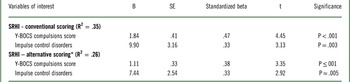
Thirty-six OCD patients (49.3%) described frequently or always expecting gains in positive affect (or reward) with the realization of their main compulsive behavior. We found correlations between the TICS anticipatory/consummatory scores and the TEPS anticipatory/consummatory pleasure scores to be moderate (r=0.25 and p=0.03, r=0.27 and p=0.02, respectively). The lack of correlation between the TICS and measures other than the TEPS is consistent with its satisfactory divergent validity (see the Supplementary Material, available online). Conversely, the 2 SRHI scores correlated positively with indexes of OCD severity and the main symptom severity, namely the OCI-R total score (r=0.45; p<0.001 and r=0.37; p=0.002) and the Y-BOCS compulsions subscores (r=0.50; p<0.001 and r=0.41; p=0.001), respectively. The results of our regression analysis indicated that severity of compulsions and comorbidity with impulse control disorders significantly predicted 26–35% of the variance of the SRHI scores, depending on the scoring method (Table 1).
Stepwise regression analyses with the Self Report Habit Index (SRHI) scores as the dependent variables

SRHI: Self Report Habit Index.
* Scoring without overlapping items.
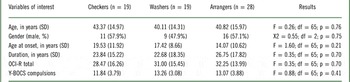
Next, we compared reward and habit across OCD groups. Specifically, we found that 19 OCD patients had primary checking, 19 had washing, and 28 had symmetry/ordering symptoms as their most clinically significant compulsions. Seven patients were excluded for having main compulsive symptoms that were not overt or motor (eg, mental compulsions) or not very well represented in the sample (eg, 2 patients endorsed “hoarding” as the main symptom). As can be seen in Table 2, no significant differences between washers, checkers, and arrangers in terms of socio-demographic features were noted.
Comparison of the socio-demographic and clinical features between the 3 OCD groups

OCI-R: Obsessive-Compulsive Inventory–Revised; Y-BOCS: Yale–Brown Obsessive-Compulsive Scale.
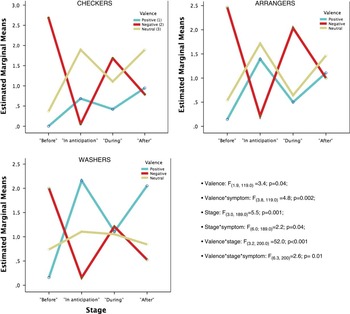
Among washers, the prevalence of patients who always or frequently expected obtaining reward from their behaviors (n=15; 78.9% of the subsample) was significantly higher than among checkers (n=5; 26.3%) or arrangers (n=13; 46.4%) (χ2=10.7; df=2; p=0.005). There were also interactions between affective valence (positive, negative, and neutral) and OCD groups (washers, checkers, and arrangers) [F(3.8, 119.0)=4.8; p=0.002]; between TICS-R stage (pre-choice, anticipatory, behavioral, and consummatory) and OCD group [F(6.0, 189.0)=2.2; p=0.04]; between affective valence and TICS-R stage [F(3.2, 200.0)=52.0; p<0.001]; and between OCD group, affective valence, and TICS stage [F(6.3, 200)=2.6; p=0.01]. As seen in Figure 1, OCD washers exhibited a significant increase of the positive affect in the anticipatory and consummatory stages as compared to the other OCD groups.
Comparison between the progression of affective states by checkers, arrangers, and washers according to the Temporal Impulsive-Compulsive Scale–Revised.

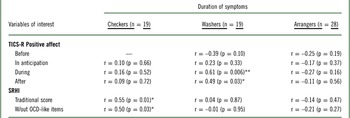
Although no significant correlation between duration of illness and TICS-R responses in the whole sample was found (see Supplementary Material), very significant correlations between positive affect during and after compulsive behaviors according to the TICS-R and duration of illness (r=0.61, p=0.006; r=0.49, p=0.032, respectively) were found in washers but not in patients showing other subtypes of compulsions (see Table 3).
Correlations between duration of symptoms, positive affects, and habitual features according to the main OCD group

TICS-R: Temporal Impulsive-Compulsive Scale–Revised; SRHI: Self Report Index of Habit Strength; (—): cannot be computed because one variable is a constant.
*p<.05; **p<.01, ***p<.001.
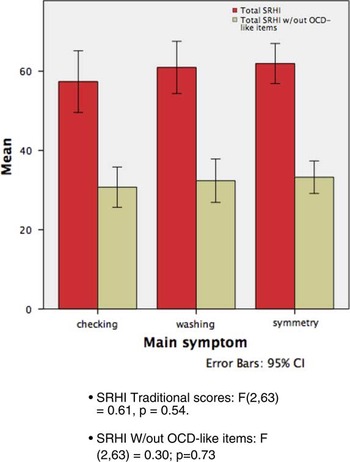
The 3 OCD groups did not differ in terms of SRHI scores according to the traditional [F (2,63)=0.61; p=0.54] and alternative systems [F (2,63)=0.30; p=0.73], the latter without OCD-like items (Figure 2). Although duration of illness did not emerge as a significant predictor of SRHI scores in the whole sample (Table 1), we have also assessed the correlations between duration of illness and SRIHS across different groups (washers, checkers, and arrangers). We found significant correlations between different SRHI scoring methods and duration of illness (r=0.55, p=0.01; r=0.50, p=0.03) that were restricted to checkers, and not reported in other groups (Table 3).
Comparison between checkers, washers, and arrangers in the Self Report Index of Habit Strength, traditional and alternative scoring systems.

Discussion
The main finding of this study was that almost half of our treatment-seeing OCD patients reported frequently or always expecting to experience gains in positive affect from the enactment of their compulsive behaviors. Thus anticipation of reward may drive compulsive symptoms in a significant subset of OCD patients. In fact, some researchers have already conceptualized OCD compulsions as addictive because of their apparent rewarding effects that follow the reduction of obsession-induced anxiety.Reference Figee, Vink and de Geus 9 Although correlations between the frequency of reward anticipation and other self-report correlates of reward and punishment were only small to moderate, we also noted that washers differed from checkers and arrangers in the trajectories of their experiences of positive, negative, and neutral affect associated with the target compulsive symptoms by exhibiting significant gains in positive affect in anticipation of the performance of their OCD behaviors. Washers also stood out in that their positive affects during and after compulsive behaviors were highly (and positively) correlated with duration of illness—a finding that could also explain why they expect to obtain rewards with washing.
Our findings suggest that, as OCD progresses, washing behaviors end up being more rewarding. This phenomenon is in accordance to our previous hypothesis.Reference Kashyap, Fontenelle and Miguel 2 , Reference Fontenelle, Oostermeijer, Harrison, Pantelis and Yücel 13 In fact, washing may be unique among other OCD dimensions. Rachman,Reference Rachman 26 for instance, suggested that, “When the fear (of contamination) is evoked, usually by direct contact with a perceived contaminant, it immediately generates a powerful, even overwhelming, urge to clean. The urge is generally so strong that it over-rides other considerations” (p. 1238). However, it is unclear whether intensity of urge is linked to reward anticipation. One could argue that the prospects of feeling clean (or sometimes “pure” or even “immaculate”) may be particularly rewarding for an OCD washer. In fact, in a previous study, washing (and symmetry) symptoms were over-represented among OCD patients who, besides having low insight, fail to resist and to control performing their compulsions.Reference Kashyap, Fontenelle and Miguel 2 Other studies have also reported that washing is particularly common in OCD that develops after posttraumatic stress disorderReference Fontenelle, Cocchi and Harrison 27 or comorbid with borderline personality disorder,Reference Melca, Yücel, Mendlowicz, de Oliveira-Souza and Fontenelle 28 two conditions known to predispose sufferers to substance addiction.Reference Whitbeck, Armenta and Welch-Lazoritz 29
There are also neurobiological findings to suggest that association between OCD washing and reward anticipation may be linked to brain deficits in reward processingReference Figee, Vink and de Geus 9 and altered dopaminergic neurotransmission.Reference Melo-Felippe, de Salles Andrade, Giori, Vieira-Fonseca, Fontenelle and Kohlrausch 30 One study reported that OCD patients were less able than healthy controls to activate the nucleus accumbens bilaterally and the left insula during anticipation of gains in a monetary incentive task. Importantly, this study also found that OCD with contamination/washing dimension symptoms displayed lower activity within these areas when compared with OCD patients with the shameful-checking symptom dimensions.Reference Figee, Vink and de Geus 9 Accordingly, we have previously found that one −287A > G catechol-Omethyltransferase polymorphism, which may be related to altered dopaminergic transmission and has been already associated with heroin addiction, was also significantly over-represented among female subjects with washing symptoms and male individuals with symmetry symptoms.Reference Melo-Felippe, de Salles Andrade, Giori, Vieira-Fonseca, Fontenelle and Kohlrausch 30
We also discovered moderate to high positive correlations between the severity of OCD (including OCI-R total scores and Y-BOCS compulsions scores) and habit strength using the both the SRHI’s traditional scoring system (r=0.46; p<0.001) and one that excluded items thought to overlap conceptually with compulsivity (ie, “that would require effort not to do it”) (r=0.36; p=0.001). These findings reinforce the association between OCD’s compulsive behaviors and habits. Importantly, however, our findings suggest that OCD compulsions and habits are not simply redundant constructs. This is the first confirmation, on a phenomenological level, that OCD compulsions can display habitual features, as previously suggested by several laboratory experiments (for a review see Gillan and RobbinsReference Gillan and Robbins 7 ). Although we noted that the strength to which a specific compulsive behavior is habitual did not depend on the compulsion type (washing, checking, or arranging), our findings suggest that checkers differ from other groups by having symptoms that become increasingly habitual with the progression of OCD. Thus, it seems that, after some time, checking may just need to be followed without inducing much emotion or being linked to any goal-driven motivations.
The results of our regression model not only supported the relationships between habit strength and severity of compulsions but also expanded them by showing that the latter, coupled with comorbidity with impulse control disorders, predicted a substantial amount (26–35%) of the variability in SRHI scores. Thus, comorbid impulse control disorders also may shape the expression of OCD compulsions by imparting them habitual contours, including greater “automaticity,” expression of one’s identity, and, as expected, a history of repetition.Reference Verplanken and Orbell 17 These findings are also consistent with evidence that OCD patients with broadly defined impulse control disorders express different characteristics, including earlier age at OCD onset, a more insidious appearance of OCD symptoms, a higher rate of comorbid anxiety disorders, a greater number and severity of compulsive symptoms, and a higher number of required serotonin reuptake inhibitor (SRI) trials.Reference Fontenelle, Mendlowicz and Versiani 1 Similar findings were reported elsewhere.Reference Matsunaga, Kiriike, Matsui, Oya, Okino and Stein 14 Thus, it seems intuitive to test whether strategies involving habit reversal could help OCD patients exhibiting more severe compulsive symptoms and/or comorbid impulse control disorders.
Instrumental behaviors are generally classified into (i) goal-directed (or “model-based”) behaviors that are planned and purposefully performed to avoid punishment (negative reinforcement) or to achieve reward (positive reinforcement) or (ii) habitual (or “model-free”) behaviors that are inflexibly and automatically performed in response to environmental stimuli.Reference Sjoerds, de Wit and van den Brink 31 , Reference Gillan, Otto, Phelps and Daw 32 Though OCD is generally considered goal-directed,Reference de Haan, Rietveld and Denys 33 we speculate that OCD compulsions may lay half way between model-based behaviors’ and model-free behaviors’ brain systems [based on ventral (caudate) and dorsal (putamen) striatum, respectively]. In fact, our findings suggest that, with OCD progression, washing may become more rewarding (by involving more ventral systems) and checking may become more habitual (by involving more dorsal systems). Although some studies have conceptualized OCD’s compulsive behaviors as arising from a generalized bias toward forming habits, which have been ascribed, for instance, to lower gray matter volumes in the caudate and medial orbitofrontal cortex (eg, Voon et al Reference Voon, Derbyshire and Ruck 34 ), these studies differed from ours as they relied on neurocognitive tests measuring individuals’ abilities to learn habits instead of the pathological behaviors (or habits) per se.
Our study is not without limitations. First, we acknowledge that our approach might be considered too exploratory for performing multiple comparisons without appropriate corrections. However, we also believe that, given the current state of knowledge and the prevailing lack of information on the correlates of reward and habit in OCD, it is advisable to be more lenient than usual.Reference Bender and Lange 35 The TICS-R is still preliminary in terms of psychometrics and may not have covered all phenomenological facets of compulsivity and impulsivity (as reviewed in Arzeno Ferrao et al Reference Arzeno Ferrao, Almeida, Bedin, Rosa and D’Arrigo Busnello 36 ). Also, some patients might have underreported more automatic or reward-related behaviors, which are often performed on the fringes of consciousness. Further, the fact that the rates of anticipation of reward in the present investigation were substantially lower than the ones reported in our pilot study suggests that the underlying construct of reward in OCD may be unstable.Reference Fontenelle, Oostermeijer, Ferreira, Lorenzetti, Luigjes and Yücel 11 However, it may well reflect adjustments made in the instrument used to assess affective states, including a clinician administered-format that provided greater flexibility to assess patients’ responses; the inclusion of a neutral (neither “good nor bad”) affective state question that allowed some OCD patients to report that, by performing their compulsive behaviors, they aimed to become “neutral” (and not necessarily “good”); and the use of frequency rather than intensity of emotions as anchors, as patients may base their reports on exceptional increases in positive affect in anticipation of compulsive symptoms that do not reflect the affective makeup of their target behaviors.
Conclusions
OCD, addiction, impulse control disorders, and habits are closely related phenomena. Compulsive washers may be more clearly characterized by problems in reward processing. In contrast, the duration of checking, severity of OCD, and comorbidity with impulse control disorders may shape compulsive behaviors by imparting them with habitual features. These findings may bear treatment implications for OCD patients with compulsive washing, who may be the subjects of future controlled trials of anti-craving medications (such as naltrexone or nalmefeneReference Piquet-Pessoa and Fontenelle 37 ) or other psychological interventions potentially relevant for the treatment of other addictive behaviors (such as contingency management or motivational interviewingReference Carroll and Onken 38 ), and to patients with severe OCD comorbid with impulse control disorders and/or chronic checking behaviors, who may be tested for alternative behavioral techniques, such as habit reversal.Reference Woods and Miltenberger 39
Disclosures
Dr. Murat Yücel reports grants from David Winston Turner Endowment Fund, grants from Monash University, and grants from National Health and Medical Research Council (Australian Government Department of Health) during the conduct of the study. Gabriela Mourão Ferreira, Andrew Dawson, Valentina Lorenzetti, and Leonardo Fontenelle do not have anything to disclose.
Supplementary Material
For supplementary material/s referred to in this article, please visit https://doi.org/10.1017/S1092852916000535
Appendix: Temporal Impulsive-Compulsive Scale–Revised (Fontenelle, Ferreira, & Yücel, 2013)