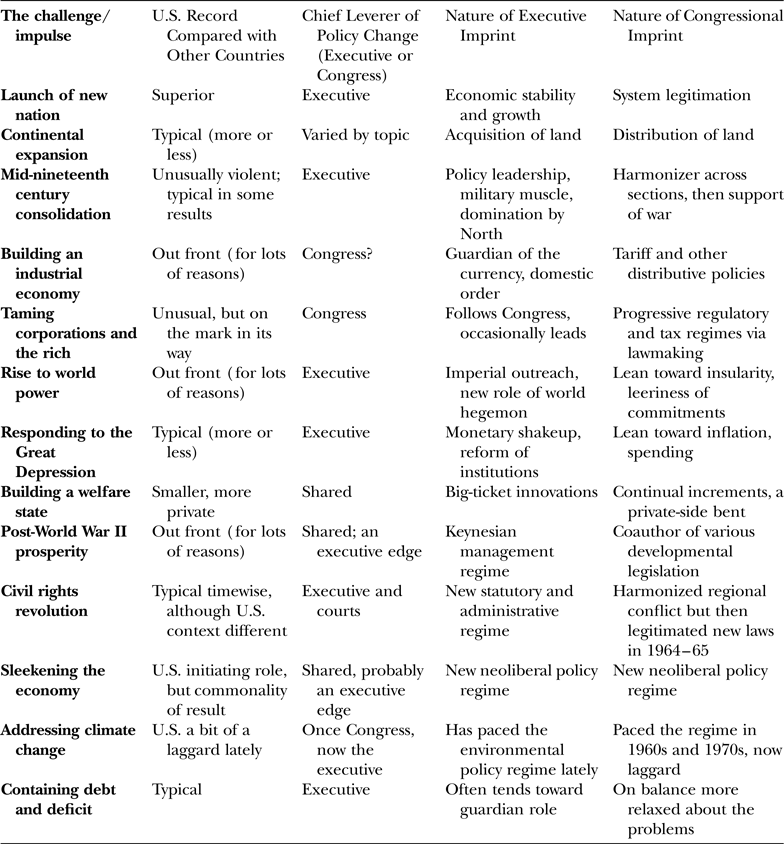
Can Congress as a “core institution” of American democracy capably address the major challenges confronting the nation at any given period? Can Congress govern? We have long asked questions like these, and today they hang in the air.Footnote 1 Budgetary and other vexations will not go away, conflict rages, and the Gallup standing of the institution is low. Perhaps a cast back through history can supply some perspective. This article reaches back to the start of U.S. national institutions in 1789.
Immediately, the questions thus posed hit difficulty. They are not answerable or tractable as is. They need to be deconstructed. Congress does not handle challenges or govern by itself. It takes part in those tasks. The presidency joins the picture, too (never mind the courts).Footnote 2 Also, in the U.S. separation-of-powers system, the juxtaposition of the two elected institutions has its own kinds of effects. Insofar as it is possible, I want to shine a light, particularly on Congress. That is to the end of reaching two audiences—mainstream political scientists, who have not analyzed Congress in the way I attempt here, and American political development scholars, who have tended to skimp on Congress, period.Footnote 3 But, along the way, the imprints of the executive branch and interbranch relations need to be inspected also.
What is a “major challenge confronting the nation”? That is a tall order. I would like to empiricize this subquestion as much as possible. We should not be anachronistic. In 1803, the government was not likely to create an Earned Income Tax Credit. Also, an itch among intellectuals should not be a sufficient guide to the “challenges” of any time. Intellectuals always have itches. For something to be a “challenge,” the sources of perception, drive, demand, or action should be larger. Looking at the history, large considerations of regime legitimacy, order, responsiveness, welfare, state building, or survival or expansion in an often hostile international world should ordinarily figure. Finally, how can we assess whether Congress was acting “capably”? That is another tall order.
RESPONSE TO IMPULSES
Here is my analytic and empirical crutch. In principle and, insofar as it can be done empirically, I try to compare U.S. policy performance—with a particular eye to Congress—to that of other relevant countries since 1789 to address both the “what is a challenge” question and the “capably” question. To draw such comparisons speaks to these two questions. It allows a plausible identification of “challenges” to examine. If something has transnational incidence it may be especially worth looking at. And comparisons can offer clues to relative performance—the United States versus the rest—albeit not clues of a quality that would admit to sure score keeping or quantification.
Now for a slight alteration of focus. As I proceed here, the term “handling challenges” is not exactly apt. “Response to impulses” is a better way to put it. Spotlighted in my interpretation is effective U.S. participation in large political or intellectual impulses that have occurred transnationally during the relevant centuries. Has the United States kept up? Everywhere, history rolls along, and as a poser of possibilities it does not respect borders. Transnational zeitgeists and contagions are in steady supply. Consciousness evolves cross-nationally, as do economic and other kinds of situations, problems, norms, urges, and opportunities. Available in consequence, for analytic purposes, is a kind of transnational Hegelian yardstick. Again, the analysis here is in principle empirical. “Impulses,” which pose “challenges” of a sort, make a wide appearance in history, and they are detectable. One can see what they are and how they are participated in. The roster of usual-suspect countries to compare the United States with evolves, as does history generally, but some such counterparts are always there. Obviously, the kinds of judgments I am attempting here need to be rough and speculative.
Let me ward off some misapprehensions. This is not exactly a survey of U.S. “problem solving.” Some of the cases I consider have that cast—that is, they exhibit wide agreement on a plight, wide agreement on a goal, and a pathway of intention and calculation that connects those dots, at least in aspiration. But some of my cases do not have much of that cast. My yardstick is a historian's. In any case under scrutiny, looking back at the history with a cold eye, often into a jumble of aims and behaviors, what can we say about this country's arrival at an end state that other countries have tended to arrive at also, that is, regardless of whether the routes to the end states have entailed eyes-open problem solving or planning. What have been the impulses and, to what degree, using this transnational gauge, have they been performed on? Those are the operative questions. To perform “capably” is to end up chalking high on the Hegelian gauge.
There is a related caution: Anything like decision by consensus is rare in the cases I discuss. Machiavelli wrote that conflict, not consensus, is a trademark of republics, and that idea matches pretty well the American experience reported here.Footnote 4 The conflict has often been brutal.
Finally, there is the question of “progress.” Is the U.S. performance since 1789 as I discuss it here a Whiggish-style record of “progress”?Footnote 5 Well, yes, in one way. That result is largely built into the method. Generally speaking, in this and other countries, successful arrivals at a sequence of specified end states are indeed what has happened. But this pattern should not be confused with any otherwise assembled verdict of “progress.” Appraised differently, history might be seen as “running a ditch” for the last two centuries.Footnote 6 Looking back, it is a matter of normative judgment whether the impulses I take up here should have been bought into at all. At least one of them was quite appalling.
I have relied on secondary sources for this enterprise. For transnational comparisons, I consult a representative scholarship, although my treatment is, generally speaking, stylized—an allowable course I hope given the largely well-known and noncontroversial nature of the patterns. For the American history, I have tried to emphasize recent scholarship, which in many cases amends old interpretations. I reach beyond standard history and political science into especially economic history. As for which aspects of the history to look at, I privilege policy over process. I key in on the content of policies and the downstream effects of making them. This choice is at odds with most treatments of Congress in political science.
My accounts here may seem telegraphic. That is because, relying on what seem like authoritative sources, I often reach for the gists of causal stories about who did what and when and with what consequence, leaving behind the dynamics and the details. As recompense, I take pains to pinpoint the references to specified pages or at least chapters so that this essay can be read as, among other things, a low-labor-costs bibliography. Often, these gists signal whether Congress or the presidency was chiefly responsible for something that happened. It goes without saying that judgment calls on this question can falter. For one thing, theoretical intricacy can intrude. But common sense based on evidence seems a decent enough reliance. For my inferences of responsibility, I look for a balance of initiative, attention, energy, and muscle. But I should downplay upfront the idea that this is a study of zero-sum relations between Congress and the presidency—one wins, the other loses. Sometimes that is the relation, but sometimes it is not. The thrusts and imprints of the two institutions may differ without being discordant one versus the other. They may just have different profiles. This is often the nature of coexistence between Congress and the executive branch.
Addressed below are thirteen U.S. “challenges” starting in 1789 that I take up more or less chronologically. This list is not exhaustive, it is selective, although it hits many orthodox high points. The list tilts toward the present—no doubt in part because the federal government grew more active during the twentieth century. The last two cases probably belong in a category by themselves since the history on them is not finished. On “owl of Minerva” grounds familiar from Hegel—who knows how the history will play out?—I skirt a variety of other “challenges” being discussed in current times that may or may not come to enjoy primacy and sticking power.
I do not intend these thirteen instances to be exhaustive. Even so, they do have a flavor of mapping the history. Insofar as they amount to that, the pattern of the mapping is unorthodox. That is intentional. I believe that the conventional periodizations of U.S. history have become stale. Recent scholarship has undermined or amended them, they have been too insular (not enough of a recognition of transnational comparisons), and, anyway, I do not believe that they have centered enough on actual U.S. policy regimes and impacts. Relatedly, I steer clear here of the aspirations, the teleologies, and the celebratory back-patting claims associated with the American political parties. Those propensities are well known and have been dwelt on often. The parties do figure here, but I emphasize the activities of individuals and formal institutions.
I start each sketch with a discussion of the policy performance of the United States, placed in transnational perspective. But each discussion is in principle a preparation for, and is followed by, a consideration of the particular roles of the U.S. executive branch and, especially, Congress in the performance of the relevant policy. Again, this setup is meant as an entryway into Congress. To get a bead on Congress, we need to know what the challenges have been, how the United States has fared against the transnational field (perhaps Congress has veered the result one way or another), and the roles of the American executive branch as well as Congress.
Generally speaking, this essay has a flavor of “what happened and why” as opposed to an overarching “so what.” The whats and whys of the thirteen treatments shoot off in several directions, they open a variety of speculations, and I will not try to try to pack them all into a tidy “so what” analysis at the close. Yet at that close I will take up two themes that seem relevant to at least many of the thirteen impulses, and I invite readers as they read through the text to entertain these two themes—sometimes they appear explicitly, sometimes they are implicit or might be drawn out—and to muse how they might figure in a “so what” discussion at the close. The first theme is the legitimacy of the U.S. political regime—that is, with a nod to Locke and Weber, its popular acceptance as authoritative. The U.S. regime goes back two and a quarter centuries, and yes, there was the Civil War, but the regime's legitimacy seems as rock-solid as, say, Switzerland's or Sweden's. Conflict runs on endlessly about policies, government performance, and second-order processes such as campaign-finance rules, yet any questioning of the country's basic constitutional institutions or for that matter its geographic composition (on the latter point, see today's Britain, Spain, or Canada) runs close to zero. This is notwithstanding the country's ample heterogeneity. How has the operation of Congress figured in this apparent sense of basic legitimacy? The second theme is the striking messiness of congressional activity. Inconstancy, incoherence, and particularism have invested many public projects. How has this propensity, a froth of real-life democracy looked at in one way, figured in the record of U.S. policymaking and its effects?
LAUNCHING THE NEW NATION IN 1789–1801
It is not easy to launch a new polity that works and lasts. Perhaps, for the new United States, the best comparisons are the new Latin American republics of around 1800 or the British settler polities—Canada, Australia, New Zealand—that came into being somewhat later. Matched against these nations, the United States developed quite well—more stable, legitimate, and prosperous than the Latin American republics (of course, problems of comparison arise), and at least the equal of the British colonies in economic growth.Footnote 7 This is to approach the new polities as they were constituted: The United States, like the British polities, but unlike many of the Latin ones, was whites only.Footnote 8
How about the institutions of the new U.S. government? Unquestionably, the economic success of the new republic was executive-led. Backed up by George Washington's steadiness and charisma,Footnote 9 Alexander Hamilton as treasury secretary acted as something like a prime minister. He pressed into existence a funded debt, the Bank of the United States, the Customs Service, the Coast Guard (smugglers had to be thwarted so as to allow collection of imposts), the U.S. Mint, a bustling securities market, readmission to the British trading area, and even, indirectly, the New York Stock Exchange. It was quite a performance. There is a wealth of recent research on these subjects.Footnote 10 Hamilton is said to have been “the first systematic macroeconomic planner in the United States and one of the first in any country.”Footnote 11 Courtesy of Hamilton, the United States was “one of the first nations [after the Netherlands and Britain] to modernize its finances.”Footnote 12 The results seem to have been decisive—low taxes, an explosion of entrepreneurialism, and “history's most successful emerging market.”Footnote 13 Soon, the mid-1790s brought an “increasing growth of American prosperity. Hamilton's financial program was working wonders.”Footnote 14 And a long economic growth surge began. In one assessment, the policy choices of the 1790s “not only established conditions for (and removed constraints on) modern economic growth, but also provided a long-term policy framework that continued to encourage growth, the territorial expansion of the United States, and the country's influence on world affairs for decades and centuries.”Footnote 15 Absent Hamilton and his policies, what? Well, to reach for an extreme, one plausible counterscenario would see the new nation as an agricultural backwater beset by debt, taxes, low growth, centrifugal forces, Indian tribes, the Spanish and the British, and mired even worse in southern slavery than the country came to be.Footnote 16 The Jeffersonians who took power in 1801 were lucky to inherit a thriving fiscal system and economy, not to mention a good navy.Footnote 17
But there was a congressional role, too. It is as legitimizer of the system in the eyes of U.S. citizens (a theme that will echo in this paper). The Bill of Rights, a demand from the anti-Federalist side, issued from the House of Representatives in 1789 thanks to James Madison, then the chamber's leading member.Footnote 18 In the mid-1790s, the House created a Ways and Means Committee “so that Congress could counter the [financial] expertise and experience that until that time had been monopolized by the executive branch.”Footnote 19 This was a key move in power-checking, a likely assistance to legitimization in both the short and long term. Albert Gallatin, the era's able intellectual adversary to Hamilton on money questions, found a footing in the Ways and Means Committee and the House in general as that chamber came to host an anti-Federalist opposition.Footnote 20 Congress's approval of the Jay Treaty with Britain in 1795–1796 brought an education in the containing of contestation—there were eight months of tense conflict, accompanied by popular mobilization and apparent shifts in public opinion, ending in a House majority party getting “rolled” by a winning cross-party coalition.Footnote 21 It was a lesson in conducting peaceful politics. It was a lesson in how to lose: The crushed Madisonian Republicans were not history's last losers to find that a roll call loss rooted in public opinion is basically unspinnable. Life has to go on. Finally, in 1801 a House controlled by the (now lame-duck) Federalist Party managed to award the presidency to Thomas Jefferson in the tense election settlement of that year. In a tangled circumstance, the House had the decision power. Compromise-prone Federalists there, joining a cross-party coalition in a nod to the voter verdict, did the trick.Footnote 22 One recent account argues: “The constitutional miracle, if there was one, did not happen in the Philadelphia of 1787 but in the Washington of 1801. It is one thing to write a Constitution, quite another for it to survive.”Footnote 23 In comparative terms, this American party turnover of 1801 was a significant first.Footnote 24 Democracy, in Adam Przeworski's influential definition, is “a system in which parties lose elections.”Footnote 25
All these congressional instances map onto the idea of Congress-led legitimization—a front on which the executive-centered Federalists, for all their economic talent, had difficulties. Note that this discussion of legitimization points up a framing argument I made earlier. Probably no one would contend that the congressional actors of 1789–1801 referred to here were trying, in an eyes-open intentional sense, to “solve the problem” of “launching the new nation” by “legitimizing” it. That was not their mind-set. Rather, their behavior, however it was animated or intended, can be reasonably judged to have contributed to an arrival at a particular end-state—a successful launch.
CONTINENTAL EXPANSION
In the nineteenth century, peoples of European extraction invaded, seized, and settled vast terrain outside Europe, thus displacing or exterminating native populations. No impulse was more common. Five continents were involved. Siberia, South Africa, and the South American cone countries were among the expansion zones, yet the cleanest analogy to America's drive to the south and west may be the British settler colonies of Canada, Australia, and New Zealand—millions of settlers flocked to those inviting spaces, too.Footnote 26 I accent here the first half or so the nineteenth century, although the impulse kept on (the U.S.–Indian wars after the 1860s, for example, had a clear counterpart in Argentina).Footnote 27 As an exercise of ethnic cleansing, this country's “Indian removal” during the Jacksonian 1830s had an especially clear parallel in Australia's Tasmania and New South Wales at that same time.Footnote 28 In all the five continents, the nineteenth-century expansions, looked at in their own terms, were certainly successful. No U.S. anomaly there. Otherwise, in brutality toward the native populations, the Americans and Australians apparently outdid the Canadians.Footnote 29 Probably the chief respect in which the Americans stood out was their need to shunt aside established powers—Britain, France, Spain, and, eventually, Mexico, not just indigenous peoples—in order to occupy the geographic spaces they sought to occupy.
White settler pressure paced it all. But in the United States the federal government played a prime role—not least to usher out those other established powers. That ordinarily meant action on the part of the executive branch. An exception was the War of 1812, a drive for territory, among other things, where Congress nudged the action.Footnote 30 But Congress ordinarily followed along and complied, occasionally complaining or constraining. There is no doubt that the White House ordinarily supplied the initiative and energy. The presidents used a variety of techniques. One was purchases: Thomas Jefferson bought Louisiana, Franklin Pierce made the Gadsden Purchase, Secretary of State William Seward bought Alaska (acting for President Andrew Johnson in the last acquisition of the North American continent).Footnote 31 There was annexation: President John Tyler set the process to acquire Texas that way.Footnote 32 There was invasion: President James K. Polk acquired half of Mexico that way (he would have taken more, but, among other things, Congress was hostile).Footnote 33 Along the Gulf Coast from today's Florida through Louisiana, held at the time by Indian tribes and the Spanish, a mix of techniques was engineered, presided over, or given a wink and a nod by Presidents James Madison and James Monroe that in today's terms seem Putinesque—secret schemes, armed intrusions, rampages, forced treaties.Footnote 34 As for the removal of Native Americans to the West, it was envisioned by, among others, Jefferson, but it took on reality in the long career of Andrew Jackson as general and president.Footnote 35 For Jackson, “The Indian Removal Act of 1830 constituted the highest priority in the new president's legislative agenda.”Footnote 36 Then he sped past the terms of congressional authorization in implementing it.Footnote 37 What was Jacksonian democracy? In Daniel Walker Howe's recent take, “In the first place it was about the extension of white supremacy across the North American continent.”Footnote 38
The executive branch led in acquiring the vast new public land. Congress led in distributing it. The system's rules needed execution, but Congress set them.Footnote 39 The story starts with an unlikelihood for a legislative body: In the mid-1780s, the Continental Congress (it was still that, then) generated through its committee processes one of the world's most rationalistic master-plans—the assignment of the whole U.S. public domain into small rectangles for purposes of surveying and sales.Footnote 40 That design stuck. But then seven decades of trademark congressional politics took over. It is a fascinating story. It is a wonder that any incumbent politician ever lost an election. They had a continent to hand out! In passing hundreds of laws, here were the themes: keep lowering the prices (eventually to zero), keep allowing smaller land plots, allow easy credit, supply debt relief once the farmer debt builds up, legitimize the inevitable land squatters, accommodate the war veterans (land plots were the pre-Civil War version of veterans' benefits), don't worry about the government making money from distributing the land, and keep changing the rules.Footnote 41 It was a ragged, volatile populism. Some of the executive branch's leaders regretted not taking in more revenue from the sales (Treasury Secretaries Hamilton and Gallatin) or blanched at the accommodation of the squatters (Gallatin and Jackson) or at the easy credit (Jackson—whose Specie Circular in 1836 took aim at it).Footnote 42 In the end, the government seems to have broken even, more or less—no windfall of revenue but no loss.Footnote 43 The consequences of it all? A nation of small farmers was speedily helped into existence—although much of the South's Indian land ended up in slave plantations. Perhaps the quick move of the land into production assisted the U.S. economic growth rate.Footnote 44
There has been a final division of labor. The presidency, in a stream of executive directives originating in the 1790s and lasting through today, has decisively shaped the management of lands remaining in public possession. Thus has public land often been reserved or tailored for Indian tribes, military use, environmental preservation, and so on—and sometimes curbed from sale. Little in the history of executive directives has been more important.Footnote 45
NATIONAL CONSOLIDATION
Moving to the 1860s, I address the U. S. abolition of slavery in a particular frame.Footnote 46 Generally speaking, the mid-nineteenth century, notably the 1860s, seems to have brought a spasm of special character across much of the developed or developing world.Footnote 47 Upended were old particularisms like church privileges, monasteries, autarkic principalities, rebellious regions, corporate orders, serfdom, feudal land rights, and slavery. Centralizing states swung into place, offering strong nationalisms, a spirit of modernizing liberalism, and a bent for commodifying property and homogenizing the rights of citizenship across entire populations.Footnote 48 Among other things, dramatic midcentury changes in transportation and communication were possibly a key to it all.Footnote 49 Partaking of this 1860s spasm in various respects were at least Germany, Italy, Hungary, Japan, Mexico, Argentina—and the United States.Footnote 50
“In crushing the emergent Confederate state, the Union was itself following, and contributing to, a much wider realignment in which large and unified nations and more centralized and economically sophisticated supremacies replaced the still loose and varied polities of the early nineteenth century.”Footnote 51 The United States “entered [the Civil War] with a states-union in crisis and emerged from it a federal state with an intensified national identity.”Footnote 52 Slavery went out. Citizenship rights, a “free labor” ideology and “an explosive expansion of central state authority” came in.Footnote 53 (I emphasize here the rights, identity, and national sovereignty aspects of these changes; for the economic side, see the section below.)
Unquestionably, this American change of the 1860s was executive-led. In the United States, as in most other countries mentioned above, wars figured in the consolidations.Footnote 54 There was an executive edge of force and steel. Abraham Lincoln as president is often compared to Otto von Bismarck of that era.Footnote 55
What was the place of Congress in this history? Three points seem worthwhile. All are familiar. First, Congress's signature drive during the many decades right through the winter of 1860–1861, when war loomed, was to arrange compromises to keep the country intact. Here was, in consequence, and for many actors like Henry Clay and Daniel Webster, in intention, the familiar “please-everybody” (meaning the white citizenry, at that time) legitimizing role. At stake was the joint national allegiance of North and South. This role stood out in the Compromise of 1850, still an example for its procedural inventiveness, as Clay and Stephen A. Douglas coupled discrete, jangling bills into an overall compromise.Footnote 56 It was kind of a golden age of the Senate playing this role.Footnote 57 Perhaps the sectional conflict could be bridged or at least postponed. Second, during the 1830s through the 1850s, in the cause of ending, or at least curbing, slavery, the processes of Capitol Hill offered a speaking platform, which certain members famously employed, thus drawing an audience and apparently radiating influence across the country. This was position taking with consequence. John Quincy Adams fought to admit antislavery petitions; David Wilmot pressed his post–Mexican War “proviso” to keep slavery from the new territories; Charles Sumner delivered and sent around the country his antislavery speeches, drawing a physical assault on the Senate floor for doing so.Footnote 58 Finally, Congress, during the Civil War itself, the South now absent, moved into a subsidiary and, generally speaking, cooperative role vis-à-vis Lincoln—at least in matters related to war management.Footnote 59
BUILDING AN INDUSTRIAL ECONOMY
“Destructive though it was, the Civil War broke the slaveocracy's power to obstruct an American development agenda.”Footnote 60 Economic improvement took on new life, with an often rivalrous eye on Britain and, later, Germany. Immediately in the 1860s, “one of the great development programs in American history,” an updated Whig mix that was now politically feasible, became law—a higher tariff plus generous government land outlays to spur homesteads, state colleges, and a transcontinental railroad.Footnote 61 The banking system was revved up thanks to coordination between Treasury Secretary Salmon P. Chase and Capitol Hill powers.Footnote 62 But in general this was a congressional, not a presidential, program. War management was one thing, but: “Less than any other major American President did Lincoln control or even influence the Congress … . The President had remarkably little connection with the legislation passed during the Civil War.” The tariff, the homesteads, the railroad, the college funding and other moves “had little connection with Lincoln aside from his formal approval of them.”Footnote 63 To finance the war itself, “Congress rather than the Treasury secretary took the lead in fiscal legislation;” greenbacks, an income tax, and a new internal revenue service were congressional concoctions.Footnote 64
Industrial development certainly did take place. The record is striking. U.S. per capita income nearly tripled between 1870 and 1910.Footnote 65 Output came to trump that of Britain, France, and Germany combined by 1914.Footnote 66 Moves in the private economy offer plenty of causal grounding for these trends.Footnote 67 But how about the government, and how about Congress in particular, by way of the initiatives of the 1860s and beyond? The stylized, plausible account is of a division of labor.Footnote 68 The courts came to guard property rights and interstate markets.Footnote 69 The executive put down contagious railroad strikes (in 1877 and 1894), protected the gold standard, and sometimes helped to manage currency crises (in 1893–94 and 1907).Footnote 70 Congress leaned toward inflation that favored farmers and silver—a small-state product well represented in the Senate, pursued distributive politics as in the 1860s enactments, and kept the protective tariff high.Footnote 71 Legislators can be deft at logrolling and ladling out goods. For many of us, the analytic window into the tariff system of earlier times is still E. E. Schattschneider's work of 1934 illuminating a practice of “reciprocal noninterference” among petitioners for duties, which transmuted “a dubious economic policy … into a great political success.”Footnote 72 It was a distributive coalitional politics that overproduced, according to the critique lodged by reformers, import duties, to the distaste of the reformers and at the expense of the median voter and overall economic efficiency. No doubt this old interpretation has force, the logic is there, although new accounts have appeared. In fact, the tariff of earlier times seems to have had three animations. It was at once a U.S. policy antidote to Britain's dominance in international trade,Footnote 73 a principled domestic program that the Republican Party pursued,Footnote 74 and the distributive Christmas tree enterprise that Schattschneider saw it as. Economists are still puzzling about its actual economic effects.Footnote 75 Interestingly, the traditional tariff was often carried by narrow congressional majorities; obstruction through congressional filibustering figured little in its fortunes.Footnote 76 At any rate, Congress, in this old tariff system, as opposed to the White House, ordinarily dominated the process and favored higher rates.Footnote 77 Across history, presidents have leaned more toward free trade—ordinarily vis-à-vis at least their own congressional parties before 1932, uniformly vis-à-vis Congress as a whole regardless of party configurations since that time.Footnote 78
On the side of government process, the scholarship that enables the discussion of this era seems stale and underdeveloped. Gilded Age stories of “a swinish scramble for government largesse,” not that they lack a basis, have probably enjoyed too much resonance for too long.Footnote 79 An image comes down of the government being not only corrupt but also passive or asleep—a blank tablet on which often greedy private interests wrote. But was that really all? There is little analysis of government steering. We could use better empirical investigation of the elite processes of those days—an alertness to evidence of design, of thought and behavior by government actors aimed at fostering a successful political economy. What is lurking in the documents? This kind of scholarship has been done for other eras. A project centering on John Sherman, who cut a figure in economic policymaking in both Congress and the executive branch from the 1850s into the 1890s, would be a welcome addition to works like those on Alexander Hamilton, on Henry Clay and his “American system,” or Senator Robert F. Wagner and the crafting of the welfare state.Footnote 80 Such a project could clarify the roles of Congress and the executive. Sherman's own two-volume account of his aims and actions is a four-decade-long steering story. Congress and the Treasury, in those days before the Federal Reserve system, shared, in Sherman's view, the unending task of guard-railing the U.S. currency between undue contraction or expansion using the gold standard, then the international norm, as a leading device.Footnote 81 For better or worse—a matter of judgment then and since—that was the program.Footnote 82 Among other things, the stability of the gold standard was thought to supply a glide path for welcome European investment.Footnote 83
TAMING THE CORPORATIONS AND THE RICH
If the “explosive economic growth” of late-nineteenth-century America was singular, so was the resulting social and political environment.Footnote 84 The world's largest corporations, along with their creativity, their production efficiencies, and their consumer miracles, brought a whirlwind of disruptive change, just as the railroads had, not to mention a new gaudy plutocracy that had plenty of political power.Footnote 85 No one had seen anything quite like it. An understandable uneasiness set in. It is not exactly clear where to look for comparisons—in a general sense the European socialist movements represented a similar reaction, but the American path was distinctive.Footnote 86 In the United States, a powerful, cross-party “antimonopoly” coalition, keyed especially to agrarian interests, and with a labor component, erupted into politics, bent on achieving economic justice.Footnote 87 This impulse helped to trigger (I put it that way because the causation was complex and multiple and has been endlessly interpreted; the antimonopoly impulse was at least a proximate and a necessary cause of it all) a quite striking and long-lasting American policy regime of business regulation and progressive taxation.Footnote 88 In came the independent regulatory agencies—an American specialty.Footnote 89 U.S. progressive taxation of personal and corporate income, topped off with gift and estate taxes, seems to have set a world standard, or was at least tied for that distinction, a century ago.Footnote 90 “[V]ery high taxes on the very rich,” Thomas Piketty writes, “was invented in the United States.”Footnote 91 Using the tax hammer, the era's reformers assaulted corporate wealth with a ferocity that is rarely seen today.Footnote 92
This regulate-and-tax regime was dominantly congressional. In general, Congress did the initiating and lifting or, when presidents chimed in as policy partners, the arranging of final terms.Footnote 93 The Interstate Commerce Act of 1887 came from Congress: “So far as can be determined, [President Grover Cleveland] took no part in any stage of the formulative process. In none of his messages to Congress did he mention railroad legislation.”Footnote 94 So did the Sherman Antitrust Act of 1890: “President Benjamin Harrison had taken no part in the drafting of the Sherman Act and scarcely seems to have noticed its passage.”Footnote 95 So did the Mann-Elkins Act, which regulated railroads again, in 1910.Footnote 96 In two instances President Theodore Roosevelt thrust himself into ongoing congressional causes: the Hepburn Act addressing the railroads in 1905 and the Pure Food and Drugs Act of 1906.Footnote 97 President Woodrow Wilson promoted the Federal Reserve Act of 1913, yet “the celebrated structural independence of the Fed was a product of political compromise among disparate groups represented in the US Congress”—namely, “city bankers, farmers/populists, and Progressives.”Footnote 98 In later years, labor laws came from Congress—the still important Davis-Bacon Act of 1931 assured that workers received local prevailing wages on federal projects (this act was nursed by Republican Congresses starting in 1927, and bought into by President Herbert Hoover).Footnote 99 The Norris-La Guardia Act of 1932 curbed antistrike injunctions and banned yellow-dog contracts. It was designed by academics and reformers, passed by a Democratic House and a Republican Senate, and signed by Hoover.Footnote 100 Senator Wagner's monument was the National Labor Relations Act of 1935, on which President Franklin Roosevelt chimed in. This measure, the Wagner Act, unquestionably merits the senator's name. He worked his signature design through Congress over a period of years.Footnote 101 “He was [the measure's] legislative instigator and tactician, and before Congress, the President, and the public he was its most ardent champion.”Footnote 102 FDR, for his part, was not an easy sell.Footnote 103
On the taxation front, Congress, spurred by then House member William Jennings Bryan, enacted an income tax in 1894; President Cleveland, not favoring it, let it pass absent his signature; the Supreme Court blocked it.Footnote 104 In a complicated politics, a Republican Congress roiled by Progressives generated the Sixteenth Amendment in 1909—this was the permanent authorization of income taxation.Footnote 105 The content of the consequent statutory income tax of 1913, backed by President Wilson, came from Congress.Footnote 106 The country's historic shift to a lastingly progressive revenue mix in 1916–18, prompted by the military buildup needs of World War I, came from pressure from “a powerful group of insurgent Democrats” on Capitol Hill. “If you want armaments,” they more or less told the (not all that reluctant) Wilson administration, “we'll tax the rich to pay for them.”Footnote 107 And so they did.
In the respects noted here, Congress ordinarily took the lead. One's impression is of a cantankerous, mercurial, free-form legislature that was often flypaper for popular impulses (although organized interests were being serviced, too). Position taking by the members to convey simple, appealing messages of blame and remedy was in style.Footnote 108 That is not distributive politics. It is populist or programmatic or ideological politics.
THE RISE TO WORLD HEGEMONY
As to foreign policy, whether this country's rise to world standing should have happened, or happened the way it did, it happened. Here I focus on U.S. projection beyond the North American continent since the 1860s. The United States became number one. In the history of this rise, what has been the place of Congress? The institution seems to have supplied a particular tilt. Notwithstanding an occasional out-front hawkishness, as in 1898 vis-à-vis Spain, Congress, on occasions when it has differed with the presidency on foreign policy, has ordinarily leaned toward quietude and stasis.Footnote 109 This isn't to say that institutional disagreement has been the norm, but it has kept occurring. In a signature role, Congress has often resisted or footdragged on White House aims for expansions, invasions, intrusions, annexations, and foreign commitments abroad. From the 1860s through the 1930s, presidents eyeing colonies or dependencies ran into Capitol Hill resistance—for example, the Dominican Republic under President Grant (annexation blocked), the Virgin Islands and Hawaii (absorption delayed), Cuba (the Teller Amendment in 1898 banned direct U.S. rule), Nicaragua, Haiti, and the Dominican Republic from 1900 through the 1920s (a variety of sticks went into the spokes).Footnote 110 It was Congress that pressed for independence of the annexed Philippines.
On the commitments side, Congress turned down the Versailles Treaty in 1919 and the World Court in 1935.Footnote 111 In the 1930s, Senate forces of isolationism amplified that view in the general public—Senator Gerald Nye's munitions hearings brought “a daily round of headlines and sensations”—and in turn impaired FDR's flexibility toward aiding Britain going into 1939–41.Footnote 112 All the government branches signed on to the Cold War, but foreign aid was a trial on Capitol Hill.Footnote 113 Congress, through hearings and otherwise, roused opposition to the Vietnam and Iraq wars, eventually cutting off funds in the former case and thus inviting the U.S. helicopter exit.Footnote 114 At several times in history, it was leaders of the Senate Foreign Relations Committee—Charles Sumner, Henry Cabot Lodge, William Borah, and J. William Fulbright—who spearheaded the opposition to White House initiatives.Footnote 115
And so it goes. It is a story of relative congressional recessiveness. There are several reported reasons: principled anti-imperialism; inattention; costs (why not spend the money at home?); race, in former times (why invite colonies that would dilute what was seen as the country's white homogeneity?); lack of formal responsibility (the president is at the wheel); and, not least, institutional friction thanks to the separation-of-powers Constitution. Congress, it is said of the Grant era, “was not blindly antiexpansionist, but it was blindly antiexecutive.”Footnote 116 The drive for Philippine independence embraced in the Tydings-McDuffie Act of 1934, a pioneering move to decolonize an empire if looked at in comparative terms, is an interesting case.Footnote 117 It saw a play-out of the above themes and then some on Capitol Hill: for example, racism (the Filipinos were not white); anti-imperialism; swelling nativism and anti-immigration sentiment during the Depression; labor union alarm about wage competition (there was rioting in California); and domestic sugar interests pressing for tariffs against Philippine products. President Hoover, casting a strategic eye at East Asia, vetoed a Philippine independence bill in 1933. Soon afterward, FDR cooperated on the slightly revised final version that succeeded in 1934, but the drive for it all came from Capitol Hill.Footnote 118
From Jefferson's Barbary war to Obama's use of drones, the White House has bent toward action. Congress has bent toward insularity—not always, yet recurrently. This distinction is not a surprise given the differing assignments of legislative and executive authority in the Constitution. Across history, the making of foreign policy has brought a kind of competitive channeling—the White House toward matching the British Empire or even Prussia in style and aims, Congress more comfortable with something like a large Switzerland. It is good bet that this juxtaposition has contributed to a feature of American imperial reach—great influence abroad (presidents can project that), yet a relative lack of colonies that came to be physically possessed (Congress blocked them).
Foreign policy is a special realm. In international relations theory, its profile is of point-source state power that allows an exercise of instrumental rationality.Footnote 119 It is an executive profile. This policy requirement raises caution about having a strong legislature in a separation-of-powers system. In 1950, Robert A. Dahl devoted a full book to Congress's capacity, mostly its incapacity, in foreign affairs: “Yet if one scrutinizes Congress with some care, the conclusion is unavoidable that the national legislature, as it now plays its exacting role on the political stage, is remarkably ill-suited to exercise a wise control over the nation's foreign policy.”Footnote 120 This indictment came in the wake of U.S. withdrawal from European affairs after World War I and the Congress-centered isolationism of the 1930s and 1940s.Footnote 121 If we judge institutions by their performance at times of maximum threat, Dahl's indictment is hard to get around. Yet presidents can be troublesome, too. The appraisals of White House action and congressional opposition to it in foreign affairs have been unending and mixed. In one wrinkle, the good cop–bad cop presentations of the two U.S. institutions may sometimes add up to a complicated exercise of instrumental rationality as other countries struggle to read the discord.Footnote 122
RESPONDING TO THE GREAT DEPRESSION
Ample recent scholarship exists on this 1930s subject. Placed in comparative perspective, how well did U.S. policymakers do? “Generically” seems to be the answer, perhaps a bit worse than generically—late, for one thing. Major laurels still go to Franklin Roosevelt as they did in the rather hagiographic scholarship of the postwar years that addressed him. Following the downslide under Hoover, the U.S. recovery in 1933–34 was executive-led, and in two decisive respects FDR acted as leader. On the political side, he seized control of the situation in March 1933, thus lancing the “fear,” as Ira Katznelson has written, that accompanied the scary and destructive banking meltdown of early (pre-FDR) 1933.Footnote 123 On the economic side, FDR quickly took the United States off the gold standard and reflated the currency. These monetary moves, in what seems a surprisingly consensual view among today's economic historians, were the key to recovery. “The abandonment of the gold standard, the impact this had on the money supply, and the deliverance from the economic effects of deflation would have to be singled out as the most important contributor to the recovery.” “What ends the downturn is going off gold.”Footnote 124 In addition, FDR promoted a legislative program—Congress was cooperative—that helped steady the turnaround: new regulation of banking, mortgages, securities, and agricultural crop markets.Footnote 125 (Bank deposit insurance originated in Congress, thanks notably to Senator Arthur Vandenberg.)Footnote 126 Work relief was begun.Footnote 127 In recovery terms, this variety of moves added up to a considerable success for the First New Deal of 1933–34.
Beyond these achievements, from the standpoint of recovery, there seems less to applaud. Many of today's economic historians look back at the ambitious National Industrial Recovery Act (NIRA) of 1933, with its wage and price controls and sector-by-sector cartelizations, as a hindrance to recovery.Footnote 128 This was a White House-led enterprise.Footnote 129 It is not clear that certain tax or regulatory moves of the still lively antimonopolist tradition contributed to recovery—for example, the high-bracket tax hikes of 1932 (under Hoover) and 1935 (under FDR), the Public Utilities Holding Company Act of 1935, the Robinson-Patman Anti-Price Discrimination Act of 1936, the Miller-Tydings Fair Trade Act of 1937, or the aggressive emphasis on antitrust in the late 1930s.Footnote 130 How about fiscal policy? The countercyclical thrust of U.S. government stimulus policy was relatively large in cross-national comparison, but that thrust does not seem to have made a significant mark.Footnote 131 Christina D. Romer writes: “Fiscal policy, in contrast [to monetary developments], contributed almost nothing to the recovery before 1942.”Footnote 132 At any rate, looking across a range of countries in the 1930s, austerity seems to have worked at least as well as a Keynesian-type countercyclical thrust.Footnote 133 In Britain, the unexciting austerity of the Tories seems to have matched, perhaps bettered, as a policy tonic, the remedies of the American New Dealers.Footnote 134 Also, to rail at business firms, as John Maynard Keynes once advised FDR not to do, was not obviously a positive formula.Footnote 135 In general, it is questionable to equate “the New Deal,” which had its own aims and well-stocked content, with the era's “economic recovery achievements.” One assessment goes: “The New Deal was at least as much social vision as economic recovery program. Frequently, the social vision got in the way of recovery.”Footnote 136
Congress, for its part, engaged in several recovery actions that seem to have paid off: it edged toward monetary easing in (pre-FDR) 1932,Footnote 137 then hastened along the relevant FDR initiatives in 1933–34—adding an ingredient of reflation in the silver-friendly Thomas Amendment.Footnote 138 Otherwise underplayed in the FDR literature is the role of World War I veterans' benefits in the 1930s. They were entirely a congressional thrust, and they were important.Footnote 139 Insofar as U.S. countercyclical spending did make a fiscal difference, the main factor seems to have been veterans' bonus bills enacted over presidential vetoes in 1931 (Hoover) and 1936 (FDR).Footnote 140 One size-up of the 1936 economy states: “Bonus payment operated as the most efficient and direct of any federal fiscal stimuli. It more quickly moved into the economy than works programs, went directly to beneficiaries, and did so without a permanent expansion of the bureaucracy.”Footnote 141
BUILDING A WELFARE STATE
The United States came to social provision late, has kept its public spending relatively low, and has nourished a public/private mix in pensions and health insurance that depends uncommonly on the private sector. There is wide agreement on these points.Footnote 142 Long-term path dependences have apparently underpinned all these tendencies and also in various ways implicate Congress. In one interpretation, the United States held off building national Weberian-style bureaucracies in the nineteenth-century partly because Congress had little appetite to do so: “The idea of imposing from above an abstract structure of positions, salaries, job qualifications, and duties on the administrative branch challenged the way Congress appropriated funds . . . . It challenged the prerogatives of congressmen to intervene in departmental affairs.”Footnote 143 Instead, the members reveled in an ugly-optics distributive politics that after 1900 foreclosed a “favorable context” for any program requiring antiseptic administration.Footnote 144 In this regard, the country's messy, expensive, half-century-long experience with Civil War veterans' pensions came to stand out.Footnote 145 Of the sources I consulted for this project, one real prize was a long, hostile analysis of that pension system by the prominent reformer Charles Francis Adams in 1912. In Adams's telling, it was a trademark congressional system: policy sovereignty located on Capitol Hill, a committee handing out particularized benefits, a credit-claiming utopia for individual members, state-of-the-art interest-group lobbying, a logic of program expansion, and a strong tendency toward universalistic bipartisanship (at least across northern members).Footnote 146 In light of an experience like this, who would trust these national politicians with a huge modern pension scheme? Another recent interpretation of the U.S. welfare state argues that progressive antimonopolism in the decades around 1900, which flourished in the congressional arena, not only sucked the era's reform oxygen into regulatory drives, it also helped generate a federal revenue base that, even if long on tax-bracket justice, was short, in ensuing generations, on money yield. Welfare states need money. Regressive taxes of low visibility, a common European design, may supply it best.Footnote 147
Since 1900, Congress and the White House have labored in the wake of these path dependences, meanwhile acting out their own distinctive proclivities. The presidency has specialized in front-page, big-bang additions to the welfare state. If sitting in the White House brings out politicians' inner Napoleons, it also brings out, to cite the shaper of the British welfare state, their inner Clement Attlees. Thus we see of FDR: “The Social Security Act was formulated in 1934 and guided to enactment in 1935 by Roosevelt himself and by Labor Secretary Frances Perkins.”Footnote 148 Lyndon Johnson (along with Congressman Wilbur Mills) pressed for Medicare in 1965, Barack Obama for the Affordable Care Act in 2009–10. Presidents Harry Truman, Richard Nixon, and Bill Clinton aimed for comparable achievements, yet failed.Footnote 149 But Congress has been busy: It is “always legislating” on social provision, even if “its normal preference was to take small steps.”Footnote 150 It has initiated or joined in expansions, as of basic Social Security in 1939 and in 1968–72.Footnote 151 Congressman Henry Waxman is said to have levered twenty-four distinct expansions of Medicaid in the 1980s.Footnote 152 The expansion of existing programs is a congressional trademark. Congress has also initiated new policies of the middle range—for example, the Children's Bureau in 1912, maternal benefits in 1921, disability benefits in 1956, Supplemental Security Income (SSI) in 1972, and the Earned Income Tax Credit (EITC) in 1975—all these signed by Republican presidents.Footnote 153 Senator Wagner coaxed FDR into public housing subsidies in 1937.Footnote 154 GI Bills offering veterans' benefits had congressional blueprints in 1944, 1984, and 2008.Footnote 155 Finally, much of the special private-side emphasis of American social provision is owed to particular congressional initiatives that have aided the story of path dependence. Deals built into the Revenue Acts of 1942 and 1954 swerved health insurance to the private side.Footnote 156 Member initiatives brought about 401(k) pension plans in 1978 and the Employee Retirement Income Security Act (ERISA) in 1974.Footnote 157 Assisting this private-side emphasis, in one interpretation, is a chronic need to forge enactment deals that assemble broad, interest-diverse coalitions to master Capitol Hill veto points.Footnote 158 All told, it is a vastly intricate system that keeps evolving substantially at congressional behest, showing a congressional spin.
POSTWAR PROSPERITYFootnote 159
A spirit of “never again,” looking back at the privations of the Depression years, seems to have invested American politics as World War II came to a close. In short order, the mission to conduct the Cold War added another reason to make the economy hum—armaments needed to be funded, allies to be braced up, the Soviet Union to be kept ahead of. In the realm of ideas, American leaders “came to emphasize economic productivity as a principle of political settlement in its own right.”Footnote 160 Growth, development, efficiency, and productivity took on value as policy aims. Eisenhower and Kennedy, the presidents from 1953 through 1963, are said to have specialized in “economic ideologies” that hinged on long-term economic soundness and growth.Footnote 161 In the United States and elsewhere, prosperity and growth did indeed soar for a quarter century or so. This country set the pace. Yet postwar Europe joined the spirit and practices: “Economic growth became a universal creed and a common expectation to which governments were expected to conform.”Footnote 162
Generally speaking, the American program for prosperity was executive-led. Still, it is a complicated story. The era's liberals aimed for top-down planning of the economy, but they missed. Congress would not go along. The National Resources Planning Board, a seedbed of liberal ideas, had its funding ended by Congress in 1943, and the Employment Act of 1946 lost much of its aimed-for planning authority on the way to enactment.Footnote 163 Still, the executive branch flourished. Harry Dexter White of the Treasury Department authored proposals that created the World Bank and the International Monetary Fund at Bretton Woods. A largely clueless Congress signed on.Footnote 164 Bolstered by the war experience, a new executive enterprise—Keynesian management of the economy to police employment, growth, and price levels—came into its own and proved successful and long lasting. The Employment Act of 1946, edited to congressional size though it was, gave this Keynesian regime authorization and shape.Footnote 165 Here was a peak instance of congressional delegation. Otherwise, the postwar presidents had their particular policy emphases. Eisenhower, for one thing, was a promoter and builder. He boasted of nearly doubling national electric kilowattage and of a new highway system whose construction would “move enough dirt and rock to bury all of Connecticut two feet deep.”Footnote 166 Kennedy sought long-term growth, not just short-term stimulus, as in his steep tax cut of 1964 (enacted posthumously).Footnote 167
On exhibit here, though, is the role of Congress. Strikingly, beyond the Keynesian management, a new unending executive task, the country's postwar drive toward growth, development, productivity, and the rest, from Truman's presidency through Kennedy's, was very much a legislative thrust—a record of lawmaking. The era is not often seen that way. It ran short on polarizing pyrotechnics, and its policy achievements lacked the “progressive” profile that is often taken as a necessary indicator that any policy action is going on at all. Cooperation between presidents and cross-party congressional majorities was common. Ushered into existence by statute were urban renewal, support of science research (the National Science Foundation), offshore oil drilling, a private atomic energy industry, “flexible prices” in agriculture, the Saint Lawrence Seaway, the interstate highway system, the Upper Colorado River Project with its big dams, support of science education (the National Defense Education Act), the space program, area redevelopment, and the communication satellite (COMSAT).Footnote 168 Freed-up international trade was advanced under Eisenhower in 1955 and Kennedy in 1962. Certainly, many of these policy moves have drawn mixed reviews since, but they were substantial moves. Their impact in economic growth terms is hard to gauge, although especially the “infrastructure investment” of the highway program has drawn interest.Footnote 169 “It is worth noting,” Robert J. Shiller comments “that the US achieved its fastest economic growth since 1929 in the 1950s and 1960s, a time of high government expenditure on the Interstate Highway System, which was launched in 1956.”Footnote 170 At any rate, we see here an era of surprisingly active lawmaking of a particular content and coalitional style. It has not drawn enough notice.
CIVIL RIGHTS
The American South had a slave system, then, after an interlude, a racial caste system. Through the 1930s, that caste system stayed deeply embedded. Revealingly, at the level of elections and lawmaking, no twentieth-century American president took a serious interest in civil rights before World War II. Then came the consciousness-raising shock of that war and the ensuing civil rights revolution—and not just in this country.Footnote 171 One comparison states: “Like many successful revolutions, the [American] civil rights revolution was disguised as a restoration [a reference to post-Civil War Reconstruction]. But in reality it was part of a global process of overturning white supremacy and white colonialism that occurred simultaneously throughout the world in the decades following World War II. The other English-speaking democracies—Britain, Canada, Australia, and New Zealand—all abolished their white-supremacist civil rights laws and white-only immigration policies at the same time that the United States did.”Footnote 172
The analogy to the British settler colonies with their indigenous racial minorities seems especially apt. It is not exact: The United States alone had a large ex-slave African American population. But in all those countries, as in the United States, we see a buildup of public sentiment and civil rights movement activity ending in policy changes in the 1960s and 1970s. The United States guaranteed its voting rights across racial lines in 1965, Canada in 1960, Australia in 1967.Footnote 173 The United States passed its anchoring Civil Rights Act in 1964; Canada issued a white paper in 1969 proposing complete formal rights for the country's Indians (who, however, for antiassimilationist reasons, rejected the idea); Australia brought a range of civil rights to its Aborigines between the late 1950s and mid-1970s.Footnote 174
Violent confrontations offered a counterpoint: One source likens America's Little Rock fracas in 1957 to London's Notting Hill in 1958 and South Africa's Sharpeville (here another settler colony, though it was chiefly nonwhite) in 1960.Footnote 175 Otherwise, facing the outside world, the United States deracialized its immigration policy in 1965, Australia did so in the mid-1960s, and New Zealand followed suit in 1974.Footnote 176 Canada backed away from its Eurocentric immigration policy in 1962.Footnote 177 At the level of party positioning, the Australian Labor Party, matching America's Democratic Party in a nice analogy, completed a historic U-turn from stern guardian of white privilege to special champion of universal rights.Footnote 178 All told, there was a good deal of parallel evolution.Footnote 179 A pro-rights Zeitgeist seems to have been at work. During this same era, colonies with black populations in central Africa and the West Indies were gaining independence.Footnote 180 Following the example of the 1960s, rights claims for groups beyond race came to proliferate in the United States and elsewhere in the 1970s and later.
If the United States addressed civil rights at about the same time as other nations, there was of course variety across its institutions. The courts and the executive branch led the American civil rights revolution.Footnote 181 Congress lagged behind for reasons that are well understood. The Senate filibuster process, which can register differences in intensity, allowed holdups of legislative action: Senators from the intensely anti–civil rights white South (where the bulk of African Americans in the South could not vote) faced off against senators from the generally pro–civil rights but lukewarm North until regional intensities more or less equilibrated in the 1960s. At that time, filibusters could be bypassed or broken. The major statutes—the Civil Rights Act of 1964 and the Voting Rights Act of 1965—thereupon passed, and they could also be enforced. Enforcement had been a great difficulty in earlier times.Footnote 182
Affirmative action—that is, using racial preference to help discriminated-against minorities—is a later and somewhat different story. On this front, the executive branch unquestionably took the lead. Federal officials moved to affirmative action in the late 1960s and 1970s through an apparent mix of policy belief, leeway inhering in the bureaucracy, White House leadership (by Presidents Lyndon Johnson and Richard Nixon), interest-group networking, and a concern for public order.Footnote 183 Executive leaders worry about public order, as they had done in the Southern confrontations over civil rights in the 1950s and early 1960s, and the ensuing years also brought disorder, this time in the cities.Footnote 184 Congress proved wary of affirmative action, but swerved into support for minority contract set-asides in 1977 that specified six racial minorities. In one interpretation, this move was “a tour de force of policy entrepreneurship by leaders of the civil rights coalition in Congress.”Footnote 185 Here we see a coalitional strategy that can be executed in legislatures and is familiar from the days of the traditional tariff: Claimants with similar aspirations can join in a principle and pool their intensities in a relation of “reciprocal noninterference.”
SLEEKENING THE ECONOMY
The 1970s brought challenges to the world's economies. Command systems in the Communist East, corporatism in Europe, and Keynesianism in the Anglophone world came under pressure as their various hierarchical techniques seemed to falter.Footnote 186 Ready with a body of ideas accenting microeconomics and market efficiencies, academic economists fostered a shift to neoliberal remedies. Ideational change seems to have led the way to policy change.Footnote 187 Deregulation, privatization, lower taxes, weaker labor unions, and a reshuffle of causal stories regarding the economy surged as agenda content. The United States joined other countries in these developments—probably a bit ahead. Especially plain is the commonality of policy movement across the Anglophone countries—Britain, Canada, Australia, New Zealand, and the United States.Footnote 188 Keynesianism was out, alternative ideas were in. Ronald Reagan targeted taxes, unions, and regulations; simultaneously, Margaret Thatcher in Britain targeted unions and pressed for privatization.Footnote 189 Yet in the United States a good deal of the policy evolution took place earlier in the 1970s. President Jimmy Carter, not Reagan, appointed Paul Volcker to the Federal Reserve, where Volcker broke orthodoxy to advance new antistagnation policies (Reagan then backed him up).Footnote 190 The deregulation drive began in the 1970s, and “within a very short time” it was “transformed from a lonely cause with poor political prospects into a buzzword and bandwagon.”Footnote 191 In Senate hearings on airline deregulation in 1975: “Witnesses from the airlines and from the CAB [Civil Aeronautics Board] found it impossible to rebut the critical [pro-deregulation] logic of Senator [Edward] Kennedy and his well-prepared staff.”Footnote 192 A 1978 enactment undid that industry's old “iron triangle” of interests. Deregulation of the railroads, also completed under Carter, was “swift and staggering.”Footnote 193 Otherwise, constraints were loosened on trucking, banking, and telecommunications.Footnote 194 Price controls on oil and natural gas were phased out in 1978–81.Footnote 195
As for the government branches, both the presidency and Congress pressed for tax cuts around 1980. Preceding the well-known Reagan cuts of 1981 was the Revenue Act of 1978 —“a major milestone in federal tax policy,” enacted by a Democratic Congress—which slashed capital gains taxes.Footnote 196 The Kemp-Roth plan, a blueprint for the across-the-board tax cuts of 1981, came from Capitol Hill. Reducing taxes around this time seems to have had popular roots; it was not just a partisan platform.Footnote 197 On the deregulation side, the Ford and Carter administrations took the lead in the 1970s, but Congress was a major player, too—notably in pressing to decontrol energy prices.Footnote 198 In the airlines case, the main opposition to deregulation came ultimately from the companies and unions.Footnote 199 Aside from widespread complaints about lines at the gas pumps, probably no one would claim that deregulation had much in the way of popular roots. Often, as in energy politics, it had some industry impetus. Yet it seems to have issued chiefly from academics, bureaucrats, and elected officials.
The neoliberal impulse was a surprising and powerful thing. It infused both the presidency and Congress, the Republican and Democratic parties, the presidential administrations of the two parties, and the politics of two adjoining decades.
CLIMATE CHANGE: A CHALLENGE ON THE TABLE
There are occasions when politics meets science. The controversy over climate change is one of them. There is a twist. Once, the United States set the pace in environmental regulation: “From the 1960s through the mid 1980s American regulatory standards [on consumer as well as environmental questions] tended to be more stringent, comprehensive and innovative than in either individual European countries or in the European Union (EU).”Footnote 200 Clean air, clean water, auto emissions, oil spills, endangered species, pesticides, toxic substances, hazardous waste, forest management—name a topic and Congress was there bearing a law. It was a congressional realm; generally speaking, the presidents were passive. It was classic position-taking politics: Even if the measures themselves were complex, tales of blame and remedy were simple and conveyable. In the face of weak or adaptive opposition, much could be legislated, and was.Footnote 201 Clearly, in the long frame, there is nothing inherent in congressional processes averse to regulating the environment.
In recent decades, however, as the green cause has morphed into “global warming” and “climate change,” Europe has surged forward, and the United States is said to have become a “regulatory laggard.”Footnote 202 Few new American laws have emerged, and, famously in 1997, the Senate turned thumbs down on the Kyoto Protocol by a vote of 95–0.Footnote 203 A cap-and-trade bill stumbled through the Democratic House in 2009 but went nowhere in the Democratic Senate. Why this new reluctance?Footnote 204 Certainly, in the United States or anywhere, today's “climate change” drive is hitting understandable difficulties—collective-action misfirings among nation-states, a causal path to future doom that is cloudy and disputed,Footnote 205 and cognitive deficiencies that may afflict us all.Footnote 206 American public opinion has been relatively lax: In a study reported in 2012, the United States ranked forty-first out of forty-seven countries in “concern for global warming.”Footnote 207 Media interest can be sluggish.Footnote 208 We may be seeing alarm fatigue, abetted by a shortage of disasters credibly connectable to climate change (although not for a lack of nominations).Footnote 209
But of particular interest here are institutional factors. Recent presidents, at least the Democratic ones, have pressed, if not always crusaded, for climate change action. But Congress has been more hostile. Probably one reason is that environmental reform has shifted toward being a quest for international commitments—ordinarily a hard sell on Capitol Hill. Politically speaking, the Kyoto Protocol looks like a cousin to the World Court of the 1930s. Also, environmental politics has mapped onto partisan polarization as it had not before, with the Republican Party increasingly frosty to diagnoses and remedies. Here we see a venerable theme. The Republicans in Congress and elsewhere, going back a century and a half, have favored American nationalism, which is an unfavorable prompt for internationalism.Footnote 210
All this having been said, on the basis of current evidence it is not clear that comparable countries are actually digging their teeth much deeper into climate change than Americans. Poor economic times have been threatening the affordability of Europe's ambitious formal commitments.Footnote 211 In a 2014 report on “environmental policy stringency” in twenty-four Organisation for Economic Co-operation and Development (OECD) countries, the United States ranked fifteenth—behind, for example, the Scandinavian countries, the Netherlands, Germany, Canada, and Japan, but ahead of, for example, Britain, France, Australia, Italy, and Belgium.Footnote 212
LONG-RUN DEBT AND DEFICIT—ANOTHER CHALLENGE ON THE TABLE
There are occasions when politics meets arithmetic. Since the early 1970s, the developed countries have suffered slowed economic growth yet keep running up expenditures, thus putting pressure on the debt/deficit, or let us say on fiscal balance. In long-term trends, sorry though they may be, this country has performed as one of the pack. In recent years, American remedial action regarding debt/deficit has apparently stood up well in comparison to others. On the various numbers, there does not seem to be a case for the United States as a serious upside or downside outlier.Footnote 213 As of 2011, in rankings of public debt as a percentage of GDP, the United States was thirteenth in a comparison set of thirty-one countries (number one means the highest debt). For example, Spain, the Netherlands, Poland, Switzerland, and Australia were freer of debt, while all the other OECD G8 countries—Japan, Italy, France, Canada, Germany, and Britain—were deeper in debt.Footnote 214 Given the trends, of course, this American near-averageness does not point to a carefree future.Footnote 215
How about the U.S. institutions? Does this country's worsening fiscal plight, or its relaxed remediation of that plight, owe any distinctive traces to the structure or practices of its institutions—Congress and the rest? Can we see smoking guns? There is a lineup of usual suspects. At the most general level, does having a mixed presidency-cum-legislature system all by itself, as opposed to parliamentary government, cause fiscal problems? Apparently not. If anything, the relation may go the other way. In one cross-national assessment, “Presidential systems matter for budget balances because they generate relatively high incentives for governments to keep budgets under control.”Footnote 216
How about divided party control of the government, of which the United States has had a good deal? I do not see a credible case that fiscal management has fared worse under conditions of divided control. Fortunately, in an analytic sense, there is evidence to use for comparison. Take some telling instances. Deficits accumulated under Reagan (divided control) but they also drew force under George W. Bush in 2001 and 2003–6 and under Obama in 2009–10 (all unified). Taming of deficits occurred under Clinton in 1993–94 (unified) but also under George H. W. Bush in 1989–90 and Clinton in 1995–2000 (divided).Footnote 217 In the case of Obama and the Democrats in 2009–10, there is the obvious point that it made sense to run a deficit to soften the Wall Street crash, yet the full record of Obama's first term shows the limits of a divided-versus-unified logic as well as something else—the surprising flexibility of the U.S. system. For one thing, the United States placed very high in the size (relative to GDP) of its countercyclical fiscal package in 2008 and calendar year 2009—first among thirty-three countries in one study, third among twenty-three in another (only Iceland and Spain ran ahead).Footnote 218 The Obama stimulus was big. Yet during the ensuing Congress of 2011–12, a time of divided party control, the government took a projected $2.7 trillion bite out of the debt/deficit—that is, $900 billion directly, plus another $1.2 trillion through “sequestration” in the Budget Control Act of 2011, then another $600 billion through the chiefly high-bracket tax hikes pressed for by Obama in the “fiscal cliff” deal following the 2012 election.Footnote 219 In both these latter cases, the fiscal results at the finish were obscured by the ugly optics of the divided-control enactment processes. But the $2.7 trillion bite was huge.Footnote 220 As of early 2015, thanks to an improving economy, yet with government under continuing divided party control, the U.S. federal budget deficit (as a share of GDP) had fallen below a forty-year average.Footnote 221
So do supermajority processes, notably in the Senate, contribute to a lack of fiscal responsibility? That case does not work, either. Federal budgets enjoy the luxury of majority rule. The reconciliation procedure of the Budget and Impoundment Act of 1974 rules out filibustering against majorities. Presidents and party majorities are aware of this huge hole in the supermajority dike, and they routinely take advantage of it. In budget terms, perhaps the system is not supermajoritarian enough. Lawrence Summers has written: “There should have been more checks and balances in place before the huge tax cuts of 1981, 2001 and 2003 [all helped by reconciliation], or to avert the many unfunded entitlement expansions of the past few decades. Most experts would agree that it is a good thing that politics thwarted the effort to establish a guaranteed annual income in the late 1960s and early 1970s and the effort to put in place a ‘single-payer’ healthcare system during the 1970s.”Footnote 222
Is Congress, in an overall sense, as compared with the presidency, a fiscal culprit? That is a surprisingly underinvestigated question. It is difficult to address. Theory and street-corner suspicion point to a yes: Distributive politics as done in the committees can be profligate;Footnote 223 the congressional budget process, certainly today's, with its opaque omnibus bills and disorienting ten-year sunsets, is no prize;Footnote 224 vision and responsibility are scarcer on Capitol Hill than they might be. But factual backing for this indictment of Congress does not jump out. A different pattern seems to prevail—or at least it did in Paul E. Peterson's careful analysis of the eight presidencies of the post–World War II era through Reagan's first term (no one seems to have done a corresponding update): On average, “[I]f the president finds a way of keeping expenditures and revenues roughly in balance, Congress does little to disturb the equilibrium. But if the president insists on major new expenditures or significant tax reductions, Congress is also willing to acquiesce, even if this may mean budget deficits. In short, on overall fiscal policy Congress is not so much responsible as deferential.”Footnote 225
If congressional deference is the norm, it matters what the presidents do.Footnote 226 What do they do? In one study, the especially “strong independent” presidents of 1789 through the 1980s were found to excel at curbing fiscal “inefficiencies”—not the same thing as fiscal “imbalances,” but suggestive.Footnote 227 At the balance task, presidents have varied. In a 2009 book, Iwan Morgan argues that certain recent presidents have shown a high concern for fiscal balance—Carter, George H. W. Bush, Clinton. Others have been more relaxed—Reagan, George W. Bush, to whom Obama might now be added.Footnote 228 Differences in policy effects seem to ensue.
Budget guardianship or hawkishness seems to be required of the presidents, at least on average. But in political terms, that is a tough role, asking as it does for electoral sacrifice by the presidents or their parties. It was risky for Hoover to provoke a large tax hike in 1932, for Eisenhower to forego pump-priming of the economy, for Carter to break with his party's spenders on jobs and health care, for George H. W. Bush to promote the budget deal of 1990 that raised taxes (so much for his “Read my lips” pledge), and for Clinton to generate the budget deal of 1993 that raised taxes again (a minus in the 1994 midterm).Footnote 229 Against considerable pressure, all four presidents after World War I, from Warren Harding through FDR, vetoed budget-busting veterans' bonus bills—although not all the vetoes stuck.Footnote 230 It is a decent bet that at least two presidents since World War II have lost the White House for their parties by insisting on fiscal constraint from Congress and getting it. Eisenhower, one of them, might have nudged the economy just enough to elect Nixon his successor in 1960 if he had acceded to spending pressure from congressional Democrats, then the majority, during his second term.Footnote 231 (Nixon himself saw the lack of a stimulus nudge as critical in 1960.Footnote 232 ) Clinton in 2000, if he had agreed to tax cuts that the House Republican majority was pressing for, rather than, as he did, guard a then-existent budget surplus so as to “save Social Security,” might have nudged the economy just enough to elect Al Gore his successor.Footnote 233 These two elections were knife-edge close. By the customary logic of econometrics, spending or tax-cut jolts of whatever origin might have reversed them.Footnote 234
Possibly Congress taken alone does indeed lean somewhat toward fiscal imbalance. The evidence is not clear-cut.Footnote 235 But the presidents are there too—as fiscal target setters and, for at least some of them, as the moving force toward fiscal equilibrium.
DISCUSSION
Those are the thirteen historical “challenges.” See Table 1 for some summary judgments regarding them. Column one lists the challenges. Column two places U.S. performance in comparative perspective. I do not want to dwell on these comparative judgments. I entered into them so as to provide a yardstick, not for their own sake. In some of the cases the United States has set the pace, but the causation is complicated, sometimes entailing the country's size, natural wealth, and location as much as its formal institutions. Certain cases offer distinctive U.S. wrinkles that I have discussed. In many cases, however, the U.S. performance has been transnationally generic or close to that, offering little justification for upside or downside readings of American distinctiveness or exceptionalism. There is a good deal of genericness. For the U.S. government taken as a whole, the answers to the “performing capably” question, insofar as they admit of assessment through peer comparison, appear if often elusively in column two.
U.S. Performance Regarding the Thirteen Challenges (or Impulses)

On to column three, which tracks whether Congress or the executive has been the chief leverer of policy change. The scoring here is mixed and messy, but on balance the executive comes out ahead. This is not a surprise. Presidents have ordinarily supplied the initiative in the American system. This question about chief leverer comes to mind quickly, but it is not the main concern here. We might also examine, for example, nonlevering—Santo Domingo doesn't get annexed, the civil rights bills don't clear the Senate, the veterans' bonuses get vetoed. Of ultimate interest here are the distinctive imprints of the two government branches, in particular Congress, regarding these various performances. For these assessments, see column four (the executive) and column five (Congress). As suggested earlier, many of these institutional juxtapositions do not have a cleanly one-versus-the-other cast. Often the two institutions have clashed, but sometimes they have just left different marks. As for Congress taken alone, whether it “performs capably” or can “handle major challenges” does not read in any determinate way from this record of deposited imprints. That is the way it is. The imprints need to be judged in context—both within the U.S. separation-of-powers system and the transnational background.
Two closing themes embrace at least some of these thirteen congressional performances. The first theme is legitimacy. The American system has been notably stable. Presidential systems with separation of powers are thought to be especially fragile,Footnote 236 but the American system, if compared against all peers, presidential or parliamentary, has enjoyed a remarkably long life. That speaks to system legitimacy. What has been Congress's role in this record? The comparativists Matthew Shugart and John Carey argue persuasively that presidential systems with legislatures that are constitutionally powerful, which the American system is, tend to be distinctively stable. That is because legislative bodies in general tend to be good at compromise, at accommodating disagreement, and, if they are constitutionally empowered to stare down rambunctious or sectarian presidents, good at legitimizing their systems across heterogeneous publics.Footnote 237 They can excel at weighing voter intensities and blending them into packages.
This seems like a story about the United States, which can be eruptively heterogeneous and intensity-prone. Does the case pan out? The material here offers some supportive clues. Probably everyone's Exhibit A would be Congress's well-known, desperate, nonstop hunt for region-appeasing compromises during the antebellum era of Clay, Webster, Calhoun, and Douglas—a time of extreme, probably unique, polarization. Yet, following that experience, and a repeat of it in key respects, was Congress's role from the 1870s until the mid-1960s in cementing the South's postslavery caste system into national acceptance and routine. The country fell apart in the 1860s. Why didn't it stay fallen apart? The white South had to be appeased. In the late-nineteenth-century Senate, the anti-civil-rights filibuster emerged as not just another tool of obstruction but as that chamber's central expression of supermajoritarianism around which norms were crafted and practices evolved.Footnote 238 Here was another exhibit of system legitimation across regions. But of course all this was a tragic history, both before the Civil War and after it. The legitimation was pretty much among just whites. African Americans, except for a span in the 1870s, lacked any, or adequate, congressional representation, thus enabling a politics deferential to southern white intensities. After 1875, no civil rights laws were enacted until 1957, and the enforcement of existing ones flagged.Footnote 239 If you are not represented in Congress, you do not count. It is a basic point. This was also the case for nineteenth-century Native Americans.
There is another clue. For legitimizing policies with the public, a good bet is to enact them by large congressional majorities or, perhaps even better, majorities that include significant elements of both parties. For one thing, the logic goes, the losers are in consequence somewhat disabled from extended carping or even sabotage. This question is understudied.Footnote 240 At any rate, such enactments are well represented in the thirteen treatments in this study. The Shugart-Carey bent for accommodation jumps out. Sturdiest of all, perhaps, are settlements that majorities of both parties agreed to at final passage, such as the Social Security Act of 1935, Medicare in 1965 (at least in the House), and the elaborately engineered Civil Rights Acts of 1964 and 1965. Coalitions with at least some cross-party composition dominated the “taming corporations and the rich” drive of the late nineteenth and early twentieth centuries, including the historic switch to progressive taxation during 1909–18, which, when the acts are looked at sequentially, enjoyed both parties' signatures.
The infrastructure moves of the 1950s, the environmental reforms of the 1960s and 1970s, and the neoliberalism of the 1970s and 1980s had a cross-party texture. So did the budget deals of 1981, 1985, 1990, 1997, 2011, and 2013Footnote 241 —not to mention the TARP bailout of 2008. In formal process terms, key measures enacted under divided party control have ranged from the Jay Treaty in 1796 through the Interstate Commerce Act in 1887, the Norris-La Guardia Act of 1932, the Marshall Plan in 1948, the Interstate Highway Act of 1956, the Clean Air Act of 1970, and the Reagan tax cuts of 1981. Enactments crafted in these ways have tended to stick. Hostilities or qualms regarding them have tended to fade. They score points for the idea of legitimation in both a policy-specific and a general systemic sense.
Admittedly, this legitimacy case is incomplete. To clinch it would require a study of congressional inaction, which is not an emphasis here. Unquestionably, Congress, whatever else may be said about it, has been very good at inaction. Deadlock, gridlock, stalemate, and stasis are the familiar terms of description.Footnote 242 For one thing, taking it from the White House standpoint, all the presidents starting with FDR in 1937, possibly excepting Lyndon Johnson, have seen some of their major policy initiatives sink on Capitol Hill.Footnote 243 That is the norm. It is what you might expect in a Shugart-Carey scenario. Note that inaction as well as action can be legitimizing, although the topic is murky. Often, when confronted by a polarized, dissonant, or irresolute public, the unsurprising behavior of a representative assembly is to do nothing at all. Often, when Congress is doing nothing at all, to the despair of partisans, intellectuals, and the media, it is actually responding to an unresolved electorate with a perfect ear.Footnote 244 “Don't!” the public is in effect collectively saying. In legitimacy terms, consider a counterfactual: Should every quick, narrow, temporary majority get to jam into law whatever its activist base wants?
The second theme is Congress's proneness to messiness. It figures in the country's distributive policy regimes that appear so prominently in column five of Table 1. This is trademark congressional stuff. It goes way back. On exhibit is a special flavor of preference aggregation: Congress takes the lead in supplying long-running streams of felicity in small or moderate-sized doses to individuals or groups who clamor for, or at least appreciate it, paying the way in costs that are diffuse or hidden. Thus we get the nineteenth-century land-distribution regime, the Civil War pensions, the traditional tariff, the interwar veterans' bonuses, and incremental entitlements expansion (as with Congressman Waxman and Medicaid). Tax expenditures would fit the list.Footnote 245 One-time deference to silver interests might also fit. What can one say about this brand of policymaking? On the one hand, it can look and be dubious. It smacks of ad hoc raids on the public domain, the consumer, the taxpayer, or future generations. It can feature constant Capitol Hill tinkering and small regard for administrability. From the standpoint of synoptic policy planning, it is a nightmare. Congress is the natural enemy of those who prefer rationalistic tidiness. On the other hand, the U.S. governing system has probably bought legitimacy with benefit streams like these—what would things have been like without them?—and it is not clear that the overall effects have been all that malign. The farm lands did get settled, the government's occasional bows to silver that did actually occur might have been a net plus, veterans' bonuses were apparently a fiscal plus as well as a much-needed one-on-one blessing in the 1930s, and so on. “Minorities rule,” Robert A. Dahl wrote in his classic inductive interpretation of American democracy.Footnote 246 Here are some minorities that have ruled. At any rate, there has been containment of the distributive propensity—often supplied by the executive branch, though sometimes by Congress itself. The final profiles of these policy regimes have reflected both the felicities associated with distribution and the containing of it. A “capability” assessment is thus complicated.
Given Congress's bent for messiness, it has been hard to build Weberian-style instrumental rationality into federal agencies—at least in domestic policy areas.Footnote 247 As reviewed earlier, the country's rather small and late welfare state may be one result, at least partly. The exceptional privateness of the country's economy may be another, at least partly. The United States has had relatively little experience with government ownership. Here is the speculation (evidence is hard to come by): Seldom has it seemed a promising idea to allow organizational units hinging on production or productivity within an arm's length of Congress's propensity for servicing constituents and interest groups and its constant tinkering. Regulate the firms, but don't try to own or operate them. Congressional experience with U.S. Post Office politics would seem to fortify this advice.Footnote 248 Once, just after World War I, the government came close to permanent ownership of the railroads, European-style. But it drew back. One misgiving was an expected exposure of a government unit to labor union influence.Footnote 249 In general, in this circuitous way, Congress through its history might have been a boon for private capitalism.
How about Congress today? It is probably best not to get too tangled in current events, but here are some key areas discussed earlier. In handling deficits and debt, looking to the mix of policy performance supplied by Congress and the executive, the United States does not seem to be underperforming its peers, notwithstanding the often weird optics—government shutdowns and the rest. In comparative terms, climate change offers a less favorable picture, yet that may reflect differences in public opinion. Doing as well as peers may be a low bar. Absolute is not the same as relative. But in these areas at least, it is hard to see any distinctive incapacity attaching to the U.S. separation-of-powers system. In recent times, Congress's own particular leanings toward inflation, trade protectionism, and running up the debt—which have made appearances in history—have been moderate, containable, or no more culpable than the propensities of the executive. Possibly the worst current U.S. problems have to with managing conflict, not just managing particular policies. In a context of public polarization there is no easy solution for a representative assembly. To accommodate diverse voter preferences through either action or inaction becomes especially tough. The elected officials can get hammered if they do—as with passing the Affordable Care Act—or hammered if they don't—as with not passing immigration reform.