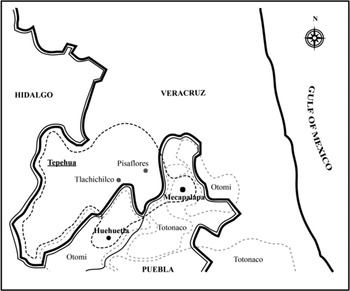
Mecapalapa Tepehua (ISO code: tee) is a language of Mexico that belongs to the Huehuetla branch of the Totonac-Tepehua linguistic family. It is spoken in the town of Mecapalapa, Puebla, Mexico. This linguistic family is composed of the Tepehua and Totonac branches (see MacKay & Trechsel Reference MacKay, Trechsel, Barriga Villanueva and Esther Herrera2014 and references there). The Tepehua branch consists of three main languages and their respective varieties: Pisaflores and Tlachichilco Tepehua are located in Veracruz, and Huehuetla Tepehua is located in Hidalgo and Puebla (see Figure 1). In comparison with Totonac, Tepehua has been poorly studied (see a comprehensive list of references in MacKay & Trechsel Reference MacKay, Trechsel, Paulette and David2012). Representative works include Watters (Reference Watters1988), on Tlachichilco morpho-syntax with a brief phonological survey; Gutiérrez, Jiménez & García (Reference Gutiérrez Morales, Jiménez García and García Ramos2013), on a Tepehua-Spanish vocabulary, which is a vocabulary for the Tepehua variety spoken in Tlachichilco; MacKay & Trechsel (Reference MacKay and Trechsel2013, Reference MacKay and Trechsel2018), providing detailed accounts of the phonological structures of Pisaflores and discussion of previous reconstructions of proto-Totonac-Tepehua sounds; and Kryder (Reference Kryder1987) and Smythe (Reference Smythe Kung2007), offering a detailed description of Huehuetla phonology.
Map showing the location of Pisaflores, Tlachichilco, Huehuetla and Mecapalapa. Continuous lines indicate states limits and dashed lines mark Tepehua and neighboring languages.

Tepehua speakers from Mecapalapa are descendants of migrants who moved from Huehuetla, Hidalgo, in the nineteenth century. Mecapalapa Tepehua (henceforth MT) is an endangered language with only 262 speakers (Morales Reference Morales Lara2008), all of whom are bilingual in Spanish and Tepehua. Linguistically, it is surrounded by Totonac and Otomi speakers.Footnote 1 The data for the present study come from field recordings of two older speakers: a male (aged 79 years) and a female (aged 68 years).
Consonants
The set of contrastive consonants in MT is made up of 21 segments.

The same consonantal inventory is reported for Tlachichilco Tepehua (Watters Reference Watters, Anna, Barbara and Eric1987, Reference Watters1988); however, in Pisaflores the uvular consonant /q/ is missing. MacKay & Trechsel (Reference MacKay and Trechsel2013) postulate that there has been a process of merger with the glottal stop /ʔ/. Smythe (Reference Smythe Kung2007) reports for Huehuetla that /q/ is only used by older speakers, while for younger speakers it has merged entirely with /ʔ/.
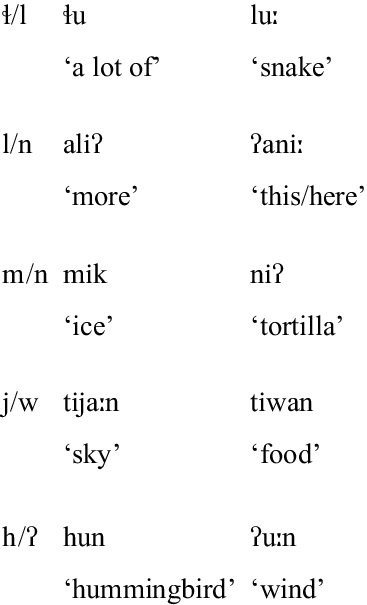
As shown in the chart above, the consonant inventory of MT includes plain and glottalized stops and affricates at five places of articulation, four fricatives, two nasals and two approximants. MT consonants are illustrated (from left to right) in word-initial position with the following minimal and near-minimal pairs:

Plain and glottalized opposition
The plain (i.e. non glottalized) vs. glottalized contrast in MT occurs at the bilabial, alveolar, postalveolar and velar places of articulation; the uvular /q/ is the only stop that does not have a glottalized counterpart.
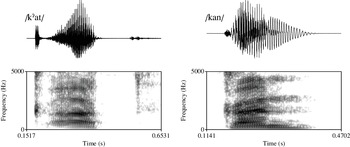
As an example of a prototypical glottalized vs. plain stop, I give the realization of the near-minimal pair /kˀat/ ‘year’ and /kan/ ‘tasty’. Note in Figure 2 that /kˀ/ has a higher amplitude burst and a longer VOT than plain /k/, according to general tendencies (Cho & Ladefoged Reference Cho and Ladefoged1999). In this particular case, burst amplitude in /kˀ/ reaches 70 dB, and the VOT is 48 ms, while in /k/ the burst is only 60 dB and the VOT is 28 ms long.
Waveforms and spectrograms of the contrast /kˀ/ vs. /k/ in /kˀat/ ‘year’ and /kan/ ‘tasty’.

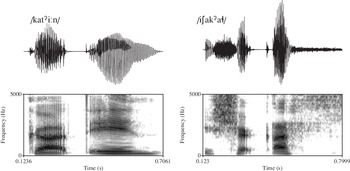
The realization of alveolar /tˀ/ and velar /kˀ/ does not vary appreciably by position. Examples of word-medial glottalized /tˀ/ and /kˀ/ are shown in Figure 3 with /katˀiːn/ ‘to dance’ and /iʃakˀaɬ/ ‘his blood’. Additionally, the glottalized /tˀ kˀ/ causes creakiness in adjacent vowels.
Intervocalic glottalized alveolar /tˀ/ and velar /kˀ/ stops in /katˀiːn/ ‘to dance’ and /iʃakˀaɬ/ ‘his blood’.

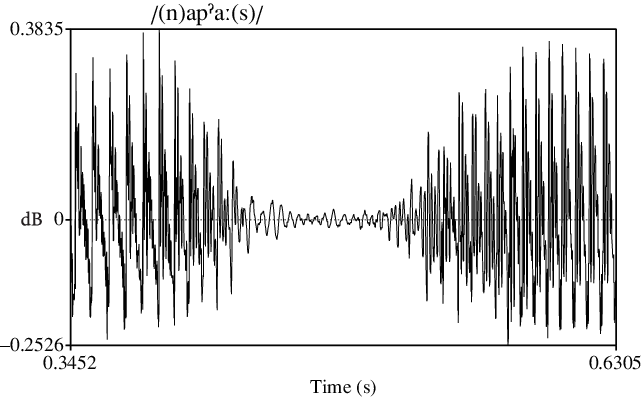
It is worth emphasizing that glottalized plosives with alveolar and velar places of articulation are generally produced as glottalized pulmonic egressives or as ejectives, since MacKay & Trechsel (Reference MacKay and Trechsel2013) state that in the related language Pisaflores Tepehua the three glottalized stops /pˀ tˀ kˀ/ are realized as implosives [ɓ ɗ ɠ]. Though they do not present acoustic evidence, they convincingly argue that this phenomenon occurs in all positions. In my data for MT, there is a change whereby the bilabial /pˀ/ is realized as [b̰], that is, it undergoes a voicing process but retains glottalization. This change only occurs when /pˀ/ is in intervocalic contexts. I do not call it implosion because neither of the two speakers consulted produces a typical implosive in which the voicing amplitude during consonant constriction increases progressively (Lindau Reference Lindau1984; Ladefoged & Maddieson Reference Ladefoged and Maddieson1996: 84; Atta, van de Weijer & Zhu Reference Atta, van de Weijer and Zhu2020: 7). Figure 4 shows the waveform for [ab̰aː] in /na-pˀaːs/ ‘it is hard’; note that there is irregular amplitude throughout the stop, with slight increase at the beginning and end of its closure. The neighboring vowels are also glottalized.
Waveform of [ab̰aː] in /napˀaːs/ ‘it is hard’.

To close this section, I introduce some remarks about the use of ‘glottalized’ for the series of /pˀ tˀ kˀ/, that is, for plosives where oral constriction is followed by glottal articulations. Both the term ‘glottalized’ and the use of the superscript [ˀ] to represent glottalization deviate from the IPA standard usage, where those sounds are called ejective, and are represented by (’). The diacritic [’] following the consonant symbol is meant to refer directly to the airstream mechanisms involved in the production of ejective sounds (i.e. plosives made with an egressive glottalic airstream; see Ladefoged & Maddieson Reference Ladefoged and Maddieson1996: 77–81). In the case of MT, /pˀ tˀ kˀ/ are single segments contrasting with plain plosives /p t k/; second, glottalized series always add creakiness on neighboring vowels [V̰CˀV̰]; third, glottalized stops, /pˀ/ in particular, can undergo voicing in an intervocalic position, but retain their glottalization (i.e. [Vb̰V]), and finally, glottalized series only sometimes constitute ejectives. This suggests that the class of /pˀ tˀ kˀ/ in Tepehua is perhaps better described as glottalized rather than ejective (see Bennett Reference Bennett2016 for a related discussion in Mayan languages). Thus, the use of glottalized diacritic [ˀ] is meant to be unspecified as to the airstream mechanism involved.
Plosives and affricates
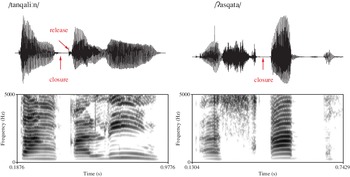
Mecapalapa Tepehua plain plosives contrast five places of articulation: bilabial, alveolar, velar, uvular and glottal. The alveolar and postalveolar regions are reserved for affricates. Among the plosives, two of them present a varied range of realizations; these are the uvular /q/ and the glottal /ʔ/. The uvular can surface as one of the five following realizations: [q q˺ ʡ ᵡqᵡ χ] that is, as a released stop, as a stop with no audible release, as an epiglottal plosive, as a stop flanked on each side by uvular frication, and finally as a plain uvular fricative. As representative examples Figures 5 and 6 give the realizations [q q˺ ʡ]. Figure 5 shows wide-band spectrograms and the acoustic record for the words /tanqaliːn/ ‘basket’ and /ʔasqata/ ‘little boy’. As is shown, in the uvular of ‘basket’ there is a burst after the oral closure, while in ‘little boy’ there is no detectable release. In the case at hand the released uvular presents a VOT of 38 ms. It should be noted that neither the released nor the /q/ with no audible release is context-dependent, as in both cases the uvular occupies the syllabic onset.
Waveforms and spectrograms of released [q] in /tanqaliːn/ ‘basket’ (left) and of [q˺] in /ʔasqata/ ‘little boy’ (right).

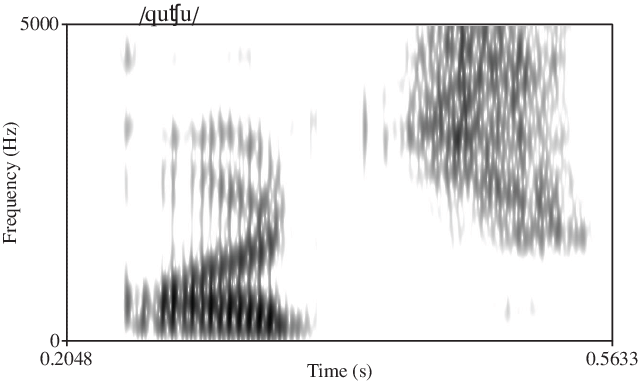
Epiglottal plosive realization of the uvular /q/ in /qutʃu/ ‘throat’.

It should be noted that the previous realizations of the uvular are not systematic, in that one and the same speaker may produce either variant. The epiglottal plosive realization [ʡ] is another instance of free variation of the uvular. While in cases like /qatuʔ/ ‘leg’ the uvular /q/ can be produced as in Figure 5, in words like /qaj/ ‘big’, /quʧu/ ‘throat’ it is realized as an epiglottal plosive: [ʡaj] and [ʡoʧu] respectively. Figure 6 shows an example of the epiglottal plosive for /quʧu/ ‘throat’.
It is clear from this Figure that [ʡ] adds creakiness on the following vowel as commonly do glottal plosive [ʔ]; but in spite of that, [ʡ] and [ʔ] are different. Whereas [ʔ] adds creakiness (see Figure 8 below), the epiglottal plosive realization of /q/ not only causes creakiness but the most important cue is that in the context of [ʡ] high vowels are lowered to mid vowels. This may be attested in /min-quʧu/ → [meɴʡoʧu] ‘your throat’, where both the vowel in min-, and the first vowel of /quʧu/ are lowered to [e] and [o] respectively. Conversely, /ʔ/ does not trigger the lowering process (i.e. [niʔ] ‘tortilla’, [qatuʔ] ‘leg’).
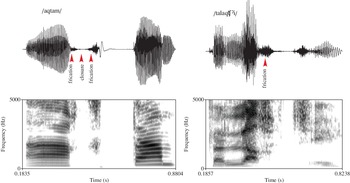
The realizations [ᵡqᵡ χ] are shown in Figure 7 with words /aqtam/ → [ɑᵡqᵡtam] ‘once’ and /talaqʧˀi/ → [talɑχʧˀi] ‘knot’. These realizations are more commonly found when the uvular is followed by a plosive or affricate.
Waveforms and spectrograms of [ᵡqᵡ] in /aqtam/ ‘once’ (left) and [χ] in /talaqtʃˀi/ ‘knot’ (right).

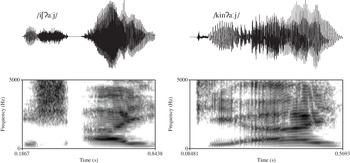
Unlike the uvular, the glottal stop /ʔ/ has two realizations with a clear distribution: when it occurs next to a consonant, (as in CʔV), it is produced as a canonical stop with creaky voice on the adjacent vowel; but between vowels, (as in VʔV), it is realized only as a creaky transition between the vowels, as is common for intervocalic glottal stop across languages (Ladefoged & Maddieson Reference Ladefoged and Maddieson1996: 75). In the first case, there is a clear stop revealing complete occlusion of the airstream, while in the second it is realized without closure. This may be seen in Figure 8 with the realizations of /iʃʔaːj/ ‘her hair’ and /kinʔaːj/ → [kḭa̰ːj] ‘my hair’; these examples consist of possessive affixes /iʃ-/ and /kin-/, third and first persons respectively, prefixed to the base /ʔaːj/ ‘hair’. In ‘my hair’, the elision of the nasal results from a general process (see below).
Waveforms and spectrograms for variable production in the glottal stop.

Fricatives
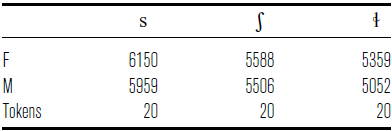
Turning now to the fricative series in MT, the following analysis focuses on the center of gravity of the two strident fricatives /s ʃ/ and the lateral /ɬ/. The glottal fricative /h/ will not be considered because it is quite rare in the corpus. To do so, Fast Fourier Transform (FFT) spectra were generated and measured at the midpoint of the fricative using a 1024-point window and a sampling rate of 22,000 Hz. The center of gravity was calculated using the method outlined in Gordon, Barthmaier & Sands (Reference Gordon, Barthmaier and Sands2002). The center of gravity measurements for MT come from 20 tokens for each fricative and across the two speakers, all the fricatives were in a stressed syllable. Table 1 presents the mean center of gravity values for male and female speakers.
Mean center of gravity frequencies in Hz for female (F) and male (M) speakers.

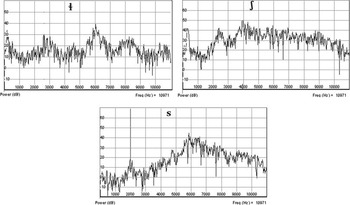
FFT spectra for /ɬ ʃ s/ from female speaker.

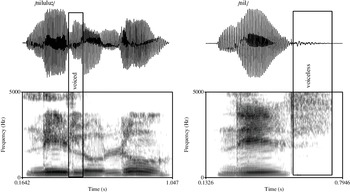
Waveforms and spectrograms for the voiced lateral (left) in /niluluː/ ‘the snake is dead’ and its corresponding voiceless fricative in coda position in /nil/ ‘to die’.

These values indicate that, for both speakers, /s/ exhibits a higher center of gravity, the second-highest values correspond to the /ʃ/ and the lowest center of gravity is shown by the lateral fricative /ɬ/. In strident fricatives, center of gravity correlates with place of articulation, in as much as for /s/ the size of the front cavity is smaller and hence the center of gravity is higher, conversely in /ʃ/ the articulation is located further back, the front cavity is larger and the spectral mean is lower.
In addition to its lowest center of gravity the lateral fricative /ɬ/ is characterized by the flattest distribution of energy in comparison to /s/ or /ʃ/. FFT spectra in Figure 9 illustrate these differences.
For /ɬ/, two spectral frequency peaks occur at around 2500 Hz and around 6000 Hz; for /ʃ/, there is a broad peak starting at 4000 Hz, and an additional peak at about 2500 Hz; and for /s/, the spectral peak frequency occurs at around 6000 Hz.
In this language, /ɬ/ contrasts with the two strident fricatives, /ʃ s/ (e.g. /ɬi/ ‘in the morning’ vs. /ʃiɬ/ ‘mucus’; /ɬkaka/ ‘spicy’ vs. /skakat/ ‘fever’), and it also contrasts with /l/ (e.g. /ɬu/ ‘a lot of’ vs. /luː/ ‘snake’). Nonetheless, /l/ and /ɬ/ only contrast in onset position, as when /l/ is in coda position it becomes [ɬ]; compare [niɬ] ‘to die’ uttered in isolation and in the phrase [niluluː] ‘the snake is dead’ /nil#u-luː/ (to die# the-snake). In Figure 10, it is clear that when /l/ is syllabified as a coda it becomes voiceless and fricative.
The nasal /n/
Mecapalapa Tepehua has two processes affecting the alveolar nasal. When /n/ is followed by a consonant with a different place of articulation, it becomes homorganic with that consonant. The group of consonants that triggers assimilation is /p t k ₦ ʧ/ (whether glottalized or not), and /q/. However, when it is followed by a fricative /s ɬ ʃ/ or one of the segments /m n l w ʔ V/, the nasal is subject to elision. This is illustrated by the realizations of the first-person possessive prefix /kin-/ in the next data. In (a), assimilation gives rise to homorganic sequences, while the cases of (b)–(c) represent two different contexts of elision. Those data also show the change of /a/ → [ɑ̞] and of /i/ → [e] caused by uvular /q/ that will be discussed in a later section in relation to the vowels.
Nasal assimilation/elision


Vowels
Mecapalapa Tepehua has a triangular vowel system containing two high vowels /i u/ and a low vowel /a/; it also has a length distinction in all of them: /iː aː uː/. The three contrastive vowels and the length distinction are illustrated below.

Vowel phonemes


Length distinction

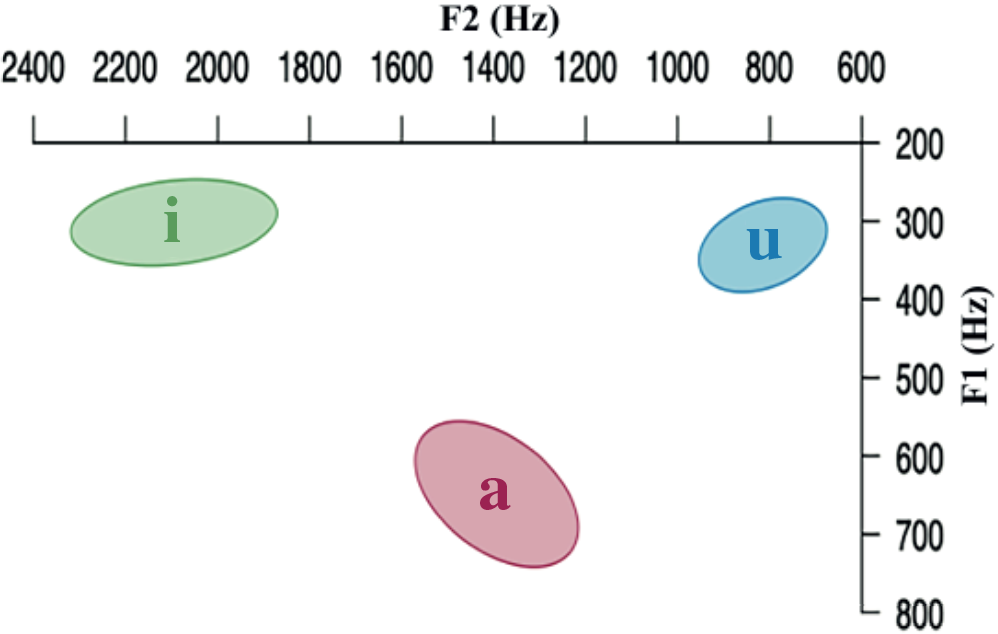
In order to show the acoustic structure of /i a u/, F1 and F2 frequencies were measured in stressed position for long and short vowels. The measurements were made at vowel mid-point using 35 tokens per vowel for the male speaker. Figure 11 displays average values of F1 and F2 plotted in the acoustic vowel space. The ellipses represent one standard deviation around the mean.
Vowels in stressed position (male speaker).

The high front vowel [i] has a mean F1 of 296 Hz and a mean F2 of 2100 Hz; [u] has a mean F1 of 330 Hz and a mean F2 of 815 Hz. The low central vowel [a] has a mean F1 of 648 Hz and a mean F2 of 1396 Hz.
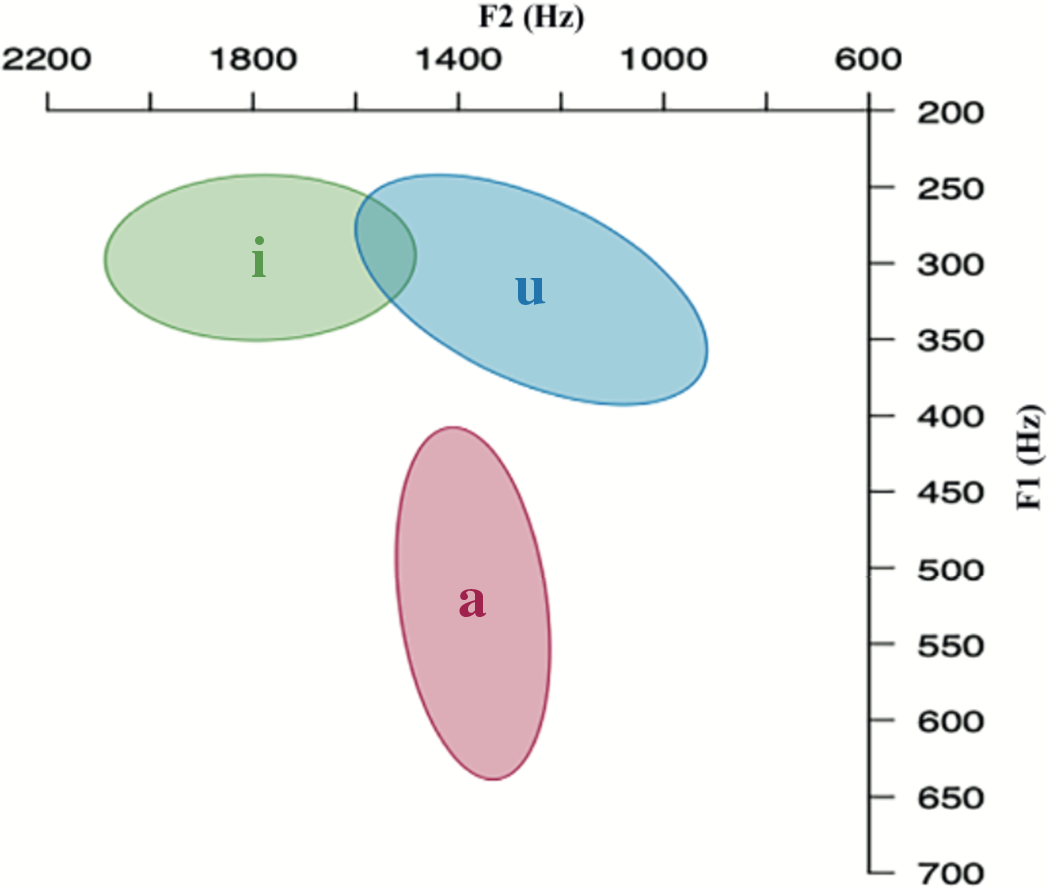
Most variation in vowel quality occurs in unstressed position. Figure 12 illustrates that vowels are more centralized and have wider formant distributions when unstressed.
Vowels in unstressed position (male speaker).

While the relationship between unstressed high vowels is the same as for the stressed position in F1 dimension ([i] = 296 Hz, [u] = 317 Hz), their F2 distribution overlap slightly around 1600 Hz. For the two high vowels the centralization is most pronounced in terms of F2: [i] has a mean F2 value of 1785 Hz, with a range of about 1400 to 2100 Hz; [u] has a mean F2 value of 1258 Hz, with a range of about 800 to 1600 Hz. Therefore, as can be seen on the chart, there is a good deal of overlap between these two high vowels. The low central vowel /a/ varies more in F1, with a mean value of 523 Hz and a range of about 400 Hz to 650 Hz. Given these facts, it is clear that in stressed position, the vowels /i u a/ are uttered on the periphery of the acoustic space and in unstressed position they are more centralized.
Despite the small vowel inventory, MT has a productive process triggered by the uvular consonant /q/ (or homorganic sequence [ɴq] and epiglottal [ʡ]) that gives rise to six phonetic vowels: [i e u o a ɑ̞]. Uvular consonants affect neighboring vowels in two ways. High vowels /i u/ are lowered to mid [e o] and /a/ → [ɑ̞], that is, it is backed and (acoustically) lowered. Those six vowels are in complementary distribution: [e o ɑ̞] occur adjacent to a uvular, whereas [i u a] occur elsewhere. This distribution also applies to Spanish loanwords, for which Spanish /e o/ are adapted into MT with high vowels, as in [pujuʃ], [mantika] and [kasawila], Spanish pollos ‘chicken’, manteca ‘lard’ and cazuela ‘casserole’, respectively. The changes /i u a/→ [e o ɑ̞] are illustrated below with the prefixes /kin-/ and /min-/ (first- and second-person possessive). They show that effects on vowels are both leftward and rightward.
Lowering and retraction of vowels adjacent to uvulars

To motivate the change /u/ → [o] in the stem /quʧu/ ‘throat’ above, I present additional data with the form of the suffix -nVʔ (progressive). This suffix copies its vowel from the base to which it attaches:
/u/ lowering to [o]

In (a)–(c), it surfaces as [-niʔ], [-nuʔ] and [-naʔ] in accordance with the last vowel of the base; in (d) it surfaces as [nuʔ] indicating that, at the phonological level, the last vowel of the base is /u/, which is realized as [o] because it is followed by /q/. This set of examples also shows that [ɑ̞] derived from lowered and retracted /a/ occurs before and after the uvular consonant.
It is important to note that vowel changes triggered by uvular are strictly local: if there is any segment between the targeted vowel and a following vowel, the change takes place only in the first one (i.e. in /qahin/ ‘turtle’, the outcome is [qɑ̞hin] and not * [qɑ̞hen]).
The lowering of high vowels by uvular stops appears to be a common process in Totonac languages (see McFarland Reference McFarland2009 for Filomeno Mata, and Herrera Reference Herrera Zendejas2014 for Papantla), and is pervasive in languages having uvular consonants (see Sylak-Glassman Reference Sylak-Glassman2014). However, in MT the low vowel is not only lowered but it is also retracted by uvular consonants.
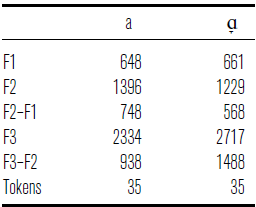
Following Evans et al. (Reference Evans, Sun, Chenhao and Michelle2016: 5) I assume that uvularization in MT lies in formant structure, that is, in the frequencies of the first three formants. Thus, it is expected that retracted and lowered vowels will have raised F1, lowered F2 and increased differences in F3–F2 when compared with non-retracted [a]. Average values of F1, F2, F3; F2–F1 and F3–F2 for these vowels are laid out in Table 2.
Formant values in Hz for [a] and [ɑ̞] for the male speaker.

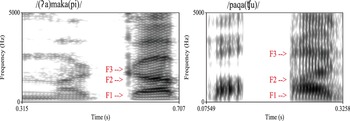
Spectrograms of [maka] in /Ɂamakapi/ ‘throw it!’ and [pɑ̞qɑ̞] in /paqatʃu/ ‘wing’. The arrows highlight F1, F2 and F3 positions.

According to the values in Table 2, F1 in uvularized vowels rises by 13 Hz, and F2 lowers by 167 Hz; the difference in F1–F2 is lower that for the corresponding plain vowel: 748 Hz for [a] and 568 Hz for [ɑ̞]. Finally, F3–F2 is higher for [ɑ̞] than [a] by 550 Hz. The differences between [a] and [ɑ̞] can be seen in Figure 13, corresponding to [maka] in /Ɂamakapi/ ‘throw it!’ and [pɑ̞qɑ̞] in /paqaʧu/ ‘wing’.
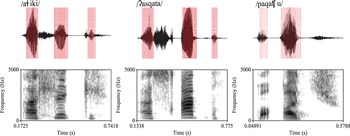
In addition, short vowels in MT are often weakened in word-final position. Besides the fully articulated variant in words like [ɬkaka] ‘spicy’, there are common cases of word-final vowels with various manifestations, ranging from weakly voiced, to devoicing or deletion. For the three short vowels /i a u/ in this context, Figure 14 gives spectrographic evidence.
In [aɬikiʱ] ‘paper sheet’ and [ʔasqa̞taʱ] ‘little boy’, both final vowels start voiced and end voiceless (see also ‘knot’ in Figure 7, ‘throw it!’ and ‘my smooth, flat griddle’). In /paqaʧu/ ‘wing’ the acoustic record does not reveal traces of voicing (see also ‘throat’ in Figure 6), that is the vowel is fully devoiced. It is however also possible to hypothesize a total gestural overlap with the preceding fricative phase of the affricate to such an extent that the vowel is voiceless. However, I cannot confirm that this is what happens; more research is needed to assess this gradient rather than categorial phenomenon in MT.
Word-final vowels in /aɬiki/ ‘paper sheet’ (left), /ʔasqata/ ‘little boy’ (center) and /paqatʃu/ ‘wing’ (right). The glottal pulses are marked in red.

Word stress
Stress is predictable and non-contrastive in MT. It falls on either the penultimate or on the rightmost syllable, being sensitive to syllable weight. Word-final stress occurs if the last syllable is heavy. If this is not the case, penultimate syllables are stressed. Final syllables count as heavy if they have a long vowel or if they have a short vowel closed by a nasal, glide, lateral or glottal stop. Word-final stress and penultimate stress are illustrated below. In the case of ‘red’, recall that /l/ → [ɬ] in coda position.
Stress on word-final syllable

Penultimate stress


Comparing the syllabic structure of words in (a) and (b), word-final obstruent codas do not contribute to syllable weight as they count as light syllables for stress placement.
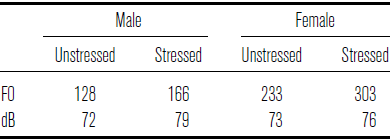
In order to ascertain the phonetic correlates of stress, f0 and intensity were measured for stressed and unstressed syllables. Measurements come from 31 tokens from the Illustration; they were made at the highest f0 and intensity peaks during the vowel. Table 3 shows the mean of f0 (Hz) and intensity (dB) across the two speakers.
F0 values (Hz) and intensity (dB) in unstressed/stressed syllable for male and female speakers.

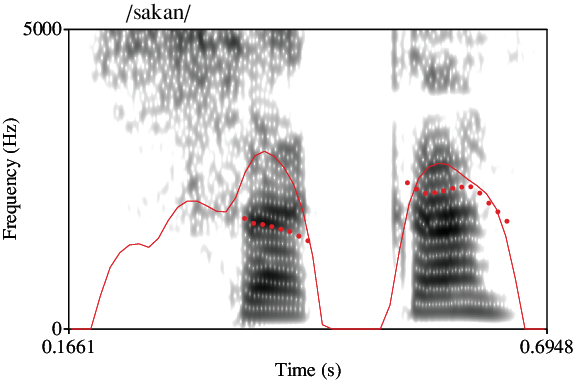
According to these figures, both speakers consistently exhibit higher f0 in stressed syllables; in unstressed position f0 is consistently lower. With regard to intensity, the situation is less clear: while the data for the male speaker show that higher f0 and intensity correlate with stress, for the female speaker the intensity difference between unstressed and stressed syllables is only 3 dB. The similar intensity values for the female speaker’s stressed vs. unstressed syllables could be due to the fact that sometimes (perhaps word-initially) the unstressed syllable is uttered at a higher intensity. Figure 15 illustrates the higher intensity of an unstressed word-initial syllable in [saˈkan] ‘tortilla dough’.
Spectrogram, intensity (solid lines) and f0 contours (dotted lines) for [saˈkan] ‘tortilla dough’, as produced by the female speaker.

F0 peak (dotted lines) coincides, as expected, with the stressed syllable [ˈkan]; on the contrary, the higher intensity peak (solid lines) in the unstressed syllable [sa] reaches 79 dB, and in the stressed one, 77 dB.
Transcription of the recorded passage
The passage corresponds to the MT version of ‘The North Wind and the Sun’ story. I give a phonemic transcription and a free translation in English and Spanish.


English translation
-
1. The wind and the sun were talking to figure out who was the strongest
-
2. Then a man appeared who was wrapped tightly in his clothes
-
3. The wind blew strong, strong
-
4. The stronger the wind blew, the more tightly the man wrapped himself in his clothes
-
5. The wind stopped blowing when he saw that he was not able to do it
-
6. As the wind was not able to do it, the sun shone strongly and the man took off his clothes
-
7. The wind recognized that the sun was the stronger of the two
Spanish translation
-
1. El viento y el sol hablaban para saber quién era el mÁs fuerte
-
2. En ese momento apareció un hombre envuelto y cubierto con su ropa
-
3. El viento sopló fuerte, fuerte
-
4. Mientras mÁs fuerte soplaba el viento, el hombre se envolvía mÁs en la ropa
-
5. El viento, al ver que no podía, dejó de soplar
-
6. Como el viento no pudo, el sol se puso a brillar con fuerza y lo descobijó
-
7. El viento tuvo que reconocer que el sol era el mÁs fuerte.
Acknowledgements
I am deeply indebted to the native Tepehua speakers, Cipriano Huerta Rayon and Juana Benitez Rivera, without whose collaboration this work would not have been possible. I would also thank Ryan Bennett for his invaluable comments. My heartfelt thanks go to the anonymous reviewers and the editors of JIPA; their constructive suggestions greatly improved this Illustration. All errors remain my own responsibility.
Supplementary material
To view supplementary material for this article (including audio files to accompany the language examples), please visit https://doi.org/10.1017/S0025100321000098