INTRODUCTION
Diabetes mellitus is a chronic and progressive metabolic disorder. It is becoming more common; the prevalence of diabetes in the UK increased from 2.8% in 1996 to 4.3% in 2005 and there are now over 2 million people diagnosed in the UK (Diabetes UK, 2007; Gonzalez et al. Reference Gonzalez, Johansson, Wallander and Rodriguez2009). Most importantly it is associated with significant morbidity and mortality, with the leading cause of death (estimated at 80% of patients that will die prematurely) due to cardiovascular disease (Diabetes UK, 2007; Brown et al. Reference Brown, Inskip and Barraclough2000). Diabetes is also a risk factor for cerebro-vascular disease (Fowler, Reference Fowler2008). Other long-term complications include retinopathy (eye disease sometimes leading to blindness), nephropathy (kidney damage sometimes requiring dialysis or transplantation) and peripheral arterial disease (atherosclerotic occlusion of the lower extremities complicated further by neuropathy (nerve damage) that can contribute to foot ulceration and amputation) (National Institute for Clinical Excellence, 2008; American Diabetes Association, 2003).
Diabetes is a disorder characterised by hyperglycaemia, caused either by an inherited or acquired deficiency in the production of insulin by the pancreas, or by insulin resistance (thus inability of the body cells to utilise insulin efficiently). Type I diabetes is triggered by a lack of insulin production with the diagnosis usually made in childhood (National Institute for Clinical Excellence, 2004). Type II diabetes is caused by either an insufficient insulin production in relation to the body’s needs, or insulin resistance. Type II diabetes is by far the most common type, accounting for around 85% of cases (National Heart Forum, unpub. report, 2006). Risk factors for the development of type II diabetes include advancing age, family history, low activity levels, poor diet and excess body weight.
People with severe mental illness are at an increased risk of physical health problems and related mortality (Harris & Barraclough, Reference Harris and Barraclough1998; Makikyro et al. Reference Makikyro, Karvonen, Hakko, Nieminen, Joukamaa, Isohanni, Jones and Jarvelin1998) and crucially find it harder to access good quality medical care. Patients with schizophrenia in particular have an increased prevalence of type II diabetes compared to the general population through a variety of mechanisms (Holt, Reference Holt2004; Bushe & Holt, Reference Bushe and Holt2004). Patients with severe mental illness tend to make poor dietary choices, smoke, be overweight and physically inactive (McCreadie, Reference McCreadie2003). People with schizophrenia have a 2–3 fold increased risk of metabolic syndrome, characterised by central obesity, hypertension, dyslipidaemia and glucose intolerance (Holt, Reference Holt2006). Research evidence also suggests that schizophrenia and bipolar disorder are themselves independent risk factors for the development of diabetes (Citrome et al, Reference Citrome, Blonde and Damatarca2005; Gough & Peveler, Reference Gough and Peveler2004). Furthermore, treatment with the atypical second generation antipsychotic medications in particular is associated with further weight gain and hyperglycaemia (Llorente & Urrutia, Reference Llorente and Urrutia2006; Citrome et al. Reference Citrome, Jaffe, Levine, Allingham and Robinson2004). Poor insight, a common feature in severe mental illness and part of the neuro-cognitive deficit, is often associated with poor adherence to treatment and surveillance strategies (Amador & David, Reference Amador and David2004; Aleman et al, Reference Aleman, Agrawal, Morgan and David2006). This in itself will have significant implications for clinic attendance rates and monitoring of diabetes. Mental health staff may not feel sufficiently confident to assertively manage these particular challenges.
The National Institute for Health and Clinical Excellence (NICE) initially published guidance on the management of type II diabetes in February 2002, updated in May 2008. There is a separate guidance for type I diabetes published in July 2004. Key recommendations included patient education at time of diagnosis with annual reinforcement and review, individualised dietary advice from a healthcare professional with specific expertise and competencies in nutrition, setting a target HbA1c involving the person in the decision (nationally set target is 6.5%), offering plasma-glucose self-monitoring, and specific guidance on clinical management (e.g. starting insulin therapy, lipid and blood pressure management, anti-thrombotic therapy, kidney damage, eye screening and neuropathic pain management).
In August 2008, the Department of Health published a document setting further specific national standards for the care of people with diabetes (Department of Health, 2008). These mainly focussed on the identification and prevention of diabetes, patient involvement in decision-making and clinical care standards including the management of emergencies and long-term complications.
AIMS OF THE STUDY
The aims of the audit were firstly to determine the proportion of patients with a diagnosis of diabetes in specialist secure psychiatric care, and secondly to establish in those identified, the proportion of patients with an individual diabetic care plan specifically aimed at the management of diabetes that conformed to NICE/national standards. Finally, we wanted to establish what the prevailing current practice for diabetes management was within the hospital, and clarify the role of the psychiatric medical team versus the on-site general practitioner and diabetes specialist nurse.
METHOD
The audit was conducted at St Andrew’s Healthcare, within a large independent charitable psychiatric hospital offering a national service of specialist secure and rehabilitation services for men, women, adolescents, and older people with challenging behaviour. Patient diagnostic groups primarily included mental illness, learning disability, acquired brain injury and neurodegenerative disorders. Besides comprehensive multidisciplinary management of relevant mental health disorders, there is a full time on site primary care physician practice to which all the inpatients have access. The practice consists of three part-time general practitioners, two full-time practice nurses and one full-time healthcare assistant.
The audit was conducted across the hospital, divided in two phases between August 2009 and September 2009. Consent to review confidential patient data was obtained from the responsible clinicians via email.
Phase one consisted of obtaining the current up-to-date hospital on-site GP practice register of all the known inpatients at St Andrew’s with diabetes between May 2009 and September 2009. These lists were cross-referenced with information gathered from visiting the wards and having interviews with senior nursing staff on every relevant inpatient ward. Information of current practice for diabetes management within the hospital was obtained from an interview with the senior GP practice specialist diabetic nurse. An audit tool was devised based on current up-to-date national guidelines (National Institute for Clinical Excellence, 2008; NHS, 2009).
The second phase consisted of data collection using all available sources of information (electronic (RiO) patient records, care plans, hospital wide risk assessment and management documents, RiO GP notes and ward documents including active administrative patient paper notes, nursing care plans, drug prescription charts and blood results), augmented by informal discussion with the relevant nursing staff. Finally, the responsible clinicians and/or associate specialists provided any further missing information unavailable through the above methods.
From the electronic and paper notes we identified patient demographic details, details of the extent of any specific individual diabetic care plans, and relevant investigations including details of blood tests done in the last six months such as plasma-glucose and HbA1c.
RESULTS
Demographic, legal and clinical characteristics of patients
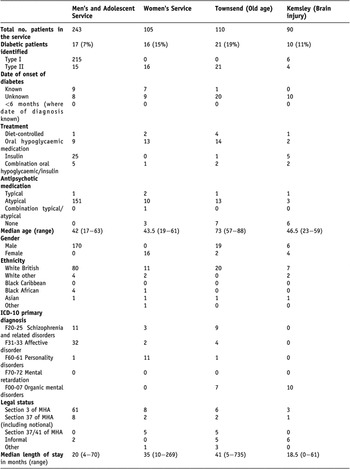
Data for the audit was collected between August 2009 and September 2009. We identified 64/548 (11.7%) known diabetic patients (Table 1). Two patients known to have diabetes were not on the GP register. Two patients from the GP practice register were excluded as they had either been discharged from St Andrew’s or had died.
Demographic, legal and clinical details of patients studied

Clinical management

The majority of patients were in the older person’s, men’s and women’s services. There was only one adolescent service patient. The median length of stay was 30.5 months (2.5 years). The majority of patients were detained under the Mental Health Act 1983 (53 of 64; 83%). The most common diagnoses varied according to the patients’ service.
All patients had had a diabetic diagnosis for more than 6 months. Only 8 of 64 (12.5%) patients were diet-controlled, with the majority of patients either on an oral hypoglycaemic agent (38 of 64; 59%), insulin (8 of 64; 12.5%) or a combination of both (10 of 64; 16%).
Of those identified in the study, 48 of 64 (75%) were on either a typical first (5 of 64; 8%), or atypical second generation (41 of 64; 64%) antipsychotic medication or a combination of both (2 of 64; 3%). Of those on second generation antipsychotic medication, the majority were on clozapine (mainly derived from the men’s service), followed closely by olanzapine, quetiapine, risperidone, and aripiprazole, with the remaining patients on a combination of two second generation medications. The most favoured combination of second generation antipsychotic medication was olanzapine and quetiapine.
Clinical management of diabetes
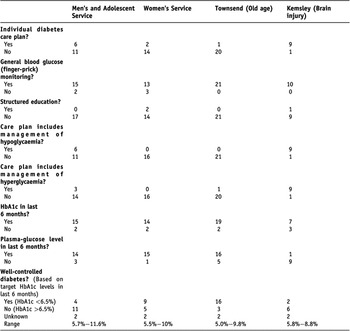
Despite being on the register and being known to have diabetes, 18 out of 64 (28%) patients had an individual care plan to address their diabetic management and risk. Three (17%) of these patients had a care plan that included structured education related to diabetes, its management and complications. Just under three quarters of patients (13 of 18) had a care plan that included the management of hyperglycaemia, and the majority of patients (15 of 18) had a care plan that included the management of hypoglycaemia.
The majority of patients had an HbA1c (55 of 64; 86%) and a plasma-glucose (46 of 64; 72%) recorded in the last 6 months before the audit. HbA1c levels across the various services ranged from 5% to 12%.
DISCUSSION
Patients in our audit represented a diverse and unique group, the majority long-stay psychiatric inpatients with severe mental illness and challenging behaviour in a specialist secure setting. Our audit findings showed an over-representation of diabetes compared to the general population, in line with previous findings of an increased prevalence of type II diabetes in patients with severe mental illness (Holt, Reference Holt2004; Gough & Peveler, Reference Gough and Peveler2004).
A cross-sectional survey of physical health in long-stay psychiatric patients previously highlighted serious concerns about avoidable health risks, recognising the need for provision of primary care services and health promotion in this population (Cormac et al. Reference Cormac, Rerriter, Benning and Saul2005).
St Andrew’s Hospital has an on-site GP practice with a dedicated specialist diabetic service responsible for the physical health management of patients with diabetes. This is a well-resourced service with medical and nursing input. Additionally the ward based associate specialists (psychiatrists) are responsible for the day-to-day management of the patients’ physical health matters on the ward.
The diabetic register is a comprehensive record of those patients in the hospital with diabetes. It is held within the practice and updated six monthly. Every patient with a diagnosis of diabetes is offered a 3–6 monthly diabetic review (glycaemic control and medication review) by the GP practice nurse as well as an annual diabetic review (additional multi- system screening).
Despite this we found that while the majority of patients had regular blood glucose and HbA1c monitoring, a small proportion of patients had a comprehensive care plan to address the needs of this complex and debilitating illness. Diabetic control was in some instances at best only acceptable based on the nationally set target for HbA1c at 6.5%. Many patients had not been offered the opportunity for regular structured education sessions, regular feedback about their own management, and did not have care plans around common and potentially life threatening complications.
The management of diabetes symptom control and its complications in people with severe mental illness bring significant and specific challenges. These include consideration of treatment choice in the review of psychotropic medication as these can potentially adversely affect glycaemic control, the patient’s capacity to make decisions relating to their diabetic management and patient adherence to diabetes-related interventions.
People with severe mental illness may have poor knowledge about the nature and management of diabetes (Dickerson et al. Reference Dickerson, Goldberg, Brown, Kreyenbuhl, Wohlheiter, Fang, Medoff and Dixon2005). Improving patients’ knowledge about diabetes and its management improves glycaemic control and overall patient outcomes (Koev et al. Reference Koev, Tankova and Kozlovski2003; Iqbal et al. Reference Iqbal, Morgan, Maksoud and Idris2008; Renders et al. Reference Renders, Valk, Griffin, Wagner, Eijk and Assendelft2001). Identifying diabetes care issues is important in order to make positive and sustained changes to service provision. A study by Kaholokula et al. (2004) identified, in a psychiatric inpatient setting, that lack of knowledge of diabetes care by both staff and patients, lack of training in diabetes care amongst staff and poor communication between mental health disciplines were barriers to diabetes care. Although the on-site GP practice tends to manage follow-up and longer-term care, the overall clinical care and management of diabetic patients was identified as a collaborative responsibility between the multi-disciplinary team and the GP practice. In order to facilitate better communication between the ward-based teams and the GP practice, we set out to implement individual diabetic care plans with input from the diabetes specialist nurse and dieticians, and the provision of an annual review summary to all relevant psychiatrists generated from the GP practice.
An additional barrier to diabetes care includes poor patient attendance rates at GP appointments. A community-based population study highlighted poor attendance rates of only 32% at family physician appointments despite telephone reminders (Shandro et al. Reference Shandro, Pick, Gruinger and Ryan2002). The reasons for such poor attendance are not entirely clear, although may be attributable to poor communication, facilitating patient leave, ward requirements and patient refusal.
Our audit highlighted the need for patients to have individual diabetic care plans, the implementation of structured education and empowering sessions to encourage and support patients to take collaborative responsibility for their diabetes care where possible. Communication between ward-based multidisciplinary teams and the GP practice nurse is an essential feature of good clinical diabetes management. Local audit can be used to identify and correct problems in relation to diabetes care. Other units may need to audit their own practice in order to improve local service provision.