In 2008, Malama Khadija Gambo Hawaja, arguably the most prominent Muslim female scholar in Jos, Nigeria, was invited to give a lecture at the graduation ceremony of Nigerian army officers. It was one of the occasions to which Khadija is usually invited. Khadija gave her lecture successfully. After she finished, a male scholar stood up, took the microphone, and addressed the organizers and the audience. He told them how disappointed he was that a woman had been invited to address men. After he had finished, Khadija asked for permission to respond, which was granted. She said, ‘I don’t know if this is a traditional event where cultures are expected to be strengthened. Allow me to remind you of a very important historical event. After the Prophet’s migration, a woman named Asmaʾ bint Yazid al-Ansari went to the Prophet as an emissary of a group of women. Asmaʾ addressed the Prophet and his companions. She was a woman; they were men and better than you. If Asmaʾ could do it, why can’t I?’
Writing about three established Muslim female scholars in Niger, a neighbouring country that shares many similarities with Nigeria, Abdoulaye Sounaye (Reference Sounaye2011) argues that women’s interference in previously male-dominated public spheres has changed traditional ways of constructing authority in many African Muslim societies. ‘Through preaching and the media, many women have stepped into the public sphere and become one of the most visible markers of modern Islam, changing the appropriation of religion and interactions within the Islamic sphere.’ These developments, Sounaye continues, show that women, as (new) ‘critical players in the changing knowledge economy, have also become social entrepreneurs, redefining the practice of Islamic learning, articulating sociopolitical agendas, and consolidating women’s presence in the religious arena, especially in urban areas’ (ibid.: 253).
Much has been written about the changing role of Muslim women in West African societies (Frede and Hill Reference Frede and Hill2014; Hill Reference Hill2018; LeBlanc Reference LeBlanc, Fourchard, Goerg and Gomez-Perez2009; Augis Reference Augis and Gomez-Perez2005; Callaway and Creevey Reference Callaway and Creevey1994; Coquery-Vidrovitch Reference Coquery-Vidrovitch1997; Gemmeke Reference Gemmeke2009; Madore Reference Madore2020). These changes, caused by democratization, media, Islamic and political reforms (Masquelier Reference Masquelier2009; Schulz Reference Schulz2008; Alidou Reference Alidou2005), have given women an opportunity to take up public spaces, use their agency in bringing in a woman’s dimension and come up with new modes of religiosity and morality. However, Africanist scholars have shown how these developments have been perceived both as welcomed by some (Hill Reference Hill2018) and as intrusive by others (Sounaye Reference Sounaye2011; Alidou Reference Alidou2005; Muazu Reference Muazu2019).
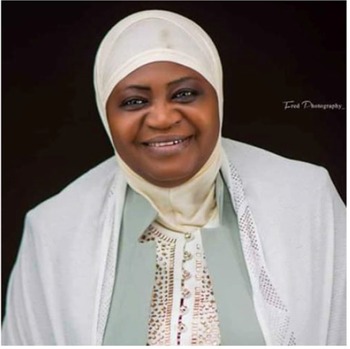
The two women I present here, Malama Khadija Gambo Hawaja (Figure 1) and Malama Dr Zahrau Muhammad Umar (Figure 2), are public preachers and have been leading female actors in the daʿwa (preaching) field for at least two decades. They use their cultural and social capital, extensive Islamic knowledge and oratory skills to proselytize, and, like their counterparts in other African countries such as Côte d’Ivoire (LeBlanc Reference LeBlanc, Fourchard, Goerg and Gomez-Perez2009; Madore Reference Madore2020), Senegal (Hill Reference Hill2018; Buggenhagen Reference Buggenhagen, Diouf and Leichtman2009; Reference Buggenhagen2012), Burkina Faso (Gomez-Perez Reference Gomez-Perez1991), Mauritania (Frede Reference Frede2014) and Niger (Sounaye Reference Sounaye2011), among many others, they contribute to the rising number of women in proselytization and Islamic knowledge production. In addition, they interpret the Qurʾan and issue fatwas, strengthening women’s presence in the religious public sphere. However, this presence is not without contention, as the increased visibility of women has led to scholarly debates about the status of the female voice, prompting many to ask, ‘Is the female voice not ʿawra [Arabic: nakedness or nudity]?’ (Muazu Reference Muazu2019). Against this backdrop, this article focuses not on the visibility of the female body, which has received significant scholarly attention (Mahdi Reference Mahdi, Diagne and Umar2008; Glapka Reference Glapka2018; Wilhelm etal. Reference Wilhelm, Hartmann, Becker, Kişi, Waldorf and Vocks2018), but on the visible audibility of the female voice. Building on Sounaye’s work, I argue that through the public usage of their voices, women are now becoming the new makers of contemporary Islam.
Khadija Gambo Hawaja. Source: <https://kadunapeacecommission.org/staff/khadijah-hawaja-gambo/>. Republished with permission.

Although scholars have written on HausaFootnote 1 Muslim women, on themes such as identity (Haour and Rossi Reference Haour and Rossi2010), socialization (Callaway Reference Callaway1984; Barkow Reference Barkow1972), education (Danfulani Reference Danfulani2013) and modernity (Alidou Reference Alidou2005), except for a few works (for instance, Hill Reference Hill2018; Muazu Reference Muazu and Owete2014; Reference Muazu2019), the role of the female voice in the religious sphere has been ignored. The Muslim legal positions on the female voice and the debates on whether a woman’s voice constitutes part of her ʿawra have become essential in determining what religious and social roles Muslim women can play in public spaces. At present, they provide a window through which to study the social positions of Hausa Muslim women in northern Nigeria and thus reveal not only how norms are regulated but also how they sometimes conflict (Muazu Reference Muazu2019). Whether a Muslim woman can recite the Qurʾan publicly, sing ‘ḥalāl’ songs, call to (adhān) or lead women in prayer, work in a radio station, give public lectures, or even answer telephone calls all depends on how the voice is understood (ibid.). Given the relevance of the human voice to women and human beings in general, the issue of ‘vocal nudity’ becomes very significant.
The term ‘vocal nudity’ is used here to refer to the perception of the female voice as part of her ʿawra or as something that is not ‘supposed to be too exposed’ based on cultural and religious understandings. Contrary to other Muslim majority countries – such as Senegal, for instance (see Hill Reference Hill2018) – the public presence of the female voice in Hausa Muslim society has always been an object of attention, concern and dispute, not only in religious contexts but also in non-religious ones (Muazu Reference Muazu2019). In northern Nigeria, the female voice is culturally taken as a measure of a woman’s dignity, femininity and suitability for marriage, all of which are gauged by how she speaks and to whom. On the one hand, a woman who talks loudly in public spaces such as markets is considered unchaste and lacking in dignity. On the other hand, according to the ideals of femininity, a girl is expected to learn how to speak softly, slowly and in a lowered ‘feminine’ voice in her journey towards womanhood. To a suitor, her voice should be tantalizing – and, of course, it should remain so when she moves to her marital home.
In the religious sphere, there are at present two contradictory trends. The first is the increasing spread of the female voice in religious activities, as in Qurʾan recitations and qaṣīda (laudatory) songs; the second is a rising perception of the female voice as part of a woman’s nudity. This perception, especially in recent decades, arises from the growth in public Qurʾan recitation competitions, which, among other things, has triggered debates on ‘proper religious practice’ and on female roles and behaviour in society in general (Muazu Reference Muazu2012; Reference Muazu2019). The debate on vocal nudity among Muslims in Nigeria came to the fore when Izala,Footnote 2 a Muslim organization with millions of followers in Nigeria and neighbouring countries, banned its female members from participating in national Qurʾan competitions. Although the reasons Izala cited were not restricted to the position of the female voice, the popular argument, which resonates with ordinary Muslims, is that the female voice is ʿawra and should not be publicized (Muazu Reference Muazu2019). Another reason for seeing the female voice as ʿawra is that women are not allowed to participate in the Saudi international Qurʾan recitation competitions at which male Nigerian Qurʾan reciters invariably excel.
Hill’s work (Reference Hill and Hirji2019) centres on how Muslim women in the Senegalese Sufi community occupy important positions of religious authority without contestation. The sikkarkats who perform the Sufi chant do it publicly to a mixed-gender audience, and the female spiritual leaders (muqaddamas) issue tarbiya (spiritual training) to both men and women with little dispute. However, despite what seems to be a lack of controversy, we see the women navigating their positions carefully, taking subservient positions in ‘performances of wrapped piety’ (ibid.: 205) to carefully demonstrate a ‘reserved feminine piety’ (ibid.: 221). We see Sayyida Seynabou and Aïde Faye, for instance, ‘engaged in many rituals of deference and self-effacement and dissociating themselves from the act of making their voices heard’ (ibid.: 204), as in the case of the former designating someone else the ‘animator’ of her words and the latter presenting her physical form as the ‘animator’ while suggesting through her vacant expression that she was not the ‘author of this act of chanting, which she did through a shy-sounding voice’ (ibid.: 204). Both dissociated themselves while they navigated between assertiveness and restraint.
Although this behaviour could be interpreted as modesty rather than subordination, special attention should be paid to these ‘silent’ aspects of the interplay between assertiveness and restraint, for men in similar situations would hardly refuse to be the authors of their own voices. While these women are often seen as strong personalities and their performances seem to go unchallenged, I argue that these acts of restraint are ways in which the public presence of their voices is tacitly challenged. Women’s cautiousness through shyness, bowing down, or giving careful and calculated credit to their husbands (see Malama Zahrau’s examples in her BBC interview below) might be a way in which they are submissively asking for permission to go public or are avoiding escalating the tacit disapproval. The lack of such ‘diplomatic’ acts by women in the Nigerian cases has often led to disputes both publicly and domestically.
Kersa, the Senegalese version of the Hausa term kunya, means restraint or shame; this is expected of both men and women, but more so of the latter. As Hill rightly points out, kersa is not accidental or an innate quality, but something carefully cultivated from an early age. Just as women learn to ‘wrap’ their bodily form, they learn to ‘wrap’ their voices and presence (Hill Reference Hill2018: 205). Importantly, kunya in the Nigerian context (I will return to this aspect later) discursively constructs the female voice as a cultural category, especially in religious circles. Just as the practice of the kersa norm in Senegal often causes women not to address the public at all, so does kunya, due to commonly held notions of ʿawra and Hausa customs.
Similarly, Sounaye (Reference Sounaye2011) shows how the three women preachers he focused on assume positions of religious authority; through public channels such as television, radio and Islamic schools, they are redefining the practice of Islamic learning and becoming Islam’s most visible representatives. Although these women are allowed to speak publicly, it is important to note that the public presence of their voices is sometimes silently – if not publicly – contested as well. For instance, Malama Huda, the prominent preacher who for years was the only woman preaching in the national media, seemed to gain more prominence when she became involved in the controversy surrounding the ratification of a law that was supposed to ‘give more rights to Muslim women’, arguing in the wake of public interest that Muslim women needed only shariʿa rights. In the case of Malama Zahra, the youngest of the three, she chooses not to discuss or speak up against child marriage – something from which she successfully emerged – as a problem that could lead to women’s lack of advancement, most likely due to public sympathy for the cultural practice or public discomfort surrounding the topic.
This is not to downplay the role of pious women who seek to elevate shariʿa rights over secular rights or over what is perceived as Western propaganda, but my familiarity with the nuances and power relations makes me see the matter differently. As someone with experience in the field of women’s preaching, I could easily identify some of these instances as moments when women must carefully balance assertiveness, restraint and the kind of debate in which they engage so as not to draw too much attention or controversy to their visibility and audibility, even if they sometimes ‘cross the line’ – as the example of Malama Zahra’s controversial involvement in the family planning debate illustrates (Sounaye Reference Sounaye2011: 541–2).
It is important to briefly mention that debates about vocal nudity are not restricted to Islam. Other religions, particularly the Abrahamic ones, also have things to say about the female voice. For example, in the Jewish tradition, there have been discussions on whether women can sing, raise their voices in song, in what context, and in whose presence. The voice of a woman (kol isha – or, more appropriately, kol b’isha) should not be raised in solos or in female choirs when singing in the presence of men. While someone’s wife is ervah (ʿawra), her hair, finger, thigh and voice are all ervah and could arouse a man and lead to forbidden relations (Borts Reference Borts2021). Quite apart from what is permitted within the Jewish tradition, in the Christian tradition the Bible stipulates that women in the congregation should remain silent in church. ‘They are not allowed to speak, but must be in submission’ – and if they want to ask about something, ‘they should ask their husbands at home, for it is disgraceful for a woman to speak in the church’ (1 Corinthians 14.33–35; 1 Timothy 2.11–14).
The Qurʾanic command relating to the female voice seems closer to the one in the Talmud than to the biblical one cited above (1 Timothy 2.11–14). It neither asks women to remain quiet nor is it associated with Eve being deceived and a sinner (Qurʾan 20.121; 2.36). Although the Qurʾan does not explicitly associate the female voice with a woman’s nudity, one verse (33.32), which refers to the wives of the Prophet Muhammad, entreats them not to be soft-spoken; otherwise, he who has a disease in his heart might succumb to temptation. This verse has set a precedent for varying and conflicting positions on the female voice as ʿawra.
Translations of the Arabic word ʿawra include nakedness, genital organs, loins, private parts, genitalia, genitals and pudenda, as well as a flaw, blemish and defect (Krawietz Reference Krawietz, Fleet, Krämer, Matringe, Nawas and Rowson2018). Under Islamic law, the term has been used to refer to a part of the body of a male, female or child, or even a former slave, that should not be exposed to those who should not see it (al-Falah Reference al-Falah1993: 17). In the Qurʾan, ʿawra appears differently and in different contexts – from private parts (Qurʾan 24.31) to times of privacy (Qurʾan 24.58) and spaces of vulnerability (Qurʾan 33.13). Other parts of the Qurʾan (for example, 7.26) use the term sawʾa instead of ʿawra and make a direct connection between covering the ʿawra and piety (taqwā), referring to both as forms of clothing. Several hadiths refer to ʿawra in terms of prohibiting a man from looking at the ʿawra of another man and a woman from looking at the ʿawra of another woman (Muslim 2010: 30). ʿAwra can be revealed only to ‘one’s spouse or what one’s right hand possesses, even when one is alone, Allah is more entitled to be shy of Him than the people’ (al-Sabuni Reference al-Sabuni1981: 143).
In this article, I consider a female understanding of vocal nudity and the female presence in Nigerian public spaces. Although the article is structured around two female preachers, I have based it on participant observation and more than a hundred interviews conducted throughout the last decade. As a Qurʾan reciter myself, for many years I took part in public state and national Qurʾan recitation competitions as a representative of my state (Plateau) and the Izala Muslim group before it put an end to female public national recitations. I have also regularly taken part in the tafsīr (Qurʾan interpretation) sessions, either by delivering them myself in some years or as part of the audience in others. As a researcher, I have been interviewing female preachers since 2011 in the cities of Kano, where Malama Zahrau is based, and Jos, where Malama Khadija performs many of her preaching activities. Jos, a relatively small city compared with Kano, is where I was born and raised. Founded in the early twentieth century as an economic mining base for the British, Jos is the capital of Plateau, one of Nigeria’s thirty-six states. Jos has been the headquarters of Izala since its founding in 1978.
On the other hand, Kano is a large, predominantly Muslim state with more than twenty million inhabitants, with a centuries-old tradition of Islamic learning and home to the Sufi order: the Qadiriyya and the Tijaniyya. It has been a historic site of numerous kingdoms and empires and was the largest and most prosperous province of the Sokoto Islamic caliphate and among the twelve northern Nigerian states that re-implemented the shariʿa in 1999.
Malama Khadija and Malama Zahrau, who present Ramadan tafsīr (Qurʾanic interpretation; Hausa: tafsīrin Azumi) to the public, rose to prominence through the publicity generated by the audio and video sessions and fatwas they offer to women. In the following section, I look at the Ramadan tafsīr sessions, where women are given a space in which to listen to fellow women recite, translate, interpret the Qurʾan and issue fatwas, which add to the body of (in this case oral) literature on the female interpretation of the Qurʾan around the globe. I then introduce Malama Khadija and Dr Zahrau, situating them in their respective milieux. While I highlight their relevance as crucial players in the production of Islamic knowledge, I discuss how they navigate the challenges of the perception of their voices as nudity and discuss their interpretation of Qurʾanic verse 33.32. In the concluding part, I examine the implications of the various understandings of the female voice for women and society in general. Finally, as Malama Khadija and Malama Zahrau take up public spaces, I show how, despite resistance, their voices are shaping contemporary Islam.
The cases of Malama Khadija and Malama Zahrau are two similar examples of what Hill sees as the ‘eruption of the female voice’ (Reference Hill2018: 193) in his description of the Senegalese women’s leadership. By choosing to ‘unwrap’ their voices and by taking public roles as scholars and muftis, they are redefining the concept of mace ta gari (Hausa: righteous woman) in twenty-first-century Muslim West Africa and inspiring others to do the same. Thus, mace ta gari, which was generally understood as God-fearing but quiet and submissive, is now portrayed by these two female religious leaders as God-fearing but very vocal and assertive.
Public Ramadan tafsīr
In the last few decades, Ramadan tafsīr where male scholars and preachers recite and translate the Arabic Qurʾan into local languages has gained popularity in northern Nigeria and, subsequently, throughout Muslim West Africa. Its popularity is evident in the number of Muslim satellite TV stations broadcasting these programmes – Sunnah TV, Mannar TV, al-Wisal (Nigeria), Hausa 7 (Cameroon), Ghana Hausa TV, Bonferey TV (Niger) and Africa TV3 – and its presence on social media platforms such as Facebook, YouTube and WhatsApp, all of which attract a large following across the Hausa-speaking world. In Nigeria, these are slowly giving way to female tafsīr circles. In addition, as more and more women are becoming involved in higher institutions of Islamic learning, many are starting female-only tafsīr circles. These, like those of the men, attract large gatherings of women and are often broadcast on radio, television and social media platforms.
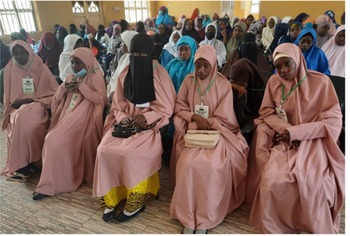
During Ramadan, hundreds of women gather each morning to listen to a female reciter and to another female translate and interpret the recited verses into Hausa and other languages (Figure 2). These programmes not only give them a new public venue in which to listen to female voices of recitation, but it also enables them to translate and interpret the Qurʾan from a female perspective and to join the growing circle of Muslim women who are interpreting the Qurʾan in different parts of the world. Scholarly works in Islamic feminism have focused on the struggle for full equality between women and men in the personal and public spheres. These studies, which are anchored in the discourse of Islam – especially its sacred text, the Qurʾan – have investigated the historical roots of women’s oppression (Ahmed Reference Ahmed1992), attempted to reinterpret the Qurʾan from a woman’s perspective (Wadud Reference Wadud1999; Reference Wadud1996; Barlas Reference Barlas2002), challenged ethnocentric presentations of Muslim women (Mernissi Reference Mernissi1985; Reference Mernissi and Lakeland1992), and mounted a detailed critique of patriarchy (Ahmed Reference Ahmed1992; Badran Reference Badran2008; Barlas Reference Barlas2002; Wadud Reference Wadud1996).
Female audience listening to Qurʾan recitation at a public competition in Abuja in 2021. Source: Nura Bello Alkali. Republished with permission.

The Hausa women’s interpretation of the Qurʾan during Ramadan linked their attempts to those of the scholarly works cited above, albeit in a purely oral form. In addition, it gave rise to two forms of interpretation. The first underpins what male scholars and preachers have said either about reinforcing traditional female roles or pushing for more women’s rights within the paradigm of Islam, which few scholars pursue.Footnote 3 As in the case of Malama Khadija discussed below, the second involves women pushing even harder to redefine Hausa Muslim women’s roles in the twenty-first century and the concept of mace ta gari. In reconceptualizing mace ta gari, gender issues relating to wives’ rights over their husbands are discussed, as well as women’s education, work, family and the female voice, focusing on Qurʾanic verse 33.32.
Verse 33.32 deserves special attention. Given that the Ramadan tafsīr takes place in public spaces where the voices of women are exposed in both recitation and speech, it is helpful to highlight how these women understand the importance of their voices in determining their place in society and how they understand the role of a Muslim woman in the twenty-first century. Below is an analysis of Malama Khadija and her interpretation of verse 33.32 in connection with vocal nudity and her understanding of mace ta gari.
Malama Khadija Gambo Hawaja
Malama Khadija is an outstanding scholar whom I have interviewed on several occasions. I have also attended her public talks and Ramadan tafsīr sessions, and, since 2008, I have been following her religious and community activities. She is a proud mother of six children. Although not from a scholarly family, she pursued her education with considerable determination and a strong will; she undertook most of her studies when she was already a wife and mother. After her training in a traditional Islamic madrasa, she acquired a national certificate in education and a bachelor’s degree in Islamic studies at the University of Jos. Khadija has worked with many NGOs, has participated in various local and international research projects, and is now a peace commissioner for the Kaduna State government. She rose to prominence through her tafsīr sessions, sometimes broadcast over the radio, and due to the many sermons and talks she is constantly invited to give both within and outside the country. She has travelled to and given lectures in many African, European and Asian countries. After engaging in only a few minutes of conversation with Khadija, one cannot help but be impressed by her command of the Arabic and English languages, oratory skills, and retentive memory of the numerous hadiths, works of the classical scholars and Arabic poems, from which she constantly quotes to illustrate her points. She is well versed in fiqh (theory or philosophy of Islamic law) and analyses societal problems from an Islamic viewpoint.
Malama Khadija is one of the few female scholars in Nigeria publicly arguing that the female voice is not ʿawra. She has stated several times, both during my interviews with her and in her public lectures, that Islam has allowed women to speak. What is prohibited, she added, ‘is the style of speech that attracts the attention of an unrelated male, that is not her husband’. A female voice is not ʿawra, she emphasized. ‘A woman should talk without beautifying her voice. I have never regarded female voices as ʿawra; it was not by mistake that Allah failed to mention the female’s voice as part of her ʿawra.’ Like Malama Zahrau, she believes that ‘the strongest point comes at the end of the verse [33.32] when women are told to speak in an honourable manner, and this command is quite clear’.Footnote 4
Malama Khadija went on to cite several verses of the Qurʾan and hadiths to buttress her point. She cited historical cases of the Prophet communicating with other women; either they spoke to him directly or he listened to their voices (see Bukhari Reference Bukhari2010: 3480) while in the presence of his male companions who were not among the women’s maḥram (related males forbidden for marriage). ‘Women went to the Prophet several times to ask questions, they went to pay allegiance to him, he accepted them and prayed for them’ (Qurʾan 60.12). She referred to the hadith literature, which is replete with evidence from the early days of Islam and throughout the Prophet’s lifetime that all religious activities were performed with women. She added that women ‘were at the mosque; they went to battles alongside the men; they were everywhere. The female believers had easy access to the Prophet, and the history of Islam is incomplete without women.’
The title of this article stems from a conversation I had with Khadija where she recounted a long hadith about a female companion called Asmaʾ bint Yazid al-Ansari of the tribe of ʿAbd al-Ashhal (see the opening vignette). During the conversation, Malama Khadija told me about an incident in which she had used this hadith to defend her position. She had been invited to give a public talk to a mixed audience at the Nigerian Army Academy, and a male scholar berated the organizers for inviting her, a woman, to speak to them. Citing the above hadith, Khadija stated: ‘If Asmaʾ could address the Prophet and his companions, who are better than you, why can’t I?’
I have heard Khadija refer to this incident and the hadith of Asmaʾ several times. For Malama Khadija, emphasizing this hadith is very significant. First, she frequently uses it to reject the idea that her voice and other women’s voices are ʿawra. Second, by employing the hadith as her reference, along with the Qurʾanic verse 33.32, to continue to use her female voice to produce Islamic knowledge publicly, she is building a new image of mace ta gari. Attempts to silence Khadija, which have also happened to other female preachers,Footnote 5 are not only the result of a difference in fatwas on vocal nudity (which I see as a minor juristic difference) but are inseparably linked to the exercise of social power, the discourse on the production of the female voice as a cultural category (see Inoue Reference Inoue2006) and reifying women’s bodies as spaces of religious configuration (LeBlanc Reference LeBlanc, Fourchard, Goerg and Gomez-Perez2009).
The female voice in Hausaland is carefully and discursively constructed over a long period. Furthermore, just like Inoue observed in the case of Japan, Hausa women’s voices are socially powerful truths. Yanda ya kamata mata su yi magana (the way women should speak) has been ‘a space of discourse in which women are sometimes objectified, condemned, staged, or normalized’ (Inoue Reference Inoue2006: 1). Statements such as ‘women should speak more politely’ and ‘women always speak foolishly and illogically’ are prevalent in Hausa society. I still remember vividly how our mother carefully cultivated in my sisters and me the right way a real woman, mace ta gari, talks. Stories of Kanuri women (in north-eastern Nigeria) who are said to obtain things from their husbands by using their ‘sweet’ and ‘entertaining’ voices have discursively formed a good part of our journey into womanhood. Mothers have been charged with the responsibility of preparing their girls for matrimony, teaching them marital skills and ‘feminine’ voices (and language) to sustain the marriage.
Women’s voice is also a theme of daʿwa. For example, the leading Izala figure Shaykh Kabiru Gombe, in his lecture on ‘halal love charms’, not only has taught his female audience how to seduce their husbands using their feminine, elegant, sexy voices but has mimicked those voices. This careful engendering of the manners and sounds of the female voice to attain the status of mace ta gari is continually taught in homes and on the podiums of daʿwa, not only by Shaykh Kabiru Gombe, but by others, as in the example of Malama Zahrau below.
The female voice, however, is perversive in northern Nigeria’s public space. Beverly Mack’s important works (Mack Reference Mack2004; Reference Mack, Jeppie and Diagne2008; Mack and Boyd Reference Mack and Boyd2000; Boyd and Mack Reference Boyd and Mack2013; see also Boyd Reference Boyd1989; Reference Boyd2001) portray the public exposure of the female voice in Hausaland. The former work (Mack Reference Mack2004) focuses on singers and performers of the twentieth century, such as the famous Barmani Choge and Binta Katsina. I grew up listening to Barmani Choge on Radio Nigeria Kaduna and have seen how her songs, particularly ‘a kama sana’a mata’, motivated secluded women to take up crafts and trade within the confines of their homes. These singers were succeeded by Kannywood Hausa cinema female singers such as Binta Labaran (popularly known as Fati Niger) and Khairat Abdullahi. Even though the latter, along with other Kannywood artists, claim that they educate audiences and give moral lessons, they are criticized as corruptors of the Hausa culture and morality (Muazu Reference Muazu2019; Edwin Reference Edwin2016). Whatever effect they may have, singers such as Barmani Choge and Fati Niger are hardly considered role models for mace ta gari.
Other works by Boyd and Mack (Reference Boyd and Mack2013; see also Boyd and Mack Reference Boyd and Mack1997) portray the other side of the exposure of the female voice in Hausaland. As a princess, scholar, poet and ‘agent religieux’ (Boyd and Last Reference Boyd and Last1985: 283–5), Nana Asmaʾu (d. 1864) took up the role of educating Muslim women in nineteenth-century Hausaland. The network of women she created was known as the ‘Yan-Taru (the Associates) and travelled throughout the caliphate, taking education to other women in the form of poems they publicly sung and chanted (Boyd and Mack Reference Boyd and Mack2013; Omar Reference Omar2014). Malama Khadija frequently links herself and her activity to this vocal role of Nana Asmaʾu and the ‘Yan-Taru in order to demonstrate that she can also use her voice. As Nana Asmaʾu is the mace ta gari par excellence, through her role, Malama Khadija is reshaping a new image of a virtuous women.
In Khadija’s definition, mace ta gari is a righteous woman who not only accepts Islam as a religion but lives according to the dictates of Islamic shariʿa. In her words: ‘She identifies with piety, inwardly and outwardly, and stays away from major sins such as adultery and fornication. She is chaste, modest, and shy.’ The last attribute – shyness – which should be inculcated not only in a woman’s behaviour but even in her polite and non-assertive voice, has been an essential characteristic in the Hausa conceptualization of mace ta gari; in contrast, Khadija is not shy. She is outspoken, assertive and very confident, which explains why some of her female audience told me that her voice comes to them as a man’s voice. With her ‘manly’ voice, Khadija is a role model and mace ta gari for many younger women in Jos. Many women in the city attend her tafsīr sessions and seek fatwa from her. I have seen girls and young women who aspire to become preachers imitate Khadija’s voice and preaching styles. One of them told me that, when she starts to preach, she will not only use both Arabic and English languages in addition to Hausa, like Khadija, but will also wear gold rings. She said this while making a gesture with her fingers, just as Khadija does.
Using her voice, Malama Khadija has been publicly criticizing what she calls the ‘patriarchal Hausa society and the male establishment’. She calls Hausa society ‘male-dominated and male-oriented’. It ‘reduces women to sex objects of pleasure tasked with maintaining the home front, performing household chores and rearing children’. It is important to note that Khadija’s example and preaching style are unique and not representative of other female preachers. Aware of her direct and robust statements about Hausa society and the criticisms they attract, she emphasized that, although she has been vocal about women taking up public spaces by arguing against perceptions of vocal nudity, she did not want to be misunderstood as someone who wants women to be ‘Westernized’. Regulating women’s morality and their bodies, she says, is not only important but necessary for a sane society, and failure in this could lead to the spread of immorality and societal decay.
She states that she is in favour of women’s rights within the provisions of the Qurʾan and Sunna and remains guided by Islam and does not support anything that will expose a woman to the dangers from which Islam is trying to protect her, such as working in organizations that might overexpose women. She states that Hausa society, being Muslim, should oppose fornication and adultery and therefore be different from a society that regards sex as a matter of consent – a society that says:
I am an adult, he is an adult, he wants me, and I want him. We come from a tradition that has boundaries. So let us not base our society on the mirror of the West. If we tread the path of those who think that there are no limitations to what women can do, we will wake up one day having lost touch with our faith.
Malama Khadija told me about several international conferences she attended on feminism, and in our interview in 2021, she called ‘Islamic feminism a hypocrisy based on the mirror of the West’.Footnote 6 Whatever her position is, the public usage of her female voice is shaping women’s perception, as we shall see below in the case of Malama Zahrau.
Malama Zahrau Muhammad Umar
Malama Zahrau, now in her fifties, is married and is a mother of seven. She has a bachelor’s degree, a master’s and a PhD in Arabic language, Hausa language and Islamic studies, all from Bayero University Kano. She has been in the field of daʿwa for more than two decades and has held very influential positions, such as her current role as Kano State’s Commissioner of Women’s Affairs and Social Development. She has also served formally as the female commander of the Islamic Hisbah shariʿa office in Kano. Hisbah is a religious police force responsible for the enforcement of shariʿa, established with the re-implementation of shariʿa in Kano in 1999 by the Kano state governor, Malam Shekarau.Footnote 7 Although Hisbah’s jurisdiction is limited (it remains under the control of the Nigerian police force), the scholars heading it have enormous influence. At the Hisbah office, there are daily queues of hundreds of people seeking fatwas and counselling.
Malama Zahrau’s position at Hisbah is a significant move towards increased female participation in religious authority in Nigeria, a move that the existing literature highlights in other countries, such as Senegal, Niger and Côte d’Ivoire (LeBlanc Reference LeBlanc, Fourchard, Goerg and Gomez-Perez2009; Hill Reference Hill2018; Sounaye Reference Sounaye2011). Along with her tafsīr sessions and media presence, her position at Hisbah has played a significant role in helping Zahrau gain public exposure and establish her authority as a religious leader. Furthermore, these positions have conferred on her an image of mace ta gari and have revealed her Islamic knowledge, oratory skills and talents for solving societal problems, especially those related to marriage. These skills have led to interviews on various state and private television and radio stations that have been aired widely, including on online platforms, making her one of the leading figures discussing the issues of women and Islam.
In a recent interview with the BBC,Footnote 8 she described her husband as ‘educated and enlightened’ (mai ilimi ne, wayayyayye) and mentioned his overwhelming support and encouragement in dealing with the burdens associated with her position, such as answering at least ten fatwas a day by telephone in addition to those she attends to in person. Most of the fatwas she issues are about women’s marital problems and child-rearing issues. In addition, Malama Zahrau has established herself as a social entrepreneur who seeks social change through Islam. One of her projects is taking in girls who have been disowned by their families, because of either premarital pregnancies or drug addiction. She rehabilitates these girls, trains them in a profession, and finds ‘suitable’ husbands for them.
I interviewed Malama Zahrau and Shaykh Aminu Daurawa, the male commander of the Hisbah, at their Hisbah headquarters in Kano in 2016. After a discussion on women and Islam, I asked them their views on the female voice and how they interpret the verse below:
O wives of the Prophet! Ye are not like any other women. Therefore, if you keep your duty [to Allah], then be not soft in speech [takhḍaʿna], lest one in whose heart is a disease [maraḍ] should be moved with desire [yaṭmaʿ]: but speak ye a speech [that is] just [wa qulna qawl al-maʿrūfa].
Both Malama Zahrau and Shaykh Daurawa believe that Qurʾan 33.32 allows women to speak publicly and does not imply that the female voice is ʿawra. They stated that the focus of the verse is not on vocal nudity but on prohibiting women from sexualizing their voices, which is also prohibited for men. ‘In the Qurʾan, men are commanded to be chaste and to lower their gaze, just like women. It is the same command,’ both stated. ‘If you look at the phrase in 33.32 – “falā takhḍaʿna bi al-qawl” – it is the one that contains what Allah has prohibited. It commands female believers not to soften their voices when they speak in order to avoid tempting the one in whose heart there is a disease.’ Malama Zahrau added: ‘What many people do not pay attention to is the last part of verse 33.32, which allows women to speak in an honourable manner [wa qulna qawl al-maʿrūfa].’
Like Malama Khadija, both Malama Zahrau and Shaykh Daurawa cited historical references to support their points:
Many women narrated hadith orally and were also scholars. The Prophet ordered the Muslim community to take half of its religion from his wife, ʿAʾisha. Not only ʿAʾisha, who is among the best seven reporters of hadith, but other wives of the Prophet, such as Hafsa, Ummu Salama, Ummu Habiba, were considered sources of excellent knowledge, especially regarding the private life of the Prophet and rulings concerning family matters. For this reason, male and female companions would meet them to ask about the affairs of their religion. During the period of the successors, Hafsa [the daughter of Ibn Sirin], Umm al-Dardaʾ [d. 81/700] and ʿAmra Ibn ʿAbd al-Rahman even regarded Ummu al-Dardaʾ as the best, better than all other scholars of hadith of her period, even including celebrated male scholars like Hasan al-Basri and Ibn Sirin. Had a woman’s voice been ʿawra, this would not have been permitted.
Based on the position set out above, Malama Zahrau continues to use her voice publicly in her sermons and in her current high-profile role as Kano State’s Commissioner of Women’s Affairs and Social Development. The theme of her sermons revolves around marital relationships, focusing on male superiority and women’s obedience. Outsiders might not consider her sermons to exhibit women’s full agency when agency is defined in terms of resistance to male authority. Malama Zahrau’s rhetoric states that men, as superiors, should protect and provide, and women, as subordinates, should be submissive and respectful. If this balance is maintained, a good marital relationship and a good society will be achieved. Malama Zahrau has often blamed the lack of this balance on women, because of their negligence in either biyayya (obedience) or kirsa. The latter (kirsa) is understood as a ‘feminine’ technique in which women have a unique ‘feminine power’ to seduce all men (in this case, husbands) and exercise their agency.
Under kirsa, women’s voices (and language) have a special place in Malama Zahrau’s various sessions. A woman’s voice, she once preached, ‘should be elegant and sweet, like the voices of [the women] of paradise, which when the man hears, entice him’.Footnote 9 Furthermore, this kind of ‘alluring’ voice, which entices the husband, does not contradict the local norm of a ‘reserved feminine piety’ (see Hill Reference Hill2018: 221) or morality but is, in this context, a crucial characteristic of piety as well as one of the expected means by which mace ta gari trains herself to be more pious. Following this notion, Malama Zahrau conceptualizes mace ta gari as a woman who obeys her husband and her mother-in-law, who cooks well, who adorns herself well, who is welcoming to the husband’s family and friends, who, if she works, protects her dignity at her workplace, and who is clean, in both body and speech.
Cleanliness in speech (Hausa: tsabtar harshe), along with kunya, discursively forms the female voice as a cultural category while portraying the voice as part of women’s ʿawra, but it is also a means through which women could be obedient to their husbands and gain spiritual reward. Malama Zahrau clarifies that this type of (female) voice should not be confused with the voice she uses during public preaching. The former is a private ‘feminine’ voice, while the latter is for the public – and both of them are legally allowed for mace ta gari. In this binary classification of the female voice, Malama Zahrau is more in line with male preachers than Malama Khadija. Male scholars such as Shaykh DaurawaFootnote 10 and Shaykh Kabiru Gombe and the famous female preacher Malama Juwairiyya share similar views with Malama Zahrau, not only on the female voice but also on the view of the voice as the site of the production of ‘proper Muslimhood’ (see LeBlanc Reference LeBlanc, Fourchard, Goerg and Gomez-Perez2009).
Despite her sermon’s rhetoric of male superiority and female obedience, Malama Zahrau and the male scholars listed above are seen as pro-women’s rights. This is because they often hold lectures on women’s rights over their husbands and emphasize women’s education, their right to work and their right to financial independence, while also highlighting women’s duty and obedience to male authority. This ‘performative apologetics’, to borrow Hill’s term (Reference Hill2016: 137–42; Reference Hill2018: 12), has allowed Malama Zahrau and other female preachers (such as Malama Juwairiyya) to continue to be makers of contemporary Islam and to face less opposition from the male scholarly establishment while maintaining a ‘safe’ space within which accepted male-favoured gender-based views could be discussed and mildly challenged. By not confronting mainstream male religious authority and the dominant understanding of pious femininity in Hausa society, as in the case of Shaykha Maryam in Senegal (Hill Reference Hill and Hirji2019), they modify some norms in subtle ways, without claiming to do so (Hill Reference Hill2018; Butler Reference Butler1999). They have explained this kind of approach as a way of reconciling their agency with their piety. As Saba Mahmood showed in her ethnography of the women’s mosque movement in Cairo, women’s agency does not necessarily equate to a desire for liberation from patriarchy, as one’s desires, goals and notions of self are produced by the regime one inhabits (Reference Mahmood2005).
Unlike Malama Khadija, Malama Zahrau does not describe Hausa society as patriarchal and male-oriented; she does not use terms frequently referred to by Malama Khadija, such as ‘patriarchy’ and ‘feminism’. Malama Khadija’s approach, which points to the fact that Hausa female preachers hardly constitute a single social category, defines her agency more in resistance to the male religious establishment. Despite sharing an ethnicity, religion and class with Malama Zahrau, the fact that she is not under the ‘control’ of any man allows her to say more. This points to how, in the Hausa context, intersectionality regarding gender includes ‘husbandly control’. Women such as Khadija, who are not married, seem to express more ‘resistance’ to men than women like Zahrau.
The binary distinction Malama Zahrau gave the female voice – dividing it into a feminine voice for husbands and another voice to be used publicly for preaching, just like Shaykh Kabiru Gombe does – allows for an interpretation of verse 33.32 that differs from that of Izala. When Izala withdrew from the Dan Fodio competition in 1997, citing, among other reasons, ‘partiality of the Dan Fodio competition judges against their members, immorality of gender mix and the ʿawra of the female voice’, one of Izala’s primary references was also verse 33.32.Footnote 11 This same verse is continually used by opponents on both sides of the debate, including by some of the Sufi scholars who are against publicizing the female voice;Footnote 12 this makes the case that the debate on the female voice is not an example of a Sufi/Salafi divide. Participants on each side of the debate are unanimous about several issues, which I consider the significant points regarding vocal nudity. These points are: that the female voice is ʿawra when she speaks with a ‘seductive or deceptive’ (khiḍāʿ) voice; that it is forbidden (ḥarām) for a woman to speak with a ‘seductive’ voice in the presence of non-related males; and that the female voice becomes ‘nude’ (ʿawra) if listening to it could lead to ‘infatuation’ (fitna).
Participants who stand on opposing sides of the debate agree on the points listed above. Malama Khadija and Malama Zahrau are on the side of those who view the public usage of the female voice in the field of daʿwa as something that is not seductive. However, other scholars, such as Izala’s Malam Aminu Yusuf and the Sufi scholar Malam Harisu, believe that female voices not only in sermons but also in Qurʾan recitation could lead to infatuation and cause fitna for the male listeners. Opposing this viewpoint, many women – not only the two I focus on here – continually use their voices, and today, in Nigeria, the female voice in recitation, qaṣīda or sermons is shaping the religious soundscape and making contemporary Islam.
The female voice: seduction or authority? Some concluding remarks
This article attempts to tell a larger story about Islam and female authority from a positionality informed by Hausa culture. Using the notion of the ʿawra of the female voice and the centrality of language in producing gender norms, the article has explored how women’s voices can be heard as human and authoritative voices, rather than as seductive voices. Despite the debate on vocal nudity and the opposition to women’s audibility, as I have shown above, female voices are shaping contemporary Islam and gaining religious authority in the realm of daʿwa; this is also true for Qurʾanic recitation and qaṣīda. Through the sermons of female preachers and the understanding of the concept of a righteous woman in both social and Islamic legal discourse, we see the construction of the female voice as a religious and cultural category and the reconstruction of the image of mace ta gari.
This is evident in Malama Zahrau’s binary distinction of the female voice as a ‘public’ and a ‘seductive’ voice for husbands, and in Malama Khadija’s assertive voice, which is perceived as a male voice in another case of ‘women who are men’ (Hill Reference Hill and Hirji2019). In these discourses, one can see the process of shaping the voice as something ‘seductive’. This process of determining what is seductive, especially in Malama Zahrau’s sermons, connects fundamentally to a question in gender theory and especially in the work of Judith Butler; this question addresses how societies determine which people are ‘women’ (submissive, sexualized) and which people are ‘men’ (dominant, not sexualized). What is largely left out of this discourse is whose ‘intent’ matters – the person speaking or the person listening? How would the interpretive process be different if it proceeded from the assumption that women are people? By what process does the speaking subject become ‘a woman’ and thus subject to the scrutiny of sexualization? In other words, to put it in Islamic legal terms, is the female voice fi al-aṣl ʿawra (inherently ʿawra)? This unresolved question is at the core of whether the female voice should be taken as seductive or simply as a human voice.
Since verse 33.32 refers to the voice, this reference, even though it ends with the clear injunction to ‘speak in an honourable manner’, is inevitably taken by some – who have already reached this conclusion – to mean that the voice of women is ʿawra. However, another way in which the two injunctions – ‘do not be soft in speech’ and ‘speak in an honourable manner’ – could be interpreted is that women should speak firmly. Verse 33.32 could indicate that women have the responsibility to speak publicly and with authority and that Qurʾan 33.32 addresses the voice as an aspect of female authority. This last view, speaking with authority, is what the female preachers I have presented above, especially Malama Khadija, do, as they constantly perform their roles as makers of contemporary Islam and as transmitters of Islamic knowledge.
Acknowledgements
I am grateful to Ann Braude, Tracy Wall, the Women’s Studies in Religion Program at Harvard Divinity School, and research associates, 2021–22.
Rahina Muazu is a visiting scholar and research associate at Harvard Divinity School, formerly at the Leibniz-Zentrum Moderner Orient in Berlin. She received her PhD in 2019 from Freie Universität Berlin and works on Muslim women and the Qurʾan in West Africa. Her forthcoming book, Qurʾan Recitation and the Nudity of the Female Voice in Nigeria, looks at the debates surrounding the female voice, vocal nudity and public space in Nigeria.