Wisdom has been considered an ideal endpoint of human psychosocial development in early developmental stage models (Erickson, Reference Erikson1959). These models suggest that this ideal endstate of human development does not automatically come with age, but that there are individual differences in developing wisdom such that not everyone attains wisdom in older age (see Staudinger and Glück, Reference Staudinger and Glück2011, for review). However, developing wisdom across the lifespan is important because the degree of wisdom as measured by wisdom scales predicts subjective well-being in old age, such as life satisfaction (Ardelt, Reference Ardelt1997). Existing research suggests that wisdom is significantly related to positive mental health in later life, and thus improves quality of life among older adults (see Bangen et al., Reference Bangen, Meeks and Jeste2013, for review).
Social scientists have paid increasing attention to the concept of wisdom over the past three decades. Pioneering studies on wisdom focused on conceptual and definitional issues (Brugman, Reference Brugman, Birren and Schaie2006). There is still no consensus definition of wisdom; however, most wisdom researchers agreed on multi-dimensional characteristics of wisdom including cognitive, affective, and reflective components (Glück and Bluck, Reference Glück and Bluck2011). Moreover, the research that has been done so far suggests that culture is an important factor in developing wisdom. Given that different cultures can shape or emphasize different dimensions of wisdom, the relative importance of the various dimensions and aspects of wisdom have tended to differ between people with dissimilar cultural orientations (Takahashi and Bordia, Reference Takahashi and Bordia2000; Yang, Reference Yang2001; Takahashi and Overton, Reference Takahashi, Overton, Sternberg and Jordan2005).
Although several earlier studies focused on the definition and assessment of wisdom, and on cultural differences in wisdom, to the best of our knowledge, the current literature has not addressed the factor structure (dimensions) of wisdom measures in Eastern participants. Although wisdom measures have been developed and validated with promising reliability and construct validity with samples from Western countries, their generalizability to Eastern cultural groups is unknown (Bagen et al., Reference Bangen, Meeks and Jeste2013). Moreover, most wisdom studies on cultural differences focused solely on limited samples from Eastern countries, such as Japanese, Indian, and Taiwanese (Takahasi and Bordia, Reference Takahashi and Bordia2000; Yang, Reference Yang2001). To expand the understanding of wisdom, this study revised an existing wisdom scale in order to make the application of the measurement more relevant to Eastern cultures and examined the impact of intra-group cultural variations on wisdom. To expand the range of Eastern samples in the literature, we chose a Korean heritage sample and focused on wisdom measurement in the Korean cultural context.
Wisdom measurements and their generalizability to an Eastern cultural sample
Assessments of wisdom can be divided into several approaches: interview-based (performance-based), questionnaire format, and a hybrid of the two (Bangen et al., Reference Bangen, Meeks and Jeste2013; Glück et al., Reference Glück2013). Self-report questionnaire measures ask respondents to rate how much they agree or disagree with certain statements or personality characteristics that represent wisdom (see Ardelt and Oh, Reference Ardelt, Oh, Jeste and Depp2010, for review). Ardelt (Reference Ardelt2003) proposed a self-report wisdom measure, the three-dimensional wisdom scale (3D-WS) including cognitive, affective, and reflective dimensions of wisdom. The cognitive component measures understanding the human condition and having knowledge/experience about life, the reflective component captures willingness and ability to thoughtfully examine issues and oneself from multiple perspectives, and the affective factor reflects sympathetic and compassionate love for others (Ardelt, Reference Ardelt2003).
Given an increasing interest in using wisdom measures cross culturally, exploring generalizability of available wisdom measures to a wider range of cultural samples is important in wisdom studies. In the present study, we revised an existing wisdom scale, the 3D-WS (Ardelt, Reference Ardelt2003), to make it more applicable to Eastern cultures, specifically to Korean culture. We chose the 3D-WS because it has several benefits. First of all, it measures key components of wisdom (cognitive, affective, and reflective dimensions). Second, it is based on both Western and Eastern wisdom theories and integrates implicit and explicit wisdom theories as well. Finally, it is an economical assessment that can be used for a standardized survey.
There were several studies on the conception of wisdom among samples from Eastern countries (Takahashi and Bordia, Reference Takahashi and Bordia2000; Yang, Reference Yang2001; Takahashi and Overton, Reference Takahashi, Overton, Sternberg and Jordan2005). Takahashi and Overton (Reference Takahashi, Overton, Sternberg and Jordan2005) suggested that Western approaches emphasize knowledge and cognitive complexity, and Eastern approaches highlight the integration of cognitive and affective components of wisdom. Yang (Reference Yang2001) found an Eastern specific component of wisdom among Taiwanese Chinese: Modesty and Unobtrusiveness. Although participants of Yang's study consisted solely of Taiwanese Chinese, he suggested that this factor is somewhat general within Eastern cultures, and corresponds to the image of the sage in Confucian and Taoist texts, which are influential in East Asian cultures. Yulgok Yi I, a Korean philosopher, suggested several virtues needed to be wise, including pursuing modesty and universal justice (Park, Reference Park2004). Given that most Eastern countries emphasize strongly that a wise person has modesty and unobtrusiveness, we included a new factor representing “Modesty and Unobtrusiveness” from Yang's study to the 3D-WS to see if their additional items would form another component of wisdom in the Eastern sample.
The concept of wisdom among Korean heritage adults
As noted earlier, little is known about the conceptualization of wisdom among Koreans. Given possible benefits from studies including additional East Asian samples (Bangen et al., Reference Bangen, Meeks and Jeste2013), we expected that research on a Korean heritage sample's concept of wisdom would result in contributions to our understanding of wisdom. Another benefit of using Korean heritage participants as a sample was that we could see the effect of acculturation on wisdom within a group of people from the same nation of origin. Acculturation has been considered as a multidimensional process by which people change attitudes, beliefs, and behaviors when they interact with a different culture (Berry, Reference Berry, Chun, Balls-Organista and Marin2003). It is known that the Korean immigrant community consists of first and second generation Korean Americans with diverse acculturation patterns with regard to maintaining their heritage culture and learning their host culture. As wisdom is a cultural product, we expected that the concept of wisdom might differ by their acculturation levels.
Present study
The present study sought to be added to the contributions of earlier investigations of cultural influences on wisdom. We revised an existing wisdom measure (3D-WS) by adding a subcomponent from Eastern empirical studies. Also, the factor structure of the revised measure was tested among a Korean heritage sample, adding Koreans to the groups represented in the literature on East–West differences in wisdom. The validity of the wisdom scale was tested through convergent, predictive, and discriminant validity tests. Since we dealt with a self-report approach to wisdom, we considered the relationship between the revised wisdom scale and self-report wisdom measures used in previous studies.
The Adult Self-Transcendence Inventory (ASTI; Levenson et al., Reference Levenson, Jennings, Aldwin and Shiraishi2005) and emotional regulation were used to test the convergent validity of the new scale. ASTI, a self-report wisdom measure, has been considered to be a critical component of wisdom (Le, Reference Le2011). In a recent study comparing wisdom measures, Glück and colleagues (Reference Glück2013) found that ASTI overlapped with a broad range of subscales of other wisdom measures including self-report and performance-based measures. It was also correlated with 3D-WS subscales (r = 0.48, r = 0.45, r = 0.33, reflective, affective, cognitive, respectively). Emotional regulation has been widely acknowledged as a key component of wisdom in the literature (Webster, Reference Webster2003; Ardelt, Reference Ardelt2011; Staudinger and Glück, Reference Staudinger and Glück2011; Bangen et al., Reference Bangen, Meeks and Jeste2013). Emotional regulation was significantly associated with all three dimensions of 3D-WS (Ardelt, Reference Ardelt2011).
Openness to experience and life satisfaction were used to test predictive validity. In a review study, Ardelt (Reference Ardelt2011) argued that openness to experience is not an essential component, but a predictor of wisdom. Life satisfaction also has been positively correlated with self-reported wisdom in several studies (Ardelt, Reference Ardelt1997; Le, Reference Le2011).
Measures of social desirability bias and intelligence were administered to test discriminant validity. The social desirability bias measure was commonly used in psychometric tests of wisdom scales (Ardelt, Reference Ardelt2003; Reference Ardelt2011; Taylor et al., Reference Taylor, Bates and Webster2011). Lastly, researchers have demonstrated that wisdom is a distinct construct from intelligence (e.g. Staudinger et al., Reference Staudinger, Lopez and Baltes1997).
Reliability was assessed by Cronbach's α. The current study used a person-oriented approach (Bergman and Magnusson, Reference Bergman and Magnusson1997) employing latent cluster analysis to identify acculturation groups by considering multiple domains of acculturation simultaneously. Cluster analysis allowed us to examine patterns of cultural orientations by grouping individuals who have responded to items in similar ways across a variety of variables that included multiple dimensions of acculturation. We tested the following hypotheses: the high Korean acculturation group will rate the “Affective” and “Modesty and Unobtrusiveness” factors higher than the high American acculturation group (Hypothesis 1). We predicted that the American acculturation group will rate the “Cognitive” factor higher than the high Korean acculturation group (Hypothesis 2).
Method
Participants
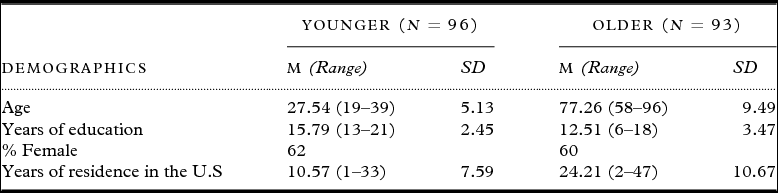
Participants included 189 Korean heritage adults (older adult: age range 58–96, younger adults: age range 19–39) living in Los Angeles. The sample was drawn from close–knit social groups, and nine groups participated in this study. Five groups were older adults and the other four groups consisted of younger adults. Ninety-three older adults were recruited from five groups: one group from a church (N = 26), one from a community organization (N = 8), and three groups from adult day healthcare centers (N = 11, 19, and 29). Staff of the centers helped the researcher to contact groups whose cognitive functioning was intact, and who could read and write. Younger adults (N = 96) were recruited from four groups: two groups from churches (N = 50, 8) and two from Korean-American associations at the University of Southern California (N = 30, 8). See Table 1 for demographic information on the samples. The young and older adults groups differed significantly with regard to education, t(187) = 7.753, p < 0.001.
Demographic variables by age group

Translation
Before measures were administered, translation into the Korean language was required. We followed Brislin's (Reference Brislin and Triandis1980) translation/back-translation procedure to create Korean versions of all questionnaires including the wisdom measure, acculturation index, and the measures for validity tests. The first author translated the measures from English into Korean to create the first Korean questionnaire packet. After the Korean version of the questionnaire was generated, a graduate student back-translated it to English as a check for consistency. Another graduate student examined the translated versions and concurred with the translation. The first author and the two graduate students were bilingual (Korean and English). All older adult participants responded to the Korean version of the questionnaire. Among younger adults, 46% used the Korean version, while 54% used the English version of the questionnaire.
Measures
The modified version of 3D-WS (3D-WS-M)
Wisdom was measured using the modified 3D-WS. This included the 39 original 3D-WS items, consisting of 14 items for the Cognitive, 12 for the Reflective, and 13 for the Affective components of wisdom. All items were assessed using one of two 5-point scales, ranging either from 1 (strongly agree) to 5 (strongly disagree) or from 1 (definitely true of myself) to 5 (not true of myself) (Ardelt, Reference Ardelt2003). Six items for the Modesty and Unobtrusiveness dimension were also included from Yang's (Reference Yang2001) study. They were assessed using a 5-point scale, ranging from 1 (definitely true of myself) to 5 (not true of myself). Items were coded so that a higher score meant higher wisdom.
Vancouver index of acculturation
The VIA is a 20-item, self-report acculturation measure (Ryder et al., Reference Ryder, Alden or and Paulhus2000). The VIA consists of two subscales that separately assess the degree to which an individual identifies with the heritage culture and with the host culture. In the present study, internal consistency coefficients (Cronbach's α) were 0.78 for the 10-item Korean culture subscale and 0.80 for the American culture subscale.
Acculturation rating scale for mexican Americans-II
The 30-item ARSMA-II originally measured three domains of acculturation: language, ethnic identity, and ethnic interaction (Cuellar et al., Reference Cuellar, Arnold and Maldonado1995). In order to explore the language domain of acculturation in depth, seven language-related items from the ARSMA-II that were not redundant with the language-related items of the VIA were used. Wording of these items was changed from “Spanish” to “Korean.” In the present study, the internal consistency coefficient was 0.79 for the Korean language subscale and 0.82 for the English language subscale.
Self-transcendence
The ASTI (Levenson et al., Reference Levenson, Jennings, Aldwin and Shiraishi2005) was used to assess self-transcendence orientation. Self-transcendence reflects a “decreasing reliance on externals for definition of the self, increasing interiority and spirituality, and a greater sense of connectedness with past and future generations” (Levenson et al., Reference Levenson, Jennings, Aldwin and Shiraishi2005). Participants were asked the extent to which they agreed with each item “compared to five years ago,” using a 4-point Likert scale ranging from 1 (disagree strongly) to 4 (agree strongly). The scale has been shown to have good reliability and validity (Levenson et al., Reference Levenson, Jennings, Aldwin and Shiraishi2005). Cronbach's α for this scale was 0.74 in this study.
Emotional regulation
Emotional regulation was measured by a subscale (8 items) of the self-assessed wisdom scale (SAWS, Webster, Reference Webster2003), which has been shown to have a consistent factor structure, adequate reliability, and expected correlations with other measures. The scale had Cronbach's α = 0.83 in the present study.
Openness to experience
This presumed correlate of wisdom was rated using the Openness subscale (8 items) of the SAWS (Webster, Reference Webster2003). Items were rated on a 6-point scale from “strongly disagree” to “strongly agree.” Cronbach's α for this scale was 0.75.
Life satisfaction
Life satisfaction was assessed using the satisfaction with life scale (Diener et al., Reference Diener, Emmons, Larsen and Griffin1985), a widely used measure of subjective well-being. Participants respond to five items using a 7-point Likert scale ranging from 1 (strongly disagree) to 7 (strongly agree). In the present study, Cronbach's α for this scale was 0.79.
Social desirability
The self-deceptive positivity subscale of the Balanced Inventory of Desirable Responding (BIDR; Paulhus, Reference Paulhus, Robinson, Shaver and Wrightsman1991) was used to check social desirability bias. The scale consists of 20 items designed to measure overconfidence in one's judgments and rationality. The 20 items of this index were measured on a scale ranging from 1 (definitely true of myself) to 5 (not true of myself). After the scoring of positively keyed items was reversed, respondents received 1 point for each extreme answer (5). The range of the total score was from 0 to 20.
Shipley-Hartford test of vocabulary (Shipley, Reference Shipley1940)
Shipley–Hartford Test of Vocabulary is widely used in the aging literature as a measure of crystallized intelligence. The vocabulary test is composed of 20 multiple-choice items. Cronbach's α for this scale was 0.83 in this study. There was no statistically significance difference in intelligence between younger and older adults, t(180) = 1.815, p = 0.07. The two cultural cluster groups also did not differ with regard to intelligence, t(180) = 1.385, p = 0.168.
Procedure
We emailed and called leaders of the groups (churches, adult day healthcare centers, and community organizations) and asked them if they were willing to allow their group members to participate the study. After obtaining permission, a brief explanation of the study was given to the potential Korean heritage participants, either in groups or individually. The questionnaire packet was administered to participants, taking an average of 35 min. The investigator encouraged participants to answer every question in the questionnaire. The data collection was conducted from January 2012 until July 2012.
Data analysis strategy
To examine the factor structure of the modified version of 3D-WS (3D-WS-M), confirmatory factor analysis was conducted. Maximum-likelihood (ML) was used as the model parameter estimation method. Multiple criteria were employed in order to assess the overall goodness of fit of the confirmatory factor analysis (CFA) models: (1) The ratio of model chi-square to model degrees of freedom (χ2/df): because the model χ2 statistic is sensitive to sample size, this ratio is often used as a model fit criterion. In this study the ratio of 5 or below was considered as an indication of a good model fit. (2) A Comparative Fit Index (CFI) of 0.90 or above was used as an indicator of an adequate model fit. (3) Root Mean Square Error of Association (RMSEA): an RMSEA of 0.05 or below is considered as an indication of a good model fit. As mean differences in the education level of the older and younger adult samples were significant, we added education as a control variable in the analysis. Cronbach's α for each dimension of 3D-WS-M was used to test the internal reliability of the scale. Validity of the new scale was tested by correlations with study measures.
Latent cluster analysis was performed to determine types of acculturation subgroups. Cluster analysis identified patterns of acculturation with 20 items from the VIA and 7 items from the ARSMA-II.
To study acculturation influence on wisdom constructs, latent mean analysis (LMA) was used. Group differences in the means of latent variables can be estimated only if the latent variables are on the same scale in all groups. Thus, the prerequisites for LMA, configural invariance, metric invariance, and scalar invariance were tested across the multiple groups. A series of multi-group CFAs were conducted to identify acculturation differences in factor structure. To test differences between two groups (high Korean acculturation vs. high American acculturation), we assessed configural invariance to examine whether each common factor was associated with identical item sets between two groups. Then we assessed metric invariance which constrained corresponding factor loadings to be equal across the groups. Finally, scalar invariance was assessed which requires that regression of items onto their associated common factors yield a vector of intercept terms that is invariant across the groups. Given that the assumptions of configural, metric, and scalar invariance were satisfied, we tested differences in latent means.
Results
A confirmatory factor analysis on the hypothesized four-factor wisdom model
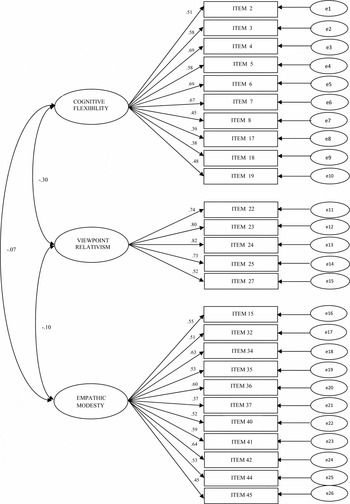
The hypothesized 45-item, four-factor wisdom model was tested by CFA. The initial model (3D-WS-M: model A) was run and resulted in a poor fit, χ 2/df = 1.915, CFI = 0.617, RMSEA = 0.069. For the first step to improve the model fit, we deleted items that loaded weakly on each factor (<0.40). Items 1, 16, 20, and 21 from the Cognitive factor; items 9, 10, 26, 28, 29, 30, and 31 from the Reflective factor; items 11, 12, 13, 14, 33, 38, and 39 from the Affective factor; and item 43 from the Modesty and Unobtrusiveness factor were removed, resulting in an improved but still poorly fitting model (Model B), χ 2/df = 1.652, CFI = 0.864, RMSEA = 0.058. Next, based on modification indices, correlated error terms were added between items 5 and 19, items 17 and 19, items 17 and 18, and items 36 and 37. This scale met the minimum fit requirements for a satisfactory model (Model C), χ 2/df = 1.457, CFI = 0.906, RMSEA = 0.049. However, since the correlation between the Affective and the Modesty and Unobtrusiveness factor was very high (r = 0.81), we combined the two factors and tested the resulting model. We added correlations between error terms for items 5 and 37, and items 40 and 41 (Model D). This resulted in an improved adequate model, χ 2/df = 1.452, CFI = 0.907, RMSEA = 0.048. Although the Δχ 2 of 0.055 with 1 degree of freedom between Models C and D was not significant, we selected Model D as our final model because of parsimony. The factor structure of the model and factor loadings are presented in Figure 1. As many items were deleted from the four factors and two factors were combined into one, each factor was then interpreted by examining item content and item loadings. Items of Factor 1 included content characterized by the desire to know the truth and by tolerance of ambiguity and uncertainty. Items of Factor 2 included the item content of Viewpoint Relativism. Items of Factor 3 reflected empathy and modesty. We called this final wisdom model the 3D-WS-K and named Factor 1 “Cognitive Flexibility,” Factor 2 “Viewpoint Relativism,” and Factor 3 “Empathic Modesty.”
Factor Structure for the 3D-WS-K. See Appendix for the full items in 3D-WS and Modesty and Unobtrusiveness.

Internal reliability
Cronbach's α for the Cognitive Flexibility, Viewpoint Relativism, Empathic Modesty dimension of the 3D-WS-K ranged from 0.82 to 0.84, confirming the internal reliability of the 3D-WS-K.
Validity
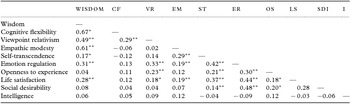
Results of correlations between the 3D-WS-K and measures are presented in Table 2. The total score of the 3D-WS-K was positively correlated with self-transcendence (r = 0.17, p < 0.05), emotional regulation (r = 0.31, p < 0.001), and life satisfaction (r = 0.28, p < 0.001). The total 3D-WS-K was unrelated to respondents’ social desirability index, intelligence, and openness to experience. We explored correlations between scores of each factor in 3D-WS-K and openness to experience. Viewpoint Relativism showed significant positive relationship with openness to experience (r = 0.23, p < 0.001). There was no significant association between Cognitive Flexibility or Empathic Modesty and openness to experience.
Correlations between 3D-WS-K and measures for validity tests

Notes. CF = cognitive flexibility; VR = viewpoint relativism; EM = empathic modesty; ST = self-transcendence; ER = emotional regulation; OE = openness to experience; LS = life satisfaction; SDI = social desirability index; I = Intelligence.
*p < 0.05, **p < 0.001.
Cluster analysis
For the acculturation cluster analysis, a two-cluster solution was obtained: a Korean values cluster (N = 90, including 47.6% of the sample) and a Bicultural values cluster (N = 99, 52.4% of the sample). The Korean values cluster showed clear orientation toward Korean culture and little involvement with the American culture. The Bicultural values cluster indicated high involvement in both Korean and American cultures. The Korean value cluster (N = 90) ranged in age from 21 to 96 years (M = 71.17, SD = 19.57). Eighty-six percent of them (N = 77) were older adults with education ranging from 6 to 18 years (M = 12.71, SD = 3.36), and 62% of them were female. The Bicultural values cluster (N = 99) ranged in age from 19 to 85 years (M = 34.64, SD = 17.30). Eighty-four percent of them (N = 83) were younger adults with education ranging from 6 to 21 years (M = 15.53, SD = 2.69), and 67% of them were female. The groups differed significantly with regard to age t(184) = –13.508, p < 0.001 and education, t(187) = 6.131, p < 0.001. There was no significant difference in intelligence between the two values clusters.
Multiple-group confirmatory factor analyses
Factorial invariance
Multi-group CFAs were conducted to investigate whether the factor structure was similar across the two clusters. Results of tests for measurement invariance models are presented in Table 3. The first multi-group CFA model (Model 1) tested for configural invariance to check whether each factor was associated with identical item sets between the Bicultural and Korean values clusters. We found that Δχ2 = 242.95 (df = 212) was not statistically significant, suggesting that configural invariance was supported (Model 1). Because Δχ2 = 25.92, with 19 degrees of freedom, was not statistically significant at p = 0.05, Model 2 supported metric invariance which constrained corresponding factor loadings to be equal across the groups. Scalar invariance was tested by testing Δχ2 comparing the scalar invariance model (Model 3) and the metric invariance model (Model 2). Scalar invariance was supported, meaning the intercepts of the latent constructs have equal values across the two groups with different acculturation levels, Δχ2 = 3.75 (df = 1). The homogeneity of variance assumption was not rejected (Model 4), suggesting that the variance values of the three factors are equal across the two groups (see Table 3).
Fit indices and χ2 differences for invariance tests between Korean and bicultural acculturation clusters

Notes. df = degree of freedom; RMSEA = root mean square error of association; CFI = comparative fit index.
Test of latent mean differences
Differences in the latent means of the three factors of the 3D-WS-K were tested. The means of the three factors in the 3D-WS-K were constrained to be zero for the reference group (Bicultural values cluster), whereas these values were estimated for the Korean values cluster. Table 4 presents latent mean parameter estimates. Results showed significant mean group differences with respect to two of the factors in the 3D-WS-K. Specifically, the Korean values cluster mean was lower than that of the Bicultural values cluster group by 2.332 (p < 0.05) with respect to Viewpoint Relativism and higher than by 3.359 with respect to Empathic Modesty (p < 0.001). There was no significant difference in Cognitive Flexibility.
Latent mean differences in three factors of 3D-WS-K between bicultural acculturation cluster and Korean acculturation cluster

Note. a = reference group.
Although we did not include analysis of age difference in the 3D-WS-K for our main results, we also tested an age-specific (young vs. old) two-group model. The factor structure of the 3D-WS-K was invariant across age groups, and younger adults scored higher than older adults on Viewpoint Relativism (mean difference = 2.234, p < 0.05). There was no significant difference in Cognitive Flexibility or Empathic Modesty.
Discussion
The current study revised an existing wisdom scale (3D-WS) in order to make the application of the measurement more relevant to Eastern cultures and examined the effect of acculturation on wisdom constructs. While we began with the idea that the major change would be the addition of a culturally relevant factor, we discovered additional changes to the structure in a Korean heritage sample in Southern California. To achieve a good model fit, we dropped several items, resulting in several changes in the wisdom construct from the original scale (3D-WS). The Cognitive component in the 3D-WS includes items that measure an understanding of life or the desire to know the truth, knowledge of the paradoxical aspects of human nature, tolerance of ambiguity and uncertainty, and the ability to make important decisions despite life's unpredictability and uncertainties (Ardelt, Reference Ardelt2003). In the 3D-WS-K, Factor 1 (Cognitive Flexibility) retained only the items that measure the desire to know the truth and tolerance of ambiguity and uncertainty.
In the 3D-WS-K, Factor 2 measures Viewpoint Relativism, which retains the items related to looking at issues from multiple viewpoints. The items related to blame, resentment, and dissatisfaction from the Reflective factor of the 3D-WS were dropped. Of particular interest in the 3D-WS-K, the Affective factor of the 3D-WS and the culturally specific Modesty and Unobtrusiveness factor combined into a single factor. In the 3D-WS-K, the combination of Affective and Modesty and Unobtrusiveness into one factor includes items that measure positive feelings and behaviors toward others (from the Affective factor) and indifference to one's own interest and lack of attention to oneself (from Modesty and Unobtrusiveness).
This result may be due to the broad concept and behavior manifestations of “Modesty” in East Asian culture. Chen et al. (Reference Chen, Bond, Chan, Tang and Buchtel2009) examined the social manifestations of modesty in Chinese and Canadian cultures. They found that modesty encompassed three behavioral components: self-effacement, other-enhancement, and avoidance of attention-seeking. Other-enhancement, specifically, represents regard for others and the elevation of others and does not originate from a negative evaluation of one's own worth. Rather, it arises from awareness of interdependence, sensitivity to one's relationships with others, and a concern with maintaining harmony and achieving integration in social interactions. This result also confirmed East Asian cultures’ (China, South Korea, and Japan) emphasis on harmonious relationships with other people (see Grossmann et al., Reference Grossmann2012, for review). Thus, integrating the Affective and Modesty and Unobtrusiveness factors into one factor seems culturally appropriate.
The convergent and predictive validity of the 3D-WS-K was supported by positive correlations with self-transcendence, emotional regulation, and life satisfaction. Discriminant validity of the 3D-WS-K was also supported by being unrelated to the social desirability index and intelligence. We expected that the 3D-WS-K will show a positive relationship with openness to experience; however, only the Viewpoint Relativism factor was positively related to openness to experience. It seems that people open to novel experiences also learn new insights into others’ viewpoints. We also found that Cognitive Flexibility was not correlated with study measures in this study. In future studies, measures of other potential correlates of the cognitive component of wisdom should be explored.
We found that the Korean values group mean of wisdom was higher on Empathic Modesty, which is consistent with the literature, suggesting a greater emphasis on the affective component of wisdom in Eastern cultures and the role of modesty as traditional East Asian concepts of wisdom. Another interesting finding of this study is that the Bicultural values group mean of wisdom was higher on the Viewpoint Relativism factor. Biculturalism values suggest familiarity and involvement in both American and Korean cultures. The bicultural aspect of acculturation would be expected to increase Viewpoint Relativism as people become proficient in two different cultures.
Inconsistent with our hypothesis, there was no difference in Cognitive Flexibility between the two cultural values clusters. Although we compared the Korean values cluster and the Bicultural values cluster, not an American values cluster, it is still interesting that the cognitive aspect of wisdom was not stressed by the Bicultural values cluster. This result was inconsistent with the suggestion in the literature that Western cultures emphasize knowledge and cognitive complexity. Theoretically, Knight and Laidlaw (Reference Knight, Laidlaw and Bengtson2009) suggested a working definition of wisdom that modified the Berlin model by de-emphasizing the cognitive aspect of wisdom and emphasizing the integration of emotion and reason. Glück and Bluck (Reference Glück and Bluck2011) found that integration of cognition and affect components of wisdom was also frequent among Western participants. In the line with these studies, our results suggest that acculturation differences likely involve the non-cognitive components of wisdom.
As seen in the sample composition, this study was designed to explore both acculturation and age differences in the concept of wisdom. However, we decided to focus on examining the acculturation effect on wisdom because of the characteristics of our sample. In this sample, the cultural clusters were confounded with age group, with the great majority of the Korean values group being old, and of the bicultural group being young, so we cannot separate acculturation effects from age effects. This comes from the nature of Korean immigration patterns such that middle aged and older adults are mainly first generation immigrants whereas the younger adults are mostly raised in the USA since childhood or born here. We would note that the findings are a contribution to existing research on wisdom whether the focus is on acculturation influences or on age differences. However, we were more interested in reporting acculturation effect because this was the first study exploring acculturation influences on the concept of wisdom. Future research should specifically work to find samples that would not lead to this confound. As noted in the Results section, if the sample was divided by age rather than accultuaration, younger adults were higher in Viewpoint Relativism. Given that Viewpoint Relativism has a positive relationship with openness to experience, and openness to experience decreases with age (e.g. Roberts et al., Reference Roberts, Robins, Caspi, Trzesniewski, Mortimer and Shana-han2003), it seems reasonable that Viewpoint Relativism was smaller in the older group.
Limitations
Several limitations to the study are important to acknowledge. First, we compared a Korean values cluster and a Bicultural values cluster to explore acculturation differences in wisdom. Therefore, our findings may not be consistent with results from other cross-cultural wisdom studies that compare differences in wisdom in two distinct cultural groups. Second, age and acculturation were confounded, and so the acculturation difference would be related to age differences. This is an important issue for future research to address to elucidate the relationship between wisdom, culture, and age. Moreover, our study sample was a relatively small convenience sample (N = 189) for a questionnaire validation study. Because the validation was conducted with a convenience Korean heritage sample, generalizability of study results to other Eastern populations may be of concern. Future research will need to confirm the psychometric strength of the 3D-WS-K across diverse Eastern populations. Finally, we did not include middle-aged Korean heritage adults in this study. As stated before, exploring age difference in the concept of wisdom was one of aims of this study. As is traditional in gerontological research, we chose to start with an age extreme design to explore age differences for the first time. Further research with all age groups is needed to clarify age and acculturation differences in wisdom among Korean heritage adults.
Conclusion
Despite these limitations, the present study represents an important contribution to the study of the effect of acculturation on wisdom. To the best of our knowledge, this is the first study exploring applicability of a wisdom measure to Korean heritage adults. Moreover, the different level of acculturation among our samples allowed us to explore cultural influences on the concept of wisdom. This study found that the revised wisdom measure had a distinct factor structure and item content in a Korean heritage sample. The 3D-WS-K includes a factor that fuses items of Affective dimension of the 3D-WS with Modesty items based on East Asian wisdom research. Acculturation influences on wisdom were confirmed from this study. These findings add to a small but growing literature on cultural influences on wisdom with a particular focus on the contrast between the East Asian and Western (European, North American) wisdom concepts.
Conflict of interest
None.
Description of authors’ roles
S. Kim designed the study, collected the data, carried out the statistical analysis, and co-authored the paper. B. Knight designed the study, supervised the data collection, and participated in the writing of the paper.
Appendix. Items in the 3D-WS (Ardelt, Reference Ardelt2003) and Modesty and Unobtrusiveness factor (Yang, Reference Yang2001)
Cognitive Dimension of the 3D-WS
-
1. Ignorance is bliss
-
2. It is better not to know too much about things that cannot be changed
-
3. In this complicated world of ours, the only way we can know what is going on is to rely on leaders or experts who can be trusted
-
4. There is only on right way to do anything
-
5. A person either knows the answer to a question or he/she does not
-
6. You can classify almost all people as either honest or crooked
-
7. People are either good or bad
-
8. Life is basically the same most of the time
-
16. A problem has little attraction for me if I do not think it has a solution.
-
17. I try to anticipate and avoid situations where there is a likely chance I will have to think in depth about something
-
18. I prefer just to let things happen rather than try to understand why they turned out that way
-
19. Simply knowing the answer rather than understanding the reasons for the answer to a problem is fine with me
-
20. I am hesitant about making important decisions after thinking about them
-
21. I often do not understand people's behavior
Reflective Dimension of the 3D-WS
-
9. Things often go wrong for me by no fault of my own.
-
10. I would feel much better if my present circumstances changed
-
22. I try to look at everybody's side of a disagreement before I make a decision
-
23. When I am upset at someone, I usually try to “put myself in his or her shoes” for a while
-
24. I always try to look at all sides of a problem
-
25. Before criticizing somebody, I try to imagine how I would feel if I were in their place
-
26. I sometimes find it difficult to see things from another person's point of view
-
27. When I am confused by a problem, one of the first things I do is survey the situation and consider all the relevant pieces of information
-
28. Sometimes I get so charged up emotionally that I am unable to consider many ways of dealing with my problems
-
29. When I look back on what has happened to me, I can not help feeling resentful
-
30. When I look back on what has happened to me, I feel cheated
-
31. I either get very angry or depressed if things go wrong
Affective Dimension of the 3D-WS
-
11. I am annoyed by unhappy people who just feel sorry for themselves
-
12. People make too much of the feelings and sensitivity of animals
-
13. There are some people I know I would never like
-
14. I can be comfortable with all kinds of people
-
15. It is not really my problem if others are in trouble and needed help
-
32. Sometimes I do not feel very sorry for other people when they are having problems
-
33. Sometimes I feel a real compassion for everyone
-
34. I often have not comforted another when he or she needed it
-
35. I do not like to get involved in listening to another person's troubles
-
36. There are certain people whom I dislike so much that I am inwardly pleased when they are caught and punished for something they have done
-
37. Sometimes when people are talking to me, I find myself wishing that they would leave
-
38. I am easily irritated by people who argue with me
-
39. If I see people in need, I try to help them one way or another
Modesty and Unobtrusiveness factor from Yang's (Reference Yang2001) study
-
40. I am showy and draw excessive attention to myself
-
41. I am too clever to my own good
-
42. I am conceited and stubborn, with a sense of superiority
-
43. I have high expectations for myself and other, and am therefore more likely to be disappointed
-
44. I take advantage of and manipulated others
-
45. I think and therefore worry too much