





Impact statement
Global mental health researchers increasingly recognize that mental health inequities are shaped by social and structural conditions, but research often still treats these conditions as isolated risk factors. This article shows how structural injustice theories can help researchers ask broader questions about how poverty, violence, displacement, discrimination and legal or institutional arrangements become interlocking patterns of disadvantage. Structural injustice theories can support collaboration across disciplines and sectors, guide analysis of structural harms and help clarify responsibilities for remedy. We argue that this engagement should not reduce structural injustice theories to a technical checklist, but instead support reflexive examination of how GMH knowledge, priorities and interventions are themselves produced. The intended impact is to support more justice-oriented, accountable and structurally informed GMH research.
Introduction
The field of global mental health (GMH) is at a crossroads. In the mid-2000s, key publications were largely focused on treating mental disorders through training nonspecialists in the use of evidence-based interventions (Lancet Global Mental Health Group, 2007, World Health Organization, 2010). In response to this earlier focus, critics questioned the predominantly biomedical orientation of GMH, the presumed universality of diagnoses and treatments applied, as well as what counts as evidence (Das and Rao, Reference Das and Rao2012). In addition, critiques have challenged a lack of attention toward the social determinants of mental health and the power relations between actors in the Global North and South (Kirmayer and Pedersen, Reference Kirmayer and Pedersen2014; Whitley, Reference Whitley2015). Accordingly, there have been calls within GMH for increasing the uptake of inter- and transdisciplinary research, promoting equitable partnership in conducting GMH research, as well as improving our understanding of how context shapes mental health and how adversity can be addressed in multi-sectoral interventions (Bemme and Kirmayer, Reference Bemme and Kirmayer2020; Rivera-Segarra et al., Reference Rivera-Segarra, Mascayano, Alnasser, van der Ven, Martinez-Ales, Durand-Arias, Moro, Karam, Hernandez-Torres, Alarcon, Ramos-Pibernus, Alvarado and Susser2022).
In this article, we zoom out and reflect on a specific group of theories that can assist efforts to respond to calls for change in GMH research. That is, we discuss the potential role that structural injustice (SI) theories could play for a field currently at a junction. Considering that SI theories combine an analysis of social systems and their impact on well-being, we believe they could provide a helpful bridge between researchers and other stakeholders focused on different facets of mental health, as well as a useful lens to understand the social roots of mental health. We also believe SI theories can assist efforts to address unfair knowledge practices in GMH.
First, we briefly describe key characteristics of SI theories, such as those developed by Powers and Faden (Reference Powers and Faden2006; Reference Powers and Faden2019) and Young (Reference Young2011). We then explore three interrelated ways in which SI theories could benefit GMH, namely, by: (1) strengthening inter- and transdisciplinarity; (2) offering a theoretical lens for data analysis and interpretation; and (3) providing a normative theoretical approach that offers a moral foundation to enrich the existing debates and research directions in GMH. We hope that this paper is accessible to a broader audience engaged with GMH research, including researchers from different disciplines, and end users, practitioners and policymakers with an interest in GMH research.
Characteristics of structural injustice theories
In the field of political theory, there is lively discussion and a rich literature regarding SI theories. Here, we provide a brief introduction for people engaged in GMH research who may not be familiar with SI theories. We focus specifically on the SI theories put forward by Powers and Faden (Reference Powers and Faden2006, Reference Powers and Faden2019) and Young (Reference Young2011), some of the most influential accounts in the field. These theories have different emphases and thereby provide some insights into key tensions in contemporary SI theory debate. Helpful resources for further reading on SI theory include the original works (Powers and Faden, Reference Powers and Faden2006, Reference Powers and Faden2019; Young, Reference Young2011), as well as introductory primers such as those by Mayerfeld on Powers and Faden (Mayerfeld, Reference Mayerfeld2020), McKeown on Young (McKeown, Reference McKeown2021), and introductions to SI theory more broadly (e.g., Browne and McKeown, Reference Browne and McKeown2024).
To start, it is helpful to understand that current political theory writing on SI continues to engage with the influential work of John Rawls. Classic Rawlsian approaches to justice tend to start with considering what a perfectly just society would look like, and focus on how resources and opportunities should be distributed under fair conditions (Rawls, Reference Rawls1971). In classic Rawlsian approaches, injustice is understood mainly as a deviation from an ideal set of rules or principles that everyone would hypothetically agree to behind a ‘veil of ignorance’, where nobody knows their future position in society. The emphasis is therefore on designing fair institutional arrangements for an already broadly cooperative society. Rawlsian approaches are therefore also referred to as ‘ideal’ theories.
In contrast, nonideal theories start from the observation that societies currently show stark power and resource inequalities, and that some groups of people experience more widespread and persistent disadvantages than others (Stemplowska and Swift, Reference Stemplowska and Swift2012). The works of Powers and Faden and Young both fall in the category of a nonideal theory. Table 1 provides an overview of some of the similarities and differences between their SI theories.
Key characteristics of structural injustice theories

Table 1. Long description
The table consists of three columns and six rows. The first column lists the categories of comparison, while the second and third columns detail the theories of Powers and Faden and Young and Nussbaum, respectively.
* Key works: Powers and Faden are associated with Social Justice (2006) and Structural Injustice (2019). Young and Nussbaum are associated with Justice and the Politics of Difference (Reference Young1990) and Responsibility for Justice (2011).
* Main focus: Powers and Faden focus on human well-being across six dimensions (health, security, knowledge, respect, attachment, and self-determination). Young and Nussbaum focus on how social relations and everyday practices create oppression and domination between groups.
* What counts as structural: Powers and Faden define it by asymmetric, near-inescapable, profound, and pervasive impacts. Young and Nussbaum identify the five faces of oppression: exploitation, marginalization, powerlessness, cultural imperialism, and violence.
* How inequities arise: Powers and Faden point to unfair power relations and identifiable agents controlling well-being. Young and Nussbaum describe cumulative, unintended effects of institutional actions within accepted norms that constrain life options.
* Responsibilities: Powers and Faden assign primary responsibility to states and institutions. Young and Nussbaum propose a social connection model where responsibility is shared, forward-looking, and based on power and privilege.
In addition to being nonideal theories, what Powers and Faden and Young’s works also have in common is that they do not approach injustice simply as the unfair distribution of resources in otherwise largely fair social arrangements. In that way, SI theories do not conceptualize injustice as a process of unfair distribution in the liberal sense that has dominated post-war political philosophy (Rawls, Reference Rawls1971; Nozick, Reference Nozick1974; Sandel, Reference Sandel2010). Rather, they analyze how systems of oppression create advantages for some precisely by disadvantaging others through ongoing and dynamic processes. For Young and Nussbaum (Reference Young2011), for example, oppression includes marginalization, exploitation, powerlessness, cultural imperialism and violence. SI theories aim to identify how inequities result from actors (intentionally or unintentionally) benefitting from asymmetric power relations, and conversely, how challenging it is for marginalized populations to escape chains of adversity that are reinforced across multiple domains of social arrangements. In other words, SI theories engage with how experiencing adversity is not just a matter of bad luck in otherwise largely benignly organized societies, but how compounded adversities are experienced due to the way societies are organized.
For GMH, this focus of SI theory on dynamic processes through which people become exposed to interlocking adversities is helpful for the design and evaluation of complex mental health interventions for marginalized populations. For example, it has been repeatedly observed that people are disproportionately affected by disasters based on pre-disaster social standing. In one illustrative case, historically marginalized caste groups are often concentrated on highly hazardous, low-lying lands close to riverbanks in the Koshi River basin in India, because of historical landlessness and systemic poverty, resulting in high vulnerability to the impacts of seasonal flooding (Sahani et al., Reference Sahani, Badiger, Samrat and Krishnan2023; Nizam et al., Reference Nizam, Sivakumar and Rajan2026). Mental health responses to flooding, based on an analysis of these preexisting structural injustices, would likely combine the provision of psychological support with social interventions aimed at reducing the systemic precariousness of historically marginalized caste groups, in which experiences of distress are rooted.
Finally, we highlight the structural element of SI theories: SI theories require an explanation of how structural injustices differ from accidental or incidental injustices. For example, in their 2019 Structural Injustice: Power, Advantage, and Human Rights, Powers and Faden argue that unjust structural influences must have an (1) asymmetric, (2) near-inescapable, (3) profound and (4) pervasive impact. Other theoretical work on structural injustice discusses various related aspects, such as why these kinds of injustices should be considered as a separate category, how they emerge, how to assign moral and political responsibility for injustice, including the matter of reparations, or how to assess institutions and corporate agents regarding structural injustices (Young, Reference Young2011).
For GMH, a focus on structural aspects of injustice dovetails with epidemiological literature that shows bidirectional relationships between adversities, such as poverty, and mental health. A 2020 review summarizes how interactions between poverty and mental health can create self-reinforcing systems when poverty ‘gets under the skin’, for example, through changed cognitions (bandwidth and self-belief), stigma and psychological distress – psychological impacts that constrain options to escape poverty (Ridley et al., Reference Ridley, Rao, Schilbach and Patel2020). In behavioral economics, there is increasing attention for the so-called ‘psychology of poverty’ (Ghosal et al., Reference Ghosal, Jana, Mani, Mitra and Roy2022; Park et al., Reference Park, Ho, Hallez, Kaur, Srinivasan and Zhao2025). What this research points to is that, over time, poverty and mental health can create vicious cycles. The psychology of poverty literature indicates one set of pathways through which structural disadvantage becomes self-reinforcing. SI theory (e.g., through Powers and Faden’s notions of asymmetry, near-inescapable, profound and pervasive impacts) is helpful to ensure that analyses are anchored in broader understandings of social arrangements, power and responsibility. Applying SI theory can facilitate an analysis of poverty not simply as an isolated risk factor, but as a risk factor embedded in broader interlocking chains of adversity that are rooted in how societies are organized.
Having briefly outlined some key features of SI theories, we now turn to three ways in which we believe SI theories may enhance GMH research, and ultimately inform policy and practice.
Strengthening inter- and transdisciplinarity
Defining inter- and transdisciplinarity
One way in which SI theories can support GMH efforts is by strengthening inter- and transdisciplinary approaches. The terms inter- and transdisciplinarity tend to be used in different ways, or sometimes interchangeably. In line with an emerging consensus, we follow Choi and Pak’s (Reference Choi and Pak2006) approach, where multi-, inter- and transdisciplinary research are placed on a continuum of intensifying levels of collaboration. Multidisciplinary research draws on knowledge from different disciplines, but there is no true integration of perspectives (i.e., interaction is additive). In multidisciplinary research, experts from different disciplines work together on the same topic, but mainly from their own angle side by side, without mixing their methods. Interdisciplinary research goes further and ‘analyses, synthesizes and harmonizes links between disciplines into a coordinated and coherent whole’ (p. 351, Choi and Pak, Reference Choi and Pak2006) (i.e., it is interactive). In interdisciplinary research, different experts not only work together but also combine their approaches to create something new. Transdisciplinary research integrates various disciplinary perspectives in such a way that each of their traditional boundaries is transcended (i.e., holistic) (Choi and Pak, Reference Choi and Pak2006). Transdisciplinary research is also often used as a label to describe research that goes beyond academic collaboration to involve community knowledge and expertise from stakeholders in policy and practice sectors focused on solving societally relevant and often complex concerns (e.g., Hirsch Hadorn et al., Reference Hirsch Hadorn, Hoffman-Riem, Biber-Klemm, Grossenbacher-Mansuy, Joye, Pohl, Wiesman and Zemp2008).
New space for inter- and transdisciplinarity in global mental health
Drawing on her ethnographic fieldwork with GMH actors, Dörte Bemme describes a ‘reflexive turn’ in GMH and a shift toward a social paradigm (Bemme, Reference Bemme2023). This reflexive turn entails that critical evaluation of the universality of concepts comes from within the field. Bemme describes how GMH actors, as part of this process, build on the malleability of mental health concepts as a strength rather than a liability. The shift toward a social paradigm has involved stronger attention to the social determinants of mental health and changes in conceptualizations of the role of communities for mental health (see, e.g., Rose-Clarke et al., Reference Rose-Clarke, Gurung, Brooke-Sumner, Burgess, Burns, Kakuma, Kusi-Mensah, Ladrido-Ignacio, Maulik, Roberts, Walker, Williams, Yaro, Thornicroft and Lund2020; Pathare et al., Reference Pathare, Burgess and Collins2021; Alegria et al., Reference Alegria, Alvarez, Cheng and Falgas-Bague2023; Mathias et al., Reference Mathias, Bunkley, Pillai, Ae-Ngibise, Kpobi, Taylor, Joag, Rawat, Hammoudeh, Mitwalli, Kagee, van Rensburg, Bemme, Burgess, Jain, Kienzler and Read2024). To illustrate, an editorial accompanying the relaunch of this journal advocates for a ‘Public Mental Health approach, incorporating culture and context and prioritizing equity and inclusion, particularly of previously marginalized groups’ (Bass et al., Reference Bass, Chibanda, Petersen, Winkler, Sijbrandij and Shidhaye2023, cf., Moitra et al., Reference Moitra, Owens, Hailemariam, Wilson, Mensa-Kwao, Gonese, Kamamia, White, Young and Collins2023). The reflexive turn, the call for stronger attention to the structural and social determinants of mental health and the demand for a greater role for marginalized populations all point to a key imperative: advancing inter- and transdisciplinary collaboration in GMH. However, inter- and transdisciplinary research is easier called for than implemented. Key challenges include those related to communication (e.g., disciplines come with their own language and key terms); differences in epistemology and methodology; difficulties in defining common research objectives; and power differentials between disciplines and stakeholders in the research process (Bemme and Kirmayer, Reference Bemme and Kirmayer2020; Newman, Reference Newman2024).
One way through which such challenges can be overcome is the use of bridging concepts and boundary objects.
Bridging concepts and boundary objects
Bridging concepts are shared ideas or metaphors that create a common language that different stakeholders can engage with. For example, in the context of studying climate change, the concept of social-ecological resilience allows researchers from different disciplines to discuss how climate change may affect interconnected people, places and systems at different levels, such as households, communities, ecosystems, infrastructure and national policy systems (Beichler et al., Reference Beichler, Hasibovic, Davidse and Deppisch2014). In mental health, the concept of socio-ecological resilience, that is, protective processes being rooted in processes that happen at different levels (e.g., individual, family, school and community), can also be used to strengthen transdisciplinary research, by allowing researchers and children, parents and teachers in settings affected by armed conflict to map resources at different levels (Tol et al., Reference Tol, Reis, Susanty and de Jong2010; Afifi et al., Reference Afifi, Makhoul, Hajj and Nakkash2011).
Boundary objects are entities (e.g., objects, ideas, tools and frameworks), which are shared by different stakeholder communities (i.e., are at the boundaries of their work), but defined and applied differently within them (Star and Griesemer, Reference Star and Griesemer1989). A classic example of a boundary object is the patient chart. This object is used by various professionals, providing a sufficient structure to allow them to collaborate, but all use the chart in different ways.
Boundary objects can be used by different stakeholder groups to work together without requiring consensus. Boundary objects should be used reflexively regarding power differentials between the groups using the boundary object. Key elements of boundary objects include: (1) interpretative flexibility (i.e., the object can be understood and used in different ways); (2) ability to provide a certain structure to the way information and work processes flow; and (3) vague definitions between stakeholder groups, while allowing more precise and in-depth definitions within stakeholder groups with the idea that groups may move back and forth between these definitions of the object (Star, Reference Star2010). One could argue that the intervention pyramid from the Inter-Agency Standing Committee for Mental Health and Psychosocial Support in Emergencies pyramid is an example of a boundary object (Inter-Agency Standing Committee [IASC], 2007). This pyramid depicts four different levels of services, required for progressively smaller population groups (i.e., the population-at-large benefits from ensuring that all humanitarian services are provided in ways that are not psychologically and socially harmful, and more selective groups of people need progressively more specialized services). This intervention pyramid allows humanitarian agencies providing specialized clinical services and those strengthening community-based social supports to discuss and coordinate their work without the requirement of agreement on intervention approaches.
We posit that SI theories can be a helpful source of bridging concepts and boundary objects to strengthen inter- and transdisciplinary GMH research. For example, Powers and Faden’s (Reference Powers and Faden2006, Reference Powers and Faden2019) notion of well-being. They describe well-being comprising six core elements: health (physical and mental); knowledge and understanding; personal security; equal respect; personal attachments; and self-determination. These elements are interrelated. Furthermore, the well-being elements are influenced by background social and economic conditions. A simplified diagram such as that provided in Figure 1 could function as a boundary object between different stakeholders who focus on different elements of well-being (Tol, Reference Tol2020).
Wellbeing in Powers and Faden’s SI theory (see Tol, Reference Tol2020).

Figure 1. Long description
A large rectangular box at the top is labeled HUMAN WELLBEING. Inside this box are six smaller dashed-line squares arranged horizontally. From left to right, they are labeled: Health including mental health, Personal security including interpersonal violence, Knowledge and understanding, Equal respect, Personal attachments, and Self-determination. A series of curved double-headed arrows arch over these squares, connecting each component to the others to indicate mutual influence. Below the main rectangle, four large overlapping ellipses are arranged horizontally, labeled collectively at the bottom as Overlapping background social and economic conditions. Multiple straight arrows point upward from the intersections and centers of these ellipses toward the base of the HUMAN WELLBEING rectangle, representing the foundational impact of these conditions on wellbeing.
Consider, for example, the design and evaluation of gender-based violence interventions in humanitarian settings. Consensus-based guidance suggests that such interventions should be implemented across all sectors of humanitarian action, and should include mental health components (Inter-Agency Standing Committee, 2015). However, an evaluation of an intervention which combined activities in the protection and health sectors with Congolese refugees in Tanzania highlighted the multi-sectoral challenges faced when implementing activities across these sectors, and recommended further investments in inter- and transdisciplinary dialogue (Greene et al., Reference Greene, Bencomo, Rees, Ventevogel, Likindikoki, Nemiro, Bonz, Mbwambo, Tol and McGovern2021a). In future collaborations, Figure 1 could help structure communication in co-creation processes that involve women with lived experience, mental health clinicians, women’s protection specialists, feminist scholars, community psychologists and other stakeholders, while they consider action across multiple elements of well-being. Figure 1 could in that way function as a boundary object if: (1) it was sufficiently malleable to have traction for various actors (i.e., interpretative flexibility); (2) it provided a structure for information flow between sectors/disciplines, for example, by allowing actors to map a theory of change onto the well-being diagram, and/or structure a monitoring and evaluation strategy in relation to the diagram); and (3) it allowed stakeholders to go back and forth between broad definitions between stakeholders and more specific uses within stakeholder groups, for example, with mental health clinicians developing detailed procedures to measure various psychological distress states, and feminist scholars detailing how empowerment may be operationalized under self-determination. The use of Figure 1 as a boundary object in this manner would allow inter- and transdisciplinary efforts to be grounded in the analysis of real-world conditions, a key feature of both SI theories and transdisciplinary research approaches.
SI theories informing data collection and analysis
Although SI theories were not purposively developed with this aim in mind, we argue that they can be used: (1) to design and inform empirical studies; and (2) as analytical tools or frameworks in empirical studies.
Klaus Høyer divides the term theory into three different categorizations: (1) theory as a representation of the empirical findings, with theory reflecting ‘reality’ in the best possible way, (2) theory as a tin-opener or inspiration, that is, using theory to ‘open the way’ to an increased understanding of a particular aspect in the data, and (3) theory as a lens through which the researcher sees the world. Using theory as a tin-opener or a lens is a common strategy in the social sciences, whereas viewing theory as representation is more common in health sciences (Hoeyer, Reference Hoeyer, Vallgårda and Koch2008).
Despite the fact that SI theories have not yet been widely used as a framework to guide data analysis in the field of GMH, we argue that they have potential to help illuminate the social processes through which inequities influence well-being, including mental health. To illustrate how they could be used as such, we describe a study aiming to understand the different barriers to accessing (mental) healthcare for refugees in Kenya, Nairobi and the underlying mechanisms of these barriers (Nieuwe Weme et al., Reference Nieuwe Weme, Wanga, Mastaki, Osur and Tol2025). This qualitative study included 69 in-depth life-history interviews and accompanying ethnographic field notes and observations. Powers and Faden’s SI theory (Powers and Faden, Reference Powers and Faden2006, Reference Powers and Faden2019) was chosen post-hoc because it was perceived to be a strong fit following the initial data analyses (Nieuwe Weme et al., Reference Nieuwe Weme, Wanga, Mastaki, Osur and Tol2025). Importantly, the SI theoretical framework was applied to categories derived through prior inductive coding by a research team of whom the majority were of Somali or Congolese origin and resided in the studied communities, ensuring that the analytical process built on participant-generated understandings of their own structural conditions rather than imposing an external theoretical vocabulary from the outset (Nieuwe Weme et al., Reference Nieuwe Weme, Wanga, Mastaki, Osur and Tol2025).
A coding framework was developed based on this theory, drawing heavily on two of the main tenets of Powers and Faden’s theory. First, the six core elements of well-being formed the core of the coding framework. This part of the coding framework allowed the identification of connections in the data set: (1) between the different elements of well-being; and (2) between well-being components and background social and economic factors. Analyzing both these types of connections brought out coherent, interlocking patterns that systematically marginalized urban refugees.
Second, the authors considered the four defining characteristics of unjust structural impacts (asymmetric impact, near-inescapable impact, profound impact and pervasive impact) in the coding framework (Powers and Faden, Reference Powers and Faden2006, Reference Powers and Faden2019). Based on its application in data analysis, the authors found that a key advantage of Powers and Faden’s theory lies in its ability to identify interlocking patterns of disadvantage. The theory operates across at least three levels of reality: individual well-being, underlying socioeconomic factors and the broader social structure. Because of this, it enables researchers to trace effects on individual well-being back to various social processes in a dynamic manner. Applying Powers and Faden’s SI theory thus pushes researchers to examine the foundations of what shapes communities, including existing institutions, social conventions and cultural expectations.
The defining characteristics of unjust structural influence provide useful guidance for identifying these structural patterns of distress, both at the level of socioeconomic factors and at the level of well-being itself. While a single socioeconomic factor may cause distress – whether through a direct effect on mental health or indirectly through its impact on other elements of well-being – interacting causes often produce more pervasive and multidimensional effects.
Applying Powers and Faden’s SI theory in this study revealed an interlocking pattern in which precarious legal status, exclusion from livelihoods and heightened risks of sexual and gender-based violence systematically undermined well-being. These disadvantages reinforced each other: lack of documentation restricted mobility and work opportunities, which in turn deepened poverty and dependence, while also exposing women in particular to violence that could not safely be reported. The finding that structures harming refugees simultaneously protected the rights and opportunities of others supports the conclusion that the combined effects were asymmetric, profound and near-inescapable, while also touching all six elements of well-being in Powers and Faden’s formulation. Rather than isolated risk factors, these findings show how structural patterns entrap refugees in disadvantage and create persistent threats to mental health and well-being by amplifying chronic stress, eroding coping resources and reinforcing cycles of psychological distress.
Taken together, this illustrates the broader potential of SI theories as an analytical research tool in global mental health. By moving beyond individual risk factors to show the interlocking systems that undermine well-being, SI theory can support more comprehensive explanations of mental health disparities, highlight overlooked structural determinants of distress and well-being and identify possible leverage points for intervention. In this way, it offers a promising framework for global mental health research that is attentive to questions of justice.
Critical engagement with knowledge production in GMH: SI theories’ normative dimensions
In this final section, we explore how the field of GMH could benefit by reflecting on the normative dimensions of SI theories. A normative theory consists of a series of criteria, principles and rules to guide and evaluate individual actions, institutions and social systems. In contrast to descriptive theories, which simply describe how the world currently is, normative theories focus on how the world should be. Normative theories provide a moral framework to assess whether things are ‘good or bad’, and whether actions are ‘right or wrong’ (Buckler, Reference Buckler, Marsh and Stoker2010). SI theories may be considered normative as they go beyond describing how social systems operate: they make claims about whether society is structurally unjust, providing criteria for the moral assessment of social arrangements that produce systemic disadvantages, and assigning responsibilities for transforming unjust structures.
Discussing normative dimensions in GMH research may feel uncomfortable, as an unspoken norm in the field is that GMH research should be done in a politically neutral way. For example, in studies on poverty and mental health, poverty is often measured by assessing income and then analyzing links between lower incomes and worse mental health outcomes statistically (Lund et al., Reference Lund, De Silva, Plagerson, Cooper, Chisholm, Das, Knapp and Patel2011; Ridley et al., Reference Ridley, Rao, Schilbach and Patel2020), without discussing how poverty is produced, who may be responsible for it and how it should be remedied (Burns, Reference Burns2015). In reality, such an alleged ‘neutral’ stance is only superficially so, as it aligns with positivist epistemological notions that emphasize objectivity and measurability (i.e., reality is objectively measurable, and systematic observations can yield value-neutral truths); impartiality and universality (i.e., good science should abstract from context, leading to universally valid knowledge); and materialism (i.e., the ‘highest truth’ concerns identifying neurobiological mechanisms and social context is of secondary interest). In GMH policy and practice, this stance often translates to favoring technical rationality, that is, solving mental health concerns through scalable treatments and standardized tools. In other words, this neutral stance is itself a political stance, with its own tacit epistemological positions. Using it as the common sense or default position is misleading and obscures the implicit ways through which GMH agendas are shaped.
The positivist epistemological assumptions commonly embedded in GMH research can lead to a restricted view of the complex ways in which social environments shape mental health. For example, GMH research has often relied on a Social Determinants of Health (SDoH) approach to study social risk factors (CSDH, 2008, Marmot et al., Reference Marmot, Friel, Bell, Houweling and Taylor2008, Lund et al., Reference Lund, Brooke-Sumner, Baingana, Baron, Breuer, Chandra, Haushofer, Herrman, Jordans, Kieling, Medina-Mora, Morgan, Omigbodun, Tol, Patel and Saxena2018, Patel et al., Reference Patel, Saxena, Lund, Thornicroft, Baingana, Bolton, Chisholm, Collins, Cooper, Eaton, Herrman, Herzallah, Huang, Jordans, Kleinman, Medina-Mora, Morgan, Niaz, Omigbodun, Prince, Rahman, Saraceno, Sarkar, De Silva, Singh, Stein, Sunkel and UnUtzer2018). Although SDoH frameworks can support analysis of structural factors, GMH research does not commonly apply SDoH to study the structural determinants of mental health, that is, the overarching societal, economic and political systems that shape everyday living conditions (e.g., discrimination based on race, ethnicity or caste) (Mariwala & Rizwan, Reference Mariwala and Rizwan2021). SDoH applications in GMH tend to highlight the importance of social contexts and ‘mid-stream’ factors, but they often under-emphasize the upstream structural causes of poor mental health (Bemme and Behague, Reference Bemme and Behague2024). By focusing on the role of isolated, more downstream variables, these applications risk reducing complex social realities into discrete and measurable ‘risk factors’ that can be added, removed and studied in isolation (Cosgrove et al., Reference Cosgrove, Mills, Amsterdam, Heath, Mehta, Kalathil and Shaughnessy2019; Bemme and Behague, Reference Bemme and Behague2024). This framing risks an individualized (and often medicalized) conception of suffering while obscuring how interrelated political, economic, social and institutional processes dynamically shape mental health (Harvey et al., Reference Harvey, Pinones-Rivera and Holmes2022; Bemme and Behague, Reference Bemme and Behague2024; Burgess et al., Reference Burgess, Chobhthaigh, Biswal, Ceccolini, Fadipe, Khan, Aggarwal, Pabla, Solis, Pillutla, Sarkar, Frasco, lemmi, Pathare and Lund2025).
In addition to obscuring the broader social structures that influence mental health, positivist assumptions also make it harder to discuss power inequities in the research process itself, since research is presented as the impartial collection of value-neutral facts. There is a rich tradition of theoretical approaches that have questioned positivist assumptions in public health and health equity research, including postmodern, feminist, queer and critical theoretical approaches (Graham et al., Reference Graham, Brown-Jeffy, Aronson and Stephens2011). For example, Chandra Ford and Collins Airhihenbuwa developed Public Health Critical Race Praxis (PHCRP), a semi-structured research process applying Critical Race Theory to public health research and practice (Ford and Airhihenbuwa, Reference Ford and Airhihenbuwa2018). Critical Race Theory-inspired approaches in public health and mental health aim to change not only how specific research projects are organized (e.g., which research questions are asked, and which methods are applied), but they also urge change in how the knowledge production process itself is organized (e.g., aiming to understand the racial biases that have informed which research questions are asked, and which methods are applied) (Graham et al., Reference Graham, Brown-Jeffy, Aronson and Stephens2011; Ford and Airhihenbuwa, Reference Ford and Airhihenbuwa2018).
In GMH, Burgess et al. (Reference Burgess, Chobhthaigh, Biswal, Ceccolini, Fadipe, Khan, Aggarwal, Pabla, Solis, Pillutla, Sarkar, Frasco, lemmi, Pathare and Lund2025) have recently put forward a Socio-Political Economy of Global Mental Health framework, which integrates attention to sociopolitical economic dimensions with the concept of intersectionality. The term intersectionality is commonly used to describe how interlocking systems of power and discrimination, such as those organized around ethnicity, gender, caste, sexuality, disability and socioeconomic position – shape the lives of marginalized groups. Burgess et al. (Reference Burgess, Chobhthaigh, Biswal, Ceccolini, Fadipe, Khan, Aggarwal, Pabla, Solis, Pillutla, Sarkar, Frasco, lemmi, Pathare and Lund2025) build on the work of Patricia Hill Collins on intersectionality, which places an analysis of power and oppression as central organizing forces, similarly to SI theories discussed here. They applied this framework in a scoping review of the mental health literature and found the field is still in its infancy in explicitly examining intersecting forms of discrimination as mechanisms through which structural determinants shape mental health outcomes (Burgess et al., Reference Burgess, Chobhthaigh, Biswal, Ceccolini, Fadipe, Khan, Aggarwal, Pabla, Solis, Pillutla, Sarkar, Frasco, lemmi, Pathare and Lund2025).
For mental health specifically, it is also important to highlight the contributions of consumer/survivor/ex-patient, inmate and Mad community (c/s/x/m)-led movements (Eromosele, Reference Eromosele2020; Eromosele, Reference Eromosele, Beresford and Russo2022). In diverse ways across the Global North and Global South, these movements have called attention to abuse and coercion in psychiatric treatment systems and have advocated for people affected by these abuses to be central to their reform or transformation. Similar to critical theoretical approaches (e.g., Critical Race Theory), c/s/x/m-led movements have also critiqued the unquestioned, implicit biomedical, professionalized and ostensibly value-neutral assumptions embedded in much GMH research (Beresford and Rose, Reference Beresford and Rose2023).
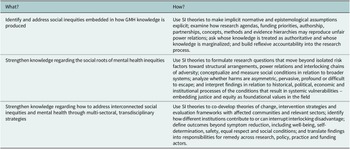
Complementary to these critical theoretical approaches, we believe SI theories may provide additional helpful vantage points to assist GMH at a time of transition. SI theories offer a specific normative vocabulary for examining structural harms, interlocking disadvantage and responsibilities for remedy in GMH, including injustice embedded in research agendas and knowledge production. In Table 2, we summarize how SI theories within a normative framework could assist GMH research alongside other critical theoretical approaches.
Examples of potential applications of SI theories’ normative dimensions across various areas of GMH

Table 2. Long description
The table consists of two columns titled What? and How?.
Row 1:
- What: Identify and address social inequities embedded in how G M H knowledge is produced.
- How: Use S I theories to make implicit normative and epistemological assumptions explicit. Examine how research agendas, funding, authorship, and evidence hierarchies reproduce power relations. Ask whose knowledge is authoritative versus marginalized and build reflexive accountability.
Row 2:
- What: Strengthen knowledge regarding the social roots of mental health inequities.
- How: Formulate research questions focusing on structural arrangements and interlocking chains of adversity. Measure social conditions in relation to broader systems. Analyze if harms are asymmetric or pervasive. Interpret findings in relation to historical, political, and economic processes to embed justice and equity.
Row 3:
- What: Strengthen knowledge regarding how to address interconnected social inequities and mental health through multi-sectoral, transdisciplinary strategies.
- How: Co-develop theories of change and intervention strategies with affected communities. Identify how institutions can interrupt disadvantage. Define outcomes beyond symptom reduction, such as well-being and self-determination. Translate findings into responsibilities for remedy across policy and practice.
First, SI theories could help question the social inequities that are part of knowledge production itself. For GMH, such efforts align with calls for decolonization in global health. There has been increasing recognition in the global health literature, including in GMH, of how the field can perpetuate and reproduce patterns of power and oppression rooted in colonial histories, including Eurocentric, capitalist and patriarchal value systems (Rivera-Segarra et al., Reference Rivera-Segarra, Mascayano, Alnasser, van der Ven, Martinez-Ales, Durand-Arias, Moro, Karam, Hernandez-Torres, Alarcon, Ramos-Pibernus, Alvarado and Susser2022; Khan et al., Reference Khan, Naidu, Torres, Noor, Bump and Abimbola2024). Writing on the decolonization of GMH discusses power, oppression, coloniality and epistemic injustices, for example, in relation to who gets to frame what GMH is about, who has access to research and training resources and whose knowledge counts (Bhakuni and Abimbola, Reference Bhakuni and Abimbola2021; Adhikari et al., Reference Adhikari, Torres and Oele2023). SI theories can complement such efforts by providing a theoretical lens and normative vocabulary for analyzing when inequities in knowledge production form part of structurally unfair arrangements, for example, by examining whether their impacts are asymmetric, near-inescapable, profound and pervasive. Powers and Faden’s conceptualization of well-being could be used to analyze how interlocking inequities in knowledge production affect different dimensions of well-being for researchers, communities and knowledge holders in marginalized positions. In addition, SI theory can assist decolonization efforts in GMH by analyzing where responsibility lies and what kinds of remedies are required, for example, through Young’s social connection model.
Second, SI theories could strengthen knowledge regarding the social roots of mental health inequities by helping researchers formulate questions that move beyond isolated risk factors. For instance, in research on IPV, poverty and mental health among refugee women, an SI-informed study would not only ask whether IPV victimization or poverty predicts depression symptoms. It would also ask how gendered power relations, economic dependency, displacement-related legal precarity, restricted livelihoods and humanitarian protection systems interact to create interlocking patterns of disadvantage. As argued in earlier work on interpersonal violence and mental health, research can reorient from identifying common risk factors toward more fine-grained analysis of contextually determined patterns of disadvantage, and a social justice lens may help to avoid losing ‘the forest for the trees’ (Tol, Reference Tol2020). In line with Powers and Faden’s framework, such research could examine whether these harms are asymmetric, near-inescapable, profound and pervasive, and how they affect multiple dimensions of well-being, including personal security, mental health, equal respect, personal attachments and self-determination. Such an approach would support interpretation of findings in relation to historical, political, economic and institutional processes rather than as isolated associations between discrete exposures and symptoms.
Third, SI theories could strengthen knowledge regarding how to address interconnected social inequities and mental health through multi-sectoral and transdisciplinary strategies. Research on the Nguvu intervention provides a useful example of where such an approach could have strengthened the work (Greene et al., Reference Greene, Likindikoki, Rees, Bonz, Kaysen, Misinzo, Njau, Kiluwa, Turner, Ventevogel, Mbwambo and Tol2021b). Nguvu was developed to integrate psychological support and advocacy counseling for Congolese refugee women experiencing IPV and psychological distress in Tanzania (Greene et al., Reference Greene, Rees, Likindikoki, Bonz, Joscelyne, Kaysen, Nixon, Njau, Tankink, Tiwari, Ventevogel, Mbwambo and Tol2019). Initial formative research, which included a desk review, stakeholder consultations, GBV service mapping and qualitative research, identified that existing GBV prevention activities in the camp already included efforts to address gender norms and potential perpetrators. Therefore, the Nguvu intervention was designed as a complementary intervention for women currently experiencing IPV and distress (Greene et al., Reference Greene, Jordans, Kohrt, Ventevogel, Kirmayer, Hassan, Chiumento, van Ommeren and Tol2017, Reference Greene, Rees, Likindikoki, Bonz, Joscelyne, Kaysen, Nixon, Njau, Tankink, Tiwari, Ventevogel, Mbwambo and Tol2019). A later process evaluation suggested that the intervention was relevant and acceptable, and that participants valued reduced self-blame, solidarity, social support and skills to manage distress; however, participants and stakeholders also emphasized that poverty, financial dependence, restrictions on livelihoods, men’s behavior and gendered norms, limited infrastructure and humanitarian coordination shaped both IPV risk and intervention feasibility, and recommended future adaptations such as economic empowerment and greater engagement with men (Greene et al., Reference Greene, Bencomo, Rees, Ventevogel, Likindikoki, Nemiro, Bonz, Mbwambo, Tol and McGovern2021a, Reference Greene, Scognamiglio, Likindikoki, Misinzo, Njau, Bonz, Ventevogel, Mbwambo and Tol2022). These findings suggest that this research would have benefited from using SI theory earlier in the process: to co-develop a broader theory of change with affected women and relevant sectors, to identify how different institutions contributed to or could interrupt interlocking disadvantage, and to evaluate outcomes beyond symptoms, including self-determination, safety, equal respect, social support, livelihood conditions and responsibilities for remedy.
Conclusion
As GMH seeks to address its foundational critiques and embrace a more equitable, context-sensitive future, SI theory provides a versatile and powerful framework. Following substantial critiques on an initially narrower mission to scale up evidence-based treatments through task sharing, the field has begun to respond dynamically. Calls from both inside and outside the field now demand greater attention to the social context, equity in Global North–South collaborations, diversity in research methodology and stronger prioritization of non-Western approaches to supporting mental health. At this crossroads, the field faces a choice between incrementally expanding a predominantly biomedical agenda or more fully engaging with systemic equity concerns and their structural roots.
In this article, we put forward three ways in which SI theories could assist the field on a more transformative path. SI theories can facilitate inter- and transdisciplinary collaborations, which are critical for tackling the highly complex problems the field faces, for example, through providing bridging concepts and boundary objects. In addition, SI theories can provide helpful frameworks for data collection and analysis, illuminating the interconnected patterns of adversity through which more upstream and midstream determinants of mental health dynamically influence mental health. Moreover, we argue that engaging with SI theories’ normative dimensions will assist GMH stakeholders with addressing social inequities in knowledge production itself and pushing the field toward confronting the structural determinants that interconnect with mental health and how to address mental health in multi-sectoral, transdisciplinary ways.
We do not mean to argue for SI theories as an exclusive theoretical option for strengthening inter- and transdisciplinarity, informing data analysis or providing a normative framework. With regard to normative dimensions, we have discussed Critical Race Theory-inspired public health approaches, c/s/x/m and Mad community-led movements and scholarship and the sociopolitical economy of the GMH framework. Among these theories, SI theories are particularly helpful in illuminating interconnected patterns of adversity arising from social structures (e.g., through the criteria of asymmetry, near-inescapability, profoundness and pervasiveness), as well as identifying the (collective) responsibility for remedying these at the macro-level. This element of SI theories, we believe, can be particularly helpful in moving beyond individualized risk-factor lists toward a richer understanding of how distal and proximal social processes interact. However, rather than privileging one framework, GMH can benefit from a theoretical toolkit where different approaches complement each other.
We do not understand the application of SI theory in GMH research as a technocratic operationalization of critical concepts within existing GMH systems. Rather, we encourage GMH researchers, practitioners, policymakers, funders and institutions to engage with SI theories as reflexive resources for examining and transforming the arrangements through which GMH knowledge, interventions and priorities are produced. Such engagement should remain accountable to affected communities and in dialogue with survivor/Mad, c/s/x/m, decolonial and Global South knowledge traditions. We hope that this use of SI theory will open up pathways for more equitable and justice-oriented global mental health research, practice and policies, complementing the current orientation on the treatment of mental disorders with efforts aimed at transforming the unjust systems that perpetuate mental health inequities.
Open peer review
To view the open peer review materials for this article, please visit http://doi.org/10.1017/gmh.2026.10293.
Data availability statement
Access to qualitative data described in the paragraph ‘SI theories informing data collection and analysis’ (Nieuwe Weme et al., Reference Nieuwe Weme, Wanga, Mastaki, Osur and Tol2025) may be requested from DNW.
Author contribution
WT developed an initial outline of the paper, with support from MMC, EDN, DNW and JBS. All authors contributed by drafting sections, reviewing and revising the paper.
Funding statement
WT was financially supported through an endowed professorship by ARQ National Psychotrauma Centre.
Competing interest
The authors declare none.
AI
Co-pilot was used to check for grammar and minor editing suggestions.



 Open access

