Introduction
Nutrient contents and secondary metabolites of host plants contribute to the nutritional performance, growth, development, and reproduction of insect pests (Awmack and Leather, Reference Awmack and Leather2002; Machovsky-Capuska et al., Reference Machovsky-Capuska, Senior, Simpson and Raubenheimer2016). Plant's secondary metabolites, such as phenols, terpenes, and nitrogen-containing compounds, can exhibit toxic, repellent or antifeedant effects on insect pests (Beck, Reference Beck1965; Horber, Reference Horber, Maxwell and Jennings1980; Bernays and Chapman, Reference Bernays and Chapman1994). Due to the negative impact of these secondary metabolites on insects, these compounds play a crucial role in efficient plant defense, helping to increase host resistance against insect pests (Stout et al., Reference Stout, Workman, Bostock and Duffey1998; Agrawal et al., Reference Agrawal, Gorski and Tallamy1999).
The development and reproduction of leaf-chewing insects are affected by host plants’ nutritional value and biochemistry, highlighting the necessity to understand the relationship between the host quality and consumption of food by insect herbivores (Soler et al., Reference Soler, Van der Putten, Harvey, Vet, Dicke and Bezemer2012). Feed responses of insects are routinely determined by measuring the nutritional indices, including consumption index (CI), approximate digestibility (AD), the efficiency of conversion of ingested food (ECI), and the efficiency of conversion of digested food (ECD), relative consumption rate (RCR), and relative growth rate (RGR) using the methods described by Waldbauer (Reference Waldbauer1968), and Sogbesan and Ugwumba (Reference Sogbesan and Ugwumba2008). These nutritional indices help evaluate the physiological performance of insects in response to feeding on different host plants (Hemati et al., Reference Hemati, Naseri, Ganbalani, Dastjerdi and Golizadeh2012). AD is the most important parameter that reflects the suitability of food for insects and the uptake of ingested food through the midgut wall (Chapman, Reference Chapman1998). ECI and ECD are general measures of an insect's ability to utilize food for growth and development (Koul et al., Reference Koul, Singh, Sing and Singh2004; Nathan et al., Reference Nathan, Chung and Murugan2005). Two other parameters, the index of plant quality (IPQ) and the standardized insect-growth index (SII), are used to assess the host plant quality for insects (Mardani-Talaee et al., Reference Mardani-Talaee, Zibaee, Nouri-Ganbalani, Rahimi and Tajmiri2015). IPQ is an indicator of the food quality of host plants for chewing insects (Pereyra and Sánchez, Reference Pereyra and Sánchez2006). SII expresses the impact of food quality on pupal weight and the developmental time of herbivorous insects (Komatsu et al., Reference Komatsu, Okuda, Takahashi and Matsunaga2004).
Beans (Phaseolus vulgaris L.; Fabaceae) and cowpeas (Vigna sinensis L.; Fabaceae) are important field crops and contain high levels of proteins, carbohydrates, fibers, minerals, and a variety of phytochemicals with antioxidant activity, such as phenolic acids, anthocyanins, and flavonoids (Costa et al., Reference Costa, Queiroz-Monici, Reis and Oliveira2006; Granito et al., Reference Granito, Palolini and Perez2008; Siddiq et al., Reference Siddiq, Ravi and Dolan2010; Gonçalves et al., Reference Gonçalves, Goufo, Barros, Domínguez-Perles, Trindade, Rosa, Ferreira and Rodrigues2016; Harmankaya et al., Reference Harmankaya, Ceyhan, Çelik, Sert, Kahraman and Özcan2016). Like the rest of the world, beans are broadly cultivated as one of the highly nutritious foods in Iran (Johary et al., Reference Johary, Dizadji and Naderpour2016). The Egyptian cotton leafworm, Spodoptera littoralis (Boisd) (Lep.: Noctuidae), is recognized as one of the most destructive pests in bean farms and as a polyphagous insect pest of a diverse range of vegetables, ornamental crops, and fruit trees (Champion et al., Reference Champion, Brettany, Ginnigle and Tailor1997; Azab et al., Reference Azab, Sadek and Crailsheim2001; Hatem et al., Reference Hatem, Abdel-Samad, Saleh, Soliman and Hussien2009; Gacemi et al., Reference Gacemi, Taibi, Abed, M'hammedi Bouzina, Bellague and Tarmoul2019). Besides, it can reduce the photosynthetic area and growth rate of more than 100 plant species in 40 families as a leaf feeder and cutworm on seedlings and bolls (Pluschkell et al., Reference Pluschkell, Horowitz, Weintraub and Ishaaya1998; Darvishzadeh, Reference Darvishzadeh2014). The use of synthetic insecticides, a common strategy to control S. littoralis, has led to the development of insecticide-resistant insects (Wei et al., Reference Wei, Zhang, Yang, Xie, An and Liang2018; Ismail, Reference Ismail2020). The long-term use of pesticides also has a negative effect on the environment, natural enemies of the pest, and human health (Le et al., Reference Le, Lim, Lee, Choi, Kim and Min2010; Radwan et al., Reference Radwan, Youssef, Hashem and Shalaby2019). Using alternative control approaches to reduce chemical spraying warrants, the use of resistant cultivars is advised as an effective control technique for devastating insect pests (Dent, Reference Dent and Dent2000; Sarfraz et al., Reference Sarfraz, Dosdall and Keddie2006).
Host plant resistance is a crucial tool that is both economically and environmentally beneficial (Kennedy et al., Reference Kennedy, Gould, Deponti and Stinner1987). Antixenosis, antibiosis, and tolerance are the three types of plant resistance mechanisms against herbivorous insects. Antibiosis is mediated by physical and chemical characteristics of plants that adversely affect the survival, development, or reproduction of pests, for example, through interfering with the food digestion and nutrient uptake by insects (Scriber and Slansky, Reference Scriber and Slansky1981). These plant resistance traits can delay pests’ growth and development, and lead to adverse consequences on nutritional indices and digestive enzyme activities in insects (Mendiola-Olaya et al., Reference Mendiola-Olaya, Valencia-Jimenez, Valdes-Rodriguez, Delano-Frier and Blanco-Labra2000; Kotkar et al., Reference Kotkar, Sarate, Tamhane and Giri2009).
Studies have been previously performed to investigate the effect of host plants on the growth and feeding responses of S. littoralis. Studying the effect of temperature on consumption and utilization of artificial diet by S. littoralis larvae showed that the highest feeding and growth rate was obtained at 25°C (Hegazi and Schopf, Reference Hegazi and Schopf1984). By rearing S. littoralis on different cotton genotypes, Khedr et al. (Reference Khedr, AL-Shannaf, Mead and Shaker2015) reported that feeding on Giza86 and Suvin varieties was accompanied by a slower growth rate, lower food efficiency, and a reduction in crucial metabolic components. Studying the effect of four host plants on the nutritional performance of S. littoralis revealed that tomato was the most suitable host for the pest (Gacemi et al., Reference Gacemi, Taibi, Abed, M'hammedi Bouzina, Bellague and Tarmoul2019). To the best of our knowledge, there have not been any attempts considering the effects of bean cultivars on the nutritional performance of S. littoralis, so far. Therefore, the present study aimed to assess the total contents of three secondary metabolites including anthocyanins, flavonoids, and phenols in 11 bean cultivars and test whether these secondary metabolites would affect the nutritional indices of S. littoralis larvae under laboratory conditions.
Material and methods
Plant material
Seeds of bean cultivars including common bean (P. vulgaris L.; Arabi, Sadri, Ghaffar, and Saleh cultivars), red kidney bean (P. vulgaris; Dadfar, Ofogh, and Yaghout cultivars), white kidney bean (P. vulgaris; Dorsa and Almas cultivars), and cowpea (V. sinensis L.; Mashhad and 1057 cultivars) were supplied by the Seed and Plant Improvement Institute (Karaj, Iran). The seeds were cultivated in plastic pots (3 liters, 20 cm diameter × 18 cm height) filled with soil and sand in 2:1 ratio under greenhouse conditions set at 25 ± 5°C, 60 ± 10% relative humidity, and 14:10 h light:dark photoperiod. The leaves were utilized at ten-leaf stage for the experiments.
Insect material
Spodoptera littoralis larvae were collected from a wild population on field-grown beans in the Karon region (Khuzestan province) in the southwest of Iran in September 2019. The S. littoralis larvae were transferred on bean leaves in the growth chamber at 25 ± 1°C, 60 ± 5% RH, and a photoperiod of 16:8 h (L: D). To preserve the S. littoralis population, bean leaves were daily transferred for the rearing of larval stages and wet cotton soaked in honey solution (10%) was used for feeding of adult individuals. Prior to conducting the experiment, the S. littoralis were reared on the studied bean cultivars for two generations to achieve a homogenous cohort.
Determination of secondary metabolites in bean leaves cultivars
The total anthocyanins and flavonoids contents in the leaves of bean cultivars were determined according to the method described by Kim et al. (Reference Kim, Chun, Kim, Moon and Lee2003). Leaves of bean cultivars (2 g) were placed in a mortar, and 3 ml of acidified ethanol (1:100 acid acetic:ethanol) was gradually added. After crushing the leaf samples, they were centrifuged at 12,000 g for 15 min. The extract was filtered through Whatman filter paper No. 1 and heated at 80°C in a water bath for 5 min. After cooling, the absorbance of extracts was measured at 520 nm for total anthocyanins and 415 nm for total flavonoids using a UV-visible spectrophotometer (S2100SUV, UNICO, USA).
The Slinkard and Singleton (Reference Slinkard and Singleton1997) method was used to determine the total phenolic contents in the leaves of tested bean cultivars. Briefly, the crude plant extracts were centrifuged at 12,000 g for 15 min, and supernatants were transferred to 1.5 ml Folin-Ciocalteau reagent (1: 10 v v−1). In total, 1.4 ml of 7% sodium carbonate was then added to the mixture and incubated for 30 min in the dark. Gallic acid (0, 20, 40, 60, 80, 100, 120, 180, and 200 mg ml−1) was used as the standard. Distilled water was mixed with reagents and used as the blank. The absorbance of standards and samples was measured at 765 nm using a spectrophotometer. Triple replicates were performed for each cultivar.
Nutritional indices of S. littoralis
Forty adults of S. littoralis (20 females and 20 males) were placed in a clear plastic container of 30 cm diameter and 40 cm depth for oviposition. After oviposition, 40 eggs were allocated to be tested on each cultivar. The first- and second-instar larvae of S. littoralis were reared in plastic dishes (15 cm diameter × 25 cm height) until the third instar. Newly emerged third instar larvae were reared individually in Petri dishes (8 cm diameter × 1 cm height) to prevent cannibalistic behavior. The weights of larvae were measured at four larval developmental stages (the third-, fourth-, fifth-, and sixth-instar larvae) before and after feeding on the leaves of bean cultivars until the larvae reached the pre-pupal stage.
The bean leaves used for feeding the larvae were replaced with fresh ones every 24 h. The weights of larvae, the remaining leaf materials, and the feces produced by larvae were recorded daily. To estimate the dry weights of the larvae, leaves, and feces, 25 samples from each were weighed, oven-dried at 60°C for 48 h, and re-weighed.
The nutritional indices of S. littoralis larvae were calculated using the following formulae (Waldbauer, Reference Waldbauer1968):
Consumption index (CI) = [(E/A)]; Approximate digestibility (AD) = [(E−F)/E]; Efficiency of conversion of ingested food (ECI) = [(P/E) × 100]; Efficiency of conversion of digestion food (ECD) = [(P/E−F) × 100]; Relative consumption rates (RCR) = [(E/W 0 × T)]; and Relative growth rates (RGR) = [P/W 0 × T],where A = average of larval dry weight over time (mg), E = dry weight of the food consumed (mg), F = dry weight of feces produced, P = dry weight gain of larvae (mg), T = the feeding duration (day), and W 0 = primary weight of larvae (mg).
The standardized insect-growth index (SII) was calculated by dividing the pupal weight (P w) by the larval period (T) (Pretorius, Reference Pretorius1976; Itoyama et al., Reference Itoyama, Kawahira, Murata and Tojo1999):

IPQ for different bean cultivars was determined by dividing pupal weight by the dry weight of insect frass (Koricheva and Haukioja, Reference Koricheva and Haukioja1992);

Data analysis
At first, all data obtained from measuring the contents of secondary metabolites and nutritional indices were checked for normality (Shapiro–Wilk test) and homogeneity of variances (Levene's test), respectively. Then, data were analyzed using a one-way analysis of variance (ANOVA) by SPSS statistics software ver. 22. The statistical differences among means were compared using Tukey's post hoc Honestly Significant Difference (HSD) test at an α cut-off of 1% (α = 0.01). Finally, cluster analyses were performed based on the nutritional indices of S. littoralis larvae with SPSS statistics software ver. 22, using Ward's method.
Results
Secondary metabolites contents in bean leaves cultivars
Significant differences were observed in the total contents of anthocyanins, flavonoids, and phenols in the leaves of tested bean cultivars (table 1). The results indicated that the Almas cultivar (23.45 mg ml−1) accumulated the highest total anthocyanins contents in the leaves, whereas leaves of the Mashhad cultivar (9.88 mg ml−1) had the lowest total anthocyanins contents. The contents of total flavonoids were the maximum in the 1057 cultivar (63.67 mg ml−1) and the minimum amount in the Dorsa cultivar (1.37 mg ml−1). The highest total contents of phenols were observed in the Mashhad cultivar (13.59 mg ml−1), and the lowest attributed to Yaghout (1.80 mg ml−1) and Arabi (1.90 mg ml−1) cultivars.
The mean (±SE) of total contents of anthocyanins, flavonoids, and phenols in bean leaves cultivars, according to the methods described by Kim et al. (Reference Kim, Chun, Kim, Moon and Lee2003); Slinkard and Singleton (Reference Slinkard and Singleton1997)

The means followed by different letters in the same rows are significantly different (Tukey, P < 0.01).
Impact of bean cultivars on nutritional indices of S. littoralis
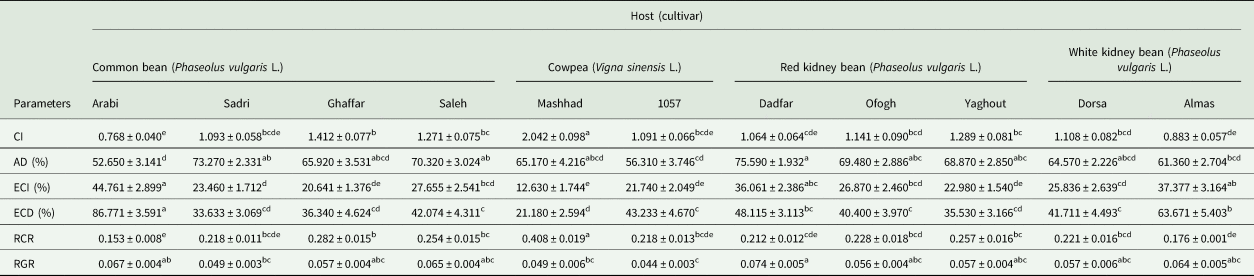
The results of the nutritional indices of third, fourth, fifth, sixth, and total larval instars of S. littoralis fed on the various bean cultivars are shown in tables 2–6. The CI of the third instar larvae reached its maximum value on the Mashhad cultivar (2.04), whereas the lowest CI value was recorded in those fed on the Arabi cultivar (0.76). The S. littoralis larvae fed on Dadfar and Arabi cultivars were shown to have the highest (75.59%) and lowest (52.65%) AD values, respectively. The highest (44.76 and 86.77%) and the lowest (12.63 and 21.18%) values for ECI and ECD indices were observed in the larvae reared on Arabi and Mashhad cultivars, respectively. The larvae reared on Mashhad and Arabi cultivars had the highest (0.40 mg mg−1 day−1) and the lowest (0.15 mg mg−1 day−1) RCR values, respectively. The highest value of RGR was achieved on the Dadfar cultivar (0.07 mg mg−1 day−1), while the lowest was recorded on the 1057 cultivar (0.04 mg mg−1 day−1).
Nutritional indices of the third instar larvae of Spodoptera littoralis fed on different bean cultivars

CI, consumption index; AD, approximate digestibility; ECI, efficiency of conversion of ingested food; ECD, efficiency of conversion of digested food; RCR, relative consumption rate; RGR, relative growth rate.
The means followed by different letters in the same rows are significantly different (Tukey, P < 0.01).
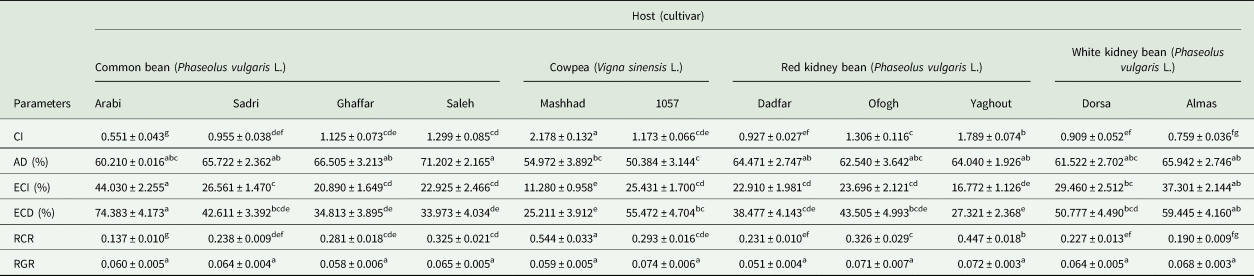
Nutritional indices of the fourth instar larvae of Spodoptera littoralis fed on different bean cultivars

CI, consumption index; AD, approximate digestibility; ECI, efficiency of conversion of ingested food; ECD, efficiency of conversion of digested food; RCR, relative consumption rate; RGR, relative growth rate.
The means followed by different letters in the same rows are significantly different (Tukey, P < 0.01).
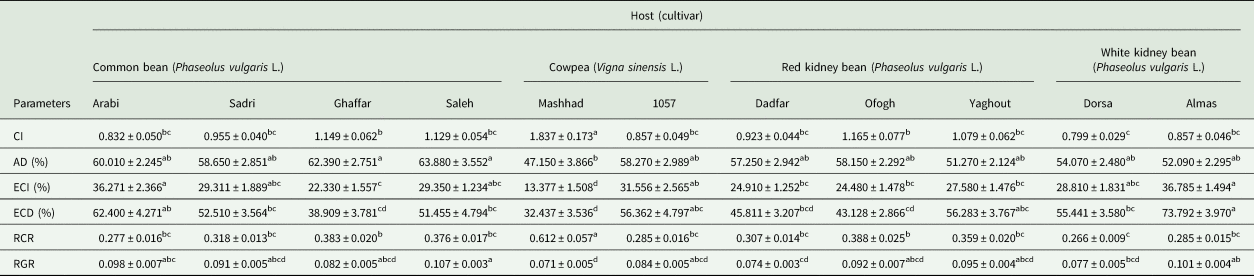
Nutritional indices of the fifth instar larvae of Spodoptera littoralis fed on different bean cultivars

CI, consumption index; AD, approximate digestibility; ECI, efficiency of conversion of ingested food; ECD, efficiency of conversion of digested food; RCR, relative consumption rate; RGR, relative growth rate.
The means followed by different letters in the same rows are significantly different (Tukey, P < 0.01).
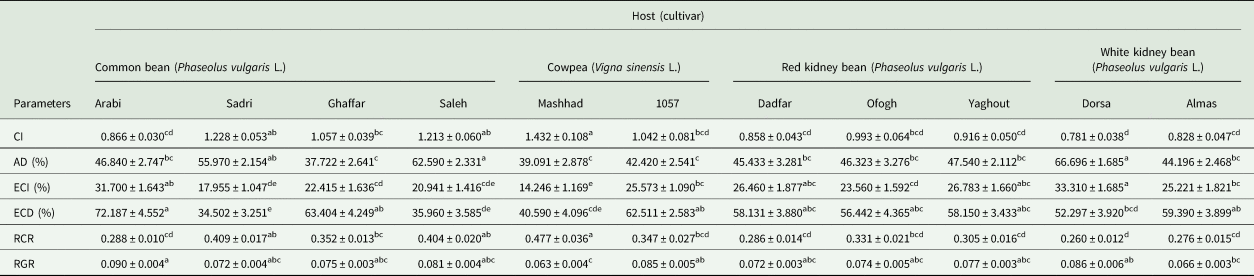
Nutritional indices of the sixth instar larvae of Spodoptera littoralis fed on different bean cultivars

CI, consumption index; AD, approximate digestibility; ECI, efficiency of conversion of ingested food; ECD, efficiency of conversion of digested food; RCR, relative consumption rate; RGR, relative growth rate.
The means followed by different letters in the same rows are significantly different (Tukey, P < 0.01).
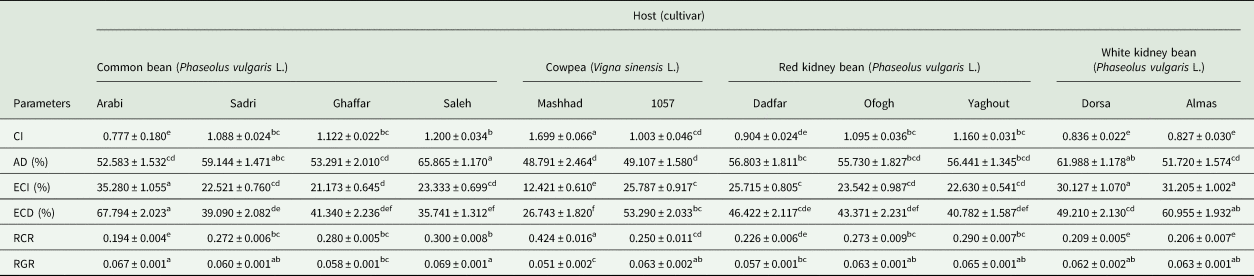
Nutritional indices of total larval instars of Spodoptera littoralis fed on different bean cultivars

CI, consumption index; AD, approximate digestibility; ECI, efficiency of conversion of ingested food; ECD, efficiency of conversion of digested food; RCR, relative consumption rate; RGR, relative growth rate.
The means followed by different letters in the same rows are significantly different (Tukey, P < 0.01).
The fourth instar larvae of S. littoralis fed with the leaves of Mashhad and Arabi cultivars showed the highest (2.17) and the lowest (0.55) CI values, respectively. The maximum (71.20%) and minimum (50.38%) values of the AD index were observed in the larvae fed by Saleh and 1057 cultivars, respectively. The lowest value of the ECI index was obtained on the Mashhad cultivar (11.28%). In contrast, the highest ECI was observed in larvae reared on the Arabi cultivar (44.03%). The highest ECD value was achieved on the Arabi cultivar (74.38%), while the lowest one was recorded on both Mashhad (25.21%) and Yaghout (27.32%) cultivars. On the other hand, the highest (0.54 mg mg−1 day−1) and the lowest (0.13 mg mg−1 day−1) RCR values were recorded on Mashhad and Arabi cultivars, respectively. However, no significant difference in RGR values was observed among larvae feeding on the different bean cultivars.
The CI value was found to be the highest (1.83) and the lowest (0.79) in the fifth instar larvae grown on Mashhad and Dorsa cultivars, respectively. The highest AD value was recorded in larvae reared on both Saleh (63.88%) and Ghaffar (62.39%) cultivars, and the lowest AD value was observed after feeding larvae with the Mashhad cultivar (47.15%). The highest ECI index was recorded in S. littoralis fed on Almas (36.78%) and Arabi (36.27%) cultivars, and the lowest one was observed in larvae grown on the Mashhad cultivar (13.37%). The larvae reared on Almas and Mashhad cultivars had maximum (73.79%) and minimum (32.43%) values of ECD, respectively. The S. littoralis larvae fed on Mashhad and Dorsa cultivars showed the highest (0.61 mg mg−1 day−1) and the lowest (0.26 mg mg−1 day−1) RCR values, respectively. The highest (0.10 mg mg−1 day−1) and lowest (0.07 mg mg−1 day−1) RGR values were achieved by rearing larvae on Saleh and Mashhad cultivars, respectively.
The highest (1.43) and lowest (0.78) CI values were recorded in the sixth instar larvae reared on Mashhad and Dorsa cultivars, respectively. The lowest AD value was recorded in the larvae raised on Ghaffar (37.72%), Mashhad (39.09%) and 1057 (42.42%) cultivars, respectively. The highest AD value was observed in the larvae grown on Dorsa (66.69%) and Saleh (62.59%) cultivars. The S. littoralis larvae that were fed with the Dorsa and Mashhad cultivars had the highest (33.31%) and the lowest (14.24%) ECI values, respectively. In contrast, the highest (0.47 mg mg−1 day−1) and the lowest (0.26 mg mg−1 day−1) RCR values were recorded in larvae fed on Mashhad and Dorsa cultivars, respectively. The larvae fed on Arabi and Sadri cultivars had the highest (72.18%) and lowest (34.50%) ECD values, respectively. The lowest (0.06 mg mg−1 day−1) and the highest (0.09 mg mg−1 day−1) RGR values were recorded in the larvae reared on Mashhad and Arabi cultivars, respectively.
The total larval instars of S. littoralis fed on the Mashhad cultivar were found to have the highest (1.69) CI values compared to those fed on other cultivars. The S. littoralis larvae fed on the Saleh cultivar had the highest AD value (65.86%), while the larvae reared on both Mashhad and 1057 cultivars had the lowest AD values of 48.79 and 49.10%, respectively. The lowest value of ECI index was observed in the larvae fed on the Mashhad cultivar (12.42%), whereas the highest ECI values were recorded on Arabi (35.28%), Almas (31.20%), and Dorsa (30.12%) cultivars. The lowest (26.74%) and the highest (67.79%) values of the ECD index were recorded in larvae reared on Mashhad and Arabi cultivars, respectively. The highest RCR value was observed in S. littoralis fed on the Mashhad cultivar (0.42 mg mg−1 day−1), yet the lowest RCR value was recorded in the larvae on Arabi (0.19 mg mg−1 day−1), Almas (0.20 mg mg−1 day−1), and Dorsa (0.21 mg mg−1 day−1) cultivars. The lowest value of the RGR index was observed in the larvae fed on the Mashhad cultivar (0.05 mg mg−1 day−1) and the highest value on Saleh (0.07 mg mg−1 day−1) and Arabi (0.06 mg mg−1 day−1) cultivars.
Determination of larval weight, food consumed, feces produced, and larval gain weight of S. littoralis
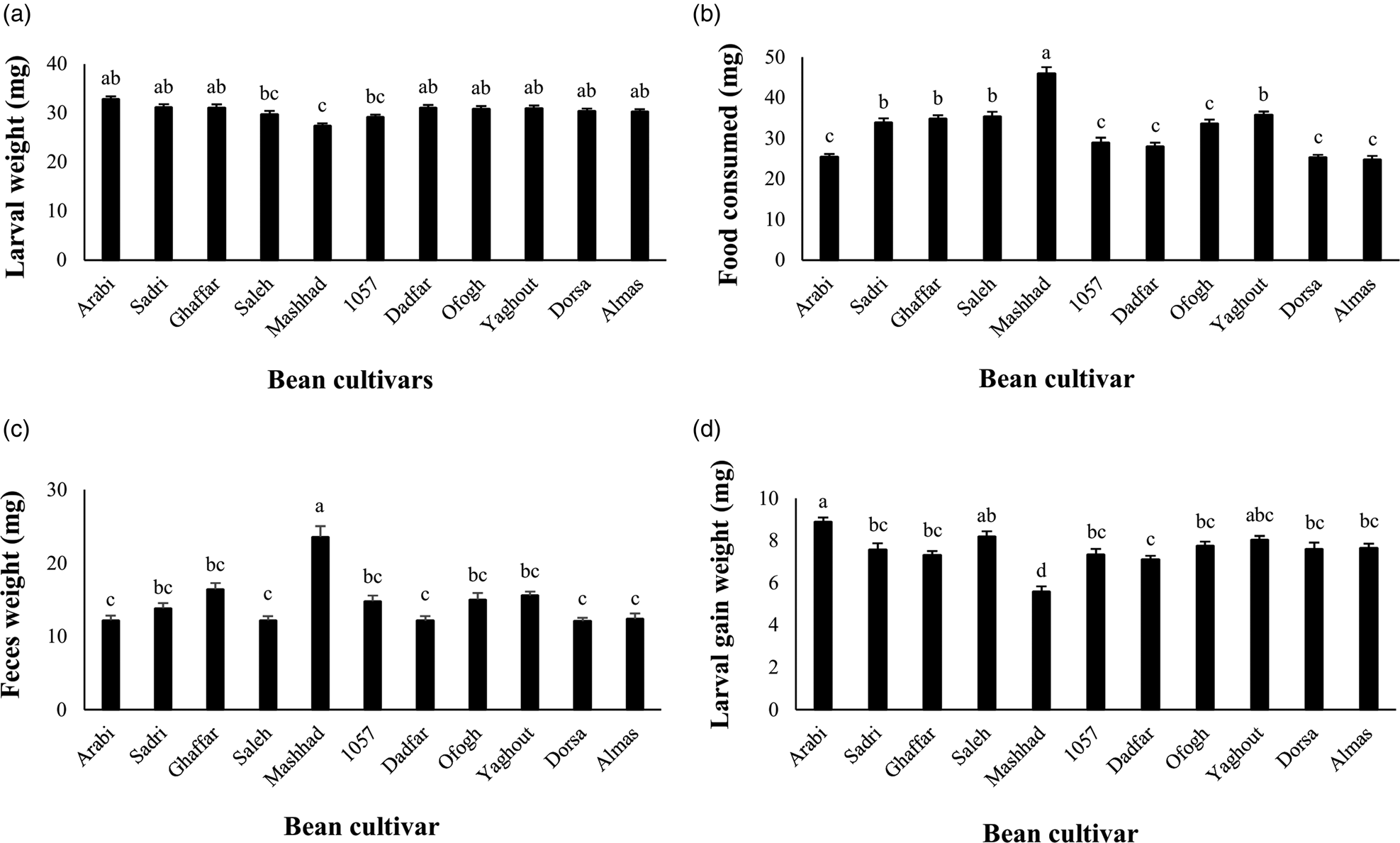
The lowest larval weight (27.38 mg) was achieved in S. littoralis larvae fed on the Mashhad cultivar (fig. 1a). The highest values of food consumed (46.06 mg) and feces produced (23.57 mg) were achieved in the total larval instars fed on the Mashhad cultivar (figs 1b, c). The larvae of S. littoralis fed on Arabi and Mashhad cultivars revealed the maximum (8.89 mg) and the minimum (5.60 mg) values of larval gain weight, respectively (fig. 1d)
(a) Mean larval weight, (b) food consumed, (c) feces produced, and (d) larval gain weight of Spodoptera littoralis for total larval instars on different bean cultivars. Bars represent standard errors of the means. The means followed by different letters are significantly different (Tukey, P < 0.01).

Determination of IPQ and SII of S. littoralis
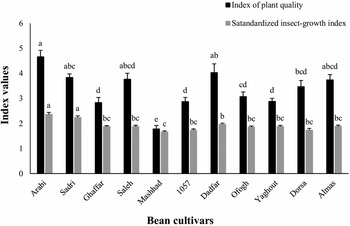
Significant differences in the IPQ and SII were observed in S. littoralis fed on different bean cultivars (fig. 2). The lowest and the highest values of IPQ were observed in Mashhad (1.78) and Arabi (4.66) cultivars, respectively. The maximum value of SII was obtained by growing larvae on Arabi (2.36) and Sadri (2.24) cultivars, whereas the minimum was recorded on the Mashhad cultivar (1.65).
Index of plant quality (IPQ) and standardized insect-growth index (SII) of Spodoptera littoralis fed on different bean cultivars. Bars represent standard errors of the means. The means followed by different letters are significantly different (Tukey, P < 0.01).

Cluster analysis
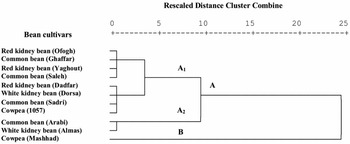
Dendrogram of nutritional indices generated from S. littoralis larvae fed on different bean cultivars is illustrated in fig. 3. Based on the comparison of nutritional indices, two different bean cultivar categories were revealed: group A and B. Group A consisted of A1 (Ofogh, Ghaffar, Yaghout, Saleh, Dadfar, Dorsa, Sadri and 1057 cultivars) and A2 (Arabi and Almas cultivars), which were considered as intermediate and suitable hosts, respectively. On the other hand, group B (Mashhad cultivar) was classified as a partially unsuitable host for S. littoralis larvae (fig. 3).
Dendrogram of bean cultivars based on the nutritional performance of Spodoptera littoralis fed on different bean cultivars (Ward's method).

Discussion
Organic foods with reduced pesticide exposure are increasingly demanded by health-conscious consumers throughout the world. To this end, resistant plant cultivars can be used to control herbivorous pests through antibiosis and resistance development due to toxins, antifeedants, and secondary metabolite compounds (Smith, Reference Smith2005; Hesler and Dashiell, Reference Hesler and Dashiell2011; Sulistyo and Inayati, Reference Sulistyo and Inayati2016). Our findings demonstrated that the tested bean cultivars accumulated different levels of secondary metabolites, which affected the nutritional indices of Egyptian cotton leafworm, suggesting the potential of host quality to affect the nutritional fitness of herbivorous insects.
As plant defense compounds against herbivores, secondary metabolites can delay the herbivorous pest growth (War et al., Reference War, Paulraj, War and Ignacimuthu2011a, Reference War, Paulraj, Ahmad, Buhroo, Hussain, Ignacimuthu and Sharma2012; Iason et al., Reference Iason, Dicke and Hartley2012). Phenolic compounds are the most significant secondary plant metabolites produced through the shikimic acid pathway from primary metabolites (Tsai et al., Reference Tsai, Harding, Tschaplinski, Lindroth and Yuan2006; Bernards and Bastrup, Reference Bernards, Bastrup-Spohr and Schaller2008; War et al., Reference War, Paulraj, War and Ignacimuthu2011b). In the current study, a significant difference in the total contents of anthocyanins, flavonoids, and phenols was found in the leaves of different bean cultivars. The high amount of total phenols content observed in the Mashhad cultivar might negatively affect the nutritional performance of S. littoralis. Previous studies demonstrated that the phenolic compounds in plant tissues caused a reduction in food consumption and growth rates of various insect herbivores, including Spodoptera litura Hübner, Epirrita autumnata Borkhausen, and Operophtera brumata (L.) (Stevenson et al., Reference Stevenson, Anderson, Blaney and Simmonds1993; Haukioja et al., Reference Haukioja, Ossipov and Lempa2002; Simmonds, Reference Simmonds2003). The lowest weight gain by S. littoralis larvae feeding on the Mashhad cultivar might be attributed to the insect's increased enzymatic activities in response to ingesting high levels of phenolic compounds present in the leaves of the Mashhad cultivar (War et al., Reference War, Paulraj, War and Ignacimuthu2011b). It was shown that phenolic contents in host plants could cause a reduction in reproductive performance and the development rate of insect pests (Mardani-Talaee et al., Reference Mardani-Talaee, Nouri-Ganblani, Razmjou, Hassanpour, Naseri and Asgharzadeh2016).
Nutritional indices help to understand the behavioral and physiological basis of insect pest response to various host plants (Lazarevic and Peric-Mataruga, Reference Lazarevic and Peric-Mataruga2003). Previous studies revealed that different plant cultivars affect the nutritional performance of S. littoralis (Ladhari et al., Reference Ladhari, Laarif, Omezzine and Haouala2013; Khedr et al., Reference Khedr, AL-Shannaf, Mead and Shaker2015; Khafagi et al., Reference Khafagi, Hegazi and Neama2016; Gacemi et al., Reference Gacemi, Taibi, Abed, M'hammedi Bouzina, Bellague and Tarmoul2019). Our findings showed that nutritional indices of S. littoralis were significantly affected by feeding on the leaves of various bean cultivars due to physiological differences.
The AD value reflects the nutritional value and the host suitability (host-plant biochemistry), which is crucial to understand the relationship between the quality of plant leaves consumed by the herbivore (Chapman, Reference Chapman1998). The lowest AD value observed in S. littoralis larvae fed on Mashhad and 1057 cultivars might contribute to qualitative and quantitative variations of plant defenses, such as high flavonoid and phenolic contents and low nitrogen content in the leaves, which reduce the digestibility of food for insects (Panizzi and Parra, Reference Panizzi and Parra2012). It has been shown that there is a positive relationship between the AD value and nitrogen contents of leaf tissues (Mattson, Reference Mattson1980). The value of the AD index of total larval instars of S. littoralis on the Mashhad cultivar was comparable to those reported by Ladhari et al. (Reference Ladhari, Laarif, Omezzine and Haouala2013), Khedr et al. (Reference Khedr, AL-Shannaf, Mead and Shaker2015), and Khafagi et al. (Reference Khafagi, Hegazi and Neama2016) on artificial diets (40.4%).
Variation in ECI and ECD can be related to differences in the chemical and physiological properties of the ingested food (Luthy and Wolfersberger, Reference Luthy, Wolfersberger, Charles, Decluse and Nielsen-LeRoux2000). The lowest values of ECI and ECD in the third, fourth, fifth, sixth, and total larval instars of S. littoralis were recorded on the Mashhad cultivar, indicating the higher metabolic cost (e.g., allelochemicals) affecting catabolism, and consequently, excretion (Koul et al., Reference Koul, Singh, Sing and Singh2004). It is well known that the optimal nutritional necessity differs mainly underpinning gender, stage, time, reproduction, physiological stress, diapause, and migration (Nation, Reference Nation2008). Studies have shown that the higher amounts of phenolics, lectins, H2O2, and other oxidative products of ROS (reactive oxygen species) in bean leaves directly damage the midgut epithelium of S. littoralis, leading to a reduction in the larval weight gain (Appel and Martin, Reference Appel and Martin1992; Koul et al., Reference Koul, Singh, Sing and Singh2004; Khedr et al., Reference Khedr, AL-Shannaf, Mead and Shaker2015). In general, ECI and ECD values are reduced due to antibiosis resistance traits of plants that interfere with the digestion and absorption of food by insects (Vandenborre et al., Reference Vandenborre, Miersch, Hause, Smagghe, Wasternack and Van Damme2009; Lukasik et al., Reference Lukasik, Kornacka, Goławska, Sytykiewicz, Sprawka and Wójcicka2017). The ECI and ECD values recorded for S. littoralis on the Mashhad cultivar were almost similar to those reported by Gacemi et al. (Reference Gacemi, Taibi, Abed, M'hammedi Bouzina, Bellague and Tarmoul2019) for the insects on potato (14.3%) and tomato (23.4%), respectively. The highest ECI and ECD values of total larval instars were achieved on the Arabi cultivar, which attributes to the high efficiency of larvae to convert the ingested food to biomass, possibly due to the high quality of this cultivar.
Despite recording the highest values of food consumption, CI and RCR indices in total larval instars on the Mashhad cultivar, ECI and ECD indices were the lowest on this cultivar. Decreased levels of ECI and ECD could have originated from the lower capability of larvae in converting the ingested and digested food to biomass and the consequent delay in the larval development on this cultivar. The amount of food consumption by insects depends on the presence of morphological structures (leaf surface, trichomes, cell wall thickness, and wax) as the first defensive barrier of host plants against herbivores, which affect the growth, the duration of ingestion and digestion, and metabolism in the insects (Hanley et al., Reference Hanley, Lamont, Fairbanks and Rafferty2007; Agrawal et al., Reference Agrawal, Fishbein, Jetter, Salminen, Goldstein, Freitag and Sparks2009).
It has been reported that the host plant quality is related to body biomass and the duration of development. Herbivorous larvae reared on a high-nutrient diet exhibit enhanced growth rates and complete immature stages faster than the larvae reared on a low-nutrient diet (Schroeder, Reference Schroeder1981). The lowest value of RGR in the fifth, sixth, and total larval instars was recorded on the Mashhad cultivar, indicating a reduction in growth rate and/or a more extended development period, which was attributed to the low nutritional value of this cultivar (Lazarevic and Peric-Mataruga, Reference Lazarevic and Peric-Mataruga2003; Hwang et al., Reference Hwang, Liu and Shen2008). The highest RGR values of the sixth and total instars of S. littoralis larvae on the Arabi cultivar revealed that there was a higher increase rate in larval weight per gram body weight per day, as well as a shorter larval development period on this cultivar, which shows a high nutrient level compared to the other cultivars.
In the present study, the lowest SII of S. littoralis was achieved on the Mashhad cultivar, probably because of the lowest IPQ value recorded for this cultivar. The high values of food consumption and feces production on the Mashhad cultivar might be related to the high total contents of phenolic compounds in the leaf tissues. The insect pests acquire essential compounds through digestion of foods, yet the presence of secondary metabolites in plant tissue affects the digestive capacity of insects to break down food into smaller components that support the growth of pests (Scriber and Slansky, Reference Scriber and Slansky1981; Price et al., Reference Price, Denno, Eubanks, Finke and Kaplan2011). In response to a reduction of absorbable nutrients, pests would consume more foods (Hemmati et al., Reference Hemmati, Takalloo, Taghdir, Mehrabadi, Balalaei, Moharramipour and Sajedi2021). In contrast to the Mashhad cultivar, the native cultivar (Arabi cultivar in Khuzestan province, Iran) had a higher IPQ value, reflecting the pest adaptation to consume the Arabi cultivar over time, and consequently, improved S. littoralis SII value as a suitable host for the insect.
The cluster analysis findings showed that clustering bean cultivars into one group might be related to the high level of physiological similarity of these cultivars. When comparing the nutritional performance of S. littoralis on different bean cultivars, it was revealed that subgroup A2 contained the suitable plant cultivars, and subgroup A1 consisted of an intermediate one. Nevertheless, the Mashhad cultivar in group B was a partially unsuitable host for S. littoralis, which could be due to the lowest value of IPQ and the highest contents of secondary metabolites or digestive enzyme inhibitors in this cultivar. Furthermore, the Mashhad cultivar might affect the performance of S. littoralis larvae through additional tolerance factors such as fortified cell walls, altered protein contents, other secondary metabolite classes, pest perception, and signaling pathways, etc.
The present research investigated herbivore–plant interactions between S. littoralis and 11 bean cultivars, and has revealed a complicated series of bottom-up effects; affecting all food levels. The findings revealed that the nutritional performance of S. littoralis larvae was significantly decreased on the Mashhad cultivar compared to the other cultivars. Furthermore, the level of total phenols content in leaf tissues of the Mashhad cultivar was considerably higher than others, which could lead to the increased tolerance of this cultivar against S. littoralis by affecting the physiological and biochemical processes of the pest. Our findings revealed that the Mashhad cultivar was a partially unsuitable cultivar for S. littoralis, and could be used in implementing effective control programs for S. littoralis. To collect additional applicable data to control S. littoralis, it is suggested to thoroughly investigate the population growth parameters of this insect pest under laboratory conditions.
Acknowledgements
This work was financially supported by Shahid Chamran University of Ahvaz (Grant No. SCU.AP98.400).
Conflict of interest
None.