Globally, disasters are on the rise. 1 While whole communities are negatively impacted by emergencies and disasters, certain groups, such as children, people with disabilities and those with other access and functional needs, are considered to be most at-risk for experiencing negative health outcomes as a result of disasters.Reference Baker and Cormier 2 Of these populations, children make up the largest vulnerable population the United StatesReference Dziuban, Peacock and Frogel 3 ; approximately 25% of the US population is under the age of 18. Children are at increased risk for experiencing several negative physical and mental health conditions as a result of an emergency or disaster.Reference Baker and Cormier 2 , Reference Dziuban, Peacock and Frogel 3 While there are some events, such as natural disasters, that cannot always be prevented, there are man-made, intentional events such as the Oklahoma City bombing or school shootings that may purposefully target children because of the emotional pain that can inflict on society as a whole.Reference Dziuban, Peacock and Frogel 3
Over the years, there has been increased interest in the topic of children and preparedness, with much of the attention being given to school-aged children. 4 , Reference Silverman, Chen and Brener 5 However, before entering kindergarten, approximately 61% of the nearly 20.4 million US children under the age of 5 spend time in a regular childcare setting.Reference Laughlin 6 With so many US children being in formalized childcare arrangements, there is a possibility that they will be separated from their families during emergencies; these children will then depend on their childcare providers for safety and support during these stressful situations.Reference Cornette and Pui-Ka 7 In recent years, the importance of protecting children in childcare settings has been brought to light with the promulgation of rules for the Child Care Development Block Grant Act of 2014, which requires childcare providers that receive federal funding to have a disaster plan in place.Reference Morgan 8
No known work has yet explored preparedness in childcare settings; therefore, the overall purpose of this study was to describe the perceived preparedness capabilities among US childcare providers. Two types of childcare providers were included in this study: (1) childcare centers and (2) residential family care providers. A childcare center is best described as a commercial building in the community, which has capacity to serve a large number of children and employs numerous staff members. In contrast, residential family care providers typically work independently (without additional staff) to deliver childcare in their own homes to a smaller number of children. An exploratory aim of this study was to assess differences in levels of perceived preparedness between those who provide care in childcare centers and those who provide care in their own residences.
METHODS
Participants and Procedures
In order to participate in this survey, participants had to be a childcare administrator of either a center or a residential family setting in the United States. A convenience sample was used to obtain survey data. Participants were recruited online for this study between October 2016 and April 2017 using a national childcare nonprofit’s website and newsletter to reach potential participants. Participants were directed to a link to complete the survey on SurveyMonkey.com. Surveys took approximately 10 minutes to complete. Survey participants were entered into a raffle for a $50 gift card to an online mass merchant. Miami University’s institutional review board approved this study.
Measures
The survey instrument was developed by the nonprofit’s preparedness team and deemed to have appropriate content validity. The survey contained items about preparedness planning and recovery and response as well as perceived preparedness for certain emergency situations (eg, fire, flooding).
Data Analysis
Data were analyzed using SPSS version 24.0 software. Descriptive statistics were calculated and chi-square tests were used to test for differences between childcare center providers and residential family childcare providers.
RESULTS
A total of 610 childcare administrators completed the survey: 235 childcare center administrators and 375 residential family childcare administrators. In both samples, the majority of respondents reported working in the field for more than 10 years; 77.40% (n=182) of childcare center administrators and 68.80% (n=258) of residential family childcare administrators reported having worked for more than 10 years in the early childhood industry.
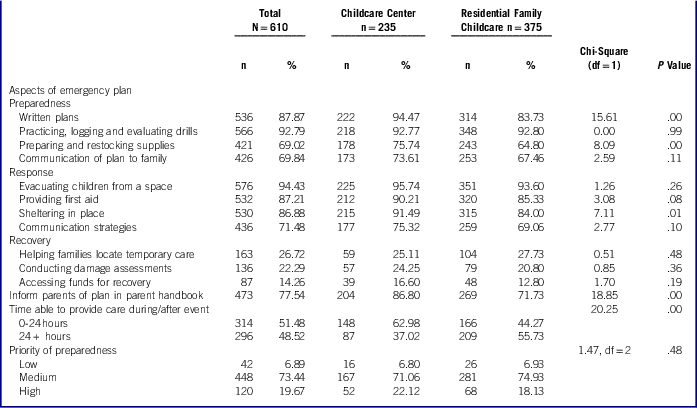
Regarding emergency plans among both center and residential family childcare administrators, preparedness (69.02% to 92.79%) and response (71.48% to 94.43%) aspects were reported to be included more frequently in plans than recovery (14.26% to 26.72%) aspects were (Table 1). Childcare centers were more likely to report that they had written plans (94.47%, n=222) than residential family childcare providers (83.73%, n=314) were (χ1 2=15.62; P<.001), and the childcare centers were more likely to report that they had plans for preparing/restocking supplies (75.74%; n=178) than the residential family childcare providers (64.80%; n=242) were (χ1 2=8.09; P<.001). In addition, childcare centers were more likely to report that they had plans for sheltering in place during a response (91.49%, n=215) than residential family childcare providers (84.00%, n=315) were (χ1 2=7.11; P=.01) (Table 1).
Differences in aspects of emergency plans by child care setting

Overall, 77.54% (n=473) of childcare administrators reported informing parents about their emergency plans in the parent handbook; childcare centers 86.80% (n=204) were more likely to report that they inform parents about emergency plans in the parent handbook than residential family childcare providers (71.73%; n=269) were (χ1 2=18.85; P<.001). Residential family childcare administrators (55.73%, n=209) reported being better able to provide care to children for longer than 24 hours during/after an emergency or disaster than childcare centers (37.02%; n=87) were (χ1 2=20.25; P<.001) (Table 1).
There were no significant differences between the perceived priority level (low, medium, high) of preparedness between childcare center administrators and residential family childcare administrators (χ2 2=1.47, P=.48); the majority of both types of providers rated preparedness as a medium priority (73.44%; n=448) (Table 1).
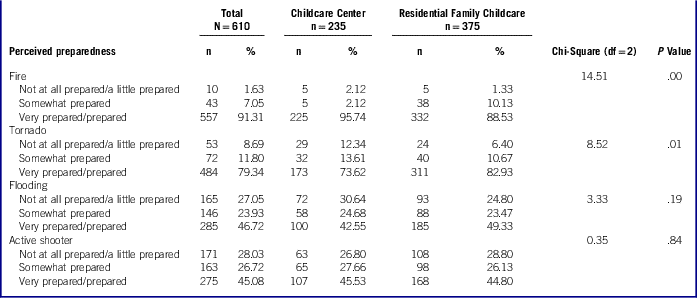
Overall, childcare administrators reported being most prepared (very prepared/prepared) for a fire (91.31%; n=557), followed by tornados (79.34%; n=484), floods (46.72%; n=285), and finally active shooter situations (45.08%; n=275). Childcare centers were more likely to report being very prepared/prepared for a fire (95.74%, n=225) than residential family childcare providers (88.53%, n=332) were (χ2 2=14.51; P<.001), while residential family childcare providers were more likely to report that they were very prepared/prepared for a tornado (82.93%; n=311) than childcare center providers (73.62%, n=173) were (χ2 2=8.52, P=.01) (Table 2).
Differences in perceptions of preparedness by child care setting

DISCUSSION
This was the first known study to examine emergency response plans, communication strategies, and perceived levels of preparedness among childcare administrators in the United States. In regard to having a written emergency response plan in place, the results of this study were promising. A total of 88% of childcare centers and residential family childcare providers reported having a written emergency response plan; one could infer that the mandates set forth by the states, and more recently by the Child Care Development Block Grant Act of 2014, for childcare providers who receive federal funding to have a disaster plan in place are contributing to these high rates of written plans.
Regarding communication plans with families during emergencies, the results were somewhat less promising as only 70% of centers and residential family childcare providers reported having such communication plans in place. In addition, the majority of both types of providers perceived preparedness as a medium-level priority (73%); from a preparedness perspective, it would be ideal if more providers viewed preparedness as a higher priority.
Overall, findings from this study indicate that there are a few notable differences between centers and residential family providers when it comes to preparedness. Fifty-six percent of residential family childcare providers reported being able to care for children for more than 24 hours during/after a disaster, while only 37% of childcare center administrators reported being able to provide care for more than 24 hours. This finding makes sense due to the environmental differences between childcare centers and residential family programs. Centers often operate more as a small business with employees and staffing issues, while residential family providers work out of their own homes and have less staffing-related issues, and they have access to amenities such as showers, bedrooms, etc. However, it must be noted that while residential family care providers indicated being able to care for children for longer periods of time than centers did, the family care providers were less likely to report having plans for restocking supplies than centers (65% vs 76%, respectively), which is a somewhat inconsistent finding, as supplies would be needed when caring for children for long periods of time.
Childcare center administrators were significantly more likely to report having written plans in place than did residential family childcare administrators (94% vs. 84%, respectively), as well as reported being more likely to communicate with parents about preparedness plans in a parent handbook (87% vs. 72%, respectively). Dissemination of childcare providers’ plans to parents ensures that parents know what to expect during an emergency and also allows for an opportunity for parents to engage in a dialogue about emergency issues with those entrusted to provide care to their children. According to guidance from Child Care Aware® of America, providers are encouraged to establish a series of preparedness touch-points with parents throughout the year to ensure emergency contact information is up-to-date and to provide a refresher to parents about emergency plans, procedures, and policies. 9
One key finding from this study was that 91% of childcare center administrators and residential family childcare administrators reported being very prepared/prepared for fire-related emergencies. Due to strict licensing regulations, which require childcare providers in all 50 states to engage in fire drills, this finding was not suprising. 10 While preparedness for fire-related emergencies is mandated through statewide regulations of childcare providers, other disasters/emergencies (eg, flooding, tornado, active shooter) are not subject to the same strict licensing regulations. 10 The lack of statewide licensing regulations for other disasters/emergencies may explain why the respondents’ levels of perceived preparedness for tornadoes (79% very prepared/prepared), flooding (47% very prepared/prepared), and active shooter situations (45% very prepared/prepared) were lower than their perceived level of preparedness for fire (91% very prepared/prepared).
Even though this was the first known study to examine and compare perceived levels of preparedness among childcare administrators in the United States, the study has limitations that must be noted. One of the main limitations of this study was its use of convenience sampling to collect survey data, which does not allow for generalization to the entire population (only to those who completed the survey). In addition, respondents self-reported their data on an online survey platform, which could potentially introduce response bias. Lastly, the survey questionnaire only examined a few possible emergencies (eg, fire, flooding) and did not contain questions about several other possible emergencies (eg, communicable disease outbreaks, snow storms, hurricanes).
CONCLUSIONS
While this study was a first step in describing the perceived levels of preparedness among childcare providers, much more work is needed in the areas of research and practice. Future work should assess how childcare providers respond to and recover from emergencies and disasters. Having state-level licensing regulations requiring providers to have emergency plans in place is perhaps is the most effective way to reach childcare providers and ensure that they are at least somewhat prepared. However, having a plan is one thing, executing that plan is another. In order to ensure that childcare providers are comfortable executing these plans, additional resources such as educational trainings, technical assistance offerings and easy-to-use materials are needed. It is not a question of whether or not another disaster or emergency event will occur; it is a matter of when and where the next event will occur. There is a societal responsibility to our nation’s children to ensure that they are protected and that their caregivers are as trained and as well prepared as possible to handle the next event whenever and wherever it may occur.