Research on extensive reading has provided evidence on the role of repetition in lexical learning from L2 reading (e.g., Chen & Truscott, Reference Chen and Truscott2010; Horst, Reference Horst2005; Rott, Reference Rott1999; Waring & Nation, Reference Waring and Nation2004; Webb, Reference Webb2007). By contrast, eye-movement studies on reading behavior have documented the cognitive effects of repetition on lexical processing and the associated lexical retention in terms of online processing patterns and the eye-mind link hypothesis (Godfroid, Boers, & Housen, Reference Godfroid, Boers and Housen2013; Juhasz & Pollatsek, Reference Juhasz, Pollatsek, Liversedge, Gilchrist and Everling2011; Pellicer-Sánchez, 2016; Rayner & Well, Reference Rayner and Well1996). The present study aimed to bring together methods from both strands to investigate incidental vocabulary acquisition from L2 reading and track the cognitive effects of repetition on the development of vocabulary knowledge and form-meaning connection.
BACKGROUND
Incidental Word Learning and Exposure Frequency
Incidental word learning has been defined as the potential to acquire vocabulary as a by-product of reading for meaning (Paribakht & Wesche, Reference Paribakht and Wesche1999). Although incidental learning has been characterized as slow and inefficient in terms of acquisition and retention (e.g., Laufer, Reference Laufer2003, Reference Laufer2005; Macaro, Reference Macaro2003; Read, Reference Read2004), many researchers and teachers believe it is an essential supplement for learners to independently expand their vocabulary (see Schmitt, Reference Schmitt2008, Reference Schmitt2010). This kind of learning is usually incremental, beginning with knowledge of form and gradually building to form-meaning connection as a function of repeated exposures in different contexts (Webb, Reference Webb2007). A series of studies on extensive reading has constituted a major line of research in vocabulary acquisition. The classic study of Saragi, Nation, and Meister (Reference Saragi, Nation and Meister1978) used the novel A Clockwork Orange (1962) by Anthony Burgess. It was of particular interest because it included Russian slang words, referred to as Nadsat, which served as the targets in the authors’ reading experiment. They found that native English speakers could learn an average of 76% of 90 Russian slang words used in the novel. Pitts, White, and Krashen (Reference Pitts, White and Krashen1989) used one chapter of the same novel with second language readers and found modest rates of learning, about 6.4% to 8.1% of 30 target Russian words. Day, Omura, and Hiramatsu (Reference Day, Omura and Hiramatsu1991) reported that Japanese EFL learners learned an average of 3 words out of 17 target words encountered in a simplified short story, The Mystery of the African Mask. Horst, Cobb, and Meara (Reference Horst, Cobb and Meara1998) had learners read a simplified version of The Mayor of Casterbridge, and reported that learners could pick up an average of 11% of the target words. Horst (Reference Horst2005) showed that readers picked up around 51% of the target words from selected extracts of different graded readers. Waring and Takaki (Reference Waring and Takaki2003) used the 400 headwords graded reader A Little Princess. They found that learners scored higher in meaning recognition of the target words than productive translation and that scores in both tests dropped sharply after three months. Pigada and Schmitt (Reference Pigada and Schmitt2006) found that a French learner showed considerable improvement in word spelling but a lesser command of meaning and grammatical knowledge after one month of extensive reading, with overall gains in 69% of the target words. Webb (Reference Webb2007) reported that vocabulary encounters in reading positively reinforced spelling, associations, syntax, grammatical functions, and form-meaning mapping. Pellicer-Sánchez and Schmitt (Reference Pellicer-Sánchez and Schmitt2010), using the authentic novel Things Fall Apart, found that meaning recognition reached 84% after 10 exposures while performance on meaning recall was much lower, around 55%.
In particular, extensive reading research have highlighted the role of repeated encounters. For example, Rott (Reference Rott1999) found that six exposures led to better word retention than two or four exposures in reading comprehension. Horst, Cobb, and Meara (Reference Horst, Cobb and Meara1998) found that words that appeared eight or more times in a long novel had a better chance of being learned by most of the participants than words that appeared less often. Several studies agreed on 10+ exposures for a reliable grasp of form-meaning connection (Pellicer-Sánchez & Schmitt, Reference Pellicer-Sánchez and Schmitt2010; Pigada & Schmitt, Reference Pigada and Schmitt2006; Webb, Reference Webb2007). Waring and Takaki (Reference Waring and Takaki2003), however, suggested that learners may need up to 20 encounters with target words for substantial acquisition to be achieved. Recently, Webb and Chang (Reference Webb and Chang2015a) went beyond the limited-span single-text studies and conducted a wide-scale study where students read multiple graded readers over an extended period with 100 target words tested. While sizable relative gains were found in the posttest (44.6%) and good retention was maintained (36.6%), the relationship between repeated encounters and learning gains was not significant. The authors thus postulated that there is no specific number of encounters that guarantee acquisition and that the role of repetition is affected by many variables including proficiency (Zahar, Cobb, & Spada, Reference Zahar, Cobb and Spada2001), background knowledge (Pulido, Reference Pulido2004), or contextual information (Webb, Reference Webb2008). In their own study, the authors believed that the audio support, discussion of stories, and the use of journals and dictionaries were all combined factors that increased comprehension and vocabulary learning. They maintained that repetition may yield immediate learning outcomes but other factors come into play in the long term. In a later study, the same authors (2015b) additionally found that vocabulary size and prior word knowledge, rather than repetition, were significantly associated with the amount of learning gains readers could retain from multiple readings over time.
This body of literature suggests that repeated exposure to new vocabulary in L2 reading is a crucially important factor; however, it is certainly not the only one. Because all these studies presented only paper-and-pencil results with learning tested offline at the end of the experiment, researchers are unable to make claims about what happens in the mind of readers when they encounter unfamiliar words in text. Studies that used think-aloud protocols (e.g., Bengeleil & Paribakht, Reference Bengeleil and Paribakht2004; Fraser, Reference Fraser1999; Paribakht & Wesche, Reference Paribakht and Wesche1999) or retrospective interviews can probe into some aspects of these cognitive processes by showing how learners utilized context clues and other linguistic resources. However, neither method can capture real-time processing or signal how processing can be affected by repeated encounters and contextual properties. One approach to investigate this issue is to combine online measures with offline testing to track processing and associate it with learning outcomes. Eye-movement methodology is currently a popular and precise technique to answer these questions (Godfroid et al., Reference Godfroid, Boers and Housen2013).
Eye Movement in Reading Research
Eye-tracking literature demonstrates that eye movements provide an accurate representation of the cognitive processes in the reader’s mind. This assumption was coined the “eye-mind” link, which proposes a connection between overt and covert attention (Rayner, Reference Rayner1998, Reference Rayner2009). In collecting eye-movement measures, reading studies most commonly report fixation durations. First fixation duration refers to the duration (in milliseconds) of a reader’s first fixation in an area of interest (e.g., a word or a series of words). Gaze duration combines the sum of all fixations made on a single interest area before exiting it to the left or to the right. Total reading time includes the sum of all fixation durations on an interest area (see Winke, Godfroid, & Gass, Reference Winke, Godfroid and Gass2013). A distinction is usually made between early measures (first fixation duration and gaze duration) that tap into the initial stages of lexical access, and late measures (total reading times), which indicate later processes of form-meaning encoding and semantic integration (Reichle, Warren, & McConnell, Reference Reichle, Warren and McConnell2009). Other reported reading behaviors include skipping—which most commonly occurs with familiar, high-frequency, and shorter words—and regression, which involves going back to the target area for reanalysis (Rayner & Juhasz, Reference Rayner and Juhasz2004).
Many eye-movement studies have looked at native and nonnative speakers’ processing of written input (e.g., Ashby, Rayner, & Clifton, Reference Ashby, Rayner and Clifton2005; Clifton, Staub, & Rayner, Reference Clifton, Staub, Rayner, van Gompel, Fischer, Murray and Hill2007). Online processing patterns were found to be influenced by predictability, which was associated with shorter and fewer fixations (Kliegl, Grabner, Rolfs, & Engbert, Reference Kliegl, Grabner, Rolfs and Engbert2004). Similar results were found for the effects of word frequency, word familiarity, and age of acquisition (Joseph, Wonnacott, Forbes, & Nation, Reference Joseph, Wonnacott, Forbes and Nation2014; Rayner, Reference Rayner1998; Rayner & Well Reference Rayner and Well1996; Williams & Morris, Reference Williams and Morris2004). These findings generally supported the assumption that more time is spent processing novel, unfamiliar, or low-frequency words than familiar or high-frequency words (Chaffin, Morris, & Seely, Reference Chaffin, Morris and Seely2001; Godfroid et al., Reference Godfroid, Boers and Housen2013; Pellicer-Sánchez, Reference Pellicer-Sánchez2016; Williams & Morris, Reference Williams and Morris2004).
Several studies have investigated how readers responded to repeated encounters with target words. Hyönä and Niemi (Reference Hyönä and Niemi1990) used the repeated reading paradigm with Finnish readers. The readers’ fixation times decreased consistently from the first to the third encounter with target sentences, and the number of their progressive fixations and regressions also decreased. Similarly, Raney and Rayner (Reference Raney and Rayner1995) and Rayner, Raney, and Pollatsek (Reference Rayner, Raney, Pollatsek, Lorch and O’Brien1995) investigated the effects of repeated exposure on native English speakers’ second reading performance. They found that individuals had shorter reading times, made fewer fixations, and had longer saccades during the second reading of the same text. Moreover, shorter fixation durations were associated with high-frequency words, suggesting independent effects of word frequency and repetition on reading times. Joseph and colleagues (2014) found significant decreases in reading times as a function of number of exposures and shorter reading times for novel words that had been presented earlier in the text than for those only presented later. Early words were remembered more accurately in an offline posttest.
Online Processing and Vocabulary Learning
Few studies have specifically investigated the potential association between online processing patterns and word learning. In the L1 context, Chaffin and colleagues (2001) found that the familiarity of target words and context quality (informative or neutral) determined the amount of time readers spent on the target words; learners fixated the most on novel words encountered in neutral contexts. No vocabulary posttest was conducted to check for learning, but the results implied that readers might have acquired some novel words from the text. Williams and Morris (Reference Williams and Morris2004) examined the effect of word familiarity in reading comprehension and word recognition. They found that readers spent more processing time on novel words than familiar words, and that there was a systematic relationship between online processing patterns (i.e., reading times) and retention of new word meanings. Brusnighan and Folk (Reference Brusnighan and Folk2012) found that readers spent more time processing sentences that contained novel compound words and that they could retain new word meanings from a single exposure. There was a strong relationship between increased processing times and accuracy in vocabulary retention measures in this study.
In the L2 context, Godfroid and colleagues (2013) extended the eye-movement investigation to longer, more coherent paragraphs. Twenty-eight advanced EFL learners read 12 short paragraphs with target words that consisted of known words, pseudo words, or a combination of both. Readers fixated longer on pseudo words than on known words. The testing consisted of a gap-filling multiple-choice measure where students selected from 18 options. The results showed that total reading time was a significant predictor of the probability of word recognition in a surprise posttest. Better recognition scores were associated with longer processing times. This study is innovative in L2 vocabulary research by bringing attention to a robust method of quantifying the cognitive processes underlying incidental learning. Their results captured the effect of encountering novel words in a single exposure and reflected one aspect of vocabulary learning, which is recognition.
Pellicer-Sánchez (Reference Pellicer-Sánchez2016) extended the investigation of online processing to a longer story (2,330 words) with six target pseudo words and six familiar (control) words, each repeated eight times. The testing included form recognition, meaning recognition, and meaning recall. The participants were 23 L2 speakers of English from diverse L1 backgrounds. The results showed that for nonwords, learners recognized the form at 86% and the meaning at 75%, while their meaning recall was at 55%. Target words were read relatively faster after three or four repetitions, while by the eighth encounter their speed almost matched that of the familiar words. There was a positive association between online reading measures and vocabulary learning outcomes, with longer reading times associated with higher vocabulary gains.
Goals of the Study
Many paper-and-pencil studies on L2 reading have pointed to the importance of repeated encounters in developing vocabulary knowledge while maintaining that there is no set number of repetitions that guarantee learning (Webb & Chang, Reference Webb and Chang2015a). Eye-movement approaches have tapped into the cognitive processes of encountering unfamiliar words both in a single exposure (Godfroid et al., Reference Godfroid, Boers and Housen2013) and eight exposures (Pellicer-Sánchez, Reference Pellicer-Sánchez2016). After tracking moment-by-moment interaction with reading texts, both studies could provide a cognitive picture of the factors that increase or decrease attention to target words with a closer study of the variance found in vocabulary learning as a function of repetition and how processing patterns change in response to meeting novel words repeatedly. The present study builds on both studies to seek more insight into the cognitive effects of repeated encounters in a more authentic source of extensive reading and through more exposures in the natural context of reading. Because the goal of extensive reading is to expose learners to large quantities of material within their linguistic competence and provide opportunities for incidental vocabulary acquisition (Grabe & Stoller, Reference Grabe and Stoller2011), learning outcomes are ideally tracked longitudinally over time and through multiple texts (Schmitt, Reference Schmitt2010; Webb & Chang, Reference Webb and Chang2015a). The current study can thus be categorized under incidental vocabulary learning research that derives methodology from extensive reading studies by using a single text from one of the graded readers adapted for extensive reading programs.
Participants read a stage 1 graded reader, Goodbye Mr. Hollywood by John Escott, on a computer screen while their eye movements were recorded. The reading text included 20 novel and 20 familiar words in a range of repetition from 1 to 30. They were subsequently tested on form recognition, meaning recognition, and meaning recall of target words. To investigate the holistic effects of attention and exposure, processing measures were analyzed and compared with learning outcomes to investigate what factors would override or support the roles of the number of encounters to novel words in L2 reading environment.
CURRENT STUDY
Research Questions
The current study is guided by the following research questions:
RQ1. What processing patterns do learners of English exhibit for novel lexical items in silent reading relative to known control items? And what is the effect of repeated encounters on the processing of novel words compared to control words in the text?
RQ2. What is the effect of exposure frequency on the acquisition of receptive and productive knowledge of word form and meaning, as measured in vocabulary posttests?
RQ3. To what extent do eye-fixation times on novel words predict the learning gains of L2 readers in the vocabulary knowledge posttests?
Participants
The participants in this study were 42 advanced second language learners of English (22 females and 20 males) ranging in age from 19 to 35 (M = 22, SD = 4.2). Thirty participants were undergraduate international students with diverse majors who were also enrolled in advanced ESL reading and writing classes, and 12 participants were graduate students mostly majoring in scientific and engineering fields. Participants represented different language backgrounds including Chinese (N =13), Arabic (N = 4), Spanish (N = 5), Portuguese (N = 5), Japanese (N = 5), African languages (N = 5), and Hindi (N = 2), in addition to single representations for Korean, Polish, and Russian. Proficiency levels were determined based on self-reports of recent TOEFL IBT scores that ranged from 79 to 100 (M = 89, SD = 7.3). Their vocabulary sizes, measured at the 5K level using Meara’s (Reference Meara1992) vocabulary size test, yielded an average of 3,908 (SD = 659).
Materials
Vocabulary Size Test
To confirm that students’ vocabulary levels matched the selected reading material, a yes-no vocabulary size measure, adapted from Meara (Reference Meara1992), was administered prior to the experimental session. The test comprised five levels targeting the first 5,000 most frequent words according to Nation (Reference Nation2001). Each level contained 60 words (40 real words and 20 nonwords). The score on each level is calculated based on the estimation of hits (real words checked as known) against false alarms (nonwords checked as known). A participant’s vocabulary size at 5K is estimated as the sum of scores across the five levels multiplied by 10. This particular test was selected for its quick administration in addition to the fact that the experimental reading material targeted the 5K level in lexical coverage. Examples of this test can be found online at http://www.lextutor.ca/tests/.
Reading Material
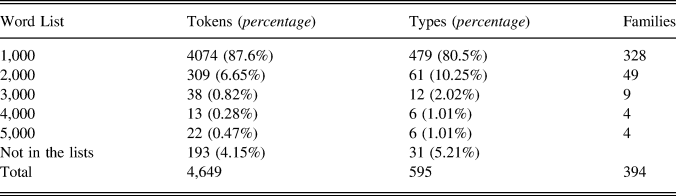
Several short novels were reviewed for content and length and then analyzed through the Range software (Heatley, Nation, & Coxhead, Reference Heatley, Nation and Coxhead2002), which lists the words in a given text according to their frequency and word families. The final selection was a short novel called Goodbye Mr. Hollywood by John Escott, which is a stage 1 (400 headwords) graded reader made available through the Bookworms Library, Oxford University Press. It is available in print with a word count of 5,400 (642 word types and 372 word families) and classified under thriller and adventure stories. The text was cut down to 4,649 words (595 types and 394 word families) to reduce the time requirement for the experiment. Accordingly, the lexical density (types/tokens ratio) was not high (12.9%). Range output confirmed that the lexical coverage of the story is at the 5,000-word level. Proper nouns constituted around 4% of the text. Table 1 outlines the lexical distribution of the text across frequency levels.
Lexical profile of Goodbye Mr. Hollywood

Target Words
Two versions of the story were created, each including 20 target words and 20 control words with occurrences ranging from 1 to 30. The target words were changed into matching pseudo words retrieved from online resources, especially the ARC Nonword Database (http://www.cogsci.mq.edu.au/∼nwdb/) and previous vocabulary research (Godfroid et al., Reference Godfroid, Boers and Housen2013; Webb, Reference Webb2007, Reference Webb2008). The pseudo words in version A appeared in their familiar forms in version B and vice versa. With this procedure, the two versions were counterbalanced and every pseudo word in a given context had a familiar counterpart in the other text version. To minimize item effect and visual influences on eye movements, the pseudo words were matched with familiar counterparts in part of speech and number of letters and syllables. The pseudo words were shared with native speakers to ensure they were English-like, readable, not easily confused with any other familiar word or rhyming with the actual word they represented. In the following text are two examples of how the target words appeared in the reading. In example 1, the pseudo word replaced “push” while in the second example it replaced “kill.”
(1) Version A: “The Man with the white hair tried to blef me in front of a car in Vancouver,” Nick said. “I am sure he did. I did not fall by myself.”
(2) Version B: Nick returned to his car. There was a letter on the window. Nick read. It said: “I am going to blef you, Mr. Hollywood.”
To estimate context predictability, a modified cloze procedure was conducted. The story versions were circulated online to native speakers who were asked to intuitively fill in gaps with appropriate real words. Each story version contained 121 gaps representing the 20 target words in different encounters through the text. A total of 108 responses were received (56 in version A and 52 in version B). Context predictability was calculated as the proportion of a correct answer over the total number of responses for an item. Generally, predictability of individual tokens ranged between 5% and 96%. This procedure was conducted to ensure that the story is quite comprehensible to second language readers and that the contexts are fairly transparent. The list of target words with number of encounters and their predictability ranges are provided in Appendix A. Based on the previous lexical profile, the total number of pseudo tokens in the story was 121, which accounted for 2.6% of the total tokens in the text. This guaranteed that the reading material provided approximately 97.4% of lexical coverage, which falls within the recommended lexical coverage range (95%–98%) to ensure reading comprehension and the ability to guess novel words from context (Nation, Reference Nation2006).
Comprehension Packet
A 50-item comprehension test (5–8 items per chapter) was created to monitor readers’ understanding of the main content of the story. The items included a combination of true/false statements and multiple-choice questions, depending on the content of each chapter. The test was printed out in seven pages (one page per chapter) along with characters’ illustrations copied from the story book to foster reader engagement and visualization of the content.
Vocabulary Tests
Three vocabulary tests were prepared to measure form recognition, meaning recognition, and meaning recall of the target pseudo words.
(1) Form recognition. The form recognition test comprised 100 vocabulary items including the 20 target pseudo words, familiar words from the text and other sources, and pseudo words out of the text. The pseudo words were mostly orthographically close to the target words and were selected in the same range of length and number of syllables. The familiar words were chosen either from the text or from concrete words that were relevant to the story. Participants were instructed to circle only the words that were seen in the reading material. The scoring for the test was based on the number of correctly selected pseudo words that occurred in the text. A sample from the test is provided in Appendix B.
(2) Meaning recall. The meaning recall test included the 20 target pseudo words in addition to 10 distractor items that represented pseudo words not in the text, familiar words from the text, and other English words relevant to the story. The task was to recall meanings or synonyms for the given items. Scoring was based on supplying the exact word or close synonym relevant to the story. For example, acceptable responses for the word “hotel” were motel, inn, or hostel but answers like building or apartment were not accepted. A sample of the meaning recall test is provided in Appendix C.
(3) Meaning recognition. The meaning recognition test was a multiple-choice test with 30 items covering the target words along with other additional pseudo words, familiar words from the text, and others relevant to the story. Each item had five meaning options in addition to an “I don’t know” option to minimize guessing. All options were semantically possible and relevant to the story to avoid any bias effect. A sample of the test is provided in Appendix D.
Procedure
Apparatus
Eye-movement recording during silent reading was done with the desktop-mounted version of the EyeLink 1000, an eye-tracker manufactured by SR Research (http://www.sr-research.com/). The text was typed in Courier New font size 18, on a 19-inch computer monitor set up 55 cm from the participants’ eyes. The font color was black on a light grey background. The full experiment file consisted of 87 screens including introductory pages, instructions, and break transitions. The main story content was thus provided in 70 screens, each containing 60 to 70 words in double-spaced text. Minor editing was performed on the displayed text to assure that target words did not appear in the beginning of screens or at the beginning and/or end of sentences because it was found that targets in these positions either receive longer fixations or get skipped. Breaks were offered at the end of each chapter that ranged between 7 and 11 screens. Eye calibration was set to be performed at the beginning of the experiment and after breaks. Participants advanced from one screen to another using a button on the right side of a handheld controller. Drift correction was set up at the beginning of each screen. Participants placed their heads on a chin and forehead rest during reading time to minimize head movements.
The Reading Session
Participants were randomly assigned to either version A or B of the story. Once they finished a chapter, a break prompt appeared on the screen. At the beginning of the break, they took the comprehension packet on the side of the desk and responded only to the questions on the chapter they had just finished. When ready, they returned to the chin rest and performed calibration for the following chapter. When the participant reached the end of the story, they would complete the last page in the comprehension packet, then move to another desk in the lab to complete the posttests. The reading session for each participant, including calibration, breaks and comprehension check, took an average of 45 to 70 minutes.
The Testing Session
Participants took the vocabulary tests in the following order to avoid transfer effects: form recognition, meaning recall, and meaning recognition. The testing session for an average participant took a maximum of 15 minutes.
Analyses
Definition of Variables
I distinguish between online and offline effects on vocabulary outcomes. Online variables refer to the information in eye-movement records that includes early measures of processing (e.g., first fixation and gaze duration) and late processing measures (e.g., total times). I also report skipping rates, regressions-in, and regressions-out of the interest areas. Regressions-in refer to instances when readers returned to a target word after having fixated the word and exited it to the right. Regressions-out refer to times when readers’ gaze durations (GDs) on a word were followed by regressions to words previously read before exiting the word to the right. These processing measures are reported for each of the target tokens as well as summed over vocabulary items to test if eye-movement behavior predicts learning outcomes in token-based and item-based analyses.
Total exposure is treated as an offline item-based factor that represents the number of times a vocabulary item was seen in the text. Based on exposure, each item contributed a different number of tokens. The instance of meeting a single token was labeled as an “encounter.” Because there are two versions of the reading material where target and control words were counterbalanced, each participant contributed reading times to two conditions: experimental and control. The factor of condition was used to describe differences in processing measures and reading behavior between the target words (pseudo words) and control words (familiar English words). Vocabulary outcomes, scored as 0 or 1 for each item, represented three categorical dependent variables in the statistical models: one for form recognition, one for meaning recognition, and the third for meaning recall.
Data Structure
Each participant contributed 242 observations, representing the total number of experimental and control tokens. The layout of the data showed items nested within subjects, and encounters nested within items. Based on this hierarchical structure, I adopted a generalized linear mixed model (GLMM) to fit the appropriate regression that can accommodate multiple levels (Heck, Thomas, & Tabata, Reference Heck, Thomas and Tabata2012). GLMM is conducted with two levels when we test by vocabulary item so that the model would only include subject variables and item variables in repeated measures. The model expands to three levels when we need to test the level of encounter including information about all the tokens of all items.
Reporting Results
The GLMM output calculates the probability of the incidence of a dependent variable in terms of an odds ratio (OR), quantifying the predicted change in the dependent measure as a function of a one unit increase in a given predictor (Ferguson, Reference Ferguson2009). An OR larger than one indicates a positive relationship and an OR less than one indicates a negative relationship. The interpretation of an OR varies according to the type of the dependent variable. For example, if encounter predicted fixation times (continuous variable) with an OR of 0.25, this would indicate that one additional encounter predicts a percent decrease in fixation times by 75% (1 – 0.25 * 100%). By contrast, if repeated exposure predicted form recognition (binary categorical variable) with an OR of 1.75, this would indicate that one extra exposure was associated with an increase in the odds of correct responses in form recognition by 75% (1.75 – 1 * 100%). A strong relationship starts at OR < 0.33 or OR > 3 (Ferguson, Reference Ferguson2009; Menard, Reference Menard2010; Powers & Xie, Reference Powers and Xie2008).
RESULTS
Online Reading Patterns
First Fixation Durations
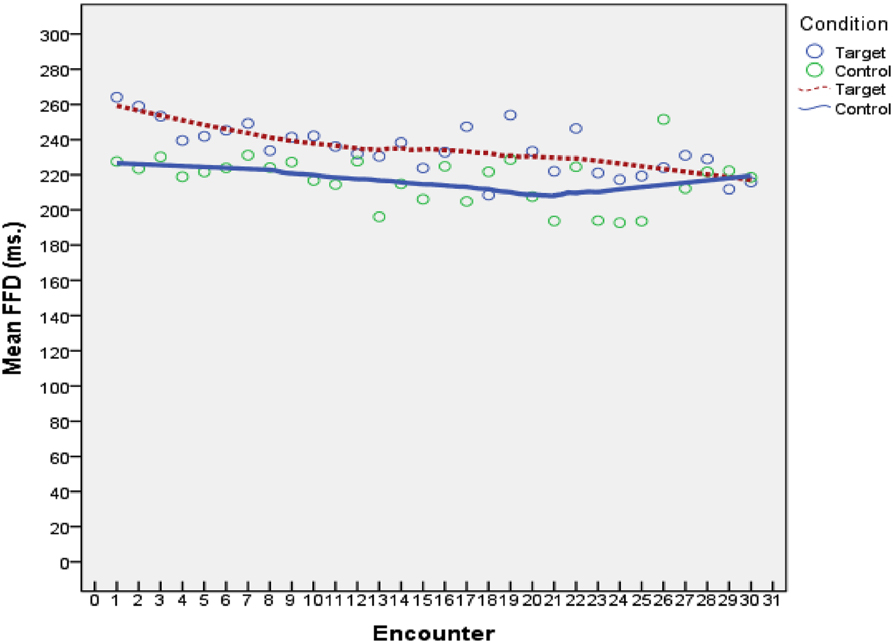
Figure 1 shows that first fixation durations on target words started at an average of 264 ms (SD = 124) and ended with 215 ms (SD = 88), while first fixations on control words started at 227 ms (SD = 86) and ended at 218 ms (SD = 88). Visually, there were no major changes in fixation times from first to last encounter or major differences between conditions. Condition significantly predicted first fixation (OR = 1.08, 95% CI = [1.04, 1.12], p < .001), implying that fixation times in the experimental condition were significantly longer than in the control condition and the probability of fixating longer on a target word increased by about 8% when the word was unfamiliar. Encounter was slightly associated with a decrease in first fixation durations (OR = 0.98, 95% CI = [0.967, 0.993], p < .001), implying that adding more encounters was associated with a negative change in first fixation durations by a factor of 2%. There was a significant interaction between encounter and condition (OR = 1.01, 95% CI = [1.005, 1.03], p < .001), which implies that target and control words started to behave similarly as number of encounters increased.
Mean first fixation times (in milliseconds) on target and control words by encounter.

Gaze Durations
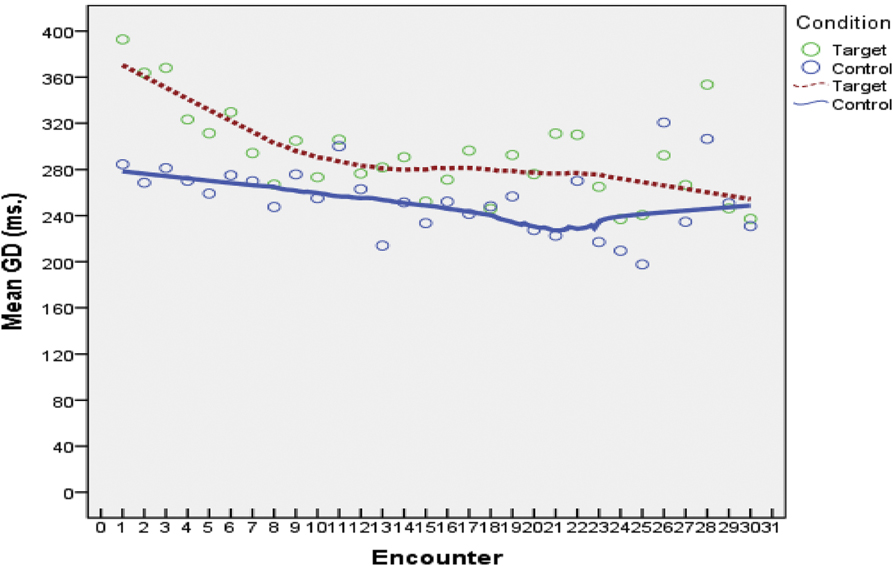
The scatter plot in Figure 2 shows that GDs on target words started at 393 ms (SD = 282) and ended at 237 (SD = 118). Condition was a significant predictor of the variance in GDs (OR = 1.24, 95% CI = [1.17, 1.32], p < .001), meaning that the probability of longer GDs on pseudo words increased by around 24% when target words were unfamiliar. Each additional encounter predicted a decrease in GD by about 5% (OR = 0.95, 95% CI = [0.94, 0.97], p < .001). There was a small interaction between encounter and condition (OR = 1.04, 95% CI = [1.01, 1.10], p < .001).
Mean gaze durations (in milliseconds) on target and control words by encounter.

Total Reading Times
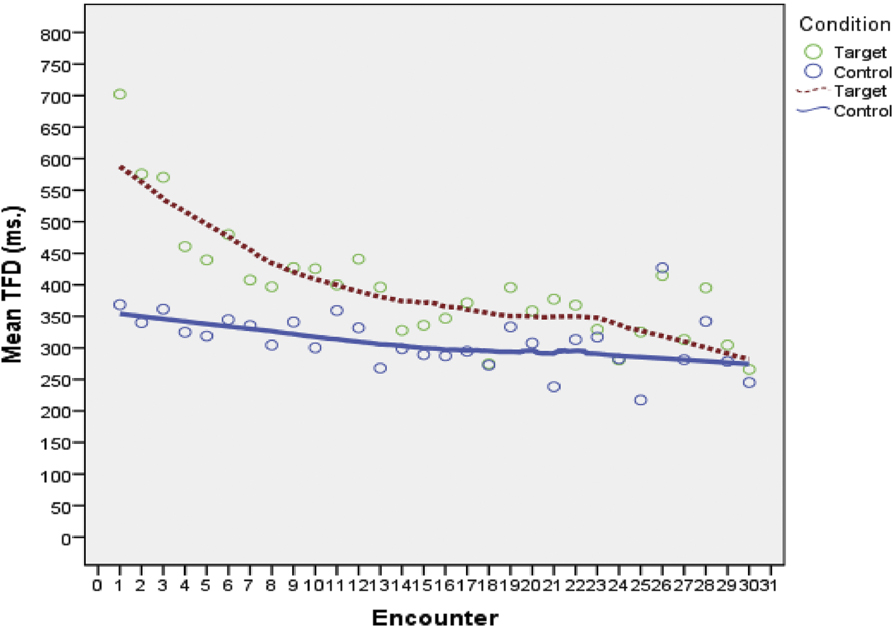
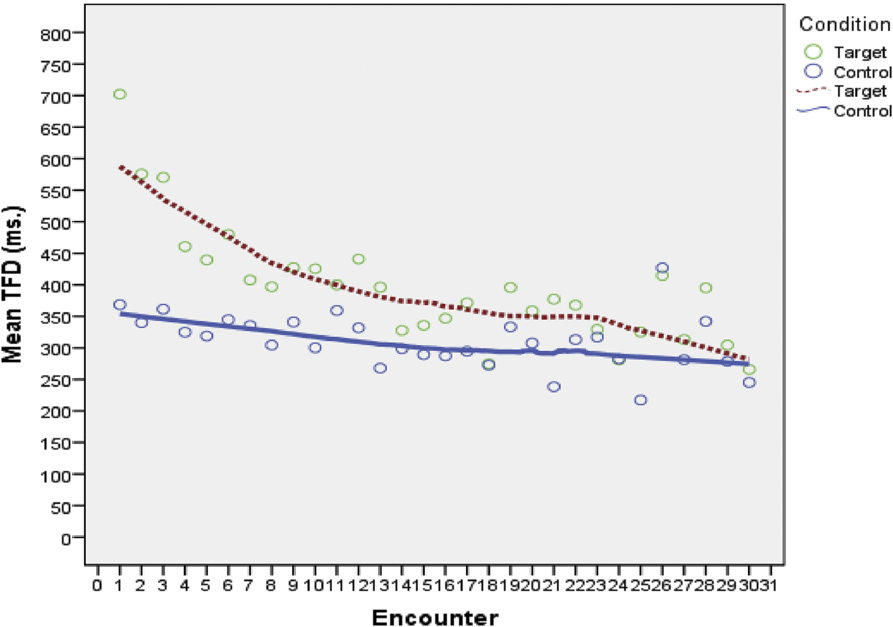
Figure 3 shows that total reading times were highest on the first encounter of target words (M = 702 ms, SD = 512) and lowest by the final encounter (M = 265 ms, SD = 130). Condition was a significant predictor of the variance in total reading times (OR = 1.68, 95% CI = [1.42, 1.77], p < .001), indicating that readers had longer times on target words than known words. Each additional encounter was associated with a decrease in total times of around 12% (OR = 0.88, 95% CI = [0.87, 0.91], p < .001), which was modulated by a small interaction between encounter and condition (OR = 1.020, 95% CI = [1.016, 1.023], p < .001).
Mean total reading times (in milliseconds) for target and control words by encounter.
Skipping
Skipping was more frequent in the control condition than in the experimental condition (around 21% of target occurrences and 26% of control occurrences). Condition was a significant predictor of skipping (OR = 0.82, 95% CI = [0.71, 0.95], p = .007), meaning that the odds of skipping increased by around 18% when the target words were familiar. The effect of encounter was not significant (OR = 0.96, 95% CI = [0.90, 1.03], p = .273).
Regressions-in
Readers returned more to target items (almost 25%) than to control items (almost 15%). Condition was a strong predictor of regression-in rates (OR = 2.79, 95% CI = [2.42, 3.22], p < .001), which indicated that the odds of regressing-in significantly increased by 2.79 times when the target was unfamiliar. Each additional encounter decreased the odds of regressing to the target word by about 28 % (OR = 0.72, 95% CI = [0.67, 0.77], p < .001), implying that regressions-in were more frequent in initial encounters.
Regressions-out
Regressions-out occurred on nearly 27% of target observations and on 22% of control observations. Condition was a significant predictor of regression-out rates (OR = 1.21, 95% CI = [1.09, 1.34], p < .001), which shows that the odds of regressing-out increased by about 21% when the target was unfamiliar. Each additional encounter decreased the odds of regressing out of the interest area by 2% (OR = 0.98, 95% CI = [0.97, 0.99], p = .010).
Exposure Frequency and Vocabulary Gains
Results indicate the highest gains in form recognition, followed by meaning recognition and finally meaning recall. Table 2 indicates that participants could retain the form of 42% of the target words while they recognized the meaning of 30% of the words, but recalled the meaning of only 13% of the same target items.
Average word gains in the vocabulary posttests (max = 20)

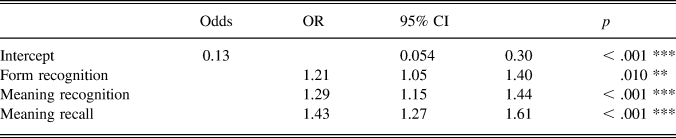
Controlling for item effects and word length, the logistic regression output showed that total exposure was a significant predictor for all the vocabulary outcomes but to somewhat different degrees: form recognition (OR = 1.21, 95% CI = [1.05, 1.40], p = .010), meaning recognition (OR = 1.29, 95% CI = [1.15, 1.44], p < .001), and meaning recall (OR = 1.42, 95% CI = [1.27, 1.61], p < .001). The regression output in Table 3 indicates that each additional exposure increased the probability of form recognition by approximately 21%, meaning recognition by close to 29%, and meaning recall by 43%.
Results for the effects of exposure on vocabulary gains

Note: The (*) marks signify the level of significance of the p value.
Token-Based Processing and Vocabulary Learning
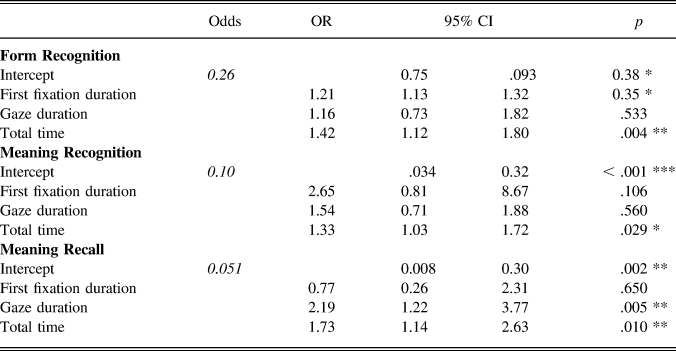
Online reading measures on individual tokens showed significant positive relationships of form recognition, with first fixation durations (OR = 1.21, 95% CI = [1.13, 1.32], p = .035) and total reading times (OR = 1.42, 95% CI = [1.12, 1.80], p =.004), indicating that, hypothetically, a one-second increase in first fixations and total time spent on a target occurrence would increase the probability of form recognition success by 21% and 42%, respectively. Meaning recognition results pointed to a positive effect of total reading times on vocabulary outcomes (OR =1.33, 95% CI = [1.03, 1.72], p = .029). A one-second increase in reading times of each token increased the probability of meaning recognition by 33%. Meaning recall was significantly predicted by GDs (OR = 2.19, 95% CI = [1.22, 3.77], p = .005) and total reading times (OR = 1.73, 95% CI = [1.14, 2.63], p = .010). Table 4 summarizes token-based predictors of vocabulary gains.
Token-based predictors of vocabulary gains

Note: The (*) marks signify the level of significance of the p value.
Cumulative Online Processing and Vocabulary Learning
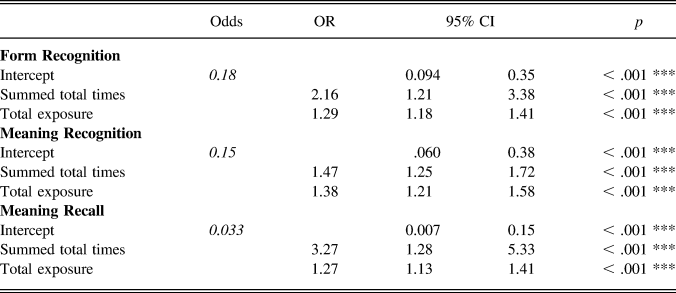
Total reading times spent on target words positively increased the chances of learning form (OR = 2.16, 95% CI = [1.21, 3.38], p < .001). At the level of text-based features, total exposure positively influenced form recognition, although the effect was somewhat smaller than online processing times (OR = 1.29, 95% CI = [1.18, 1.41], p < .001). Meaning recognition was significantly predicted by summed reading times (OR =1.47, 95% CI = [1.25, 1.72], p < .001) and total exposure (OR =1.38, 95% CI = [1.21, 1.58], p < .001). Meaning recall followed the same pattern with total reading times (OR =3.27, 95% CI = [1.28, 5.33], p < .001) and total exposure (OR =1.27, 95% CI = [1.13, 1.41], p < .001). Table 5 summarizes online and offline predictors of vocabulary learning.
Results of the online vs. text-based predictors of vocabulary gains

Note: The (*) marks signify the level of significance of the p value.
GENERAL SUMMARY OF RESULTS
Participants in this study read the graded reader Goodbye Mr. Hollywood, a stage 1 story of 4,649 words, which was found to be well within their current English proficiency levels. The percentage of pseudo tokens in the story was less than 3%, and the lexical coverage of the story was satisfactory (Nation, Reference Nation2001, Reference Nation2006). Readers met pseudo words and familiar control words in equal numbers of exposures ranging from 1 to 30, yielding 121 tokens in each condition. Eye movements were recorded during reading to compare online and text-based effects on incidental vocabulary learning.
Online reading patterns pointed to significant differences between attention to target items and familiar items. First fixations, GDs, and total times decreased as a result of additional encounters with target words, pointing to a gradual increase in familiarity with pseudo words as the text progressed. The decrease in reading times was more significant in early encounters (1–12) than in later encounters. There were more regressions and less skips in early encounters that confirmed extra attention to target words in initial exposures.
Readers displayed the greatest learning outcomes in form recognition followed by meaning recognition and, finally, meaning recall. Total exposure predicted all vocabulary outcomes but to varying degrees. Token-based online processing measures demonstrated that total time was a positive indicator of learning success in all vocabulary tests, while first fixations predicted only form recognition, and GDs predicted only meaning recall. Summed total times strongly predicted learning success in all vocabulary measures, particularly in form recognition and meaning recall. These results might suggest that individual attention on the part of the reader during multiple exposures can be more central to explain vocabulary learning above and beyond repeated exposure.
DISCUSSION
Lexical Processing in Repeated Encounters
The first research question sought to investigate how second language readers processed unknown words in the graded reader Goodbye Mr. Hollywood. It was shown that readers gave relatively more attention to pseudo words as compared to familiar words, particularly in early encounters. GDs and total times were inflated between encounters 1 and 12, after which target and control words started to exhibit similar processing times. Steady decreases were more significant in early encounters than in later encounters. A possible explanation can be provided by the E-Z Reader model, which postulates different stages of lexical processing (e.g., Pollatsek, Reichle, & Rayner, Reference Pollatsek, Reichle and Rayner2006). In this model, first fixations reflect an early stage of a familiarity check, and do not capture later events of reanalysis, word recognition, or form-meaning mapping. The unfamiliarity of target words then triggered subsequent fixations that fed into GDs, and the reported frequent regressions to target words ultimately fed into total times. This scenario may have caused the noteworthy rise of attention exhibited in early encounters.
The fact that readers did pay more attention to pseudo words, particularly in early encounters, was also confirmed by other evidence from reading behavior. In particular, skipping was less frequent on pseudo words while regressions occurred more frequently, especially in early encounters. Parafoveal processing (i.e., previewing the target word while focused on a word prior to it) may have occurred for novel words, making them less likely to be skipped at first pass. Less skipping and more regressions indicated increased processing and reanalysis of target words, which may have supported the form-meaning mapping process.
One important aspect of processing repeated encounters is the decrease in reading times. Repeated encounters were associated with shorter fixation times, suggesting a gradual increase in familiarity with target forms over time. Pellicer-Sánchez (Reference Pellicer-Sánchez2016) explained this as an increase in reading fluency, pointing out that unfamiliar words started to behave in a similar way to the real words by the eighth exposure. In the present study, the difference between reading target and control words became smaller by later encounters, particularly after 11 to 12 exposures, and seemed to become identical by the 30th encounter, which was the maximum number of encounters for a vocabulary item in the text. This cutoff point (at 11–12 encounters) might indicate the acquisition of some meaning traces, which increased reading speed. The difference in results between the two studies can be attributed to the different exposure conditions in that Pellicer-Sánchez (Reference Pellicer-Sánchez2016) used six target words consisting of only nouns with a maximum of eight encounters each. Processing patterns may have been different if more encounters were investigated. In the present study, the control and pseudo words were counterbalanced in two versions, while Pellicer-Sánchez embedded six different control words in the same text. Taken together, eye-movement findings from both studies signal evidence of learning through processing patterns yet they still conform with the arguments made by extensive reading research that there is no threshold of repetitions that guarantee learning and that many other individual and textual factors are at play in vocabulary processing and learning while reading (Waring & Takaki, Reference Waring and Takaki2003; Webb & Chang, Reference Webb and Chang2015a).
Early Indicators of Vocabulary Intake
In line with previous literature on vocabulary acquisition (Chen & Truscott, Reference Chen and Truscott2010; Pigada & Schmitt, Reference Pigada and Schmitt2006; Webb, Reference Webb2007), knowledge of form was the first component to develop followed by meaning recognition and meaning recall. These differential learning rates can be explained in terms of a progression from the lowest to the highest cognitive demands on the learner’s memory. Controlling for total exposure, it was found that total time spent on individual tokens was associated with successful intake in all three vocabulary measures. Additionally, first fixations predicted form recognition while GDs predicted meaning recall. The kind of associations found between online processing and different types of vocabulary gain aligns with the claim that different eye-movement measures tap into different cognitive processes. These results can be interpreted in the light of the E-Z Reader model, a serial attention simulation for eye movements in reading studies (Reichle, Rayner, & Pollatsek, Reference Reichle, Rayner and Pollatsek2003). Serial attention models assume that attention is allocated sequentially to support lexical processing of one word at a time and that lexical processing causes the eye to move from one word to the next. The E-Z Reader model has been found to be the most comprehensive in linking lexical recognition process to eye fixations and to account for reading behavior in alphabetic and nonalphabetic languages (Liversedge, Gilchrist, & Everling, Reference Liversedge, Gilchrist and Everling2011; Pollatsek, Reichle & Rayner, Reference Pollatsek, Reichle and Rayner2006; Rayner, Ashby, Pollatsek, & Reichle, Reference Rayner, Ashby, Pollatsek and Reichle2004).
Within the framework of the E-Z Reader model, lexical processing has been posited to proceed in two stages: an early stage called a “familiarity check,” and a later stage referred to as “the completion of lexical access.” The fact that first fixation durations predicted form recognition conforms to this hypothesis in that early lexical processing is largely form-focused (Reichle et al., Reference Reichle, Warren and McConnell2009). GD, as the total duration of early processing, predicted meaning recall, which may indicate that subsequent lexical processing of form-meaning mapping and encoding into memory become more important with subsequent fixations on the target word. The same principle would explain why total time, as a late measure, predicted all types of vocabulary learning. Because total time marks the completion of lexical access and sentence integration, it was indicative of the total attention devoted to each individual token in the text. As the total time spent on every encounter of a target word increased, there was a greater chance that the reader would retain that word in all vocabulary measures.
Combined Measures of Attention and Exposure
It was clearly shown that summed total reading times positively predicted learning outcomes in all vocabulary measures. This confirmed an association between online processing and lexical retention as documented by previous research (Godfroid et al., Reference Godfroid, Boers and Housen2013; Pellicer-Sánchez, Reference Pellicer-Sánchez2016). The fact that summed total times were a strong predictor of learning outcomes after controlling for total exposure might indicate that individual attention to target words can explain the variance in vocabulary learning above and beyond mere repeated exposures. This finding aligns with lexical processing data, which showed that readers invested more time in initial encounters checking for familiarity and reanalyzing context.
From the reader’s perspective, exposures were not equal in the amount of context and information they provided about target words. Thus, when we compare online times with total exposure (i.e., the number of encounters), we are comparing two dimensions of exposure that I will distinguish as dynamic versus static exposure. Dynamic exposure involves the sum of all the information that readers have accrued from all encounters with a given word. Static exposure, however, is an offline variable investigated in extensive reading research as the number of exposures. It is mainly a scale variable that is associated with learning outcomes. In the present study, it was the dynamic exposure that captured the processing events and readers’ interaction with target words and all the stages of lexical integration (Reichle et al., Reference Reichle, Warren and McConnell2009). From this perspective, it is plausible that the way in which readers utilized their repeated encounters with target words strongly predicted learning outcomes beyond encounters per se.
CONCLUSION
The present study sheds more light on the cognitive aspects of engagement (Schmitt, Reference Schmitt2008) and involvement (Laufer & Hulstijn, Reference Laufer and Hulstijn2001), which have been emphasized in vocabulary acquisition research and particularly within the incidental learning framework. Reader engagement with lexical items is reflected in online measures which capture ongoing processing of new vocabulary in different contexts. This adds another dimension to extensive reading as a source of vocabulary development, distinguishing between learning opportunities offered by the text and the expected learning outcomes based on textual features and readers’ engagement.
Practical and Pedagogical Implications
The results of the study are most clearly relevant to second language vocabulary learning and teaching. Maximizing exposure to vocabulary in rich contexts is a recommended strategy to ensure the best conditions for internalizing partially known words or acquiring new vocabulary. Exposure is not only confined to reading, but can also be extended to task-based learning where different input modalities (speaking, listening, reading, and writing) can integrate vocabulary learning goals in variable contexts (Brown, Waring, & Donkaewbua, Reference Brown, Waring and Donkaewbua2008).
The present study corroborates previous research on the role of extensive reading in creating possible opportunities for learning new vocabulary. One relevant implication for extensive reading is that it can afford more familiarity with new lexical items, although this does not guarantee successful internalization of new word meanings in a limited time frame. This is particularly true because the effects of extensive reading are longitudinal in nature. Webb and Chang (Reference Webb and Chang2015a, Reference Webb and Chang2015b) highlighted this factor in their studies, finding that learning gains tend to be larger from reading multiple graded readers rather than a single text and that the role of exposure frequency becomes less important over a longer period. Thus, the results from the present study reflect only the immediate effects of exposure; we cannot confirm durable learning, which is a limitation. Extensive reading programs should be evaluated over longer periods of time, considering all factors of input, textual features, and individual reading behavior as well as learners’ proficiency, vocabulary size, and motivation.
Recommendations for Further Research
The current study provides additional insights in SLA vocabulary research and extends further understanding of the cognitive aspects of incidental vocabulary acquisition. As a newly integrated technology in second language vocabulary research, the eye-tracking technique can answer specific questions about learners’ interaction with L2 material with considerable temporal and spatial accuracy. Implementing eye-tracking methodology in SLA is likely to open new avenues of investigation to uncover detailed cognitive processes in language acquisition, in general, and vocabulary development, in particular.
Vocabulary learning from reading is not a by-product of a single factor but is rather influenced by multiple variables with differing effect sizes. What makes this type of statistical analysis complicated is that the model controls for the effects of other variables in the equation before assessing the effect of the variable of interest. Therefore, one variable may moderate or reduce other effects. For example, text-based variables were found to be good predictors of learning. However, their roles were moderated, showing that there were factors beyond the text that had more important roles, particularly the reader’s processing behavior.
A significant variable not addressed in the present study is context quality, which has been found to affect the acquisition of word meaning in incidental vocabulary learning from reading (Webb, Reference Webb2008). The norming procedure conducted with native speakers revealed variance in predictability for different tokens in the text, which is likely to have influenced the participants’ online processing patterns. The effects of exposure frequency, particularly in meaning recognition and recall, indicate there can be other interactions at work in determining the quality of learning. The fact that different eye measures predicted different vocabulary knowledge outcomes points to a possible interaction between encounters and context richness or the level of predictability of individual tokens within the text. Further replications can consider this variable for a more inclusive explanation of lexical gains from context.
Some methodological issues regarding the nature of tasks and participants should be noted. Using a head mount and a chin rest during the reading task might have interfered with the natural reading behavior of readers to some extent. Further eye-tracking research can make use of more advanced eye-tracking equipment, which do not require head stabilization, to maximize the ecological validity of task performance without jeopardizing the accuracy of eye-movement measures. It must be noted, though, that the kind of sophisticated data retrieved through eye-tracking methodology justifies the need to sacrifice some ecological validity. Moreover, the lab-controlled experiment condensed the number of exposures into one experimental session, which may not exactly match the typical incremental route that learners go through in incidental learning, where repeated exposures are spaced over longer periods of time.
Vocabulary acquisition from L2 reading is usually characterized as incidental when learners are not told of an upcoming test after reading (Laufer & Hulstijn, Reference Laufer and Hulstijn2001). In the current study, the amount of attention measured through eye movements seemed to be learner driven because the stated goal of leisure reading focusing on meaning provided no external motivation to manipulate the existence or amount of attention on target vocabulary. Future research could examine how drawing readers’ attention to focus on novel words in L2 input may yield different processing patterns and subsequently impact vocabulary gains. However, this kind of methodological manipulation should point to vocabulary gains in terms of a clear distinction between incidental and intentional learning.
Finally, the ideal extensive reading study will be longitudinal in nature and evaluate learning outcomes from several readings over longer periods of time (Horst, Reference Horst2005). The present study provided a model for further large-scale research that can consider a wider variety of reading material and more authentic texts with different populations of second language learners. Although eye-movement research can provide precise quantitative accounts of lexical processing, it would be beneficial in future studies to apply stimulated recalls or think-aloud protocols to explore qualitative aspects of attention to target words and reading fluency and their relationship to vocabulary acquisition (Rott, Reference Rott2005; Rott & Williams, Reference Rott and Williams2003). Generally speaking, combining quantitative and qualitative methods to explore lexical learning from reading would add to our understanding of attention and engagement in reading comprehension and provide further evidence on the process of incidental vocabulary learning from L2 reading.
APPENDIX A
TARGET WORDS WITH NUMBER OF ENCOUNTERS AND PREDICTABILITY

APPENDIX B
FORM RECOGNITION TEST SAMPLE
Circle only the words you have encountered in the story

APPENDIX C
MEANING RECALL TEST SAMPLE

APPENDIX D
MEANING RECOGNITION TEST SAMPLE