The link between parental problem drinking and children's maladjustment is now well established. Children of parents with alcohol problems are at greater risk for emotional and behavioral problems (Chen & Weitzman, Reference Chen and Weitzman2005; DeLucia, Belz, & Chassin, Reference DeLucia, Belz and Chassin2001; Edwards, Leonard, & Eiden, Reference Edwards, Leonard and Eiden2001), substance use (Chen & Weitzman, Reference Chen and Weitzman2005; Colder, Chassin, Stice, & Curran, Reference Colder, Chassin, Stice and Curran1997; Jacob & Windle, Reference Jacob and Windle2000), and academic problems (Casa-Gil & Navarro-Guzman, Reference Casa-Gil and Navarro-Guzman2002; McGrath, Watson, & Chassin, Reference McGrath, Watson and Chassin1999; Puttler, Zucker, Fitzgerald, & Bingham, Reference Puttler, Zucker, Fitzgerald and Bingham1998). Deficits in child functioning are seen in community samples of problem drinking as well as clinical samples (Keller, Cummings, & Davies, Reference Keller, Cummings and Davies2005), and levels of children's adjustment problems tend to persist even after parental recovery (DeLucia et al., Reference DeLucia, Belz and Chassin2001). However, not all children experience these difficulties and some cope with adversity very well (West & Prinz, Reference West and Prinz1987), indicating the importance of identifying the underlying mechanisms involved.
The purpose of this paper is to address a critical gap in research concerning the effects of parental problem drinking on children, specifically by providing a rigorous longitudinal test of multiple and complex family processes involved in these effects. Consistent with a developmental psychopathology perspective on family processes and child development (Cummings, Davies, & Campbell, Reference Cummings, Davies and Campbell2000), studies have begun moving beyond this first generation of research on bivariate relations between drinking and child outcomes to considering the role of parenting, including parental warmth, in the context of parental alcohol problems. For example, fathers with alcohol problems demonstrate less sensitivity, positive affect, and verbalizations with their infants than fathers without alcohol problems (Eiden, Chavez, & Leonard, Reference Eiden, Chavez and Leonard1999). Moreover, men's problem drinking may disrupt women's ability to parent warmly (Edwards, Eiden, & Leonard, Reference Edwards, Eiden and Leonard2004; Eiden & Leonard, Reference Eiden and Leonard1996). Longitudinal studies support these findings, with men's drinking problems predicting maternal and paternal negativity and insensitive parenting during free and structured play with their children 1 year later (Eiden, Leonard, Hoyle, & Chavez, Reference Eiden, Leonard, Hoyle and Chavez2004). Parental warmth contributes to the development of emotion regulation and healthy emotional and behavioral adjustment in children and therefore may be a pathway of effects in families characterized by problem drinking (Eiden, Edwards, & Leonard, Reference Eiden, Edwards and Leonard2004).
Parental alcohol problems may also be associated with poor parental control of children, including increased psychological control. Psychological control involves the use of guilt and intrusiveness to manipulate children into behaving in desired ways, and has been consistently linked with children's adjustment problems (e.g., Aunola & Nurmi, Reference Aunola and Nurmi2005; Loukas, Paulos, & Robinson, Reference Loukas, Paulos and Robinson2005). Individuals suffering from alcohol problems often score higher on measures of anxiety, neuroticism, and dependent personality (e.g., King, Bernardy, & Hauner, Reference King, Bernardy and Hauner2003; Marchiori, Loschi, Marconi, Mioni, & Pavan, Reference Marchiori, Loschi, Marconi, Mioni and Pavan1999), and these personality problems have been associated with domineering interactional styles among problem drinkers (Matano & Locke, Reference Matano and Locke1995). Thus, parents with alcohol problems may be more likely to employ psychological control with their children. Research supports this hypothesis. For example, a retrospective study of adult children of alcoholics found that they reported experiencing greater levels of psychological control than a comparison group (Kelley et al., Reference Kelley, Nair, Rawlings, Cash, Steer and Fals-Stewart2005). In addition, longitudinal research has found that problems with fathers' parental control partially mediate effects of paternal alcoholism on trajectories of adolescent substance use (Chassin, Curran, Hussong, & Colder, Reference Chassin, Curran, Hussong and Colder1996; see also Stice, Barrera, & Chassin, Reference Stice, Barrera and Chassin1993).
Although a promising avenue of research, the focus on parenting deficits as an explanatory process leaves a gap in the study of family processes (Cummings et al., Reference Cummings, Davies and Campbell2000). For example, cross-sectional studies suggest marital problems may be a mechanism of risk for children exposed to parental drinking. Marital conflict is closely linked to parental drinking problems (Murphy, Winters, O'Farrell, Fals-Stewart, & Murphy, Reference Murphy, Winters, O'Farrell, Fals-Stewart and Murphy2005; Quigley & Leonard, Reference Quigley and Leonard2000), including the use of physical aggression and verbal aggression (El-Sheikh & Flanagan, Reference El-Sheikh and Flanagan2001). In an experimental study, MacDonald, Zanna, and Holmes (Reference MacDonald, Zanna and Holmes2000) assigned men to a nonalcohol, placebo, or alcohol condition, and then asked them to discuss a conflict with their romantic partners. Men in the alcohol condition experienced greater negative affect, perceived greater negative affect in their partners, blamed their partners more, and were less secure about their relationship. Because of the severity of conflict associated with problem drinking, stonewalling (emotional disengagement, withdrawal from the relationship) may therefore be a problem for such couples. Thus, parental drinking problems may expose children to higher levels of aggressive and unresolved marital conflict.
Aggressive and unresolved conflict elevates risk for many of the adjustment problems exhibited by children of problem drinkers, including internalizing and externalizing problems (Davies, Cummings, & Winter, Reference Davies, Cummings and Winter2004; Davies, Harold, Goeke-Morey, & Cummings, Reference Davies, Harold, Goeke-Morey and Cummings2002) and decreased social competence (Parke et al., Reference Parke, Kim, Flyr, McDowell, Simpkins, Killian, Grych and Fincham2001). Children react with fear and sadness to threat, hostility, withdrawal, and aggression in marital conflict (Cummings, Goeke-Morey, & Papp, Reference Cummings, Goeke-Morey and Papp2003). Resolution is important for children's sense of family stability and long-term adjustment; therefore, stonewalling is a particularly destructive conflict tactic (Cummings & Davies, Reference Cummings and Davies1994). Thus, children of parents with drinking problems may be exposed to destructive conflict processes especially threatening to their well-being. The implication is that although ineffective parenting may help account for why children of problem drinkers are at increased risk for adjustment problems, exposure to destructive marital conflict reflects another, perhaps equally important, pathway of risk.
Based on these previous findings, several recent studies have explored both marital conflict and parenting as mediators of the relationship between parental drinking problems and children's maladjustment. For example, a cross-sectional study by El-Sheikh and Flanagan (Reference El-Sheikh and Flanagan2001) found both parenting and marital functioning were mediators when considered separately, but only parenting was a significant mediator when both were included in regression models. In contrast, Keller et al. (Reference Keller, Cummings and Davies2005) employed structural equation modeling and found evidence of a more complex pathway in which parental problem drinking was related to increased marital conflict, increased marital conflict was associated with poor parenting practices, and poor parenting was linked to children's internalizing and externalizing problems. Thus, an intriguing possibility is that parenting deficits attributed to drinking problems are the result of increased marital conflict. In a cross-sectional study, Pillow, Barrera, and Chassin (Reference Pillow, Barrera and Chassin1998) found that family-related conflict (e.g., parent–child conflict, interparental conflict) served as a major explanatory variable for relations between parental alcoholism and adolescents' substance use, and in a related longitudinal study found that family conflict helps account for why adult children of alcoholics have greater difficulties with the leaving home transition and experience greater internalizing and externalizing problems (Hussong & Chassin, Reference Hussong and Chassin2002; see also Barrera, Li, & Chassin, Reference Barrera, Li and Chassin1995). These studies emphasize that the impact of parental problem drinking on children may include multiple domains of family functioning, consistent with a developmental psychopathology perspective on parental risk behavior, family processes, and child development (Davies & Cummings, Reference Davies, Cummings, Cicchetti and Cohen2006).
However, additional research is needed. Keller et al. (Reference Keller, Cummings and Davies2005) was a cross-sectional study and did not differentiate parental drinking problems based on parent gender. Other studies considered family conflict broadly, rather than distinguishing between problems in the parent–child and interparental relationships. In addition, many studies only focus on father's drinking problems and fail to differentiate between maternal and paternal drinking effects on family functioning. It is therefore unclear whether maternal and paternal drinking problems have similar relationships to family functioning. Cummings and O'Reilly (Reference Cummings, O'Reilly and Lamb1997) present a process-oriented fathering framework in which various factors, such as father–child relationships, marital interactions, parental psychological functioning, and child characteristics, all play important roles in the healthy adjustment of children. Based on this framework, it is possible that paternal drinking, which is often more common and severe than maternal drinking (Edwards, Eiden, & Leonard, Reference Edwards, Eiden and Leonard2004), will indirectly lead to more negative effects on child adjustment through the marital relationship and parent–child relationships. As a result, children may be more likely to exhibit internalizing and externalizing problems primarily because of their fathers' drinking (Cummings & O'Reilly, Reference Cummings, O'Reilly and Lamb1997; Davies & Lindsay, Reference Davies, Lindsay, Grych and Fincham2001). Thus, additional research is needed to examine possible differential relations between parental drinking problems and family functioning based on parent gender.
The current study advances the investigation of pathways of family processes linked with child adjustment (e.g., Keller et al., Reference Keller, Cummings and Davies2005) by exploring these issues within a longitudinal framework. Few studies have considered longitudinal relations between parental drinking problems and family relations. Although they cannot prove causation, longitudinal studies are critical in establishing that alcohol problems precede family dysfunction. Using longitudinal analyses, the current study attempts to establish the long-term effects of parental drinking on marital conflict, parenting, and child adjustment over time, as well as establish the direction of these effects.
Thus, the present study focuses on two important questions. First, it is hypothesized that the complex pathway identified by Keller et al. (Reference Keller, Cummings and Davies2005) will be supported by longitudinal tests. That is, parental problem drinking will be related to increased destructive interparental conflict behaviors 1 year later, these destructive behaviors will be linked to poor parenting, and poor parenting will be associated with greater internalizing and externalizing problems in children at the third time point. This study will focus on stonewalling and verbal and physical aggression as destructive conflict behaviors because they have been implicated as important in the context of parental drinking and have been linked to children's adjustment problems (Cummings et al., Reference Cummings, Goeke-Morey and Papp2003). In addition, lack of parental warmth and high parental psychological control have been indicated as important parental deficits in families characterized by alcohol problems (Eiden et al., Reference Eiden, Leonard, Hoyle and Chavez2004) and marital conflict (Krishnakumar & Buehler, Reference Krishnakumar and Buehler2000). Second, the Cummings and O'Reilly (Reference Cummings, O'Reilly and Lamb1997) fathering framework suggests that fathers' drinking may have more of an influence on child adjustment than mothers' drinking because of the effects that paternal drinking has on other family factors, including marital conflict. It is therefore hypothesized that paternal drinking will be more strongly associated with destructive marital conflict, negative parenting, and child maladjustment.
This study focuses on children between the ages of 5 and 8. This developmental period is characterized by improved logical thought and executive functioning (Kail, Reference Kail2000), increased perspective-taking abilities, and assuming varied family and social roles (Collins, Maccoby, Steinberg, Hetherington, & Borstein, Reference Collins, Maccoby, Steinberg, Hetherington and Borstein2000). Thus, children in this age range have a clearer understanding and increased concern about family functioning, including parental mental health, parent–child relations, and marital functioning (Cicchetti, Cummings, Greenberg, & Marvin, Reference Cicchetti, Cummings, Greenberg, Marvin, Cicchetti and Greenberg1990; Davies & Cummings, Reference Davies and Cummings1994). Moreover, as children in this age range are making the transition into school, they are faced with diverse and complex social and cognitive challenges, perhaps resulting in the initial emergence of internalizing and externalizing problems (Chase-Lansdale, Wakschlag, & Brooks-Gunn, Reference Chase-Lansdale, Wakschlag and Brooks-Gunn1995). Thus, parental and family functioning may have distinctive patterns of effects on children in this age range, including the onset of patterns of risk for the development of psychopathology associated with family processes.
Consistent with a developmental psychopathology perspective emphasizing the study of normal and abnormal together (Cicchetti & Cohen, Reference Cicchetti and Cohen1995; Sroufe, Reference Sroufe1990), problem drinking is treated as a continuous variable in this study, capturing the entire spectrum of alcohol problems, including dependence, abuse, and social, work, and family problems. This permits the study of symptoms in the everyday life of community families, where drinking problems may not meet clinical criteria for disorder but nevertheless represent a significant risk to child and family functioning (Keller et al., Reference Keller, Cummings and Davies2005). Furthermore, it avoids making somewhat arbitrary distinctions between health and disorder, (e.g., Sroufe, Reference Sroufe1997) and instead captures symptom levels at multiple points on the developmental spectrum of disorder. Research and theory on alcohol problems suggests a developmental course (Jellinek, Reference Jellinek1952) and heterogeneity in symptom expression (Caetano, Reference Caetano1996), indicating the utility of treating problem drinking as a continuous variable (Caetano, Reference Caetano1987).
The current study addresses an important gap in research on the effects of parental problem drinking by employing rigorous longitudinal tests to establish the direction of effects, considering multiple and complex family processes (parent–child and marital relationship problems) involved in the effects of parental drinking, adopting a developmental psychopathology perspective on the role of parental drinking problems, and considering relations at a critical developmental stage for children. In particular, the longitudinal nature of this study, combined with the added distinction between maternal and paternal drinking problems, represents a significant advance on earlier research.
Methods
Participants
Participants are from a larger study of community families living in a midsize Midwest town, a large Northeast city, and their surrounding areas. Families were recruited through postcards sent to several local neighborhoods, flyers, booths at community functions, and referrals from other participants. Recruitment materials indicated only that participants were needed for a research study on families and would be compensated for their time. Families indicating interest in participating were given information about the type of tasks involved (completing questionnaires, watching videos, playing with children, etc.), and were never given specific information about the hypotheses being addressed. Families were eligible to participate if they had been living together for at least 3 years, had one child currently enrolled in kindergarten, and were able to complete questionnaires in English. One participating family will be excluded from analyses because the parents were not in a stable relationship. The remaining sample from the first wave of data collection consisted of 235 families.
The majority of couples were married (88.1%). Couples had been living together for an average of 11 years. Approximately 95% of female parents and 88% of male parents were the participating children's biological parents. For ease of discussion, all parents will be referred to as mothers and fathers. Demographic characteristics indicate that the sample is representative of the national regions from which it was drawn. The distribution of participants were 78% White, 17% Black or African American, 1% Asian American, 2% multiracial, and 2% other races, with one person leaving the race question blank. These demographic characteristics indicate that the sample was representative of the counties from which the sample was drawn (2000 US Census data across the two counties: 82% White, 13% Black or African American, 2% Asian, 2% multiracial, 2% other races). Approximately 4% of family members in our sample were Hispanic (2000 US Census across the two counties: 5% Hispanic). The median and mode family income was between $40,000 and $54,999/year. Participants averaged about 14 years of education. There were no between-site differences in demographic characteristics.
Families participated once per year for 3 years. This study had a high retention rate: 227 families participated in Wave 2 (97% of the original sample) and 215 families participated in Wave 3 (91% of the original sample). Reasons for attrition included divorce (N = 1), hectic schedules (N = 5), family medical problems (N = 4), disinclination (N = 2), unknown reasons (N = 5), and inability to contact (N = 3). Families who did not participate in later waves had lower incomes and included less educated mothers and fathers. However, there were no significant differences between retained and dropped families in terms of age, time living together, race, or marital status or on measures of problem drinking, marital conflict, and child functioning.
Procedure
These data were drawn from a larger study and were collected during laboratory visits. Visits were scheduled 1 year apart, beginning when children were in kindergarten. The study was conducted under the oversight of the institutional review boards (IRBs) at both data collection sites; all procedures and consent and assent forms were approved by the IRBs before the study began.
Measures
Parental drinking problems
At the first and third time points, both parents completed the Parental Alcohol Experiences Scale (PAE; Windle, Reference Windle1997). At the first time point, parents completed this measure with regard to their own drinking and that of their partner and reports were averaged for each partner. Because of time constraints, at the third time point only self-report of drinking was obtained. In comparison to alternative measures of problem drinking, the PAE is unique in assessing a wide range of alcohol problems that are likely to occur in community samples. It is a 15-item inventory of symptoms associated with alcohol dependence and abuse, and was designed to provide a continuous measure of alcohol problems in clinical and nonclinical samples. Items include assessments of social, legal, family, and work/school problems associated with drinking that have been indicated as important in previous studies of alcohol dependence and abuse (Davies & Windle, Reference Davies and Windle1997). Participants rated how often they (and their partner) experienced each of the symptoms within the past year on a scale from 1 (never) to 5 (frequently/more than 10 times). Scores are created by summing responses. The PAE has high 6-month retest reliability (r = .71; Windle, Reference Windle2000) and internal consistency (ranging from .81 to .84; Davies & Windle, Reference Davies and Windle1997; Windle, Reference Windle1996, Reference Windle2000) with adolescents and adults. Convergent validity of the measure has also been established, with higher scores on the PAE being associated with less drinking inhibition, early onset drinking, and drinking to cope with problems. In the current study, reliability coefficients ranged from .65 to .87. Participants demonstrated a wide range of drinking problems, with a majority endorsing at least one symptom. Common symptoms included drinking alone, thinking about cutting down on drinking, having an argument because of drinking, drinking to forget one's troubles, and regretting afterward the things done while drinking. Twenty-one percent of men and 9.3% of women endorsed five or more symptoms at the first time point, indicating potentially clinical levels of alcohol dependence or abuse. These levels are consistent with epidemiological studies (Grant, Reference Grant2000). Please see Keller, Cummings, and Davies (Reference Keller, Cummings and Davies2005) for additional details about specific symptoms levels in the current sample.
Parental depressive symptoms
Mothers and fathers completed the Centers for Epidemiologic Studies Depression Scale (Radloff, Reference Radloff1977) as a self-report measure of depressive symptomatology at Time 1 (T1). Scores range from 0 to 60, with higher scores indicating higher levels of depressive symptoms. Within the current sample, the α values were .86 for men and .87 for women. Mean scores were 8.38 (SD = 7.57) for men and 8.97 (SD = 7.97) for women. In this sample, 13.7% of men and 16.7% of women had scores of 16 or above, indicating potentially serious levels of dysphoria.
Marital conflict behaviors
At the first and second time points, both parents completed the stonewalling, verbal aggression, and physical aggression subscales of the Conflict Properties Scale (Kerig, Reference Kerig1996) with regard to their own and their partners' behavior during marital conflict. These are six-, eight-, and seven-item scales rated on a 4-point Likert scale (0 = never engage in the behavior, 3 = often engage in the behavior). The stonewalling subscale assesses an individual's refusal to work together with a partner toward conflict resolution. In the current sample, reliability coefficients range from .58 to .87 (M = .76) for the three scales. Following recommended practice (Kerig, Reference Kerig1996) and reflecting a focus on marital conflict as a couple-wide rather than individual problem, scores were created by summing items and averaging across reports to provide one score on each subscale per family. The current sample includes levels of stonewalling, verbal, and physical aggression similar to other community samples (Kerig, Reference Kerig1996).
Parental warmth
At the first and second time points, both parents completed the warmth and affection subscale (WAS) of the Parental Acceptance and Rejection Questionnaire (Rohner, Saavedra, & Granum, Reference Rohner, Saavedra and Granum1991) regarding their own parenting. The WAS is a 20-item scale that assesses the frequency with which parents encourage, accept, comfort, and demonstrate affection toward children. Items are rated on a 5-point Likert scale (1 = never, 5 = always). Scores are created by summing the responses. In the current study, reliability coefficients for the WAS were .90 and .92 for mothers and fathers, respectively.
Parental psychological control
At the first and second time points, both parents completed the control through guilt subscale of the Children's Report of Parental Behavior Inventory, revised for use with parents (Margolies & Weintraub, Reference Margolies and Weintraub1977; Schwarz, Barton-Henry, & Pruzinsky, Reference Schwarz, Barton-Henry and Pruzinsky1985). This measure consists of five items (e.g., “You let your child know that you are hurt by the things he/she does”) rated on a 5-point scale. Scores are computed by summing response to items, with higher scores reflecting greater parental psychological control. In the present study, reliability coefficients ranged from .84 to .90.
Children's internalizing and externalizing problems
At the first and third time points, both parents completed the internalizing and externalizing subscales of the Child Behavior Checklist (Achenbach, Howell, Quay, & Connors, Reference Achenbach, Howell, Quay and Connors1991). For the externalizing subscale, parents rate how much children exhibit aggressive and delinquent behavior. For the internalizing subscale, parents rate how much children exhibit withdrawn, anxious, or depressed behaviors. Ratings are made on a 3-point Likert scale, and scores are created by summing item responses, with higher scores reflecting greater problems. In the current study, reliability coefficients ranged from .84 to .90. Between 19 and 27% of children were in the borderline or clinical range for internalizing problems, depending on mother or father report. Between 19 and 24% of children were in the borderline or clinical range for externalizing problems. These levels are similar to other community samples (Du Rocher-Schudlich & Cummings, Reference DuRocher-Schudlich and Cummings2003; Moser & Jacob, Reference Moser and Jacob1997). To reduce the number of variables in analysis, scores were averaged across reporters.
Results
Descriptive and preliminary analyses
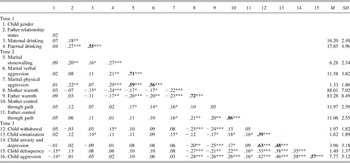
Table 1 presents means, standard deviations, and intercorrelations between the primary variables for the first hypothesis, which considered parental drinking problems as predictors of family and child functioning. Correlations between variables measuring the same construct were all significant, indicating the utility of creating latent variables. Correlations between variables indicating different latent constructs provide preliminary evidence for the proposed models. That is, fathers' drinking problems at T1 were related to destructive marital conflict behaviors at T2; marital conflict was related to parenting problems; and poor parenting at T2 was strongly associated with greater adjustment problems at T3.
Means, standard deviations, and intercorrelations among all primary variables

Note: Correlations among indicators within latent constructs are denoted in bold. Gender is coded so that higher scores are given to girls; father relationship status is coded so that higher scores are given to nonbiological fathers. Measures of problem drinking are based on 5-point Likert ratings of 15 symptoms and scores can therefore range from 15 to 75. Note that, on average, women endorsed between one and two symptoms, whereas men endorsed between two and three symptoms.
* p < .05.
** p < .01.
*** p < .001.
Models of parental drinking predicting later family functioning
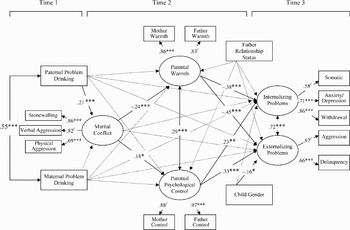
Structural equation model tests with latent variables were conducted using the AMOS 4.0 statistical package (Arbuckle & Wothke, Reference Arbuckle and Wothke1999), which uses maximum likelihood estimation to handle missing data. Initially, a model was run linking parental drinking at T1 to family functioning at T2 and family functioning at T2 to children's adjustment at T3 (see Figure 1). Associations between family variables and children's adjustment controlled for child gender and the relationship status (biological or nonbiological) of the father. Based on standard fit indices, the model presented in Figure 1 was a good fit for the data, χ 2 (83) = 144.5, p < .001; χ 2/df = 1.741, root mean square error (RMSEA) = .056, 90% confidence interval (CI) = .041–.071. Supporting the results of the correlational analyses, all unfixed manifest indicators significantly loaded onto latent constructs, indicating the adequacy of the measurement model (see Figure 1).
Relations between parental drinking problems, marital conflict and parenting, and children's adjustment problems. Coefficients are standardized estimates; *p < .05, **p < .01, ***p < .001; f denotes fixed path, χ 2 (104) = 192.5, p < .001; χ 2/df = 1.851; root mean square error of approximation = .060, 90% confidence interval = .047–.073.

Examination of the path coefficients in the first model revealed that greater paternal drinking problems at T1 were related to more destructive marital conflict behaviors 1 year later. More destructive marital conflict was related to decreased parental warmth and greater parental psychological control. Decreased parental warmth at T2 was associated with greater internalizing and externalizing problems at T3. Similarly, increased psychological control at T2 predicted greater internalizing and externalizing problems at T3. No relations were detected between maternal drinking problems and either family or child functioning.
Examining parental depressive symptoms as a possible confound
Alcohol problems and depressive symptoms have been linked in previous research (American Psychological Association, 2000; Brown & Schuckit, Reference Brown and Schuckit1988); thus, links between parental drinking and family functioning may actually reflect relations between comorbid depressive symptoms and family functioning. To determine whether relations identified in Figure 1 would be better explained by parental depressive symptoms, both mothers' and fathers' symptoms were included in the model as covariates of all relations. The significance of relations presented in the initial model was not altered. Furthermore, the inclusion of depressive symptoms resulted in a significant decrease in model fit, χ 2 (20) = 38.0, p < .01. Therefore, it appears that possible comorbid depressive symptoms do not account for the relations presented in Figure 1.
Differential relations based on parent gender
Results suggested that paternal problem drinking may be more strongly linked than maternal problem drinking to family functioning. To test whether these differences were statistically significant, the model was retested, with the paths to family and child functioning constrained to be equal for maternal and paternal drinking. The decrease in model fit χ 2 (5) = 10.5, approached statistical significance (p = .053). A comparison of the individual pathways indicated that only when the links between parental drinking and marital conflict were constrained to be equal for mother and father drinking problems did the decrease in model fit approach significance, χ 2 (1) = 3.0, p = .083. These results suggest the possibility that fathers' drinking problems were more strongly related to marital conflict than mothers' drinking.
Differential relations based on child gender
To determine whether the relations presented in Figure 1 were moderated by child gender, a multigroup analysis within structural equation modeling was conducted. Unfortunately, the model was too complex to converge. For this reason, manifest variables were aggregated to create composite scores representing each latent variable. An examination of this model indicated that most of the significant paths detected in Figure 1 were replicated for both boys and girls. Moreover, follow-up tests indicated that constrained and unconstrained models did not differ significantly in fit for boys and girls. Thus, these results indicated that child gender was not a moderator of relations.
Tests of indirect effects
To determine whether processes implicated as important in Figure 1 served as intervening variables or mediators, the significance of the indirect effects was tested using bootstrapping. In bootstrapping, N observations are randomly drawn from the original sample of N participants, with replacement, to create a new data set. Analyses are conducted on this new data set, providing parameter estimates of interest. This process is repeated several times (bootstrapping 500 samples is a standard approach), creating a distribution of parameter estimates. A 95% CI for this distribution provides an indication of the significance of the parameter estimate (see Efron & Tibshirani, Reference Efron and Tibshirani1998, for a detailed overview). Bootstrapping is especially useful for testing the significance of parameters that do not follow a normal distribution. The measure of indirect effect, computed by multiplying the path coefficients for the link between the independent variable and the mediator and the link between the mediator and the dependent variable, is an example of such a nonnormal parameter (MacKinnon, Lockwood, Hoffman, West, & Sheets, Reference MacKinnon, Lockwood, Hoffman, West and Sheets2002). For this reason, bootstrapping outperforms traditional approaches for testing mediation that do assume normality (MacKinnon, Lockwood, & Williams, Reference MacKinnon, Lockwood and Williams2004), and is recommended by methodologists (Shrout & Bolger, Reference Shrout and Bolger2002). Bootstrapping was conducted within the AMOS program, and 95% CIs were based on 500 bootstrap samples. The bootstrapping function within AMOS requires complete data; therefore, cases with missing data were excluded from these analyses. Reported confidence intervals are for the standardized indirect effects, and are bias corrected.
Results indicated that the indirect effect of fathers' problem drinking on parental warmth was significant (95% CI = −.277 to −.028), as were the indirect effects of marital conflict on children's internalizing and externalizing problems through parental warmth (95% CI = .054−.204 and .064−.285, respectively). The indirect effects of fathers' problem drinking on parental psychological control was also significant (95% CI = .016−.214), as were the indirect effects of marital conflict on children's internalizing and externalizing problems through parental psychological control (95% CI = .001−.137 and .002−.161, respectively). The indirect effect of paternal drinking on child internalizing and externalizing problems represents the complex indirect effects through both marital conflict and parental warmth; both of these complex indirect effects were significant. By constraining the pathways not involved in these complex indirect effects to zero, we controlled for other potential mediators, reducing the potential for bias. All of these constrained paths were not significantly different from zero. The path from fathers' drinking problems to marital conflict, from marital conflict to parental warmth, and from parental warmth to internalizing problems was a significant indirect effect (95% CI = .013−.113). Similar results were obtained for externalizing problems (95% CI = .014−.204). The path from fathers' drinking problems to marital conflict, from marital conflict to parental psychological control, and from parental psychological control to children's internalizing problems was also a significant indirect effect (95% CI = .001− 067). However, this was not the case for externalizing problems (95% CI = 0−.053).
Tests with autoregressive effects
To provide additional support for hypotheses, model tests were next conducted that controlled for autoregressive effects.Footnote 1 It was impossible to include autoregressive effects in the full model presented in Figure 1, because of the high complexity of the model relative to sample size. For this reason, separate models were run focusing on different putative causal pathways. In all models reported below, error terms for the same measure were allowed to correlate across different time points. Factor loadings for all latent constructs were nearly identical to those presented in Figure 1 and thus are not presented.
In the first model, fathers' problem drinking at T1 was included as a predictor of marital conflict at T2, controlling for marital conflict and mothers' problem drinking at T1. This model was a good fit for the data, χ 2 (13) = 22.2, p = .053, χ 2/df = 1.704; RMSEA = .055, 90% CI = .000−.093. The stability coefficient for marital conflict was significant, β = .82, p < .001. However, fathers' drinking problems continued to predict marital conflict (β = .14, p < .01).
Next, a model testing whether marital conflict would predict later parenting problems after controlling for earlier parenting problems and fathers' parental status (biological vs. nonbiological father) was run. Although these relations were cross-sectional in Figure 1, the tests were longitudinal in the model controlling for autoregressive effects. The model was an acceptable fit for the data, χ 2 (39) = 78.3, p < .001; χ 2/df = 2.007; RMSEA = .066, 90% CI = .044−.087. Although parental warmth was highly stable (β = .72, p < .001), results indicated that marital conflict at T1 continued to predict parental warmth at T2 even after controlling for earlier warmth (β = −.10, p < .05). However, marital conflict at T1 no longer predicted parental psychological control at T2 after controlling for earlier psychological control (β = −.02, p = .67).
Finally, models were conducted testing whether parenting would continue to predict children's adjustment after controlling for earlier levels of adjustment, fathers' relationship status, family income, race, and child gender. One model considered both dimensions of parenting as predictors of later internalizing problems. This model was a good fit for the data, χ 2 (43) = 52.6, p = .149, χ 2/df = 1.224; RMSEA = .031, 90% CI = .000−.057. Children's internalizing problems were highly stable between T1 and T3 (β = .68, p < .001). However, parental warmth and psychological control at T2 continued to predict children's internalizing problems at T3 (β = −.14, p < .05, and β = .15, p < .01, respectively). A second model considered both dimensions of parenting as predictors of later externalizing problems. This model was an acceptable fit for the data, χ 2 (17) = 27.6, p < .05, χ 2/df = 1.628, RMSEA = .052, 90% CI = .004−.086. T1 externalizing problems were highly related to T3 externalizing problems (β = .71, p < .001). However, both parental warmth and parental psychological control continued to predict decreased externalizing problems (β = −.11, p < .05, and β = .12, p < .05, respectively).
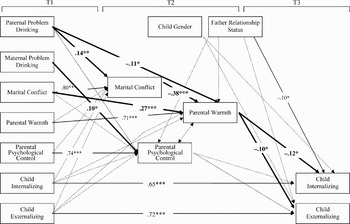
Tests of relations between variables that controlled for autoregressive effects revealed that the strength of relations often remained significant, but typically were reduced. This suggests that tests of the indirect effects based on Figure 1, which did not control for autoregressive effects, may have resulted in overestimation. For this reason, a final full model was run in which aggregated variables were used to reduce model complexity, but autoregressive terms were included (see Figure 2). This model was a good fit for the data, χ 2 (43) = 64.9, p < .05, χ 2/df = 1.510, RMSEA = .047, 90% CI = .020−.069. For reasons of clarity of exposition, and recognizing limits of each approach, correspondences between this model and the above submodels with latent variables are emphasized.
Relations between parental drinking problems, marital conflict and parenting, and children's adjustment problems, controlling for autoregressive effects. Variables within time points were permitted to correlate; however, these relations are not shown to simplify presentation. Coefficients are standardized estimates; *p < .05, **p < .01, ***p < .001; f denotes fixed path, χ 2 (60) = 120.1, p < .001; χ 2/df = 2.002; root mean square error of approximation = .065, 90% confidence interval = .048–.082.

As shown in Figure 2, after controlling for autoregressive effects, all paths identified in Figure 1 and supported by follow-up tests with autoregressive effects were significant. Father's problem drinking was associated with greater marital conflict 1 year later, greater marital conflict was related to decreased parental warmth, and decreased parental warmth predicted greater internalizing and externalizing problems in children 1 year later.
Tests of indirect effects also support earlier findings. The indirect effect of fathers' problem drinking on parental warmth (through marital conflict) was significant (95% CI = −.135 to −.014), as were the indirect effects of marital conflict on children's internalizing (95% CI = .023−.120) and externalizing problems (95% CI = .030−.106) through parental warmth. Similarly, the complex indirect effects of fathers' alcohol problems on children's adjustment through both marital conflict and parental warmth were significant (95% CI = .003−.027 for internalizing problems and .003−.026 for externalizing problems). There was also a significant indirect effect of fathers' problem drinking on children's externalizing problems through only parental warmth (95% CI = .002−.054).
Discussion
Few studies have examined the complex processes involved in the link between parental problem drinking and children's adjustment problems, and even fewer have done so in ways that can help establish the direction of effects. This study breaks new ground in addressing these gaps, employing rigorous longitudinal tests with autoregressive controls. Furthermore, this report is unique in considering disruptions to both the marital and parent–child relationship, as well as testing a complex chain of events involving these processes. In addition, more light is shed upon the rarely examined differences between the effects of fathers' and mothers' drinking on family functioning. As a result, this study uniquely advances understanding about how parental problem drinking affects families and thereby influences child development and adjustment.
Complex pathways between fathers' drinking problems and children's adjustment were supported. First, paternal drinking problems were related to increased marital conflict; marital conflict was associated with decreased parental warmth, and decreased warmth was related to children's internalizing and externalizing problems. Follow-up analyses revealed that these complex indirect effects were statistically significant, and significant relations generally remained even after controlling for autoregressive effects. The analyses presented in Figure 2 represent particularly stringent tests of the hypotheses, and thus is more parsimonious and informative in important respects because of the inclusion of autoregressive lags. These findings emphasize the importance of understanding the roles of multiple family processes and the unfolding of pathways of development over time, consistent with the principles of a developmental psychopathology approach to explanation of children's risk for psychopathology (Cicchetti & Cohen, Reference Cicchetti and Cohen1995). Thus, although direct links between paternal drinking and child adjustment were not found, the findings support that community levels of drinking problems may lead to child problems by increasing family disruptions, which are more proximally associated with child problems than parental drinking. Thus, an indirect “chain of events” hypothesis of parental drinking affecting children through changes in family processes was supported.
Although previous studies have found that alcohol problems are associated with parenting deficits (Eiden, Chavez, & Leonard, Reference Eiden, Chavez and Leonard1999; Locke & Newcomb, Reference Locke and Newcomb2003), the current study suggests that problem drinking may be more proximally linked to marital conflict, at least in the context of relatively minor drinking problems, and that this increased marital conflict accounts for the link between drinking problems and parental warmth (see also cross-sectional findings reported by Keller et al., Reference Keller, Cummings and Davies2005). Emphasizing the importance of even subclinical levels of drinking problems in contributing to children's risk for adjustment problems, the marital relationship may be particularly sensitive to even low levels of symptoms because they are more likely to occur in the presence of a spouse. One occasion of problem drinking may result in an offensive behavior (e.g., flirting with others, involvement in a physical altercation) that becomes a long-term source of conflict in a romantic relationship.
Alternatively, it is possible that relations with fathers' problem drinking are the result of persistent low-grade drinking problems that are not found for mothers. In other words, it is possible that one occasion of problem drinking indicates a greater likelihood of previous or future occasions of problem drinking, or suggests the early stage of a trajectory of disorder. Furthermore, father's problem drinking may be more likely associated with comorbid antisocial problems. Intoxication is associated with impairments in emotion regulation (Kano et al, Reference Kano, Gyoba, Kamachi, Mochizuki, Hongo and Yanai2003), particularly in the detection of the emotional expressions of others (Philippot, Kornreich, & Blairy, Reference Philippot, Kornreich, Blairy and Philippot2003; Townshend & Duka, Reference Townshend and Duka2003), cognition (Casbon, Curtin, Lang, & Patrick, Reference Casbon, Curtin, Lang and Patrick2003), and verbal communication (Lindman, Jarvinen, & Vidjeskog, Reference Lindman, Jarvinen and Vidjeskog1987). Recent studies suggest that impaired cognition accounts for dampened fear responses and disinhibition during intoxication (Curtin, Patrick, Lang, Cacioppo, & Birbaumer, Reference Curtin, Patrick, Lang, Cacioppo and Birbaumer2001; Stritzke, Lang, & Patrick, Reference Stritzke, Lang and Patrick1996) that may result in greater risk taking and offensive behavior. Men who have consumed alcohol are especially likely to interpret the behavior of others as aggressive and aggressively respond to others (Ogle & Miller, Reference Ogle and Miller2004). Furthermore, there is increased risk of injury during alcohol consumption (Watt, Purdie, Roche, & McClure, Reference Watt, Purdie, Roche and McClure2004). Thus, intoxication places individuals at increased risk for a wide range of negative events, potentially creating problems for marital relationships.
These disruptions to the marital relationship may then undermine couples' ability to act as warm and sensitive parents. A substantial amount of research has linked problems in the marital relationship to problems in the parent–child relationship (Cox, Paley, & Harter, Reference Cox, Paley, Harter, Grych and Fincham2001). For example, in a cross-lagged study, Davies, Sturge-Apple, and Cummings (Reference Davies, Sturge-Apple and Cummings2004) found that marital conflict predicted decreases in maternal acceptance 1 year later; in the context of family difficulties (e.g., parental depressive symptoms), links between marital conflict and parenting were even stronger. Thus, the marital hostility and aggression demonstrated by men with drinking problems (Murphy et al., Reference Murphy, Winters, O'Farrell, Fals-Stewart and Murphy2005; Quigley & Leonard, Reference Quigley and Leonard2000) may spill over into the parent–child relationship (Grych, Reference Grych and Bornstein2002). These findings are supported by previous research linking men's drinking problems to mothers' negative and insensitive parenting (Eiden et al., Reference Edwards, Eiden and Leonard2004) and supports the El-Sheikh and Flanagan (Reference El-Sheikh and Flanagan2001) finding that parenting is a robust mediator of the relationship between parental alcohol problems and children's adjustment.
A picture is therefore emerging in which paternal drinking problems undermine parenting (indirectly), thus negatively impacting children's adjustment over time. The current study supports both marital conflict and lack of parental warmth as important mechanisms of risk in the context of fathers' alcohol problems. It further suggests that multiple complex processes are set into motion even by community levels of alcohol problems, emphasizing the importance of studying psychopathology as a continuum of severity. Notably, parental control also emerged as a mediator, but only in the nondirectional, prospective models rather than the autoregressive models. The evidence thus more strongly supported parental warmth than psychological control as a mediator. Nonetheless, the current findings are sufficient to suggest that future research should further investigate the possible role of parental psychological control in mediating the effects of paternal drinking problems.
Significant relations were not detected between maternal drinking problems and other variables. After controlling for paternal drinking, no significant relations were detected between maternal drinking problems and marital conflict, parenting, or children's adjustment. Nevertheless, these findings should not be interpreted as evidence that maternal alcohol problems have no impact on family and child functioning. Previous research indicates that women suffering substance abuse problems demonstrate parenting deficits including decreased warmth and sensitivity (Harmer, Sanderson, & Martin, Reference Harmer, Sanderson and Martin1999; Mayes & Truman, Reference Mayes, Truman and Borstein2002), and that children of women with alcohol use disorders are at greater risk for adjustment problems (Barrera, Li, & Chassin, Reference Barrera, Li and Chassin1995; El-Sheikh & Flanagan, Reference El-Sheikh and Flanagan2001). In the current study, maternal drinking problems were significantly correlated to decreased maternal warmth and increased child internalizing problems at later time points. However, when included in latent variable models these relationships were not detected.
One possible explanation for the contradictory findings in the current study is that maternal and paternal drinking problems were highly correlated with each other. Because men's drinking problems are often more profound (Ogle & Miller, Reference Ogle and Miller2004) and occur at higher rates than women's (Caetano & Tam, Reference Caetano and Tam1995), when examined together men's symptoms may emerge as the more dominant predictor of family problems. That is, maternal problem drinking might be a weaker predictor because of less variability and a correlation with paternal problem drinking. As a result, studies examining more severe levels of women's alcohol problems in the absence of men's alcohol problems may very well find that women's drinking places families at risk. At the same time, the results of the current study likely provide an accurate picture of relations within the general population, because the levels of men's and women's drinking problems correspond closely to typical community patterns. These findings support the fathering vulnerability hypothesis, suggesting that fathers' mental health is an especially important pathway through which men influence family and child functioning (Cummings & O'Reilly, Reference Cummings, O'Reilly and Lamb1997; Davies & Lindsay, Reference Davies, Lindsay, Grych and Fincham2001).
Despite the advances made by the current study, there are limitations that should be noted. It was not possible to test indirect effects, relations controlling for autoregressive effects, and the longitudinal link between marital conflict and parenting all in the same model. Constraining model paths to zero may have resulted in overestimation of indirect effects. Notably, this problem is inherent to any tests of indirect effects. That is, all theoretically possible mediators cannot be included in any study, and paths involving not-included variables are thus, in effect, constrained to zero. Moreover, the measures of marital conflict and problem drinking contained possible overlap in the sense that a single item on the PAE may reflect alcohol-related marital conflict. At the same time, this item was not a measure of conflict but an assessment of attributions about the effects of drinking on relations with the partner. Nonetheless, results should therefore be interpreted with some caution. Similarly, future research examining ethnicity and SES as covariates or potential moderators is necessary to improve the generalizability of the study and the understanding of these family relations.
In addition, because maternal drinking problems frequently occur in the context of paternal drinking problems, maternal drinking may actually be a proxy for “two alcoholic parents” rather than reflecting only the effects of maternal drinking problems. Additional research employing an alternative design in which “mother drinking only” and “father drinking only” families were compared would help address this question. Although the current study did not make use of this type of design, it is important to note that the goal was to establish relations between parental drinking and family problems for the general population. In this sense, that maternal drinking problems tend to occur only in the context of paternal drinking does not impact interpretation of how maternal drinking problems tend to affect community families (e.g., it appears that paternal drinking problems are the robust predictor risk, whereas the additional presence of maternal problems has little impact). However, additional research may also address the question of whether the presence of maternal drinking problems might moderate relations between fathers' drinking and family processes.
It should also be noted that relations between parental drinking problems and child outcomes may be nonlinear (with relations being strongest for severe levels of alcohol problems). Although the current study has made an important contribution in testing for complex relationships, the linear parameter estimates may only approximate truly nonlinear population values. As statistical methods continue to advance, it may be possible to employ nonlinear modeling techniques to improve estimation. Finally, it is possible that children's internalizing and externalizing problems are the result of prenatal exposure to alcohol. Although there was a relative absence of relations between maternal drinking and child outcomes, and no children had been diagnosed with fetal alcohol syndrome, information about children's prenatal exposure was not obtained and cannot be ruled out. Future research is also needed to explore alternative dimensions of parenting as possible explanatory variables. For example, parental monitoring and consistent discipline are important aspects of the parent–child relationship and may be disrupted by drinking problems (Roosa, Tein, Groppenbacher, Michaels, & Dumka, Reference Roosa, Tein, Groppenbacher, Michaels and Dumka1993). Monitoring may emerge as an especially important variable during adolescence, when parents' close attention to adolescent activities can prevent substance use, delinquency, and other risky behaviors (Beck, Boyle & Boekeloo, Reference Beck, Boyle and Boekeloo2004).
Despite these limitations, the results of this study build on the findings of earlier work (e.g., El Sheikh & Flanagan, Reference El-Sheikh and Flanagan2001; Keller et al., Reference Keller, Cummings and Davies2005) and add to the current understanding of the processes through which parental drinking problems impact children's adjustment. This study also examines the relatively unexplored area of the effects of family problems on parental drinking. Unlike cross-sectional studies, the current study helps to unravel the complex processes that exist within the family system over time. Most important, it advances our knowledge of how parental drinking influences family functioning and how family problems in turn relate to increased parental drinking problems.