Introduction
The socioeconomic state of a child's family is an important contributor to the child's well-being. The deleterious effect of poverty and chronic low socioeconomic states on the physical, cognitive, and academic development of children is well documented (Brooks-Gunn & Duncan, Reference Brooks-Gunn and Duncan1997; Costello et al. Reference Costello, Compton, Keeler and Angold2003). Poverty is also associated with increased rates of mental illnesses, including both internalizing and externalizing behaviors (Duncan et al. Reference Duncan, Brooks-Gunn and Klebanov1994; Korenman et al. Reference Korenman, Miller and Sjaastad1995; McLeod & Shanahan, Reference McLeod and Shanahan1996). Heckman (Reference Heckman2007) notes that the negative effects of low socioeconomic states during infancy and the preschool years can be long term in nature, affecting the child's academic and economic achievements during adolescence and adulthood, and proposes the need to focus on investing early in the child's life, even prior to the preschool years. The definition of low socioeconomic state, however, extends beyond poverty or chronic low socioeconomic states and material hardship (Gershoff et al. Reference Gershoff, Aber, Raver and Lennon2007). Elder's (Reference Elder1999) study of children of the Great Depression, a transient state of macroeconomic crisis, noted that adolescents who experienced the Great Depression developed distinct personality characteristics. A recent study noted that youth who were infants between the ages of 0 and 18 months during a macroeconomic crisis (specifically, a period of high regional unemployment) had a greater risk of developing substance abuse and behavioral problems during adolescence (Ramanathan et al. Reference Ramanathan, Balasubramanian and Krishnadas2013). Although this finding was stronger for individuals from lower socioeconomic strata, it held true across all baseline socioeconomic states. These findings and Elder's observations suggest that transient economic problems can have long-term effects.
In this study, we build on this research by focusing on the impact of early transient financial difficulties (in the first 3 years of life) on later cognitive and behavioral functioning. We chose to focus on this age as it is recognized as a critical period from a number of different aspects – neurodevelopmental, psychosocial (Erikson, Reference Erikson1993), and finally academic (Heckman, Reference Heckman2007). Neurobiologically, the early stages of child development are marked by a steady increase in both white and gray matter along with highly active synaptic pruning processes (Lenroot & Giedd, Reference Lenroot and Giedd2006). These brain reorganization activities are influenced by cortisol and stress (Hanson et al. Reference Hanson, Chandra, Wolfe and Pollak2011, Reference Hanson, Hair, Shen, Shi, Gilmore, Wolfe and Pollak2013). Since the brain reaches 75% of its adult size by the age of 2 years (Lenroot & Giedd, Reference Lenroot and Giedd2006), the effects of such reorganization will be enduring. However, certain areas, such as the corpus callosum and the associative cortices, retain plasticity, which can influence the reversibility of the impact of a stressful event during infancy (Lenroot & Giedd, Reference Lenroot and Giedd2006; Yoshikawa et al. Reference Yoshikawa, Aber and Beardslee2012).
We define transient family income decline (TID) as a transient drop in family income by 50% or more. Specifically, we examine if the effect of TID is enduring in nature. We focus on specific longer-term cognitive and behavioral domains, including math and reading skills and behavioral problems. We chose these areas primarily because of the role that early infancy plays in socioemotional regulation, which in turn can influence cognitive and behavioral domains (Dolan, Reference Dolan2002) more than the motor domain. Our hypotheses build on the literature examining the impact of poverty and stress on brain development. We hypothesize that:
-
(1) The impact of a transient drop in income in early childhood will have long-term effects on behavioral and cognitive functioning.
-
(2) The impact of transient financial difficulties in the first 3 years of life on later cognitive and behavioral problems will be greater than the impact of transient financial difficulties during later years, specifically in the 3- to 5-year period.
We test our hypotheses in two different ways: a baseline sample consisting of all children and a subsample of matched siblings, which allows us to control for any maternal and intra-familial effects.
Methods
The National Longitudinal Survey of Youth 79 (NLSY79) (Bureau of Labor Statistics, U.S. Department of Labor, 2002) is a nationally representative longitudinal sample of about 12 000 young individuals born in the late 1950s and early 1960s, who were between 14 and 22 years old in 1979. Data were collected yearly from 1979 to 1994, and biennially since 1996. The NLSY79 is linked to two datasets that contain weekly work experience data (NLSY79 Work History) and information from a battery of cognitive, socioemotional and physiological assessments of the NLSY79 respondents’ children (NLSY79 Child/Young Adult File). These three linked datasets were used to study the association between early-life financial difficulties and later-life cognitive and behavioral problems.
We used linear regression models without sampling weightsFootnote † Footnote 1 for our analyses. The main predictor variable for this analysis was whether a child was exposed to TID during infancy. TID was defined to be 1 for a child if, in any of the first 3 years of the child's life, total net family income dropped by 50% or more relative to the previous year.Footnote 2 We defined TID as a dichotomous variable because our hypotheses do not predict a uniform effect over the entire distribution of income changes; rather, they focus on the effects of a sharp decrease in income (indeed, we do not predict that a sharp increase in income would exhibit the opposite effects). If the income data were missing, they were linearly interpolated from years for which these data were available (using the ipolate procedure). If we could not interpolate income because there were fewer than the required two observations for interpolation, the data was dropped from the analysis. In all, 14.2% of observations were imputed. The TID variable was also created for the 3–5 age groups. However, we did not pursue any detailed analysis of this age group since we did not find any significant overall effects in our first set of analyses. In order to eliminate the confounding effect of permanent transition into a lower socioeconomic state, only individuals whose family income returned to the pre-TID level within 3 years were included.
The main dependent variables for this analysis were the Peabody Tests for Math and Vocabulary PIAT Math and PPVT scores, and the behavior problem index (BPI) (Parcel & Menaghan, Reference Parcel and Menaghan1988). These variables were obtained from the Mother Supplement survey instrument in NLSY79 Child/YA File, which includes a selection of scales measuring the child's motor and social development, and behavior problems. This information is obtained from the mother, and assessed at various time points between 5 and 14 years of age. The median age of assessment was 9 years for all variables except PPVT (7 years).
The confounding variables that were controlled for were: socioeconomic factors (family income in the year before birth, family income at the time of measurement of the dependent variable), parental characteristics (teen pregnancy, the mother's desire to have a child), and child characteristics (birth order, gender, age, race). These variables have been identified as having an influence on either the dependent or the independent variables (Lahey et al. Reference Lahey, Hammer, Crumrine and Forehand1980; Duncan et al. Reference Duncan, Brooks-Gunn and Klebanov1994; Jutte et al. Reference Jutte, Roos, Brownell, Briggs, MacWilliam and Roos2010). In addition, we included calendar year-fixed effects in our baseline models to control for intertemporal variations in our variables.
We first compared the effect across the two age groups (0–2 and 3–5) by including two dummy variables for these two age groups in a single regression (Online Supplementary Appendix, Section I). Since the effect on 3–5 was always insignificant, we focused on the 0–2 age group for our remaining analysis. We limited the sample to children who had been exposed to TID only at infancy (0–2 years) and children who had never been exposed to any TID. Children who had been exposed to TID at infancy and at a later age were excluded.Footnote 3 This ensures that the coefficient estimate on the TID dummy variable can be directly interpreted as the impact of TID at infancy. When computing standard errors (s.e.) in our regressions, we allow the covariance between observations belonging to children of the same mother to be non-zero but assume zero covariance between observations belonging to children of different mothers. In addition to examining the effect of TID at infancy on the means of the dependent variables, we also examined its clinical impact as the probability of the child being in the highest quartile of BPI scores or the lowest quartile of PIAT reading and math scores. We created five dummy variables, one for each of our outcome variables. These were set to one if the child was in a concerning quartile and zero otherwise. We then used the same linear regression models with these dummy variables as the dependent variables. We present both the unstandardized and standardized coefficients for our mean effects; the standardized coefficients are computed as the ratio of the unstandardized coefficient to the residual s.e.. We also present the implicit changes in absolute scores groups based on predicted values from regressions of the dependent variables on only the controls.
To provide greater confidence in the causality of our results, we controlled for the role of maternal and intra-familial effects using a subsample of children who had been exposed to TID at infancy and had younger siblings who were not exposed to any TID. We did not reverse the comparison because if the younger sibling had been exposed to TID at infancy, the elder sibling would have been exposed to it as well at some point in his or her life. We then used fixed-effects regressions with fixed effects for the mother, along with other controls. The use of fixed effects for the mother limits the comparison with children of the same mother, and because one of the siblings is exposed to TID and the other is not, the coefficient on TID from these regressions can be interpreted as the effect of TID after controlling for intra-familial effects. The data were analyzed using STATA SE 13.0 (2013). The False Discovery Rate method was used for correcting for multiple comparisons (Benjamini & Yekutieli, Reference Benjamini and Yekutieli2001).
Finally, we performed additional tests to: (i) ensure the robustness of our baseline results by using additional controls, and explore (ii) longer-term associations and (iii) potential heterogeneity in our results.
For (i), we used different definitions of TID (30% and 70% decrease in family income), added more controls [parental relationship status, maternal education (Sameroff et al. Reference Sameroff, Seifer, Barocas, Zax and Greenspan1987), and birth weight (Datar et al. Reference Datar, Kilburn and Loughran2010)], used an alternate definition of transience (family income returning to only 75% of pre-TID levels within 3 years), dropped subjects with imputed data, and excluded children born after 1996 [a potential concern is the switch in federal assistance programs in 1997 from Aid to Families with Dependent Children (AFDC) to the more restrictive Temporary Assistance for Needy Families (TANF)].
To explore potential longer-term associations (ii), we used the baseline model to examine delinquency and the Center for Epidemiological Studies Depression (CESD) percentile scores between the ages of 15 and 18 years. We constructed the delinquency measure based on nine underlying behaviors suggested by the NLSY, including illegal activities such as stealing and breaking parental rules. Depression was assessed using the 7- or 11-item CESD scale; we created percentile scores for the two sets of scoring and in addition examined one question that relates to self-reported depression (‘I felt depressed’).
We performed several exploratory analyses of heterogeneity in our results (iii), including contemporary home environment, family income, family composition, and child's age and gender. The Home Observation for Measurement of Environment (HOME) (Parcel & Menaghan, Reference Parcel and Menaghan1989) was used to identify any interactional roles between the contemporary environment (home emotional support and cognitive stimulation scores) and outcome variables, and was measured at the time of measurement of BPI (Bradley et al. Reference Bradley, Caldwell and Rock1988). Additional details about the HOME variables are presented in the Online Supplementary Appendix. For analyzing the moderating effect of the home environment, we dichotomized the environment variables at the 25th percentile and interacted them with TID. We then included this interaction term along with the direct terms for TID and the dichotomized environment variables in linear regressions similar to those discussed above along with the same set of controls. Thus, the coefficient on the interaction term represents the additional effect of not being in the lowest quartile of environment scores on the association between TID and behavioral and cognitive scores. For ease of understanding, we also present predicted values of the dependent variables based on these regressions for the different groups of children. With regard to family income, we examined if children from lower- or higher-income families had a differential effect. We divided the sample into three bins – low (those in the lowest quartile of income in the year before birth), medium (those in the middle two quartiles), and high (those in the highest quartile), and reestimated our baseline regressions. For the last three, we used interactions of these variables with TID similar to those in our moderation analysis described above for the HOME variable.
Results
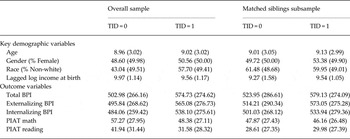
Sample description (Table 1)
The sample size varied from 8272 (PIAT Reading) to 17 348 (internalizing behavioral problems) for our baseline regressions. The corresponding sample sizes for matched-sibling analysis were 2049–4238. Based on our largest sample, the children's birth years ranged from 1980 to 2004, with 1989 as the median birth year (Online Supplementary Appendix Fig. A1). In this sample, 19.9% of children experienced TID. Those exposed to TID did not differ significantly on mean age (p value: 0.32), but differed marginally on gender (p value: 0.04) from those who were not exposed to TID. Firstborns were more likely to be among those exposed to TID than among those not exposed to TID (41.7% v. 34.6% firstborns; p value: <0.01), and African Americans and Hispanics were more likely to be among those exposed to TID than among those not exposed to TID (p value: <0.01). Table 1 provides additional descriptive statistics on our sample.
Summary statistics of samples

Note: Each cell presents mean and sample s.d. (in parentheses) of relevant variable. Statistics for demographic variables based on largest sample (sample for internalizing BPI).
Relationship between early TID and cognitive development
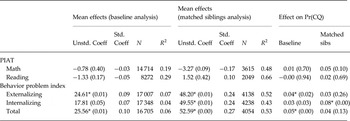
Exposure to TID in the first 3 years of life was not associated with impairment in cognitive development (Table 2) as measured by PIAT Math and Reading scores (p: 0.17 for Reading and 0.40 for Math). The effects remained insignificant in the corresponding matched-sibling analysis (p: 0.42 for Reading and 0.09 for Math).
The differential effect of exposure to TID in the first 3 years of age on cognitive and behavioral outcomes

Note: p values in parentheses; * indicates significant at or lower than 5% level, Benjamini–Hochberg–Yekutieli corrected; standardized coefficient for mean effects computed as the ratio of unstandardized coefficient and residual s.e.; other covariates included in the baseline analysis are log family income in the year of dependent variable measurement; log family income before birth; child's age, gender, and birth order; mother's race; mother's desire for children; a dummy variable for teenage pregnancy; and in the baseline analysis, year fixed effects. Pr(CQ) refers to the probability of being in a concerning quartile (lowest quartile of the PIAT Math and Reading scores or highest quartile of the BPI scores).
Relationship between early TID and behavioral problems
TID exposure in the first 3 years of life (Tables 1 and 2) was significantly related to the risk of developing behavioral problems (std. coeff: 0.10; p < 0.01; Δ abs. score: 511–543), particularly externalizing behavior problems (std. coeff: 0.09; p < 0.01; Δ abs. score: 503–533). The effect on internalizing behavior problems was positive (std. coeff: 0.07; Δ abs. score: 489–517) but insignificant. This association was significantly greater when the exposure happened between the ages of 0 and 2 years than when exposure to TID happened between the ages of 3 and 5 years (Online Supplementary Appendix, Section I). Furthermore, TID at infancy appeared to increase the probability of being in the top quartile of total and externalizing behavior problems (19.1–23.8% and 19.8–23.3%, respectively). The analogous effect on internalizing behavior problems was smaller (20.2–23.2%).
Of the control variables, current income and lagged income at birth had significant negative associations with all BPI scores, while age had significant positive associations. Female gender was associated with significantly lower total and externalizing BPI scores; the association with internalizing BPI scores was positive but insignificant. None of the other control variables with the exception of teenage pregnancy (negatively associated with internalizing BPI scores) was significant.
In the corresponding matched-sibling analysis, TID was associated with significantly greater mean scores on behavioral problems among exposed children as compared with the non-exposed matched siblings (Total BPI Δ abs. score: 535–586; Ext. BPI Δ abs. score: 525–580; Int. BPI Δ abs. score: 507–541; p < 0.01 throughout). The probability of being in the highest quartile of internalizing BPI scores was significantly higher (20.1–28.6%) while the effects on total and externalizing BPI scores were smaller (22.9–27.1% and 23.4–26.5%, respectively).
Robustness checks and exploratory analysis (Online Supplementary Appendix, Sections II, III, & IV)
-
(i) Replicating our results at different levels of income depreciation (30% and 70% drops) did not qualitatively change our results.
-
(ii) Controlling for parental relationship status (including parental separation during the first 3 years of life and not being in a two-parent family), maternal education, and birth weight, including individuals whose family income returned to only 75% of pre-TID levels within 3 years or dropping subjects with imputed data did not qualitatively change our results.
-
(iii) Limiting the analysis to children born before 1997 [a potential concern is the switch in federal assistance programs in 1997 from Aid to Families with Dependent Children (AFDC) to the more restrictive Temporary Assistance for Needy Families (TANF)] slightly weakened the statistical significance of the results, but the magnitudes of the effects remained very close to our baseline estimates.
-
(iv) From a longer-term perspective, we found a significant association between TID at infancy and the probability of engaging in delinquent behavior (particularly getting drunk and skipping school) between 15 and 18 years of age. We also found a strong positive association between TID at infancy and self-reported depression but not with the total CESD scores.
-
(v) With regard to the moderating role of contemporary home environment, the effect of early TID on BPI was more significant among children who had a better home environment as compared with children who had poorer home emotional support and cognitive stimulation at the time of measurement of BPI (p < 0.05).
-
(vi) The effects were higher in magnitude for children in the low income (the lowest quartile of income in the year before birth) and high income (the highest quartile of income in the year before birth) categories than for those in the middle category.
-
(vii) No significant moderating effect of a child's age, gender, or family composition on the association was noted, with the exception of internalizing BPI scores, which was negatively moderated by age.
Discussion
The most robust results of our study relate to the first hypothesis. Consistent with it, exposure to transient financial difficulties during infancy increased the risk of developing behavioral problems at around age 8, particularly for externalizing behaviors. Some of our exploratory analyses revealed longer-lasting effects, including a greater propensity to engage in delinquent behaviors. The effect on Math and Reading scores was generally insignificant, suggesting that early transient financial stress may not influence long-term cognitive outcomes. This is in line with studies exploring early life stress that have commented on the potential reversibility of the effect of early life stress on cognitive outcomes, thus limiting the influence of early life stress on long-term cognitive outcomes (Pechtel & Pizzagalli, Reference Pechtel and Pizzagalli2011). Compared with the effect on cognition, the effect of early childhood adversity on long-term behavioral changes, including an increased risk of developing depression later in adulthood, has been reported to be more long-lasting (Duncan et al. Reference Duncan, Brooks-Gunn and Klebanov1994; Korenman et al. Reference Korenman, Miller and Sjaastad1995; Costello et al. Reference Costello, Compton, Keeler and Angold2003; Pechtel & Pizzagalli, Reference Pechtel and Pizzagalli2011). McLeod & Shanahan (Reference McLeod and Shanahan1996), in an earlier study using the same dataset (NLSY79), noted that exposure to poverty at an early age (of around 4 years) was associated with later-life depression and antisocial behaviors. This study extends McLeod & Shanahan's (Reference McLeod and Shanahan1996) work by examining the effect of a transient drop in household income at an earlier age (before 3 years of age) and comparing it with older ages.
From a clinical perspective, the effect of TID on total and externalizing BPI scores was comparable with two other known risk factors: poverty and male gender. The effect size of poverty [defined as a drop of one standard deviation (s.d.) in lagged income at birth] on total and externalizing BPI was 0.04 s.d., and for the male gender, the corresponding effect sizes were 0.16 s.d. for total BPI and 0.22 s.d. for externalizing BPI; the corresponding effect sizes for TID were 0.10 and 0.09. Similarly, the increased probability of having clinically relevant (highest quartile) BPI scores (4.7%) was comparable with being male (5.4%) and having chronic low income (1.5%). The effect on internalizing BPI scores was somewhat smaller and statistically insignificant, but nonetheless comparable in magnitude (increase in the probability of being in the highest quartile from 20.2% to 23.2% v. 19.8% to 23.3% for externalizing scores). Early childhood adversity has been implicated in the development of both internalizing and externalizing behavior problems (Laucht et al. Reference Laucht, Esser, Baving, Gerhold, Hoesch, Ihle, Steigleider, Stock, Stoehr, Weindrich and Schmidt2000), with some authors (Shaw et al. Reference Shaw, Vondra, Hommerding, Keenan and Dunn1994) reporting a greater influence on externalizing behavior problems. When genetic and intra-familial factors were controlled for, the effect of TID on internalizing behavioral problems was greater than on externalizing problems, suggesting that intra-familial factors may have a greater role in the risk of developing externalizing behavioral problems as compared with internalizing behavioral problems. In our sample, being in the middle-income group emerged as a potential protective factor Werner (Reference Werner1987), in the Kauai longitudinal study, found that children belonging to the middle-income class, as compared with the lower-income class, had better developmental outcomes following exposure to perinatal stress. However, the surprising finding in our study was that a higher-income group did not act as a financial buffer. This finding could have been driven by the fact that TID would have resulted in a greater net financial shock for the higher-income group as compared with the middle-income group. Another interesting observation was that TID acted as a more prominent risk factor in children living in better home environments at a later period. This effect is likely because children living in current poorer home environments had significantly lower scores as a result of the poor home environment itself, and TID did not act as a significant risk factor over and above this. Further, children with greater contemporary home emotional support had higher externalizing behavior problems as a result of exposure to TID during infancy; this association was not noted for internalizing behavior problems. This, along with our stronger result with later delinquent behaviors, suggests that perhaps the effect on externalizing behavior problems is more long-lasting as compared with internalizing behaviors. We can speculate that perhaps the epigenetic influences of early life stresses affect the various domains of externalizing behaviors in a more persistent manner as compared with internalizing behaviors.
In line with our second hypothesis, the impact of TID on behavioral states was highest when the stress occurred in the first 3 years of life as compared with when it occurred in the later years. This could be driven by a greater degree of resilience at a later age, rendering children more immune to exposure to stress (Masten, Reference Masten2001). However, this finding is contrary to Duncan et al.’s (1994) report that age of exposure to socioeconomic adversity does not significantly influence the effect of poverty on behavioral and cognitive outcomes; rather, it is the duration of exposure that plays a significant role in the association. These differences in observations could have been driven by the differences in samples; Duncan et al.’s (1994) sample was composed of infants with low birth weight only. It is, however, in line with Heckman's (Reference Heckman2007) suggestion that early intervention should start in the preschool years. Dawson et al. (Reference Dawson, Ashman and Carver2000) discuss the critical nature of early childhood between the ages of 0 and 3, particularly in terms of exposure to stress and later behavioral outcomes.
Early adverse experiences, including adverse parenting, change the hypothalamo–pituitary–adrenal (HPA) axis (Dawson et al. Reference Dawson, Ashman and Carver2000; Hackman & Farah, Reference Hackman and Farah2009), leading to a ‘hyperaroused’ HPA axis (Dawson et al. Reference Dawson, Ashman and Carver2000). This in turn affects the hippocampus and other brain regions (Weinstock, Reference Weinstock1997) and also changes the levels of various neurotransmitters, including serotonin and dopamine (Fameli et al. Reference Fameli, Kitraki and Stylianopoulou1994). Early adverse experiences can also affect methylation, and thus expression of certain genes, including the promoter region of the glucocorticoid receptor gene NR3C1 (Tyrka et al. Reference Tyrka, Price, Marsit, Walters and Carpenter2012; Romens et al. Reference Romens, McDonald, Svaren and Pollak2015), which influences HPA response to stress. The long-lasting behavioral changes found in our study also suggest that, despite being transient, early-life financial stress affected the child in a more long-lasting manner, perhaps through an effect on neurobiological systems.
A key strength of our study lies in the matched-sibling analysis, which includes mother fixed effects, and helps control for many intra-familial and genetic influences. The results are, by and large, similar to the baseline results; the size of the effects on BPI scores is higher once we control for such intra-familial and genetic factors. This suggests that these factors influence the association between TID at infancy and the outcome variables. Even in the sample of matched siblings, the negative association of TID with behavioral problems persisted, strongly suggesting a causal role for TID. The probability of being in the highest quartile of internalizing BPI scores was higher by 9% for siblings exposed to TID. A protective factor that the study did not examine was the existence of social support networks and child care support. The study has some other limitations. Our results may have been driven by other stresses that do not affect the family income in the child's life (such as a sick grandparent). Another concern is that total net family income may have dropped because the mother may have been employed before birth and then been on maternity leave, which could have biased our estimates. However, this is unlikely to be a concern in our case because redefining TID to exclude any income drops in the first year of the child's life excluded only 7% of the children. Finally, because this is not an experimental design, we cannot assign causation with certainty. Nonetheless, our matched-sibling analysis addresses a lot of unobserved-but-fixed intra-familial factors that may be at play, and provides some reassurance about the direction of our results.
To summarize, this study further lends credence to the observation that the effects of transient financial difficulties during early childhood can be long-lasting. These effects were primarily seen for behavioral problems. In particular, the probability of being in the top quartile of externalizing BPI scores was higher by 4% for children exposed to TID. Our exploratory analyses of the influence of TID on later-life behavioral problems suggest that the impact of TID may persevere into adolescence and young adulthood. By underlining the role of early-life transient financial difficulties on subsequent behavioral problems in children, these results fill a critical gap in our understanding of the role of financial problems and, by extension, early life stresses on child development. They highlight the need for early intervention services (Doyle et al. Reference Doyle, Harmon, Heckman and Tremblay2009) for families experiencing financial crises and also provide some ground for making policies and programs (Zigler et al. Reference Zigler, Taussig and Black1992) that can help prevent long-term behavioral problems among children.
Supplementary material
The supplementary material for this article can be found at https://doi.org/10.1017/S0033291717000666.
Acknowledgements
This study was supported by a NARSAD Young Investigator Award to Seethalakshmi Ramanathan.
Declaration of Interest
None.