In a small café on the Avenue Franklin Roosevelt in the Goulette (halq al-ouadi), the municipality including the port of Tunis, Emel Methlouthi sings over the airwaves of Shems FM in her distinctive, soulful timbre. The open door sucks in the early autumn sea breeze, blending with the lyrics and sending shivers down my spine. I am sitting with Asma, one of my regular interlocutors and fieldwork mediators. I look at her, attempting to work out whether she is caught up in the moment in the same way that I am, but she appears to be fully absorbed in her mobile phone, responding to a few text messages. It has been four years since the mass uprising that resulted in the dictatorial regime of President Zin al-Abidine Ben Ali’s Rassemblement constitutionnel démocratique (Constitutional Democratic Rally party, from here on RCD) being overthrown. Now, after two rounds of legislative elections in 2011 and the ratification of a new constitution in January 2014, the first parliamentary elections are set to take place later this week. Tunis is buzzing with energy as the political parties as well as civil society are intensifying their efforts to prepare the Tunisian citizenry for this high point of democratic proceduralism. ‘It’s been a busy month’, I mutter, half to myself, half to Asma. ‘It’s been a busy four years!’ she counters.
Asma was an undergraduate at the University of Manouba, in Tunis, when she joined the citizen protests of 2011 that forced Ben Ali to flee, ultimately resulting in the dismantling of the cabinet and, eventually, the parliament, too. Not only did Asma openly defy the police and armed forces, but she also disregarded the warnings of her worried parents. Since then, she has attempted to balance her study for a graduate degree with numerous associational activities, during the afternoons, evenings, and weekends. Her engagement with civil society involves taking long bus rides all over the country so that she can teach the general population about participating in public life through public speaking and using the media for advocacy purposes. This is not all, though: Asma has also joined a newly formed political party – a spin-off from the left-wing coalition of parties – where, as a member of the youth wing, she is responsible for managing the get-out-the-vote campaign in Gabès, her birthplace, the sixth-largest city in Tunisia, in the country’s south-east. This evening, she will attend a meeting at the party headquarters to coordinate similar campaigns across the country. I am truly in awe of her verve and her stamina.
As well as taking on a didactic role in public life, Asma has herself participated in training sessions aimed at building her democratic skills. In fact, we had arranged this afternoon’s coffee meeting specifically to discuss a three-day programme she recently attended on ‘Interpersonal Communication’ (tawasul bayna al-afrad). The training was organised by a Tunisian NGO with EU funding and offered to a selected group of participants from various associations. Asma has arrived with her handbag practically bursting at the seams, stuffed with the programme’s paperwork: the curriculum, daily schedules, and her handwritten notes. I’m eager to pore over the documents with her. But just as we begin to settle in, our plans are cut short; Asma suddenly realises she’s mixed up the time for an evening event she’s meant to attend. ‘What a gaffe!’ she exclaims with a laugh. ‘So typical of me to double-book myself!’ We quickly gather our things and signal the waiter for the bill, already on our feet and halfway out the door.
As we are paying, announcements sound from the radio: Alongside coverage of the unfolding political campaigns nationwide, there are reports of roadblocks and ongoing strikes in the south-eastern mining basin, as well as demonstrations and sit-ins erupting in the north. But it’s the next news item that stops us in our tracks. The presenter announces a standoff and exchange of gunfire between security forces and what is being described as a ‘terrorist cell’ in the Tunis suburb of Oued Ellil. The group – reportedly made up of two men, six women, and two children – is said to have been planning to disrupt the upcoming elections, though the Ministry of Interior’s official statement remains vague about the cell’s methods and motives (Portes, Reference Portes2014). A hush falls over the café. After a moment of silence, the waiter, who looks to be in his forties, breaks it with a sombre remark.
Waiter – What has become of our country? Strikes every day, protests every day, and now a standoff as well …. These people cannot be Tunisian.
Asma cuts him off in discernible disapproval – Of course they’re Tunisian! They’re like you and me.
Waiter (slightly startled by Asma’s candour and with a hint of annoyance in his look) – They are ruining our democracy!
Asma – No, they’re not. They are disappointed, they are angry. I do not agree with the standoff, but people in general have the right to disagree. Isn’t this what democracy is about?
Waiter – In democracy, we speak with our vote. That other stuff was part of the revolution. Now, we’ve moved on.
Asma – Well, Sir, I am still a revolutionary (thaʾira) and I am also a democrat (dimuqratiyya).
The waiter shrugs this last comment off, hinting that it does not make sense to him. Once we are sitting alongside one another in the taxi, Asma and I discuss the waiter’s unease around arguing about politics with a younger woman, before speculating that this type of interaction, in terms of its form and content, may have been new to him.
Several years have passed since I conducted my fieldwork, but I have often thought about that exchange between Asma and the waiter in the café since then. In some ways, it was typical of my ethnographic experience at that time, but it was also uniquely clarifying since it brought into focus some of the key themes that emerged when I was researching the aftermath of the 2011 revolution and what came to be called the ‘democratic transition’. To begin with, the broadcasting of Methlouthi’s revolutionary anthem over the radio interjected the procedural culmination of Tunisia’s democracy – that is to say, free and fair elections – with the spirit of revolution. What is more, Asma herself related to both democracy through her engagement with party politics and civil society and to the revolution through participating in the uprising, poignantly refusing to draw a distinction between ‘revolutionary’, on the one hand, and ‘democrat’, on the other. In this respect, her disagreement with the waiter about what was happening at the time – has the revolution ended, has it been replaced by democracy, and, if so, how? – points to an ongoing porousness between the two. Finally, this porousness was also demonstrated in the exchange between Asma and the waiter: Their exchange is noteworthy not only for opening up a series of questions about forms of governance and the practice of citizenship but also for occurring in the public space of a café.
This book explores the Tunisian public sphere. Although it was heavily circumscribed during the periods of the French Protectorate (1861–1956), the nationalist single-party state headed by Habib Bourguiba (Reference Bourguiba1956–87), and the police state headed by Ben Ali (1987–2011), the Tunisian public sphere nonetheless burgeoned during the revolution and then continued to thrive as a dynamic space for civic exchange during the institutional transformations that followed immediately after. It became the object of intense reflection and a means of systematic intervention for Tunisians from all walks of life. Tunisians consciously engaged with – but also far exceeded – the domain of dispassionate rational argument among constitutionally equal strangers in twentieth-century theories of liberal democracy. Through the close-up lens offered by ethnography, the book traces the many ways in which the ongoing deliberations of the diverse Tunisian citizenry yielded new and changing visions of collective life and popular sovereignty. Such exchanges reflect the ongoing conversation that constitutes the Tunisian democratic project. As demonstrated by the exchange between Asma and the waiter, the goals, terms, and registers of debate of this democratic project continue to be unstable and in flux. This book encourages a view of instability as inherent to democracy as well as an element that unsettles the conceptual, discursive, and experiential divisions between revolution and democracy. As such, the book ultimately argues that revolution and democracy are experientially, discursively, and conceptually entwined frameworks in which people determine the parameters of their peoplehood and debate the extent and forms of their freedoms.
Disputed Narratives
The verbal exchange between Asma and the waiter was but one instance of the broader negotiation regarding the contours and meaning of revolution and democracy in post-2011 Tunisia. For the waiter, the street protests, worker strikes, and terrorism ultimately constituted a single, yet multifaceted, threat to democracy. This view was far from unique – as the book will show, many others shared similar socio-political concerns. By contrast, Asma sought to reclaim the protesters, the strikers, and even the insurgents as citizens, thereby perceiving them as legitimate actors within the socio-political landscape. Her position – which, again, was shared by many others – reflected a more expansive understanding of democracy, one that accommodated a broader spectrum of democratic expression. In this view, civility (or non-violence) was not the defining criterion, as it seemed to be for the waiter. Perhaps most significantly, both understood democracy to be a mode of political organisation as well as a modality of communication. Their brief dispute over the social and institutional connections between revolution and democracy indicates the two main lenses through which people both inside and outside Tunisia have attempted to understand the events and experiences of 2011 and later. I designate one as the prevailing liberal democratic lens and the other as its various modifications and alternatives, keeping in mind that this binary provides a convenient shorthand for introducing our context but eventually falls short of capturing the complexity of the public sphere that this book aims to define, examine, and historicise.
A range of commentators – including members of the Tunisian political elite as well as the country’s middle classes, international democracy professionals, and foreign media – articulated a narrative of Tunisia as ‘the one country of the Arab Spring to go through a revolution and change of government and emerge peacefully with a pluralistic system’ (Gall, Reference Gall2014). This narrative holds up Tunisia as a shining example of democratic ‘transition’. Transitology understands democracy in accordance with certain prerequisites that become classified in different regime typologies (democracy versus autocracy and so on). Both these prerequisites and the typologies are based on the conviction that the historical experiences of Euro-American democracies and their moral-intellectual vocabularies can and should serve as a general schema. This transitological understanding places the country in stark contrast to other countries in the South West Asian and North African (SWANA) region, whose popular uprisings either reverted to authoritarian configurations or disintegrated into civil war. Explanations of what has come to be known as the Tunisian ‘exception’, a revolution driven by democratic aspirations, pointed to the country’s long history of constitutionalism (with the first constitution being ratified in 1861) and its relatively continuous streak of liberal legal proceduralism, from the nineteenth century onwards (International Crisis Group, 2014). The Tunisian exception was widely credited with igniting waves of political contestation across the region. Its influence resonated far beyond the region, inspiring anti-austerity movements from the Mediterranean to North America.
In 2011, this narrative did more than reflect socio-political actions on the ground – it began to actively shape them. The discourse of praiseworthy Tunisian exceptionalism proposed that a revolution sparked by popular unrest required a specific agent to carry it through to completion as a constitutional democracy. That agent was defined as an elected representative parliament, led by an elected president of the Republic. This narrative, then, played a crucial role in shifting the centre of political action from the people in the streets to their representatives within formal political institutions. Indeed, as early as February 2011, during the ongoing sit-ins in the capital and elsewhere that were demanding the dissolution of all government bodies, an interim government took the lead in organising the first free and fair legislative elections, to be held in October that year. This interim government worked in cooperation with the Independent Supreme Authority for Elections (al-hay’a al-‘ulya al-mustaqilla lil-intikhabat), a mixed body of former political actors and revolutionaries that assumed the mission to lead the country to democracy. One hundred political parties participated in the first electoral round of October 2011, which culminated in the National Constituent Assembly (NCA) (majlis al-watani al-ta’sisi).1
With an initial one-year mandate, the NCA had the twofold task of governing Tunisia during the interim period between revolution and democracy at the same time as labouring vigorously to draft the country’s new constitution. It did this in the face of the pressure of foreign patronage, intense public scrutiny, and physical threats to its members, culminating in the assassination of one of its delegates. Two years later, the NCA finally ratified what some qualified as ‘the most progressive constitution in the Arab world’ (Maboudi, Reference Maboudi2020, p. 774) and as an important innovation in democratic constitution making everywhere (Ginsburg Reference Ginsburg and Bisarya2022, p. 49). Simultaneously, it laid the legislative foundations for two rounds of parliamentary and presidential elections to be held in October and December 2014. At the parliamentary elections, 69 per cent of registered voters turned out to seal the procedural legitimacy of what many were describing as Tunisia’s ‘fledgling’ democracy (The New Arab, 2014). The electoral results of December 2014 led to the formation of a coalition government that brought together two ostensibly staunch ideological opponents: the Islamist Party Ennahda (Renaissance) and the league of secularist parties Nidaʾ Tounes (Call of Tunisia). This coming together was especially significant, as it signalled the shared willingness – at least on the surface – among both old and new political actors to consolidate the transition process. The term ‘consensus’ (tawafuq) soon emerged as the keyword used to describe these unexpected concessions and alliances (Murphy, Reference Murphy2013; Boutieri, Reference Boutieri2021).
Alongside this institutional effervescence, a staggering influx of international patrons seised the opportunity to establish civil society organisations. The apparent alignment between the priorities of many Tunisians and the agendas of international political and human rights funders led to the creation of nearly 20,000 NGOs. At that time, most shared a common mission: to disseminate electoral frameworks and democratic values to the farthest corners of the country. Indeed, when I began my fieldwork in 2013, Tunisia was saturated with international civil society organisations promoting democracy, so much so that the original goals of the revolution, along with the lived experiences of it, appeared to have receded from the forefront of public discourse. This proliferation reflected the increasing entanglement of local aspirations with global governance frameworks and donor-driven agendas.
Yet many citizens actively resisted the fading presence of the revolution in public discourse. Diverse perspectives emerged, from scholars of the country to committed activists and a broad spectrum of ordinary citizens. Their internal variations notwithstanding, these interlocutors articulated competing claims to the relationship between revolution and democracy, seeking to challenge and complicate the prevailing understanding that democracy commences only upon the conclusion of the revolution. By emphasising the interconnection between the two, they recognised democracy as a continuation of the revolution’s unfinished objectives.
More specifically, many insisted that the revolution had its roots in longer trajectories of cultural, intellectual, and armed dissent, which dated back to the country’s colonisation by France in 1956 (Chomiak, Reference Chomiak2011; Omri, Reference Omri2012; Gana, 2016). This history of dissent provided a repository of vocabularies and practices for the various protests that had intermittently occurred (and been suppressed) over decades, including the mass uprisings of 2011 (Tripp, Reference Tripp2013; Hamza and Meddeb, Reference Marzouki and Meddeb2016; Boutieri, Reference Boutieri2023).2 By exposing the longue durée of political protest as well as its violent erasure, activists sought to highlight the weight of the colonial and postcolonial dependencies, as well as the ramifications of the long-term authoritarianism that dominated since independence, not only in Tunisian imaginations but also in such various enactments of revolution and democracy (Hamouchene, Reference Hamouchene2019; Sadiki and Saleh, Reference Sadiki and Saleh2023). Scholars, in particular, devoted considerable effort to scrutinising the enduring state ideology of Tunisianité (Tunisian-ness), a national ethos rooted in reformism, and its entanglement with a distinctly pro-Western modernism characterised by liberal, secular, and progressive elements (Mullin and Rouabah, Reference Mullin and Rouabah2016). By drawing attention to the longevity of this ideology and underscoring its recent transformations, shaped by economic liberalisation and the global War on Terror, scholars revealed mainstream portrayals of the Tunisian ‘people’ and their ‘will’ during the period of democratisation to be projections of the aspirations of the former elite.
In turn, these differentiated conceptualisations of revolution and democracy produced distinct evaluations of political voice and political practice. What some lauded as the peaceful and civilised ‘Jasmine Revolution’ (Assaad, Reference Assaad2011) was qualified by others as a ferocious watershed event (Inkyfada, 2020).3 In this latter portrayal, the self-immolation of Mohamed Bouazizi, a young vendor, in December 2010 in the interior town of Sidi Bouzid, dramatically exposed the systemic violence of Ben Ali’s police state – symbolised by the confiscation of his scales and produce. Moreover, it underscored the widespread neglect and socio-economic marginalisation endured by large segments of the population, a legacy tracing back to the extractive policies instituted under the French Protectorate in 1883. Indeed, recorded and written testimonies of the revolution foregrounded its violence, sometimes by recounting the numbers of the injured and the dead (Inkyfada, 2020). The definitive count of the revolution’s martyrs (shuhadaʾ), the term used to designate those killed in confrontations with security forces, became a contested issue, fuelling political manoeuvring among rival groups seeking to claim credit for the revolution’s success as well as sparking public debate (Lachenal, Reference Lachenal2021). However, for those Tunisian citizens who believed that the deployment of security forces in 2011 only continued the country’s long history of state repression, the injured and dead joined a much lengthier roster of tortured, assassinated, and otherwise disappeared citizens before and after independence.4 In their various narratives of the 2011 revolution (thawra), citizens recounted the ‘war scenes’ that erupted from confrontations between protesters and state security forces, with ‘battles’ spreading from the insurgent interior of the country to the coastal towns and into downtown Tunis.5
Beyond the physical confrontations, however, the lexicon of the revolution reveals a remarkable public irreverence towards the regime – an attitude that, according to those very same testimonies, was simply unimaginable prior to the uprisings. This lexicon is far richer than the globally relatable tripartite slogan of ‘work, dignity, social justice’ (shughl, karama, ʿadala ijtimaʿiyya), speaking of martyrs (shuhadaʾ), tear gas (bombles lacrymo), bullets (kartouche), blood (dam), torture (taʿdhib), murder (qatl), and prison (sijn). In January 2011, protesters stood outside the Ministry of Interior with their fists in the air, demonstrating their wrath, as they urged the president to step down: ‘Go Away!’ (Dégage! irhal!).6 Across the country, the massive billboards bearing the former president’s image, which had once loomed ominously over public spaces, were torn down. Police stations were set ablaze, and the symbols of the dictatorship’s infrastructure were defaced with graffiti (Tripp, Reference Tripp2016). This lexicon also reflects the emotional release people experienced after decades of disdain (hogra), born from the physical, economic, and ideological abuses inflicted by the dictatorial regime. This outpouring of emotion was powerfully embodied by the militant lawyer Abdelnasser Laouini, who, elated by the news of Ben Ali’s flight to Saudi Arabia on the evening of 14 January, boldly broke the military curfew and marched down Avenue Bourguiba, shouting, ‘He left! He left! The criminal left!’ (hrab! hrab! al-mujrim hrab!) (Inkyfada, 2020).
Neither the intensity of the protests nor the public irreverence towards the regime waned during the subsequent cycles of constitutional drafting, institutional reform, and free and fair elections (Abrougui, 2013). As the radio announcements of October 2014 confirmed, people continued to occupy public spaces, disrupting production, services, and circulation on a regular basis, with the number of protests per day reaching as high as ninety in 2013 (McCarthy, Reference McCarthy2022, p. 801). Even foreign commentators noted the ongoing expressions of newly gained freedom of speech. On the revolution’s anniversary in 2013, the Open Society Foundation observed: ‘The new freedom is palpable in the streets, where protests continue to erupt, and in heated debates at public meetings, where activists confront officials’ (Stone, Reference Stone2013). Such public negotiations persisted in various ways both up to as well as after the parliamentary election of 2014, with the vibrant media scene – both mainstream and social – further initiating, shaping, and amplifying a plethora of disputes regarding the past, present, and future of Tunisian society.
Some of these disputes led to street skirmishes, vandalism, and even murder. The assassinations of prominent leftist militant Chokri Belaid in February 2013 and NCA delegate Mohammad Brahmi in July 2013 remain landmark acts of political violence, extreme manifestations of the ongoing ideological struggle that has defined the post-uprising period. Even so, it was not until 2015 that the diverse visions of revolution and democracy fell under the shadow of securitisation, not only in terms of its discourse but also in terms of its operations. The two terrorist attacks in 2015, at the Bardo Museum in Tunis in March and in the beach town of Sousse in June, resulted in heavy casualties that included numerous foreign tourists. These attacks contributed to the consolidation of a singular, security-focused vision of democracy, one that prioritised stability and sought to suppress and ultimately overcome the ongoing revolutionary unrest. Indeed, in the aftermath of these attacks, certain forms of assembly – such as street protests and labour strikes – were once again brought under government control with the declaration of a state of emergency aimed at protecting Tunisian democracy. Moreover, from 2015 onward, ongoing clashes between the Tunisian army and various insurgent groups allegedly linked to ISIS as well as to Algerian and Libyan terrorist organisations heightened public fears and reinforced official narratives centred on the security of the population and the sovereignty of the state. By 2016, several funders had adjusted their calls to NGOs, urging them to provide training focused on resistance to radicalisation. (British Council, 2017).
The ethnographic fieldwork for my research on the Tunisian public sphere was conducted between 2013 and 2016. Since that period, significant developments have transpired. From 2011 to 2021, Tunisia underwent ten governmental reconfigurations, while municipal elections initially scheduled for 2014, 2018, and 2019 were postponed due to unforeseen and frequently tumultuous political shifts. Furthermore, the overwhelming national debt, which amounted to 85 per cent of GDP in 2020, resulted in additional reductions in public expenditure – something that started in the late 1980s – and led to the staggering figure of 25 per cent inflation on basic commodities (Chomiak, Reference Chomiak2021). Widespread unemployment, which was one of the primary reasons for the mass mobilisations in 2011, remained high among Tunisians aged eighteen to thirty-five, while the Covid-19 pandemic exacerbated not only the financial precarity experienced by most of the population but also the general sense of political crisis. Indeed, estimates suggest that almost 28,000 Tunisians made the perilous journey across the Mediterranean in search of better opportunities since 2011 (Bellingreri, Reference Bellingreri2019). This sense of political crisis intensified further in July 2021, when Kais Saied, the president of the Republic elected in 2019, dissolved parliament, personally appointed a new cabinet, and announced plans to rewrite the Tunisian constitution through an online consultation process involving the general population (Brown, Reference Brown2022). Although the online consultation process appeared to signal an openness to mass participation, it stood in stark contrast to the growing number of arrests targeting the president’s political opponents, as well as artists, journalists, and ordinary citizens (Amnesty International, 2024).
Undoubtedly, the institutional developments that have unfolded since 2016 have significantly reshaped the public deliberations examined and contextualised in this book. Nonetheless, the period from 2013 to 2016 remains a critical window into how Tunisian citizens initially engaged in debates over the meanings and purposes of revolution and democracy. These negotiations have continued to inform and shape the evolving intersections between these two political frameworks in the years that followed. Such an approach to revolution and democracy not only enables a decoupling of democracy from its prevailing liberal qualifiers, but it also creates space to critically examine the affordances and risks inherent in various democratic visions both in terms of lived experience and modes of political organisation.
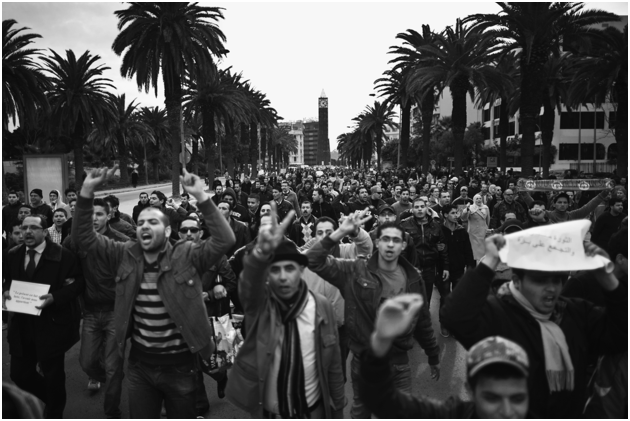
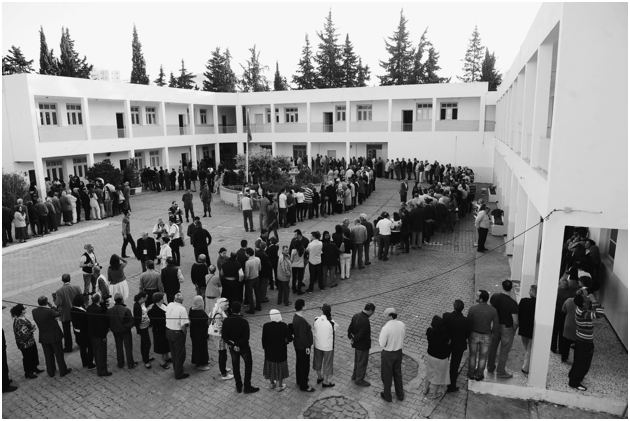
The implications of this approach extend beyond Tunisia, as the entangled relationship between revolution and democracy – marked by diverse and contested interpretations – challenges dominant, largely Euro-American, modernist frameworks through which both concepts have traditionally been theorised. In an era of global liberal democratic crisis, reflected in the rise of majoritarian politics across contexts, the Tunisian experience offers important insights into democracy more broadly. It reveals the risks of imposing historically burdened liberal models while sidelining alternative, locally grounded pathways to democratic emergence and renewal. Tunisia thus compels us to reimagine democracy beyond inherited paradigms and to recognise its inescapably social and therefore plural and evolving forms (Figures 1.1 and 1.2).
People demonstrate against Ben Ali’s Constitutional Democratic Rally (RCD), Tunis, January 2011.
People wait in a line outside a polling station to vote in Tunisia’s first-ever free elections, Tunis, October 2011.
Civic Trainers and Their Work
The protagonists of this book participate in what Tunisians call ‘associational life’ (la vie associative or al-mujtamaʿ al-madani), which work as equivalents to ‘civil society’ in international parlance. These trainers, in the various ways in which they educate their fellow Tunisians about how to speak to and debate with each other, work towards the creation of a public that is capable of reasoning and, therefore, of negotiating the organisation of their state and the running of their society for the common good. In short, these trainers seek to turn the public into ‘an authority for politics rather than its playing field’ (Calhoun, Reference Calhoun1993, p. 28). Given their diverse backgrounds and distinct motivations, the book illustrates how their contributions shape the emergence of a Tunisian public sphere that accommodates a multiplicity of visions and legacies – some of which converge, while others remain in tension or outright contradiction.
Although these protagonists view themselves as training the Tunisian public to deliberate in a democratic environment, the communicative qualities that they aim to inculcate vary according to their different ideological orientations. Some emphasise structured debate as a model for public speaking while also viewing it as a tool for advocacy and a means of managing difference and disagreement more broadly. Others, by contrast, encourage more open-ended discussions, which can involve brainstorming, personal testimony, and even direct accusation. Similarly, some trainers tailor their programs to specific social groups – school students, youth, women, or individuals considered at risk of extremism – while others design their training with society at large in mind.
Some of the protagonists entered the field in the aftermath of 2011, a period marked by the arrival of numerous regional and international agencies engaged in democracy promotion. These included the League of Arab States, UNDP, the World Bank, the European Union, the National Democratic Institute, the International Republican Institute, the Westminster Foundation for Democracy, and various foreign offices representing established democracies. Collaboration between local trainers and these organisations took several forms: applying for funding to support local NGO initiatives, receiving direct training from international experts, and translating established curricula on democratic citizenship into Arabic. Other civic trainers came into their roles through long-standing activism within formerly underground political groups. These veteran dissidents, often with decades of experience in opposition to the state, participated directly in the events of 2011 and regard their civic training work as a continuation, or at times an expansion, of that political struggle. Yet others developed their public engagement skills through volunteering, university politics, cultural associations, or charitable initiatives during the dictatorship years. For some, family histories proved instrumental either to inspire them to carry forward a political legacy or to prompt them to deliberately break from it.
Many trainers who feature here navigate the boundaries between associational life and party politics, often oscillating between the two or actively combining them. Others straddle different divides, such as that between civic activism and professional development, as they move through volunteering efforts, periods of unemployment, or the pursuit of stable, paid employment. While none of their trajectories can be neatly encapsulated by a single category of generation, gender, class, or geography, they all contend with the persistent and intersecting tensions of social difference. Such tensions have shaped both their lived experiences and their interpretations of revolution and democracy, becoming especially pronounced in moments when their work brings them into contact with individuals who resist their pedagogical frameworks and challenge their legitimacy as instructors.
In the above respects, civic trainers were no different from other citizens across the country, all of whom found themselves with greater freedom to question and confront their differences – whether with family members, friends, neighbours, teachers, or ideological adversaries. In the aftermath of 2011, Tunisian society emerged from a context in which public discourse had been suppressed and collective action tightly controlled, into an expansive arena where deliberation became possible. This newfound openness encompassed a wide range of expressive modalities – some aligned with, others extended beyond or even exceeded the idealised bounds of rational argumentation. Such discussions unfolded everywhere: from the plenary sessions on constitutional drafting held by the NCA, to the spaces outside where protests took place; from the congresses of emerging political parties competing for votes, to hotel conference rooms where trainers educated Tunisians on the practicalities of democratic organisation; from courtrooms to local assemblies engaged in various forms of transitional justice; and from doorsteps and living rooms to cafés and other public spaces where party campaigners and voters held conversations. These passionate exchanges of opinion also resonated widely across mainstream media, online news platforms, and social media. The spectrum of social interaction rapidly diversified, expanding the remit of who engaged with whom and the styles of communication and the sensibilities brought to each encounter.
This book traces these spaces, genres, and sensibilities of the Tunisian public through a form and flow sensitive approach (Gaonkar and Povinelli, Reference Gaonkar and Povinelli2003). It explores a selection of public deliberations about the future of the Tunisian state and society, examining not only their content but also the communicative infrastructures that enable them. Here, I want to specify my methodological choices. The communicative infrastructures I examine involved national linguistic choices, which are very revealing but do not constitute the primary focus of this book. Instead, I concentrate on the vocabularies of political experience (form) and their mediation through diverse channels (flow), which in turn shaped and amplified these vocabularies. I contend that both form and flow played a crucial role in making certain socio-political agendas intelligible, sidelined, or silenced.
In practice, I observed a number of civic trainers as they made their way around the country. Through my systematic contact with them both during their training work and at other times (for instance, I was sometimes asked to contribute to the design and delivery of their pedagogies and to help interpret their reception), I was able to note the simultaneous acts of inclusion and exclusion that they performed as they sought to demarcate their respective public sphere. These trainers, who were in the early stages of begetting a novel political order through modes of talk, sanctioned diverse repertoires for discussing politics at the same time designating their legitimate interlocutors. Both the trainers and their interlocutors in the field remained acutely aware that the struggle for signification is not open to all – and is not fair. Nonetheless, their practice, while it enacted forms of power, inevitably engendered a diversity that permeated the frameworks of revolution and democracy. Hence, whether in the more formally organised interactions of NGO training programmes, in the ciné clubs, and in teacher assemblies, or in the informal spaces of homes and cafés, revolution and democracy emerged as open signifiers, with the potential to function as world-making conceptual frameworks and strategies for action (Paley Reference Paley2002; Cherstich et al., Reference Cherstich, Holbraad and Tassi2020).
Interested in the broader circuits of deliberation that intersected the diverse modes of public reason these civic trainers forged, during fieldwork I interacted with development professionals, engaged in academic exchanges, and talked with aspiring politicians and elected parliamentarians. Everyday conversations beyond these fields helped me to gauge the reach and influence of these diverse modes. While the fieldwork itself focused primarily on face-to-face public deliberations, this book goes further by systematically linking these interactions to various modes of broader dissemination across both national and transnational spheres. Accordingly, it examines recruitment advertisements for civic training on Facebook, activist films, nationally televised plenary sessions of the NCA, and public reporting and editorials on current affairs across newspapers, radio programs, and television.
What intrigued me most, both ethnographically and theoretically, was this paradox: Although my interlocutors understood democracy as embodying the deliberative ideal – that is, privileging ‘collective deliberation about matters of concern to all’ over ‘interest-group pluralism’ (Benhabib, Reference Benhabib1997, p. 2) – their communicative practices consistently diverged from and transcended the expectations set by contemporary liberal democratic norms. Perhaps most intriguing of all were the practical, discursive, and affective continuities between the social repertoires of democracy – such as mass participation, equality, and freedom – and the revolutionary experience, whose goals and sensibilities permeated this transformative period. What is more, this occurred despite the fact that my interlocutors faced continuing and overwhelming pressure from international institutions to conform with distinct international modalities of democracy.
Waging Democracy
The song ‘My Word is Free’ (kelmti horra) became a revolutionary anthem that was jubilantly sung during the mass protests and sit-ins that were being held across Tunisia. I first encountered it in an amateur video capturing Methlouthi singing a cappella, surrounded by protesters on Avenue Bourguiba in downtown Tunis. Her voice both melded with and rose above the surrounding murmur of the protesting crowd, punctuated by rhythmic slogans. Through her rendition, the song voiced a collective defiance – Methlouthi sang of resisting the regime’s violence, expressing irreverence toward its power, and envisioning a world where free words could rebuild the polity. Ultimately, then, the song stood as a paean to lasting freedom of expression. Its popularity suggests the significance of public deliberation in the political values held by Tunisian citizens, to the extent that it became a cornerstone in their understanding of democracy. Indeed, the new constitution that was adopted in 2014 ratified the rights to freedom of expression and association, marking the end of censorship. The long-standing silence of the public sphere had finally come to an end. The voice, both as a sonic practice and as a symbol of public and political presence, is widely recognised as a vital metonym for agency within European modernity (Weidman, 2004, p. 38). Similarly, in Tunisia and many other contexts worldwide, this dual nature of the voice assumed central importance in speaking back to power and asserting claims to liberation.7
By 2015, however, Methlouthi’s song and, by extension, its metaphor of the Tunisian voice, became entextualised otherwise. Methlouthi performed the song at the Oslo City Hall ceremony honouring a quartet of civil society organisations with that year’s Nobel Peace Prize.8 On this occasion, the song transcended its role as an expression of revolutionary spirit, instead marking and celebrating a pivotal turning point in the democratisation process. This turning point, which was honoured by the Nobel Peace Prize Committee, occurred in the summer of 2013, when the quartet in question – the Tunisian General Labour Union, the Tunisian Confederation of Industry, Trade, and Handicrafts, the Tunisian Human Rights League, and the Tunisian Order of Lawyers – was instrumental in organising a process of National Dialogue (al-hiwar al-watani) to parallel the NCA’s drafting of the constitution. This National Dialogue ultimately resulted in the elected government of 2011 stepping down to appease ongoing social unrest and political conflict. For the international community, this civil society intervention epitomised an understanding of democracy as dialogue insofar as dialogue engenders a politics of compromise. The semantic shift of the song from a national revolutionary anthem to a song of democracy points to the way in which the Tunisian voice was transfigured from the voice of the people to a voice of political representation (Bishara, Reference Bishara2023) – and, by extension, the way in which Tunisians were transformed from revolutionaries to democratic citizens. As is evident from the ethnographic vignette at the beginning of the chapter, such transformation was ongoing and contested.
As mentioned above, the insights in the book are derived from a period of fieldwork that coincided with what much of the world considered to be Tunisia’s democratic transition (2013–15), which received international acclaim from the highest echelons of the world’s established democracies. US President Barack Obama congratulated Tunisia on its ‘extraordinary progress’ and promoted the country as a major non-NATO ally (Baker, Reference Baker2015). Such accolades call attention not only to how Tunisia was being labelled but also how it was being taught to become a democracy. Following the 2011 uprising, the Tunisian public sphere was the focus of substantial international investment, including through the promotion of democracy. Since the previous cases of the Balkans and the former Yugoslavia (Greenberg, Reference Greenberg2014), foreign policy has been implemented by bilateral or multilateral agencies through programmes promoting democracy. According to international stakeholders, such as the United States and the EU, newly liberated populations were required to adopt participatory approaches to democracy, which were to be introduced by international experts as well as appropriately trained local staff (Dzenovksa, Reference Dzenovska2010; Coles, 2017). These approaches were deeply reformist, desiring the transformation of citizen dispositions, with one key feature being the ability to speak civilly in public.9 In Tunisia, the internationally funded training initiatives focused on public speaking propagated a specific model of democracy. According to their pedagogy, a democratic subject is someone capable of thinking and speaking rationally, engaging with others non-violently, and reaching common solutions through informed and civil debate. This debate holds the potential to resolve social conflicts and check state overreach.
The above stipulations largely materialised an idea that had long been advocated by theorists of deliberative democracy (Habermas, Reference Habermas1991 [1962]; Rawls, Reference Rawls1997). According to these theorists, the democratic functions of state institutions in complex and differentiated societies interact and depend on the ‘public dimension of the political process’ (Emden and Midgley, Reference Emden and Midgley2013, p. 2). In accordance with this theorising, a crucial element of liberal, representative, democratic states is a certain kind of public reason accompanied by distinctive content, tone, spatial allocation, and legal frameworks. In the period following WWII, this normative designation of public reason came to elaborate the public sphere as an arena of activity in which the people, who are first and foremost rational deliberating subjects, can safeguard the polity against the potential abuses of the state (Habermas Reference Habermas1991 [1962]).
On a global level, the broad dissemination of such principles through the international promotion of democracy reflected the dominant understanding that liberalism constituted a litmus test for the realisation of democracy in foreign policy. Discussing United States foreign policy after the 1990s, David Scott described this dominant understanding by means of the militaristic phrase ‘waging democracy’:
The legitimacy of sovereignty now depends on the internal nature of political regimes not the external fact of territorial order. In short, the new post-Cold War/post-9/11 world of Pax Americana, is, at once, a civilisational and an imperial project that articulates itself in the political idiom of democracy and the acceleration of global democracy promotion.
In sum, the international promotion of democracy ultimately institutionalised an intolerance towards political diversity. This intolerance has a long pedigree in European imperialism, which leaned on liberal thought to distribute liberal proceduralism and propagate liberal sensibilities as naturalised and universal political realities (Mehta, 1991). Such intolerance became essentially hegemonic in the post–Cold War period – that is, after the demise of socialism – not only with policy circles, but also within academic disciplines (Wedeen, Reference Wedeen, Shami and Miller-Idriss2016).
In the Tunisian context, however, liberalism had been a technique of governance long before the discourses of democracy started to emerge. The Tunisian political elites instrumentalised liberalism in service of the period of Ottoman Beylical rule, which was succeeded by a period of nationalist rule and then, eventually, a period of neoliberal rule. In fact, the political legacy of colonialism, broadly understood not only as the legal framework offered by the French Protectorate, but also as intense socio-economic competition with Europe over two centuries, resulted in certain aspects of liberalism being adopted as foundations of Tunisian national identity. Subsequent chapters of this book will interrogate the persistence and force of what Beatrice Hibou has called Tunisian ‘reformism’ – a state discourse that has mainly been shaped through the endorsement of many elements of liberal proceduralism, including its investment in gradualism when it was time to implement change (Reference Hibou2009). In the wake of the 2011 uprisings, it was this legacy of reformism that resulted in the support for the ‘parliamentarisation of protest’ (McCarthy, Reference McCarthy2022, p. 800) as well as the involvement of the long-established political elites with democratic elections and constitutional drafting. Since reformism had constituted such a foundational element of the period of authoritarian rule, many noted reformist tendencies among the proponents of counter-revolution following 2011 (Mbarek, Reference Mbarek, Ginsburg and Bisarya2022). This book explores how liberalism was disseminated as the communicative repertoire of democracy in Tunisia, while also investigating how it was modified in the process. Indeed, by tracing the imbrication of liberalism and democracy not only at a global level, but also throughout the longue durée of Tunisian modernity, the book contributes to the broader critical understanding of liberalism’s complex legacies in postcolonial contexts as well as those of the global south.
The Liberal Public Sphere
The public sphere features centrally in the, now iconic, historical and conceptual account of the emergence and transformation of political participation in post-Restoration England and pre-revolutionary France by Jürgen Habermas (Reference Habermas1991 [1962]). His argument famously locates the beginnings of the public sphere in the parallel developments that resulted from the movement of commodities over long distances (as part of colonial trade), the circulation of news among private individuals, and the increasing disentanglement of these individuals from the formerly exclusively public authorities of the prince, the court, and the church. In nascent spaces of assembly – such as English coffeehouses, French salons, and German literary societies – male individuals cultivated the ability to discuss social, cultural, and political matters. Habermas claims that such deliberative conditions (underpinned by literacy and print capitalism) favoured individualism and independence from social rank and material constraints.10 The secularisation, modernisation, and individualisation of the communicative infrastructure of what Habermas describes as the bourgeois public sphere all worked to re-energise Enlightenment – and, more directly, Kantian – ideals of human reason as access to truth (Calhoun, Reference Calhoun1993, p. 17).
Setting aside the question of historical accuracy in this account of the public sphere, this model brings a modernist ideal of human reason into alignment with liberal principles of social organisation and, ultimately, democracy, which Habermas seeks to inject with progressive potential. While not as abstract as Benedict Anderson’s understanding of imagined national community (Reference Anderson2006 [1983]), borne out of and sustained mainly through reading practices, the public in Habermas is de-substantialised through assumptions about its social equality and the universalisation of its subjectivity. This form of abstraction, which crucially depends on the sidelining of private commitments (in the form of gender, class, and religion, etc.), became foundational to the normative model of public reason at the service of liberal constitutional democracy developed by John Rawls (Reference Rawls1993). To make this abstraction a workable aspect of public reason, Rawls confines it to the deliberations within strictly political forums. He identifies public reason with ‘the discourse of judges in their decisions, the discourse of government officials, [and] the discourse of candidates for public office’ (Rawls, Reference Rawls1997, p. 767). Other forms of reasoning, meanwhile, are relegated to what he terms ‘background culture’ (Rawls, Reference Rawls1997, p. 768).
Subsequent theorisations of the public sphere, through feminist (Fraser, 1993), queer (Warner, Reference Warner2002), subaltern (Chakrabarty, Reference Chakrabarty2005), and anthropological (Povinelli, Reference Povinelli2002) lenses, have produced a critical corpus exploring liberalism’s highly idealised structuring of social life and politics. By studying liberalism away from its metropoles, however, anthropologists have long demonstrated that it is a plural intellectual and legal tradition that remains in constant evolution (Spencer, Reference Spencer1997). Indeed, by focusing closely on various manifestations of this tradition, not only in the life of institutions, but also in the lives of ordinary people, anthropologists have been able to demonstrate how liberalism infuses cultural behaviours and practices (Coleman and Golub, Reference Coleman and Golub2008). Precisely because they have remained attentive to the wide diffusion of liberal norms across a dizzying array of societies in the post–Cold War period, anthropologists have designated liberalism as a ‘lingua franca, or perhaps a form of manners’ aimed at navigating difference primarily through a concern with ‘how to speak to strangers’ (Westbrook, Reference Westbrook2016). As well as attempting to make implicit or undeclared liberal norms explicit, anthropologists have further explored the modalities of public reason that have been employed by numerous publics, where rationality, individualism, and bourgeois etiquette do not constitute preconditions for discourse and praxis (Mazzarella, Reference Mazzarella2015). John Bowen’s concept of ‘reasoning repertoires’ (Reference Bowen2003, p. 5) openly challenges and replaces the normativity of public reason by emphasising the social embeddedness of reasoning, which in turn calls for ‘socially contextualised political theorising’ (Reference Bowen2003, p. 10).
This book bears all the above insights in mind, yet it pays particular attention to communicative practices and their methods of dissemination, as well as to the beliefs surrounding these practices, in organic relation to diverse political arrangements. In this sense, the book continues the enquiry into the public sphere inaugurated by Susan Gal and Katherine Woolard’s Language and Publics: The Making of Authority – a work that encouraged us to think about ‘communicative behaviour as an enactment of a collective order’, without neglecting ‘processes of conflict, competition, exclusion, boundary-making, differentiation, and transgression’ (Reference Gal and Woolard2014 [2001], p. 2; see also Briggs and Bauman, Reference Bauman and Briggs2003; Weidman, 2004). Because of their determination to grapple with both the materiality and the ideation of voices, the scholarship of Gal and Woodward was especially successful in moving the argument away from liberal democratic normativity in public deliberation and to dramatically broaden the remit of political ‘utterance, sound, or even noise’ (Kunreuther, Reference Kunreuther2018, p. 2).
Anthropologists of the SWANA region, along with scholars from other disciplines, have long focused on the public sphere and forms of public reasoning, partly because they, like mid-twentieth-century liberal philosophers, have grappled with a similar conceptual challenge: What kind of social involvement can encourage mass participation in the service of democracy? Despite the existence of parliamentary institutions and electoral cycles prior to the 2011 uprising, the absence of freedom of expression and association ultimately rendered electoral politics either deeply suspect or irrelevant for many.11 Hence, electoral politics in the SWANA region have not been as prominent as imaginations of democratic life have been in the minds of Tunisian citizens. Equally, researchers focusing on the region have struggled to find any non-state-controlled zone of civil society, insofar as civil society constitutes the ‘capacity of a political community to organise itself, independent of the specific direction of state power’ (Calhoun, Reference Calhoun1993, p. 270). The fluidity and porousness of the concept of the public sphere has allowed scholars to consider modalities of presence and sociality that may include political discussion, while struggling to achieve state accountability.
One such modality was the male-dominated sociality of the coffeehouse. To be sure, coffeehouses in the region have enabled varied social interactions and verbal exchanges due to their diverse locations, designs, clientele, and consumption habits (Örs, Reference Örs2002; Graiouid, Reference Graiouid2007). The most compelling argument linking coffeehouses to the emergence of a public sphere that became engaged in negotiating a social contract with the state has been advanced by Ottomanist historians of the sixteenth century (Kafadar, 2018; Gürbüzel, Reference Gurbuzel2023). This body of scholarship challenged the historical anachronism that situates the origins of coffeehouse-based deliberation in seventeenth-century Western Europe. In Tunisia, some of the modern-day coffeehouses served as hubs of anti-colonial activity, while others played parts in the state’s encroachment on leisure practices – by subsidising coffee – and on citizen privacy – by embedding surveillance networks (Collins, Reference Collins2009).
The so-called Arab Street has also emerged as a space of male publicness, marked by a necessarily ambivalent relationship to public deliberation (Eickelman and Piscatori, 2009). Furthermore, tribal assemblies staged acts of public deliberation and mediation under the auspices of hierarchical male relations. In modern states, however, the roles of such tribal assemblies have been amplified, as they mediate between citizens and the parliamentary monarchies and republics in the region (Antoun, Reference Antoun2000). In some contexts, assemblies of a more inclusive nature have been able to carve out spaces for public discussion, even though the ripple effects on the exercise of power have remained uncertain. Lisa Wedeen, discussing Yemeni qat chewing, urged us to recognise the democratic nature of such deliberations, despite the absence of democratic institutional indicators (Reference Wedeen2007). Marc Lynch similarly showed how consciously (pan-)Arab public opinion materialised through the growth and dissemination of media and new media technologies (Reference Lynch2006).
Another strand of scholarship aiming to remodel the concept of the public sphere – both in the region as well as more broadly – focused on religious deliberation (Asad, 1986; Mahmood, Reference Mahmood2005; Hirschkind, Reference Hirschkind2006; Walton Reference Walton2013), demonstrating that religious debate and argumentation are not necessarily antithetical to civil society or to democracy, even if they remain abhorrent to (some iterations of) liberalism. By taking on board these various philosophical and anthropological revisions, as well as by considering regional articulations of the public sphere, this book argues for the necessity of a more capacious definition of public reason, able to recognise political meanings and effects that emerge outside and beyond the spaces and principles of liberalism.
Liberal Exclusions
In an interview given shortly after the events of 2011, Tunisian philosopher Youssef Seddik discussed the merits of challenging established norms of public interaction and repertoires of thought in the aftermath of a dictatorship that systematically cultivated silence and detachment (Seddik, 2011, p. 80). As a self-proclaimed secular philosopher, Seddik responded to the criticism he received for inviting members of the Islamist party Ennahda to a conference in Tunis by claiming that the country had opened up to new forms of participatory citizenship:
I think we all cherish the fact of a rediscovered citizenship, and these people [Islamists] are also citizens. If you [Islamists] tell me ‘I will vote, I respect women, I respect the modifications in personal status code that respects women entirely’, if you tell me all this while being an Islamist, I will take you on your word. Maybe, later on, if you come to power, you will change your discourse and bring Tunisia back to the dark ages. Maybe. But this is a risk to take. History is made of risks.
Both the criticism and Seddik’s response are revealing, as this exchange brings into sharp focus a Tunisian public sphere in which social boundaries are being actively renegotiated – particularly along the fault-line of religion – and increasingly scrutinised by a broad range of actors. On the one hand, Seddik’s accusers appear to understand the mere presence of an Islamist political actor at a conference – in this case, Ajmi Lourimi, also a philosopher, as constituting a threat to democratic public deliberation. On the other hand, Seddik defends the rights of non-secular interlocutors to participate in public argumentation while also setting clear limits on the content of non-secular arguments. Non-secular interlocutors have to exhibit a willingness to support the electoral process while also affirming the social and legal acceptance of individual rights, with women’s equality being axiomatic of such rights. In other words, even though Seddik claims to be open to the risk of democratic turn-taking, his statement binds all public interlocutors into a liberal framework of collective life and state politics.
In deliberative democratic theory, this bind has been known as the ‘translation proviso’, which has been most explicitly elaborated in relation to religious reasoning in the public sphere. Habermas portrayed an ideal public communicative situation whereby interlocutors translate their diverse lifeworlds into reasonable arguments (1992). Rawls’ subsequent account of public reason allowed for religion in the form of ‘reasonable comprehensive doctrines’ to feature in ordinary public deliberations but removed it from institutional deliberations (Reference Rawls1993, Reference Rawls1997). Habermas retained this proviso (distance and translation) when articulating the relationship between religious faith and institutional arrangements (Reference Habermas2006). Even though he suggested that the weight of the proviso should be shared by secular and religious citizens alike – therefore encouraging secular citizens to try and detect any general guidelines in religious faith – Habermas insisted that abstract reason should have an ‘institutional threshold between the wildlife of the political public sphere and the formal proceedings within political bodies. We better use the image of a filter that allows only secular contributions from the Babel of voices to pass through’ (Reference Habermas2006, pp. 8–9). As such, Seddik’s statement appears to be indicative of the hold that normative liberal ideology and its communicative infrastructure have had over discussions of difference since 2011.This exchange offers me an opportunity to differentiate my approach from that of the scholarship on the revolution and democracy in Tunisia that addresses both political frameworks exclusively through the antagonism between secularism and religion.12
When I arrived in Tunisia, in June 2013, the national and international media were full of feverish debates over political Islam, with politicians, journalists, and citizens – including those on the secular left – pitting political Islamists against established secular elites and fearing that they would undermine the liberal way of life and the liberal legal system. The domestic and international anxiety relating to Tunisian democracy came to rest on the prominent place that the Ennahda party occupied in the NCA, charged with the drafting of Tunisia’s new constitution, and in the first elected coalition government.13 This anxiety was consequential in the drafting of the new constitution. While the NCA negotiations brought divergent understandings of society to the surface, the promulgation of the Constitution of 2014 rested to a large extent on the acceptance of liberal provisos – Ennahda backed down from most of their initial suggestions, which included presenting Islamic law (sharia) as a constitutional source, promoting an article defending the protection of the sacred domain, and qualifying the article promoting the equality among the sexes with the suggestion that women and men are ‘complementary’ to each other (McCarthy, Reference McCarthy2015).
Notwithstanding public attention to the position of religion in the new Tunisian democracy, the Tunisian public sphere nonetheless negotiated broader ideas, energies, and potentials. By examining a range of deliberative spaces where citizens with diverse moral commitments come together, the book shows that Tunisian citizens hold moral commitments that are neither fixed nor isolated from other experiences. In fact, such commitments appear to intersect with local conceptions of sovereignty, global visions of democracy, and the material consequences of democratisation within a neoliberal framework. As such, the book attempts to broaden the lens through which we interpret the agonistic dynamics of the public sphere and its kin domain of citizenship.
Thus, if the Ennahda party and its voters were suspect interlocutors, others were excised from the public sphere outright. Indeed, numerous groups faced significant obstacles in making their voices heard within public discourse. Among those were the Leagues for the Protection of the Revolution – neighbourhood protection committees that coalesced shortly after the ousting of Ben Ali in 2011. They initially came together to defend communities against the security forces, whose allegiance was at the time unknown, as well as to offer practical support to communities during the tumultuous period of regime change. However, various members of the League subsequently faced media criticism for abusing their temporary authority and perpetuating violence, leading to their characterisation in the press as ‘militias’ and ‘terrorists’ (Belghith and Patel, Reference Belghith and Patel2013). Besides the Leagues, the residents of many of the poorer neighbourhoods of Tunis – such as the stigmatised Hay Ettadamun and Duar Hichar – as well as those residing in the country’s systematically marginalised hinterland, found it hard to vocalise their ideas about the future in a public way. Indeed, the public presence and utterances of marginalised young men in the capital were perceived as unacceptable by some. As early as March 2011, residents of Tunis’ more bourgeois suburbs mobilised to curb what they saw as the ‘excesses’ of the revolution, aiming to evict and silence poorer people whom they believed did not belong there (Tripp, Reference Tripp2016). Tellingly, many of those who were dismissed were connected to the revolution and this remained the primary frame of reference once the focus of the public sphere had turned to democracy. Such classifications of people as revolutionaries or democrats hint at the underlying and tense negotiations of who counts as the demos of democracy.
This book offers broad conceptions of the public sphere and democratic deliberation, by considering a range of people and their diverse forms of interaction – modes that are normally excluded from the elite realms of debate and politics – as political actors, too. In this way, the book casts light on alternative opportunities for public deliberation that have the potential to bring about different possibilities of society and politics to those resulting from liberal citizenship. Some of these alternative publics are illegible and sometimes even abhorrent to established liberal sensibilities. In the book, I refer to such deliberations as ‘the democratic grotesque’ – a term that I coin to point to democratic speech, aesthetics, and affects that vex traditional liberal boundaries. This vexation is evident in the words of the café waiter, who calls attention to acts of disagreement that are allowed during revolution but not allowed during democracy. I consider how we can see these various modes of public reasoning if we decouple democracy from the normative horizon of liberalism, all the while recognising the continuing status and power of liberalism within the Tunisian state and polity. My argument is that such a decoupling would reveal that these alternative publics also constitute democracy and may, in fact, articulate some of its foundational elements – elements that modern liberal representation has sidelined, silenced, or outright ostracised.
Revolution and Democracy
In the midst of the euphoria surrounding the accomplishments of Tunisian democracy, Jocelyne Dakhlia, a Tunisian scholar, wrote in a blog titled Dissonance/Najaz (Dissonance): ‘I don’t feel like talking about transition because I choose the revolution’ (Reference Dakhlia2016), qualifying her preference for revolution over democracy through a series of arguments. At the institutional level, Dakhlia contended that the internationalisation of liberal democracy means that Tunisians have no choice but to surrender to the epistemic imposition of Euro-American articulation of democracy as foundational. At the material level, she was disappointed with the way democracy was institutionally inaugurated after 2011 ‘because capitalism, liberalism, and democracy had proven inadequate to the needs of most people, in Tunisia as elsewhere’ (Reference Dakhlia2016). At the epistemological level, Dakhlia questioned the qualifiers of revolution and democracy attributed by international promoters of democracy, in which disorder and unpredictability swiftly give way to an ordered pathway towards political reorganisation. Rather, Dakhlia asked readers to consider democracy as something ‘dirty, founded on disagreement and divergence of views, implying conflict, division, and going with invective, accusation, and the airing of dirty laundry, and with processes that are more or less scandalous’ (Reference Dakhlia2016). Lastly, at the social level, she reminded readers that separating the space of institutional politics from that of social life is itself a political act – one that shapes the possibilities both for the revolution and for what follows.
Her endorsement of revolution as a more fertile socio-political terrain than democracy brings her in collision with political science analyses of democracy that assume that democracy is, first and foremost, a type of governance. For the latter, like any other type of governance, democracy aims to establish order. However, when Tunisian political scientist Sami Zemni used the term ‘extraordinary politics’ to discuss post-2011 Tunisia, borrowing the phrase from Stathis Kalyvas, he claimed that the revolution and what followed it amounted to ‘a reconstitutive phase of the political’ (Zemni, 2015, p. 1). This reconstitutive phase gave space to intense negotiations among the ‘fragmented, pluralistic, and conflicting forces that make up the Tunisian people’ (2015, p. 1). Significantly, Zemni extended this reconstitutive phase beyond the normative timeline of the revolution and well into the period of the drafting of the constitution and the holding of elections.
I echo and enrich this joint interpretive direction, arguing that democracy, as a result of this extension, appears not primarily as a system of governance but rather as a form of political sociality that allows for permanent ‘dissensus’. Unlike the idealised concept of consensus, which implies a shared feeling that produces collective agreement, the notion of dissensus points to the creative potential inherent in deep disagreements over the social foundations of authority. Critics of liberal democratic politics, such as Chantal Mouffe (2010) and Jacques Rancière (Reference Rancière and Corcoran2010), made compelling arguments against a utopic vision of the democratic public, by challenging the assumption that the democratic public can neutrally guide itself towards consensus in an ostensibly open and equal arena of participation. These critics diverged, however, in where they locate the manifestation of, and ultimately the efficacy of dissensus. For Mouffe, adversaries domesticate their hostility through electoral campaigns and institutional procedures in order to find solutions and reach agreements that are provisional and vulnerable to challenge. Yet if, for Mouffe, dissensus is a volatile solution to the preservation of democracy, for Rancière, an adversarial dynamic across all social interactions is a fundamental condition of democracy. As a more intense and permanent form of disagreement, dissensus does not simply indicate dissent from a dominant position – rather, it signifies a rejection of governance through the preservation of existing social entitlements to representation.14
This line of thinking accords with anthropological studies of revolutions, which have highlighted how revolutions engage the totality of social experience, penetrating the most intimate spheres of social interaction and subjectivity (Thiranagama, Reference Thiranagama2011; Shah, 2016; al-Khalili, Reference Al-Khalili2023; Wilson, Reference Wilson2023). Interestingly, some anthropologists of democracy have also characterised it as a ‘total form of sociality’ (Cook, Long, and Moore, Reference Cook, Long and Moore2016, p. 3; see also, Piliavsky Reference Piliavsky2015), contending that democratic engagement unfolds across deliberative, intellectual, affective, and phantasmatic dimensions. To be sure, democracy entails relationships that necessarily ‘place particular pressures and demands upon the subject’ (2016, p. 7). The accordance that I note above allows me to trace the unfolding of both revolution and democracy within intimate social relations. Approaching civic trainer condemnations, imaginations, and enactments of kinship and gender through the lenses of both revolution and democracy reveals both frameworks to be potentially world-making. Yet, contrary to Marxist elaborations of revolutionary world-making and to liberal elaborations of democratic world-making, both of which envisage clear demarcations between the two frameworks, the civic trainers featured in this book do not impose ontological boundaries between revolution and democracy. Instead, they allow both concepts to continually interact in their life stories as well as in their plans for the future.
The Arab Uprisings of 2011, along with subsequent anthropological contributions to the study of revolution, have produced insights extending beyond the SWANA region. Drawing on foundational anthropological theories of ritual (Van Gennep, 1981 [1901]) and its transformative potential (Turner, 1989), Walter Armbrust (Reference Armbrust2019) operationalised the concept of ‘liminality’ to analyse revolution. In this context, ‘liminality’ refers to the temporary suspension of established hierarchies and rules of social order that can encourage states of communal co-presence (or, in Turner’s term, communitas), but that can also be equally generative of schisms (schismogenesis). This book similarly shows how the concept of liminality can help us focus on the ways established modes of deliberation (and, by extension, of political order) can be disrupted. Nonetheless, the book decidedly argues that liminality is a quality that can extend beyond revolution and into democracy. In fact, liminality helps us recognise democracy as an ongoing process of revisiting existing hierarchies and the principles of their legitimation.
This understanding of democracy as a deeply unsettling process – disruptive not only at the institutional level but also within the fabric of social life – resonates strongly with the Tunisian experiences explored in this book. Even so, this understanding is not often applied to analyses of democracy in the SWANA region. Rather, scholars of revolution in this region have understood liminality to be an exclusive feature of revolution, not of what comes after. Instead of equating liminality with revolution and separating it from democracy, we could recognise the liminal qualities of democracy – in particular, its generative capacity in terms of opening alternative visions of the social. This may in turn enable us to see in democracy a far larger remit than liberal pedagogies of citizenship.
My broader invitation can be summed up as follows: If liberal representative democracy is not the only valid model of political legitimacy, nor the final product of a long historical progression, then the possibilities for how it can be envisioned and practiced are far more expansive than traditionally believed. Then it follows that the space in which it can be imagined and enacted is much broader than has been conventionally assumed. The example of Tunisian democracy, as emerging from revolution and continually unfolding through the communicative practices of the Tunisian people who enabled it, presents us with an overture to the possibilities of the democratic, while also warning us of the numerous everyday practices and individual motivations through which such possibilities can be restrained and silenced. Innovation in democratic life can always come from anywhere. Ultimately, then, my invitation is to think with Tunisians not only about the future of their own democracy but about the future of democracy tout court.
Chapter Outline
Chapter 2 examines the most intensely promoted and most widely attended liberal initiative of political education in post-revolutionary Tunisia: debate training. Debate training (munadhara) is the remit of young university-educated Tunisians who, following the guidelines of foreign donors such as the Open Society Foundation, the British Council, and the EU, teach the general public to deliberate issues of public interest. Although shaped by international influences, Tunisian liberal political culture has deep roots dating back to the nineteenth century and has persisted through the nationalist and neoliberal periods up to and beyond 2011.The chapter shows that this liberal national-international nexus is the terrain upon which citizens build and enact norms of democratic civility. These norms then become the basis for a public negotiation of revolutionary incivility. However, debate trainers face difficulties in disseminating the deliberative conditions and sensibilities that they believe are necessary for liberal democracy, exposing Tunisian society’s pressure points: class, regional, and religious differentiation. These pressure points offer a common ground through which to engage with theories of deliberative liberal democracy and its dependence on a specific type of public sphere.
Having established the dominance of a liberal framework for public deliberation while exposing its fault-lines in Chapter 2, in Chapter 3 I turn to an important alternative form of public deliberation focusing on a group of Tunisian left-wing militants who organise their own discussion-based initiatives. Chief among these is the ciné-club – an assembly that combines film screenings with collective debate. The ciné-club revives a previously marginalised legacy of protest in Tunisia and highlights the country’s contributions to the global radical movements of the long 1960s. Unlike public forums such as transitional justice hearings, which sought to align leftist revolutionary culture with Tunisia’s liberal democratic transition, ciné-club discussions insist on preserving the revolutionary aims of the past. They assert that leftist political culture can shape the present without being diluted into liberal democratic norms. In doing so, the ciné-club challenges the temporal logic of liberal citizenship – disrupting the narrative of a linear, inevitable progression toward liberal democracy and proposing instead an open-ended, event-driven revolutionary present.
Chapter 4 continues the exploration of the Tunisian public sphere by examining how free speech – its content, aesthetics, and emotional dimensions – is negotiated within and around a key public institution: the school. Following the adoption of Tunisia’s 2014 constitution, which enshrined freedom of expression, a group of high school teachers initiated classroom dialogues aimed at reforming the subject of civic education (al-tarbiya al-madaniyya). These exchanges with students focus on defining the limits of free speech (hurriyat al-taʿbir) and acceptable forms of dissent. Their differing interpretations reflect a broader agonistic struggle in Tunisian society over who constitutes the demos and how democratic subjects should speak and act in public. The chapter introduces two key concepts for understanding these contests. The first is the democratic grotesque – a communicative mode that disrupts the classical ideal of rational, dispassionate deliberation, embracing excess, irony, and affect instead. The second is dissensus, as theorised by Jacques Rancière: a stance of enduring disagreement that destabilises established hierarchies and reanimates democratic life. I argue that the democratic grotesque challenges prevailing notions of the demos, casting it as the bearer of dissensus. Together, these concepts highlight democracy’s liminal dimension, extending the idea of liminality beyond revolutionary rupture to ongoing democratic practice.
Following the book’s gradual movement from large-scale operations to local conversations and from formal to informal exchanges, Chapter 5 explores the post-revolutionary public sphere through the renegotiation of kinship and gender relations. Activists of diverse genders and ideologies grapple with how both the 2011 revolution and the unfolding democracy until 2016 reproduced patriarchal discourses. They view patriarchy as a relational framework that legitimises subordination both privately and publicly. In response, these activists challenge filiation and its gendered implications to create new social relations. Their intellectual and emotional rejection of patriarchal genealogy sparks a public search for alternative ways to organise alliance and intimacy, reshaping dominant ideas of the Tunisian public. Drawing on the anthropology of revolution and democracy as ‘total social phenomena’ (Cook et al., Reference Cook, Long and Moore2016), this chapter revisits North African scholarship on kinship and politics, applying its insights to the new dynamics of a (post)revolutionary democratic context.
The concluding chapter relates the book’s findings to the unfolding political developments in Tunisia from 2016 to the present. Drawing on the vibrant deliberative practices of Tunisian publics between 2013 and 2016, I argue that the subsequent erosion of civic and political rights was not caused by violations of liberal norms. Instead, it stemmed from the top-down, unconditional imposition of these norms and the disregard for local democratic expressions, which worn public trust in democracy and its social potential. Amid constitutional crises, government reshuffles, and demagogic presidential rhetoric, Tunisian citizens continue to engage in debates about how to live democratically. This ongoing deliberation is highly informative of democracy’s affordances and risks both in Tunisia and beyond. I emphasise that Tunisians’ experiences of revolution and democracy blur the conventional divide between institutional politics and social life. Enlarging the remit to discuss democratic crisis in the so-called established democracies, I contend that there is a lot to be gained in understanding democratic experience when we leave the confines not only of institutional politics but also those of North-Atlantic legacies of framing democracy.
In closing, I address declarations of democracy’s demise, in Tunisia and elsewhere. Amid institutional instability and everyday uncertainty, Tunisian citizens continue to ask what democracy means and how it should be lived. There is no definitive conclusion at this moment. As one activist declared during a ten-year commemoration of the revolution’s outbreak: ‘Once we spoke, there was no return’ (kallamna, wa alan la rujuʿ) (Inkyfada, 2021). This declaration remains central to Tunisians struggles for democracy today.