







1. Introduction
The spectral analysis of methylidyne (CH) emitted from the interstellar medium (ISM) in the molecular clouds M17 and W51 allows for the calculation of CH column densities as well as the column density of diatomic hydrogen
 $\mathrm{H}_2$
. Determination of these abundances in the interstellar medium (ISM) has been fundamental for the stellar-gas cycle and the evolution of the universe Nagaraj et al. (Reference Nagaraj, Ciardullo, Bowman and Gronwall2021). The most abundant molecules in the ISM equate to diatomic hydrogen (
 $\mathrm{H}_2$
), carbon monoxide (CO), and methylidyne (CH), respectively Omont (Reference Omont2007). Through radio spectroscopy, it is possible to determine the properties of the molecular clouds through different standardized parameters, such as column densities (N) shown by Krumholz et al. (Reference Krumholz, Klein, McKee, Offner and Cunningham2007). The direct observation of
 $\mathrm{H}_2$
through radio is not possible, e.g., Field et al. (Reference Field, Somerville and Dressler1966), due to its high moment of inertia and weak interactions with its surroundings; molecular tracers allow for statistical analysis of column density ratios for
 ${N_{\mathrm{H}_2}/}{N_{CH}}$
within the regions, to document the quantity and distribution of the molecular component as revised in Burgh et al. (Reference Burgh, France and McCandliss2007). The permitted transitions of diatomic molecules such as CO can be explained through the energy released by the change in energy levels
 $\triangle{}\mathrm{E}_{rot}$
Ransom & Cordon (Reference Ransom and Cordon2016). The W51 region is one of the most massive and extensive molecular clouds in the plane of MWG at a distance of
 $ \sim 5 \ kpc$
, it is often found within the 5% of the largest molecular clouds Carpenter & Sanders (Reference Carpenter and Sanders1998). As for the M17 region, it has a luminosity of
 $ \sim 6 \times 10^{6}L_{_\odot}$
; by exhibiting an edge-on orientation, it has been of particular interest to study different molecular gas populations Thronson & Harper (Reference Thronson and Harper1983).
While the ground-state transition of CO (at 115 GHz) has served as a workhorse tracer of molecular gas for decades, recent observations indicate that there is a low-density molecular component of the ISM in which CO is not detectable (the so-called “CO-dark” gas) seen in Skalidis et al. (Reference Skalidis, Ysard, Tibaldo and Collaboration2024). In light of this, other molecular tracers may be crucial to detecting this important component of the ISM. Observations of the ground-state CH hyperfine lines at 3.3 GHz could be a viable solution, though the CH lines have not been observed frequently due to the long integration times required for their detection and a lack of radio telescopes operating at S-band. The 2023 upgrade of the 12-m radio telescope at the former Arecibo Observatory (AO) equipped the antenna with a wideband, cryogenically cooled receiver Roshi et al. (Reference Roshi, Perillat, Fernandez, Mani, Perera, Manoharan, Quintero and Venkataraman2024) covering 2-14 GHz. Before the observatory was decommissioned, test observations (including the observations presented here) were conducted to determine the telescope’s propensity to detect CH. At 3.3 GHz, the telescope’s resolution is 3.05 kHz, which would permit the creation of a galactic plane map of CH in the Milky Way Galaxy (MWG), within a reasonable period of years. This could be a tremendous step forward in quantifying the low-density component of the ISM, which may remain undetected to date. This spectral analysis of CH in M17 and W51 serves as an undergraduate research project, demonstrates the capabilities of the 12-m antenna, and presents some of the first results of the pilot survey.
2. Observations and Column Densities
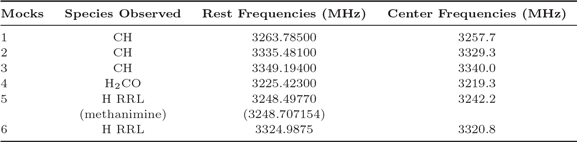
The W51 and M17 datasets were collected at the former AO 12-m radio telescope via position switching. The spectrometer was divided into six sub-bands with a bandwidth of 25 MHz each, which contained the rest frequency of the observed transitions (see Table 1). The Molecular Clouds Data Reduction Pipeline (MCD-RP) was used to process the data. This six-step pipeline includes corrections for Doppler velocity and an advanced RFI identification algorithm developed at the University of Puerto Rico-Mayagüez by E. Morales-Butler.
Mock Sub-spectrometer Species Observed with Rest and Center Frequencies.

Table 1 Long description
A table with six rows and four columns. The columns are labeled Mock, Species Observed, Rest Frequencies (MHz), and Center Frequencies (MHz). Row 1: Mock 1, Species Observed CH, Rest Frequencies 3263.78500, Center Frequencies 3257.7. Row 2: Mock 2, Species Observed CH, Rest Frequencies 3335.48100, Center Frequencies 3329.3. Row 3: Mock 3, Species Observed CH, Rest Frequencies 3349.19400, Center Frequencies 3340. Row 4: Mock 4, Species Observed H2CO, Rest Frequencies 3225.42300, Center Frequencies 3219.3. Row 5: Mock 5, Species Observed H RRL (methanimine) (3248.707154), Rest Frequencies 3248.49770, Center Frequencies 3242.2. Row 6: Mock 6, Species Observed H RRL, Rest Frequencies 3324.9875, Center Frequencies 3320.8.
Notes: This table shows the species, rest frequency of each transition, and center frequency of each bandpass.
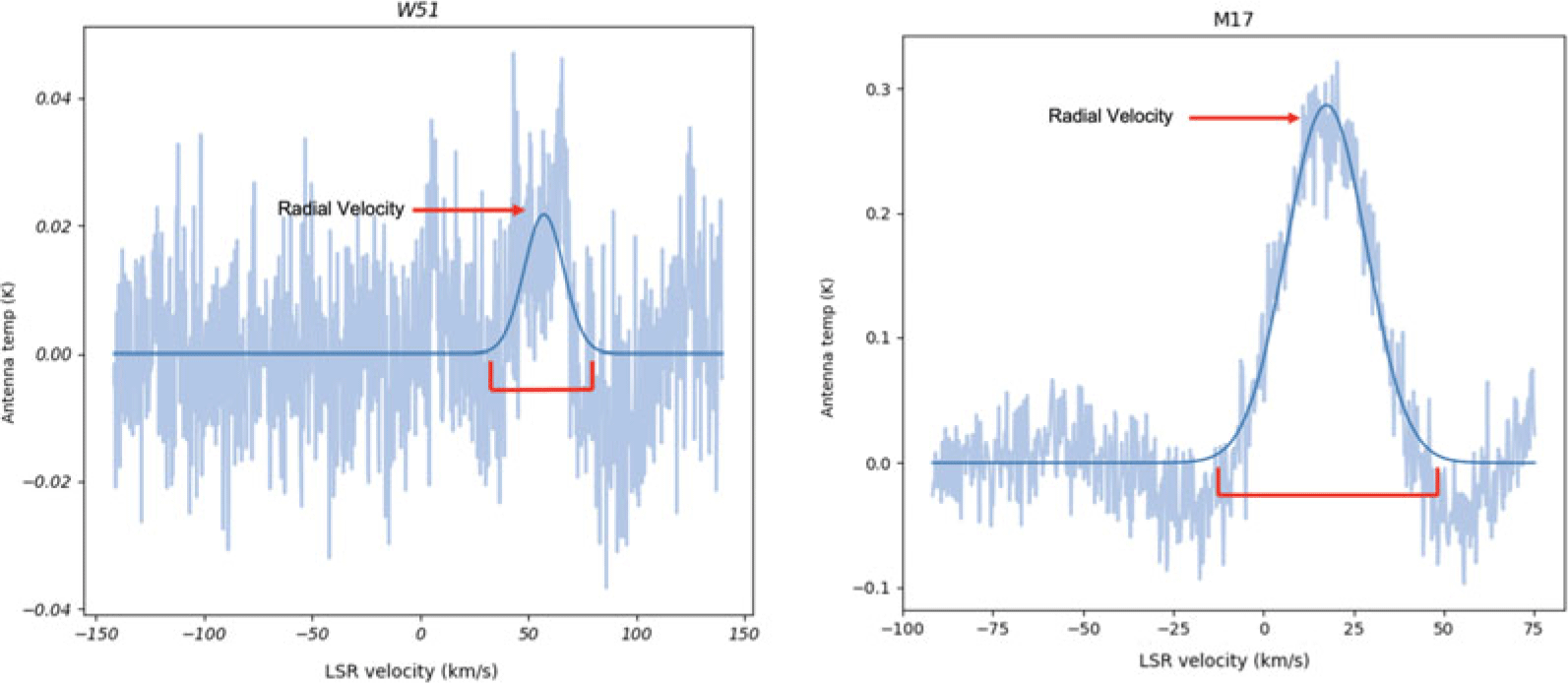
A hyperfine transition spectral line in Mock 2 corresponding to CH was detected in W51 with a velocity of with a velocity of
 $v_{LSR} = 57.28 \, \, km/s$
. Moreover, after RFI corrections, the results for the column density of CH can be expressed as:
 \begin{equation}W(\mathrm{CH}) = \int T_a \, dv \end{equation}
 \begin{equation}N_{\mathrm{CH}} = 2.84 \times 10^{14}\cdot \frac{T_{\mathrm{ex}}}{T_{\mathrm{ex}} - T_{\mathrm{bg}}}\cdot W(\mathrm{CH}) \end{equation}
 \begin{equation} N_{\mathrm{CH}} = 1.75 \times 10^{13} \, \mathrm{cm}^{-2} \end{equation}
The equations (1b) and (1c) allowed for the completion of one of the primary objectives and calculation of the column density for
 $\mathrm{H}_2$
as
 $N_{\mathrm{H}_2} = N_{\mathrm{CH}}/{4.3 \times 10^{-8}} = 6.12 \times 10^{20} \, \, \mathrm{cm}^{-2}$
. CH was not detected in M17, which could mean the observations were sensitivity-limited, due to either insufficient integration time or significant data loss from RFI. The molecular structures within the molecular cloud are also be small enough in angular size to have been beam-diluted.
The
 $N_{\mathrm{H}_2}$
for W51 could also be derived from CO as a molecular tracer, i.e., Burgh et al. (Reference Burgh, France and McCandliss2007) calculations obtained for other dense ISM regions. This analysis was performed for W51 with CO data from the Harvard-Smithsonian Center for Astrophysics Galactic Plane Survey of the MWG:
 \begin{equation}N_{\mathrm{H}_2} = W(\mathrm{CO}) \cdot X_{\mathrm{CO}} \ , \ \ \ \ \ X_{\mathrm{CO}} = 2.80 \times 10^{20} \, \mathrm{K km s}^{-1} \, \mathrm{cm}^{-2}\end{equation}
 \begin{equation}N_{\mathrm{H}_2} = 0.92 \times 10^{22} \, \mathrm{cm}^{-2} \end{equation}
The result seen in (2b) is approximately two orders of magnitude higher than the
 $N_{\mathrm{H}_2}$
estimated with CH. A possible explanation for this difference leads to CH spectral lines not following local thermodynamic equilibrium (LTE) ratios; therefore, arriving at the
 $N_{\mathrm{H}_2}$
previously shown. This would express consistency between these values to further validate N calculations to be utilized across various ISM regions, including but not limited to M16 and M20.
For ISM molecular clouds M17 and W51, H RRLs were also observed corresponding to H125
 $\alpha$
and H126
 $\alpha$
transitions when gas is ionized by nearby stars as seen in Mock 5 and 6, respectively. Figure 1 provides a spectrum of the molecular cloud M17 and its first H RRL detection in Mock 5.
The CH spectrum of W51 for Mock 2 detected on 2023-07-22 is shown on the left. The H RRL H125
 $\alpha$
Mock 5 spectrum for M17 detected on 2023-07-22 is shown on the right. The parameters retrieved, such as
 $v_{LSR}$
, allowed for the corresponding statistical calculations.

3. Discussion and Future Work
The molecular clouds M17 and W51 are active regions in the galactic plane of the MWG. Through observations performed by the former AO 12-m radio telescope, datasets about the distribution of CH across the galactic plane of MWG were collected as part of this pilot survey, estimating the column density of
 $N_{\mathrm{H}_2}$
for the star-forming regions. The observational setup allowed for the collection of CH,
 $\mathrm{H}_2\mathrm{CO}$
, and H RRL spectral lines. Of specific interest has been the detection of CH within the molecular cloud W51 found in Mock 2. For M17, CH was not detected; however, this molecule could still be present within this region. Our observations could have been sensitivity-limited. For W51, after an intensive data reduction process through the MCD-RP, the parameters retrieved from a statistical analysis indicate that
 $N_{\mathrm{CH}} = 1.75 \times 10^{13} \, \mathrm{cm}^{-2}$
and that
 $N_{\mathrm{H}_2} = 6.12 \times 10^{20} \, \mathrm{cm}^{-2} $
. This differs by approximately two orders of magnitude from estimates for
 $N_{\mathrm{H}_2}$
retrieved from dense regions of the ISM by observations of CO. The next phase includes modeling CH with radiative transfer algorithms to show more accurate
 $N_{\mathrm{H}_2}$
while addressing the effectiveness of CH as a molecular tracer. Moreover, the
 $v_{LSR}$
for W51 in Mock 2 is aligned with previous calculations for W51
 $v_{LSR}$
radio observations previously detailed in Jacob et al. (Reference Jacob, Nandakumar, Roy, Menten, Neufeld, Faure, Tiwari, Pillai, Robishaw and Duran2024).
The spectra of H RRLs detected for M17 and W51 in both Mock 5 and Mock 6 constitute the first step toward understanding the distribution of hydrogen (H) within the clouds. Moreover, parameters such as electron temperature (
 $T_e$
) will be calculated to understand the stellar-gas cycle activity present in stellar clusters within the molecular clouds. This will provide the survey with its first look into heating exchange mechanisms previously modeled by Pequignot et al. (Reference Pequignot, Walsh, Zijlstra and Dudziak2000), and gas-phase structures throughout the molecular clouds Rubin et al. (Reference Rubin, Simpson, Erickson and Haas1991). The analysis of H RRLs spectra will be fundamental to further characterize these ISM molecular clouds. Potential changes in the operational activities of the former AO 12-m radio telescope could provide a framework for the development of large M17 and W51 observational datasets.
Acknowledgments
I would like to extend my gratitude to mentors P.I. Allison Smith and Prof. Emmanuel Morales-Butler for their guidance and support. I also extend my gratitude to collaborator Diana Berrios. This work was supported by the NASA Cooperative Agreement 80NSSC20M0052 and Cooperative Agreement Award AST-2132229.
 α
 vLSR


