

Even in the most tranquil of times, putting together a special issue presents difficulties. The COVID-19 pandemic made production of this Special Issue on Disgust and Political Attitudes not just more challenging; it also underscored the value of the work carried out here. A better understanding of how trait and state disgust relate to politics during “normal” times offers insights into how people might act during a destabilizing pandemic and in its aftermath.
This special issue of Politics and the Life Sciences showcases how disgust, whether as an induced emotional state or as a trait that varies across individuals, can help us understand attitudes toward policy, politicians, and political ideology. Before we introduce the six articles that make up this special issue, we provide a brief introduction to disgust. We next discuss the process by which research funding was provided in support of the Association for Politics and the Life Sciences (APLS) goal of engendering more transparent scientific practices, while introducing key concepts for the open science movement and where pre-analysis plans, data, and analysis scripts may be found for the articles in this issue. Next, we consider how each of the articles contributes to our knowledge of disgust and political attitudes, as well as to scientific practice. We conclude by discussing areas of disgust-related research that have questions ripe for answering.
Disgust and political attitudes
Disgust is a powerful motivator. It develops in infancy, its expression is recognized across cultures, and markers of associated states such as nausea, vomiting, and proximate avoidance of infection threats can be observed among nonhuman animals. Recent research suggests that this emotion has implications for our understanding of politics. For example, research suggests that disgust responses partially underly prejudice against different groups such as the homeless, immigrants, and homosexuals (e.g., Aarøe et al., Reference Aarøe, Petersen and Arceneaux2017; Adams et al. Reference Adams, Stewart and Blanchar2014; Clifford & Piston, Reference Clifford and Piston2017; Inbar et al., Reference Inbar, Pizarro, Knobe and Bloom2009). Other research suggests that the tendency to experience disgust is associated with ideological leanings, such that less disgust-sensitive individuals tend to be more liberal rather than conservative (e.g., Smith et al., Reference Smith, Oxley, Hibbing, Alford and Hibbing2011; Terrizzi et al., Reference Terrizzi, Shook and Ventis2010). Research also suggests that disgust shapes the processing of political arguments, such that people feel disgust and other aversive emotions in the face of political arguments they disagree with, motivating them to avoid careful consideration of opposing viewpoints (MacKuen et al., Reference MacKuen, Wolak, Keele and Marcus2010). This research is thus challenging the long-standing view that people’s political views are grounded in cold, rational considerations. Instead, political attitudes and behaviors are tied to emotional and biological processes.
Structure
In 2018, the APLS Council decided to fund special issues composed of research manuscripts adhering to the tenets of open science while simultaneously addressing questions raised by biopolitical research. Specifically, the Council aimed to support data collection based upon research proposals reviewed and accepted prior to data collection. In line with this goal, all articles in this special issue were either preregistered studies or registered reports. By focusing on the emotion of disgust, APLS supported a focus on a topic that has seen an increase in interest over the past decade: how disgust influences political attitudes.
We invited researchers from across the social sciences to submit funding proposals in the form of pre-analysis plans. These pre-analysis plans were first “blinded” by the managing editor before the expert editors evaluated the proposals on the basis of the theoretical importance and feasibility of the proposed research. Specifically, funding decisions were based on the following components:
-
1. Identification of key research questions based on salient literature, with directional hypotheses where feasible
-
2. Research design, measures, data collection methodology, and data analysis methods
-
3. Timeline for the research collection and analysis
-
4. Description of facilities where research will be carried out
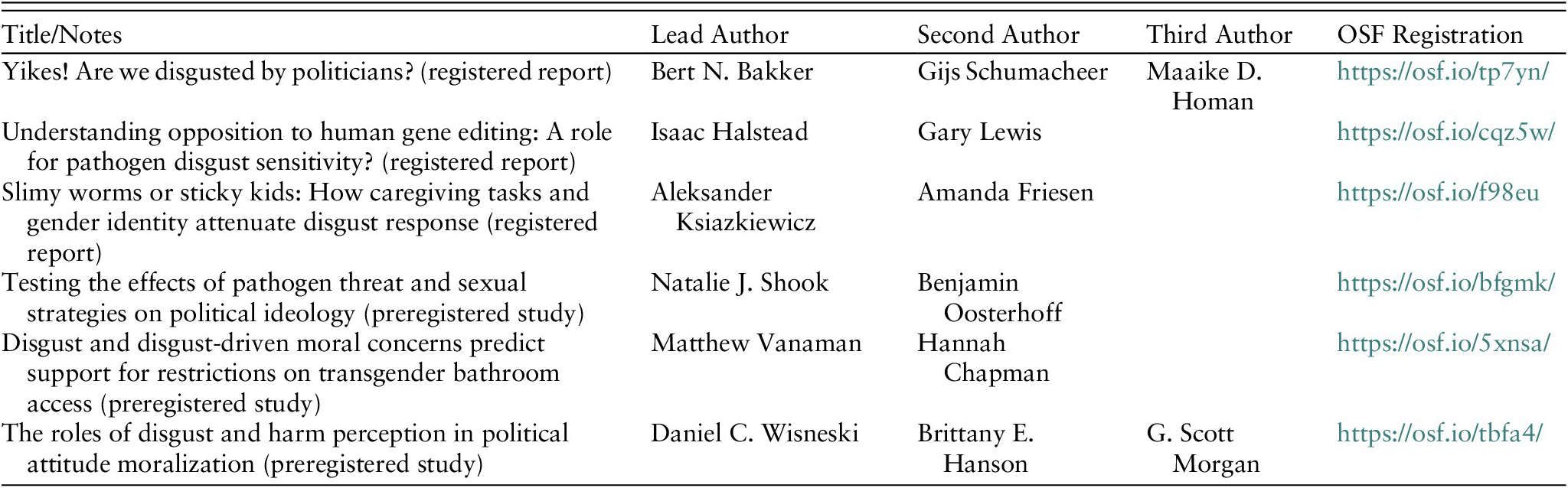
By accepting funding, the researchers obligated themselves to not only carry out their proposed research as planned but also to provide publicly accessible deliverables of a publishable manuscript and the data set and statistical application script on which the findings were based. Interested individuals may access the data set and statistical application script at the links provided in Table 1.
Special Issue on Disgust and Political Attitudes, articles, authors, and open science access.

The goal of APLS funding this research was not just to contribute to the larger research corpus through novel research ideas on how, why, and when disgust shapes political attitudes and behaviors, but also to reward the execution of such research with strict adherence to the principles of reproducible research. To facilitate this, the APLS funded seven projects US$1,500 each for data collection expenses and made the final publication decision independent of outcomes. The special issue welcomed both replications and null findings. In return, our scholars preregistered their studies and made all their materials public through the OSF website (see Table 1).
Funding decisions were made during late 2018, with allocation of funding occurring after evidence of Open Science Framework preregistration. Four of the seven projects funded opted for the registered report (RR) option, undergoing double-blind peer review of the pre-analysis plan (PAP) before receiving an in principle acceptance (IPA) prior to collecting data. The remaining three projects opted for preregistered approaches, in which case a more traditional review process was carried out after data were collected, analyzed, and written up.
The articles
The registered report “Yikes! Are we disgusted by politicians?” by Bert N. Bakker, Gijs Schumacher, and Maaike D. Homan examined the effect of disgust trait and state response to in-group and out-group Dutch political leaders who committed moral violations. By considering both psycho-physiological and self-reported emotional response, the authors test multiple hypotheses regarding response to moral violations by participants most and least liked political party leaders. This study not only provides further evidence of the disjunction between experiential and physiological emotion; it also offers a good example of detailing and justifying deviations from a pre-analysis plan. Furthermore, the focus on the IPA underscores, in the words of the authors, “the importance of the registered report format. Null findings tend to be much less likely to be written and/or published (Franco et al. Reference Franco, Malhotra and Simonovits2014). But in this format they get published.”
The registered report “Understanding opposition to human gene editing: A role for pathogen disgust sensitivity?” by Isaac Halstead and Gary Lewis not only shines a light on reactions to gene editing, an important and transformative technology, but also illustrates how to report counterintuitive findings that are at odds with preregistered hypotheses. Namely, instead of relating to opposition to human gene editing, increased pathogen disgust sensitivity relates to greater support for gene editing to treat medical (mental and health) disorders and to enhance lifespan, strength, attractiveness, and cognitive ability. This relation remained even after controlling for demographic and other psychological variables.
The registered report “Slimy worms or sticky kids: How caregiving tasks and gender identity attenuate disgust response” by Aleksander Ksiazkiewicz and Amanda Friesen forges new ground in considering how biological sex, gender identity, and parental status are correlated with pathogen disgust sensitivity, as well as with items intended to capture disgust in caregiving (e.g., parenting) contexts. The complexities raised in this study suggest a nuanced relation between political ideology and policy attitudes, and they offer future directions for exploring interactions between biological sex, gender identification, and disgust.
Natalie J. Shook and Benjamin Oosterhoff’s preregistered study “Testing the effects of pathogen threat and sexual strategies on political ideology” underscores the importance of pre-analysis plans as they consider two related, yet distinct, evolutionary theories concerning political ideology. The first considers how ideology might be influenced by pathogen-avoidance strategies, whereas the second theory considers how ideology is influenced by sexual reproduction strategies. While the two large-scale studies replicated past work suggesting that trait-level pathogen-avoidance and sexual strategies variables relate to ideology, they found that experimental manipulations aimed at manipulating pathogen-avoidance and reproductive motivations had no effect on ideology. Publication of these high-powered null findings forestalls unnecessary future research.
The preregistered study by Matthew Vanaman and Hannah Chapman, “Disgust and disgust-driven moral concerns predict support for restrictions on transgender bathroom access” finds that pathogen disgust relates to attitudes toward legislation that aims to limit transsexual access to bathrooms, partially via “purity” concerns. The authors detected no unique relation between sexual, injury-specific, and moral trait disgust on attitudes toward this same legislation. Even when operating through purity concerns as enunciated by the moral foundations theory, support for bathroom bills appears to be driven by pathogen avoidance—whether by sexually transmitted diseases associated with transgendered individuals or by triggering the pathogen-avoidance system through perceived physical differences. While underscoring the role played by the trait pathogen disgust, the further finding that purity played a more powerful role than they desire to avoid harm is of particular importance for understanding the rhetoric surrounding this public policy arena.
Daniel C. Wisneski, Brittany E. Hanson, and G. Scott Morgan’s preregistered study “The roles of disgust and harm perception in political attitude moralization” provides a high-powered study in which the authors carry out a two-stage online study aimed at inducing the discrete emotions of anger and disgust, and with them perceptions of harm, regarding the Flint, Michigan, water crisis. This study attempts to consider whether changes in state disgust are associated with changes in moral conviction regarding the harm done by lead in the water and the need to use bottled and filtered water in everyday consumption by residents. While findings were not consistent with hypotheses, exploratory analyses provide insight into the nature of causality when appraising and responding to potential harms.
Questions to be addressed
The articles in this issue contribute to a literature suggesting that disgust is relevant to politics. They also highlight multiple outstanding questions regarding how, why, and when disgust and politics are related. These debates include, for example, questions such as the following:
-
• Why do people vary in trait disgust in the first place, and how should we interpret this variation? Ksiazkiewicz and Friesen propose that this variation partially reflects social pressures to experience disgust in a gender-normative fashion. More tests, perhaps those investigating how observers perceive men and women who express disgust toward pathogen cues, will be necessary to further evaluate this hypothesis. Recent twin research has found that disgust sensitivity is similarly heritable in both men and women and that similarities between twins in disgust sensitivity are entirely accounted for by genetic rather than environmental similarities (Tybur et al., Reference Tybur, Wesseldijk and Jern2020). More work investigating the genetic, social, and nonsocial environmental factors shaping disgust sensitivity will be necessary to fully understand how trait disgust relates to ideology.
-
• How do we measure disgust? Bakker and colleagues raise critical issues regarding the validity of psychophysiology measures, at least as they are typically reported in the literature (see also Bakker et al., Reference Bakker, Schumacher, Gothreau and Arceneaux2020; Osmundsen et al., Reference Osmundsen, Hendry, Laustsen, Smith and Petersenin press). Issues of validity also apply to visual attention tasks, which have often been used in the disgust literature (e.g., Parsons et al., Reference Parsons, Kruijt and Fox2019). Self-report measures of trait disgust have fared better in this regard, with thorough investigations into the factor structure of disgust, its test-retest reliability, and its relation to personality (e.g., Tybur et al., Reference Tybur, Çınar, Karinen and Perone2018). But measuring state disgust remains a challenge, and further improvements in the measurement and interpretation of trait disgust can surely be made.
-
• How and why does disgust relate to the two key dimensions of ideology: tendencies toward left-wing versus right-wing and traditional versus progressive? (Claessens et al., Reference Claessens, Fischer, Chaudhuri, Sibley and Atkinson2020). Researchers have interpreted relations between disgust and ideology as suggesting that conservatism partially functions to neutralize pathogen threats posed by out-groups (e.g., Terrizzi et al., Reference Terrizzi, Shook and McDaniel2013). This perspective, however, may need to be reevaluated in light of some studies reporting that ideology relates more strongly to sexual disgust than pathogen disgust (e.g., Billingsley et al., Reference Billingsley, Lieberman and Tybur2018; Shook and Oosterhof, Reference Shook and Oosterhoff2020, this issue; Tybur et al. Reference Tybur, Inbar, Güler and Molho2015; but see Aarøe et al., Reference Aarøe, Petersen and Arceneaux2020) and that pathogen disgust relates more strongly to the dimensions of ideology associated with intragroup norm adherence than intergroup biases (e.g., Karinen et al., Reference Karinen, Molho, Kupfer and Tybur2019). Better understanding which specific political sentiments relate to which specific domains of disgust can help us understand the motivational roots of ideological orientations.
-
• Why and how do feelings of disgust produce prejudice? Findings suggest that individuals who are higher in disgust sensitivity are more likely to be prejudiced toward a range of groups, including homosexuals and foreigners (e.g., Aarøe et al., Reference Aarøe, Petersen and Arceneaux2017; Inbar et al., Reference Inbar, Pizarro, Knobe and Bloom2009). Some researchers have interpreted these results as indicating that the disgust system is designed to generate avoidance of out-groups (e.g., Faulkner et al., Reference Faulkner, Schaller, Park and Duncan2004). Other researchers have argued that disgust motivates avoidance of all other individuals, whether out-group or in-group (e.g., van Leeuwen & Petersen, Reference van Leeuwen and Petersen2018). Some researchers argue that the primary mechanism relates to increased conformity with local norms (Navarrete & Fessler, Reference Navarrete and Fessler2006).
-
• How does the emotion of disgust relate to support for health care? The emotion of disgust evolved, at least in part, to help our ancestors avoid individuals with contamination risk (Tybur et al., Reference Tybur, Lieberman and Griskevicius2009). At the same time, there is substantial anthropological evidence for health care toward sick and injured individuals (Steinkopf, Reference Steinkopf2017). Does attention to sickness also generate support for modern-day health care institutions? At present, very little research has explored such political effects of disgust sensitivity.
-
• How do different types of disgust shape political attitudes? Most existing research on disgust and politics has focused on pathogen-related disgust reactions. But people also feel disgust toward views they see as morally wrong or toward sexual behaviors (Stewart et al. Reference Stewart, Adams and Senior2020; Tybur et al., Reference Tybur, Lieberman and Griskevicius2009). At present, we know very little about how these other types of disgust shapes political attitudes. For example, what is the role of moral disgust in partisan conflict and polarization? Does it encourage indirect aggression and reputational attacks? (e.g., Molho et al., Reference Molho, Tybur, Güler, Balliet and Hofmann2017). Or do individual differences in propensity to experience sexual disgust track attitudes on political issues related drug policy, sex, and marriage? (e.g., Kurzban et al., Reference Kurzban, Dukes and Weeden2010).
-
• Are the effects of disgust similar across cultures? Most work on disgust and politics has been conducted on Western populations and, hence, we know little about how well the political associations of disgust responses generalize more broadly. Existing cross-cultural work points in different directions. One large-scale study found that individual differences in support for traditional political values and individual differences in disgust sensitivity are fairly similar across 30 nations (Tybur et al., Reference Tybur, Inbar, Aarøe, Barclay, Barlow, De Barra and Consedine2016). Another study found that individual differences in disgust sensitivity are only related to avoidance of out-groups in some but not all populations (van Leeuwen & Petersen, Reference van Leeuwen and Petersen2018).
Conclusion
The major goal behind this funded Special Issue on Disgust and Political Attitudes has been to reward open science adhering to the tenets of transparency throughout the scientific process. By funding scientific inquiry, APLS has taken a bold step to address the “replication crisis” faced in the sciences and has proffered an innovative model that reduces professional risks faced in the contemporary “publish or perish” environment. At the same time, the blinded funding review approach enhances the egalitarian and meritocratic attributes of the process thus allowing for greater diversity in intellectual interrogation.
That not only was top-quality research funded and carried out, but also that each article encountered and reported null findings, underscores success in meeting our objective. With scientific progress marked not so much with cries of “Eureka!” as mutters of “that’s odd…,” we hope that future research benefits from the type of honest dialogue systematically engendered here. Specifically, we do so by balancing preregistered testing and replication with exploration, while at the same time recognizing that the intellectual underpinnings of humility and open-mindedness are core components of what makes science a force for societal good.