Introduction
Virtual confrontation might be sufficient to protect virtual constitutional rights; I doubt whether it is sufficient to protect real ones.
—Justice Antonin Scalia, “Amendments to Rule 26(b) of the Federal Rules of Criminal Procedure” (2002)The COVID-19 pandemic necessitated unprecedented adaptation by the American judiciary, as it did for judiciaries around the world. As the severity of the pandemic became manifest, courts across the United States provided remote access to hearings (Ferrere Reference Ferrere2020). Even the US Supreme Court found it had to alter standard procedure, allowing public access to its live teleconferenced oral arguments, ending a centuries-old tradition of never allowing recording or broadcast of the video of its oral arguments (Liptak Reference Liptak2020).
The effective adoption of virtual courts around the world requires addressing the diverse technological comfort levels and levels of technology access across various demographic segments. Disparities in digital literacy and connectivity, especially in rural areas, significantly impacts the accessibility and efficacy of virtual court proceedings (Zorza Reference Zorza2007). This digital divide not only hinders the transition to online systems but also raises concerns about maintaining the principle of equal access to justice for all citizens. Recent research suggests that virtual hearings may lead to unfair proceedings and inequitable outcomes, especially in trial courts (Diamond et al. Reference Diamond, Bowman, Wong and Patton2010; Eagly Reference Eagly2015; Thorley and Mitts Reference Thorley and Mitts2019). For example, one study found that immigration courts were less likely to grant asylum in video hearings compared to in-person hearings (Walsh and Walsh Reference Walsh and Walsh2007). Similarly, there is evidence that defendants who had video hearings were set higher bail bonds than those who had in-person hearings (Eagly Reference Eagly2015). These studies, however, do not discern whether and to what degree the observed disparities can be attributed to the technology gap among participants or to the effect that the virtual setting might have on judges and their biases.
In this article, we investigate a natural experiment that demonstrates the impact of pandemic-induced virtual hearings on traffic court decisions. Using an original dataset comprising over forty thousand traffic charges from Pulaski County, Arkansas, we tested whether litigants appearing in person have different dispositional outcomes than those appearing virtually from a remote location (typically, their home) and those who appeared virtually from on-site “drive-thru” stations where quality technology and connectivity were provided. We hypothesize that litigants appearing in virtual traffic court are more likely to be convicted and that this effect is less pronounced for those provided with dependable on-site Internet and technology. We conducted similar tests on pandemic-era traffic court data from Orange County, Florida, and expanded our analyses in these tests to determine whether litigants’ age, sex, and gender influence virtual court dispositions.
To test our focal hypotheses, we used a difference-in-differences (DiD) approach that leverages the diverse COVID-19 hearing protocols adopted by Pulaski County judges. We found that fully remote hearings lead to stricter outcomes for traffic violations but that this effect is partially offset by the use of consistent and reliable technology. Our analysis, however, reveals minimal evidence of litigant identity influencing biases in virtual courts. Based on these findings, we propose recommendations to create more equitable and accessible virtual courts.
Virtual court hearings
The technologies involved in video teleconferencing complicate the hearing process and introduce several possible points of failure in the judicial process, such as poor connectivity and audio quality (US Government Accountability Office Reference Government Accountability Office2017, 55–58). A fundamental obstacle to attaining equitable outcomes in remote court hearings is the relative lack of computer access and quality Internet access among rural, poor, and minority populations (Atske and Perrin Reference Atske and Perrin2021; Dolcini et al Reference Dolcini, Canchola, Catania, Song Mayeda, Dietz, Cotto-Negrón and Naraya2021; Li et al. Reference Li, Spoer, Lampe, Hsieh, Nelson, Vierse, Thorpe and Gourevitch2023). Several studies, however, suggest that remote courts can increase access (National Center for State Courts 2020; Zhang Reference Zhang2021; McKenna Reference McKenna, Raj Kumar and Sreejith2022), especially for underserved populations (Zorza Reference Zorza2007; Turner Reference Turner2021).
This article builds on research indicating that judges frequently employ heuristics—cognitive shortcuts—to facilitate more rapid decision making (Tversky and Kahneman Reference Tversky and Kahneman1974; Rachlinski, Guthrie, and Wistrich Reference Rachlinski, Guthrie and Wistrich2007). The use of these heuristics is shaped by institutional factors including case volume (Epstein and Knight Reference Epstein and Knight2013), time available for hearing cases (Hemrajani and Hobert Jr. Reference Hemrajani and Hobert2024), and the physical environment of courtrooms (Mulcahy Reference Mulcahy2010). Meeting in virtual settings imposes additional cognitive demands on participants (Hinds Reference Hinds1999), which may increase reliance on heuristic decision making (Marbin, Hutchinson, and Schaeffer Reference Marbin, Hutchinson and Schaeffer2021). Specifically, communication is often hampered in virtual settings, and, as one Arkansas district court judge noted, “our internet access was not very good therefore the video would freeze up or disconnect. … It was actually a little aggravating trying to use it.”Footnote 1 Studies have shown that increased cognitive load leads individuals to favor status quo outcomes as these require less cognitive effort to evaluate and endorse (Kool et al. Reference Kool, McGuire, Rosen and Botvinick2010). This suggests that the extra cognitive burden imposed by virtual environments could systematically bias judges toward upholding the charges against a defendant—the status quo outcome.
Even with perfect connectivity, though, videoconferencing introduces disadvantages for defendants that would also make the dismissal of charges less likely. In remote hearings, the conveyance of nonverbal cues is greatly limited, and eye contact is more difficult, as is defendants’ ability to convey innocence and trustworthiness (Poulin Reference Poulin2004). Virtual hearings can stymie effective attorney-client communication (Poulin Reference Poulin2004, 1129–30; Diamond et al Reference Diamond, Bowman, Wong and Patton2010, 881–82; Bellone Reference Bellone2013, 44–45). Additionally, the visual sharing of personal surroundings—ranging from mundane home decorations to more striking elements like pets or children—deviates markedly from the uniform backdrop of traditional courtrooms (Nylund Reference Nylund2021; Blumberg et al. Reference Blumberg, Deutsch, Caballero and Blumberg2023; Muir, Newman, and Meredith Rossner Reference Muir, Newman and Rossner2025). This inconsistency introduces extralegal factors, potentially influencing judges’ perceptions of defendants whose physical backgrounds might inadvertently signal socioeconomic status or even presumption of guilt (Devine and Caughlin Reference Devine and Caughlin2014; Rossner et al. Reference Rossner, Tait, McKimmie and Sarre2017; McKay Reference McKay2018).
Prior studies on remote court access were based on limited charges, small sample sizes, and often self-selected populations (Bandes and Feigenson Reference Bandes and Feigenson2021). For example, one prominent study examined whether online hearings reduced disparities in dispositional outcome based on race, age, and gender, finding evidence that they did (Mentovich, Prescott, and Rabinovich-Einy Reference Mentovich, Prescott and Rabinovich-Einy2020). The findings of this study (which focused on traffic court hearings in Michigan) examined online hearings that were held only for certain charges and only for litigants who opted into virtual hearings, and the proceedings were predominately asynchronous and conducted over multiple days or weeks via email and similar media. This approach did not isolate the effects of technological variance, nor did the mode of proceedings necessarily impact judges’ reliance on heuristics in quick decision making (Peer and Gamliel Reference Peer and Gamliel2013; Perez Reference Perez2016; Hemrajani and Hobert Jr. Reference Hemrajani and Hobert2024).
Even given what we have learned from remote court access during the COVID-19 pandemic, issues regarding the balance between public access and accountability in virtual hearings remain unresolved (Townend and Magrath Reference Townend and Magrath2021). While remote access during this crisis likely increased participation and flexibility in certain court contexts (Harker and Ryan Reference Harker and Ryan2022), virtual courtrooms were often disorganized and fraught with technical malfunctions, interfering with defendants’ ability to confer with counsel, project trustworthiness, and communicate effectively in court, often resulting in inequitable outcomes such as extended periods of pretrial detention—this was an especially undesirable result during this crisis as extended detention might increase the likelihood of contracting COVID-19 (Epps Jr. and Hayter Reference Epps and Hayter2021; Nir and Musial Reference Nir and Musial2022). Compounded with other difficulties inherent in remote access, the aforementioned disparities in Internet quality (Zorza Reference Zorza2007; Thorley and Mitts Reference Thorley and Mitts2019) exacerbate inequalities for minority racial groups (Harris Reference Harris2023) and for elderly people (Wick Reference Wick2023). Beyond the US context, the transition to remote hearings during the COVID-19 pandemic highlighted similar limitations regarding virtual hearing principles and their impact on the manifestation of litigants’ right to fair trials.Footnote 2
Given the impact of increased cognitive load on judges’ tendency to affirm charges (as well as the other extralegal factors introduced by remote hearings), we developed our first hypothesis:
Hypothesis 1: The adoption of remote-accessed judicial proceedings in traffic courts leads to a higher incidence of standard, status quo decisions—here, enforcing fines or penalties—compared to traditional in-person court settings.
We expect that judges’ inclination toward status quo decisions in virtual court environments is partially conditioned on technological disparities and variances, such as differences in Internet connectivity, equipment quality, domestic environment, and digital literacy among participants. Thus, we developed our second hypothesis:
Hypothesis 2: Providing defendants with access to better technology and consistent, on-site Internet connection mitigates judges’ tendency to uphold the status quo—enforcing fines or penalties—in virtual judicial proceedings.
Empirics
Research design
Traffic courts serve as an ideal testing ground to evaluate these effects due to their high volume of cases and the immediacy of their decisions. As one Arkansas traffic court judge put it, “I like to tell people the Supreme Court of the United States takes an average of 75 cases a year. I usually do that before noon on Wednesday.”Footnote 3 Traffic courts usually deal with lower-stakes issues and primarily impose fines, with only a minority of cases leading to short jail sentences. We maintain that such low-stakes environments generally amplify heuristic biases. For this study, Arkansas was chosen due to its robust data collection methods in traffic courts and the availability of this data through public case search websites.Footnote 4 Notably, Arkansas’s exclusion of jury or panel trials for traffic violations ensures that decisions can be singularly attributed to one judge.
Before describing the data used to test the theory, a brief description of the traffic court system in the United States is warranted. Any person (herein referred to as “defendant”) who commits one or more traffic offenses is ticketed with one or more infractions by an officer. The officer then submits this ticket to the jurisdictional district court of the county in which the offense was committed. In most cases, the ticket can be paid online or at the court window without the need for a formal hearing. These are “non-mandatory court” offenses for which the court does not schedule a plea and arraignment hearing if the person pays the ticket. A plea and arraignment hearing is only scheduled if the person refuses to pay or wishes to challenge the ticket. For some charges—typically, Class B and unclassified misdemeanors—or when more than two charges are on a single ticket, jail time is a potential outcome, and a plea and arraignment hearing is mandatory. At this hearing, a defendant can make a plea of guilty, not guilty, or nolo contendere (no contest). In case of guilty or nolo contendere pleas, a decision on the case is usually rendered immediately by the judge. If a defendant pleads not guilty and charges cannot be dismissed immediately, a trial is scheduled for the case. During the trial, the judge hears and considers arguments from the prosecutor and the defense and typically renders a decision (guilty, not guilty, or dismissed) immediately. If a defendant is found guilty, the judge determines the amount of fine to be imposed, subject to a statutory minimum and maximum.
Once the COVID-19 pandemic was formally recognized, it was generally not permitted for traffic courts to hold in-person hearings. In mid-March 2020, the Supreme Court of Arkansas all but suspended physical hearings, granting individual court judges the latitude to determine whether their proceedings were “necessary to protect the constitutional rights” of defendants, among other exceptions. The court also gave each presiding judge the power to hold court via teleconferenced hearings (Kemp Reference Kemp2020; Supreme Court of Arkansas 2020). The court gave discretion to individual judges to decide the manner of holding virtual hearings, stating that “[a]ll judges and court clerks are encouraged to utilize all available technologies—including facsimile machines, e-mail, teleconferencing, and video conferencing continue handling judicial matters” (Supreme Court of Arkansas 2020, 3). These “emergency measures” continued in some form until the “return to regular” order was issued on June 10, 2021 (Supreme Court of Arkansas 2021).
Little Rock Traffic Court, which has jurisdiction over all traffic offenses committed in Little Rock city limits, was among the first to implement virtual hearings. Defendants who had hearings scheduled during the pandemic were offered two options. First, they could take a conditional plea of no contest and pay the fine online. In this case, the ticket would not go on their record. Second, in cases of mandatory court or if they wanted to have a hearing, then they could schedule a virtual hearing. Here, defendants needed to send in a form or call the court, after which the court assigned them a date to appear virtually. This virtual hearing was fully remote, conducted using the Webex videoconferencing program, which defendants had to install on their own device in order to attend. Defendants were required to have a computer, cell phone, or mobile device with a microphone and camera in order to attend the virtual hearing. The court was fully remote from April 2020 until June 2021. Little Rock continued an optional virtual hearing option even after the pandemic.
Pulaski County District Court in Arkansas, which is three miles away from Little Rock Traffic Court, also suspended in-person hearings during the COVID-19 pandemic. However, unlike Little Rock Traffic Court, Pulaski County District Court did not switch to fully remote hearings. After the county judge closed county buildings, the district court did not hold “in-person” hearings from April 17, 2020, until August 2020. Staff rotated to accommodate the Centers for Disease Control and Prevention’s guidelines of maintaining a six-foot buffer between employees. All court business was conducted via email, US mail, or phone. Once “in-person” plea hearings resumed in August, tents were set up outside, and court hearings were conducted virtually with laptops or iPads. Defendants remained in their personal vehicles until their cases were called. At the appropriate time, staff members notified defendants to enter the tent and approach the laptop to enter a plea via Zoom while the judge, attorneys, and other court staff remained in the courtroom. No trials were held until October 2020. No trials were conducted virtually, except for the first appearances of individuals incarcerated in the Pulaski County Regional Detention Facility. Both the hardware and the software were thus provided by the court. These “drive-thru” hearings did not provide the convenient at-home access of fully remote hearings, but they ensured that litigants were not excluded simply because they lacked the requisite technology or technological prowess to attend a remote hearing. It also standardized the background environment of the hearing, ensuring that the judge was not influenced by cues in a person’s home. After October, Pulaski County hearings were “in person” with courtroom capacity limited. On-site drive-thru hearings were conducted from August 17, 2020, until October 4, 2020, and have not been conducted since.
Finally, North Little Rock District Court is 2.6 miles away from the Little Rock County Court. North Little Rock District Court did not have virtual hearings at all. Except for a month after the emergency measures were introduced, when the court was closed due to city-wide lockdowns, North Little Rock County “[n]ever closed the courthouse,” and all those arraignments (and trials) were conducted live in court, with social distancing protocols and face protection required.Footnote 5
The three different processes for dealing with traffic disputes during COVID-19 thus provide two important leverage points to study the effect of remote proceedings on judicial fairness. First, two courts had to move to virtual hearings due to the unexpected lockdowns imposed due to the pandemic. This allows us to test whether and how movement from physical to digital hearing spaces changes case outcomes. It also allows us to examine whether virtual hearings diminish or amplify biases related to race, age, and gender. Second, the fact that Little Rock conducted fully remote hearings while Pulaski County implemented a unique “drive-thru” hearing format allows us to assess the impact of different virtual hearing formats—especially the impact of technological variances and environment—on judicial decision making.
We conducted our analysis as follows. For the first, we treated the restrictions implemented as part of the COVID-19 lockdown as an exogenous variable that led to conditions of a natural experiment. We assumed that people do not strategically commit offenses based on whether they would get a virtual hearing and that judges cannot choose to not hold a legally mandated hearing. Each judge’s decision whether to conduct court in person or remotely was contingent almost wholly on logistical consideration, such as their court’s staffing and available technology.Footnote 6 The onset of COVID-19 divided defendants into two groups—those who had physical hearings (control group) and those who had virtual hearings (treatment group). Any other variable that would usually affect case outcomes (for example, case type, judge, number of charges) could not have affected the onset of COVID-19 and, thus, could be treated as controlled unobserved confounders. We did this for the three courts separately.
For the second part of our analysis—leveraging the differing approaches to virtual hearings—we used a DiD approach to examine the specific effect of technological access on decision making. The litigants who attended North Little Rock District Court acted as a “control group” where physical hearings continued as before. Pulaski County District Court acted as “treatment group 1” where litigants had to drive to the courthouse as normal but remained in their vehicle, attending the hearing virtually using standardized equipment and software. Little Rock Traffic Court acted as “treatment group 2” where litigants with differing background environments had to use their own equipment and connect to their hearing. Thus, we were able to isolate the effect of technological gaps and environmental cues on hearing outcomes and compare on-site, virtual (drive-thru), and remote virtual hearings. The DiD analysis compares the changes in judicial decisions before and after the implementation of these different hearing formats in both counties. This method controls for confounding variables that are constant over time and that differ between the groups, such as the influence of COVID-19 itself, allowing for a more robust estimation of the causal effect of the hearing format on judicial decision making. The key assumption here is that, in the absence of the treatment (fully remote hearing format), the average change in the outcome due to COVID-19 would have been the same in both groups.
Data
We obtained charge-level traffic court data for all counties in Arkansas from the Office of Research and Justice Statistics from the period 2020 to 2021. This dataset contained information including case number, charge code, name of the court, date of violation, date of disposition, and disposition for all traffic cases in the state. To ensure that our data collection task was manageable, we selected Pulaski County, which is the largest county in Arkansas. We then built an automated web scraper running on a headless browser, which could query the Arkansas judiciary website for each case number and obtain the relevant case information. We ran the web scraper for all case numbers in our dataset for each case disposed between 2020 and 2021 in all courts in Pulaski County. Through pattern-based string matching, we gleaned information about the judge, officer, attorneys, and parties involved in each charge. We also obtained data on all developments in each case, including plea hearings, trials, and payments. For each of these developments, we collected information about the scheduled time, scheduled date, and the hearing result. Our final dataset contains 48,082 charges in 16,048 cases with the following variables: case number, charge number, charge code, charge description, party name, judge name, officer name, attorney name, date of violation, date of disposition, date of plea hearing, time of plea hearing, date of trial, time of trial, and disposition.
Variables
Our main dependent variable was the case-level disposition, which is either guilty, not guilty, dismissed, or no contest. The data also specifies several categories of dismissal, including warning and civil penalties. To ensure consistency and to standardize the variable, we coded dismissal as a dichotomous category. All cases dismissed for any reason and all cases in which the court found the defendant not guilty are treated as “dismissed.” All other cases, such as no contest or guilty verdicts are treated as “not dismissed.” Overall, 26.9 percent of all traffic charges are dismissed in Arkansas; most charges are confirmed. The status quo decision is generally the confirmation of the charge since most traffic offense charges are based on strong evidence, such as camera footage and officer testimony. Essentially, a defendant must offer exculpatory evidence against the charge in order to rebut this strong evidence. Interviews with an Arkansas traffic court judge confirmed this intuition.Footnote 7
Our primary explanatory variable was the type of hearing that took place (see Table 1). In the case of Pulaski County, drive-thru (virtual, on-site) hearings were held from August 17, 2020, until October 4, 2020. In the case of Little Rock Traffic Court, remote virtual hearings began on April 17, 2020, and continued until March 31, 2021. If the date on which a case’s disposal in either of these courts occurred within the time frame, it was coded as a case decided by a “drive-thru” or “virtual” hearing, respectively. For all other dates, the case was coded as decided by a “physical” hearing. Since North Little Rock District Court did not have any form of remote hearing, these in-person hearings were coded as “physical.” Our second variable was whether the hearing took place during the COVID-19 pandemic—that is, whether it took place when the Arkansas Supreme Court’s emergency procedure mandate was ongoing.
Modality and location for Little Rock traffic courts during the COVID-19 shutdown

Table 1 Long description
A table with three rows and three columns. The columns are labeled Court, Modality, and Location. The rows are as follows: Row 1: Court, Little Rock; Modality, Virtual; Location, Remote (variable technology and connectivity). Row 2: Court, Pulaski County; Modality, Virtual; Location, On-site (reliable technology and connectivity). Row 3: Court, North Little Rock; Modality, In person; Location, On-site.
We also controlled for defendant demographics—age, gender, and race. Prior studies suggest that elderly individuals are likely to have higher fines (Wick Reference Wick2023) and that the challenges they face in the court setting—including communication barriers and the need for increased time for information processing (Parks and Nowacki Reference Parks and Nowacki2020)—are likely exacerbated in the virtual setting (Bošković Reference Bošković and Pavlović2023). Similarly, studies have shown that defendants who are black or members of another minority group disproportionately receive harsher punishments in the American criminal justice system (Steffensmeier, Ulmer, and Kramer Reference Steffensmeier, Ulmer and Kramer1998; Doerner and Demuth Reference Doerner and Demuth2010; Chew and Kelley Reference Chew and Kelley2012; Parks and Nowacki Reference Parks and Nowacki2020), and remote access technologies would possibly emphasize rather than obviate racial differences (Costley Reference Costley2020). Similarly, women are likely to be given more lenient sentences relative to men (Nagel and Johnson Reference Nagel and Johnson1994; Rodriguez, Curry, and Lee Reference Rodriguez, Curry and Lee2006; Starr Reference Starr2015; Nowacki Reference Nowacki2019; Yan and Lao Reference Yan and Lao2021; Macken Reference Macken2023), and these may be nullified in virtual environments (Johnston, Kennedy, and Shuman Reference Johnston, Kennedy and Gayle Shuman1987).
The defendants’ ages were calculated by subtracting their birth year from the disposition year, both obtained from the case status page. Gender and race were obtained using name classification software, which uses the name of the litigants to identify the probable gender (Blevins and Mullen Reference Blevins and Mullen2015) and race (Xie Reference Xie2022). While not absolutely accurate, these programs can be reliably used in social science to predict identity-based biases (Mateos Reference Mateos2007; Thomas et al. Reference Thomas, Ramiller, Ren and Toomet2024). Additionally, errors in these probabilistic predictions of gender and race are expected to be random, meaning that, while their application may lead to inefficiency and elevated standard errors, it would not bias or skew the results.
We did not find any systematic ordering to case scheduling during the COVID-19 pandemic, and the Arkansas traffic court judge and other court clerks confirmed that cases were not ordered deliberately. Cases of all types have an almost equal probability to be instituted before and after COVID-19. We therefore assume that cases were randomly distributed across the different hearing periods of the courts. Nonetheless, to ensure the robustness of results, we added controls such as case type, attorney, and number of charges in our regression models (in the Appendix). None of these controls changed our main results.
Arkansas traffic courts: before, during, and after the COVID-19 pandemic
The COVID-19 pandemic significantly affected dismissal rates in all counties in Arkansas. The mean dismissal rate before the emergency measures (January 1, 2020, through April 16, 2020) was 20.4 percent, while the mean dismissal rate during the emergency measures (April 17, 2020, through June 10, 2021) was 26.1 percent (Figure 1). A t-test confirms that this difference in means is significant. Contrary to other studies, then, we found that judges were likely to be more lenient during COVID-19 while the emergency measures for courts were in force. We got the same result from a logistic regression with controls for case type, county, and judges. This at least points to a COVID-19 effect where judges were more lenient in the COVID-19 era compared to the earlier period.
Difference in means in dismissal rates across Arkansas traffic courts, 2020–21.

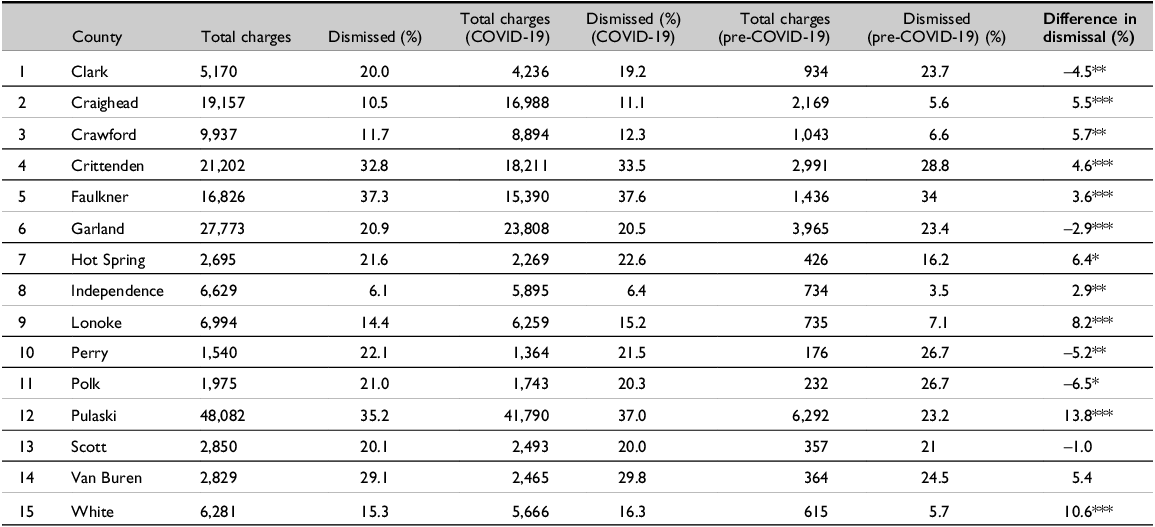
However, we cannot know whether this decrease in dismissal rates is solely or primarily due to the virtual hearings that took place during this time, as each judge was left to decide whether to adopt virtual hearings and in what manner. As we have pointed out, some judges closed courts altogether, some judges adopted a hybrid model with some virtual hearings, some held only remote virtual hearings, and some continued to hold in-person hearings with social distancing protocols. As can be seen in Table 2, which gives the average dismissal rates by county in the two phases, while there is considerable difference between counties, most counties saw a considerable increase in dismissal rates during COVID-19. Pulaski, which is the largest county and the county relevant to our analysis, saw as much as a 14 percent increase in dismissal rates.
Dismissal rates in counties in Arkansas before and after COVID-19
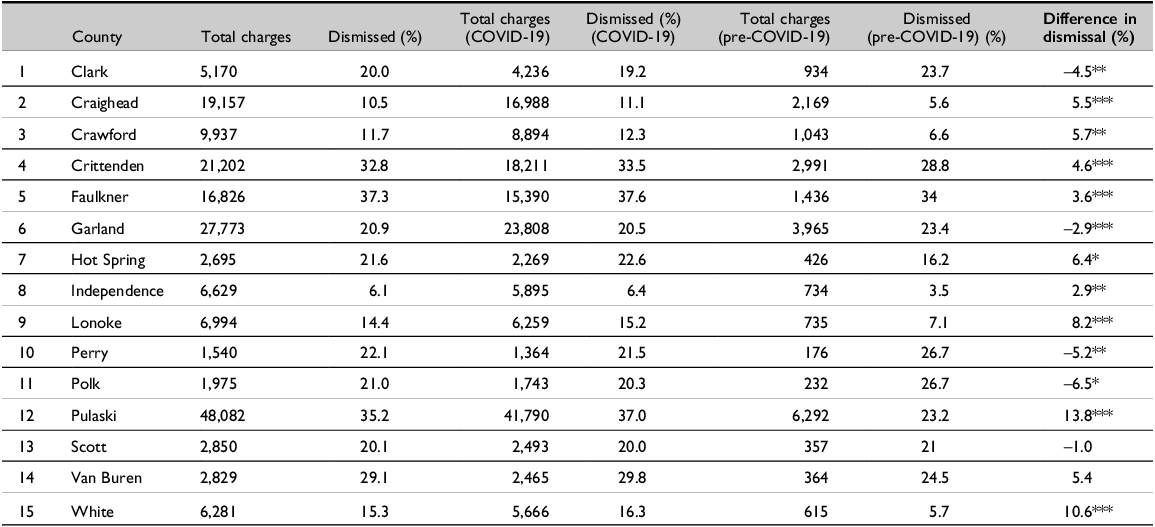
Table 2 Long description
The table presents data on dismissal rates in various counties in Arkansas before and during COVID-19. It includes 15 rows and 8 columns. The columns are labeled as County, Total charges, Dismissed (%), Total charges (COVID-19), Dismissed (COVID-19) (%), Total charges (pre-COVID-19), Dismissed (pre-COVID-19) (%), and Difference in dismissal (%). Each row lists data for a specific county. Row 1: Clark, 5,170, 20.0, 4,236, 19.2, 934, 23.7, -4.5**. Row 2: Craighead, 19,157, 10.5, 16,988, 11.1, 2,169, 5.6, 5.5***. Row 3: Crawford, 9,937, 11.7, 8,894, 12.3, 1,043, 6.6, 5.7**. Row 4: Crittenden, 21,202, 32.8, 18,211, 33.5, 2,991, 28.8, 4.6***. Row 5: Faulkner, 16,826, 37.3, 15,390, 37.6, 1,436, 34, 3.6***. Row 6: Garland, 27,773, 20.9, 23,808, 20.5, 3,965, 23.4, -2.9***. Row 7: Hot Spring, 2,695, 21.6, 2,269, 22.6, 426, 16.2, 6.4*. Row 8: Independence, 6,629, 6.1, 5,895, 6.4, 734, 3.5, 2.9**. Row 9: Lonoke, 6,994, 14.4, 6,259, 15.2, 735, 7.1, 8.2***. Row 10: Perry, 1,540, 22.1, 1,364, 21.5, 176, 26.7, -5.2**. Row 11: Polk, 1,975, 21.0, 1,743, 20.3, 232, 26.7, -6.5*. Row 12: Pulaski, 48,082, 35.2, 41,790, 37.0, 6,292, 23.2, 13.8***. Row 13: Scott, 2,850, 20.1, 2,493, 20.0, 357, 21, -1.0. Row 14: Van Buren, 2,829, 29.1, 2,465, 29.8, 364, 24.5, 5.4. Row 15: White, 6,281, 15.3, 5,666, 16.3, 615, 5.7, 10.6***. The table shows the total charges, the percentage of charges dismissed, and the difference in dismissal rates before and during COVID-19 for each county.
Note: This table only shows state counties with more than 1,000 cases in the relevant period. Percentage values are rounded to the nearest single decimal. Asterisks indicate the p-value of the difference in proportions test. If a p-value is less than 0.05, it is flagged with one asterisk (*). If a p-value is less than 0.01, it is flagged with two asterisks (**). If a p-value is less than 0.001, it is flagged with three asterisks (***). Total charges (pre-COVID-19) are charges that were disposed of before April 2020, and total charges (post-COVID) are those that were disposed of after April 1, 2020.
Figure 2 shows the average rates of dismissal for different courts in Pulaski County for each month. As can be seen, there is a marked difference in the pre-COVID and COVID dismissal rates. Little Rock Traffic Court, which switched to fully remote virtual hearings, experienced a noticeable decrease in dismissal rates during COVID-19. Pulaski County District Court, which switched to on-site virtual (drive-thru) hearings, experienced a marked increase in dismissal rates. North Little Rock District Court, where there were physical hearings, also seems to have a small increase in dismissal rates. There is one obvious outlier observation in North Little Rock right after COVID-19 began: in June 2020, North Little Rock District Court dismissed as many as 54 percent of the charges that came before it. This result was because North Little Rock District Court was completely closed for two months and saw only five cases decided in May 2020. Upon reopening, the judge batched and dismissed backlogged registration violations, expired license infractions, and similar minor charges.Footnote 8
Monthly average rates of dismissal for courts in Pulaski County, January–October 2020.

Comparing fully remote hearings and on-site virtual hearings
To investigate whether the increase in dismissal rates is due to the hearing formats, we examined whether there was a difference in the differences of dismissal rates between the three courts—Little Rock Traffic Court (virtual remote hearings through the end of the court cycle), Pulaski County District Court (on-site virtual drive-thru hearings for limited time), and North Little Rock District Court (in-person, socially distanced hearings throughout the pandemic). To ensure that we did not compare data after COVID-19 protocols ceased in individual courts, we only used cases disposed until October 4, 2020, when Pulaski County ceased holding drive-thru hearings. Figure 3 shows the comparison between Little Rock Traffic Court (fully remote) and North Little Rock District Court (in person). What is important to notice is that in the fully remote court, unlike the rest of the state or the county, there was a decrease (–5.9 percent) in the dismissal rates. This is particularly important since Little Rock Traffic Court was, to our knowledge, the only court that had mandatory virtual hearings. Second, while Pulaski County District Court is generally a far stricter court than Little Rock District Court (with charge dismissal rates of 15.5 percent and 40.5 percent, respectively), during COVID-19, the relative dismissal rates decreased in Pulaski County District Court. That is to say, while the dismissal rates when conducting virtual hearings decreased for Little Rock District Court, the dismissal rates for Pulaski County District Court increased from 15.5 percent to 16.3 percent (a 0.8 percent shift). Finally, while North Little Rock District Court is in general the strictest court in the county (with a pre-COVID-19 charge dismissal rate of 9 percent), this court exhibited the highest rate of dismissal increase during the pandemic (10.1 percent).
Difference-in-differences between dismissal rates, Pulaski County courts before and during COVID-19.

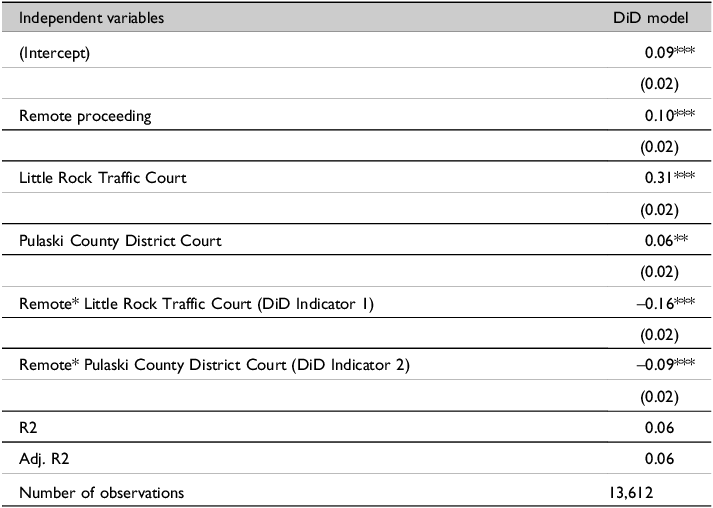
This DiD comparison can help us understand the effect of COVID-19 and the hearing format. Since the pandemic affected all three courts equally, we can assume that its effects on dismissal rates followed a parallel trend across all three courts. Thus, considerations such as general leniency due to the fact that everyone was suffering,Footnote 9 a drop in serious traffic crimes due to the lockdown, and a change in mitigating circumstances warranting case dismissals would affect all three courts equally. Thus, the difference in the differences between the three courts can be attributed to the difference in hearing formats. COVID-19, in general, seems to have increased rates of dismissal on average. In North Little Rock District Court, which continued to hold in-person (physical) hearings, dismissal rates increased by 10.1 percent. By contrast, drive-thru hearings seem to have increased dismissal rates by 0.8 percent, and fully remote hearings seem to have decreased the rate of dismissals by 5.9 percent. The DiD estimator in all of these cases is significant (see Table 3). We thus found some evidence supporting Hypothesis 1: virtual hearings do seem to increase the likelihood that judges will rule against a defendant and confirm charges.
Difference-in-difference analysis (linear probability model), Pulaski County

Table 3 Long description
The table presents a difference-in-difference (DiD) model analysis of the effects of different court hearing formats on dismissal rates during COVID-19. It includes independent variables and their corresponding DiD model values. The table has 8 rows and 2 columns. The columns are labeled 'Independent variables' and 'DiD model'. The rows are labeled as follows: (Intercept), Remote proceeding, Little Rock Traffic Court, Pulaski County District Court, Remote* Little Rock Traffic Court (DiD Indicator 1), Remote* Pulaski County District Court (DiD Indicator 2), R2, Adj. R2, and Number of observations. The values in the 'DiD model' column are: 0.09 (0.02), 0.10 (0.02), 0.31 (0.02), 0.06 (0.02), -0.16 (0.02), -0.09 (0.02), 0.06, 0.06, and 13,612 respectively.
Notes: ***p < 0.001; **p < 0.01; *p < 0.05. Results of a linear probability regression model through ordinary least squares. Dependent variable is whether charge was dismissed. The reference category for the courts is North Little Rock District Court. Standard errors in parenthesis. Logistic regression yields similar results. The sample includes all cases from January 1, 2020, to October 10, 2020.
The difference in the differences between Pulaski County District Court (drive-thru) and Little Rock Traffic Court (fully virtual) also highlights the effect of variance in technology. In Little Rock Traffic Court, where technology and court environments were not controlled, dismissal rates were lower. This was perhaps due not only to the technological disparities and variances, such as differences in Internet connectivity, equipment quality, and digital literacy among participants, but also to the varied environmental cues received by judges from these virtual settings. As one clerk explained, “it didn’t work as well as we would have liked because people didn’t take it seriously. People stretched out in bed, relaxing. One guy was walking around with a bird on his shoulder, just squawking.”Footnote 10
Pulaski County District Court’s on-site remote access provided stable connectivity and a more controlled virtual environment, and, in this court, we see a lower rate of dismissals, indicating that standardizing the technological environment can mitigate or condition, at least in part, the heuristic biases associated with virtual hearings. However, even in these more standardized environments, technological barriers are not completely absent. As the Pulaski County District Court clerk put it, even in the drive-thru hearing, “audio was sometimes bad on either end. Some defendants/attorneys were unfamiliar with the technology used for Zoom, having difficulty logging on. At times, the availability of internet was lacking.”Footnote 11 This is why, while Pulaski County District Court might have had an increased rate of dismissal, it was not equal to other courts hearing matters during COVID-19, such as North Little Rock District Court (which remained in person). We thus find some evidence for Hypothesis 2: the effect of virtual hearings is conditioned on technological variation.
While our primary DiD model controls for time-invariant differences between courts, one might still be concerned that the introduction of virtual hearings induced a selection effect where litigants with weaker cases were opting to attend virtual hearings when they otherwise would have paid the ticket. However, several pieces of evidence suggest that this is not a primary driver of our results. First, a balance test revealed no significant demographic shift in the litigant pool before and after the policy change (Table A2 in the Appendix). Second, for Little Rock Traffic Court (fully remote), we compared the outcomes for people who had been charged before the April 17 policy change but whose hearings fell sixty days before or after the policy change. Since individuals cannot precisely time their traffic violations, the timing of their eventual court hearing relative to the judiciary’s sudden policy change is plausibly exogenous. We found a sharp and statistically significant drop in dismissals right at the implementation date (Table A3 in the Appendix). While selection on unobserved characteristics can never be entirely ruled out, these provide some evidence that the change in hearing format itself, rather than a change in the defendant population, is the primary driver of our findings.
To ensure the robustness of our results, we re-estimated the models using alternative time periods and by excluding the outlier month of June 2020 for North Little Rock District Court (in person). Removing the June 2020 data for North Little Rock District Court reduced the overall magnitude of the COVID-19-related coefficients, and the “remote proceeding” term ceases to be statistically significant. In this re-estimated model, there is no longer a significant difference in North Little Rock District Court’s pre- and post-COVID-19 dismissal rates (Figure A2 in the Appendix). However, the direction of the effects remains consistent with the main analysis, and the DiD term for the fully remote Little Rock Traffic Court (Remote × Court) remains negative and significant, indicating that fully remote hearings had lower dismissal rates relative to in-person hearings. Extending the analysis to cover the entire period of emergency measures yields similar patterns to our original results. The direction and significance of the key coefficients remain unchanged, even when the June 2020 in-person hearings are excluded from this expanded sample (Table A4 in the Appendix).
To examine whether racial minority members, elderly people, and women were particularly affected by virtual hearings, we ran a regression, interacting each of these identity variables with the type of hearing. The results of the logistic model are given in Table A2 of the Appendix. The coefficients for the interaction terms for demographic variables reveal interesting results. In on-site virtual hearings, older and non-white persons were more likely to have their cases dismissed. Similarly, in both remote virtual and on-site virtual hearings, male defendants were more likely to be convicted than female defendants. It is possible that, since the elderly and women were especially vulnerable to COVID-19, they were shown additional leniency by courts. Further research is needed to examine why virtual hearings led to more lenient outcomes for these groups.
Orange County
In order to determine whether our results are not limited simply to Arkansas, we also examined the effect of virtual hearings in Orange County, Florida. Similar to Arkansas, on April 6, 2020, the chief justice of the Florida Supreme Court issued Order no. AOSC20-23, suspending physical hearings and giving the power of courts to hear matters via remote hearings.Footnote 12 Orange County traffic courts were among the earliest Florida courts to implement this approach. Defendants who had hearings scheduled during the pandemic were offered two options (again, like Arkansas). First, they could take a conditional plea of no contest and pay the fine online. In this case, the ticket would not go on their record. Second, for mandatory hearings or if the defendant wanted a hearing, defendants could schedule a virtual hearing by sending in the required form. The court then assigned a date on which the defendant was summoned to attend a virtual hearing. This virtual hearing was fully remote and took place on Microsoft Teams, which defendants had to install. Defendants were required to have a computer, cell phone, or mobile device with a microphone and camera to attend the virtual hearing. Orange County continued an optional remote virtual hearing option even after the pandemic.
Unlike in Pulaski County, Arkansas, however, we were unable to find data for a neighboring county or court that had physical hearings. In the case of Orange County, then, we could not isolate the effect of virtual hearings from other COVID-19-related factors that might have affected case outcomes. However, analyses of Orange County dispositions during this time provide supporting evidence for Hypothesis 1. While holding only virtual hearings, the rate of dismissals in Orange County courts decreased. Generally, Orange County traffic courts are stricter than Arkansas’s with a 16.3 percent rate of dismissal, but this rate fell to around 13.5 percent during the period when hearings were virtual (Figure 4). This provides further evidence that virtual hearings increase the likelihood that judges will opt for the status quo option. Like in the Arkansas context, some identity variables in Orange County operated as significant moderators on the effect of virtual hearings. Being older and being a minority increases rather than decreases the chance of dismissal in virtual hearings (Table A5 in the Appendix). Again, further study is required to make sense of these contradictory results.
Difference in means in dismissal rates across courts in Orange County, Florida, 2020–21.

Conclusion
In this article, we have examined whether remote proceedings that took place during COVID-19 in Arkansas traffic courts led to inequitable outcomes for litigants. We found strong evidence that Arkansas traffic court judges were less likely to dismiss charges when the case was heard virtually. We also found that part of the reason for this effect was unequal technological access, which could be mitigated by providing standardized technology to all litigants. This research highlights the need for standardization of court protocols during crisis. During the COVID-19 pandemic, the fifty states in the United States adopted different protocols for hearings, often leaving each court’s approach up to the presiding judge (Justia 2020). As we have discussed, in some states (such as Arkansas), disparate modes of operation were adopted by courts that were only miles apart. While even standardized approaches to remote court are likely to result in some inequities (Benninger et al. Reference Benninger, Colwell, Mukamal and Plachinski2021), disparate approaches to administering justice often lead to disparate results in the attainment of that justice, which exaggerates the impact of those inequities.
Ideally, we will continue to improve the telecommunication technologies and approaches to holding virtual court so that we will be better equipped to administer courts if another crisis emerges. To accomplish this goal, more substantial research is needed, including simulated trials, qualitative interviews, and legal or ethical analyses examining remote hearings. More empirical examination is critical in incorporating actual case data, especially research tracking outcomes longitudinally across diverse contexts (see, for example, Orcutt et al. Reference Orcutt, Goodman, Tobey, Batterman-Faunce and Thomas2001; Eagly Reference Eagly2015). Methodological limitations pervade current scholarship. Addressing such limitations through partnerships that enable the analysis of real court statistics could strengthen the validity and precision of findings on remote hearings and fairness.
Finally, proposed expansions of remote legal proceedings underscore the need for extensive stakeholder consultation and controlled piloting before broad implementation. Judges, attorneys, community advocates, victims’ groups, and defendant representatives should actively contribute feedback on the risks and benefits of substituting remote hearings for traditional in-person participation. Similarly, collecting high-quality data from structured pilot programs can illuminate the impact of remote hearing on fairness and rights protection.
Supplementary material
The supplementary material for this article can be found at https://doi.org/10.1017/lsi.2025.10133.