

When people start college, enter a new job, or begin a new relationship, they may notice that self-defining aspects previously deemed meaningful and beneficial to them are no longer part of who they are. The social environment has a large influence on self-concept change, because it provides important information about the kind of person that an individual is (Trautwein, Lüdtke, Marsh, & Nagy, Reference Trautwein, Lüdtke, Marsh and Nagy2009). Markus and Wurf (Reference Markus, Wurf, Rosenweig and Porter1987) defined the self-concept as a cognitive structure that consists of multiple self-related dimensions organised hierarchically in memory. Thus, self-concept change can be defined as ‘changes in the characteristics used to describe the self’ (Gore & Cross, Reference Gore and Cross2011, p. 137). These characteristics, or self-aspects, may involve personality traits (e.g., outgoing), connections to others (e.g., brother), physical attributes (e.g., tall), group memberships (e.g., Chinese-American), or other important characteristics. Multiple instances of low-order change may then lead to higher order changes in the cognitive structure of the self-concept. Although there are multiple factors that can explain how this occurs, the focus of our research is the change that occurs through close relationships.
Factors That Predict Self-Concept Change
Self-concept change typically is driven by three main elements: the reward element, the cognitive accessibility element, and the social comparison element (Gore & Cross, Reference Gore and Cross2014). Although any instance of self-concept change will likely feature a combination of these three elements, it is still unclear when some elements may influence self-change more than others. The reward element involves maximising the rewards and minimising the punishment from one's social environment through the acquisition of certain self-aspects. The reward element of self-concept change tends to be more influential when the outcome of the change is positive and the change is perceived to increase the likelihood of obtaining the outcome (Atkinson & Birch, Reference Atkinson and Birch1970). The cognitive accessibility element refers to the availability of stimuli in one's memory and the relevance of it to the situation at hand (Kihlstrom & Cantor, Reference Kihlstrom, Cantor and Berkowitz1984; Kihlstrom et al., Reference Kihlstrom, Cantor, Albright, Chew, Klein, Niedenthal and Berkowitz1988; Markus, Reference Markus1983). Cognitive accessibility leads to self-concept change when the environment contains stimuli that frequently activate a given set of self-relevant aspects. As a result of priming and cognitive saliency, one may internalise this as a central self-aspect.
The third element of self-concept change is the social comparison element. Social comparisons enable the development of the self-concept through the connections people have with others (Gest, Domitrovich, & Welsh, Reference Gest, Domitrovich and Welsh2005; Masten, Morison, & Pelligrini, Reference Masten, Morison and Pellegrini1985). Therefore, when an individual enters a new social role, the new social interactions that follow will require them to take on perspectives different from their own. This perspective-taking leads to increased similarity and to identification with the target, which then leads to changes in the self-concept through increased interdependence (Laurent & Myers, Reference Laurent and Myers2011; Mussweiler, Reference Mussweiler2003). Because this process occurs through changes in the social network, one of the primary mechanisms of change through the social comparison element would be through the development and discontinuation of close relationships.
When people develop intimate relationships with those around them, they typically experience self-expansion (Aron & Aron, Reference Aron and Aron1986), which often involves building upon one's previously existing self-concept by integrating new characteristics into one's self-definition (Aron & Aron, Reference Aron and Aron1986). Often, this is experienced when developing new close relationships. Through these relationships, the individual begins to understand the perspectives and characteristics of the other person. In doing so, they also assimilate these characteristics into their own self-definition. This allows new self-aspects to become more centralised in defining the self (Pelham & Wachsmuth, Reference Pelham and Wachsmuth1995). The most common example of self-expansion is found when individuals fall in love. Aron and colleagues showed that when people fall in love, it is due to their motivation to build upon their current self-concept and include the close other into the self (Aron & Aron, Reference Aron and Aron1986; see also Aron & Aron, Reference Aron and Aron1995; Aron, Paris, & Aron, Reference Aron, Paris and Aron1995). It is important to note that the connection between relationship formation and self-expansion is not limited to romantic relationships, but can also refer to new family members or new friendships. This broader investigation of the process, however, was not addressed in past studies.
Establishing close relationships with others can lead to self-expansion, but the loss of an existing close relationship can lead to self-constriction (Slotter, Gardner, & Finkel, Reference Slotter, Gardner and Finkel2010). By discontinuing a relationship, self-aspects that were tied to that other person can no longer be used to describe the self. Slotter et al. (Reference Slotter, Gardner and Finkel2010) found that following a breakup, individuals used fewer self-descriptors in online profiles than did those who experienced a similarly tumultuous event such as a career change. This relationship change causes a reduction in the person's self-concept because there is nothing available to replace the self-aspects tied to the partner. Further, Lewandowski, Aron, Bassis, and Kunak (Reference Lewandowski, Aron, Bassis and Kunak2006) found that individuals who experience more self-expansion as a result of a close relationship are also likely to experience more self-constriction if the relationship ends. Taken together, this suggests that close relationships are important sources of self-concept change.
Similar to the research on self-expansion, however, self-constriction effects have only been noted in romantic relationships. Specifically, past work has only focused on self-aspects before and after the dissolution of a romantic relationship. Therefore, neither body of work has investigated these processes in other types of relationships, nor have they examined other types of changes in relationships, such as geographic relocation. Although romantic relationships are important life experiences, there are other experiences that can affect multiple relationships simultaneously, and can affect multiple areas of the self-concept as well. This is especially evident during life transitions that involve significant changes in one's social environment, such as the transition to college for many young adults.
Approximately 69% of college students enrol immediately after high school (National Center for Education Statistics, 2018). Some are living away from their homes for the first time, leaving behind their friends, family, and all of the social connections that previously reinforced their self-concept. The transition to college is a particularly useful life event to study in self-concept change research because it involves several components that foster some form of change. First, most of the students are at an age in which they have not established a stable identity, and are in the process of ‘finding themselves’ (Hamachek, Reference Hamachek, Brinthaupt and Lipka1994). Second, the transition usually involves relocation to a new environment, with 80% of college students living away from home (Tellefsen, Reference Tellefsen2018). Third, college offers multiple ways for individuals to form new relationships, join new groups, learn new skills, and experience new worldviews, which are all factors that can cause self-concept change (Fondacaro & Heller, Reference Fondacaro and Heller1983; Wills & Vaughan, Reference Wills and Vaughan1989). Fourth, between 15–20 million young adults attend college in any given year (National Center for Education Statistics, 2018), making the transition to college a relatively common form of relocation for young adults in the United States.
Overview and Hypotheses
Due to the lack of a firmly established identity as well as the substantial change in the social environment, many college students are struggling with balancing aspects from their old relationships and integrating new ones as a result of new social experiences. The literature on self-concept change, however, has not yet examined the degree to which changes across multiple relationships foster self-concept change. Most investigations of self-concept change in the context of close relationships have focused on changes during the development and dissolution of romantic relationships, or they have examined change processes in a single laboratory session. We sought to broaden the scope of self-concept change by examining changes across multiple areas of the self-concept, across multiple relationships, and over the course of two months.
We also sought to test this using a variety of assessments of self-concept and self-concept change. There are several options for assessing changes in the self-concept, but to date this is the first set of studies to utilise more than one of those options. When investigating changes in the self-concept, two major categories exist in the assessment of these changes: spontaneous and reactive measures (Brinthaupt & Erwin, Reference Brinthaupt, Erwin, Brinthaupt and Lipka1992). Spontaneous measures allow for the investigation of self-expansion and self-constriction, whereas reactive measures allow for the investigation of the change in the degree to which descriptors (e.g., personality traits) are self-descriptive. Both measures provide insight into the type of changes occurring in the individual (see Gore, Cross, & Russell, Reference Gore, Cross and Russell2013 for a review). Thus, our studies utilised each of these measures to allow for replication across various methodologies. In Study 1, we utilised a spontaneous measure of self-concept change, whereas we used a reactive measure of self-concept change in Study 2.
In summary, we sought to contribute to this literature in several ways: (a) we expanded the investigation of relationship and self-concept changes to include a variety of relationships (i.e., parent, sibling, friend, roommate); (b) we focused on changes that occur during a significant life transition, when both relationships and the self-concept are likely to change (i.e., the transition to college); (c) we utilised two forms of self-concept change assessment (i.e., spontaneous in Study 1, which included self-expansion and constriction, and reactive in Study 2 to examine changes across a personality profile) to demonstrate that this occurs across multiple levels of the self-concept; and (d) we included assessments of relationships that were established before and after the transition to examine the unique contribution of each type of relationship.
We hypothesised that higher levels of closeness in new relationships would predict more change in the self-concept, and higher levels of closeness in old relationships would predict less change. In Study 1, we analysed baseline levels of closeness only, whereas we analysed baseline levels of closeness as well as changes in closeness over time to distinguish between initial and later stages of relationships on self-concept change in Study 2.
STUDY 1
Despite the extensive research on self-concept change in romantic relationships, other contexts involving relationship and self-concept changes have largely been ignored. The purpose of Study 1 was to investigate the influence of old and new relationships on spontaneous self-concept change during the first few months of college. Spontaneous measures involve participants answering an open-ended question about themselves (e.g., writing a paragraph on ‘Who I Am’). Although they involve low control over the possible responses participants provide, spontaneous self-report measures are considered acceptable ways of measuring the self-concept (Brinthaupt & Erwin, Reference Brinthaupt, Erwin, Brinthaupt and Lipka1992; Gore & Cross, Reference Gore and Cross2011), particularly if the researcher is able to reduce the amount of coding involved. To measure change in a spontaneous measure, participants complete a list of self-aspects, then they examine their original list of attributes at a later time point. During this second session, they either delete characteristics that are no longer relevant to the self (self-constriction), or they add new characteristics to their list that has since become self-descriptive (self-expansion). The deletions to the list suggest that the person is experiencing difficulty in expressing her or his original self-aspects in the new environment, either because those self-aspects are discouraged or because they are not reinforced in the new environment. In contrast, additions to the list suggest that the person has taken on new self-defining aspects that are now beneficial in the current environment. Assessing the amount of overall self-concept change involves summing the amount of deletions and additions to the person's list. This provides an indicator of perceived self-concept change with a high degree of face validity.
We hypothesised that closeness to old relationships at the beginning of college would be negatively associated with later self-constriction and self-expansion, and closeness to new relationships would be positively associated with later self-constriction and self-expansion.
Method
Participants
Participants were 143 freshmen who were in their first 8 weeks of college (40 males, 101 females, 2 unspecified; 87% were European American; 90% were between 18 and 19 years old, age range = 18–38 years old). They were given course credit for their participation in the study.
Materials
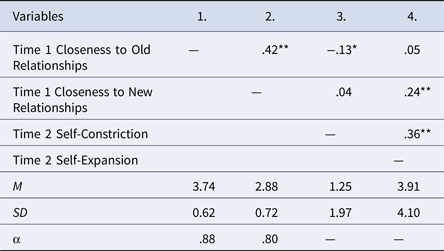
Table 1 displays the descriptive and reliability statistics for each measure, and the bivariate correlations among them.
Correlations Among Variables, Descriptive and Reliability Statistics (Study 1)

Note. **p < .01, *p < .05.
Spontaneous self-concept and change
To assess the mechanisms of change, participants first completed the Twenty Statements Test (TST; Kuhn & McPartland, Reference Kuhn and McPartland1954), which involves completing the statement, ‘I am …’ 20 times. Participants were asked to only include important information that describes themselves, but that this could be any variety of attributes.
Next, participants categorised each of their statements into one of each of the following categories: personality characteristic, physical characteristic, activity or skill, relationship with a friend, relationship with a family member, group membership, attitudes/beliefs/values, or other. Finally, participants listed up to five objects they own that they believe are symbolic of who they are, and five places that they believe are symbolic of who they are.
To assess self-constriction, participants at Time 2 received their Time 1 Twenty Statements list, and the objects/places lists. They crossed out the items they believed were either no longer relevant to their life in college, or were difficult to express in their current environment. The number of crossed-out items from their lists at each time point were counted to represent their Self-Constriction score. To assess self-expansion, participants at Time 2 added any new statements (or objects or places) to their lists that were not relevant at Time 1 but were now aspects that they considered when they thought about themselves. The number of items participants added to their lists were counted to represent their Self-Expansion score. Overall, participants added more self-aspects at Time 2 than they deleted, M Constriction = 1.25, SD = 1.97, M Expansion = 3.91, SD = 4.10, t(141) = 8.21, p < .001.
Closeness
Participants were asked to indicate how close they felt to close others from before and after starting college by rating the following statements using a 5-point Likert scale (1 = not at all, 5 = extremely): ‘How significant is this relationship in your life?’, ‘How much do you depend on this person?’, and ‘To what extent are you “attached” to this person?’ Participants also completed an Inclusion of Other in the Self scale (IOS; Aron, Aron, & Smollan, Reference Aron, Aron and Smollan1992) item for each relationship. The original IOS scale provides seven options for responding, whereas ours only provided five. Our version still provided the full range of inclusion categories, from none to almost complete overlap. The mean rating across the items and across all old relationships (mother/mother figure, father/father figure, sibling, and close friend from high school) was obtained for the Time 1 Closeness to Old Relationships score. The mean rating across the items and across all new relationships (roommate and close friend from college) was obtained for the Time 1 Closeness to New Relationships score. If participants did not have a relationship that fit into a category, they were instructed to skip the item. A romantic relationship item was also included in the questionnaire, but it was not included in either score because it did not note whether the relationship was established before or after the transition to college.
Procedure
The first administration of this study was performed during the participants’ first 8 weeks of college. Upon the first administration, participants completed a TST self-report to gauge the self-aspects that were relevant to their self-concept. Participants also reported the amount of contact and the amount of closeness they felt they had with both old and new close others. This was only reported during the first administration. Old close others were defined as the participants’ parents, siblings, and friends from high school. New close others were defined as a roommate or friend from college. The second administration took place 8 weeks after the participants’ initial administration. Participants were provided with their responses to the previous TST and asked to delete aspects they felt were no longer relevant to their self-concept and to add any aspects that they felt were relevant to their current self-concept.
Results
To test the hypotheses, two linear regression analyses were conducted with the centred Time 1 Closeness to Old Relationships and Time 1 Closeness to New Relationships entered as the independent variables and Time 2 Self-Constriction and Time 2 Self-Expansion scores entered separately as the dependent variables. The results indicated that Time 1 Closeness to Old Relationships was negatively associated with Time 2 Self-Constriction (β = −.18, p = .047), but Time 1 Closeness to New Relationships was not significantly associated with it (β = .08, ns). Furthermore, the results indicated that Time 1 Closeness to New Relationships was positively associated with Time 2 Self-Expansion (β = .24, p = .011), but Time 1 Closeness to Old Relationships was not significantly associated with it (β = −.03, ns). Thus, the hypotheses were partially confirmed: closeness to old relationships was only associated with less self-constriction, whereas closeness to new relationships was only associated with more self-expansion.
Discussion
The findings of Study 1 provide insight into how old and new relationships are associated with self-concept change during a major life transition. Eight weeks after entering college, new relationships are associated with expansions to the self-concept. In contrast, feeling less connected to old relationships was related to constriction of the self-concept. These results portray the importance of the connection between established and new self-aspects and the development and dissolution of close relationships.
This study provides a better understanding of how close relationships relate to self-concept change, but there are some limitations that should be addressed. A limitation of this study was that we only examined closeness at the beginning stages of the transition; we did not assess changes in closeness over time. Changes in how close people feel in the relationships they have from before and after the transition may better explain why people change. It is also important to examine alternative methods for assessing change. To address these limitations, we developed Study 2 to examine changes in closeness on reactive self-concept change.
STUDY 2
The results of Study 1 suggested that closeness levels in old and new relationships at the beginning of a transition are associated with later changes in the self-concept. This did not, however, allow us to examine how changes in relationships during the transition relate to changes in the self-concept. We also employed an assessment of self-concept change that did not allow for an investigation of changes in the centrality of self-aspects. The purpose of Study 2 was to expand upon the results of Study 1 using a reactive measure of personality profile change and using assessments of closeness to old and new relationships at both time points. Reactive measures require self-report ratings on one or more dimensions so that the investigator can assess overall change to a profile (Gore et al., Reference Gore, Cross and Russell2013). To assess changes in an individual's profile, participants provide ratings of themselves at least two times, which would essentially be a specialised version of a single-perceiver, multiple-targets (1PMT) design (for reviews, see Gore et al., Reference Gore, Cross and Russell2013; Kenny & Winquist, Reference Kenny, Winquist, Hall and Bernieri2001). Effective measures of change in a personality profile should provide a single, numeric indicator (i.e., a single change score) across a variety of personality traits. This is done by obtaining the absolute agreement intraclass coefficient across all ratings at both time points (which assesses stability), and subtracting the coefficient from 1.00 (to assess change).
We hypothesised that decreased closeness to old relationships, and increased closeness to new relationships, should each predict change in the overall personality profile.
Method
Participants
Participants were 195 freshmen who were in their first eight weeks of college (53 males, 141 females, 1 unspecified; 84% were European-American; 92% were between 18 and 19 years old, age range = 18–30 years old). They were given course credit for their participation in the study.
Materials
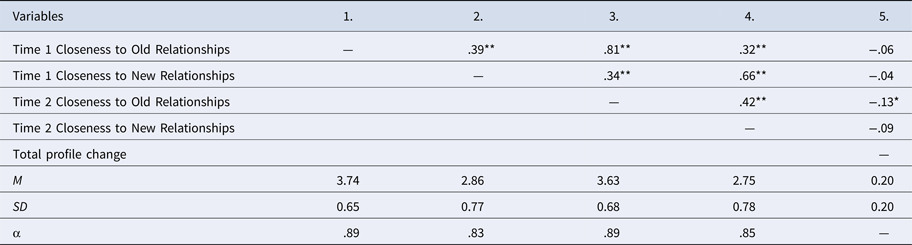
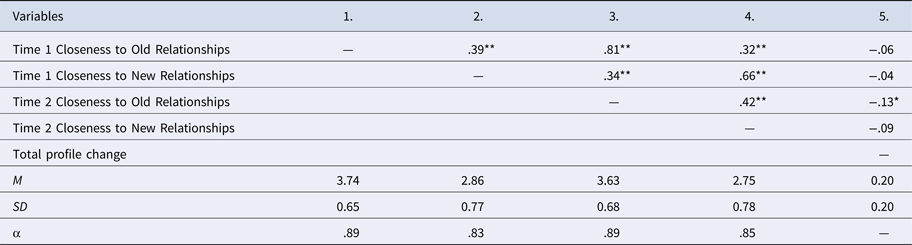
Table 2 displays the descriptive and reliability statistics for each measure, and the bivariate correlations among them.
Correlations Among Variables, Descriptive and Reliability Statistics (Study 2)
Note. **p < .01, *p < .05.
Reactive self-concept and change
At both time points, participants completed a 25-item version of the Big Five Personality measure (John, Reference John, Buss and Cantor1989). Participants rated single words or phrases based on how self-descriptive they were on a 5-point scale (1 = not at all descriptive of me, 5 = extremely descriptive of me). In order to assess personality profile change, an intraclass correlation coefficient (ICC) between Time 1 and Time 2 was computed using the responses from the Big Five personality assessment. This method is recommended for instances where the interest is summarising total change in a profile rather than changes in individual traits (Gore et al., Reference Gore, Cross and Russell2013). Intraclass correlation coefficients typically summarise trait-by-trait consistency across several raters (see Bernieri, Zuckerman, Koestner, & Rosenthal, Reference Bernieri, Zuckerman, Koestner and Rosenthal1994). The ICC factors all three elements of a profile (elevation, scatter, and shape) into a single statistic, which offers an overall summary of change. Intraclass correlation coefficients are typically used to examine consistency rather than change, so we operationalised overall profile change as 1.00 minus the correlation coefficient (intraclass change = 1.00 – r ICC).
Closeness
Participants completed the same measures for Closeness to Old Relationships and Closeness to New Relationships as were used for Study 1, except they completed these measures at both time points.
Procedure
Participants were required to complete two separate administrations of the tests, 8 weeks apart. The first administration of this study was conducted within the participants’ first 2 months of college. Participants completed a questionnaire assessing amount of closeness they felt they had with both old and new close others. In addition to these measures, participants were asked to complete a Big Five personality assessment. The second administration of this study was performed 8 weeks after the initial administration. Participants were asked again to complete a second assessment of closeness as well as Big Five personality measures.
Results
To test the hypotheses, a hierarchical linear regression was conducted with the centered Time 1 Closeness to Old Relationships and Time 1 Closeness to New Relationships scores entered in Block 1, the centred Time 2 Closeness to Old Relationships and Time 2 Closeness to New Relationships scores were added in Block 2, and the Total Profile Change score was entered as the dependent variable. The results indicated that neither Time 1 Closeness variables predicted Total Profile Change at Time 2 (β = .12 for Old Relationships, β = .04 for New Relationships, ns). Time 2 Closeness to Old Relationships negatively predicted Total Profile Change (β = −.22, p = .048), whereas Time 2 Closeness to New Relationships did not (β = −.06, ns). These findings provided partial support for the hypothesis, in that only decreased closeness from old relationships was related to personality profile change.
Discussion
The findings of Study 2 provide a more complete picture of the relationship mechanisms involved in self-concept change. By investigating the effect of closeness with others over time, we found that reactive change was predicted more by the decreased closeness to old relationships than by increased closeness to new relationships. This suggests that changes in established relationships produce higher order change, such as in a personality profile, more so than new relationships. This is likely because the verification processes that occur within established relationships are more powerful than being exposed to new self-relevant information. When the ties to established relationships weaken, this allows for more changes across personality traits.
General Discussion
Close relationships are important sources of self-relevant information, including the development, maintenance, and alteration of the self-concept. This is particularly evident during major life transitions, such as beginning college. Across both studies, we found that changes in ties to old relationships predicted self-concept constriction (Study 1) and changes in a personality profile (Study 2). The development of new relationships, however, seemed to only predict self-expansion (Study 1).
Although Studies 1 and 2 produced similar results, there are important differences between the two. For example, Study 1 showed that closeness to others at Time 1 was important, whereas Study 2 found that closeness at Time 1 was unimportant. Because we assessed spontaneous self-change across multiple domains in Study 1 and reactive change in personality traits Study 2, it may be that we narrowed our focus in Study 2 to a type of self-aspect that is vulnerable to change at later stages of a life transition than in the early stages. It could also be that spontaneous change, especially in regard to self-expansion, occurs more easily than personality profile changes, or that most personality profile changes involve self-constriction rather than self-expansion. Indeed, we found that participants added more self-aspects to their overall self-concept than they deleted in Study 1. Spontaneous change and self-expansion contain a wider variety of self-aspects and allow for more variance in a short period of time. Therefore, variables from earlier stages may be able to predict spontaneous change more effectively than reactive change. In contrast, reactive change may be more laborious as it involves a narrow set of self-aspects. Similarly, reactive change may only be predicted by variables happening concurrently, making it more difficult for earlier variables to predict it.
Implications
Our research both replicates and expands upon prior research on relationships and self-concept change. As an expansion of Aron and Aron (Reference Aron and Aron1986), feeling close to new friends in the social environment predicted more self-expansion than feeling close to old friends and family. In contrast, self-constriction was evident in both studies, in that those who felt less close with people from their home environment reported more spontaneous and reactive self-concept change. This suggests that some self-aspects correspond to previously existing close relationships, but those aspects are no longer applicable to their current social environment. In that regard, we provided further evidence for self-concept constriction when relationships dissolve (Lewandowski et al., Reference Lewandowski, Aron, Bassis and Kunak2006; Slotter et al., Reference Slotter, Gardner and Finkel2010), but we expanded upon this work by showing that self-concept constriction happens beyond the dissolution of romantic relationships.
These studies utilised a unique approach to investigate the process of self-concept change by measuring both spontaneous and reactive change. As shown in Study 1, both new and old relationships can influence a person's self-concept development through spontaneous change during a significant life transition. Increased closeness to old relationships will result in less self-constriction as the individual's established self-aspects are being reinforced and supported by an established social network. However, if the individual experiences closeness in new relationships, they begin to expand upon their self-concept based on the novel experiences and perspectives gained from this interaction. Study 2 provides insight into how reactive change occurs as a result of decreased feelings of closeness with old relationships over time. No other research has investigated the effects of diminished contact with old relationships in relation to the overall personality profile change of an individual over time. With the contributions from each of these studies, the different mechanisms of self-concept change can be better understood.
This is also the first series of studies to examine the link between close relationships and self-concept change during the transition to college. As noted earlier, most research on self-expansion and self-constriction has focused on the development and dissolution of romantic relationships. By examining a life transition that incorporates multiple changes in close relationships and in the self-concept, we were able to expand earlier investigations. The factors that exist during this life experience, however, should be taken into consideration when considering the link between relationship and self-concept changes in other contexts. First, the transition to college is a considerable change for many students, involving one of the first significant changes in social environments for many. Second, the developmental stage for many students is one of self-concept instability, which allows for stronger input from the social environment. These factors are rarely experienced in everyday occurrences, but they may also exist in other contexts. For example, relocating to a different geographic location, and particularly one with a different culture, may also foster similar change processes. These relocations may be due to career transfers, refugee resettlement, or exploration of a new lifestyle. In these cases, the significant changes in the social environment and potential for self-concept instability may be similar to experiences of transitioning to college.
By taking a prospective approach towards understanding self-concept change, these studies further the knowledge in this area above that of previous research. Many previous examples of self-concept research attempt to target these mechanisms for change in a cross-sectional manner (e.g., Lewandowski & Ackerman, Reference Lewandowski and Ackerman2006), which does not allow adequate time for the participant to assimilate changes that researchers are interested in. Because change regarding the self-concept requires time to develop, this method should be considered when evaluating change in future studies. Future studies should also consider addressing some of the limitations of the current research.
Limitations and Future Directions
The present research could be improved and expanded upon in numerous ways. First, we only examined a single source of change, closeness in relationships, but we did not examine other important elements of change. For example, the current studies did not look into one's motivation to change. Some people are more internally driven to change while others may derive this motivation more from their relationships. Future applications should therefore consider assessing change motives in addition to environmental changes.
Second, 8 weeks allows for some change to occur, but this is still a relatively brief time span to note changes in one's overall self-concept. Furthermore, by not assessing closeness to old and new relationships at Time 2 in Study 1, we were unable to note how changes in relationships predicted changes in the spontaneous self-concept scores. Future research could employ similar methods as the current studies, but extend the measurement period, measure both spontaneous and reactive self-concept at each assessment period, and measure closeness in old and new relationships at each assessment period.
Third, over 70% of the samples in both studies were female, which could inflate the association between relationships and the self-concept. Girls and women are socialised to place a high level of importance on developing and maintaining close relationships (Rose & Rudolph, Reference Rose and Rudolph2006), and several gender differences have been tied to differences in the degree to which close relationships are integrated into one's self-definition (Cross & Madson, Reference Cross and Madson1997). Thus, changes in close relationships may be particularly tied to changes in the self-concept for women more than for men. Our samples did not allow for moderation tests, but future studies should consider this.
Conclusions
When people first enter a new social environment, they must determine which self-defining information is supported and which parts are no longer useful. At the same time, they must balance between meeting new people and attending to old friends and family from the previous social environment. They initially attempt to navigate this new environment using the old self-aspects familiar to them, but they may find that those are no applicable. One of the most common first major life transitions of this kind is the transition into a college environment. As an individual establishes ties with their new close others and loses ties with their friends and family from back home, they will assimilate some self-aspects and abandon others. It appears, though, that the detachment from old relationships may be a more consistent source of change than the development of new ones.