Borderline personality disorder (BPD) is a chronic psychopathological condition characterized by affective dysregulation, behavioral impulsivity and relationship instability (e.g., American Psychiatric Association, 2000; Mortensen, Rausmussen, & Håberg, Reference Mortensen, Rausmussen and Håberg2010; Skodol et al., Reference Skodol, Gunderson, Pfohl, Widiger, Livesley and Siever2002). Further, it is believed that BPD patients possess both a heightened emotional sensitivity and an inability to regulate these intense emotional responses, especially in response to negative emotional information (Crowell, Beauchaine, & Linehan, Reference Crowell, Beuchaine and Linehan2009; Selby & Joiner, Reference Selby and Joiner2009). In turn, these features of BPD may lead to problems in decision-making, substance use and health-risking sexual behavior (e.g., Maurex et al., Reference Maurex, Zaboli, Wiens, Asberg, Leopardi and Öhman2009; Tull, Gratz, & Weiss, Reference Tull, Gratz and Weiss2011). However, little is known about the underlying decision-making processes in these individuals. The current research aimed to bridge this gap.
Research focusing on the biological factors underlying BPD has revealed that the disorder is associated with a dysfunctional frontolimbic network including the medial and lateral prefrontal cortex, the insula, anterior cingulate, and amygdala (Ruocco, Medaglia, Ayaz, & Chute, Reference Ruocco, Medaglia, Ayaz and Chute2010; Silbersweig et al., Reference Silbersweig, Clarkin, Goldstein, Kernberg, Tuescher, Levy and Stern2007; Schmahl & Bremmer, Reference Schmahl and Bremmer2006; Schulze et al., Reference Schulze, Domes, Krüger, Berger, Fleischer, Prehn and Herpertz2011). Incidentally, evidence has accumulated that these same neural structures that are implicated in BPD dysfunction are also associated with human decision-making processes (Bechara, Damasio, Damasio, & Lee, Reference Bechara, Damasio, Damasio and Lee1999; Bechara, Damasio, Tranel, & Damasio, Reference Bechara, Damasio, Tranel and Damasio1997; Damasio, Reference Damasio1994; de Martino, Kumaran, Seymour, & Dolan, Reference de Martino, Kumaran, Seymour and Dolan2006; Seymour & Dolan, Reference Seymour and Dolan2008; Weller, Levin, Shiv, & Bechara, Reference Weller, Levin, Shiv and Bechara2007, 2009).
In the context of everyday life, most decisions, ranging from the mundane to the highly consequential, involve uncertain future outcomes. With this point in mind, taking a “risk” indicates that one has chosen an option with greater outcome variability than another option. Whereas self-report measures of risk-taking assess either retrospective accounts or future behavioral intentions, laboratory-based decision-making tasks are designed to measure how individuals approach risky decisions (e.g., Weber & Johnson, Reference Weber, Johnson, Glimcher, Camerer, Fehr and Poldrack2008). Ideally, when considering the “risk-behavior” of a particular group, we need both types of measures: behavioral accounts allow us to infer that a clinical group has, or intend to, take more real-world risks, and laboratory-based tests allow us to study why they make the choices that they do from a process level. Although these approaches address risk in different ways, numerous studies highlight the convergent validity of laboratory tasks with health-risking behaviors (Bechara et al., Reference Bechara, Damasio, Damasio and Lee1999; Cavedini, Riboldi, Keller, D’Annucci, & Bellodi, Reference Cavedini, Riboldi, Keller, D’Annucci and Bellodi2002; Schonberg, Fox, & Poldrack, Reference Schonberg, Fox and Poldrack2010).
In this respect, past research has clearly demonstrated that BPD patients usually show elevated rates of “real-life” risk-taking behaviors such as substance use and sexual promiscuity (e.g., Tull et al., Reference Tull, Gratz and Weiss2011). Moreover previous research using the Iowa Gambling Task (IGT), a complex decision-making task that was designed to capture the real-life decision-making deficits of patients with ventromedial prefrontal cortex (VMPFC) damage (Bechara et al., Reference Bechara, Damasio, Tranel and Damasio1997), has found decision deficits associated with BPD. For instance, using the IGT, Haaland and Landrø (2007) found that BPD patients were more likely than controls to choose decks that were associated with poor long-term outcomes - a pattern similar to that observed in VMPFC lesion patients (see also Maurex et al., Reference Maurex, Zaboli, Wiens, Asberg, Leopardi and Öhman2009; Ruocco, McCloskey, Lee, & Coccaro, Reference Ruocco, McCloskey, Lee and Coccaro2009). Using a decision-making task involving explicit outcome probabilities, Bazanis et al. (Reference Bazanis, Rogers, Dowson, Taylor, Meux, Staley and Sahakian2002) found that BPD patients were more likely to choose riskier options than controls. Finally, Kirkpatrick et al. (Reference Kirkpatrick, Joyce, Milton, Duggan, Tyrer and Rogers2007) found that BPD patients do not discriminate appropriately between options with large and small losses, though only when the probability of winning was high. These authors note that this performance might result from an inability to properly balance the appetitive and aversive motivational states excited by the available reinforcement signals (i.e., cues signaling a high probability to obtain a reward versus a large potential punishment associated with a particular decision).
Although behavioral accounts of risk-taking provide useful information, they are silent to potential divergences in decision processes between BPD patients and non-clinical samples. Additionally, although BPD studies involving laboratory-based decision tasks have demonstrated broad deficits in decision-making as a function of BPD pathology, these studies preclude the opportunity to further decompose the etiology of such deficits. For instance, many studies have used paradigms that involve “mixed” gambles (i.e., possibility of rewards and punishments present in the same trial).Therefore, they cannot directly address whether BPD is associated with differential patterns of decision-making when choices involve risks that are presented as potential gains or losses. This distinction is important because previous research has suggested that decision making for losses and gains may be mediated by qualitatively different processes. At the behavioral level, Kahneman and Tversky’s Prospect Theory (1979) research first formalized the principle of loss aversion; individuals were more likely to take a risk to avoid a loss than to achieve a gain of the same magnitude. From a developmental perspective, research has suggested that the ability to make advantageous choices when faced with a risk involving a potential loss develops later in life than for decisions involving potential gains (Weller, Levin, & Denburg, Reference Weller, Levin and Denburg2011). Moreover, advances in neuroscience have suggested that gain-versus loss-related decision-making may be based on partially separable systems (see Mohr, Biele, & Heekeren, Reference Mohr, Biele and Heekeren2010 for a review).
Given the potentially drastic consequences that realizing a loss may bear, the presence of potential losses looms larger than an equivalent potential gain. Researchers and theorists have suggested that losses may evoke stronger emotional responses than potential gains (Tversky & Kahneman, Reference Tversky and Kahneman1981). These findings are supported by neuropsychological research suggesting that losses produce greater autonomic arousal (Satterthwaite et al., Reference Satterthwaite, Green, Myerson, Parker, Ramaratnam and Buckner2007) and greater frontal-cortical activation (e.g. Gehring & Willoughby, Reference Gehring and Willoughby2002). We argue that this heightened emotional response may be especially mismanaged by BPD patients. Research suggests that BPD patients demonstrate a greater sensitivity to negative emotional information, and subsequently react by engaging in dysregulated behaviors (Crowell et al., Reference Crowell, Beuchaine and Linehan2009). A hypersensitivity to negative affective information may lead to greater loss aversion, and would manifest itself through a greater incidence of risk taking when decisions involve potential losses. Further, it would be related to lower sensitivity to contextual cues that signal that a choice would be advantageous or disadvantageous to take, such as the expected values of choice options.
In this study, we compared the degree of risk taking between a sample of BPD patients and matched comparison subjects, employing two decision-making tasks in which decisions were required between an uncertain (risk) and a sure (riskless) option. We predicted that BPD patients would show increased risk taking and would be less sensitive to changes in environmental contingencies when potential losses are present. To test these hypotheses, we used a framing task (de Martino et al., Reference de Martino, Kumaran, Seymour and Dolan2006) that involved making choices between a sure choice (i.e., keeping or losing a portion of an initial starting amount) and a gamble (i.e., X% chance to keep or lose all of an initial amount). These choices were normatively equivalent and trials were framed as either gains or losses. We also tested risky decision-making using the Cups task, which tests how inviduals approach risky decisions for potential “pure” gains (e.g., Choice between winning $1 for sure and a 50% chance to win $2) and “pure” losses (e.g., Choice between losing $1 for sure and a 50% chance to lose $2). Put differently, gains and losses are manipulated at the contextual level for the framing task, whereas they are manipulated at the outcome level in the Cups task. The Cups task also allows for an examination of how individuals adjust their decision-making based on changes in the relative expected values (EV) between choice options. In this case, sensitivity to EV can be construed as an index of decision-making performance in the sense that lower values indicate a greater deviation from normatively optimal choices. Because both the gain and loss framing conditions involve a potential loss, we expected greater risk taking in BPD compared to comparison subjects regardless of domain. However, in the Cups task, since risk taking is enhanced in the loss domain and BPD patients are more prone to risk taking, we expected that deficits, marked by an insensitivity to EV and greater risk taking, would be present in the loss domain, but not for the gain domain.
Method
Participants
The experimental sample was composed of 12 outpatients (8 women), aged between 18 and 41 years (M = 27.83, SD = 7.53), attending psychiatric services in a public health care center in Murcia (Spain), and met DSM-IV (APA, 2000) criteria for borderline personality disorder. For each patient, two clinical psychiatrists established diagnosis by using the Structured Clinical Interview for DSM-IV (First, Spitzer, Gibbon, & Williams, Reference First, Spitzer, Gibbon and Williams1997a, b). At the time of the study, patients did not meet diagnosis criteria for major depression or drug abuse, as informed by the Spanish version of the MINI International Neuropsychiatric Interview (Sheehan et al., Reference Sheehan, Lecrubier, Harnett-Sheehan, Amorim, Janavs, Weiller and Dunbar1998). Two patients showed a concurrent diagnosis of pathology of the Axis-I (bulimia nervosa and generalized anxiety disorder). Exclusion criteria to participate in the study were: a) a history of neurological disorder, b) a current diagnosis of alcohol or drug dependence, or c) a current diagnosis of a psychotic disorder or major depression. Nine patients were taking psychotropic medication, like antidepressants (8 patients), anxiolytics (5 patients), antipsychotics (2 patients), or mood stabilizers (3 patients). In addition, 7 patients reported past history of substance abuse. The comparison group was composed of 16 healthy subjects (4 men) aged between 18 and 48 years (M = 28.94, SD = 8.84), with no history of psychiatric or neurological disorder, or substance abuse. Participants did not receive any compensation for their participation in this study. Written consent was obtained from each subejct. The Committee for Research Ethics of the University of Murcia approved the study, which followed the guidelines of the Helsinki Declaration.
Tasks
Framing task
We constructed a Spanish version of the de Martino et al. (Reference de Martino, Kumaran, Seymour and Dolan2006) framing task. Participants completed 32 gain frame trials and 32 loss frame trials. At the beginning of each trial, a message with the starting amount of money that subjects would receive was shown for 2-s. Four initial amounts were used (25€, 50€, 75€, and 100€). Subjects were informed that they could not retain the whole of this amount, but would have to choose between an uncertain (gamble) option and a sure one. In the gain frame, the sure option appeared as the amount of money retained from the starting amount (e.g., keep 25€ of a total of 50€), while in the loss frame the sure option was presented as the amount of money lost from the inital amount (e.g., lose 25€ of a total of 50€). The task used 4 different probabilities of winning or losing (.20, .40, .60, and .80). The gamble option was represented in each trial by a pie-chart depicting the probability of winning and losing (e.g., a 20% chance to keep 50€ of 50€ was paired with a 80% chance to keep 0€ of 50€ in the gain frame; a 20% chance to lose 0€ of 50€ was paired with a 80% chance to lose 50€ of 50€ in the loss frame). All the variables in the task were fully balanced between the frame conditions. In addition, the relative EV between the gamble and sure options were always equivalent in each trial (but catch trials) and between frames.
In order to ensure that subjects were engaged in the task, participants also completed 32 “catch” trials. For both frames, the EV for the gamble and sure options were unbalanced in these trials. In 50% of the catch trials, a comparison of the relative EV between the options heavily favoured the gamble option (gamble weighted; 95% probability of winning the initial amount, whereas the amount of the sure option was the 50% of the initial amount). In the other 50% of the catch trials, the sure option (sure-weighted) was strongly preferable when comparing the relative EVs of the two choices (the gamble option was 5% probability of winning the initial amount, while the amount of the sure option was 50% of the initial amount).
Cups task
A Spanish version of the Cups task (Weller et al., Reference Weller, Levin, Shiv and Bechara2007) was constructed. This task consisted of 54 trials representing 3 trials each of all combinations of two domains (gain/loss), 3 levels of probability (.20/.33/.50) and 3 levels of outcome magnitude for the risky option (2/3/5€) compared to 1€ for the riskless option. Thus, each participant had multiple exposures to each combination of probability and outcome magnitude within both the gain and loss domains. This task provides immediate feedback after each choice. Within each domain some combinations of probability and magnitude created trials in which the risky and riskless options had equal EV (EQEV): .20 x 5, .33 x 3, and .50 x 2 on both gain and loss trials. Some combinations were risk advantageous (RA; EV for the risky option > EV sure option): .33 x 5, .50 x 3, .50 x 5 on gain trials; .20 x 2, .20 x 3, .33 x 2 on loss trials, while other combinations were risk disadvantageous (RD; EV for the risky option < EV sure option): .20 x 2, .20 x 3, .33 x 2 on gain trials; .33 x 5, .50 x 3, .50 x 5 on loss trials. Gain and loss trials were presented as blocks, counterbalanced in order across participants in each group. Probability and outcome combinations were presented in random order and the left-right position of riskless and risky options was also randomized.
Gain trials involved the choice between an option that offered a sure gain of 1€ and another option that offered a designated probability (i.e., number of cups) of winning multiple euros or no euros. Loss trials involved the choice between a sure loss of 1€ and a designated probability of losing multiple euros or no euros. Participants started each loss trial with enough euros to ensure that they would not end up with a losing total. On each trial, an array of 2, 3, or 5 cups was shown on each side of the screen. One array was identified as the certain side where 1€ would be gained (lost) for whichever cup was selected. The other array was identified as the risky side where the selection of one cup would lead to a designated number of euros gained (lost) and the other cups would lead to no gain (loss). Thus, the number of cups from which to choose on the risky side indicated the probability of winning or losing. A bank was depicted at the bottom of the screen where euros were shown being added to (subtracted from) the participant’s account. A random process with p = 1/(number of cups) determined whether the risky choice led to a gain (loss). When the participant completed all 54 trials, their total amount won appeared on the screen.
Data analysis
In order to test whether subjects showed continued engagement throughout the framing task, we analysed the percentage of gamble options selected in “catch” trials by a mixed model ANOVA 2 (Group) X 2 (Frame: proportion of gambling in the gain frame, and proportion of gambling in the loss frame) X 2 (Trial Weight: sure-weighted/gamble-weighted), with Group as a between-subjects factor, and Frame and Trial Weight as within-subjects variables. We, then, analysed the percentage of trials in which subjects chose the gamble option within each frame by a mixed model ANOVA 2 (Group) X 2 (Frame), with Group as a between-subjects variable and Frame as a within-subjects factor. Finally, for each group we analysed the risk-seeking and risk-averse behaviors, defined as the percentage of gamble choices with respect to risk-neutral behavior (gambling in 50% of trials), by using one-tailed t-tests.
In order to compare the groups’ risk taking in the Cups task as a function of the relative EV differences between choice option in each domain, we conducted a mixed model ANOVA 2 (Group) X 2 (Domain: Gain/Loss) X 3 (EV level: RA/EQEV/RD), with Group as a between-subjects factor, and Domain and EV level as within-subjects variables. We also conducted linear contrasts between RA and RD trials as a more powerful test of the effects of EV level by a mixed model ANOVA 2 (Group) X 2 (Domain: Gain/Loss) X 2 (EV level: RA and RD). Finally, for each group we calculated an EV sensitivity index (expressed as the number of risky choices made for RA trials - the number of risky choices made for RD trials) for each domain and we compared both groups by using t-tests.
All the statistical analyses were conducted with the PASW package (version 19; SPSS, Chicago, IL), and the specific assumptions for each statistical analysis were met. A measure of the effect size, partial eta squared, was obtained for the main statistical tests, and a Cohen’s d was obtained for t-test analyses. Follow-up t-tests were performed with a Bonferroni correction to control the overall level of significance.
Results
The BPD and comparison participants were matched in terms of age, t(26) = .35, p = .73 and gender, χ2(1) = .23, p = .63. We conducted preliminary analyses in order to study the potential effects of previous substance abuse and current medication on the task performance of BPD patients. Results did not reveal differences between patients with and without a history of substance abuse. Regarding medication, we did not find significant differences depending on the type of medication.
Framing Task
Results obtained on “catch” trials did not show any significant main effect for Group, F(1, 26) = .80, p = .38, Domain, F(1, 26) = 2.88, p = .10, or interaction with other variables (All Ps > .10). Subjects selected the gamble option when trials were gamble-weighted, and the sure option when trials were sure-weighted, F(1, 26) = 84.40, p = .0001, η2 = .79.
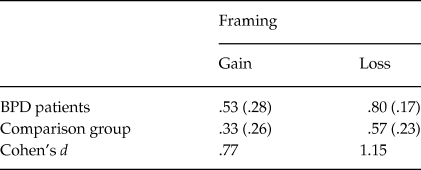
Results on the percentage of gamble choices within each frame (see Table 1) showed a significant main effect of Frame, F(1, 26) = 25.19, p = .0001, η2 = .492, indicating that subjects selected more frequently the gamble option in the loss frame (M = .67, SD = .23) than in the gain frame (M = .42, SD = .28). In addition, a significant effect of Group was also found, F(1, 26) = 7.52, p = .011, η2 = .224, showing that BPD patients selected more frequently the gamble option (M = .66, SD = .16) than the comparison group (M = .45, SD = .22). The Group X Frame interaction was not significant, F(1, 26) = .10, p = .75.
Framing Task (Mean and SD)

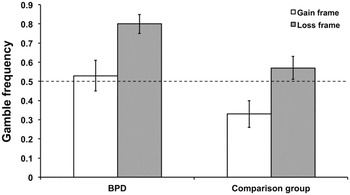
Finally, the analyses conducted on the risk-seeking and risk-averse behaviors, defined with respect to risk-neutral (see Figure 1) revealed that comparison subjects showed risk-aversion in the gain frame, gambling on 33% of trials, t(15) = –2.54, p = .023, d = .64, and tended to be slightly risk-seeking in the loss frame, gambling on 57% of trials, though this test did not reach statistical significance, t(15) = 1.26, p = .23. On the other hand, BPD did not show risk-aversion in the gain frame, gambling on 53% of trials, t(11) = .33, p = .75, but they were risk-seeking in the loss frame, gambling on 80% of trials, t(11) = 6.13, p < .0001, d = 1.77.
Framing task: proportion of gamble choices (and standard error) in BPD patients and comparison participants in win and loss frames. The line represents risk-neutrality.

Cups Task
Results examining group level-differences in risk-taking depending on the EV level and Domain showed a marginal main effect for Domain, in that both BPD patients and the comparison group made more risks in the loss domain than in the gain domain, F(1, 26) = 4.07, p = .054, η2 = .135 (see Table 2 for a breakdown of the proportion of risky choice by EV Level). We did not find a significant effect for either Group, F(1, 26) = .43, p = .52, or the Domain X Group interaction, F(1, 26) = .47, p = .50.
Cups Task (Mean and SD)

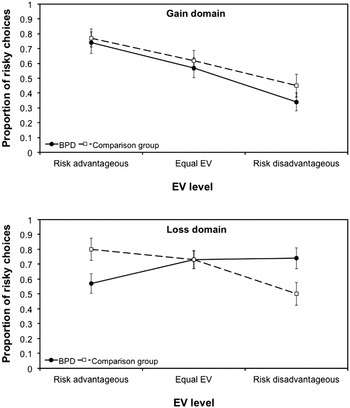
As expected, the linear contrast analyses showed a main effect for EV Level, with the proportion of risky choices being greater on risk-advantageous trials than risk disadvantageous trials, F(1, 26) = 15.16, p = .001, η2 = .37. A significant Domain X EV Level interaction showed that subjects were more responsive to relative EV between choice options in the gain domain than in the loss domain, F(1, 26) = 8.36, p = .008, η2 = .243. We also found a significant Domain X EV level X Group interaction, F(1, 26) = 6.91, p = .014, η2 = .210. As seen in Figure 2, BPD patients were able to adjust their decision making in response to EV differences in the gain domain, but they were not sensitive to the relative EV between choice options in the loss domain. Follow-up t-tests were conducted to examine group-level EV sensitivity differences for each domain. Analyses revealed that, for potential losses, BPD patients showed lower EV sensitivity than the comparison group, t(26) = –3.14, p = .004, d = 1.24. However, no differences in EV sensitivity appeared in the gain domain, t(26) = .53, p = .603, d = 0.21.
Cups task: adaptative decision-making (and standard error) as a function of EV level and domain for BPD patients and comparison participants.

Discussion
The goal of this study was to characterize how BPD patients approached risky decisions when risks are presented as gains or losses. Consistent with the predictions of Prospect Theory (Kahneman & Tversy, Reference Kahneman and Tversky1979), both BPD patients and comparison participants were more likely to take a risk to avoid a loss than to achieve gains. However, though BPD patients showed this framing effect, their decision-making diverges from that shown by healthy subjects. Comparison participants clearly showed risk-aversion in the gain frame, but did not clearly deviated from risk-neutrality in the loss frame. Conversely, BPD patients showed a robust risk-seeking in the loss frame, but did not deviate from risk-neutrality in the gain frame, a pattern similar to that found in amygdala damage patients (e.g., Talmi, Hurlemann, Patin, & Dolan, Reference Talmi, Hurlemann, Patin and Dolan2010). Importantly, BPD patients more frequently chose the risky option than healthy comparison subjects when a possible loss was present as a potential outcome regardless of how the loss was represented, either as an actual loss, or as keeping none of a starting amount.
Although our data from the framing task show an overall risk tendency in BPD patients, and an increase in risk-taking in the loss frame, they do not reveal how patients adjust their behavior when the outcome, rather than the contextual frame, is presented as a potential gain or loss. For this purpose, the Cups task provided complementary data to those obtained in the framing task. Overall, BPD patients did not show a higher frequency of risky choices in the Cups task than comparison participants. However, we found the BPD patients specifically displayed a relative insensitivity to the relative EV between choice options when considering risky decisions that involve avoiding potential losses. Previous findings obtained by Kirkpatrick et al. (Reference Kirkpatrick, Joyce, Milton, Duggan, Tyrer and Rogers2007) revealed that while non-BPD participants chose the gamble option (versus a control option) less often when the possible losses associated to this option were large compared to when the possible losses were small, BPD participants did not show this pattern, but an attenuation of this effect when the probability of winning was high. In addition, BPD participants compared to non-BPD participants chose more often the gamble option when there was an escape option (a “do not gamble option” that did not involve any loss or gain). Our findings further extend these obtained by Kirkpatrick et al. (Reference Kirkpatrick, Joyce, Milton, Duggan, Tyrer and Rogers2007), revealing that both the context where the decision is made (gain versus loss) as well as the combination of the possible outcome and probability of winning or losing, i.e., expected value, are relevant factors necessary to explain the decision-making deficits observed in BPD patients. Therefore, and in order to reconcile the findings of both studies, the absence of a control for these two variables could explain the difference between our results and those obtained by Kirkpatrick et al.
These authors proposed that the decision-making deficits of BPD patients could reveal failures to process punishment cues, resulting from an imbalance between appetitive and aversive motivational cues derived from the contextual information provided by the task (e.g., Kirkpatrick et al., Reference Kirkpatrick, Joyce, Milton, Duggan, Tyrer and Rogers2007). This explanation is congruent with the performance of our BPD sample in the loss domain, characterized by an increase of risky choices when the risk was disadvantageous, and a decrease when the risk was advantageous. This pattern of risk taking might result from an inappropriate balance of the motivational systems derived from the reinforcement information in a negative emotional context (loss domain), supported, possibly, by a dysfunction of the frontolimbic circuitry related to emotion and decision making.
Potentially, this proposed imbalance might be the result of the combination of limbic system, primarily the amygdala, hyperactivity and deficits in prefrontal cortex-mediated emotional control processes that can serve to decontextualize the decision problem. This lack of control could interfere with the consideration of the present outcome probabilities associated to the choice, leading to suboptimal choices.
The current study was not designed to test anatomical hypotheses, but it is tempting to speculate that these similarities may exist due to over-active subcortical processing of emotion, relative to prefrontal control mechanisms, e.g., neural dysfunction in the amygdala-MPFC circuitry (Banks, Eddy, Angstadt, Nathan, & Phan, Reference Banks, Eddy, Angstadt, Nathan and Phan2007; Silbersweig et al., Reference Silbersweig, Clarkin, Goldstein, Kernberg, Tuescher, Levy and Stern2007). In addition, researchers have suggested that the suboptimal decision making observed in BPD patients result from affective dysregulation (e.g., Haaland & Landrø, 2007), arising from a dysfunction of this circuitry. An enhanced emotional reactivity, possibly related to a limbic hyperactivity (Koenigsberg et al., Reference Koenigsberg, Siever, Lee, Pizzarello, New, Goodman and Prohovnik2009), may make BPD patients more sensitive to sure losses and lead them to select riskier options to avoid the certain loss. However, our results only partially support this conclusion. BPD patients showed greater disadvantageous risk taking, in accordance with the hypothesis of a hypersensitivity to negative affective information in BPD patients, but surprisingly, they also took less risky choices when it was advantageous to take a risk, contrasting with such hypothesis. We thus posit that the decision-making deficits observed in BPD may be associated with an inability to properly evaluate choice options when a potential loss is present. We posit that if BPD patients show a heightened reactivity to potential losses, this may result in the discounting of contextual information that may signal whether one should approach or avoid a risky option.
Although these results are promising, we must be cautious particularly due to the preliminary nature of the current study. Additionally, 9 patients were taking psychiatric medication, which may have resulted in an underestimation of risk behavior. In addition, 7 patients had a past history of substance abuse, which might also influence our results. Previous research, however, has not found effects of either current medication history or past substance abuse on decision-making in BPD patients (Bazanis et al., Reference Bazanis, Rogers, Dowson, Taylor, Meux, Staley and Sahakian2002; Silbersweig et al., Reference Silbersweig, Clarkin, Goldstein, Kernberg, Tuescher, Levy and Stern2007), and our preliminary analyses did not reveal any effect of these variables on the results obtained. A limitation of this research is the reduced sample size, which could result in non-significant results due to power issues, as in the case of the marginal effects found in the Cups task. In addition, since we used very strict criteria for inclusion in the study, as the absence of both comorbid diagnosis and current substance abuse, the generalization of our results might be limited because these two conditions are usually present in BPD patients. Finally, we must also note that current moods may potentially impact decision-making processes (Damasio, Reference Damasio1994; Tversky & Kahneman, Reference Tversky and Kahneman1981). Because we did not obtain an independent measure of the current emotional state of our sample, our study is silent to this issue. However, decision-making studies in BPD patients that have used independent measures of the emotional state have concluded that affective symptomatology, like depression and anxiety, do not explain differences in risk taking between BPD patients and healthy comparison subjects (e.g., Haaland & Landrø, Reference Haaland and Landrø2007; Kirkpatrick et al., Reference Kirkpatrick, Joyce, Milton, Duggan, Tyrer and Rogers2007).
Our results lead us to conclude that BPD patients show a propensity to risky choices, particularly when outcomes involve potential losses, characterized by a lesser ability to adjust their behavior in the face of changing environmental contingencies. Further studies are needed in order to clarify the potential role of affective dysfunction observed in BPD patients on risky decision-making pattern by using, for example, psychophysiological measurements (e.g., skin conductance or heart rate) or electrophysiological measures (e.g. evoked-response potentials). Such investigations may help to study the degree to which BPD patients differently respond to potential losses in terms of heightened arousal and emotion regulation.