Implications
Livestock manure is a source of greenhouse gas (GHG) emissions, mainly as methane and nitrous oxide. GHG emissions are biogenic and regulated by manure characteristics, and therefore emissions can be manipulated via handling, treatment and storage conditions. Globally, livestock production systems vary widely, and this is also true for GHG mitigation potentials, but generally efforts to conserve nutrients in manure for crop production will also reduce GHG emissions. Future growth in livestock production is projected to occur mainly in confined animal feeding operations, which also appear to have the greatest potential for GHG mitigation.
Introduction
Since the mid 20th century, there has been a growing pressure on land resources for production of food and feed for livestock and, increasingly, crops for energy production (Hoogwijk et al., Reference Hoogwijk, Faaij, Eickhout, de Vries and Turkenburg2005). To fulfil the demand for meat, milk and eggs, livestock production in developing countries is expanding, especially in peri-urban areas (Gerber et al., Reference Gerber, Chilonda, Franceschini and Menzi2005), and worldwide becomes more specialised (Steinfeld et al., Reference Steinfeld, Gerber, Wassenaar, Castel, Rosales and de Haan2006). In consequence of these trends, increasing volumes of livestock manure are produced, which are a source of greenhouse gases (GHGs) contributing to radiative forcing (Forster et al., Reference Forster, Ramaswamy, Artaxo, Berntsen, Betts, Fahey, Haywood, Lean, Lowe, Myhre, Nganga, Prinn, Raga, Schulz and Van Dorland2007). Using a life cycle approach, the relative contribution of global livestock production to anthropogenic GHG emissions was estimated to be 18% (Steinfeld et al., Reference Steinfeld, Gerber, Wassenaar, Castel, Rosales and de Haan2006), whereas a similar analysis for the European Union arrived at 12.8%, or 9.1% without land use and land use change-related emissions (Leip et al., Reference Leip, Weiss, Wassenaar, Perez, Fellmann, Loudjani, Tubiello, Grandgirard, Monni and Biala2011).
GHG emissions from agriculture are biogenic, and the GHG balance of manure management reflects a multitude of microbial activities, that is: emissions of methane (CH4) are the net result of methanogenesis and CH4 oxidation; nitrous oxide (N2O) is a product of several processes, but may also be consumed via denitrification before escaping to the atmosphere; and the carbon dioxide (CO2) balance is influenced by manures via (net) soil carbon stock changes upon field deposition and any production of bioenergy.
Within the lifecycle of livestock products, most variability occurs at the level of farming system (Oenema et al., Reference Oenema, Kros and de Vries2003), and globally livestock manure differs widely in volume, composition and storage conditions. This is discussed with reference to four specific cases of livestock production that differ in production intensity and regulation. The range of manure characteristics is extended by treatments such as composting, forced aeration, solid–liquid separation, anaerobic digestion or use of additives. Moreover, feeding is part of the manure management chain by determining the quality and nutrient composition of excreta. The paper includes an overview of management practices with a potential for GHG mitigation. Management at one stage affects manure composition and emissions at subsequent stages, and therefore the entire continuum of manure management and treatment must be taken into account when evaluating individual or combinations of GHG mitigation measures (Chadwick et al., Reference Chadwick, Sommer, Thorman, Fangueiro, Cardenas, Amon and Misselbrook2011), which calls for the use of whole-farm models (Del Prado et al., Reference Del Prado, Crosson, Olesen and Rotz2013). The paper finally discusses opportunities for, and barriers against, GHG mitigation. Although excretal returns during grazing should also be considered in the context of manure management, this review will mainly focus on the management of manure collected during confinement.
CH4 and N2O emissions from manure: sources and sinks
Understanding the microbial ecology of manure environments is critically important for proper estimation of GHG emissions from manure management, and for efforts to predict effects of management changes and develop GHG mitigation strategies. Here, we briefly review the response of microorganisms in manure environments to key environmental controls.
Methanogenesis
CH4 emissions may occur from all manure environments, but is mainly associated with liquid or compacted manure (Osada et al., Reference Osada, Kuroda and Yonaga2000; Chadwick et al., Reference Chadwick, Sommer, Thorman, Fangueiro, Cardenas, Amon and Misselbrook2011). Methanogenesis occurs only under strictly anaerobic conditions where it is coupled to other processes involved in the breakdown of manure organic matter (Valentine, Reference Valentine2007). Little is known about the microbiological basis of methanogenesis in fresh manure, but the methanogenic potential in fresh manure is low, probably because of inhibitory concentrations of ammonia (NH3) derived from urine (Chen et al., Reference Chen, Cheng and Creamer2008). There are, however, slow-growing methanogens capable of adapting to as much as 7 g total ammoniacal N/l (i.e., Methanosarcina spp.), which are known to develop in manure and anaerobic digesters (Rastogi et al., Reference Rastogi, Ranade, Yeole, Gupta, Patole and Shouche2008; de Vrieze et al., Reference De Vrieze, Hennebel, Boon and Verstraete2012).
Owing to a marginal energy yield (Valentine, Reference Valentine2007), methanogenesis is sensitive to low temperature, and therefore cooling is a potential CH4 mitigation option (Sommer et al., Reference Sommer, Petersen and Møller2004; Umetsu et al., Reference Umetsu, Kimura, Takahashi, Kishimoto, Kojima and Young2005). For cool temperate climates, frequent removal of manure from the housing to an outside store has been proposed as a low-cost strategy to reduce CH4 emissions (Sommer et al., Reference Sommer, Olesen, Petersen, Weisbjerg, Valli, Rohde and Béline2009). However, the predicted effect of frequent removal assumes that there is no difference in the potential for CH4 production between slurry pits and the outside storage facility, which may not be the case if adapted organisms have not yet developed in the slurry pit, for example, because of inhibitory concentrations of NH3, or cleaning after emptying (Haeussermann et al., Reference Haeussermann, Hartung, Gallmann and Jungbluth2006).
Presumably, during the gradual filling of an outside storage tank or lagoon, there will be a fast inoculation of newly added slurry, such that in the final storage facility CH4 production and emissions can be predicted by the physical and chemical properties of the slurry, that is, substrate availability for methanogens (Wood et al., Reference Wood, Gordon, Wagner-Riddle, Dunfield and Madani2012). This is also the assumption of the 2006 methodology of the Intergovernmental Panel on Climate Change (IPCC), which links CH4 emissions from liquid manure to mean storage temperature (IPCC, 2006).
CH4 oxidation
CH4 is oxidised mainly by aerobic bacteria (Hanson and Hanson, Reference Hanson and Hanson1996). Both methanogens and CH4-oxidising bacteria (MOB) are present in solid manure (Sharma et al., Reference Sharma, Ryan, Hao, Larney, McAllister and Topp2011). There are few studies on the potential for CH4 oxidation, but MOB population dynamics during composting and maturation phases have been described for other organic residues (Wilshusen et al., Reference Wilshusen, Hettiaratchi, De Visscher and Saint-Fort2004; Halet et al., Reference Halet, Boon and Verstraete2006), and thus MOB activity may play a role in mitigating CH4 emissions from solid manure, as proposed by Szanto et al. (Reference Szanto, Hamelers, Rulkens and Veeken2007).
An organic surface crust is often present on livestock slurry stores, which may contain a significant potential for CH4 oxidation (Ambus and Petersen, Reference Ambus and Petersen2005; Petersen et al., Reference Petersen, Amon and Gattinger2005; Hansen et al., Reference Hansen, Nielsen, Schramm, Nielsen, Revsbech and Hansen2009). However, Nielsen et al. (Reference Nielsen, Schramm, Nielsen and Revsbech2013) found that potential methane oxidation (PMO) in two natural crusts from piggeries remained low until late autumn, indicating that MOB activity was low during summer and early autumn where most of the annual emissions occur (Husted, Reference Husted1994). The reason for this delay is unknown; however, a crust overlying liquid manure will be rich in NH3, and also nitrification and denitrification activity could potentially interfere with CH4 oxidation activity. Duan et al. (Reference Duan, Elsgaard and Petersen2013) found PMO in a surface crust to be 50 to 100 times more sensitive to nitrite (NO2−) than to NH4+ or nitrate (NO3−), and <1 mM NO2− significantly inhibited CH4 oxidation activity.
N2O emissions via nitrification and denitrification
The conversion of oxidised N to gaseous forms during manure handling, storage and after field application can represent a significant loss of plant-available N (Rotz, Reference Rotz2004). Both N2O and, indirectly, NH3 volatilisation and NO3− leaching contribute importantly to the GHG balance of manure management. Whereas CH4 production and oxidation processes are associated with anoxic and oxic conditions, respectively, emissions of N2O are stimulated under O2-limited conditions.
Nitrification is a two-step conversion of NH3 via NO2− to NO3−, primarily carried out by ammonia-oxidising (AOB) and nitrite-oxidising bacteria (NOB). Ammonia-oxidising archaea have also been found in composting manure and soil, but are not responsive to N inputs, and hence their role is uncertain (Jia and Conrad, Reference Jia and Conrad2009; Yamamoto et al., Reference Yamamoto, Otawa and Nakai2010). N2O is produced by AOB, either as a side-product in the conversion of NH3 or by a subsequent conversion of NO2− via a process called nitrifier denitrification (Goreau et al., Reference Goreau, Kaplan, Wofsky, McElroy, Valois and Watson1980; Kool et al., Reference Kool, Dolfing, Wrage and Van Groenigen2011). Nitrifier denitrification may be a mechanism to avoid toxic levels of NO2−, which can occur when there is an imbalance between AOB and NOB activity, for example, because of competition for O2 (Laanbroek and Gerards, Reference Laanbroek and Gerards1991).
Denitrification is carried out by a phylogenetically diverse group of heterotrophic bacteria, although the process has also been found among fungi and archaea (Wallenstein et al., Reference Wallenstein, Myrold, Firestone and Voytek2006). Most denitrifiers are facultative anaerobes, that is, they prefer O2 as electron acceptor, but can use NO3− or NO2− in the absence of O2. The expression of genes for denitrifying enzymes is stimulated at low O2 levels, but N2O reductase is unstable even with traces of O2 (Thomson et al., Reference Thomson, Giannopoulos, Pretty, Baggs and Richardson2012). Therefore, N2O can accumulate around oxic–anoxic interfaces in the manure.
Manure environments – during storage and after field application – are characterised by steep gradients in O2 because of intense decomposer activity, which enables potentials for nitrification and denitrification to develop at close proximity around oxic–anoxic interfaces (Petersen et al., Reference Petersen, Nielsen, Haarder and Henriksen1992 and Reference Petersen, Nielsen, Frostegård and Olesen1996). Chemical gradients can also develop that may influence N2O emissions. The pH of fresh manure is neutral to alkaline, and dominated by NH4+ + NH3 and carbonates derived from decomposer activity (Husted et al., Reference Husted, Jensen and Jørgensen1991). Around air–liquid interfaces, CO2 and NH3 will be lost to the gas phase, thereby removing buffering capacity and alkalinity. As NH3 oxidation is an acidifying process, there is thus a potential for significant reduction in pH because of nitrification. For example, Petersen et al. (Reference Petersen, Nielsen, Haarder and Henriksen1992) observed a drop in pH from 6.5 to 4.5 around manure hot spots in a sandy loam soil that coincided with a more than 10-fold increase in potential NH3 oxidation. If pH declines, rates of nitrification and denitrification may also decline (Cuhel et al., Reference Cuhel, Simek, Laughlin, Bru, Chèneby, Watson and Philippot2010; Cytryn et al., Reference Cytryn, Levkovitch, Negreanu, Dowd, Frenk and Silber2012), but the N2O-to-N2 ratio of denitrification will increase (Baggs et al., Reference Baggs, Smales and Bateman2010). It can be speculated that this environment is also conducive to N2O emissions via nitrifier denitrification if NO2− accumulates because of selective inhibition of NOB (de Boer and Kowalchuk, Reference De Boer and Kowalchuk2001; Kool et al., Reference Kool, Dolfing, Wrage and Van Groenigen2011). Indeed, Fukumoto (Reference Fukumoto2006) showed that addition of NOB to a compost prevented NO2− accumulation and N2O emission.
Manure management practices – a global view
The relative importance of microbial processes leading to CH4 and N2O emissions will depend on the manure environment as determined by local management practices and climate, factors that differ greatly between regions, as exemplified for dairy production in Table 1. For dairy production, grassland systems predominate in Central and South America, Africa and Asia/Oceania; confined animals with solid manure management in Eastern Europe and the Russian Federation; and some regions have a high proportion of liquid manure management for confined animals.
Regional differences in manure management practices for dairy production

CSA = Central and South America; NENA = Near East and North Africa; SSA = Sub-Saharan Africa.
The table shows the relative importance (in %) of liquid and soil manure management practices, including systems dominated by grazing.
1Lagoons are typically earthen sedimentation basins for dilute waste from housed animals; sludge is degraded anaerobically, while the liquid evaporates or is pumped to spray fields. Liquid manure/slurry typically has a higher dry matter content and may include bedding material and is stored in tanks and may form a crust during storage. Solid storage is used for manure from housed animals on deep litter, or with separate collection of faeces + bedding material and urine, respectively. Drylots are large confinements where a compacted pad forms on the ground, which is infrequently scraped and may be stacked for composting. In pasture/range-dominated systems, most manure will be deposited during grazing.
Source: Food and Agriculture Organization of the United Nations (FAO) (2010).
In grassland-based systems, faeces and urine from grazing animals is deposited on pastures or rangeland and not handled (Oenema et al., Reference Oenema, Oudendag and Velthof2007). Dry areas of the tropics, and continental climates of Asia and North America, are dominated by extensive grazing by ruminants (cattle, sheep, goats, camels), often in a rotational way (Steinfeld et al., Reference Steinfeld, Gerber, Wassenaar, Castel, Rosales and de Haan2006). Intensive grazing, mainly by cattle, is found in medium to high population density areas, mostly in temperate climate zones of Europe, North and South America and, increasingly, in the humid tropics. In both extensive and intensive grazing systems, substantial N losses may occur through leaching and volatilisation from point sources of urine and faeces where N concentrations may exceed the equivalent of 200 and 2000 kg N/ha, respectively (Lantinga et al., Reference Lantinga, Keuning, Groenwold and Deenan1987).
If livestock production is partly or completely based on confined animal feeding, manure is normally collected and must be managed from the time of excretion, during storage, possibly by treatment, and finally during spreading to land (Chadwick et al., Reference Chadwick, Sommer, Thorman, Fangueiro, Cardenas, Amon and Misselbrook2011), although in some regions a proportion is also directly discharged to the environment. On-farm manure management systems can vary widely depending on animal category, housing design and manure collection system. Burton and Turner (Reference Burton and Turner2003) distinguished three categories of manure management: (a) systems collecting liquid manure (slurry) from animals kept on slatted or solid floors regularly swept clear of any excreta, sometimes with some dilution from washing water; (b) systems producing solid manure (farmyard manure) from animals kept on bedding material, which is collected together with all excreta; and (c) systems producing mixed manure from animals kept on bedding material, but with drainage and separate collection of liquids. In dry climates, animals may also be kept in unpaved feedlots where manure is periodically removed (IPCC, 2006). Before storage and field application, manure can be treated by different methods for improved handling, nutrient use or energy generation (see next section). As basis for further discussion of GHG mitigation potentials via changes in manure management, we present four specific livestock production situations. It must be stressed that these examples are not intended to represent the true diversity, but rather four different levels of intensification.
Sub-Saharan Africa – subsistence farming
Sub-Saharan Africa is characterised by extensive subsistence farming. In West Africa, agricultural land covers 30% to 60% of the area, and population density is 45 to 80 per km2. Farming systems are dominated by cereal (corn, sorghum and millet) and cotton production, and the area available for grazing is limited. Livestock consists mainly of cattle at 0.08 to 4.8 tropical livestock units (TLU)/ha (Anon., 2007), where 1 TLU = 250 kg live weight (Hoffmann et al., Reference Hoffmann, Gerling, Kyiogwom and Mané-Bielfeldt2001). During the dry season, animals are confined and fed crop residues. When the agricultural season begins (rainy season), shepherds lead their livestock to graze on pastures either near the farm or over long distances (transhumance). There are three main categories of farms. Farms dominated by crop production (cropped area 5 to 11 ha, 1 to 6 TLU) constitute 68% of all. Agro-pastoralist farms with more emphasis on livestock (11 to 24 ha, 11 to 30 TLU) represent 30% of all farms. The last 2% are specialist breeders with cattle herds up to 15 TLU and small areas (on average 0.6 ha) with cereals for their own consumption (Vall et al., Reference Vall, Dugué and Blanchard2006).
There is considerable diversity in management of animal manure between farms (Manlay et al., Reference Manlay, Chotte, Masse, Laurent and Feller2002; Blanchard, Reference Blanchard2010); the main priority is recycling of nutrients for crop production. Garbage piles with domestic waste, daily sweepings and faeces from small ruminants, and some soil, may be produced in the homestead area. Confining animals helps produce organic fertiliser in significant quantities, by facilitating manure collection. Some farmers add bedding material and feed leftovers to the pen or animal shed (Landais and Guérin, Reference Landais and Guérin1992; Landais and Lhoste, Reference Landais and Lhoste1993; Ganry et al., Reference Ganry, Feller, Harmand and Guilbert2001), which further increases the quantity and nutrient content of manure, as nutrients in urine are trapped by the litter. Household compost may be produced in pits near the homestead area on the basis of animal faeces, feed and crop residues, and domestic waste (Ganry et al., Reference Ganry, Feller, Harmand and Guilbert2001). Farmers may irrigate the pit, turn the compost and use a cover to limit N losses and promote decomposition.
Nutrient cycling and losses associated with the management of manure have been estimated for farms with 10 to 75 TLU in South Mali (Blanchard, Reference Blanchard2010). Between 38% and 50% of animal faeces (6 to 40 t/year) is deposited during grazing on common pastures. Deposition of faeces during transhumance represents 0 to 25 t/year. The monitoring study indicates that, for farms of West Africa, 46% of the N in crop residues and manure is returned to the soil of common pastures or areas of transhumance, whereas 13% is lost in gaseous form at the time of excretion. Organic manure produced on the farm represents 24% of the N, and 17% is lost through leaching or in gaseous form during handling and storage of manure and compost (Blanchard, Reference Blanchard2010). The N cycling efficiencies were close to those reported by Rufino et al. (Reference Rufino, Tittonell, van Wijk, Castellanos-Navarrete, Delve, de Ridder and Giller2007) of 13% to 28%.
With the rising price of mineral fertilisers, reduction in fertiliser subsidies and programmes promoting organic manure quality, there is an increasing focus on efficient use of nutrients in livestock manure (Blanchard and Vall, Reference Blanchard and Vall2010). To increase nutrient conservation, recommendations are to compost under roofs and on floors (Rufino and Rowe, Reference Rufino and Rowe2006), and to limit storage time (Tittonell et al., Reference Tittonell, Rufino, Janssen and Giller2010). Farmers aim to keep animals longer in confinement by improving forage availability (Landais and Lhoste, Reference Landais and Lhoste1993). Bio-digesters on farms to provide energy for light and cooking are still new to this region, but will produce a new type of manure to be managed.
Vietnam – smallholder confined animal feeding operations (CAFOs)
In Vietnam, total livestock production has increased significantly since the late 20th century, but with little adaptation of existing manure management practices. Traditionally, solid manure is removed manually from pig and cattle houses on a daily basis and floors cleaned with water (Vu et al., Reference Vu, Tran and Dang2007). As pigs are also cooled with water, there may be a 10-fold dilution of manure (Vu et al., Reference Vu, Tran, Nguyen, Vu, Vu and Jensen2012). Asian farming systems typically include crop production, fish farming and livestock. A survey in two North Vietnamese provinces found that 5% and 35% of the manure, respectively, was used for cash crops (Vu et al., Reference Vu, Tran and Dang2007). Addition of untreated animal manure to rice paddies may increase N2O and CH4 emissions significantly, but emissions can be reduced by water management; it has been shown that intermittent irrigation and/or midseason drainage reduces CH4 emissions from paddy fields compared with continuous flooding (Minamikawa et al., 2006).
Both liquid and solid manure (fresh or composted) are applied to fish ponds. If dilute liquid manure is not drained to a fish pond, it is mostly discharged to rivers or ditches, as the nutrient content is low. This discharge can account for 7% to 15% of livestock feed N intake, 10% to 17% of P intake and 9% to 23% of K intake (Vu et al., Reference Vu, Tran, Nguyen, Vu, Vu and Jensen2012).
Biogas production is used at the farm scale in most Asian countries, where it substitutes other energy sources while also reducing odour and improving nutrient use efficiency (Cu et al., Reference Cu, Pham, Le, Nguyen, Le, Nguyen and Sommer2012; Wang and Zhang, Reference Wang and Zhang2012). In Vietnam, 110 000 digesters were in use in 2010, which may increase to 300 000 by 2018 (Cu et al., Reference Cu, Pham, Le, Nguyen, Le, Nguyen and Sommer2012). For comparison, in China, 30 million biogas plants were in use in 2009, a number that is also expected to increase (Jiang et al., Reference Jiang, Sommer and Christensen2011). For a small farm with a total production of 12 pigs/year, the GHG balances of manure management without and with anaerobic digestion have been estimated at 2271 and −504 kg CO2 Eq/year, respectively (S. G. Sommer, unpublished data). However, even well-managed biogas plants have minor leakages of CH4 to the environment (Sommer et al., Reference Sommer, Petersen and Møller2004), and small-scale digesters in Asian countries are often not well managed (Jiang et al., Reference Jiang, Sommer and Christensen2011; Cu et al., Reference Cu, Pham, Le, Nguyen, Le, Nguyen and Sommer2012). A study from Thailand estimated the release to account for 15% of the gas produced (Prapaspongsa, Reference Prapaspongsa2010), and recently Bruun et al. (Reference Bruun, Jensen, Vu Thi Khanh Van and Sommer2013) concluded that, for Vietnam, the loss of CH4 from digesters could be as high as 40%, which would make biogas production a net source of GHG.
In summary, livestock production in Vietnam and other countries of Southeast Asia is characterised by significant growth, but with little progress in manure management, and therefore GHG emissions are increasing. On-farm biogas production is a potential GHG mitigation option, but management should be improved.
China – small- and large-scale CAFOs
Livestock numbers in China have increased markedly over the past two decades (MOA, 2010), with the associated manure generation reaching 3000 to 3500 Mt in 2007 (MEP, 2010). This manure is generated through a combination of backyard low-productivity household farms and highly productive intensive livestock enterprises, similar to those seen throughout the United States and Europe. However, as the demand for livestock products increases within China, so will livestock numbers and volumes of manure generated, with an estimated increase of around 1000 Mt between the years 2000 and 2030 (Chadwick et al., Reference Chadwick, Qing, Yan'an, Guanghui and Qirong2012). A recent survey suggests that the proportion of livestock reared in intensive systems is increasing, especially in the peri-urban areas (MOA, 2010). For example, MOA data show that ∼80% of broilers and laying hens, and 50% of pigs, are now reared in CAFOs in China.
Another recent survey (2007 data) has suggested that almost 20% of manure is ‘wasted’ and not applied to land, which has implications for water quality and indirect N2O emissions via NO3−. Of the remaining 80%, ca. 26% is composted, 8% used for biogas production before spreading and the rest of the manure (66%) is spread directly to land. A range of subsidies will lead to more livestock manure being managed via the digestion and composting routes. Simple containment to ensure that manure is applied to land will improve both air and water quality.
More centralised livestock production presents opportunities for GHG emission control during the manure production (housing) and handling phases (centralised biogas production), although careful planning is necessary to ensure that manure nutrients are used effectively on agricultural land (both proximate to the production unit, and at distance where, e.g., composted faecal matter is sold). Local-, household- and village-scale anaerobic digestion schemes have been implemented, but the lack of mechanisation for removal of solids from digesters and land spreading means that use of nutrients in the digestate is not optimised.
Manure and fertiliser N use in China is excessive, especially for high-value crops such as fruit and vegetables (Gao et al., Reference Gao, Bai, Zhuo, Zhou and Chen2012). It can be as high as 1 to 2 t N/ha per year. If greater account was made of manure nutrients, especially N, for crop supply, then less fertiliser N would need to be applied, reducing the carbon footprint of production and use of fertilisers (Zhang et al., Reference Zhang, Dou, He, Ju, Powlson, Chadwick, Norse, Lu, Zhang, Wu, Chen, Cassman and Zhang2013). A reduction in these excessive applications would reduce direct and indirect (via NO3− leaching) emissions of N2O from soil, especially if one considers the non-linear relationship between application rate and direct emissions (e.g., Cardenas et al., Reference Cardenas, Thorman, Ashlee, Butler, Chadwick, Chambers, Cuttle, Donovan, Kingston, Lane and Scholefield2010).
EU – highly regulated livestock production
For socio-economic reasons, European livestock production is increasingly intensive, with specialisation and mechanisation leading to larger farms (Burton and Turner, Reference Burton and Turner2003). Intensive systems are dominated by three animal categories: cattle, pigs and poultry. They are often ‘landless’ in the sense that <10% of animal feed is produced on the farm (Kruska et al., Reference Kruska, Reid, Thornton, Henninger and Kristjanson2003). The geographic uncoupling of feed production from animal production is a fundamental challenge because of the concentration of nutrients in livestock-intensive areas – here, as in other parts of the world.
Large proportions of nutrient intake are excreted, for example, 60% to 70% of ingested N for fattening pigs and laying hens, and 70% to 90% for cattle depending on physiological stage (Peyraud et al., Reference Peyraud, Cellier, Donnars and Réchauchère2012). Manure is commonly used as a fertiliser on the farm, but transfer between farms is also seen in regions with high livestock densities (e.g., Netherlands, Western France). Regulations have been introduced in almost all countries to prevent discharge to rivers and streams, guidelines are available for storage and land application (timing, location, rate, method). The EU Nitrates Directive stipulates a maximum annual application of 170 kg/ha of manure N (European Commission (EC), 1991), although some derogations exist that allow higher rates for crops with a high N uptake potential. Nutrient recycling is a challenge for large livestock farms with little or no land (e.g., a farm with 20 000 fattening pig places requires 2 to 3000 ha of cropland for manure recycling; Menzi et al., Reference Menzi, Oenema, Burton, Shipin, Gerber, Robinson and Franceschini2010). By assigning an N fertiliser value to the manure, regulations and recommendations can ensure that manure nutrients are considered as a primary source of macro-nutrients (Anon., 2012).
In Europe, 30% to 40% of livestock excreta are deposited during grazing and thus not handled. The remaining 60% to 70% is collected in housing systems, a percentage that tends to increase. Manure management systems producing solid manure represent 20% to 30% of excreta, whereas the remainder is handled as slurry that is either stored in pits beneath animal confinements or in outside tanks (Oenema et al., Reference Oenema, Oudendag and Velthof2007). The proportion of manure in liquid form varies considerably between countries; it is generally higher (>65%) in central and northern Europe, even reaching more than 95% in the Netherlands, and lower (<50%) in the United Kingdom, France and some parts of Eastern Europe where housing systems are often associated with bedding materials (e.g., deep litter). For both liquid and solid manure, the appropriate storage capacity depends on the maximum length of time during which manure cannot be applied to land. In Europe, because of the winter break in vegetation growth, the required storage capacity ranges from 4 to 9 months (Menzi et al., Reference Menzi, Oenema, Burton, Shipin, Gerber, Robinson and Franceschini2010).
There are several drivers leading farmers towards liquid manure management systems. In addition to easier handling, liquid manure has a higher mineral N-to-organic N ratio and thus a higher percentage of plant-available N, and there are several options for treatment with a potential to improve manure quality and reduce losses towards the environment. In addition, production of 25 t solid manure requires straw from approximately 1 ha of cereals (Schröder, Reference Schröder2005), and hence availability and price of straw is a constraint. Mechanical separation of liquid manure is practised to varying extent in European countries, for example, 90% of pig slurry in Greece, 10% of all slurry in Spain and in Italy 15% of cattle and 40% of pig slurry (Burton and Turner, Reference Burton and Turner2003). Aeration of slurry is increasingly practised in France and the Netherlands. Biogas production is expanding in several countries, but the proportion of livestock slurry that is treated varies greatly (Anon., 2010).
GHG emissions, direct and indirect, occur at all stages of manure management. Although livestock production in EU is already highly regulated, this does not include GHG emissions, and hence there is scope for further improvements in manure management. NH3 and GHG emissions may be higher for either slurry or solid manure depending on management stage (housing, storage, spreading) and animal species (Gac et al., Reference Gac, Béline, Bioteau and Maguet2007), and hence it is important to identify mitigation strategies for both categories.
Manure handling and treatment for GHG mitigation
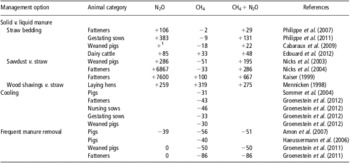
In this section, we briefly discuss GHG mitigation potentials of the most relevant options for solid and liquid manure management. Liquid manure is collected in slurry channels below slatted floors or deposited on soiled slats and surfaces, whereas solid manure accumulates as litter on the floor. GHG emissions tend to be higher for solid manure-based systems (Table 2), particularly for N2O and with fattening pigs. Manure removed from animal houses or confined areas may be treated or stored outside, and is mostly field-applied to recycle nutrients. At all stages, management has an impact on GHG emissions.
Effects of different management options on CH4, N2O and combined CH4 + N2O emissions from housing

‘+’ represents higher emissions (%) and ‘–’ lower emissions (%) compared with the reference (untreated) manure. The comparison of systems is based on CO2 equivalents.
1N2O emissions from slurry were not measurable.
Housing – diet
Diet has not only a direct effect on CH4 emissions from enteric fermentation, but also an indirect effect on CH4 emissions during storage, by affecting manure composition (e.g., Hindrichsen et al., Reference Hindrichsen, Wettstein, Machmüller, Jörg and Kreuzer2005); see also section ‘On-farm interactions’ below. The effect of diet on denitrification and N2O emission is related to the protein balance, as excess N is excreted, and a reduction in manure N concentration will also reduce N2O emissions (Misselbrook et al., Reference Misselbrook, Chadwick, Pain and Headon1998). Inclusion of some natural compounds (such as tannins via birdsfoot trefoil) in the diet can increase the proportion of N excreted in organic compounds via faeces, rather than in the urine as urea, which in turn reduces the potential for NH3 emissions and N2O emissions (Misselbrook et al., Reference Misselbrook, Powell, Broderick and Grabber2005), but potentially also plant availability.
Housing – manipulation of storage temperature
The temperature dependency of methanogenesis was already discussed. Active cooling of slurry channels may be a cost-effective CH4 mitigation option if the exchanged heat can be used (Sommer et al., Reference Sommer, Petersen and Møller2004). Cooling of slurry below slatted floors to 10°C has been found to reduce CH4 emissions by 30% to 46% compared with the situation without cooling (Table 2). Manure cooling can also mitigate NH3 emissions from in-house manure storage (Groenestein et al., Reference Groenestein, Smits, Huijsmans and Oenema2011).
Frequent removal of manure to an outside store relies on a significant temperature difference between housing and outside store (Sommer et al., Reference Sommer, Olesen, Petersen, Weisbjerg, Valli, Rohde and Béline2009) and is therefore most relevant for cold and temperate climates. Efficacy will depend on the methanogenic potential of the slurry, as discussed above, but several studies did find significant (40% to 86%) reductions in GHG emissions from pig housing with frequent manure removal (Table 2).
Solid manure – composting
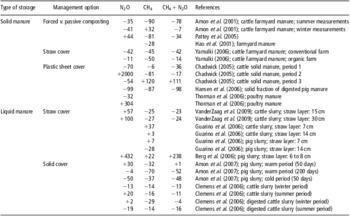
Composting is a process where microorganisms transform degradable organic matter into CO2 and water under (predominantly) aerobic conditions. Manure can either be left undisturbed during the composting process (passive composting), mechanically turned (extensive composting) or actively aerated (intensive composting). Aeration may reduce CH4 emissions (Table 3), but increase N2O and NH3 emissions (Pattey et al., Reference Pattey, Trzcinski and Desjardins2005; Webb et al., Reference Webb, Sommer, Kupper, Groenestein, Hutchings, Eurich-Menden, Rodhe, Misselbrook and Amon2012). Combined CH4 and N2O emissions are generally lower after forced aeration and turning compared with passive composting (Table 3).
Effects of different management options on CH4, N2O and combined CH4 + N2O emissions from storage

‘+’ represents higher emissions (%) and ‘–’ lower emissions (%) compared with the reference (untreated) manure. The comparison of systems is based on CO2 equivalents.
Solid manure – cover during storage
Covering solid manure with straw or a plastic sheet reduces in general both N2O and CH4 emissions, and therefore total GHG emissions, compared with the situation without cover (Table 3). However, Chadwick (Reference Chadwick2005) showed both a reduction (up to 36%) and an increase (by 11%) of total GHG emissions when covering compacted cattle solid manure with a plastic sheet. Thorman et al. (Reference Thorman, Chadwick, Boyles, Matthews, Sagoo and Harrison2006) reported both a reduction and an increase in N2O emissions after covering poultry solid manure with a plastic sheet. NH3 emissions may also be reduced by covering the heap (Chadwick, Reference Chadwick2005; Webb et al., Reference Webb, Sommer, Kupper, Groenestein, Hutchings, Eurich-Menden, Rodhe, Misselbrook and Amon2012).
Liquid manure – cover during storage
Covers on liquid manure stores are mainly adopted to reduce NH3 emissions. N2O emissions from liquid manure are negligible during storage, unless a surface crust is present (e.g., VanderZaag et al., Reference VanderZaag, Gordon, Jamieson, Burton and Stratton2009). With a crust, potentials for nitrification and denitrification can develop and lead to N2O emissions, as the crust dries and oxygen enters the crust (Sommer et al., Reference Sommer, Petersen and Søegaard2000; Petersen et al., Reference Petersen, Dorno, Lindholst, Feilberg and Eriksen2013). As explained above, surface crusts also develop a potential for CH4 oxidation, although the importance of this process is not known at present. However, significant stimulation may be feasible as the half saturation constant for this process is three to four orders of magnitude above atmospheric concentrations (Petersen and Ambus, Reference Petersen and Ambus2006; Duan et al., Reference Duan, Elsgaard and Petersen2013). Reported values (Table 3) show that covering slurry with either a solid cover, straw or a natural surface crust results in lower CH4 emissions, higher N2O emissions and, in general, a reduction of overall GHG emissions, when compared with uncovered slurry. Emissions of CH4 and N2O were higher when using straw instead of a solid cover (Amon et al., Reference Amon, Kryvoruchko, Amon and Zechmeister-Boltenstern2006), but in a related study a straw crust in combination with a solid cover on the store gave the lowest emissions (Clemens et al., Reference Clemens, Trimborn, Weiland and Amon2006), possibly by increasing CH4 availability to MOB as discussed by Petersen et al. (Reference Petersen, Dorno, Lindholst, Feilberg and Eriksen2013).
Treatment technologies – manure separation
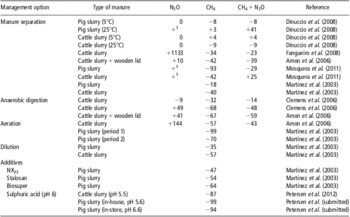
Manure separation is a process whereby a fraction of slurry particles is isolated by one of several mechanical separation processes (Burton, Reference Burton2007). Storage of the liquid fraction may result in lower N2O emissions than untreated slurry (and higher potential NH3 emissions) if crust formation is prevented. However, N2O emissions from the solid fraction during storage can be high (Fangueiro et al., Reference Fangueiro, Coutinho, Chadwick, Moreira and Trindade2008), and thus overall N2O emissions during storage may increase significantly after separation without additional measures (Table 4). Separate storage of the liquid and solid fractions after manure separation have in most cases, but not always, resulted in lower CH4 emissions (Table 4). Similarly, combined CH4 and N2O emissions from storage of both separation products have usually, but not always, been lower than from untreated manure (cf. Dinuccio et al., Reference Dinuccio, Berg and Balsari2008; Mosquera et al., Reference Mosquera, Schils, Groenestein, Hoeksma, Velthof and Hummelink2011). This indicates that slurry separation requires additional measures to achieve GHG mitigation during subsequent storage. The efficiency of covering for both solid and liquid fractions was discussed above, but anaerobic digestion of the solid fraction is also an option (Sutaryo et al., Reference Sutaryo, Ward and Møller2012).
Effects of different management options on CH4, N2O and combined CH4 + N2O emissions from manure treatment

‘+’ represents higher emissions (%) and ‘–’ lower emissions (%) compared with the reference (untreated) manure. The comparison of systems is based on CO2 equivalents.
1N2O emissions from untreated slurry were not measurable.
Treatment technologies – anaerobic (co-)digestion
Anaerobic (co-)digestion is a treatment technology specifically designed to optimise methanogenesis from manure and other residues. During the process, easily degradable organic matter in manure and other organic substrates is transformed into biogas (mainly CO2 and CH4). Besides energy substituting fossil fuel, this treatment reduces the potential for CH4 emissions during subsequent storage, but an enriched methanogenic microflora in digested slurry will continue to produce CH4 at high rates during the cooling phase (Sommer et al., Reference Sommer, Petersen and Søegaard2000). It is important that CH4 is collected during this phase, or a significant part of potential GHG mitigation may be lost. Available data (e.g., Table 4) show a reduction in CH4, and in combined CH4 and N2O emissions from storage of digested manure compared with untreated cattle slurry. Anaerobic digestion will reduce the amount of C recycled to soil, but a new study has found that the long-term stabilisation of manure C in the soil is the same at 12% to 14% irrespective of pre-treatment (Thomsen et al., Reference Thomsen, Olesen, Møller, Sørensen and Christensen2012).
Treatment technologies – aeration
Amon et al. (Reference Amon, Kryvoruchko, Amon and Zechmeister-Boltenstern2006) reported a reduction in CH4 emission (by 57%), an increase in N2O emission (by 144%) and a decrease in total GHG emissions (by 43%) with aeration of cattle slurry. Martinez et al. (Reference Martinez, Guiziou, Peu and Gueutier2003) reported reductions in CH4 emissions of 70% to 99% after aeration of pig slurry. The overall potential for loss of N as NH3 or denitrification products will be high, and N2O emissions as high as 19% of total N in pig slurry have been reported (see Chadwick et al., Reference Chadwick, Sommer, Thorman, Fangueiro, Cardenas, Amon and Misselbrook2011, for references). Hence, measures to conserve N during aeration may be needed to ensure GHG mitigation via this treatment.
Treatment technologies – additives
Chemical additives have been evaluated that change the chemical environment of slurry and thereby prevent unwanted transformations. Martinez et al. (Reference Martinez, Guiziou, Peu and Gueutier2003) reported reductions in CH4 emission of 47% to 64% by different chemical additives in pig slurry. In Denmark, slurry acidification to a pH around 6 by sulphuric acid is increasingly used as an NH3 mitigation strategy. In 2012, around 10% of the total slurry volume was acidified by one of several technologies, which adjust slurry pH either in slurry channels, in the store before spreading, or during spreading. Interestingly, acidification by sulphuric acid has also been found to reduce CH4 emissions from cattle slurry by 67% to 87% (Petersen et al., Reference Petersen, Andersen and Eriksen2012), and from pig slurry by 94% to 99%, (S. O. Petersen; unpublished results) during 3-month storage periods. Mechanisms of inhibition likely involve sulphur transformations, as significant CH4 mitigation is also achieved with sulphate or reduced S amendment alone (Petersen et al., Reference Petersen, Andersen and Eriksen2012), and with even a moderate reduction of pH by sulphuric acid (Table 4). Mitigation of CH4 emissions is of course achieved only if slurry is acidified before storage.
Land spreading – application method, rate and timing
Emissions of CH4 after land spreading of manures are insignificant (Collins et al., Reference Collins, Alva, Streubel, Fransen, Frear, Chen, Kruger and Granatstein2011) relative to the large losses from manure storage and enteric fermentation. Measures to reduce N2O emissions after land spreading include choice of application method, optimising rate and timing of application to match crop requirements. Emissions of NH3 can be minimised by proper selection of application method, but different studies (e.g., Vallejo et al., 2005; Velthof et al., Reference Velthof, Mosquera, Huis in't Veld and Hummelink2010) have shown that this may instead stimulate direct N2O emissions. A stimulation of N2O is not always observed, possibly owing to a complex interaction with soil type and soil moisture (Thomsen et al., Reference Thomsen, Pedersen, Nyord and Petersen2010). According to the Tier 1 approach of the IPCC guidelines (IPCC, 2006), direct N2O emissions after land spreading are independent of crop and soil type, and of the type of manure applied, but this is clearly not the case (Van Groenigen et al., Reference Van Groenigen, Kasper, Velthof, van den Pol-van Dasselaar and Kuikman2004; Mosquera et al., Reference Mosquera, Hol, Rappoldt and Dolfing2007; Velthof et al., Reference Velthof, Mosquera, Huis in't Veld and Hummelink2010). When both direct and indirect (because of NH3 emissions and NO3− leaching) N2O emissions are considered, the choice of manure application technique appears to have little impact on overall N2O emissions (Velthof et al., Reference Velthof, Mosquera, Huis in't Veld and Hummelink2010). On the other hand, a reduction of N losses will potentially increase crop yields and thereby reduce emissions per unit product. Apparently, N2O emissions increase curvi-linearly when N application rates exceed crop N requirements (Van Groenigen et al., Reference Van Groenigen, Kasper, Velthof, van den Pol-van Dasselaar and Kuikman2004; Cardenas et al., Reference Cardenas, Thorman, Ashlee, Butler, Chadwick, Chambers, Cuttle, Donovan, Kingston, Lane and Scholefield2010). Similarly, proper timing of application has been shown to influence both direct and indirect N2O emissions after land spreading of manures (Weslien et al., Reference Weslien, Klemedtsson, Svensson, Galle, Kasimir-Klemedtsson and Gustafsson1998; Chambers et al., Reference Chambers, Smith and Pain2000; Thorman et al., Reference Thorman, Chadwick, Harrison, Boyles and Matthews2007). These various observations suggest that, by optimising application method, rate and timing of manure application relative to the need of growing crops, N2O emissions from land spreading may be kept to a minimum.
Use of nitrification inhibitors (NI)
Synthetic NI have been developed to promote plant N uptake by reducing losses via NO3− leaching or denitrification. Effects of NI on crop yields are mostly moderate or absent, although better in situations with a high potential for loss of plant-available N (Nelson and Huber, Reference Nelson and Huber1992; Subbarao et al., Reference Subbarao, Ito, Sahrawat, Berry, Nakahara, Ishikawa, Watanabe, Suenaga, Rondon and Rao2006). In recent years, research has refocussed to mainly consider effects of NI on both direct and indirect (via NO3− leaching) N2O emissions from N amendments to soil (e.g., Di and Cameron, Reference Di and Cameron2012). In the main, NI appear successful at reducing N2O emissions from urine (Zaman and Nguyen, Reference Zaman and Nguyen2012), fertilisers (Ding et al., Reference Ding, Yu and Cai2011) and livestock slurries (Dittert et al., Reference Dittert, Bol, King, Chadwick and Hatch2001; Vallejo et al., Reference Vallejo, Skiba, García-Torres, Arce, López-Fernández and Sánchez-Martín2006) in a range of climates and soil types throughout the world, although their efficacy varies between studies (Akiyama et al., Reference Akiyama, Yan and Yagi2010). It is not entirely clear what controls this inconsistency. The fact that laboratory studies (e.g., Hatch et al., Reference Hatch, Trinidade, Cardenas, Carneiro, Hawkins, Scholefield and Chadwick2005) tend to report greater inhibition of N2O than field studies (Dittert et al., Reference Dittert, Bol, King, Chadwick and Hatch2001) suggests that soil conditions, such as variations in temperature or leaching/runoff after excessive rainfall, reduces the effect of NI. The most well-documented compounds, that is, nitrapyrin (N-serve), dicyandiamide (DCD) and 3,4-dimethylpyrazol phosphate (DMPP), have very different properties with respect to volatility and water solubility (Subbarao et al., Reference Subbarao, Ito, Sahrawat, Berry, Nakahara, Ishikawa, Watanabe, Suenaga, Rondon and Rao2006). Soil temperature is important for the effect of NI, and the efficiency declines linearly above 10°C owing to the combined effect of higher nitrification rates and more rapid NI degradation (Subbarao et al., Reference Subbarao, Ito, Sahrawat, Berry, Nakahara, Ishikawa, Watanabe, Suenaga, Rondon and Rao2006). Zaman and Nguyen (Reference Zaman and Nguyen2012) measured greater efficacy of DCD to reduce N2O emissions following urine deposition in autumn than in spring, which they attributed to the cooler autumn temperatures. Ongoing research should elucidate the controlling factors, but the additional challenge will be in developing cost-effective strategies for the use of NI, either via N-containing amendment themselves or directly to the soil.
On-farm interactions
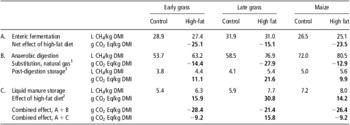
GHG mitigation measures may influence several gases and may influence emissions at other stages of manure management. Negative interactions occur when efforts to mitigate an emission lead to higher emissions of other pollutants, or of the same pollutant at a different stage; this is referred to as pollution swapping (Monteny et al., Reference Monteny, Bannink and Chadwick2006). The trade-off between NH3 and N2O in connection with land spreading was already mentioned. However, interactions may also be positive. In a recent study, Reference Brask, Lund, Hellwing, Poulsen and WeisbjergBrask et al. (submitted) fed dairy cattle one of three basic diets, with or without a supplement of rapeseed to increase the fat intake. Across a lactation period, they observed a reduction in enteric CH4 emissions with all three diets (Table 5), but there was also an increase in the CH4 production potential (β0) of faeces from cattle on the high-fat diets. The calculations in Table 5 suggest that combining a high-fat diet for cattle with anaerobic digestion of the manure (A + B) could maximise GHG mitigation, representing a positive interaction. On the other hand, the example also implies that, in the absence of biogas treatment, high-fat diets for cattle could lead to higher CH4 emissions from the manure during storage (A + C), resulting in a partial or complete loss of any mitigation achieved for CH4 from enteric fermentation. According to Møller et al. (Reference Møller, Sarker, Hellwin and Weisbjerg2012), this negative interaction will be compounded in warmer climates where the CH4 conversion factor for liquid manure storage is much higher than the 10% used in the example of Table 5 (IPCC, 2006).
On the basis of experimental data and literature data, GHG balances for three basic diets, with and without a supplementary source of fat were calculated

Effects of feeding, anaerobic digestion and storage on CH4 emissions and energy substitution are expressed as CO2 equivalents (bold). Negative numbers indicate a reduction in emissions. Source of experimental data: Brask et al. (submitted).
1Substitution of natural gas, assuming 39.7 MJ/kg CH4, 57 g CO2/MJ natural gas and 80% conversion efficiency.
2A 30% reduction compared with untreated dairy slurry is assumed (Nielsen et al., Reference Nielsen, Lyck, Mikkelsen, Hoffmann, Gyldenkærne, Winther, Nielsen, Fauser, Thomsen, Plejdrup, Albrektsen, Hjelgaard, Johannsen, Vesterdal, Rasmussen, Arfaoui and Baunbæk2010).
3Estimated assuming a methane conversion factor, of 10% (Nielsen et al., Reference Nielsen, Lyck, Mikkelsen, Hoffmann, Gyldenkærne, Winther, Nielsen, Fauser, Thomsen, Plejdrup, Albrektsen, Hjelgaard, Johannsen, Vesterdal, Rasmussen, Arfaoui and Baunbæk2010).
GHG mitigation at the farm level
It is clear from the previous sections that effects of GHG mitigation measures must be evaluated at the farm level to account for effects on C and/or N flows and associated GHG emissions in other farm components (e.g., Schils et al., Reference Schils, Olesen, del Prado and Soussana2007). Several examples of on-farm interactions were already presented above. Whole-farm modelling can reduce the need for costly experimental verification and may capture potential trade-offs in emissions, also relative to land use management and local conditions (climate and soil), and thus help predict overall environmental impact.
Model complexity – pros and cons
Farm models simulate flows and losses of N and C (including GHG emissions) associated with manure management using either emission factors, empirical equations, or process-oriented mechanisms, with principles and complexity depending on their origin and scope. In order to describe the various on-farm interactions, models need a mass balance approach where nutrient, water and matter is calculated at each step as the difference between inputs and outputs, and where processes at one stage depend on what happened at previous stages.
Farm models based on empirical or semi-empirical principles have their individual strengths and limitations. For example, MELODIE (Chardon et al., Reference Chardon, Rigolot, Baratte, Espagnol, Raison, Martin-Clouaire, Rellier, Le Gall, Dourmad, Piquemal, Leterme, Paillat, Delaby, Garcia, Peyraud, Poupa, Morvan and Faverdin2012) translates general farm objectives and constraints into an activity plan for the year without detailed user-input data, and the model has been successfully used to simulate GHG emissions from manure handling activities in pig production systems (Rigolot et al., Reference Rigolot, Espagnol, Pomar and Dourmad2010a and Reference Rigolot, Espagnol, Robin, Hassouna, Béline, Paillat and Dourmad2010b). Other farm models include a comprehensive calculation of GHG emissions at the manure management level (including biogenic C emissions), for example, DAIRYGHG (Rotz et al., Reference Rotz, Montes and Chianese2010) and FARMGHG (Olesen et al., Reference Olesen, Schelde, Weiske, Weisbjerg, Asman and Djurhuus2006), or they are developed to assess trade-offs with other ecosystem services, for example, SIMSDAIRY (Del Prado et al., Reference Del Prado, Misselbrook, Chadwick, Hopkins, Dewhurst, Davison, Butler, Schröder and Scholefield2011), or economic performance, for example, DAIRYWISE (Schils et al., Reference Schils, Verhagen, Aarts, Kuikman and Šebek2006). To the best of our knowledge, there is no single farm model that represents all stages of manure management with a full and detailed process-based approach. MANURE-DNDC (Li et al., Reference Li, Salas, Zhang, Krauter, Rotz and Mitloehner2012) is a new, mostly mechanistic approach based on the DNDC biogeochemical model for soils (Li et al., Reference Li, Frolking and Frolking1992) that was recently developed to simulate GHG emissions in the soil–plant-manure system.
While fully mechanistic approaches offer greater robustness in capturing effects and interactions, and flexibility in comparing systems, they are also sometimes difficult to parameterise, and data requirements may limit their use. On the other hand, models that are over-simplified may be imprecise if not accounting for, for example, management practices and climatic conditions. Hence, there is a need for balanced system-based models that can effectively account for farmer practices and local climate while complexity and parameterisation is still manageable. In general terms, whole-farm models should be evaluated for their ability to simulate temporal, spatial and genetic variability, coupling of water, nutrients and energy flows and transformations, farmer decision making and economics, indirect emissions, and uncertainty of results. For manure management, it is important that the nutrient feedback loops are simulated; manure N applied to soil influences the productivity where feed is grown, and is itself an output from the animal feed intake. Del Prado et al. (Reference Del Prado, Crosson, Olesen and Rotz2013) discuss in more detail the requirements of whole-farm models for simulating GHG mitigation in ruminant systems.
Effects of climate
Within and between regions, there are large gradients in climatic conditions, and farm models have different output sensitivity to factors such as temperature and precipitation. To the best of our knowledge, models involved in GHG mitigation all ignore the direct effect of climate (e.g., heat stress) on animal performance and metabolism. Following excretion, models may consider volume and simulate the dilution caused by rainfall (e.g., MELODIE). Modelled C and N transformations in manure, and derived losses, are generally related to temperature using empirical equations, for example, CH4 from manure storage may be based on an Arrhenius equation (FARMGHG), or use a more process-based approach where chemical thermodynamics and kinetics are controlled by a group of environmental factors including temperature, moisture and redox potential (MANURE-DNDC).
Model applications
Validation of whole-farm models is difficult, and generally partial validations are performed for individual farm components. Alternatively, models may be evaluated for specific scenarios to assess their usefulness. Several studies have looked at GHG mitigation measures affecting emissions from manure management. Li et al. (Reference Li, Salas, Zhang, Krauter, Rotz and Mitloehner2012), using MANURE-DNDC, predicted a 17% decrease in N excretion, and a 13% decrease in total GHG emissions, after reducing the CP content of a dairy cow diet from 18% to 15%. This model does not predict a change in the urine N-to-dung N ratio; however, according to, for example, Panetta et al. (Reference Panetta, Powers, Xin, Kerr and Stalder2006), an increase in animal N retention will reduce mainly urine N excretion and therefore total ammoniacal N flows. This in turn may be predicted to reduce overall GHG emissions per unit of product, mainly because of an increase in animal N use efficiency and reductions in N2O and NH3 emissions at the different stages of manure management. Hence, the GHG mitigation potential of reducing CP in the diet could be even higher than predicted by MANURE-DNDC. If CP reduction is achieved by replacing grass for maize (or another arable crop), there is, however, concern that soil carbon may be lost as CO2 owing to ploughing of existing grassland (Vellinga and Hoving, Reference Vellinga and Hoving2011). Some authors have proposed the use of mechanistic models of rumen function (Dijkstra et al., Reference Dijkstra, Oenema and Bannink2011), but generally they are too complex for integration in a farm scale model (Del Prado et al., Reference Del Prado, Crosson, Olesen and Rotz2013).
Whole-farm model simulations have shown that mitigation measures that do not involve changes in manure management practices may still have implications for manure-derived GHG emissions. For example, Schils et al. (Reference Schils, Olesen, del Prado and Soussana2007), evaluating several models, predicted that a reduction in the length of the grazing period would give a modest decrease in GHG emissions because of a decrease in N2O emissions from N deposited during grazing, and because of a decrease in CH4 from enteric fermentation as a result of better feed quality, although there is also an increase in CH4 emissions from manure stores and a reduction in potential soil C storage. Del Prado et al. (Reference Del Prado, Crosson, Olesen and Rotz2013) compared three UK farms and concluded that, relative to confinement, half-year grazing had slightly lower, but extensive grazing considerably higher GHG emissions, both on area and product basis. It was further concluded that soil conditions and climate will greatly affect the potential for N2O emissions from N deposition during grazing, hampering the development of general recommendations for mitigation.
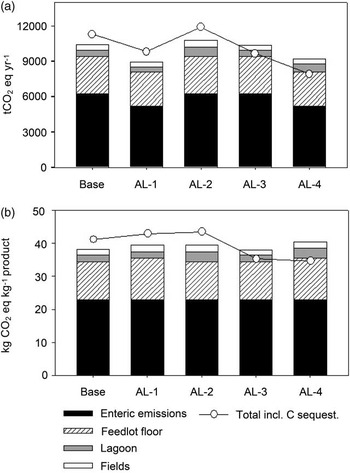
An important application of whole-farm models is for the evaluation of GHG mitigation strategies that include measures adopted simultaneously for manure management and other farm components. This may be useful for identifying potential synergies or incompatible measures. Li et al. (Reference Li, Salas, Zhang, Krauter, Rotz and Mitloehner2012) used the MANURE-DNDC model to simulate effects of three different measures, that is, reducing dietary CP (AL-1), covering the lagoon (AL-2), and replacing corn and soya with alfalfa (AL-3) and their combined effect (AL-4), see Figure 1. A reduction of GHG emissions (30% total, and 16% per unit of product) was estimated, although mainly because of an increase in soil C sequestration, and despite a decline in animal productivity and enhanced CH4 emissions from the lagoon when covered.
Contribution of different sources to annual GHG emissions from a dairy farm as determined with the whole-farm model Manure-DNDC. Emissions of CH4 and N2O were calculated for each source with a baseline and alternative management scenarios and expressed (a) as total emissions (t CO2 Eq/year), and (b) relative to the farm productivity in meat and milk (kg CO2 Eq/kg product). The alternative management scenarios were: Reduced dietary crude protein (AL-1), covering of lagoon (AL-2), replacing corn/soya with alfalfa (AL-3) and a combination of all these measures (AL-4). Adapted from Li et al. (Reference Li, Salas, Zhang, Krauter, Rotz and Mitloehner2012).

Whole-farm models need to account for effects of manure treatment. In the example of Table 5, a high-fat diet for cattle in combination with anaerobic digestion of the manure resulted in a positive interaction with respect to GHG mitigation, whereas storage without treatment of manure from cattle on a high-fat diet could outbalance or even reverse GHG mitigation achieved for enteric fermentation. There is evidently a need to verify such basic calculations experimentally via feeding-storage experiments, and to evaluate the importance of these effects at the farm level via modelling. Del Prado et al. (Reference Del Prado, Chadwick, Cardenas, Misselbrook, Scholefield and Merino2010) tested increased dietary fat intake as one of eight mitigation measures applied in different combinations for dairy systems using SIMSDAIRY. The inclusion of fat supplements in the diet reduced overall GHG emissions by 8% to 14%, and the adoption of additional measures to improve plant N use efficiency, such as the use of NI, enabled maximum GHG mitigation of about 45%. However, SIMSDAIRY did not account for changes in manure composition because of a high-fat diet, or for consequences of unsaturated fat supplementation on rumen function and DM intake. Some models simulate energy production by anaerobic digestion of manure, but not effects of this treatment on C and N transformations in the soil after field application (e.g., FARMGHG), or only account for the changed proportion of ammoniacal N in the digestate (SIMSDAIRY). Thus, besides more experimental evidence for effects of mitigation measures, there is also a need for further model development to simulate the multiple effects of GHG mitigation measures and strategies.
How to achieve GHG mitigation?
The previous sections have highlighted the diversity of manure environments and management practices encountered across regions. Considering also the complex regulation of microbial processes behind CH4 and N2O emissions, GHG mitigation for manure management is clearly a significant challenge. The economic and cultural context of livestock production varies greatly between regions, and this is also true for opportunities to improve manure management for GHG mitigation. While models suggest that part-time grazing could lead to reductions in GHG emissions compared with confinement under business-as-usual scenarios, the magnitude of on-farm emissions and emissions from excretal returns to pastures will depend on local conditions with respect to climate and soil type. In addition, land resources for agriculture are finite and under pressure from population growth and increasing demands for food and feed production; thus, in many cases, increasing access to grazing may not be an option. Instead, we believe that key to GHG mitigation is containment of nutrients by limiting leakage and atmospheric losses, as the closing of nutrient cycles also serves to prevent direct and indirect GHG emissions. Integrated crop and livestock production (mixed farming) has been suggested to improve nutrient use efficiency and reduce environmental impacts under both North American (Russelle et al., Reference Russelle, Entz and Franzluebbers2007), European (Ryschawy et al., Reference Ryschawy, Choisis, Choisis, Joannon and Gibon2012) and tropical conditions (Ogburn and White, Reference Ogburn and White2011). In this paper, via four selected cases, we have argued that in subsistence farming a main priority must be to improve nutrient use efficiency for increasing crop yields, for example via improved storage conditions and more targeted use of manure nutrients for crop production. Losses of C and N during traditional composting may be considerable, and options for anaerobic storage should be explored. Where farm effluents are to some extent ‘wasted’ by direct discharge into water courses, infrastructure is required to enable farmers to store livestock manures. Policy intervention via legislation, and by provision of subsidies, may be needed to ensure this. Containment is also an issue in large-scale intensive livestock production, where NH3 emissions in particular represent a threat to natural environments and human health (Sutton et al., Reference Sutton, Oenema, Erisman, Leip, van Grinsven and Winiwarter2011).
Also key to GHG mitigation is constraining inputs for food and feed production. The imbalance between nutrients in excretal returns from livestock and the land available for manure recycling can be a significant challenge, in developing countries, as well as in regions where livestock production is already highly intensified, as spreading of manure N in excess of crop requirements increases the potential for environmental losses, including emissions of NH3, N2O and other N compounds. For example, a reduction in average surplus N from 175 to 123 kg/ha was achieved by Danish agriculture between 1980 and 2004 by adoption of fertiliser plans that take the availability of N in manure into account, together with measures to reduce environmental losses during storage and field application (Kyllingsbæk and Hansen, Reference Kyllingsbæk and Hansen2007).
Projected changes in livestock numbers by 2050 were recently published in a study by Bouwman et al. (Reference Bouwman, Goldewijk, Van Der Hoek, Beusen, Van Vuuren, Willems, Rufino and Stehfest2012), see Figure 2. They include dramatic increases in South and Central America (cattle), Africa (cattle, sheep/goats) and South Asia (cattle, pigs, sheep/goats). Around 75% of the increase in livestock production is foreseen to occur by intensification (IAASTD, 2009). As described in previous sections, intensification is characterised by a higher degree of animal confinement, and a shift towards liquid manure management with more opportunities for containment of nutrients, manure treatment and nutrient recycling. From an economic perspective, intensive livestock production is also characterised by a greater cash flow, and hence better opportunities to fund investments in facilities and treatment technologies for improved manure management. These all suggest that the greatest GHG mitigation potentials, also in many developing countries, will be associated with new or expanding CAFOs, and regulations may be easier to enforce in these livestock production systems.
Global animal stocks for 1900, 1950, 2000 and 2050 for cattle (a), pigs (b), and sheep and goats (c). Adapted from Bouwman et al. (Reference Bouwman, Goldewijk, Van Der Hoek, Beusen, Van Vuuren, Willems, Rufino and Stehfest2012).

GHG emission inventories are to a large extent based on annual emission factors, which do not capture effects of all management options discussed above. Another major difficulty is the large variability in manure characteristics behind average emission factors, which makes the effect of GHG mitigation efforts highly uncertain. Therefore, modelling is required for more precise estimates of GHG emissions and mitigation potentials. It is important to identify models with sufficient responsiveness towards factors controlling the microbial processes leading to CH4 and N2O emissions, notably temperature and oxygen status, but at the same time with a (limited) data requirement that will allow wide adoption. Evidently, microbial activities in manure during storage will be affected by local climatic conditions, and currently the documentation of GHG emissions is strongly biased towards temperate climatic conditions, as reflected in the reference list to this paper. Future research should fill the gap of documenting GHG emissions from livestock manure as influenced by management in warmer climates, and efforts should continue to develop models that can support the evaluation of GHG mitigation strategies across climate zones.
Acknowledgements
Contributions of S. O. Petersen, M. Blanchard and N. Edouard were supported by the AnimalChange project funded by the European Community (FP7/2007–2013) under the grant agreement no. 266018. The contributions of S. O. Petersen and S. G. Sommer were supported by the Danish Strategic Research Council project no. 12-132631 (BioChain). A. del Prado would like to thank the Spanish National R + D+i Plan (grant no. CGL2009-10176) and Basque Department of Education, Universities and Research (grant no. PC2010-33A) for funding part of this study.
This paper was published as part of a supplement to animal, publication of which was supported by the Greenhouse Gases & Animal Agriculture Conference 2013. The papers included in this supplement were invited by the Guest Editors and have undergone the standard journal formal review process. They may be cited. The Guest Editors appointed to this supplement are R. J. Dewhurst, D. R. Chadwick, E. Charmley, N. M. Holden, D. A. Kenny, G. Lanigan, D. Moran, C. J. Newbold, P. O'Kiely, and T. Yan. The Guest Editors declare no conflict of interest.