Nowadays, Information and Communication Technologies (ICT) are becoming ever more strongly established in our society, especially among the adolescent population. According to the Spanish National Institute of Statistics, in 2011, 83.1% of boys and girls aged between 16 and 24 had used the Internet on a daily basis for at least 5 days a week over the previous 3 months (Instituto Nacional de Estadística [INE], 2011). In 2014, this percentage increased to 98.3% (INE, 2014). This growth in Internet use has developed hand in hand with its abuse by youngsters. Therefore, current studies are focusing on this emerging problematic behavior.
Recent research has shown that it is not possible to speak of “Internet addiction” in the same terms as other addictive disorders (Carbonell, Fúster, Chamarro, & Oberst, Reference Carbonell, Fúster, Chamarro and Oberst2012). In fact, this behavioral problem has been excluded from the latest edition of the Diagnostic and Statistical Manual of Mental Disorders (DSM; APA, 2013). Instead, scientific literature has often labeled this problematic behavior as “Internet abuse”, which has been defined in similar terms as the substance abuse disorder and pathological gambling DSM-IV criteria. Specifically, Internet abuse has been understood in terms of the negative effect of its use, including symptoms such as tolerance increase, negative effects, activities reduction, loss of control, avoidance and desire to be connected (Beranuy, Chamarro, Graner, & Carbonell, Reference Beranuy, Chamarro, Graner and Carbonell2009). Using this definition, international studies on the prevalence of Internet abuse have shown percentages ranging between 1% and 17% (Poli & Agrimi, Reference Poli and Agrimi2012; Shaw & Black, Reference Shaw and Black2008; Wang et al., Reference Wang, Luo, Bai, Kong, Luo, Gao and Sun2013; Zboralski et al., Reference Zboralski, Orzechowska, Talarowska, Darmosz, Janiak, Janiak and Gałecki2009) and similar results have been found in the Spanish population (Carbonell et al., Reference Carbonell, Fúster, Chamarro and Oberst2012; López-Fernández, Freixa-Blanxart, & Honrubia-Serrano, Reference López-Fernández, Freixa-Blanxart and Honrubia-Serrano2013; Sánchez-Martínez & Otero Puime, Reference Sánchez-Martínez and Otero2010).
Adolescents are more likely to develop problematic Internet use (Castellana, Sánchez-Carbonell, Graner, & Beranuy, Reference Castellana, Sánchez-Carbonell, Graner and Beranuy2007). On the one hand, they use the Internet more than any other group, and feel more familiar with ICT (Sanchez-Carbonell, Beranuy, Castellana, Chamarro, & Oberst, Reference Sanchez-Carbonell, Beranuy, Castellana, Chamarro and Oberst2008). Furthermore, adolescents are especially vulnerable because important psychological and social changes take place at this age, such as self-concept clarity or their relationships with peers (Israelashvili, Kim, & Bukobza, Reference Israelashvili, Kim and Bukobza2012). These developmental processes may induce stress in adolescents, which can be overcome through the use of social networks. In this sense, these contexts may help adolescents to develop fictitious or idealized identities that fit their own expectations, giving them the opportunity to establish less threatening social interactions, thanks to the anonymity and the characteristics of the contacts, which are not face-to-face (Echeburúa & de Corral, Reference Echeburúa and de Corral2010; Herrera, Pacheco, Palomar, & Zavala, Reference Herrera, Pacheco, Palomar and Zavala2010). Furthermore, it must be taken into account that many problems related to the development of addictive behaviors emerge at the adolescent stage, and the earlier the onset of any addiction, the more aggravated the consequences and the higher the resistance to treatment (Hernández López et al., Reference Hernández, Roldán, Jiménez, Mora, Escarpa and Pérez2009).
Several studies have tried to identify the factors that influence the onset and maintenance of this problematic behavior. On the one hand, it has been found that different personality characteristics or emotional states, such as impulsivity, dysphoria, intolerance to unpleasant stimuli or sensation-seeking disposition, may increase vulnerability to the development of Internet abuse (Korkeila, Reference Korkeila2012). Other intrapersonal risk factors such as excessive shyness, low self-esteem, inadequate coping style for everyday situations or the presence of previous psychiatric problems (e.g. depression, ADHD, social phobia, etc.) may also be related to Internet abuse (Estévez, Bayón, De la Cruz, & Fernández-Liria, Reference Estévez, Bayón, De la Cruz, Fernández-Liria, Echeburúa, Labrador and Becoña2009; Shaw & Black, Reference Shaw and Black2008). On the other hand, interpersonal factors such as inadequate management of free time, lack of goals or poor school performance have been associated with this pathological behavior (Tsitsika et al., Reference Tsitsika, Critselis, Louizou, Janikian, Freskou, Marangou and Kafetzis2011).
More specifically, different studies have shown the relationship between Internet abuse and poorer social skills, such as assertion, peer relationships, public speaking and family relationships (Herrera et al., Reference Herrera, Pacheco, Palomar and Zavala2010; Jimenez & Pantoja, Reference Jiménez and Pantoja2007). In particular, Internet use may be increased by a family structure that is dysfunctional or with weak cohesion, poor social relationships or intense peer-group pressure (Echeburúa & de Corral, Reference Echeburúa and de Corral2010; Estévez et al., Reference Estévez, Bayón, De la Cruz, Fernández-Liria, Echeburúa, Labrador and Becoña2009; García del Castillo et al., Reference García, Terol, Nieto, Lledo, Sánchez, Martín-Aragón and Sitges2008; Tsitsika et al., Reference Tsitsika, Critselis, Louizou, Janikian, Freskou, Marangou and Kafetzis2011). In this regard, and given the importance of this type of interpersonal factors in the development of other addictive disorders (Becoña, Reference Becoña2002), it is important to find out how adolescents interact with their environment by assessing their social skills in both real and virtual contexts (Carballo, Pérez-Jover, Espada, Orgilés, & Piqueras, Reference Carballo, Pérez-Jover, Espada, Orgilés and Piqueras2012), topic on which there is a lack of sufficient research.
Furthermore, it is important to stress the significant relationship, revealed through research, between problematic Internet use and addictions to psychoactive substances (Korkeila, Reference Korkeila2012; Sánchez & Otero, Reference Sánchez-Martínez and Otero2010; Sanchez-Carbonell et al., Reference Sanchez-Carbonell, Beranuy, Castellana, Chamarro and Oberst2008; Tsouvelas & Giotakos, Reference Tsouvelas and Giotakos2011). American results have shown that adolescents who use social networks daily are three times more likely to consume alcohol than those who do not (CASA, 2011). Moreover, these results revealed that they have double the probability of using marijuana, as well as being five times more likely to be cigarette smokers. In different Spanish samples, statistically significant relationships between Internet and frequency of drug use were also found (Garrote, Reference Garrote2013; Secades-Villa et al., Reference Secades-Villa, Calafat, Fernández-Hermida, Juan, Duch, Skärstand and Talic2014).
In addition, studies have also shown a close relationship between Internet abuse and other “behavioral addictions”, such as addiction to sex or to other ICT (Griffiths, Reference Griffiths2012; Sanchez-Carbonell et al., Reference Sanchez-Carbonell, Beranuy, Castellana, Chamarro and Oberst2008). This research suggests that having an addictive personality can transfer over into the world of online communication, and that, as with any other addictive behavior, its consequences need to be studied. The aim of this paper, therefore, is to analyze the relationship between personal and interpersonal risk factors and Internet abuse among Spanish adolescents. Furthermore, the relationship between adolescents’ social skills in real and virtual contexts and Internet abuse is analyzed, as well as the relationship between this problematic behavior and drug use.
Method
Participants
At the time of sampling, a total of 31,280 adolescents were attending 40 high schools in the district of Elche and Alicante (Spain). The minimum sample sized required for this study was 544 participants (10% expected percentage of internet abuse in Spanish students, 95% confidence interval, ±2.5 margin of error). Initially, there were 853 participants, and only 814 completed the questionnaires (43.6% girls), with an age range from 13 to 17 (M = 14.83 SD ± 0.88).
Six public high schools in the province of Alicante, randomly selected, took part in the study. After receiving authorization from the schools’ head teachers, 47 classes of third and fourth grade were randomly selected.
Measures
Internet use
An ad-hoc 3-item questionnaire was used to assess frequency of Internet use during one week and the number of daily connections, as well as the type of use (work, downloads, online games, etc.) Perception of friends’ Internet use was also assessed.
Internet abuse
It was assessed through the Experiences Related to Internet Use Questionnaire (CERI, Beranuy et al., Reference Beranuy, Chamarro, Graner and Carbonell2009), which is a self-administered short questionnaire with 10 items in a 4 point Likert-type scale, based on the criteria established for substance abuse and pathological gambling. Therefore, questionnaire scores ranged from 0 to 40. Scores over 33 indicate Internet abuse, in line with the criteria of the original versions. The questionnaire has met the criteria for reliability (α = 0.77; Beranuy et al., Reference Beranuy, Chamarro, Graner and Carbonell2009). The alpha was 0.79 in the present study.
Substance use
Was assessed through a questionnaire based on the ESTUDES survey of the Spanish National Plan on Drugs (Plan Nacional Sobre Drogas, 2008). This variable assessed whether adolescents had used alcohol, tobacco or cannabis at any time in their life. Moreover, adolescents were asked to describe their weekend alcohol use over the past month, which was evaluated in terms of standard drink units, in order to assess their level of binge drinking (> 60 g. for men, and > 40 g. for women, in any single time, at least once per month; National Institute on Alcohol Abuse and Alcoholism, 2004).
Social skills in real and virtual contexts
Were assessed through the Multidimensional Scale of Social Expression-C (EMES-C; Caballo & Ortega, Reference Caballo and Ortega1989). This questionnaire gathers information on thoughts teenagers may have when interacting with their friends. In this case, participants were asked to respond with regard to both virtual and real contexts. The instrument consists of 40 items, assessed through a Likert-type scale with 5 options (0 = always, 4 = never). On this questionnaire, lower scores indicate greater fear and poorer, less adaptive social skills. The instrument has good psychometric characteristics, with a Cronbach’s alpha of 0.92. The alpha was 0.94 in the present study. Moreover, it shows good concurrent validity with other questionnaires that assess similar psychological variables, expressed in significant correlations above 0.40 (Caballo & Ortega, Reference Caballo and Ortega1989). In addition, similar psychometric properties were found when using this instrument in a virtual context (Carballo et al., Reference Carballo, Pérez-Jover, Espada, Orgilés and Piqueras2012).
Interpersonal risk factors
Were evaluated by means of the “Family Risk” and “Group of friends or peers” subscales of the “Interpersonal Risk Factors for Drug Use in Adolescents” questionnaire (FRIDA; Secades, Carballo, Fernández, García, & García, Reference Secades, Carballo, Fernández, García and García2006). The “Family Risk” factor refers to various aspects including family relationships, drug use of the adolescent’s family and perception of family conflict. High scores indicate the presence of family drug users, low level of affective family relationships, and high family conflict. The “Group of friends” factor measures the perceived attitude of the adolescent’s friends towards drugs and the Internet, their level of drug use and the kind of activities the adolescent can do with his/her friends. High scores on this factor indicate that the adolescent’s friends are drug users and have positive attitudes toward drugs, and that the adolescent usually carries out risky activities, such as going to places where drugs are used. These subscales showed acceptable scale consistency, with Cronbach’s alphas of .64 and .86, respectively (Carballo et al., Reference Carballo, García, Secades, Fernández, García, Errasti and Alhalabí2004). The alphas were .67 and .77 in the present study.
Procedure
Paper questionnaires were administered collectively during school time by trained personnel. After being given a brief summary of the research objectives, the students responded to the instruments following the instructions provided. Participation was voluntary, anonymous and confidential, and parental consent was obtained. The study was approved by the Research Ethics Committee of the Universidad Miguel Hernández de Elche (Spain).
Statistical Analysis
The data were coded and analyzed by means of the IBM SPSS Statistics 20.0 program for Windows. Descriptive analyses were carried out with the aim of differentiating participants presenting Internet abuse (IA) from those who did not abuse Internet (NIA), as well as analyzing the characteristics of Internet use in terms of quantity and frequency of connection and type of use. Chi-square values were calculated for non-continuous variables, while t-tests for independent samples and dependent samples were used for continuous variables.
The effect sizes were calculated using the standard difference of means test for assessing the size of the differences, considering 0.20 as medium/low size, 0.50 as moderate size, and 0.80 as large size (Cohen, Reference Cohen1988). The Confidence level used in the application of the statistical tests was 95%.
Results
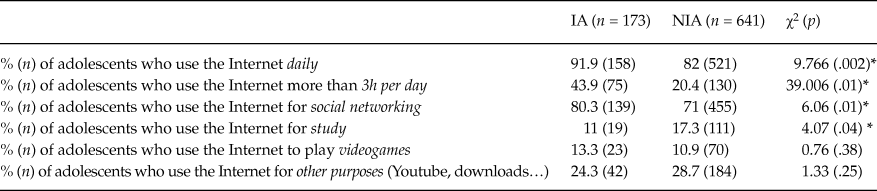
A total of 21.3% (n = 173) of the adolescents assessed obtained a score indicative of Internet abuse. As shown in Table 1, IA participants, in contrast to NIA group, showed statistically significant differences, in terms of frequency of Internet use and online hours per day. Specifically, 91.9% of IA participants claimed to use Internet daily, as opposed to 82% of the non-abusers (χ2 = 9.766; p < .05). Almost double the number of participants with problematic use stated that they used Internet for more than 3 hours per day, in contrast to those in the NIA (χ2 = 39.006; p < .05). Also, those in the IA made more use of social networks that NIA (χ2 = 6.06; p < .05), which usually used the web for academic purposes (χ2 = 4.07; p < .05).
Internet use variables reported by Internet Abusers (IA) and Non-Internet Abusers (NIA)

Note: * p < .05.
Regarding the use of psychoactive substances, As shown in Table 2 significant differences were found between IA and NIA. IA participants were more likely to report lifetime alcohol use (χ2 = 17.39; p < .05) and to be cigarette smokers (χ2 = 14.51; p < .05).
Substance use variables reported by Internet Abusers (IA) and Non-Internet Abusers (NIA)

Note: * p < .05.
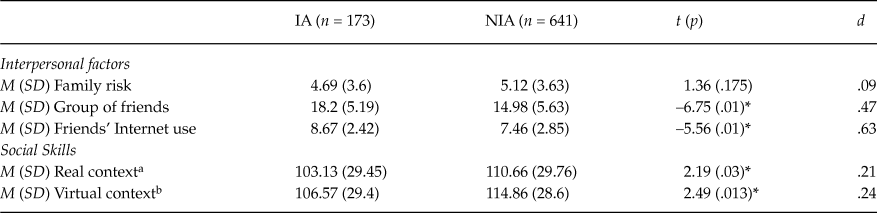
As shown in Table 3, statistically significant differences were obtained between the two groups with moderate-high effect size in the “group of friends” factor score (t = –6.75; p < .05; d =.47) and in Internet use by the adolescent’s friends (t = –5.56; p < .05; d = .63). IA were at greater risk in both cases.
Interpersonal Factors and Social Skills variables reported by Internet Abusers (IA) and Non-Internet Abusers (NIA)

Note: * p < .05.
a IA, n = 95; NIA, n = 355.
b IA, n = 96; NIA, n = 336.
Finally, on analyzing the participants’ social skills, in both real and virtual contexts, lower scores in social skills were found for IA in both contexts (Real context: t = 2.19; p < .05; d = .21; Virtual context: t = 2.49; p < .05; d = .24). Moreover, an intra-group comparison was performed, which revealed differences in social skills in both contexts, and high percentages of explained variance. These differences were greater in the virtual context for both groups. The NIA obtained a mean (SD) of 111.33 (29.39) for the real context, in contrast to the mean score of 115.34 (28.26) for the virtual context (t = –5.99; p < .05; d = .67). Whereas, the IA obtained a mean (SD) of 103.62 (29.96) for the real context, as opposed to the mean (SD) of 109.29 (28.26) for the virtual context (t = –4.44; p < .05; d = .94).
Discussion
The aim of this research was to analyze the relation between certain risk factors, both personal and interpersonal, and Internet abuse in Spanish adolescents. We found that 21.3% of the participants showed a problematic use of Internet. These figures are higher than those yielded by other studies with Spanish adolescents (Carbonell et al., Reference Carbonell, Fúster, Chamarro and Oberst2012). Probably, these prevalence differences could be related to the emerging easy access to the Internet (Gómez, Rial, Braña, & Varela, Reference Gómez Salgado, Rial, Braña and Varela2014).
Unlike previous international studies (Siomos et al., Reference Siomos, Floros, Fisoun, Evaggelia, Farkonas, Sergentani and Geroukalis2012), our results showed that the IA group presented a higher percentage of use of social networks than videogames – a finding that may be related to the increased use of social networks in Spain in recent years. However, Spanish studies have showed similar results: chat applications and Messenger, followed by social networking applications, were the most used tools among Internet problematic users (Carbonell et al., Reference Carbonell, Fúster, Chamarro and Oberst2012; Estevez et al., Reference Estévez, Bayón, De la Cruz, Fernández-Liria, Echeburúa, Labrador and Becoña2009).
The possibility, in this context, of adopting fictitious or idealized identities, and of interacting with people like oneself, at a time of life when this aspect takes on special relevance, may explain the high frequency of use of this tool among the young people in this survey (Israelashvili et al., Reference Israelashvili, Kim and Bukobza2012; Kandell, Reference Kandell1998). On this point, high prevalence on this study may suggest that the use of social networks may contribute to increasing the severity and presence of symptoms associated with Internet addiction (Kittinger, Correia, & Irons, Reference Kittinger, Correia and Irons2012). Moreover, in accordance with previous research, the NIA group focused more on using Internet for academic purposes or for information-seeking (Tsitsika et al., Reference Tsitsika, Critselis, Kormas, Filippopoulou, Tounissidou, Freskou and Kafetzis2009; Young, Reference Young1998).
As it is shown in previous studies, the IA group reported higher rates of lifetime use of alcohol and tobacco (CASA, 2011; Korkeila, Reference Korkeila2012; Sánchez & Otero, Reference Sánchez-Martínez and Otero2010; Secades-Villa et al., Reference Secades-Villa, Calafat, Fernández-Hermida, Juan, Duch, Skärstand and Talic2014; Tsouvelas & Giotakos, Reference Tsouvelas and Giotakos2011). The co-occurrence of excessive Internet use and drug use may be due to risk neurobehavioral and psychological factors (Secades-Villa et al., Reference Secades-Villa, Calafat, Fernández-Hermida, Juan, Duch, Skärstand and Talic2014). However, this study did not find a relationship between binge drinking and cannabis use, probably because participants were at the onset age of substance use.
Moreover, those in the IA group seemed to have a circle of friends with more favourable attitudes toward drug use and Internet use, as well as a greater tendency to become involved in risky behaviours. The great potential influence of the adolescent`s peer group on his or her behaviour and attitudes may increase the risk of developing these and other maladaptive behaviours (Echeburúa & de Corral, Reference Echeburúa and de Corral2010; Estévez et al., Reference Estévez, Bayón, De la Cruz, Fernández-Liria, Echeburúa, Labrador and Becoña2009; Tsitsika et al., Reference Tsitsika, Critselis, Louizou, Janikian, Freskou, Marangou and Kafetzis2011).
However, no differences were found between the scores of the two groups for the family risk factors. These data are at odds with those of previous studies that highlighted a dysfunctional family pattern in Internet abuse and addictions (Ni, Yan, Chen, & Liu, Reference Ni, Yan, Chen and Liu2009; Tsitsika et al., Reference Tsitsika, Critselis, Louizou, Janikian, Freskou, Marangou and Kafetzis2011). Future research should include a more exhaustive assessment with new instruments to determine the weight of this variable more clearly. This would help to influence the development of the problem.
Finally, on evaluating the adolescents’ social skills, in both real and virtual contexts, it was observed that those in the IA scored significantly lower than the NIA for both contexts. In this sense, it is important to highlight the fact that the deficit in social skills has been associated with a greater likelihood of the youngster starting maladaptive behaviors, such as drug use (López & Rodríguez-Arias, Reference López and Rodríguez-Arias2010).
Furthermore, on assessing performance in both contexts and for both groups by means of intra-group analysis, it was found that EMES-C mean scores for both IA and NIA were higher in the virtual context than in the real context. As mentioned previously, these results could be understood in the light of the Internet’s tendency to be perceived as a “safe” and “comfortable” communication channel for adolescents, in which there is a greater feeling of control over the personal information they present, reducing the possibility of negative appraisal by others (Lee & Stapinski, Reference Lee and Stapinski2012).
Nevertheless, and in spite of these results, there is a need of future studies which, with larger samples and longitudinal designs, would permit a more exhaustive analysis of the factors considered here. The sample selected could not be representative of the adolescent’s population, because it only included high school students, and it would be difficult to generalize these results to the non-student population. Furthermore, this study has the limitations associated to the self-report inventories (i.e. social desirability bias, embarrassment to reveal personal details, missing data, exaggerated answers). In these sense, it would be desirable to assess the validity of adolescent’s responses (e.g. using infrequency response scales).
In conclusion, despite measuring Internet abuse, rather than addiction, and in spite of its several limitations, results obtained in the present study may indicate risk factors that could be similar to those described for other addictions and risky behaviours with onset in adolescence. The identification and control of substance use, social skills and peer group factors could be useful to launch specific preventive programs for this problem, with a view to promoting the responsible use of virtual environments.