INTRODUCTION
Existential crises are common in palliative care, and it is well known that both patients (Benzein & Saveman, Reference Benzein and Saveman2008; Coyle, Reference Coyle2006; Henoch & Danielson, Reference Henoch and Danielson2009; Lee, Reference Lee2008) and next of kin (Beck et al., Reference Beck, Tornquist and Brostrom2012; Kristjanson et al., Reference Kristjanson, Sloan and Dudgeon1996; Milberg et al., Reference Milberg, Strang and Jakobsson2004; Syren et al., Reference Syren, Savemann and Benzein2006) have a need for support from the palliative care team during such a crisis. At the same time, it is well known that staff members are fully aware of these needs but often do not feel confident regarding how to offer such support (Browall et al., Reference Browall, Melin-Johansson and Strang2010; Strang et al., Reference Strang, Henoch and Danielson2014). Therefore, we felt it was important to design a feasible team-based training model that would lead to improved competence, which would be useful in clinical practice. A prerequisite was the development of a model that could be performed without excessive effort.
The point of departure for this study was the first author's doctoral dissertation (Sand, Reference Sand2008), which concerned existential crisis in palliative cancer care. It demonstrated the importance of paying attention to the existential dimension in palliative care, and it provided new knowledge about the coping strategies of dying cancer patients (Sand et al., Reference Sand, Olsson and Strang2009) and the important meaning-making process inherent therein. This knowledge was of great importance for the process of designing a training program that could enhance the confidence of staff members to provide support to patients and next of kin undergoing an existential crisis.
As a first step, preceding the design of the actual study, three series of seminars were conducted focusing on meaning and meaning-making. During the seminars, short theoretical lectures were intertwined with discussions based on clinical as well as personal experiences. The seminars were carried out with: (1) a group of nurses working in palliative care, (2) a group of assistant nurses working in dementia care, and (3) a small group of patients receiving palliative homecare. Even though these seminars were only briefly evaluated, it was clear that they were highly appreciated. On completion, the participants expressed a higher sense of professional and personal understanding of feelings and reactions related to existential questions. As a result, they felt more confident in relation to existential challenges in general. During this period, a training model gradually took shape. Based on these encouraging results, there was a growing need for evaluation of a formalized model.
AIM
The aim of the present study was to investigate whether this training model could provide palliative care staff increased knowledge, awareness, and preparedness—all useful tools for their clinical work. A secondary aim was to explore how their work might impact them both personally and with regard to how they take care of themselves.
METHODS
The Training Model
The model comprised three integrated key elements: (1) theoretical knowledge, (2) care-related reflection, and (3) self-reflection. The overall aims inherent in the model were to explore how we can understand ourselves and others and how we can support ourselves and others in existentially challenging situations. The importance of reflection as a way to facilitate an encounter between theory, clinical practice, and private reality became clear during the pilot seminars. Reflection was therefore highlighted more clearly in the model that was finally tested.
The importance of reflection in modern pedagogy is also highlighted by the Structure of Learning Outcomes (SOLO) taxonomy of understanding and learning (Biggs & Tang, Reference Biggs and Tang2011). In short, SOLO levels 1–3 are about quantitative learning (e.g., identifying, selecting, describing, and discussing data), whereas learning on SOLO levels 4 and 5 is qualitative and concerns the integration of data into structural patterns as well as reflection and generalization. In this way, the essence of what was learned can be abstracted beyond the subject area in which it was learned.
Permanent multi-professional groups with no more than nine participants met once a week for two-hour seminars on seven occasions. During the seminars, short theoretical lectures were alternated with discussions inspired by members' everyday clinical and private experiences, with the aim of applying the theories to reality. As a follow-up to every seminar, participants received a few written questions that were related to the day's topic, in order to promote reflection on their own time.
A seminar leader took responsibility for the theoretical lectures and for formulating the written questions. She also purposefully encouraged a supportive environment both intellectually and emotionally. This was done by emphasizing the importance of confidentiality, encouraging free expression of opinions and emotions, giving support and feedback, and encouraging participants to discuss with and give feedback to each other. In order to empower the participants and to provide opportunities for independent reflection, participants took personal responsibility for how they wanted to document the seminars (e.g., through their own notes).
An overview of the content of the seminars and examples of the written questions are provided in Appendix 1.
Sampling, Data Collection, and Analysis
Participants
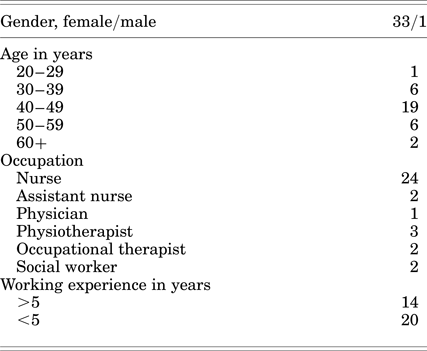
Staff members at four palliative care units in the Stockholm County Council area were informed about the intervention by their team leaders, who were instructed to choose interested participants in order to form a varied sample with respect to occupation, age, experience, and gender so as to obtain maximum-variation sampling (Patton, Reference Patton2002) (see Table 1). The information also included details about how the intervention was intended to be evaluated.
Sociodemographic data of participants

The Seminar Leader
The seminars were led by the first author of this article. She is a clinical social worker, has a Ph.D., and has worked in palliative care for more than 10 years.
Quantitative Data
Of the 35 participants, 34 completed the quantitative evaluation. It was performed directly before (baseline) and directly after the series in order to explore participants' perceptions about their knowledge acquisition. A study-specific questionnaire was constructed by the authors, and participants were asked to consider different statements regarding: (1) knowledge and understanding of existential issues, (2) preparedness to support in an existential crisis, and (3) self-awareness. A 9-point Likert-type scale was employed, ranging from “not true at all” to “totally true.” The questionnaire also allowed for open-ended comments that were analyzed as part of the qualitative data.
Differences in perceived competence between age groups (20–39, 40–49, and 50+ years) and between few and more years of experience in palliative care (1–5 and >5 years) were tested using the Mann–Whitney U Test. Differences between mean values before and after the seminar series were tested using Wilcoxon's signed-rank test.
Qualitative Data
The focus group discussions (Patton, Reference Patton2002), with a total of 25 participants, took place one month after the intervention. One month was chosen since the main objective of the focus groups was to explore whether participants felt that the seminars had given them something they perceived as useful in their daily clinical work. An interview guide with four themes to support the discussions was formulated by the research group. The interviews were conducted by a senior researcher who acted as moderator and an observer, neither of whom had been involved during the seminars.
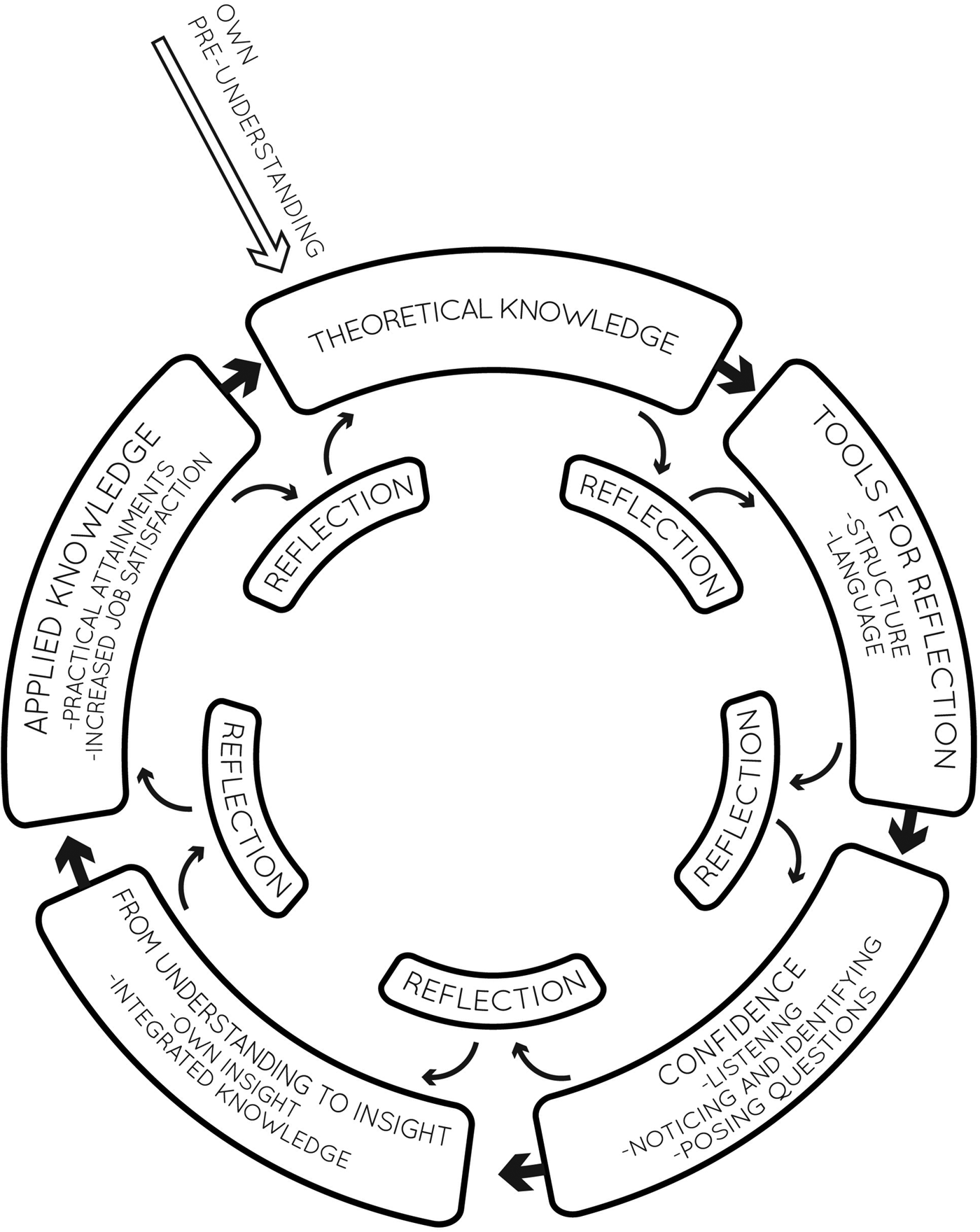
The discussions were recorded, transcribed in slightly modified verbatim mode, and analyzed using qualitative content analysis (Krippendorff, Reference Krippendorff2004; Weber, Reference Weber1990) with a manifest focus and no predefined codes. As far as possible, the actual words spoken by the informants were used. The analysis was performed using the steps now described: First, texts were read through several times to promote familiarity with the content. Second, they were reread systematically to identify meaning units, that is, words or text segments, patterns of meaning, and issues of potential interest with reference to the research question. The segments were also marked with a preliminary code. In a third step, those segments marked with similar codes were grouped together to form preliminary categories. Fourth, the statements in each preliminary category were scrutinized and compared to find the central component and then fused into categories. In the next step, the final categories were compared to avoid obvious overlapping. In the final step, the categories were compared and analyzed in order to reveal possible relationships or hierarchies between them. This comparison revealed a distinct relationship between the categories, which is illustrated in Figure 1.
The Process of Learning as a Whole. The process of learning with TrainingModel Sand/TER. The training model contributed to new knowledge, understanding, and insight as well as promoting practical skills and increased job satisfaction. This was accomplished through theoretical knowledge (T) and clinical situations (empirical knowledge [E] and reflection [R]), and the training model was named Sand/TER. Theoretical knowledge was important, but it was not sufficient to obtain new and useful knowledge. It needed to be conceptualized, and reflection was the motor for this process of conceptualization.

RESULTS
Quantitative Evaluation
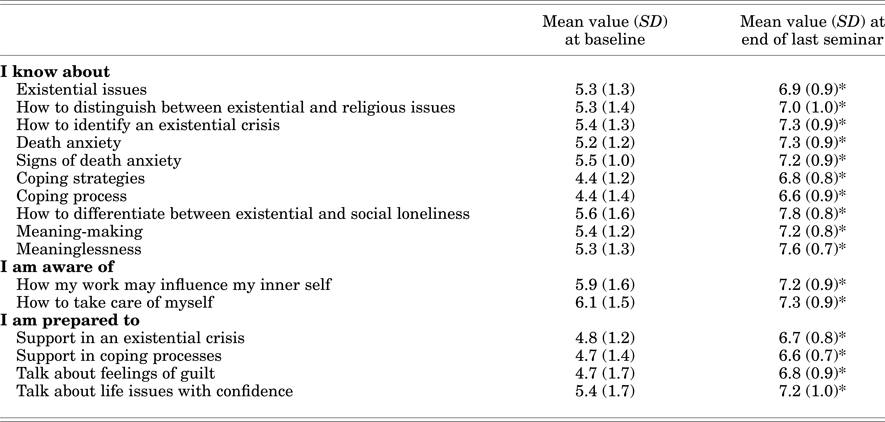
The participants were partly familiar with existential issues at baseline. The mean values of knowledge and understanding (“I know about”) varied from 4.4 to 5.6 before the seminar series. Knowledge about coping processes in palliative care showed the lowest and that about issues of loneliness the highest mean value (Table 2).
Mean values of items in the evaluation questionnaire before and after the seminar series

*p < 0.001, Wilcoxon's signed-rank test.
There were no significant differences between the mean values of the three age groups, nor were baseline answers different depending on years in the profession.
After the seminar series, mean values showed statistically significant increases regarding all items (Table 2). The largest knowledge increases (>2.0 points) were seen for coping strategies, how to differentiate between types of loneliness, and knowledge about meaninglessness.
There were no significant differences between age groups regarding measures after the seminar series. However, after the seminar series, participants with only 1–5 years of experience in their profession assessed both their knowledge regarding how to identify death anxiety significantly higher (p < 0.02) and their competence to differentiate between existential isolation and social loneliness significantly higher (p < 0.05) than the more experienced group. Answers regarding awareness about one's own well-being and preparedness to provide support in an existential crisis did not differ with respect to years in the profession.
Qualitative Analysis
This analysis was mainly based on the focus group interviews. In a few cases, meanings or quotations were derived from the open-ended free comments in the quantitative questionnaire. Condensed quotations were used in the results. The categories and subcategories are summarized in Figure 1.
Theoretical Knowledge
Theoretical knowledge served different useful purposes. New theoretical knowledge about existential issues elucidated the meaning of existential questions as well as the existential crisis and placed the existential issues in a clinical context. Before the intervention, existential issues had been perceived as too vague and extensive to comprehend, and therefore a deterrent, too complicated, and too demanding to even approach. The seminars offered the possibility to break extensive subjects down into smaller parts and then gradually reassemble them. Existential questions were played down, and the participants saw that, though the questions could be challenging, they were about general human experiences and were commonplace in everyday palliative care:
Today I have another view of what existential issues are. Previously, I had the image of an existential crisis as something so complicated that it was impossible to grasp. To be able to divide the existential dimension into smaller parts makes it easier to understand. We may consider patients to be demanding when they call on us again and again without knowing what they want. Now I think that the reason why they call could be [existential] loneliness.
New knowledge about the dying patient's coping process was pointed out as highly valued. A familiarity with the strategies as well as how they were used and served their purpose gave the participants a new sense of confidence in how to offer sensitive support during the changeable and sometimes unpredictable coping process:
I have gained a new understanding about the meaning of providing support … // … The courage to not abandon the patient, being present in silence, to be able to meet the patient where he/she is, and to understand that this position could change from time to time. It is not despair all the time. It shifts. It is a sort of oscillating movement—into and out of the disease.
Tools for Reflection
The theoretical knowledge provided participants with structure and a common language that facilitated their continuous reflection during and between seminars. The theoretical knowledge was discussed in relation to everyday experiences mainly from the participants' work, but also from their private lives and experiences. The seminars offered the possibility to not only share but also to compare their own experiences with those of others and to pose questions to each other about difficult situations.
Structure
Not all of the theoretical knowledge presented was completely new for the participants. They reported that they were “partly familiar” with some of it, or had “unsorted thoughts” about it or “vague feelings” that they had used the theories before in some way. When they had a chance to acquaint themselves with the theories, they discovered that the theories gave structure to unsorted thoughts and fragmented knowledge. The theories offered reassurance about their own way of working. The theoretical knowledge served as a supporting map to provide orientation in confusing situations, which was confirming:
It has become clearer, more understandable. I am usually not so fond of theories, and stuff like that, but this time I have embraced them. Previously, I could not distinguish one emotional expression from another, but now I can see that this is about [existential] challenges, and this is about loneliness, which means that I have gained a greater understanding of what can possibly dwell in the patients' minds.
Language
Receiving and adopting a language and becoming familiar with adequate words and expressions were described as fundamental: “Without a language, it is not possible to talk with either oneself or with others.” It was stressed that usable words are a prerequisite in several situations: to be able to name what you see, share experiences with colleagues in the team, have a dialogue with patients and oneself, and give support to someone else: “I now have a language for what I previously thought about but couldn't express.”
Confidence
There was confidence, and there was time for reflection in the small and fixed seminar groups. It was possible to think, to twist and turn thoughts and doubts, and to test theories against reality with help from colleagues and with support and feedback from the seminar leader. Under these circumstances, when the theoretical knowledge was reflected in everyday experiences, participants could build trust in their own capabilities. This meant that they could slow down and meet patients and families with increased confidence and greater calm:
We talked a lot about life issues and that life issues are not problems to be solved, and especially not by us. We can be there and we can share, but no more than that. It has given me a sense of confidence … // … And, by the way, what is the worst thing that could happen? Perhaps that someone starts crying, and even if this could be trying, it is not impossible to handle.
Listening
The new confidence was reflected in participants' use of their listening skills. They listened with a new attention and reflected over the meaning of what patients and their next of kin had to say:
I have learned that listening is an activity, an important task assignment. I have always paid attention and listened to patients, but I do it in a somewhat more reflective, different way now.
Noticing and Identifying
As a result of greater confidence, participants described an increased tendency to take note of what other people say and of their behavior. The new theoretical knowledge made it possible to interpret and understand what they saw, a first step toward gaining a situational awareness:
It has become so clear that patients use different protective strategies [as a necessary denial]. For example, making plans for something that is never going to happen, like a round-the-world trip, or this patient we have on the ward today who pays great attention in making plans for his funeral, perhaps as a way to hold onto a sense of control.
Posing Questions
The new understanding contributed to preparedness for dialogues about existential challenges. The participants described a readiness to pose questions as well as a readiness to receive a variety of possible answers:
When you are prepared to hear the answers, you dare to pose those questions, and I am more confident in these kinds of situations now … // … I am not there to present solutions. What I can do is to listen and to pose open questions that hopefully could help the patient to find her own answers.
From Understanding to Insight
The knowledge grew gradually and became more structured and articulated as it developed. New knowledge that, through reflection, was possible to integrate into an already recognized structural pattern became understandable and thus useful. It fitted in and could therefore make sense:
It is something we can rely on, so we don't have to panic when we meet different kinds of reactions both at work and overall. I think that I now have a toolkit that helps me to understand both myself and others.
During the seminars, participants had discussed such existential issues as death anxiety, isolation, and meaninglessness in a thoughtful and nuanced way. This process resulted in a deepened understanding and awareness of the impact of existential challenges in palliative care, and of the patient's and next of kin's struggle to create a bearable existence in the face of death. This awareness was pointed out as being a protector against value procedures and judgments.
One's Own Insight
The experience of feeling confident and being able to rely on one's professional understanding also involved one's own inner self and reactions. The theoretical knowledge had helped the participants to recognize and understand their own feelings that could arise both at work and in their private lives, and it gave them confidence: “Okay, now I'm feeling like this, and perhaps it's not so strange.” They had also been aware of the empowering value inherent in narratives and that it could be supportive just to formulate thoughts and feelings together with another person:
Instead of moving on quickly and talking a lot myself, I slow down more now. I wait and try to ask myself, “Where is the person I have in front of me just now, what does she need?” … // … I can sit down and listen because I know from my own insight that it could be helpful and soothing for the patient to formulate thoughts and feelings in words … // … It is not always necessary to offer a pill to someone who can't sleep.
Integrated Knowledge
As a result of the process of reviewing and reflecting, the theoretical knowledge that initially had required effort to use had become automatic, a reflexive/reflective tool:
What I have learned has been integrated in me. When I work, I do not think, “This is it.” It is more on an unconscious level … // … You use it without thinking so much about it, I think.
Applied Knowledge
There were examples of how the integrated knowledge was applied when giving support to others and to oneself. The new attainments were contrasted with earlier attempts to give support.
Practical Attainments
Attainments that were considered useful were those that facilitated presence, relieved participants from the burden of being a problem solver, and those they could use to shield themselves from becoming emotionally drained:
Today I am aware that some patients and family members can affect me too deeply, and I also have strategies to shield myself from being emotionally involved in a way that is not good for me.
After the intervention, participants felt that it was possible to rely on the conviction that it is enough to give support by true presence, true listening, and by posing open questions. As a consequence, it was easier to be present, to set time limits for visits, and to be able to leave a patient even if a problem was not solved:
The awareness makes it easier to share and be present, but also to leave a patient. We can do what we know is important, but we cannot change the fact that someone is going to die. I can harbor this … this has really been a learning experience [for] me.
Increased Job Satisfaction
New knowledge, new understanding, and new insights were skills that were reassuring, gave confidence, and contributed to increased job satisfaction:
To feel confident instead of feeling inadequate all the time makes a big difference. It is meaningful when you have something to give, and because of that it is easier to manage.
DISCUSSION
The Process of Learning
The SOLO taxonomy of understanding and learning (Biggs & Tang, Reference Biggs and Tang2011) mentioned earlier in this article consists of five different levels. SOLO levels 1–3 are about quantitative learning and start with the simple acquisition of unstructured information. Level 2 deals with such issues as recognizing, identifying, defining, and telling, whereas level 3 is about selecting, describing, narrating, and discussing data. In levels 4 and 5, learning becomes qualitative and details learned in earlier stages become integrated into structural patterns. The highest level (level 5) is about reflection, generalization, and the creation of theories and hypotheses. In this way, the essence of what was learned can be abstracted beyond the subject area in which it was learned—that is to say, the knowledge can be applied to new and broader domains. The results of this our corresponded well to SOLO levels 2–3 as well as to 4 and 5, which is necessary if the knowledge is to be useful and applicable in existential crises. The seminars had obviously provided opportunities to develop a competence for addressing real-life clinical situations and pay attention to people who may be coping in different ways. This is especially important in situations where it is impossible to adhere to manuals or “cookbook instructions.” This new competence was reflected in the focus group discussions when the participants had already tested their new skills.
Reflection
In order to feel confident in unpredictable situations, it is important to have theoretical knowledge, but this by itself is not sufficient. For the knowledge to become useful, it must be conceptualized, and reflection is the motor of this process of conceptualization. In our training model, reflection is a key element and is used both in the form of care-related reflection and self-reflection. The core, the very essence of the seminars, was the process of reflection, the aim being to help participants adopt a reflective stance. Other researchers (Henoch et al., Reference Henoch, Strang and Browall2015) have also described reflection as being an important part of training so as to prepare staff to cope with existential challenges.
The reflective process is impossible to rush. It requires time, and there was enough time during the seminars. The reflective lens that grew during and between seminars helped the participants, step by step, to make meaning of complex situations. The process enabled a greater understanding of both themselves and of the situation. In this way, future actions could be influenced by this understanding (Sandars, Reference Sandars2009). Since reflective capacity is fundamental in interaction with other people, it is characteristic of professional competence. Therefore, activities to promote reflection are now incorporated into the education of health professionals on different levels (Mann et al., Reference Mann, Gordon and MacLeod2009; Mann, Reference Mann2008; Sargeant et al., Reference Sargeant, Mann and van der Vleuten2009).
In fact, reflection is an essential part of self-regulated and lifelong learning. The so-called hermeneutic circle or spiral is a model that illustrates the process through which people gain understanding with help from interpretation and reflection (Palmer, Reference Palmer1969). The process starts with the well-known and continues as a tacking procedure between what is not understood and goes back to sources that eventually can contribute to a deepened understanding. Reflection is consequently a well-known procedure and, once you become aware of it, easy to practice.
For students, the process of reflection appears to be stimulated by complex clinical problems (Brajtman et al., Reference Brajtman, Higuchi and Murray2009; Mann et al., Reference Mann, Gordon and MacLeod2009). It gives them a chance to use the theoretical knowledge they have acquired. In the seminar groups, the situation was reversed. There it was the theoretical knowledge that initiated the reflective process and gave participants the opportunity to gain a better understanding of their clinical work.
The Role of Confidence
Confidence emerged as a key factor in our study. It was through confidence that participants gained the courage to begin the process of reflection that gradually contributed to a deeper confidence, which yielded increased job satisfaction. In a review article about understanding the key variables influencing the reflective process in education, Mann et al. (Reference Mann, Gordon and MacLeod2009) stated that confidence is a prerequisite for exploration. Across diverse settings and methods, it appears that the most influential elements for reflection are a supportive environment created by discussions in small groups, accommodating individual differences in terms of learning style, enough time, free expression of opinions, and support and feedback from an engaged and responsive supervisor. During the seminars, all these factors were at hand. Moreover, one of the most significant tasks for the seminar leader was to safeguard confidence both individually and at the group level.
The Specific Challenges in Palliative Care
There are several sources of perceived uncertainty in the palliative care team, including communication challenges, concerns about not providing the best possible support due to a lack of knowledge and experience, and the need to face existential issues (Peterson et al., Reference Peterson, Johnson and Halvorsen2010). A further concern is how to cope with emotional demands (Zambrano et al., Reference Zambrano, Chur-Hansen and Crawford2012). A need to find strategies to face personal feelings that are evoked during encounters with dying patients and to be able to manage the balancing act between being emotionally involved without becoming over-involved has been strongly expressed (Zambrano et al., Reference Zambrano, Chur-Hansen and Crawford2014).
When working in palliative care, an awareness of existential challenges and their impact on “man as such” (Frankl, Reference Frankl2004/1946; May, 1994/1984; Tillich, Reference Tillich2014/1952; Yalom, Reference Yalom1980) is a powerful working tool. Aside from the insight into one's own and others' ways of coping with a given situation, it also contributes to a realistic picture of what is possible to achieve through support. The discussions in the seminars revealed a common tension between the ideal and the reality and the experiences of striving against unreachable goals. To be able to distinguish unnecessary suffering that is possible to relieve from suffering that is a part of being human had helped the participants in our study to develop realistic supporting strategies and to slow down when necessary (Moulton et al., Reference Moulton, Regehr and Mylopoulos2007). The new awareness and confidence resulted in increased job satisfaction.
Methodological Considerations
The focus group interviews took place one month after the intervention. This means that our results cannot be uncritically extrapolated to lasting effects beyond one month. Practical issues should also be considered. Although the model was adapted for a clinical setting (2 hours on 7 occasions = 14 hours), this may still be too time-consuming for some palliative care settings. However, shorter interventions also seem to produce positive effects, as demonstrated by Friedrichsen et al. (Reference Friedrichsen, Heedman and Åstradsson2013).
The mixed-methods research design (Östlund et al., Reference Östlund, Kidd and Wengstrom2011) utilized in our study strengthens the results, as they were triangulated. In the quantitative analysis, participants showed a significant increase in perceived knowledge. The qualitative analysis of the focus group discussions provided an understanding of these results, of how theoretical knowledge transformed into usable working tools and contributed to participants' experience of being better prepared to support people during an existential crisis. The process of reflection that appeared during the qualitative analysis showed and explained how participants conceptualized theoretical knowledge in their clinical work (Figure 1). However, it is only possible to interpret the results as short-term effects, since no follow-up evaluation was made beyond one month.
The participants were highly motivated. They were interested in the topic from the start, as the baseline results from the questionnaire showed. Their clinical work served as a continuous reminder of the need for usable working tools, and it also facilitated learning. The results might have looked different in another setting (e.g., if participation had been mandatory). On the other hand, this model was created for, and based upon, the participants' own interests and voluntary participation.
ACKNOWLEDGMENTS
We thank the Swedish Cancer Society for financial support. Sara Runesdotter is acknowledged for help with statistical analysis and Annica Charoub for assistance in qualitative data collection. We would also like to thank Jenny McGreevy for linguistic revision.
SUPPLEMENTARY MATERIALS
To view supplementary materials (Appendix 1) for this article, please visit https://doi.org/10.1017/S1478951517000633.