Introduction
Sleep disturbances are a common problem in older people. Approximately 40% of people over 65 years are affected (Foley et al., Reference Foley, Monjan, Simonsick, Wallace and Blazer1999). Age-related changes in sleep architecture and the presence of medical and psychiatric comorbidities increases sleep disruption, changes in daytime activities, and the presence of daytime napping (Bliwise and Breus, Reference Bliwise, Breus, Lichtstein and Morin2000). Several negative consequences are associated with sleep disturbances, including increase in cognitive decline, metabolic disease, high blood pressure, cardiovascular disease mortality, frailty, impaired quality of life, and pain for affected persons (Fung et al., Reference Fung2016).
Data from a recent study show a prevalence of more than 20% of nursing home residents with dementia-related sleep disturbances (Wilfling et al., Reference Wilfling, Dichter, Trutschel and Köpke2019). In people with dementia, sleep disturbances may lead to worsening of cognitive symptoms, behavioral and psychological symptoms of dementia (BPSD), such as restlessness and wandering, and further harms, such as accidental falls. Not getting enough sleep leads to a lower quality of life and greater difficulty of function during the day (Lee et al., Reference Lee2007). Daytime sleepiness reduces residents’ participation in social activities and thereby enhances social withdrawal (Alessi and Schnelle, Reference Alessi and Schnelle2000). Furthermore, sleep disturbances have been reported as a risk factor of institutionalization (Gibson et al., Reference Gibson, Gander and Jones2014).
In nursing homes, the relationship between nurses and residents is characterized by a reciprocal interaction. The behavior and emotions of residents affect the nurses’ well-being and behavior and viceversa (Bird et al., Reference Bird, Anderson, Macpherson and Blair2016). Also sleep disturbances led to further BPSD, causing a lower quality of general health, reduced workability, high burnout levels (Schmidt et al., Reference Schmidt, Dichter, Palm, Müller and Hasselhorn2012), depression, anxiety, and sleep problems (McPherson et al., Reference McPherson, Hiskey and Alderson2016) and significant distress (Lee et al., Reference Lee2007). Sick leave, turnover, and higher economic costs might be the consequences (Aasmul et al., Reference Aasmul, Husebo and Flo2016). Therefore, treatment of sleep disturbances in nursing home residents should be a high priority.
Pharmacotherapies are commonly used for sleep disturbances in nursing home residents (Sloane et al., Reference Sloane, Zimmerman, Brown, Ives and Walsh2002). A recent Cochrane review (McCleery et al., Reference McCleery, Cohen and Sharpley2014) shows that currently there is no effective pharmacological intervention to manage sleep problems in people with dementia in different settings. Although regularly prescribed, drug therapies are often inadequate and potentially harmful, e.g. antipsychotics, benzodiazepines, or sedative hypnotic medications (Richter et al., Reference Richter, Mann, Meyer, Haastert and Köpke2012). These challenges reinforce the need to consider nonpharmacological interventions in nursing homes as well as guidelines propose to use nonpharmacological interventions for BPSD, including sleep problems (Deuschl and Maier, Reference Deuschl and Maier2016; National Institute for Health and Care Excellence, 2018).
In nursing homes, potential environmental disturbances such as noise (e.g. television, radio, ringing of alarm systems, noise by other residents), light, and organizational features of night care routines play a role in the sleep quality of residents (Herrmann and Flick, Reference Herrmann and Flick2012; Schnelle et al., Reference Schnelle1998). Commonly used nursing interventions like repositioning for pressure ulcer prophylaxis, incontinence care, and toileting may lead to interrupted sleep of residents. In the case of two or more beds in a room, nursing interventions lead to a disturbance of the night’s rest for all residents of the room (Bliwise and Breus, Reference Bliwise, Breus, Lichtstein and Morin2000; Ouslander et al., Reference Ouslander2006). Furthermore, a nonstimulating environment may lead to excessive daytime and early evening napping that would exacerbate sleep disturbances (Cruise et al., Reference Cruise, Schnelle, Alessi, Simmons and Ouslander1998). These factors must be taken into account in the development and application of interventions.
However, recently conducted systematic reviews on nonpharmacological interventions to avoid sleep disturbances (Capezuti et al., Reference Capezuti2018; Wilfling et al., Reference Wilfling2015) found only weak evidence for the effectiveness of nonpharmacological interventions. The results showed that currently there is no “gold standard” intervention. From the studies assessed in Wilfling et al. (Reference Wilfling2015), it seems most likely that multicomponent or “complex” interventions have the strongest potential to be effective in improving sleep. Complex interventions contain multiple (interacting) components and are characterized by the number and difficulty of behaviors required by those delivering or receiving the intervention, the number of groups of organizational levels targeted by the intervention, the number and heterogeneity of outcomes, and the degree of flexibility or tailoring of the intervention (Craig et al., Reference Craig2013). Therefore, complex interventions may be most suitable for the multifactorial origin of sleep disturbances and the need to apply tailored interventions.
The presentation and description of multicomponent interventions is a challenging task both in individual studies and in reviews. Previous systematic reviews (Capezuti et al., Reference Capezuti2018; Wilfling et al., Reference Wilfling2015) have not analyzed multicomponent interventions in detail. Therefore, this systematic review aims to identify, describe, and summarize multicomponent, nonpharmacological interventions to avoid and reduce sleep disturbances in nursing home residents. We add value to the existing systematic reviews due to an updated literature search, rigorous methodology, and analyzing single components of multicomponent interventions based on TIDieR (Hoffmann et al., Reference Hoffmann2014) and CReDECI 2 criteria (Möhler et al., Reference Möhler, Köpke and Meyer2015). Ideally, the results of this review will give guidance to develop a multicomponent, nonpharmacological intervention based on current frameworks for complex interventions (Craig et al., Reference Craig2013; Hoffmann et al., Reference Hoffmann2014; Moore et al., Reference Moore2015).
Methods
This review followed the established methodological frameworks for systematic evidence syntheses (Higgins et al., Reference Higgins2011) and the PRISMA statement (Liberati et al., Reference Liberati2009). No study protocol was registered.
Literature search
The search strategy was defined by the principles of a systematic search and implied free text keywords and Medical subject headings (Mesh terms). We did a computerized search in December 2018, using the databases Medline via PubMed, CINAHL, Scopus, and Cochrane Library. In order to identify all multicomponent, nonpharmacological interventions aimed to avoid sleep disturbances in nursing home residents, a complex search strategy was developed. Major search terms for all databases are represented in Table S1. Relevant gray literature was derived via Google Scholar. Furthermore, we checked reference lists of included studies and relevant reviews identified through the search.
Study selection
All evaluation studies investigating multicomponent, nonpharmacological interventions aiming to avoid or reduce sleep disturbances in nursing home residents were eligible for inclusion, with exception of case studies. For the purpose of this review, “multicomponent interventions” were defined as interventions that contain several (interacting) components having different characteristics. The number of components and range of effects may vary (Craig et al., Reference Craig2013).
We included scientific articles published in peer reviewed journals in English and German language. To gather the largest possible number of multicomponent interventions, no limitations of the publication year and the cognitive status of residents were applied. To get included, studies must have determined a sleep-related outcome through patient-reported or clinician-reported measurement. We excluded studies including participants with sleep apnea and respiratory interventions, as this is primarily a respiratory problem requiring different treatment strategies. Specific inclusion and exclusion criteria are listed in Table S2.
The final set of articles was transferred to the web service Rayyan (Ouzzani et al., Reference Ouzzani, Hammady, Fedorowicz and Elmagarmid2016). Two independent reviewers assessed titles and abstracts from all search results to identify eligible studies. After selection of potentially relevant articles, full reports were obtained and assessed for inclusion and exclusion. Any disagreement on the eligibility of studies was resolved through discussion to reach consensus or, if required, by involving a third experienced review author.
Data extraction and methodological quality
Data from each included study were extracted by one reviewer, and the accuracy of the data extraction was independently cross-checked by a second reviewer. In case of disagreement or discrepancy, we involved a third review author to reach consensus. Data were extracted into standardized tables, including source, study design, number of groups, setting, participants, interventions, measurement of sleep, and main findings according to the Cochrane Handbook for Systematic Reviews of Interventions (Higgins et al., Reference Higgins2011).
The methodological quality of all included studies was assessed using the Cochrane Risk of Bias tool for randomized controlled trials (RCTs) (Higgins et al., Reference Higgins2011) and the CASP Appraisal Checklists (Critical Appraisal Skills Programme, 2019) for all other study designs. Two reviewers independently assessed and scored included studies’ methodological quality in order to identify any potential sources of bias.
Synthesis of extracted evidence
Components of included intervention programs were analyzed in detail applying the TIDieR (Hoffmann et al., Reference Hoffmann2014) and CReDECI 2 criteria (Möhler et al., Reference Möhler, Köpke and Meyer2015). The methods of data synthesis depended on the quality and heterogeneity of existing data. Given the complexity of interventions, grouping included studies into categories based on the aim of the intervention or intervention type was not feasible. Therefore, the characteristics of studies were analyzed based on TIDieR criteria (Hoffmann et al., Reference Hoffmann2014) and compared with each other with regard to procedures, materials, mode of delivery, intervention provider, and intervention period. A narrative analysis was performed for the study results.
Results
Description of included studies
A total of 2056 studies were identified through database search. After removing duplicates, the final dataset consisted of 2024 articles. After title and abstract screening, 1894 records were excluded. Overall, 130 full texts were screened, and finally ten publications reporting on nine multicomponent interventions were included in the review. All studies were published in English. The process of study selection is presented in Figure S1.
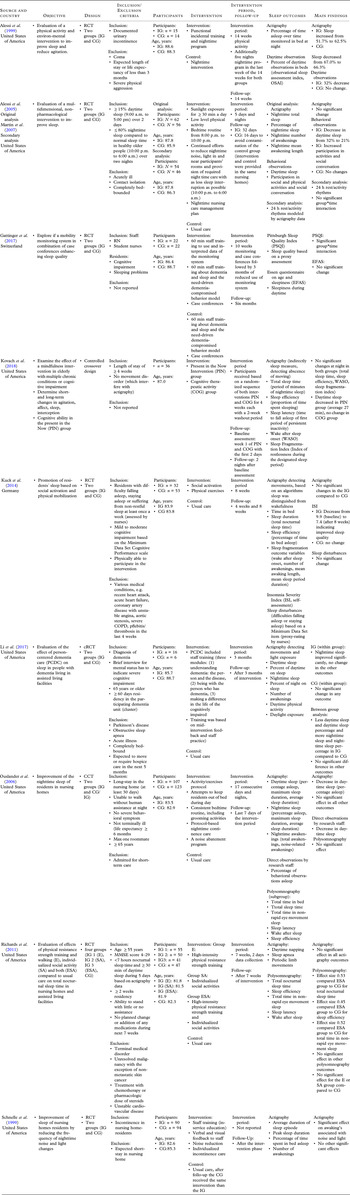
Of the ten included publications, most were RCTs (n = 7) (Alessi et al., Reference Alessi, Yoon, Schnelle, Al-Samarrai and Cruise1999; Reference Alessi2005; Gattinger et al., Reference Gattinger, Hantikainen, Ott and Stark2017; Kuck et al., Reference Kuck, Pantke and Flick2014; Li et al., Reference Li, Grandner, Chang, Jungquist and Porock2017; Richards et al., Reference Richards2011; Schnelle et al., Reference Schnelle, Alessi, Al-Samarrai, Fricker and Ouslander1999; Martin et al., Reference Martin, Marler, Harker, Josephson and Alessi2007). The two other studies used a nonrandomized cross-over design (Kovach et al., Reference Kovach, Evans, Sattell, Rosenau and Gopalakrishnan2018), or a nonrandomized controlled design (Ouslander et al., Reference Ouslander2006). The study of Martin et al. (Reference Martin, Marler, Harker, Josephson and Alessi2007) is a secondary data analysis of Alessi et al. (Reference Alessi2005). Therefore, reference is only made to Martin et al. (Reference Martin, Marler, Harker, Josephson and Alessi2007) when the specific results of the secondary data analysis are described or discussed. Study characteristics are summarized in Table 1.
Characteristics of included studies

Abbreviations: RCT, randomized controlled trial; cRCT, cluster-randomized controlled trial; CCT, controlled clinical trial; IG, Intervention Group; CG, control group; MDS-NH, minimum dataset – nursing home; MMSE, mini-mental State examination.
Overall, 941 participants (range 22–230) living in nursing homes were included. The facilities were located in the United States (n = 7 studies) (Alessi et al., Reference Alessi, Yoon, Schnelle, Al-Samarrai and Cruise1999; Reference Alessi2005; Kovach et al., Reference Kovach, Evans, Sattell, Rosenau and Gopalakrishnan2018; Kuck et al., Reference Kuck, Pantke and Flick2014; Li et al., Reference Li, Grandner, Chang, Jungquist and Porock2017; Ouslander et al., Reference Ouslander2006; Schnelle et al., Reference Schnelle, Alessi, Al-Samarrai, Fricker and Ouslander1999), Switzerland (Gattinger et al., Reference Gattinger, Hantikainen, Ott and Stark2017), and Germany (Kuck et al., Reference Kuck, Pantke and Flick2014). All studies (n = 9) (Alessi et al., Reference Alessi, Yoon, Schnelle, Al-Samarrai and Cruise1999; Reference Alessi2005; Gattinger et al., Reference Gattinger, Hantikainen, Ott and Stark2017; Kovach et al., Reference Kovach, Evans, Sattell, Rosenau and Gopalakrishnan2018; Kuck et al., Reference Kuck, Pantke and Flick2014; Li et al., Reference Li, Grandner, Chang, Jungquist and Porock2017; Ouslander et al., Reference Ouslander2006; Richards et al., Reference Richards2011; Schnelle et al., Reference Schnelle, Alessi, Al-Samarrai, Fricker and Ouslander1999) included participants with cognitive impairment. Patients with known sleep problems were included in five studies (Alessi et al., Reference Alessi, Yoon, Schnelle, Al-Samarrai and Cruise1999; Reference Alessi2005; Gattinger et al., Reference Gattinger, Hantikainen, Ott and Stark2017; Kuck et al., Reference Kuck, Pantke and Flick2014; Schnelle et al., Reference Schnelle, Alessi, Al-Samarrai, Fricker and Ouslander1999).
Methodological quality
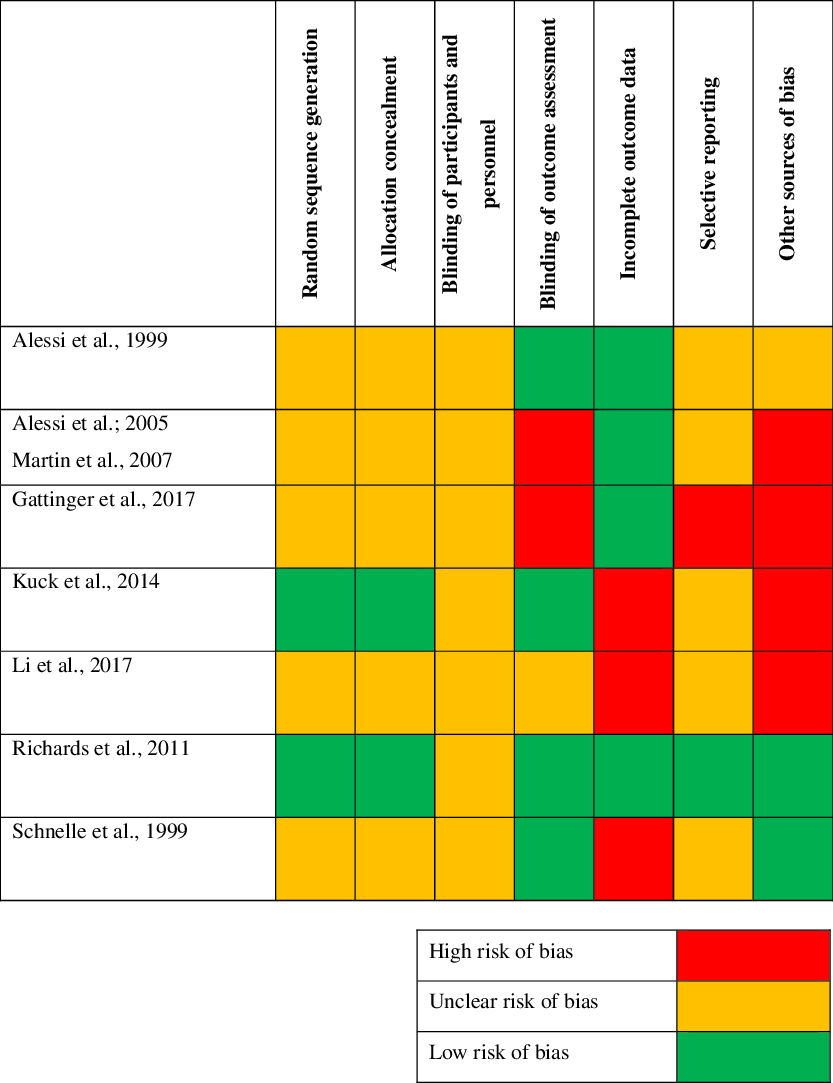
Among the seven RCTs (Alessi et al., Reference Alessi, Yoon, Schnelle, Al-Samarrai and Cruise1999; Reference Alessi2005; Gattinger et al., Reference Gattinger, Hantikainen, Ott and Stark2017; Kuck et al., Reference Kuck, Pantke and Flick2014; Li et al., Reference Li, Grandner, Chang, Jungquist and Porock2017; Richards et al., Reference Richards2011; Schnelle et al., Reference Schnelle, Alessi, Al-Samarrai, Fricker and Ouslander1999), most studies had an unclear risk of bias regarding random sequence generation, allocation concealment, and blinding of participants and personnel. In two studies (Alessi et al., Reference Alessi2005; Gattinger et al., Reference Gattinger, Hantikainen, Ott and Stark2017), outcome assessors were not blinded to group allocation. In three studies (Kuck et al., Reference Kuck, Pantke and Flick2014; Li et al., Reference Li, Grandner, Chang, Jungquist and Porock2017; Schnelle et al., Reference Schnelle, Alessi, Al-Samarrai, Fricker and Ouslander1999), we judged the risk of bias regarding incomplete outcome data as high, because of missing information about drop-outs. Five studies (Alessi et al., Reference Alessi, Yoon, Schnelle, Al-Samarrai and Cruise1999; Reference Alessi2005; Kuck et al., Reference Kuck, Pantke and Flick2014; Li et al., Reference Li, Grandner, Chang, Jungquist and Porock2017; Schnelle et al., Reference Schnelle, Alessi, Al-Samarrai, Fricker and Ouslander1999) had an unclear risk of bias regarding incomplete outcome data because no study protocol was found. Only one study was at high risk of bias since one of the instruments for the assessment of the primary outcomes listed in the registration record was not mentioned in the study publication (Gattinger et al., Reference Gattinger, Hantikainen, Ott and Stark2017). Other sources of bias were found in four studies (Alessi et al., Reference Alessi2005; Gattinger et al., Reference Gattinger, Hantikainen, Ott and Stark2017; Kuck et al., Reference Kuck, Pantke and Flick2014; Li et al., Reference Li, Grandner, Chang, Jungquist and Porock2017) due to unbalanced intervention and control groups, shorter average delay between baseline and follow-up in intervention versus control group, missing cluster-adjusting analysis of results, and missing conflict of interest statements. The risk of bias for RCTs is summarized in Figure 1.
Summary of Cochrane risk of bias for randomized controlled trials (n = 7).

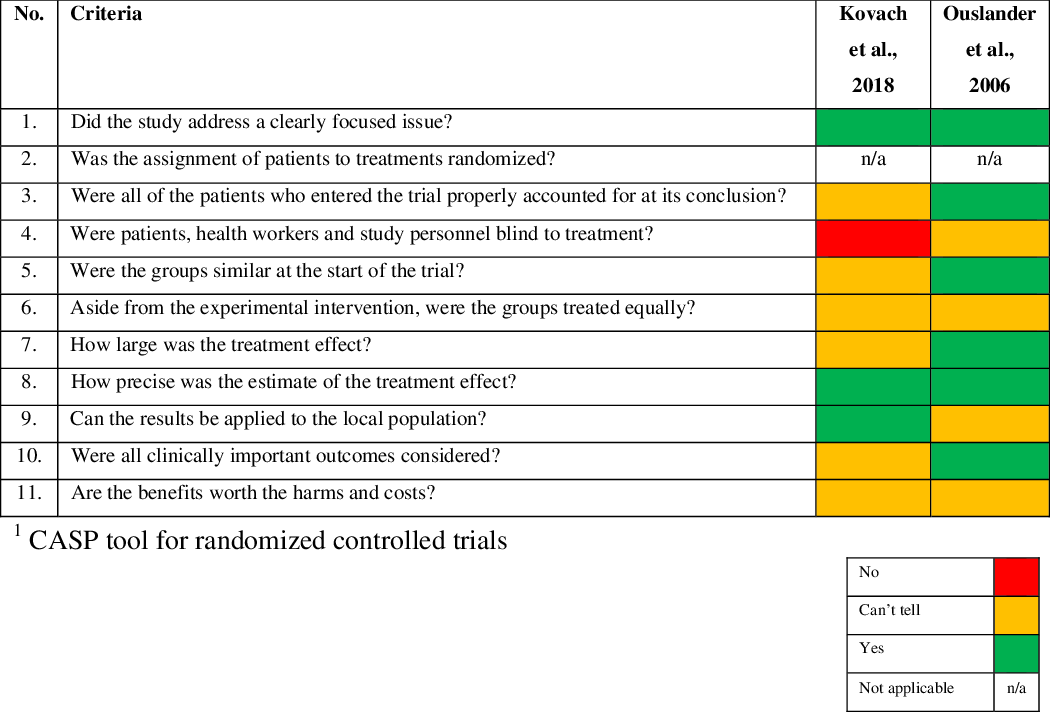
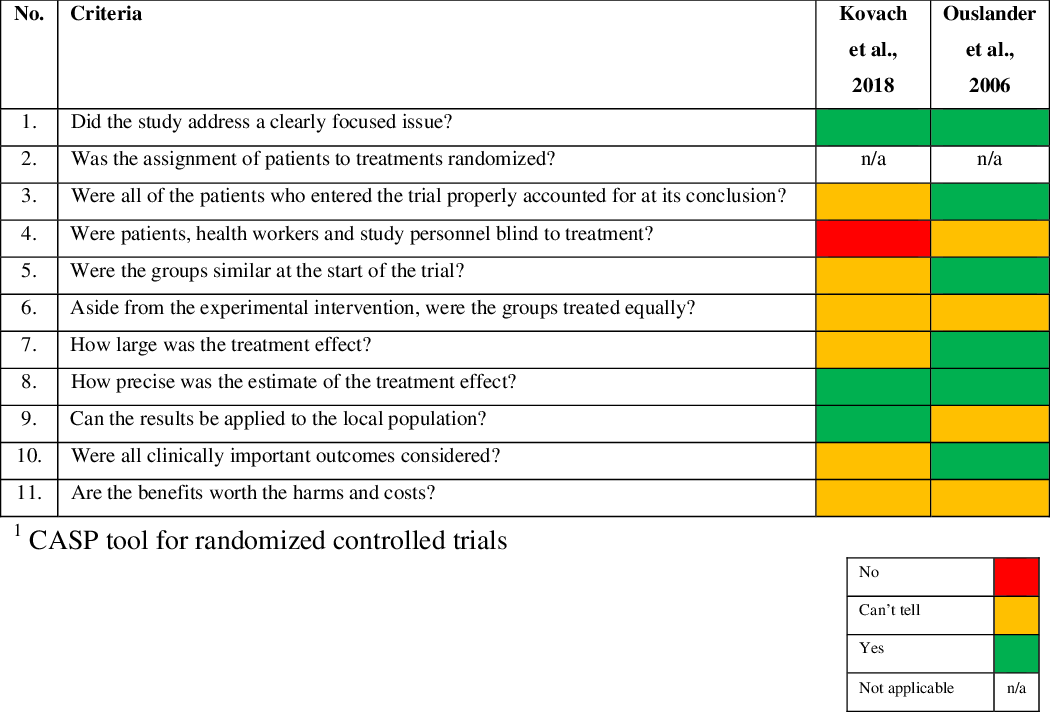
Risk of bias in the two nonrandomized studies (Kovach et al., Reference Kovach, Evans, Sattell, Rosenau and Gopalakrishnan2018; Ouslander et al., Reference Ouslander2006) was mainly unclear and important information were missing due to incomplete reporting (Figure 2). Therefore, we evaluated the quality of evidence as low or very low due to several methodological limitations und missing of important information.
Summary of the quality appraisal of nonrandomized studies (n = 2) based on the CASP tool1.
Moreover, no study published a study protocol, and only two studies (Gattinger et al., Reference Gattinger, Hantikainen, Ott and Stark2017; Richards et al., Reference Richards2011) were registered in a trial register.
Measurements
Most of the included studies (Alessi et al., Reference Alessi, Yoon, Schnelle, Al-Samarrai and Cruise1999; Reference Alessi2005; Kovach et al., Reference Kovach, Evans, Sattell, Rosenau and Gopalakrishnan2018; Kuck et al., Reference Kuck, Pantke and Flick2014; Li et al., Reference Li, Grandner, Chang, Jungquist and Porock2017; Ouslander et al., Reference Ouslander2006; Richards et al., Reference Richards2011; Schnelle et al., Reference Schnelle, Alessi, Al-Samarrai, Fricker and Ouslander1999) measured sleep indirectly by wrist actigraphy. Actigraphy results were supplemented with polysomnography (Ouslander et al., Reference Ouslander2006; Richards et al., Reference Richards2011) or daytime observations (Alessi et al., Reference Alessi, Yoon, Schnelle, Al-Samarrai and Cruise1999; Reference Alessi2005). Kuck et al. (Reference Kuck, Pantke and Flick2014) supplemented the findings from actigraphy with the Insomnia Severity Index (Morin, Reference Morin1993) and the Minimum Dataset (MDS) of the Resident Assessment Instrument (RAI) (Bernabei et al., Reference Bernabei, Landi and Sgadari1996). With Reference RichardsRichards et al. (2011), one study applied exclusively used polysomnography. One study (Gattinger et al., Reference Gattinger, Hantikainen, Ott and Stark2017) used the Pittsburgh Sleep Quality Index (PSQI) (Buysse et al., Reference Buysse, Reynolds, Monk, Berman and Kupfer1989) and in addition the Essen questionnaire on age and sleepiness (EFAS) (Frohnhofen et al., Reference Frohnhofen, Fulda, Frohnhofen and Popp2013) as well as an in-bed system which recorded mobility and micro activity without any body contact.
Outcomes
The most often examined outcomes in studies using actigraphy were nighttime total sleep time (min, percentage, average) (Alessi et al., Reference Alessi2005; Kovach et al., Reference Kovach, Evans, Sattell, Rosenau and Gopalakrishnan2018; Kuck et al., Reference Kuck, Pantke and Flick2014; Li et al., Reference Li, Grandner, Chang, Jungquist and Porock2017; Ouslander et al., Reference Ouslander2006; Richards et al., Reference Richards2011; Schnelle et al., Reference Schnelle, Alessi, Al-Samarrai, Fricker and Ouslander1999), sleep efficiency (Alessi et al., Reference Alessi, Yoon, Schnelle, Al-Samarrai and Cruise1999; Reference Alessi2005; Kuck et al., Reference Kuck, Pantke and Flick2014; Richards et al., Reference Richards2011; Schnelle et al., Reference Schnelle, Alessi, Al-Samarrai, Fricker and Ouslander1999), number of awakenings (Alessi et al., Reference Alessi2005; Kuck et al., Reference Kuck, Pantke and Flick2014; Li et al., Reference Li, Grandner, Chang, Jungquist and Porock2017; Ouslander et al., Reference Ouslander2006), sleep latency (Kovach et al., Reference Kovach, Evans, Sattell, Rosenau and Gopalakrishnan2018; Richards et al., Reference Richards2011), daytime total sleep (Kovach et al., Reference Kovach, Evans, Sattell, Rosenau and Gopalakrishnan2018; Li et al., Reference Li, Grandner, Chang, Jungquist and Porock2017; Ouslander et al., Reference Ouslander2006), and mean awakening length (Alessi et al., Reference Alessi2005; Kuck et al., Reference Kuck, Pantke and Flick2014). Further actigraphy-based outcomes were rest-activity rhythm (Martin et al., Reference Martin, Marler, Harker, Josephson and Alessi2007), peak sleep (Schnelle et al., Reference Schnelle, Alessi, Al-Samarrai, Fricker and Ouslander1999), REM and NON-REM sleep (Richards et al., Reference Richards2011), mean sleep period duration (Kuck et al., Reference Kuck, Pantke and Flick2014), nighttime sleep % of observations (Alessi et al., Reference Alessi, Yoon, Schnelle, Al-Samarrai and Cruise1999), maximum and average duration of sleep episodes (Alessi et al., Reference Alessi, Yoon, Schnelle, Al-Samarrai and Cruise1999), daytime sleep, % of observations (Alessi et al., Reference Alessi2005), and total wake time (Kovach et al., Reference Kovach, Evans, Sattell, Rosenau and Gopalakrishnan2018).
One study (Gattinger et al., Reference Gattinger, Hantikainen, Ott and Stark2017) assessed sleep quality using the PSQI (Buysse et al., Reference Buysse, Reynolds, Monk, Berman and Kupfer1989) and the EFAS (Frohnhofen et al., Reference Frohnhofen, Fulda, Frohnhofen and Popp2013) for daytime sleepiness. The Arousal index (calculated from the number of awakenings and nighttime sleep) was assessed in Li et al. (Reference Li, Grandner, Chang, Jungquist and Porock2017).
Interventions
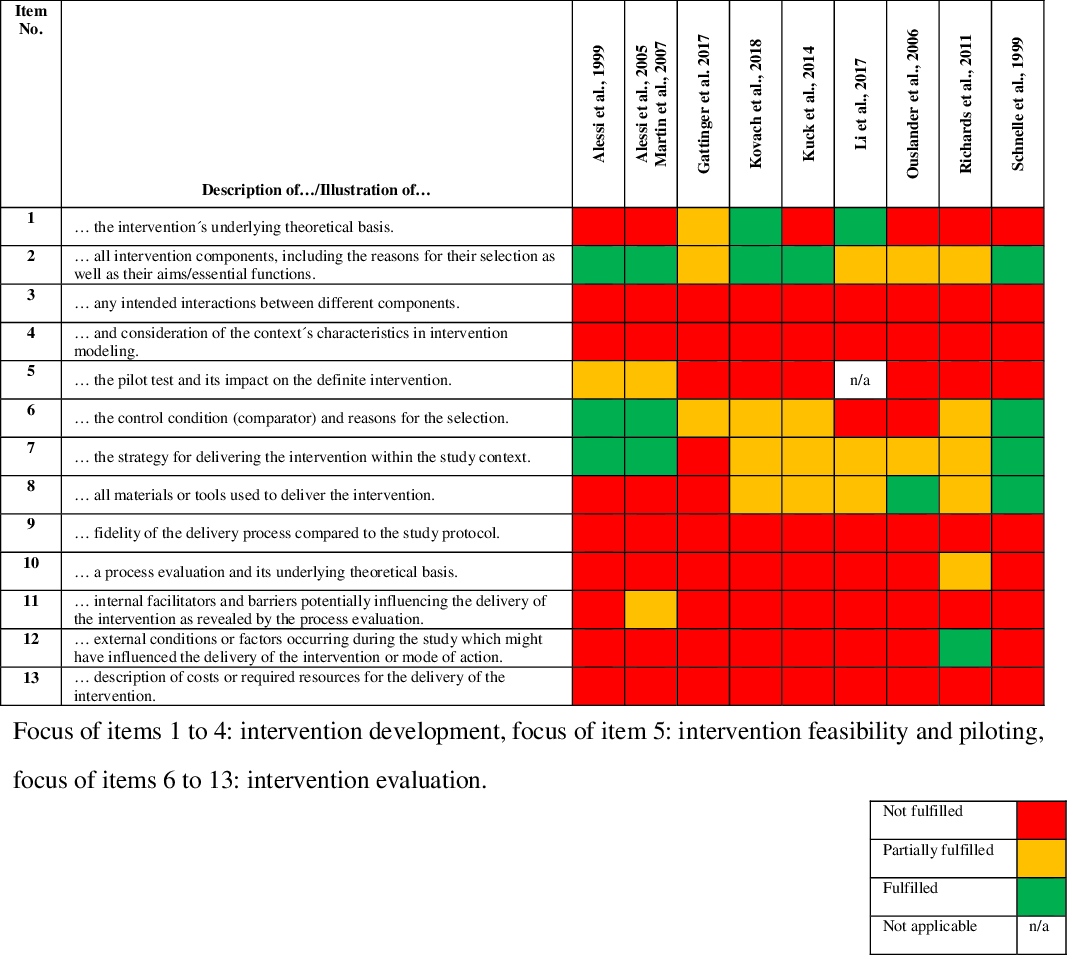
The employed interventions varied in the included studies. Components of included intervention programs were analyzed in detail applying TIDieR (Hoffmann et al., Reference Hoffmann2014) and CReDECI 2 criteria (Möhler et al., Reference Möhler, Köpke and Meyer2015). The analysis based on CReDECI 2 criteria (Figure 3) showed that none of the studies intended interactions between components or considered context’s characteristics in intervention modeling as well as internal and external facilitators or barriers influencing delivery of intervention. Furthermore, none of the studies reported about costs and required resources for the delivery of the intervention. Only two studies (Ouslander et al., Reference Ouslander2006; Schnelle et al., Reference Schnelle, Alessi, Al-Samarrai, Fricker and Ouslander1999) reported about materials or tools used for intervention delivery. None of the studies carried out a comprehensive process evaluation in order to be able to describe the effect of individual intervention components in more detail.
Analysis of included studies based on CReDECI 2 criteria.

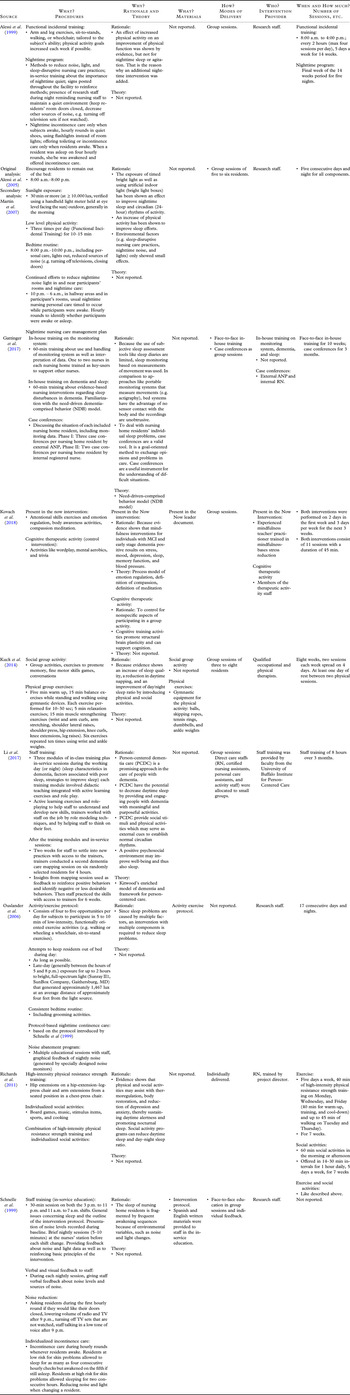
All identified interventions were developed for the implementation in nursing homes. The analyzed approaches showed similarities and differences in procedures, materials, modes of delivery, intervention provider, and intervention period (Table 2).
Description of included multicomponent, nonspharmacological interventions

Abbreviations: ANP, Advanced Nursing Practice; e.g.: example given; MCI, mild cognitive impairment; min: minutes; RN, registered nurse; CG, Control group, IG, Intervention group.
Intervention categories
The included interventions comprised different combinations of nonpharmacological interventions and different procedures. The most often evaluated component included in a multicomponent intervention was some kind of daytime activities like physical exercise (Alessi et al., Reference Alessi, Yoon, Schnelle, Al-Samarrai and Cruise1999; Reference Alessi2005; Kovach et al., Reference Kovach, Evans, Sattell, Rosenau and Gopalakrishnan2018; Kuck et al., Reference Kuck, Pantke and Flick2014; Ouslander et al., Reference Ouslander2006; Richards et al., Reference Richards2011) or social activities (Kuck et al., Reference Kuck, Pantke and Flick2014; Richards et al., Reference Richards2011) and efforts to encourage participants to remain out of bed (Alessi et al., Reference Alessi2005; Ouslander et al., Reference Ouslander2006). Followed by nighttime activities like bedtime routine (Alessi et al., Reference Alessi, Yoon, Schnelle, Al-Samarrai and Cruise1999; Reference Alessi2005; Ouslander et al., Reference Ouslander2006; Schnelle et al., Reference Schnelle, Alessi, Al-Samarrai, Fricker and Ouslander1999) and nighttime care (Alessi et al., Reference Alessi, Yoon, Schnelle, Al-Samarrai and Cruise1999; Schnelle et al., Reference Schnelle, Alessi, Al-Samarrai, Fricker and Ouslander1999). Staff training was evaluated in three studies (Gattinger et al., Reference Gattinger, Hantikainen, Ott and Stark2017; Li et al., Reference Li, Grandner, Chang, Jungquist and Porock2017; Schnelle et al., Reference Schnelle, Alessi, Al-Samarrai, Fricker and Ouslander1999) and light exposure in two studies (Alessi et al., Reference Alessi2005; Ouslander et al., Reference Ouslander2006).
Daytime activities
Physical activities included different types of exercise, such as balance, relaxation, flexibility, and strengthening exercises (Alessi et al., Reference Alessi, Yoon, Schnelle, Al-Samarrai and Cruise1999; Reference Alessi2005; Kovach et al., Reference Kovach, Evans, Sattell, Rosenau and Gopalakrishnan2018; Kuck et al., Reference Kuck, Pantke and Flick2014; Ouslander et al., Reference Ouslander2006; Richards et al., Reference Richards2011). Sessions were tailored to the participants’ ability and were offered several times a day in most studies. All studies delivering physical activities reported mixed findings. Intensity of physical exercises varied between studies, ranging from three times a day for 5 days (Alessi et al., Reference Alessi2005), 40 min for 5 days a week for 7 weeks (Richards et al., Reference Richards2011), or four sessions a day for 5 days for 14 weeks (Alessi et al., Reference Alessi, Yoon, Schnelle, Al-Samarrai and Cruise1999). The intervention was mostly delivered by research staff whereby the exact tasks and roles of the research staff are not described in comparison to the regular nursing home staff. Outcomes were mostly measured by actigraphy. No major differences regarding study design, characteristics of participants, intervention period, and follow-up to studies without improvements in sleep-related outcomes were found. Social activities included, for example, board games, music, stimulus items, and cooking (Kuck et al., Reference Kuck, Pantke and Flick2014; Richards et al., Reference Richards2011).
Alessi et al. (Reference Alessi, Yoon, Schnelle, Al-Samarrai and Cruise1999) identified positive findings for nursing home residents who received a functional training combined with a nighttime program. The RCT by Richards et al. (Reference Richards2011) reported mixed positive findings for residents with sleep problems receiving physical and social activation. The intervention was delivered for 1 hour daily, 5 days a week for 7 weeks by registered nurses. Kuck et al. (Reference Kuck, Pantke and Flick2014) demonstrated mixed findings in sleep-related outcomes, performed an RCT including residents with sleep problems, used actigraphy for outcome measurement, and delivered intervention by occupational and physical therapists for 45 min 2 days a week for 8 weeks.
Efforts to encourage participants to remain out of bed meant trying to get residents out of bed from 8 a.m. to 8 p.m. or as long as possible. Also Ouslander et al. (Reference Ouslander2006) and Alessi et al. (Reference Alessi2005) found mixed positive results, although Alessi et al. (Reference Alessi2005) also delivered the intervention for 5 days by research staff. Ouslander et al. (Reference Ouslander2006) delivered the intervention for 17 days. Both studies measured sleep-related outcomes by actigraphy. Alessi et al. (Reference Alessi2005) included residents with sleep problems at baseline. No clear differences between studies could be clarified that positively influenced sleep.
Nighttime activities
Bedtime routine (Alessi et al., Reference Alessi, Yoon, Schnelle, Al-Samarrai and Cruise1999; Reference Alessi2005; Ouslander et al., Reference Ouslander2006; Schnelle et al., Reference Schnelle, Alessi, Al-Samarrai, Fricker and Ouslander1999) included personal care and efforts to reduce noise and light, e.g. try to keep residents’ room doors closed, try to decrease other sources of noise (e.g. television sets that were turned on but not being watched). Bedtime routine was included in four studies, whereof one study found positive improvements (Alessi et al., Reference Alessi, Yoon, Schnelle, Al-Samarrai and Cruise1999) and the other studies demonstrated mixed positive findings.
Nighttime care programs focused on individualized nighttime incontinence care occurring only when residents were awake (Alessi et al., Reference Alessi, Yoon, Schnelle, Al-Samarrai and Cruise1999; Schnelle et al., Reference Schnelle, Alessi, Al-Samarrai, Fricker and Ouslander1999). The RCT by Alessi et al. (Reference Alessi, Yoon, Schnelle, Al-Samarrai and Cruise1999) showed positive results. Nighttime care was delivered for five nights by research staff, and actigraphy was used as outcome.
Staff training
Interventions offering staff training (Gattinger et al., Reference Gattinger, Hantikainen, Ott and Stark2017; Li et al., Reference Li, Grandner, Chang, Jungquist and Porock2017; Schnelle et al., Reference Schnelle, Alessi, Al-Samarrai, Fricker and Ouslander1999) contained, e.g. modules about nature of sleep, changes in sleep with aging, sleep characteristics in dementia, factors associated with poor sleep, and strategies to improve sleep. One study (Li et al., Reference Li, Grandner, Chang, Jungquist and Porock2017) additionally provided active learning exercises and role-playing for nursing home staff and another study provided case conferences (Gattinger et al., Reference Gattinger, Hantikainen, Ott and Stark2017). Training contents were similar between studies and included characteristics of sleep, changes in sleep with aging, causes of sleep problems, sleep hygiene, stimulus control techniques, and evidence-based strategies to improve sleep. The intervention period differed between studies, ranging from 60 min training and case conferences over a period of 10 weeks (Gattinger et al., Reference Gattinger, Hantikainen, Ott and Stark2017) to 8 hours training over a period of 3 months (Li et al., Reference Li, Grandner, Chang, Jungquist and Porock2017). Two studies providing staff training reported positive results and improved sleep of nursing home residents (Gattinger et al., Reference Gattinger, Hantikainen, Ott and Stark2017; Li et al., Reference Li, Grandner, Chang, Jungquist and Porock2017).
Light exposure
Light therapy (Alessi et al., Reference Alessi2005; Ouslander et al., Reference Ouslander2006) comprised daily sunlight exposure or exposure to bright, full-spectrum light from a light source. These studies showed mixed findings. Light exposure was delivered at >10.000 lux or approximately 1,467 lux.
Rationale and theoretical base of the interventions
Three studies described an underlying theory that guided the intervention development: need-driven-comprised behavior model (NDB model) (Gattinger et al., Reference Gattinger, Hantikainen, Ott and Stark2017), process model of emotion regulation, definition of compassion and definition of meditation (Kovach et al., Reference Kovach, Evans, Sattell, Rosenau and Gopalakrishnan2018), and person-centered dementia care (Li et al., Reference Li, Grandner, Chang, Jungquist and Porock2017). The other interventions were based on results from previous conducted studies.
Materials
Four studies (Kovach et al., Reference Kovach, Evans, Sattell, Rosenau and Gopalakrishnan2018; Kuck et al., Reference Kuck, Pantke and Flick2014; Ouslander et al., Reference Ouslander2006; Schnelle et al., Reference Schnelle, Alessi, Al-Samarrai, Fricker and Ouslander1999) presented information about used materials. Kuck et al. (Reference Kuck, Pantke and Flick2014) described the necessary gymnastic equipment for the physical activity. Two studies (Ouslander et al., Reference Ouslander2006; Schnelle et al., Reference Schnelle, Alessi, Al-Samarrai, Fricker and Ouslander1999) mentioned the use of an intervention protocol. In Schnelle et al. (Reference Schnelle, Alessi, Al-Samarrai, Fricker and Ouslander1999), participants received written materials during the education program. Another study (Kovach et al., Reference Kovach, Evans, Sattell, Rosenau and Gopalakrishnan2018) mentioned the use of an intervention leader protocol. None of the studies reported details about content or scope of protocols.
Modes of delivery
In most of the studies (Alessi et al., Reference Alessi, Yoon, Schnelle, Al-Samarrai and Cruise1999; Reference Alessi2005; Gattinger et al., Reference Gattinger, Hantikainen, Ott and Stark2017; Kovach et al., Reference Kovach, Evans, Sattell, Rosenau and Gopalakrishnan2018; Kuck et al., Reference Kuck, Pantke and Flick2014; Li et al., Reference Li, Grandner, Chang, Jungquist and Porock2017; Schnelle et al., Reference Schnelle, Alessi, Al-Samarrai, Fricker and Ouslander1999), the intervention was carried out in groups. In Reference RichardsRichards et al. (2011), the intervention was delivered individually. No information about the mode of delivery were reported in Ouslander et al. (Reference Ouslander2006).
Intervention provider
In four studies, the intervention was delivered by the research staff (Alessi et al., Reference Alessi1999; Reference Alessi2005; Ouslander et al., Reference Ouslander2006; Schnelle et al., Reference Schnelle, Alessi, Al-Samarrai, Fricker and Ouslander1999). In some studies, different specialists for intervention provision were found: qualified occupation and physical therapists (Kuck et al., Reference Kuck, Pantke and Flick2014); an experienced mindfulness teacher or practitioner trained in mindfulness-based stress reduction (Kovach et al., Reference Kovach, Evans, Sattell, Rosenau and Gopalakrishnan2018); faculty member from the University of Buffalo Institute for person-centered care (Li et al., Reference Li, Grandner, Chang, Jungquist and Porock2017); registered nurse (Gattinger et al., Reference Gattinger, Hantikainen, Ott and Stark2017; Richards et al., Reference Richards2011); or an external APN (Advanced Practice Nurse) (Gattinger et al., Reference Gattinger, Hantikainen, Ott and Stark2017).
Intervention period
The intervention period and number of sessions provided varied between the studies and ranged between 5 days and 3 months. Most of the studies provided the intervention for several weeks (Alessi et al., Reference Alessi, Yoon, Schnelle, Al-Samarrai and Cruise1999; Gattinger et al., Reference Gattinger, Hantikainen, Ott and Stark2017; Kovach et al., Reference Kovach, Evans, Sattell, Rosenau and Gopalakrishnan2018; Kuck et al., Reference Kuck, Pantke and Flick2014; Li et al., Reference Li, Grandner, Chang, Jungquist and Porock2017; Ouslander et al., Reference Ouslander2006; Richards et al., Reference Richards2011). Intervention durations differed between 5 days (Alessi et al., Reference Alessi2005) and 3 months (Li et al., Reference Li, Grandner, Chang, Jungquist and Porock2017). One study (Schnelle et al., Reference Schnelle, Alessi, Al-Samarrai, Fricker and Ouslander1999) did not report information about intervention period.
Effects of the interventions
Three studies (Alessi et al., Reference Alessi, Yoon, Schnelle, Al-Samarrai and Cruise1999; Gattinger et al., Reference Gattinger, Hantikainen, Ott and Stark2017; Li et al., Reference Li, Grandner, Chang, Jungquist and Porock2017) indicated positive findings of nonpharmacological interventions in sleep-related outcomes. Six studies (Alessi et al., Reference Alessi2005; Kovach et al., Reference Kovach, Evans, Sattell, Rosenau and Gopalakrishnan2018; Kuck et al., Reference Kuck, Pantke and Flick2014; Ouslander et al., Reference Ouslander2006; Richards et al., Reference Richards2011; Schnelle et al., Reference Schnelle, Alessi, Al-Samarrai, Fricker and Ouslander1999) reported mixed findings (positive results and no improvements in some outcome variables). Main study findings are displayed in Table 1.
Discussion
In this review, we included 10 publications representing nine interventional studies with a total of 941 participants evaluating multicomponent, nonpharmacological interventions to avoid and reduce sleep disturbances of nursing home residents. The included interventions were heterogeneous in terms of the influencing factors for sleep disturbances addressed, the components used, and the intensity and duration of delivery. The most evaluated intervention categories were daytime activities (n = 6), nighttime activities (n = 4), and staff training (n = 3).
One study analyzing physical activity, one study investigating nighttime activities, and two studies evaluating staff training demonstrated positive findings on sleep-related outcomes. All other studies identified mixed positive findings.
These studies included between two and five intervention components were RCTs and delivered the intervention for a period between 5 days to 3 months.
Also, in our recent Cochrane review (Wilfling et al., Reference Wilfling2015), evaluating single and multicomponent interventions studies providing staff training reported improvements in residents’ sleep (Gattinger et al., Reference Gattinger, Hantikainen, Ott and Stark2017; McCurry et al., Reference McCurry, Gibbons, Logsdon, Vitiello and Teri2005; Reference Higgins2011; Reference McCurry, Lafazia, Pike, Logsdon and Teri2012; Schnelle et al., Reference Schnelle, Alessi, Al-Samarrai, Fricker and Ouslander1999) as well as most studies conducting physical activities (Alessi et al., Alessi et al., Reference Alessi1999; Reference Alessi2005; McCurry et al., Reference McCurry, Gibbons, Logsdon, Vitiello and Teri2005; Reference Higgins2011; Richards et al., Reference Richards2011). For daytime sleep restriction, no significant improvements were found (Ancoli-Israel et al., Reference Ancoli-Israel, Martin, Kripke, Marler and Klauber2002; Wilfling et al., Reference Wilfling2015), but all included studies conducting social activities reported positive findings and improvements in sleep. However, small differences favoring light therapy (Ancoli-Israel et al., Reference Ancoli-Israel2003; Dowling et al., Reference Dowling2005; McCurry et al., Reference McCurry, Gibbons, Logsdon, Vitiello and Teri2005; Reference Higgins2011) were found in the reviews by Wilfling et al. (Reference Wilfling2015) and Capezuti et al. (Reference Capezuti2018).
Unfortunately, we are unable to draw firm conclusions mostly due to the heterogeneity of interventions, lack of methodological quality, and reporting quality. Our review confirmed the results from Capezuti et al. (Reference Capezuti2018), also showing that studies reporting positive findings showed variations in how the intervention was delivered and which intervention components were provided. This reduces the possibility to draw major conclusions. More evidence-based guidance is needed regarding procedures, delivery, frequency, and duration (Capezuti et al., Reference Capezuti2018; van der Ploeg and O’Connor, 2014). Because in this review, interventions were analyzed in detail and important insights in how effective interventions are designed and provided are presented.
Only four studies gave information about used materials. However, it is unclear how intervention protocols, written materials, and handouts were constructed and what content was illustrated. Availability and insight of these materials were not reported. Furthermore, it is not specified whether the materials were created by the research team or not. Interventions were carried out mostly (n = 7) in groups. However, it is mostly unclear how many people joined the group sessions and who moderated and guided the sessions. No information about the presence of nurses and their participation during the intervention were given. In four studies, the intervention was delivered by the research staff, but no information about their qualifications was given. Furthermore, it is unclear who research staff supported and accompanied nurses during the intervention and how nurses were involved in intervention delivery. With regard to the intervention period, heterogeneous results were found. Since the duration of intervention varied between studies (5 days and 3 months), no clear recommendations can be deduced.
Based on the analysis using TIDieR (Hoffmann et al., Reference Hoffmann2014), we identified a lack of important information about intervention components. None of the studies gave information if the intervention was planned to be personalized, titrated, or adapted and if the intervention was modified during the course of the study. None of the studies gave information about intervention adherence and fidelity as well as used strategies to improve and maintain them.
To be able to recommend which components are the most effective, interventions must be developed using adequate mixed-methods studies (Möhler et al., Reference Möhler, Köpke and Meyer2015), and interventions have to be described in detail to allow for replication and implementation in different contexts. Therefore, there is a clear need to develop evidence-based interventions, describe single components in detail based on the criteria mentioned above, evaluate the intervention in a clinical setting, and conduct a comprehensive process evaluation.
It can be assumed that the low or moderate effects of psychosocial interventions are an expression of suboptimal implementation (Craig et al., Reference Craig2013). Future multicomponent interventions to avoid or reduce sleep disturbances in nursing home residents with dementia have to deal with important factors that promote or inhibit successful implementation (Cohen-Mansfield et al., Reference Cohen-Mansfield, Thein, Marx and Dakheel-Ali2012). Important factors for successful implementation are, e.g. easiness to apply the intervention in every care, leadership engagement (Quasdorf et al., Reference Quasdorf2017; Rapaport et al., Reference Rapaport, Livingston, Murray, Mulla and Cooper2017), a dementia-friendly culture (e.g. flexible organizational structures), established networks, and support of local champions (Quasdorf et al., Reference Quasdorf2017). Barriers are, e.g. insufficient resources (Boersma et al., Reference Boersma, Van Weert, Van Meijel and Droes2017) and staff turnover (Boersma et al., Reference Boersma, Van Weert, Van Meijel and Droes2017; Quasdorf et al., Reference Quasdorf2017).
Strengths and limitations
This is the first review summarizing and describing multicomponent, nonpharmacological interventions to avoid or reduce sleep disturbances in nursing home residents in detail. Previous systematic reviews have not described multicomponent interventions in detail. Therefore, we add value to the existing systematic reviews due to analyzing single components of multicomponent interventions based on TIDieR (Hoffmann et al., Reference Hoffmann2014) and CReDECI 2 (Möhler et al., Reference Möhler, Köpke and Meyer2015) criteria. To minimize bias, the whole screening and data extraction process were conducted by two independent researchers.
As a limitation, we did not contact study authors and experts in the field and asked for unpublished and ongoing studies which might be seen as limitation.
Conclusion
This review included nine multicomponent, nonpharmacological interventions aiming to improve sleep in nursing home residents. The analysis of included interventions did not reveal a clear pattern of positive findings. Although principally showing promising results, findings are difficult to interpret as interventions were not well described, and the challenges of developing and evaluating complex interventions (Craig et al., Reference Craig2013) were not sufficiently acknowledged. Positive or mixed positive findings were demonstrated for the intervention categories “daytime activities,” “nighttime activities,” “staff training,” and “light exposure.”
The analysis showed a distinct lack of well-developed theory-based complex interventions based on adequate theoretical models and frameworks as, e.g. the MRC-Framework (Craig et al., Reference Craig2013). As an important step, interventions must be developed using adequate mixed-methods studies (Möhler et al., Reference Möhler, Köpke and Meyer2015), and interventions have to be described in detail to allow for replication and implementation in different contexts.
This review highlights the need to further develop nonpharmacological interventions to improve sleep in nursing home residents. Interventions that target both residents and caregivers should be developed and assessed in methodologically rigorous RCTs taking recommendations for the development and evaluation of complex intervention (Craig et al., Reference Craig2013) into account, especially focusing on relevant processes in a comprehensive process evaluation (Moore et al., Reference Moore2015).
As there is currently no “gold standard” intervention for sleep disturbances in people in nursing homes and as there is a lack of evidence both for pharmacological and nonpharmacological interventions, more research is needed to develop potentially effective interventions.
Conflict of interest
None.
Funding
This review was funded by the German Federal Ministry of Education and Research (BMBF grants 01GL1802A-C).
Description of authors’ roles
Study Design: DW, JH, AB, GM, SK, MH, RM, MND
Literature Search: DW, JH, RM, MND
Data Analysis: DW, JH, MND
First Draft of the Manuscript: DW, JH, AB, GM, SK, MH, RM, MND
Manuscript Preparation: DW, JH, AB, GM, SK, MH, RM, MND
Supplementary material
To view supplementary material for this article, please visit https://doi.org/10.1017/S1041610220000733