

Strong links have been established between health status, attitudes towards driving, and driving behaviour (e.g., driving restriction or cessation) in older adults. For example, from a systematic review of the literature, Marshall and Man-Son-Hing (Reference Marshall and Man-Son-Hing2011) observed that drivers with more chronic medical conditions were more likely to cease or restrict their driving. Similarly, in prospective, longitudinal research studies, Edwards, Lunsman, Perkins, Rebok, and Roth (Reference Edwards, Lunsman, Perkins, Rebok and Roth2009) found that driving cessation of older adults is associated with health declines; and O’Connor, Edwards, Small, and Andel (Reference O’Connor, Edwards, Small and Andel2011) found that decreased driving in older adulthood was significantly related to depressive symptoms and poorer self-rated health compared to older adults with stable health who maintained their driving patterns.
National associations (e.g., American Association of Motor Vehicle Administrators, 2009; Canadian Medical Association, 2012) have identified medical conditions known to affect driving that can assist physicians in determining fitness to drive. The most frequently reported chronic health conditions in drivers aged 64 to 88 include cataracts, arthritis, hearing difficulties, and high blood pressure (Ruechel & Mann, Reference Ruechel and Mann2005). In addition, other deficits affecting vision as well as cardiovascular, pulmonary, musculoskeletal, and neurological systems have been shown to directly affect driving outcomes (Anstey, Wood, Lord, & Walker, Reference Anstey, Wood, Lord and Walker2005). Medical conditions and physical frailty may put older adults at an increased risk of crashes, traffic violations, being stopped by police, and higher likelihood of injury in a car crash (e.g., Marottoli, Cooney, Wagner, Doucette, & Tinetti, Reference Marottoli, Cooney, Wagner, Doucette and Tinetti1994; McGwin, Chapman, & Owsley, Reference McGwin, Chapman and Owsley2000).
Moreover, it has been shown that health symptoms are more strongly associated with driving difficulties than are health conditions (Tuokko, Rhodes, & Dean, Reference Tuokko, Rhodes and Dean2007). Self-ratings of health symptoms affecting the spine and lower body appear particularly relevant to difficulties experienced in performing driving-related behaviors (e.g., shoulder checking, applying the brakes, stepping in or out of a vehicle) involving these lower body areas (Tuokko et al., Reference Tuokko, Rhodes and Dean2007). Anstey, Windsor, Luszcz, and Andrews (Reference Anstey, Windsor, Luczcz and Andrews2006) supported this finding by reporting that self-rated health of older adults aged 70 and older was more predictive of driving cessation than number of medical conditions. Symptoms such as pain, discomfort, and fatigue may interfere with or prevent older adults from safely operating an automobile (Ruechel & Mann, Reference Ruechel and Mann2005).
Self-rated health status has also been shown to be related to driving attitudes and beliefs. Donorfio, D’Ambrosio, Coughlin, and Mohyde (Reference Donorfio, D’Ambrosio, Coughlin and Mohyde2008) surveyed 3,824 older adults aged 50 and older on several measures of health status and attitudes towards driving, and they found that perceived health status was positively related to driving confidence and enjoyment. In a cross-sectional investigation involving a large sample (n = 928) of Canadians aged 70 and older, Tuokko et al. (Reference Tuokko, Myers, Jouk, Marshall, Man-Son-Hing and Porter2013) found that driving comfort (during the day and at night), perceived driving ability, negative perceptions of one’s own driving, and perceptions that others hold negative views about one’s driving were all significantly related to various measures of perceived health status.
Attitudes towards driving have also been shown to be related to self-regulatory driving behaviours. Common self-regulation strategies among older adults include avoidance of difficult driving situations, altering the time of day and length of time driving, not driving in certain road conditions, changing route to avoid busy roads, and reducing driving speed (Ruechel & Mann, Reference Ruechel and Mann2005). Self-regulation increases with age among men and women (D’Ambrosio, Donorfio, Coughlin, Mohyde, & Meyer, Reference D’Ambrosio, Donorfio, Coughlin, Mohyde and Meyer2008; Donorfio, Mohyde, Coughlin, & D’Ambrosio, Reference Donorfio, D’Ambrosio, Coughlin and Mohyde2008), although women have consistently been shown to self-regulate more than men (Brabyn, Schneck, Lott, & Haegerstrom-Portnoy, Reference Brabyn, Schneck, Lott and Haegerstrom-Portnoy2005; D’Ambrosio et al., Reference D’Ambrosio, Donorfio, Coughlin, Mohyde and Meyer2008; Gwyther & Holland, Reference Gwyther and Holland2012; Molnar & Eby, Reference Molnar and Eby2008; Turano et al., Reference Turano, Munoz, Hassan, Duncan, Gower and Roche2009).
Baldock, Mathias, McLean, and Berndt (Reference Baldock, Mathias, McLean and Berndt2006) reported that some of the most commonly avoided driving situations among older adults (i.e., parallel parking and driving at night in the rain) were also the situations in which older drivers reported the least amount of confidence. MacDonald, Myers, and Blanchard (Reference MacDonald, Myers and Blanchard2008) found that perceptions of driving and perceived comfort level were strongly related to self-regulation, and older drivers with a lack of awareness (indicated by a discrepancy between actual and perceived driving ability) were more confident and therefore less likely to engage in self-regulation. Lower comfort and perceived poor driving abilities have been shown to be associated with self-regulatory patterns as reflected in reduced exposure (in distance and duration) and avoidance of driving in challenging situations (Blanchard & Myers, Reference Blanchard and Myers2010). Similarly, Myers, Trang, and Crizzle (Reference Myers, Trang and Crizzle2011) observed that driving comfort scores among older adults were significantly related to actual kilometers driven in the wintertime. Indeed, driving comfort has been shown to be linked to high self-reported annual mileage, as well as being male (Parker, Macdonald, Sutcliffe, & Rabbitt, Reference Parker, Macdonald, Sutcliffe and Rabbitt2001).
It is well-known, then, that health status and driving are related, and robust links have been made among health characteristics (e.g., conditions, symptoms), attitudes towards driving, and self-regulatory driving practices (e.g., restricting or stopping driving). In many other contexts, perceptions of risk and attitudes towards driving behaviour have been proposed to act as mediators between knowledge and the degree to which behaviour is performed (Prochaska & Velicer, Reference Prochaska and Velicer1997). In the context of older drivers, it may be that the relations between perceived health status and driving self-regulatory practices are mediated by driving attitudes and perceptions. This may be particularly evident over time as older adults develop more health-related symptoms that pose an increasing burden on functioning. However, the influence of health-related concerns on older adults’ decision to self-regulate their driving may be dependent on their past and current driving attitudes and perceptions as well as changes in attitudes and perceptions over time. Indeed, although several chronic medical illnesses (e.g., cardiovascular, neurological, and metabolic diseases) are associated with increased crash risk (e.g., Marshall & Man-Son-Hing, Reference Marshall and Man-Son-Hing2011), many individuals remain safe drivers, and the presence of illness does not guarantee that individuals will restrict their driving. Understanding how driving attitudes and perceptions influence the relationship between health status and self-regulatory driving practices will be important in intervention efforts to enhance the safety of older drivers.
Longitudinal data are required if researchers are to understand how driving behaviours, attitudes, and perceptions change over time in older adults. Nevertheless, longitudinal research on driving behaviours is limited, particularly the examination of changes in attitudes and perceptions in relation to changes in health status and self-regulatory driving behaviours. The current study extends previous cross-sectional research on perceived health, attitudes, perceptions, and self-regulatory driving behaviours (Tuokko et al., Reference Tuokko, Rhodes and Dean2007; Tuokko et al., Reference Tuokko, Myers, Jouk, Marshall, Man-Son-Hing and Porter2013) by examining the longitudinal relationships among these variables. Specifically, our study examined the link between changes in perceived health status and self-regulatory driving behaviours, and tested the mediating role of driving attitudes and perceptions in older adults using longitudinal data from the Canadian Driving Research Initiative for Vehicular Safety in the Elderly (Candrive) II study cohort (Marshall et al., Reference Marshall, Man-Son-Hing, Bédard, Charlton, Gagnon and Gélinas2013).
Methods
Participants
Participants (n = 928) were drawn from Candrive II (see Marshall et al., Reference Marshall, Man-Son-Hing, Bédard, Charlton, Gagnon and Gélinas2013, for details) and were recruited from seven cities across four provinces (Ontario, Quebec, Manitoba, and British Columbia). Eligible participants were required to be aged 70 or older, drive a minimum of four times a week for at least one year with a valid license, and not have any medical contraindications that could impair their driving abilities according to the Canadian Medical Association (CMA) Driver’s Guide (2012). These contraindications included untreated obstructive sleep apnea or any other significant sleep disorder, seizure activity, macular degeneration or other visual problems uncorrected by lenses, unstable cardiac condition or heart attack, unexplained fainting spells or loss of consciousness, strokes or transient ischemic attacks, two or more hypoglycemic episodes, hallucinations, a diagnosis of dementia or Alzheimer’s disease, or driving under the influence of alcohol or illicit drugs.
Demographic information was collected at baseline. Participants ranged in age from 70 to 94 (M = 76.21, SD = 4.85) at baseline, 62 per cent (n = 577) were males, and 98.5 per cent were Caucasian. Most participants (45%) had completed some post-secondary education after high school, 19 per cent had obtained a diploma or a trade/technical certificate beyond high school, 26 per cent completed high school, and 10 per cent did not continue beyond grade school.
Attrition was minimal across the three waves of data collection. Selective attrition was examined by comparing baseline characteristics (Time 1; T1) of those who left the study one year later at T2 (n = 46, 5% attrition; 65% males) and two years later at T3 (n = 108, 12% attrition; 65% males) with those who continued. There were no significant differences in age, gender, or education at T2; however, those who dropped out at T3 were significantly older at baseline (M = 77.79, SD = 5.41) than participants who remained in the study (M = 76.01, SD = 4.74), t (926) = –3.39, p = 0.001.
Procedure
Each participating research institution received ethical approval by their respective human research ethics board prior to conducting the study. All participants provided written informed consent. Participants underwent annual comprehensive evaluations of their health status, functioning (sensory, physical, and cognitive), driving habits, and intentions for continuing to drive. Further, psychosocial questionnaires in relation to driving were completed by participants at home and returned by mail within two weeks. Follow-up assessments were also obtained every four to eight months for each assessment period, in which participants were asked to report any changes in their health status, medications, and driving patterns, as well as whether they had had any collisions. We used the first three waves (including baseline assessment) in the study described in this article.
Measures
Health Characteristics
Three measures of perceived health status were selected for examination. The first measure was a single item from the 36-item short-form health survey SF-36 (“In general, how would you say your health is?”) rated on a 5-point scale from excellent (1) to poor (5) (Ware & Sherbourne, Reference Ware and Sherbourne1992). The second measure, the Cumulative Illness Rating Scale (CIRS), was developed by Linn, Linn, and Gurel (Reference Linn, Linn and Gurel1968) to measure medical co-morbidity, or multiple, but not necessarily related, medical conditions encountered in primary care. Miller et al. (Reference Miller, Paradis, Houck, Mazumdar, Stack and Rifai1992) modified the CIRS to reflect common problems of older adults. The modified CIRS evaluates the severity of disease/condition within 14 main body systems (e.g., cardiac, musculoskeletal, endocrine, and metabolic) along 5-point scales ranging from “no problem (1)” to “extremely severe problem (4)”. The expanded CIRS used in the Candrive II study includes the identification of cancer and other disorders (e.g., localized weakness, sleep apnea). The total score ranges from 0 to 71, with a score above 25–30 indicating severe pathology in several systems (Hudon, Fortin, & Vanasse, Reference Hudon, Fortin and Vanasse2005). Good inter-rater reliability has been demonstrated in several studies (Rochon et al., Reference Rochon, Katz, Morrow, McGlinchey-Berroth, Ahlquist and Sarkarati1996; Librero, Peiro, & Ordinana, Reference Librero, Peiro and Ordinana1999) as well as strong validity (Hudon et al., Reference Hudon, Fortin and Vanasse2005) within geriatric care contexts.
The third measure assessed health-related symptoms with items that asked whether participants experience symptoms (e.g., pain, stiffness, limited strength) “at all” (score = 1) or “not at all” (score = 0) in five body areas that are particularly relevant to driving (Steinfeld, Tomita, Mann, & DeGlopper, Reference Steinfeld, Tomita, Mann and DeGlopper1999; Tuokko et al., Reference Tuokko, Rhodes and Dean2007): (a) lower body (4 items), (b) spine (6 items), (c) visual system (2 items), (d) central nervous system (CNS; 5 items), and (e) upper body (4 items). The total number of symptoms endorsed as present was summed for the body as a whole (maximum = 21).
Self-regulatory Driving Behaviours
Scores on the Situational Driving Frequency (SDF) and Situational Driving Avoidance (SDA; MacDonald et al., Reference MacDonald, Myers and Blanchard2008) measures were included as self-regulatory driving outcome variables in our analyses. The SDF and SDA scales were developed for older adults to assess self-reported practices (frequency and avoidance, respectively) concerning driving in challenging situations such as driving at night and on highways. On the 14-item SDF scale, respondents rated how frequently they engage in challenging driving situations on a 5-point scale ranging from “never (0)” to “very often (4)”. Scores can range from 0–56, with higher scores indicating greater frequency of driving in challenging situations. On the 20-item SDA scale, participants were asked to check which challenging situations, if any, they try to avoid. Possible SDA scores range from 0 to 20, with higher scores indicating greater avoidance of challenging situations. Both the SDF and SDA have shown good test–retest reliability with multiple samples (Blanchard & Myers, Reference Blanchard and Myers2010; MacDonald et al., Reference MacDonald, Myers and Blanchard2008).
Psychosocial Variables
The Driving Comfort Scale (DCS; Myers, Paradis, & Blanchard, Reference Myers, Paradis and Blanchard2008) and the Decisional Balance scale (DBS; Lindstrom-Forneri, Tuokko, & Rhodes, Reference Lindstrom-Forneri, Tuokko and Rhodes2007; Tuokko, McGee, & Rhodes, Reference Tuokko, McGee and Rhodes2006) were assessed as psychosocial predictors in the analyses. The 13-item Day and 16-item Night DCS scales (DCS-D and DCS-N, respectively) were developed inductively with older drivers to assess their level of comfort and confidence to drive in different situations, controlling for contexts in relation to traffic flow, speed, and road type. Respondents rate their level of comfort on a 5-point scale (0%, 25%, 50%, 75%, and 100%), from “not at all comfortable” to “completely comfortable”, with higher scores indicating higher levels of driving comfort during the day or at night. These measures have previously demonstrated good person and item reliabilities, as well as temporal stability in older drivers (Blanchard & Myers, Reference Blanchard and Myers2010; Myers et al., Reference Myers, Paradis and Blanchard2008).
The DBS (Lindstrom-Forneri et al., Reference Lindstrom-Forneri, Tuokko and Rhodes2007; Tuokko et al., Reference Tuokko, McGee and Rhodes2006) asks participants to rate their responses on a 5-point scale ranging from “strongly agree (1)” to “strongly disagree (5)” to statements concerning various attitudes towards driving that comprise four subscales. Positive aspects of driving relevant for the individual (Pro-self) are assessed by nine items (e.g., “Driving a vehicle is pleasurable”), with higher scores indicating less positive views of their own driving. Positive aspects of driving relevant to others (Pro-other) are assessed by seven items (e.g., “Others count on me being able to drive”), with higher scores indicating less positive views of driving in relation to others. Negative aspects of driving relevant for the individual (Con-self) are assessed by nine items (e.g., “The financial cost of maintaining a vehicle is an increasing concern of mine”), with higher scores indicating less negative views of their own driving. Negative aspects of driving relevant to others (Con-other) are assessed by six items (e.g., “My driving bothers other people”), with higher scores indicating less negative attitudes of how others view their driving.
Data Analytic Strategy
Longitudinal mediation analyses using structural equation models (SEM) were applied to the data to test whether attitudes and perceptions towards driving mediate the relationship between perceived health-related characteristics and self-regulatory driving behaviours. This analysis permits testing of indirect effects between health-related characteristics and driving behaviours through driving attitudes and perceptions. Initial levels (i.e., baseline) and changes in perceived health characteristics, driving attitudes and perceptions, and behaviours were first computed for each individual and then subsequently used in the mediation path models. Specifically, estimated within-person intercepts and slopes for each variable were computed and subsequently used as manifest variables in the mediation analyses. Changes in each of these variables are discussed by Jouk et al. (elsewhere in this issue).
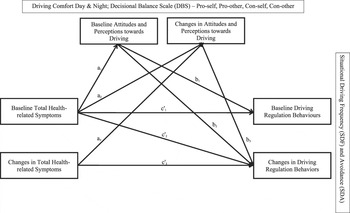
The theoretical mediation model is shown in Figure 1. Initial levels and changes in driving behaviours (i.e., intercept and slope) were regressed on initial levels and changes in perceived health symptoms to represent the direct pathways in the mediation model (denoted as the c′ pathways in the figure). The intercepts and slopes of both perceived health symptoms and driving behaviours were regressed on initial levels and changes in driving attitudes to represent the indirect pathways in the mediation model (denoted as the a and b pathways, respectively). In the case of total or full mediation, all of the observed impact of perceived health symptoms on driving behaviours (i.e., the regression coefficients in the c′ pathways) can be explained or accounted for by the combination of the relations between perceived health symptoms and driving attitudes (i.e., the a pathways) and between driving attitudes and driving behaviours (i.e., the b pathways; Baron & Kenny, Reference Baron and Kenny1986). The resulting c′ effect in a complete mediation would yield a non-significant coefficient. In the case of partial mediation, some, but not all, of the relations between perceived health symptoms and driving behaviours (c′ ) can be explained by the attitudes towards driving, leaving a non-zero c′ unmediated effect (i.e., significant coefficient).
Theoretical mediation model between health-related symptoms, attitudes/perceptions towards driving, and self-regulatory driving behaviours

The mediational role of driving attitudes was tested separately in the analyses for each driving attitude variable (driving comfort day and night and the four dimensions of the DBS) and for each driving behaviour (SDF and SDA) because previous research has shown distinctions between these constructs (Jouk et al., Reference Jouk, Tuokko, Myers, Marshall, Man-Son-Hing and Porter2014). The software package Mplus v7 (Muthén & Muthén, Reference Muthén and Muthén2012) was used to conduct the mediation analyses. Direct and indirect effects were computed using the Model Indirect option in Mplus. Age and gender were included as co-variates in the mediation models to control for their effects.
Results
Descriptive Data
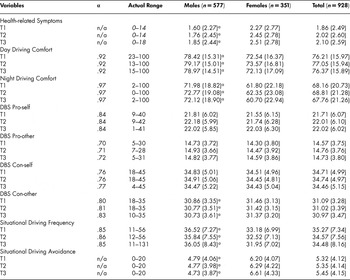
Psychometric data and mean levels of all study variables are presented in Table 1. Women reported more health-related symptoms than men at each time point.
Psychometric properties and mean levels (standard deviations) of health-related symptoms, driving attitudes, and behaviours for males and females
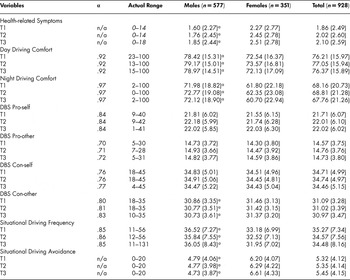
α= Cronbach’s alpha; DBS = Decisional Balance Scale; Pro-self = Higher scores indicate fewer positive perceptions of the respondent’s own driving; Pro-other = Higher scores indicate fewer positive perceptions of the respondent’s driving in relation to others; Con-self = Higher scores indicate fewer negative perceptions of the respondent’s own driving; Con-other = Higher scores indicate fewer negative perceptions of the respondent’s driving in relation to others; n/a = Not applicable as scores are counts.
a Mean levels differ significantly (p < 0.05) between males and females.
Associations between Health-related Symptoms and Self-regulatory Driving Behaviours
Initial analyses examined all of the perceived health characteristic variables, but only health-related symptoms were significantly related to changes in self-regulatory driving behaviours, and thus the remaining health variables (e.g., self-reported number of chronic health conditions and general perceptions of health) were excluded from the analyses. We first examined direct pathways between perceived health-related symptoms and self-regulatory driving behaviours before adding the attitude mediator variables. Situational driving frequency and avoidance were examined separately.
Situational Driving Frequency
Baseline levels of health symptoms were negatively associated with baseline and changes in situational driving frequency (βs = –.50 and –.03, SEs = .11 and .01, p < 0.001 and = 0.007, respectively). That is, individuals who reported more health symptoms at baseline reported driving under fewer challenging situations at baseline, and this increased over the course of the study. Increases in perceived health symptoms over time were also negatively associated with changes in situational driving frequency (β = –.58, SE = .25, p = 0.02), such that individuals who reported increasing health symptoms over the course of the study reported steeper declines in situational driving frequency.
Situational Driving Avoidance
Baseline levels of perceived health symptoms were positively associated with baseline levels of situational driving avoidance (β = .32, SE = .06, p < 0.001). While baseline levels of perceived health symptoms were not related to changes in situational driving avoidance (β = .01, SE = .01, p = 0.11), increases in perceived health symptoms were related to increases in situational driving avoidance (β = .30, SE = .13, p = 0.02). Specifically, participants who reported increasing health symptoms over the course of the study were more likely to increase their avoidance of driving in challenging situations over time.
Mediating Role of Attitudes towards Driving
The indirect effects of the model convey the extent to which driving attitudes mediate the relationship between perceived health symptoms and driving behaviours. Results are discussed separately by type of attitude towards driving and self-regulatory driving behaviour (i.e., situational driving frequency and avoidance). For ease of interpretation, only the significant pathways in the mediation models are presented in the figures, and we discuss only the significant indirect pathways (mediations) here.
Driving Comfort
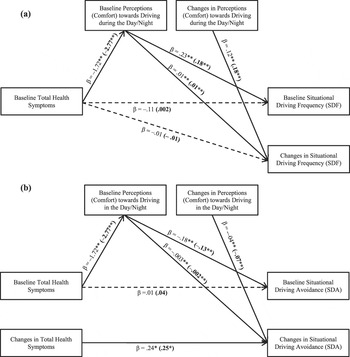
The derived mediation models for driving comfort (day and night) and situational driving frequency and avoidance are shown in Figure 2. The mediation models of driving comfort during both day and night yielded the same significant pathways and are presented simultaneously. Figure 2a depicts results of the driving comfort mediation models for the situational driving frequency outcome. After controlling for driving comfort, baseline levels of perceived health symptoms were not directly associated with either baseline (βs = –.03 and < .001, ps > 0.05 for day and night, respectively) or changes in situational driving frequency (βs = –.01 and –.003, ps > 0.05 for day and night, respectively), indicating a mediation effect. Specifically, a significant indirect effect for both driving comfort day and night (indirect effects: βs = –.12 and –.16; SEs = .02 and .02; 95% CIs = –.15, –.09; and –.19, –.12; ps < 0.001, respectively) confirmed that the association between baseline levels of perceived health symptoms and baseline levels of situational driving frequency was fully mediated by baseline levels of driving comfort. Significant indirect effects also confirmed that the association between baseline levels of perceived health symptoms and changes in situational driving frequency was fully mediated by baseline levels of driving comfort during both the day and night (indirect effects: βs = –.04 and –.05; SEs = .01 and .01; 95% CIs = –.05, –.02, and –.07, –.03; ps < 0.001, respectively). These findings suggest that baseline levels of perceived health symptoms predict initial levels and changes in situational driving frequency through driving comfort as a mediating process.
Results of the mediation models between health symptoms, driving comfort during the day/night, situational driving frequency (a) and avoidance (b), controlling for age and sex. Standardized estimates are presented. Unbolded and bolded values in parentheses represent the mediation models for attitudes towards driving during the day and night respectively. Dashed lines represent full mediation effect. *p < 0.05; **p < 0.01

Results of the driving comfort mediation models for situational driving avoidance are shown in Figure 2b. After driving comfort was entered into the model, the association between baseline levels of perceived health symptoms and baseline levels of situational driving avoidance was no longer significant (βs = .01 and –.02, ps > 0.05 for day and night, respectively), indicating a mediation effect. Specifically, a significant indirect effect for both driving comfort day and night (indirect effects: βs = .16 and .19; SEs = .02 and .02; 95% CIs = .13, .20 and .15, .23; ps < 0.001, respectively) confirmed that the association between baseline levels of perceived health symptoms and baseline levels of situational driving avoidance was fully mediated by baseline levels of driving comfort. In sum, the significant mediation by driving comfort suggests that, during the initial study assessment, elevated levels of perceived health symptoms predict more avoidance of driving in challenging situations because of lower levels of driving comfort.
Negative Attitudes about Driving in Relation to Self (Con-self)
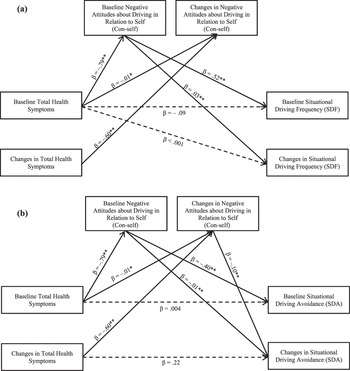
Figure 3 depicts results from the mediation models for Con-self and situational driving frequency and avoidance. As shown in Figure 3a, after controlling for Con-self, baseline levels of perceived health symptoms were not directly associated with either baseline (β = –.03, p > 0.05) or changes (β < .001, p > 0.05) in situational driving frequency, indicating mediation effects. Specifically, significant indirect effects for baseline levels of Con-self confirmed that the association between baseline levels of perceived health symptoms and both baseline and changes in levels of situational driving frequency were fully mediated by baseline levels of Con-self (indirect effects: β = –.13 & –.05, SEs = .02 & .01, 95% CIs = –.15, –.10 & –.08, –.03; ps < 0.001 for baseline and changes, respectively). The significant mediation by Con-self suggests that elevated baseline levels of perceived health symptoms may lead to greater negative attitudes about the individual’s own driving, resulting in situational driving frequency reductions over time.
Results of the mediation model between health symptoms, negative attitudes about driving in relation to self (Con-self), situational driving frequency (a) and avoidance (b), controlling for age and sex. Standardized estimates are presented. Dashed lines represent full mediation effect. *p < 0.05; **p < 0.01

Figure 3b shows results of the Con-self mediation model for the situational driving avoidance outcome. After controlling for Con-self, baseline levels of perceived health symptoms were not directly associated with baseline levels of situational driving avoidance (β = .002, p > 0.05), and changes in perceived health symptoms were not associated with changes in situational driving avoidance after entering Con-self in the model (β = .08, p > 0.05), indicating mediation effects. Examination of the significant indirect effects confirmed that baseline levels of Con-self fully mediated the association between baseline levels of health symptoms and baseline levels of situational driving avoidance (indirect effect: β = .17, SE = .02, 95% CI = .14, .20; p < 0.001), and that changes in Con-self also fully mediated the association between changes in perceived health symptoms and changes in situational driving avoidance (indirect effect: β = .02, SE = .01, 95% CI = .01, .03; p = 0.003). Taken together, these results suggest that perceived health symptoms influence the likelihood of avoiding challenging driving situations through both initial levels of negative attitudes about the individual’s own driving as well as changes in negative attitudes over time.
Negative Attitudes about Driving in Relation to Others (Con-other)
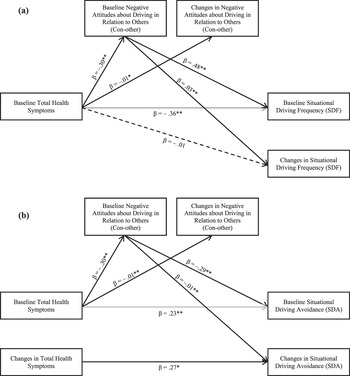
The mediation models for Con-other and situational driving frequency and avoidance are presented in Figure 4. As shown in Figure 4a, after including Con-other in the analysis, the association between baseline perceived health symptoms and baseline situational driving frequency remained significant (β = –.11, p < 0.01), suggesting a partial mediation. The significant indirect effect of baseline Con-other confirmed that the association between baseline levels of perceived health symptoms and baseline levels of situational driving frequency was partially mediated by baseline levels of Con-other (indirect effect: β = –.04, SE = .01, 95% CI = –.06, –.03; p < 0.001). In contrast, the association between baseline perceived health symptoms and changes in situational driving frequency was no longer significant after controlling for Con-other (β = –.03, p > 0.05) and a significant indirect effect confirmed that baseline levels of Con-other fully mediated the association between baseline levels of perceived health symptoms and changes in situational driving frequency (indirect effect: β = –.02, SE = .01, 95% CI = –.04, –.01; p = 0.02). This finding suggests that the association between baseline levels of perceived health symptoms and changes in situational driving frequency can be explained fully by levels of Con-other.
Results of mediation model between health symptoms, negative attitudes about driving in relation to others (Con-other), situational driving frequency (a) and avoidance (b), controlling for age and sex. Standardized estimates are presented. Dashed lines represent full mediation effect. Grey lines represent partial mediation effect. *p < 0.05; **p < 0.01

Figure 4b presents results from the mediation models with situational driving avoidance as the outcome. After controlling for Con-other, the association between baseline perceived health symptoms and baseline situational driving avoidance remained significant (β = .12, p < 0.01), suggesting a partial mediation effect. A significant indirect effect of baseline Con-other confirmed that the association between baseline levels of perceived health symptoms and baseline levels of situational driving avoidance was partially mediated by baseline levels of Con-other (indirect effect: β = .05, SE = .01, 95% CI = .03, .06; p < 0.001). This finding suggests that, at baseline, the association between perceived health symptoms and situational driving avoidance can be partially accounted for by levels of Con-other.
Positive Attitudes about Driving in Relation to Self (Pro-self) and to Others (Pro-other)
No significant mediation effects were found when Pro-self and Pro-other were included in the models for both situational driving frequency and avoidance outcomes.
Discussion
In the current study, we used longitudinal data to examine the relations among health, attitudes, perceptions, and self-regulatory driving behaviours. The results of this study replicate the findings of other studies in that strong links were observed between perceived health and driving behaviours, perceived health and driving attitudes and perceptions, and driving attitudes and perceptions and self-regulatory driving behaviours (e.g., Donorfio et al., Reference Donorfio, D’Ambrosio, Coughlin and Mohyde2008; Edwards et al., Reference Edwards, Lunsman, Perkins, Rebok and Roth2009; Jouk et al., Reference Jouk, Tuokko, Myers, Marshall, Man-Son-Hing and Porter2014; O’Connor et al., Reference O’Connor, Edwards, Small and Andel2011; Tuokko et al., Reference Tuokko, Myers, Jouk, Marshall, Man-Son-Hing and Porter2013). We extended this existing literature by testing whether driving attitudes and perceptions play mediating roles in the observed relations between perceived health and self-regulatory driving behaviours of older adults over the first data collection points of the longitudinal Candrive II study cohort. Little is presently known about the dynamic relations among these factors.
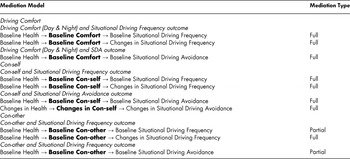
In sum, these results suggest that attitudes and perceptions, particularly with regard to driving comfort (both day and night), negative attitudes about one’s own driving (i.e., Con-self), and the perception that others view one’s driving negatively (Con-other), play important roles in mediating the relations between perceived health symptoms and engaging in self-regulatory driving behaviours (see Table 2 for summary of significant relationships). When we examine the sources of these relations, it is apparent that, at baseline, self-reported descriptions of SDF and SDA are at least in part determined by perceived health symptoms. In addition, it appears that initial reports of health symptoms (i.e., baseline) are related to initial driving attitudes and perceptions (i.e., baseline) and these attitudes and perceptions (e.g., driving comfort) fully mediate the relations between perceived health symptoms and baseline SDF and SDA. The significant mediation by attitudes/perceptions (i.e., driving comfort, Con-self, and Con-other) suggests that, during the initial study assessment, elevated levels of perceived health symptoms predict more avoidance of driving in challenging situations because of lower levels of driving comfort and more perceived negative attitudes towards driving. That is, the significant mediation by attitudes suggests that elevated baseline levels of perceived health symptoms may lead to greater negative attitudes about (or discomfort with) one’s own driving, resulting in fewer situations during which the individual drives and more avoidance of challenging driving situations.
Summary of significant mediational relationships between health-related symptoms, driving attitudes, and behaviours

Bolded terms represent mediating variable. Only significant mediation pathways are summarized.
When we examined these same relations over time (i.e., longitudinal context), we found that the measures of attitudes and perceptions differed with respect to their mediating role in relation to perceived health symptoms and driving behaviours (i.e., SDF, SDA). It was apparent that baseline levels of health symptoms and changes in SDF over time could be explained fully by baseline levels of driving comfort, Con-self, and Con-other. The only measure that fully mediated the relations between changes in perceived health symptoms and changes in driving behaviour (i.e., SDA) was Con-self. It appears, then, that health symptoms influence the likelihood of avoiding challenging driving situations through both initial levels of negative attitudes towards one’s own driving as well as changes in negative attitudes over time. This is consistent with previous research on older drivers based on self-regulatory theory (e.g., Owsley, Stalvey, & Philips, Reference Owsley, Stalvey and Philips2003; Stalvey & Owsley, Reference Stalvey and Owsley2000) as self-awareness of deficits (negative valence) is crucial for making appropriate modifications to driving behavior to reduce risk.
This study contributes to the growing body of literature that examines the links between health characteristics, driving attitudes and perceptions, and/or self-regulatory driving practices (e.g., Carmel, Rechavi, & Ben-Moshe, Reference Carmel, Rechavi and Ben-Moshe2014; Donorfio et al., Reference Donorfio, D’Ambrosio, Coughlin and Mohyde2008; Edwards et al., Reference Edwards, Lunsman, Perkins, Rebok and Roth2009; Jouk et al., Reference Jouk, Tuokko, Myers, Marshall, Man-Son-Hing and Porter2014; O’Connor et al., Reference O’Connor, Edwards, Small and Andel2011; O’Connor, Edwards, Waters, Hudak, & Valdés, Reference O’Connor, Edwards, Waters, Hudak and Valdés2013; Tuokko et al., Reference Tuokko, Myers, Jouk, Marshall, Man-Son-Hing and Porter2013) by demonstrating that attitudes towards driving mediate the relations between perceived health status and self-regulatory driving behaviours at baseline and over time. The strength of these associations is dependent on the measures used to quantify each construct and the amount of time over which the observations are made. In the context of our study, although we examined three self-reported health-related measures, only the measure of health symptoms was significantly related to changes in self-regulatory driving behaviours. In earlier research, this same measure of perceived health-related symptoms was found to be more strongly associated with self-reported driving difficulties than were health conditions (Tuokko et al., Reference Tuokko, Rhodes and Dean2007). Although six measures of attitudes and perceptions were examined, mediation effects were observed only for four (i.e., driving comfort day and night, Con-self and Con-other; see Table 2 for summary). Of these, an association between changes in perceived health symptoms and changes in avoidance of challenging driving situation, mediated by changes in attitudes, was observed only for one (i.e., Con-self). It may be that a study of longer duration would reveal additional associations. At this point, the temporal sequencing of the impact of newly emerging perceived health symptoms on attitudes towards driving and driving behaviours remains unknown.
Certainly, in the context of theories and research on behaviour change, this temporal sequencing has been proposed and observed. For example, both the transtheoretical model of behavior change (TTM; Prochaska & Velicer, Reference Prochaska and Velicer1997) and the precaution adoption process model (PAPM; Weinstein, Reference Weinstein1988) explicitly propose stages in the change process with beliefs (e.g., pros, cons, self-efficacy) and strategies to change mediating movement through the stages. The application of structural equation models to longitudinal data collected over time has provided us with a demonstration of the mediational role attitudes play in understanding the mechanism through which perceived health symptoms are related to driving behaviours.
In this research, we collected data over three points in time at yearly intervals. With additional data, collected over longer time intervals, we anticipate generating greater insights into temporal sequencing associated with changes in perceived health symptoms, attitude change, and driving behaviour. Three additional waves of annual data collection are anticipated from the Candrive II cohort, and when completed, we will be able to examine the development of these and other relations between perceived health, driving attitudes and perceptions, and driving outcomes in future studies. Moreover, as additional longitudinal studies of older drivers are undertaken, a variety of mediators and moderators are likely to become clarified.
In addition to the finite duration of the study, additional limitations of the study must be taken into consideration. First, all of the measures used in this study were self-reports by the participants. It has been demonstrated, by examining actual driving behaviors (e.g., mileage driven or data collected from in-vehicle recording devices), that drivers may not restrict their driving as much as they indicate on self-report measures (e.g., Blanchard, Myers, & Porter, Reference Blanchard, Myers and Porter2010; Crizzle, Myers, & Almeida, Reference Crizzle, Myers and Almeida2013; Crizzle, Myers, Roy, & Almeida, Reference Crizzle, Myers and Almeida2013). Similarly, measures of health provided by a physician following physical examination of the participant may yield different results than self-report measures of health status.
Another limitation is that the measures of perceived health addressed only overall health status, health symptoms, or number of health conditions. The perceived health symptom measure emerged as the only health measure significantly related to changes in self-regulatory driving behaviours, and this may be because it focused specifically on issues associated with driving difficulties (e.g., vision, pain, or stiffness in upper and lower limbs). It may be that selecting or developing other specific driving-related measures of health will prove useful in future studies.
A further potential limitation is the voluntary and restrictive nature of the sample under investigation. When recruited, participants were screened for medical contraindications that could have impaired their driving abilities. This resulted in a sample comprising relatively healthy, active drivers aged 70 and older, and may not be representative of typical drivers in this age group.
Future work with this sample and others will benefit from the examination of additional important variables that may influence self-regulatory driving practices over time. Within the Candrive II data, we will be able to extend our examination of the relationships between measures of attitudes and perceptions and self-regulatory driving practices by examining objective indicators of driving restriction in addition to self-report measures. What’s more, over time, we will be able to identify those factors that most strongly influence driving cessation. A number of specific factors related to individual drivers (i.e., physical health, cognitive status, emotional well-being, sensory state, and driving experience) and more global environmental factors (i.e., social policies, location of driving) interact and may be mediated or moderated through factors such as attitudes, perceptions, self-efficacy, and awareness (Carmel et al., Reference Carmel, Rechavi and Ben-Moshe2014; Lindstrom-Forneri, Tuokko, Garrett, & Molnar, Reference Lindstrom-Forneri, Tuokko, Garrett and Molnar2010; O’Conner et al., Reference O’Connor, Edwards, Waters, Hudak and Valdés2013). A clearer understanding of the influences on self-regulatory driving behaviours may also be of benefit when designing interventions to enhance the safety of older drivers.