


The present study constitutes the seventh member of a series of articlesFootnote 1 in which I publish Armenian lists of biblical books. This article contains, principally, the poetic list attributed to Aṙak‘el of Siwnik‘, a well-known medieval Armenian poet, savant, and scholar who lived from the mid-fourteenth century until 1409. Aṙak‘el was the nephew of the famed theologian and systematician Grigor Tat‘ewac‘i (1344?–1409), whose own canon list was published earlier in this series.Footnote 2 I am basing my text of Aṙak‘el's list on that published in the work of Ter-Movsesian on the Armenian Bible, which I present in a somewhat emended form and with an English translation below. Ter-Movsesian apparently published Aṙak‘el's text from a manuscript that in his day was in the possession of the distinguished scholar Grigor Xalat‘eanc‘.Footnote 3 The fate of this manuscript is unknown; it is not to be identified with any of the copies published here. Ter-Movsesian was also aware of another copy then in Eǰmiacin bearing the number 599. This Miscellany, copied in 1660 in an unknown place, is now preserved as number 702 in the Maštoc‘ Matenadaran in Erevan. The text appears on 186r–189v.Footnote 4
At almost the same time, from 1905 to 1911, Frederick Murad also published Aṙak‘el's list in abbreviated form from Jerusalem, Armenian Patriarchate 345, fols. 116r–117r.Footnote 5 According to Murad this manuscript was also a miscellany, but the text of Aṙak‘el's list is not mentioned in Bogharian's catalogue under this number.Footnote 6 A comparison between Ter-Movsesian's and Murad's texts reveals that they were much the same. To these witnesses I have added here the variants of two other manuscripts, Matenadaran M711 and Matenadaran M7029.Footnote 7 Manuscript M711 also contains Death of Adam and Concerning the 72 Languages.Footnote 8 This list of people and tongues is also included in Book of Questions by Grigor of Tat‘ew, part 6, section 7.Footnote 9 The other copy is available in M7029, fols. 183v–187v.Footnote 10 The manuscript was copied in Constantinople in 1654.
I base my edition below on Ter-Movsesian's text, but with some variations. It is probable that more copies exist, but in the past the work has not been included in the lists of writings of Aṙak‘el Siwnec‘i and so any information available is only incidental.Footnote 11 To judge from the character of the variants in these four witnesses, no great differences affecting the canon list itself are to be expected, even if further copies turn up. In the present paper Aṙak‘el's list is newly introduced into current canonical discussions.
The poem is written in stanzas of four lines with a monorhyme in each stanza. Each line has four feet of two syllables divided at a caesura after the second foot.Footnote 12 This form is common in Armenian medieval poetry and one that Aṙak‘el uses extensively in his Adamgirk‘.Footnote 13
Following Aṙak‘el's poetic list presented here, another as yet unstudied list is given. In the ceremony for the ordination of a bishop, the ordinand expresses his assent to the books of the Old and New Testaments, and the relevant passage listing the books is thus included in the rite.Footnote 14 This passage is provided below after the notes on the text by Aṙak‘el Siwnec‘i.
The Poetic List of Aṙak‘el of Siwnik‘
Sigla and Notes on the Edition of Aṙak‘el's List
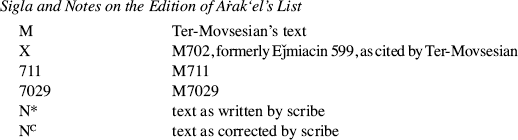
Text: I have followed Ter-Movsesian's text except in instances where I am quite certain that it is corrupt. In those cases, I have introduced variant readings into the text and signaled them in the apparatus. In some cases where I am certain that Movsesian's text is corrupt but do not find a preferable reading among those collated, I have emended his text and put the emendation in pointed brackets: < >. Corruptions allowed to stand are marked with braces: { }.
Apparatus: Movsesian's text, with the occasional emendations mentioned above, forms the lemma. All variants except for +/−  etc., and
 , are noted. When a variant affects the meaning of the text, it has been translated into English in the apparatus. Occasional editorial remarks are introduced into the apparatus following a colon. Observe that M711 has numerous spelling variants.
Translation: In the translation words included in parentheses have been added for reasons of English style and clarification.
1

2
3
4
5
6
7
8
9
10
11
12
13
14
15
16
17
18
19
20
21
22
23
24
25
26
27
28
29
30
31
32
33
34

Apparatus
Title ] om 711 ∣  “short” ] om 7029
1.1 ] om 711 1.3
 ]
 “I wrote as a poem” 711 ∣
 ]
 “this order” 711 ∣
 ]
 711 2.3
 ]
 “you learn” 711 2.4
 ]
 711
 7029 ∣
 ]
 “and two” 7029 3.1
 ]
 711 7029 +
 “books” 711 : M fits scansion better 3.2 incipit ] +
 711 ∣
 ]
 711 3.4
 ]
 X 4.2
 ]
 711
 7029 4.3
 ]
 711 7029 ∣
 ]
 7029 4.4
 ]
 7029 ∣
 ]
 711 5.2
 ]
 711 : M fits scansion better 5.3
 ]
 711 7029 ∣
 ]
 711 ∣
 ]
 711 7029 6.1
 ] 711
 M 7029 ∣
 ]
 711 : the rhyme is in
 (
 )
 in this ms (711) 6.2
 ]
 711 6.3
 ]
 711 6.4
 ]
 711
 7029 7.1
 “Psalms” ]
 “Samam” 711 ∣
 ]
 711 ∣
 ]
 X 7029 7.2
 “of Boaz” ] +
 “is” 711 : M fits scansion better ∣
 ]
 711 7.3
 ]
 with erasure mark 7029 ∣
 ]
 X
 X 711 7.4
 ]
 “and Jesse” 711
 7029 8.2
 ]
 711 ∣
 ] +
 “book(s)” 711 : M fits scansion better 9.2
 ]
 711 10.3
 ] 711
 M
 7029 ∣
 “Bałam” ]
 “Bovam” 711 11.1
 ]
 711 12.1
 ]
 711
 7029 12.2
 ]
 711 ∣
 ]
 711 12.3
 ]
 711 12.4
 ]
 “and the twelve” 711 13.2
 ]
 7029 ∣
 ]
 711 : 711 is one foot too short 14.2
 ]
 711 14.4
 ] over
 prima manu 7029 15.2
 ]
 711 : does not fit scansion 15.3
 1° ]
 711 ∣
 2° ]
 7029 16.2
 ]
 711 17.1
 “one” ]
 “the old” 711 : corrupt 17.3
 ] om 711 ∣
 ]
 711 : corrupt 17.4
 ]
 711 ∣
 ]
 711 18.1
 ]
 711 19.3
 ] om 711 ∣
 “were called, said” ] 711
 “they said” M 7029 20.3
 ]
 “and Judith” 711 ∣
 ]
 “book” 711 : perhaps better ∣
 ]
 711 : corrupt 21.2
 ]
 7029 21.3
 ]
 7029 : M 711 preferable 22.1
 ] 711
 M 7029 ∣
 “this” ]
 “man” 711 22.2
 ] i.e.,
 “five” 711 7029
 “are” M
 “7” X : either M read
 -
 “the five” as
 “are” or 711 7029 read
 “are” as
 -
 “the five”: we prefer 711 7029, cf. 4 Ezra 14:24, 37 22.3
 ]
 711 : corrupt ∣
 ]
 711 24.1
 ]
 711 24.2
 ]
 “and … epistles” 711
 7029 24.3
 ]
 “and of the apostles” 711 ∣
 ] M 7029*
 “acts” X 711 7029c +
 711 24.4
 ]
 711
 7029 ∣
 ]
 “all the” X 7029c25.1
 ]
 711 7029 : perhaps preferable 25.3
 ]
 M
 711
 7029 : a reading with
 “he was” is preferable 25.4
 ]
 “was written” 711 7029 26.1
 ]
 711 : perhaps preferable, scansion 26.3
 ] 711
 M 7029 27.1
 ]
 7029 ∣
 ]
 711 27.2
 ]
 711 ∣
 ]
 “the Spirit gave” 711 : 711 is one syllable too long; M scans if
 is read with “unwritten” ě; regardless, 27.3
 ]
 711 ∣
 ]
 711 : unknown word ∣
 ]
 7029 28.1
 ]
 7029 28.2
 ] +
 “to” 711 7029* : produces one syllable too many ∣
 ]
 711 7029 28.3 This line is one foot (two syllables) too long 29.1
 ]
 X
 “there are pains” 711 : corrupt 29.2
 ]
 711 7029 ∣
 ] om 711 29.3
 ]
 711 ∣
 ] 711 reads as numeral “7” : in stanza 3[.1–2], the total is “seventy-two”; in stanza 21, forty-four in the Old Testament + twenty-eight in the New Testament = seventy-two, but here the total is seventy or seventy-seven and not seventy-two 29.4
 ] +
 “his” 711 : either is possible 30.1
 ]
 711 30.2
 “beauty” ]
 “medicine” 7029 : graphic corruption 30.3
 ]
 711 30.4
 ]
 711 ∣
 ] 711 7029 interprets correctly, as numeral “7” 31.1
 ]
 711 7029 31.2
 ]
 711 ∣
 ]
 7029 31.4
 “we” ]
 “always” 711 ∣
 “we sin” ]
 “I sin” 711 ∣
 “eight” ]
 “according to” 711 : graphic corruption 32.1
 ] 711 7029
 M ∣
 ]
 711 33.2
 ]
 711 33.3
 711 “he carefully wrote … counsel”]
 711
 M 7029 “he wrote counsel for us” 34 totum ] om 711 34.1
 ]
 7029
General Notes on the Structure of Aṙak‘el's Canon
Aṙak‘el reckons the Old Testament to consist of forty-four books and the New Testament of twenty-eight, despite confusion on the numbers noted in the apparatus to 29.3. These numbers are reached by including one apocryphal (but closely biblically associated) work in each Testament: the Testaments of the Twelve Patriarchs in the Old TestamentFootnote 20 and the Dormition of John in the New Testament. I will discuss these below. These two numbers, forty-four and twenty-eight, add up to seventy-two, a figure the author develops typologically as corresponding to the seventy-two languages of the human race, thus symbolizing the universality of salvation.Footnote 21 This alternation between seventy and seventy-two is not infrequent because both figures had numerological significance: 7 × 10 and 12 × 6.Footnote 22
Aṙak‘el divides the Old Testament into three sections called “orders” ( ). His purpose in the list is stated in stanza 2: “so that they (i.e., people) learn the names of the orders.” His use of
 is quite interesting. The names of the orders are, in fact, not given, although those of the biblical books are. In stanza 4 “first” apparently means “first order.” The first order consists of the Pentateuch together with the Testaments of the Twelve Patriarchs. The word
 “in order” is introduced in the last line of stanza 5. In this instance, however, it does not mark the second order, which begins in stanza 6 (see also stanza 13). This second order contains all of the books that can be attributed to the period down to the Babylonian exile, thus including the period of the monarchy. In addition to the books in the collection of the Prophets (Nevi'im) in the traditional Hebrew Bible, it includes Ruth, Psalms, the four books of Solomon (including Wisdom), Job, and Sirach. Uniquely, the figure of Sirach is connected with King Solomon as his chamberlain. The third division, starting in stanza 15, contains books relating to the return and the early second commonwealth, such as Ezra, 4 Ezra (Salathiel), Nehemiah, Chronicles, Daniel, etc. This threefold division is reminiscent of the rabbinic tripartite division of Scripture. The Jewish order of Scripture is known to some Armenian canon lists.Footnote 23 However, although Aṙak‘el's list evidences a tripartite division, the contents of his divisions are not the same as those in the Jewish canon but rather organized on a historical framework.
This list is unique in its poetic form. In addition, it introduces some biblical and apocryphal traditions relating to the various books when it mentions them.
Comments on Particular Stanzas and Lines
5: This refers to the Testaments of the Twelve Patriarchs. This work is found often in Armenian Bible manuscripts.Footnote 24 Adam's name is introduced in 5.4 because Aṙak‘el viewed the Pentateuch as the history of Adam's blessing. He was extremely interested in the stories of Adam and Eve, as witnessed by his long poetic biblical retelling Adamgirk‘ or “Book of Adam”Footnote 25 and Traxtagirk‘ or “Book of Paradise.”
6.1: The text reads  “third,” but it is corrupt for
 “second,” as shown by the phrase “until this point of the second (
 ) order” (but “third” in the corrupt Armenian text) and then by the word “third” in stanza 15.Footnote 26
8: The Wisdom of Ben Sira is included in this second order, apparently because of the tradition cited here that he was King Solomon's chamberlain, a tradition unknown elsewhere. Nothing specific in this text would explicitly tie Job to the period of the Judges and the united monarchy.
10–11: Bałam is a form of the name Jeroboam. In 1 Kgs (3 Kingdoms) 11:27 it is related that he revolted against King Solomon, and according to 1 Kgs (3 Kingdoms) 11:40, 1:2, and 2 Chr 10:2, Jeroboam fled to Egypt until King Solomon's death.
11.1: On the ten tribes, see 1 Kgs (3 Kingdoms) 1:31, 35.
13: Here the exile is the point of division in the historical books.
14: The number of years in the exile, drawn from Jer 25:11–13, 29:10, is seventy. Aṙak‘el makes it seventy-two because of the requirements of his typology. The alternation between seventy and seventy-two is found elsewhere: see page 376 above. There is an overall likeness between the seventy-two books and seventy-two tongues on the one hand and, on the other, Josephus's twenty-two books; the latter are parallel to the twenty-two letters of the Hebrew alphabet and, according to Jubilees 2:15–16, the number of creations—recall that the world was created by speech, i.e., by the twenty-two letters (see also stanza 27.1 below).
15–17: On the two Ezras, see the note to stanza 18 below.
16: On the term “priest” : the ending  of
 would be best attributed to the exigencies of the monorhyme. In general, note that Aṙak‘el introduces grammatical anomalies for the sake of rhyme, such as
 in 15.1,
 in 18.4, as well as in the present instance.
18: The tradition that Scriptures were lost in the destruction of the First Temple and restored by Ezra Salathiel has been isolated and studied. It is a development and rationalization of the narrative of the revelation of Scripture in 4 Ezra 14.Footnote 27
19: The uses of  and cognates in this stanza are plays on the word, which means basically “remainder.” Here we have it in lines 1, 3, and 4.
19.2: The “six” are Ezra and the five scribes who wrote down the divine revelation according to 4 Ezra 14:24, 42.
22.1: Compare this stanza with stanza 17, which already gave the tradition about the two Ezras.
24.1: Regarding the “chapters”: Armenian has a word  , which, like Latin caput, may mean either “head” or “chapter.” Perhaps here the author views the four Gospels as parts of one great composition.
24.4: Regarding  : This byform is quite common.
25.3–4: The Dormition of John is often found in Armenian Bible manuscripts.Footnote 28
26.2: As is the case above (see stanza 18), “testaments” means “books.”
27.1: As noted above (see the note to stanza 14), the number seventy-two (referring both to the number of different tongues and the books of the Bible) is connected with the idea of universal salvation.
29.1: Regarding  : The variant
 , which may mean “there are pains,” is a graphic corruption.
29.4: The meaning of this line is obscure.
31: The calculation is unclear.  , meaning “he is,” is the seventh letter of the Armenian alphabet. It is also a fairly common name for God, translating
 (see Exod 3:14) and the numeral seven. So 7 × 70 = 490 (see Dan 9:24, “seventy weeks”). However, line 2 implies that the total is 480, which does not compute. Then the four elements and eight thoughts or mysteries are adduced, but that adds up to 492, which is a second non-computing total for line 1 of this stanza. Alternatively, we might emend 480 to 490. I have marked it by braces. We exceed, lines 3 and 4 might be interpreted to say, our bodily nature (four elements) by eight thoughts (mysteries), and these can be regarded as not being part of the computation. The reason for the number eight is unclear.
The Rite for the Ordination of BishopsFootnote 29
Are you a disciple of the Old and New Testaments, which were bestowed by the Holy Spirit through the prophets and apostles, and do you swear by this alone to shepherd your peoples and to study and teach the same all your life? Which are:
Genesis, Exodus, Leviticus, Numbers, Deuteronomy,
Joshua, Judges, Ruth, four Kingdoms, two Chronicles,
Job, Solomon, David,
the prophets Isaiah, Jeremiah, Ezekiel, Daniel and the twelve prophets.
And the New Testament, which is:
the holy Gospel of Matthew, of Mark, of Luke and of John;
fourteen epistles of Paul, Acts of the Apostles, seven Catholic Epistles,
and the Revelation of John.
General Notes
1. This list, by its character, is brief. It occurs in the liturgy as part of a series of assents given by the candidates, preceded by an asseveration of belief in the resurrection of the dead and followed by one relating to the Council of Nicea.
2. The character of the text in the 1876 edition remains unknown, and so any possible variations in medieval manuscripts remain unknown.
3. The category of historical books omits various works, some “proto-”canonical like Esther, Ezra and Nehemiah, and some “deutero-”canonical, such as Judith, Tobit, and Maccabees.
4. Presumably “Solomon” includes the Song of Solomon, Proverbs, Qoheleth and the Wisdom of Solomon. “Jeremiah” may well include Lamentations.
5. The New Testament list is standard and does not include Third Corinthians or the Dormition of John.
6. Since it is hard to believe that the Armenian Church did not regard Esther, Ezra, Nehemiah, etc., as canonical, this list cannot be taken as a dogmatic statement of Armenian canon but must be regarded as mentioning the chief works of the Old Testament in an indicative way.


 (General Catalogue of the Armenian Manuscripts in the Maštoc‘ Matenadaran) (vol. 3; Erevan: Magałat‘, 2007) 400. Apparently the variants Ter-Movsesian marks as stemming from “X” were drawn from this manuscript.


 (The Old Armenian Translation of the Revelation of John) (Jerusalem: Sts. James Press, 1905) 296–97.

 (Book of Questions) (Jerusalem: Sts. James Press, 1993; repr. of ibid. Constantinople, 1729) 298.


 (Catalogue of Manuscripts of the Maštoc‘ Matenadaran) (vol. 2; Erevan: Academy of Sciences, 1970) 445–46.
 and two others in
 . The rhyme is very regular, except for line 33.2.
 (Ritual for the Ordination of a Bishop) (Vałaršapat: Catholicossate, 1876) 22.
 .
 (Ritual for the Ordination of a Bishop) (Vałaršapat: Catholicossate, 1876) 21.


