Introduction
Wheat (Triticum spp.) is the most widely sown cereal crop in Turkey. It constitutes the major source of carbohydrates in human nutrition. Both durum (Triticum durum) and bread (Triticum aestivum) kinds of wheat are grown in Turkey (Geçit, Reference Geçit2016). Durum wheat is an important commodity around the world and is used in essential products such as pasta, couscous, bulgur, firik bulgur, breakfast cereals, bread made from durum flour and semolina used in making some desserts such as halva (Elias, Reference Elias, Di Fonzo, Kaan and Nachit1995). In Turkey, wheat was sown on 6.74 million ha in 2021 and 17.65 million tons of grains were produced. Durum wheat was sown over an area of 1.2 million ha producing 3.15 million tons of grain (TUIK, 2022). Martínez-Moreno et al. (Reference Martínez-Moreno, Ammar and Solís2022) reviewed the durum wheat situation in the World. Turkey, Italy, Morocco, Syria, Tunisia, France, Spain, Greece, Canada, Mexico, the USA, Russia, Kazakhstan, Azerbaijan and India are important durum wheat producers. In 2020/21 growing season durum wheat is cultivated on 13.5 million ha (Mha) with a World production of 33.8 million tons (International Grains Council, 2022). Wheat production is significantly affected by biotic and abiotic stresses (Burgess et al., Reference Burgess, Backhouse, Summerell, Swan, Summerell, Leslie, Backhouse, Bryden and Burgess2001). Among these, soil-borne diseases are a crucial limiting factor in wheat production (Seid et al., Reference Seid, Imren, Ali, Toumi, Paulitz and Dababat2021; Sohail et al., Reference Sohail, Erginbas-Orakci, Ozdemir, Jighly, Dreisigacker, Bektas, Birisik, Ozkan and Dababat2022). These diseases cause serious economic losses worldwide (Savary et al., Reference Savary, Ficke, Aubertot and Hollier2012). Fusarium species are one of the most damaging soil-borne pathogens causing direct losses in grain yield and producing mycotoxins that render the derived foods dangerous to humans and animals (Cook, Reference Cook, Bockus, Bowden, Hunger, Morrill, Murray and Smiley2010; Liu et al., Reference Liu, Ma, Yan, Yan, Zhou, Wei, Zheng and Liu2012). Fusarium species cause root, crown and seedling diseases in wheat in addition to head blight (Burgess et al., Reference Burgess, Backhouse, Summerell, Swan, Summerell, Leslie, Backhouse, Bryden and Burgess2001; Cook, Reference Cook, Bockus, Bowden, Hunger, Morrill, Murray and Smiley2010). F. graminearum, F. culmorum and F. pseudograminearum are commonly encountered virulent Fusarium species. Other species such as F. avenaceum, F. acuminatum, F. crookwellense and F. poae are less virulent and more geographically limited (Cook, Reference Cook, Bockus, Bowden, Hunger, Morrill, Murray and Smiley2010). Crown rot and dryland foot rot are common names being used to describe diseases caused by Fusarium spp. resulting in necrosis of root, crown, basal stem and root tissue (Burgess et al., Reference Burgess, Backhouse, Summerell, Swan, Summerell, Leslie, Backhouse, Bryden and Burgess2001; Chakraborty et al., Reference Chakraborty, Liu, Mitter, Scott, Akinsanmi, Ali, Dill-Macky, Nicol, Backhouse and Simpfendorfer2006). The dryland root, foot and crown rots caused by Fusarium species are important diseases of cereals around the globe and their effect is more pronounced under rainfed conditions where drought prevails as well as under wheat monoculture systems (Smiley et al., Reference Smiley, Gourlie and Easley2005; Tunali et al., Reference Tunali, Nicol, Hodson, Uckun, Buyuk, Erdurmus, Hekimhan, Aktas, Aydın Akbudak and Bagci2008; Chakraborty et al., Reference Chakraborty, Obanor, Westecott and Abeywickrama2010). F. culmorum and F. pseudograminearum are the most important species in wheat (Paulitz et al., Reference Paulitz, Smiley and Cook2002; Gebremariam et al., Reference Gebremariam, Karakaya, Erginbas-Orakci, Dababat and Paulitz2020; Bouarda et al., Reference Bouarda, Bassi, Wallwork, Benchacho, Labhilili, Maafa, El Aissami and Bentata2022). Dryland root rots have been reported from West Asia, North Africa (Egypt, Tunisia, Morocco), the USA, Canada, Australia and Turkey (Smiley et al., Reference Smiley, Gourlie and Easley2005; Tunali et al., Reference Tunali, Nicol, Hodson, Uckun, Buyuk, Erdurmus, Hekimhan, Aktas, Aydın Akbudak and Bagci2008; Chakraborty et al., Reference Chakraborty, Obanor, Westecott and Abeywickrama2010; Gebremariam et al., Reference Gebremariam, Paulitz, Erginbas-Orakci, Karakaya and Dababat2018). Yield losses up to 35% have been recorded in the Pacific Northwest (PNW) of the US and 25–58% in Australia, amounting to US$13 million in PNW, and US$80 million in Australia, due to reduced grain yield and quality (Smiley et al., Reference Smiley, Gourlie and Easley2005; Chakraborty et al., Reference Chakraborty, Obanor, Westecott and Abeywickrama2010). In Turkey, the distribution of fungi associated with root and crown rot disease in wheat production areas has been documented with F. culmorum being the most prevalent species followed by F. pseudograminearum (Tunali et al., Reference Tunali, Nicol, Hodson, Uckun, Buyuk, Erdurmus, Hekimhan, Aktas, Aydın Akbudak and Bagci2008; Gebremariam et al., Reference Gebremariam, Paulitz, Erginbas-Orakci, Karakaya and Dababat2018). Crown rot disease caused by F. pseudograminearum has been dramatically increased as a result of the adoption of minimum tillage and stubble retention in soil in some parts of Australia and United States. In addition, water stress in arid conditions accelerates the disease severity (Chakraborty et al., Reference Chakraborty, Liu, Mitter, Scott, Akinsanmi, Ali, Dill-Macky, Nicol, Backhouse and Simpfendorfer2006; Cook, Reference Cook, Bockus, Bowden, Hunger, Morrill, Murray and Smiley2010). Durum wheat is commonly reported as being more severely damaged than bread wheat (Statler and Darlington, Reference Statler and Darlington1972; Nsarellah et al., Reference Nsarellah, Lhaloui, Nachit, Royo, Nachit, Di Fonzo and Araus2000; Kazan and Gardiner, Reference Kazan and Gardiner2018). There are just a few partially resistant sources available for crown rot disease globally in durum wheat (Liu and Ogbonnaya, Reference Liu and Ogbonnaya2015). In Morocco, Bouarda et al. (Reference Bouarda, Bassi, Wallwork, Benchacho, Labhilili, Maafa, El Aissami and Bentata2022) used 10 F. culmorum isolates against 20 durum wheat genotypes under controlled conditions. Most genotypes were susceptible to at least eight isolates. The ICARDA's elites Icaverve, Berghisyr, Berghisyr2, Amina and Icaverve2 were identified as moderately resistant. The severity of crown rot on wheat plants may be assessed under different testing environments such as growth room, greenhouse and field. In the current study, seedling and adult plant resistance reactions of durum wheat germplasm obtained from the CIMMYT durum wheat programme in Mexico against the crown rot disease caused by F. pseudograminearum were determined under growth room and greenhouse conditions. The reactions of the control cultivars 2–49, Bezostaja 1, Kızıltan 91, Sunco and Yelken 2000 were also assessed. A virulent strain of F. pseudograminearum was used to assess the resistance of durum wheat genotypes (Gebremariam et al., Reference Gebremariam, Paulitz, Erginbas-Orakci, Karakaya and Dababat2018). The findings of this study will be of great value to breeding programmes around the World.
Materials and methods
Plant material
A set of 199 spring durum wheat genotypes was provided by the CIMMYT-Mexico durum wheat breeding programme (online Supplement S1). In addition, five control genotypes (2–49, spring bread; Sunco, spring bread; Kızıltan 91, winter durum; Bezostaja 1, winter bread; Yelken 2000, winter durum) known for their reaction to the dryland crown rot caused by F. pseudograminearum were used in this study. Genotypes Sunco and 2–49 were obtained from Australia while Yelken 2000 was obtained from Turkey. These genotypes showed moderately resistant reactions in previous studies. The susceptible genotypes Kızıltan 91 and Bezostaja 1 were obtained from Turkey (Erginbas-Orakci et al., Reference Erginbas-Orakci, Poole, Nicol, Paulitz, Dababat and Campbell2016; Erginbas Orakci et al., Reference Erginbas-Orakci, Kilinc, Eddine, Mokrini and Dababat2022; Yazıcı Kuzu et al., Reference Yazıcı Kuzu, Karakaya, Erginbaş-Orakcı, Dababat and Aydoğan2022).
Fusarium Inoculum Production
A local Fusarium species isolated from a naturally infested field in Kırşehir, Turkey (39° 39′ 709″ N, 32° 37′ 14″ E), molecularly identified as F. pseudograminearum according to Gebremariam et al. (Reference Gebremariam, Paulitz, Erginbas-Orakci, Karakaya and Dababat2018) was used in all tests. The monosporic isolate of F. pseudograminearum was cultured on Synthetic Nutrient Agar (SNA) medium (KH2PO4 1 g, KNO3 1 g, MgSO4⋅7H2O 0.5 g, KCI 0.5 g, Glucose 0.2 g, Sucrose 0.2 g, Agar 20 g, 1000 ml distilled water) at 23°C for 10 days. Oven bags (25 cm × 38 cm) were quarter filled with wheat bran (130 g) and autoclaved at 121°C for 20 min for two consecutive days. One week later, one F. pseudograminearum colonized SNA medium plate and 40 ml of sterilized water were transferred into each bag and left for 2 to 3 weeks at 23°C for sporulation and then left to dry at room temperature under aseptic conditions and thereafter used as the inoculum source for growth room and greenhouse trials (Erginbas-Orakci et al., Reference Erginbas-Orakci, Morgounov and Dababat2018a).
Growth room conditions (Seedling Resistance Screening)
Surface sterilized wheat seeds were placed onto a moist blotting paper in sterile Petri dishes and left to germinate at 23°C for 3 days. Then a single pregerminated seed was sown in a plastic tube (16 cm height × 2.5 cm diam.) (Stuewe and Sons, Corvallis, OR, USA) containing a potting mixture of sterilized sand, field soil and organic matter (50:40:10, v/v/v). Each treatment was replicated five times and tubes were placed in a completely randomized block design. The experiment was repeated twice for data validation. Sand and field soils were sterilized at 110°C for 2 h and organic manure was sterilized at 70°C for 5 h. At transplanting, 1 g of wheat bran containing approximately 5 × 10⁵ spores was added to the potting mixture for plant infestation and pregerminated seeds were planted. To enhance infection, tubes were covered with a plastic tent, watered from the bottom, and kept in the dark for 48 h before removing the plastic cover. Seedlings were left to grow under the growth room conditions for 8 weeks at 23°C, 16 h of artificial photoperiod, and relative humidity of 65 ± 5% as outlined in Mitter et al. (Reference Mitter, Zhang, Liu, Ghosh, Ghosh and Chakraborty2006).
Greenhouse conditions (Adult Plant Resistance Screening)
Single wheat seed was sown in each plastic tube (21 cm height × 3.8 cm diam.) (Stuewe and Sons, Corvallis, OR, USA) filled with the same potting mixture as mentioned above and was inoculated with 1 g wheat bran infested with F. pseudograminearum consisting of about 5 × 10⁵ spores. The plants were left to grow under the greenhouse from March to July (spring wheat growing season) and harvested at maturity. Plants were watered as necessary. Each treatment was replicated three times and placed in a completely randomized block design. The experiment was repeated twice for data validation.
Disease assessment and statistical analysis
Plants were harvested and assessed based on the browning/rotting percentage on the crown which describes the stem (1 cm above soil level) according to the modified 1–5 scale: 1 = 1–9% Resistant (R), 2 = 10–29% Moderately Resistant (MR), 3 = 30–69% Moderately Susceptible (MS), 4 = 70-89% Susceptible (S), 5 = 90–100% Highly Susceptible (HS) (Wildermuth and McNamara, Reference Wildermuth and McNamara1994; Nicol et al., Reference Nicol, Rivoal, Trethowan, van Ginkel, Mergoum and Singh2001; Erginbas-Orakci et al., Reference Erginbas-Orakci, Poole, Nicol, Paulitz, Dababat and Campbell2016).
Analysis of variance was carried out using the JMP 11 statistical package program according to the completely randomized blocks experimental design. The experiments were repeated twice for data validation. Each experiment was analysed separately. Significant differences between the 204 genotypes were calculated using the Least Significant Difference (LSD) test. The degree and significance of the relationship between the results in the greenhouse and the growth room were determined by the Pearson correlation coefficients in growth chamber and greenhouse experiments, separately. In order to ensure that the data conform to the normal distribution, the square root transformation was applied.
Results
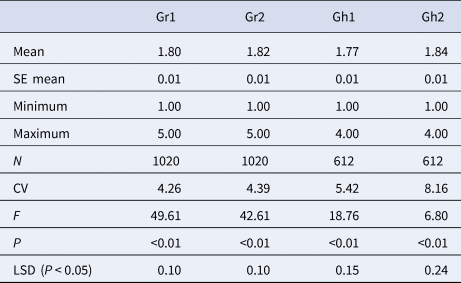
Wheat genotypes showed a large variation for their response to F. pseudograminerum. All five scale values were present in the root and crowns of the genotypes (Fig. 1). Variance analyses revealed significant (P < 0.01) genotype differences (Table 1).
Scale 1-5, developed by Wildermuth and McNamara (Reference Wildermuth and McNamara1994) and modified by Nicol et al. (Reference Nicol, Rivoal, Trethowan, van Ginkel, Mergoum and Singh2001), used to evaluate the response of durum wheat genotypes to Fusarium pseudograminearum.

Descriptive statistics and ANOVA results (CV, F and P values) (Gr, growth room; Gh, greenhouse)

Under growth room conditions, out of the 199 durum genotypes, 15 (7.5%), 20 (10%), 134 (68%), and 30 (14.5%) were found resistant, moderately resistant, and moderately susceptible, and susceptible to F. pseudograminearum, respectively. As expected, the majority of the genotypes were found to be susceptible to F. pseudograminearum. The standard control genotypes Kızıltan 91 and Bezostaja 1 showed susceptible reactions whereas the control genotypes 2–49, Sunco, and Yelken 2000 were moderately resistant to F. pseudograminearum (online Supplement S2). Adult plant resistance reaction study was performed under greenhouse conditions. Out of the 199 durum wheat genotypes screened, 19 (9.6%), 16 (8%), 121 (60.8%), and 43 (21.6%) showed resistant, moderately resistant, moderately susceptible and susceptible reactions to F. pseudograminearum, respectively. The control genotypes Kızıltan 91 and Bezostaja 1 gave susceptible reactions whereas 2–49, Sunco, and Yelken 2000 were moderately resistant to F. pseudograminearum (online Supplement S2).
Durum wheat cv Yelken 2000 (#204) showed seedling resistance (scale value: 2.4) in growth room but did not show adult plant resistance (scale value: 2.7) in greenhouse (online Supplement S2). In this study, two durum wheat lines (#84 and #197) showed resistant reactions to crown rot at both seedling (growth room) and adult stages (greenhouse). Seven genotypes (#36, 37, 67, 92, 152, 189, 199) and cv Kızıltan 91 (#202) showed susceptible reactions to F. pseudograminearum under growth room and greenhouse conditions. Durum wheat genotypes #54 and #64 plus standard control genotype 2–49 (#200) and cv Sunco (#203) showed moderately resistant reactions at seedling (growth room) and adult stages (greenhouse). Eighty five lines and the control cv Bezostaja 1 (#201) showed moderately susceptible reactions at both seedling and adult stages.
A high correlation between the two growth room experiments was found (Pearson correlation coefficient: 0. 82) (P < 0.001). Also, a high correlation between the two greenhouse experiments was observed (Pearson correlation coefficient: 0. 82) (P < 0.001). On the other hand, low correlations were found between growth room and greenhouse studies. The Pearson correlation coefficients were 0.22 and 0.25 between growth room study 1 and greenhouse studies 1 and 2 (P values < 0.001), respectively. Similarly, low correlations were observed between growth room study 2 and greenhouse studies 1 and 2 (r = 0.26 and 0.29, respectively; P values < 0.001).
Discussion
This research showed the presence of resistance to F. pseudograminearum among the CIMMYT genotypes. Under growth room conditions 15 (7.5%), and under greenhouse conditions 19 (9.6%) of the genotypes showed resistant reaction. The majority of the genotypes were moderately susceptible under both growth room and greenhouse conditions (online Supplement S2). Some of the genotypes were even more resistant compared to checks such as 2–49 or Sunco. The virtually generalized susceptibility, often extreme susceptibility, of all durum germplasm groups worldwide was a main factor that discouraged breeding programmes to address resistance to crown rot in their efforts. Results of the present study indicate that usable genetic variability for resistance to crown rot does indeed exist in durum wheat, in this particular case within the elite CIMMYT germplasm. This is highly significant as it opens avenues for resistance breeding, using elite germplasm that allows for a high likelihood of obtaining competitive varieties after a single cycle of breeding/selection.
Although F. culmorum is more common in Turkey, F. pseudograminearum is also present in Turkey and it causes significant yield reductions in the world (Gebremariam et al., Reference Gebremariam, Paulitz, Erginbas-Orakci, Karakaya and Dababat2018; Kazan and Gardiner, Reference Kazan and Gardiner2018). Therefore, the results from CIMMYT genotypes presented here will have useful outcomes to the world countries. In one study, a wide range of wheat genotypes/lines originating from more than 30 countries have been tested against Fusarium culmorum in terms of their resistance by the CIMMYT-SBP program so far (Erginbas-Orakci et al., Reference Erginbas-Orakci, Sehgal, Sohail, Ogbonnaya, Dreisigacker, Pariyar and Dababat2018b). Crown rot assessments under controlled conditions will speed the selection of the resistant genotypes for field trials. The screening system of Wallwork et al. (Reference Wallwork, Butt, Cheong and Williams2004) has allowed the identification of new sources of resistance, demonstrated that 2–49 has good resistance to crown rot, Sunco has a partial level of resistance in adult plants, and there is low to no resistance in durums. Sunco (Wallwork et al., Reference Wallwork, Butt, Cheong and Williams2004; Mitter et al., Reference Mitter, Zhang, Liu, Ghosh, Ghosh and Chakraborty2006) and 2–49 (Wildermuth and McNamara, Reference Wildermuth and McNamara1994) which originated from Australia are documented as partial resistant genotypes to F. pseudograminaerum and are widely utilized worldwide, especially for crown rot research. Li et al. (Reference Li, Liu, Chakraborty, Manners and Kazan2008) also demonstrated that both genotypes are partially resistant to the crown rot disease but water stress enhances the disease severity of 2–49. In another study done by Erginbas-Orakci et al. (Reference Erginbas-Orakci, Poole, Nicol, Paulitz, Dababat and Campbell2016), the tetraploid wheat Kızıltan 91 was used as a susceptible variety whereas genotype 2–49 were moderately resistant to crown rot and foot rot caused by F. pseudograminearum and F. culmorum, respectively. In our study, we have also observed that genotypes Sunco and 2–49 were partially resistant and Kızıltan 91 was susceptible under both growth conditions. Additionally, susceptible and resistance checks gave the expected reaction level in seedling and adult plant tests, it supported the confidence of seedling ratings to use measure resistance. Yazıcı Kuzu et al. (Reference Yazıcı Kuzu, Karakaya, Erginbaş-Orakcı, Dababat and Aydoğan2022), under growth room conditions, evaluated the seedling resistance of bread wheat genotypes to F. pseudograminearum. They found out that out of the 200 tested genotypes; 1 (0.5%), 35 (17.5%), 112 (56%), 45 (22.5%) and 7 (3.5%) were resistant, moderately resistant, moderately susceptible, susceptible and very susceptible to F. pseudograminearum, respectively. In their study, control genotypes Seri 82, and Süzen 97 exhibited susceptible reactions, and 2–49, Altay 2000, Sunco and Carisma showed moderately resistant reactions. In our current study, out of the 199 genotypes tested under growth room conditions; 15, 20, 134 and 30 genotypes exhibited resistant, moderately resistant, moderately susceptible and susceptible reactions, respectively. Under greenhouse conditions; 19, 16, 121 and 43 genotypes were found resistant, moderately resistant, moderately susceptible and susceptible, respectively. In our study, under both growth room and greenhouse conditions, control genotypes Sunco and 2–49 were moderately resistant. The durum wheat lines # 84 and # 197 showed resistant reactions under both growth room and greenhouse conditions and therefore, they look promising for breeders.
The damage to cereals caused by soil-borne pathogens especially fungi of members of the Fusarium genus is known in wheat-producing areas globally. The present study identified the resistance within the CIMMYT germplasm. The results seem promising in developing new germplasm resistant to crown rot. The selected germplasms should be further tested in field trials under natural conditions for durable adult resistance and also yield potential, especially under naturally infested dryland field conditions. Implementing the resistant germplasm with other cultural practices such as crop rotation and other Integrated Pest Management (IPM) programmes will ultimately reduce the damage and increase the grain yield (Erginbas-Orakci et al., Reference Erginbas-Orakci, Dababat, Morgounov and Braun2013). In this context, finding promising durum wheat genotypes in terms of resistance to the disease is quite important for breeding programmes interested in tackling crown rot disease. Results from the present study reliably indicate that sources of resistance can be found, with resistance at seedling and adult plant stages, and that these sources are all the more valuable since they are from an elite group of germplasm.
Supplementary material
The supplementary material for this article can be found at https://doi.org/10.1017/S147926212300093X
Acknowledgments
The authors would like to thank the Turkish Ministry of Agriculture and Forestry for their support. Thanks go to CIMMYT-Mexico durum wheat breeding programmes for providing wheat germplasm.