Introduction
Dementia is a neurodegenerative syndrome affecting multiple aspects of life through cognitive impairment as well as diminished daily functioning and neuropsychiatric symptoms (NPS). The large heterogeneity in the development of symptoms over time causes high uncertainty about the prognosis for patients, as well as their families and physicians. Upon diagnosis, many questions about the future may arise, which are often difficult to answer due to the large variation in symptom presentation and course, both within and between the patients. Despite this obvious knowledge gap in dementia prognosis, most research focuses on an earlier time frame, e.g. in order to predict the onset of dementia in people with mild cognitive impairment (Cooper et al., Reference Cooper, Sommerlad, Lyketsos and Livingston2015). The studies that did focus on dementia symptoms after diagnosis were mostly cross-sectional and tended to focus on a single domain – often being cognition – despite the fact that factor analysis has clearly indicated the presence of three distinct dementia domains (Tractenberg et al., Reference Tractenberg, Aisen, Weiner, Cummings and Hancock2006).
Examining cognitive symptoms only is an incorrect conceptualization of dementia and is inadequate to fully inform patients about their disease course. This flaw was already recognized in 1989, when a study examining mental status and daily functioning in dementia concluded that dementia is a “complex concept that is not well represented by a single score” (Reed et al., Reference Reed, Jagust and Seab1989). A recent study by Green and Zhang (Reference Green and Zhang2016) also emphasized the importance of a multidomain approach, by showing that a significant amount of patients suffered from decreased functional abilities and increased NPS, while their cognitive state remained constant. Despite these calls for multidomain research, and while the prevalence of dementia remains on the increase (Satizabal et al., Reference Satizabal, Beiser, Chouraki, Chene, Dufouil and Seshadri2016), studies on how the different symptom domains of dementia develop in patients over time are lagging behind (Brodaty et al., Reference Brodaty, Connors, Xu, Woodward and Ames2015).
To date, we are aware of only five studies that have simultaneously examined the interrelation of the three domains of dementia (Chen et al., Reference Chen, Sultzer, Hinkin, Mahler and Cummings1998; Tekin et al., Reference Tekin, Fairbanks, O'Connor, Rosenberg and Cummings2001; Tractenberg et al., Reference Tractenberg, Aisen, Weiner, Cummings and Hancock2006; Tschanz et al., Reference Tschanz2011; Green and Zhang, Reference Green and Zhang2016) and only two of them were longitudinal (Tschanz et al., Reference Tschanz2011; Green and Zhang, Reference Green and Zhang2016). None of these studies have modeled trajectories of different dementia domains jointly to appropriately examine their relatedness over time. Increasing our knowledge on the relationship between the trajectories of the different symptom domains may not only provide important prognostic information for clinical practice, but can also be useful for informing future research regarding the choice of outcome measures. Therefore, this study aimed to investigate how the cognitive, functional, and NPS trajectories of individuals with dementia are interrelated over time.
Methods
Participants
Data from the Clinical Course of Cognition and Comorbidity (4C) study were used in this study. The 4C study was a multicenter longitudinal, prospective cohort study conducted at the Alzheimer Centers of Amsterdam, Maastricht and Nijmegen, the Netherlands (Liao et al., Reference Liao2016). Of all consecutive patients seen in 2010–2011 in these Alzheimer centers, 331 gave informed consent to participate. All subjects were newly diagnosed with mild to moderate dementia according to the Diagnostic and Statistical Manual of Mental Disorders (DSM-IV-TR) criteria (American Psychiatric Association, 2000). A detailed description of the inclusion criteria and the diagnostic workup can be found elsewhere. Included patients were followed yearly for a maximum period of three years. Three local ethics committees approved the study.
Measures of dementia progression
The following measures were obtained at baseline as well as during the follow-up visits. Cognitive status was measured by a physician using the Mini-Mental State Examination (MMSE) (Folstein et al., Reference Folstein, Folstein and McHugh1975). This is a widely used measure for global cognitive functioning, which ranges from 0 to 30, with higher scores indicating better cognitive functioning. The Disability Assessment for Dementia (DAD) was used to measure functional abilities, by assessing both basic activities of daily living (ADL), such as dressing and bathing, as well as instrumental activities of daily living (iADL) such as grocery shopping and telephoning (Gélinas et al., Reference Gélinas, Gauthier, McIntyre and Gauthier1999). Total score was expressed as a percentage, with higher scores indicating better functional performance. NPS were scored using the neuropsychiatric inventory (NPI) that evaluates 12 neuropsychiatric disturbances common in dementia. The rated severity and frequency of each NPS were multiplied to obtain the total NPI score, ranging from 0 to 144, with higher scores indicating more (severe) symptoms (Cummings, Reference Cummings1997). In addition, the global Clinical Dementia Rating (CDR) scale, ranging from 0 to 3.0 (higher is worse), was used by the physician to assess dementia severity (Hughes et al., Reference Hughes, Berg, Danziger, Coben and Martin1982) and the EuroQol 5 dimensions (EQ-5D) descriptive system with three levels per question was used to assess perceived quality of life (QoL), ranging from 0 to 1, with lower scores indicating a lower QoL (Rabin and Charro, Reference Rabin and Charro2001). The DAD, NPI, and EQ-5D were assessed by a research assistant and based on information provided by the patient's informant.
Statistical analyses
Pearson's correlation coefficients were calculated to examine the interrelation between the different dementia outcomes at baseline. To examine the interrelation between the different outcomes over time, we built multilevel models for MMSE, DAD, and NPI with linear and quadratic growth factors (time and time2) and time-varying covariates. The intercept and the linear time terms were allowed to vary across individuals (i.e. random effects). A random quadratic slope was tested but did not further improve the fit of the unconditional growth models and was, therefore, constrained to zero (Singer and Willet, Reference Singer and Willet2003). Homoscedasticity and normality of errors were confirmed by visual inspection of residual plots. Time-varying covariates allowed us to look at the relationships between the different outcomes at corresponding points over time. In all models, the intercept was adjusted for age, gender, and education and all covariates were mean-centered. A significance threshold of α = 0.05 was used to assess the coefficients for each covariate.
In addition, we built parallel-process growth models for all pairs of dementia domains. In this type of model, two processes are modeled jointly, which enabled us to explicitly model the correlations between the random effects on the slopes (Corcoran et al., Reference Corcoran2008). Analyses were conducted using SAS version 9.2 and Mplus version 7.4.
Results
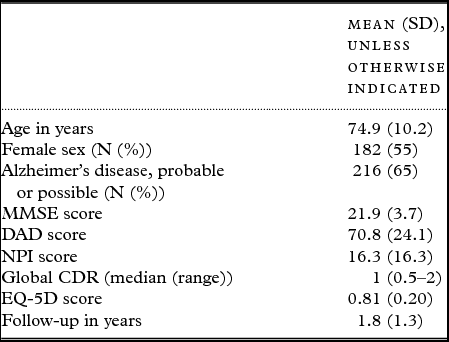
We followed 331 incident dementia cases of whom 216 had probable or possible Alzheimer's disease (AD), 71 suffered from vascular dementia or AD with a vascular component, and the remaining 44 subjects were diagnosed with various other dementia types. The participants had a mean (SD) age of 74.9 (10.2) years at inclusion and were in majority female (182, 55%). The average follow-up time was 1.8 years (range: 0.00–3.57). Table 1 presents the participant's characteristics at the time of diagnosis.
Baseline characteristics of participants (N = 331)

MMSE = mini mental state examination; DAD = disability assessment for dementia; NPI = neuropsychiatric inventory; CDR = clinical dementia rating; EQ-5D= EuroQol 5 dimensions.
Baseline correlations
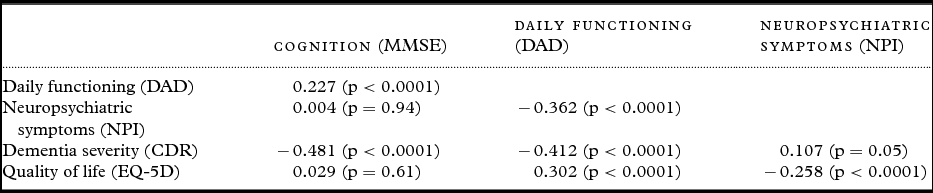
At baseline, daily functioning was significantly correlated with increased cognitive abilities and with fewer NPS. In contrast, cognition did not correlate with NPS at baseline. Both cognition and daily functioning were negatively correlated with dementia severity and the correlation between severity and NPS approached significance (r = 0.107, p = 0.05). In addition, QoL was significantly correlated with fewer NPS and increased daily functioning, while QoL did not correlate with cognition. All correlations are depicted in Table 2.
Pearson's correlations of dementia outcomes at baseline

MMSE = mini mental state examination; DAD = disability assessment for dementia; NPI = neuropsychiatric inventory; CDR = clinical dementia rating; EQ-5D = EuroQol 5 dimensions.
Course of dementia domains
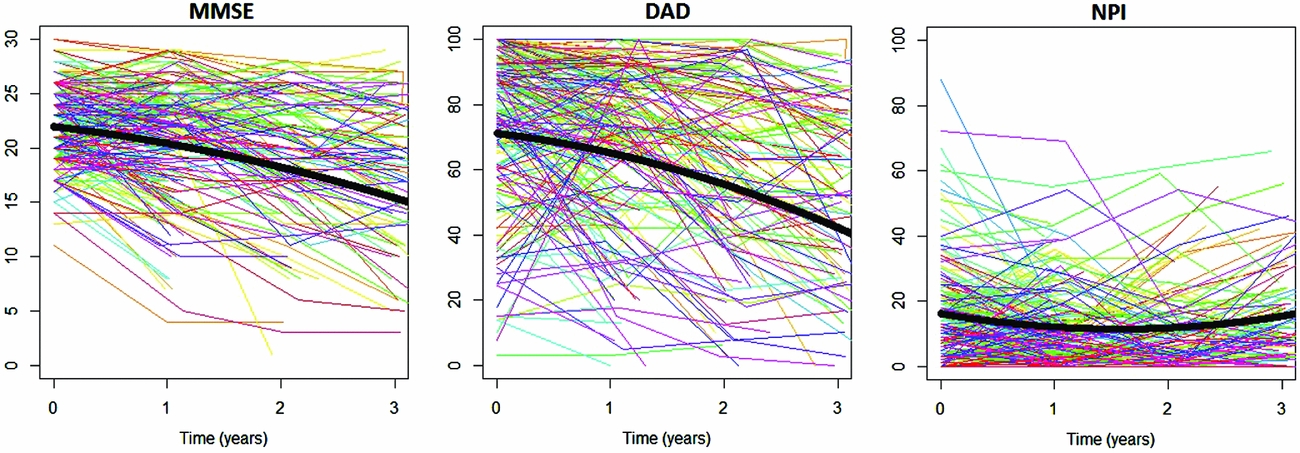
The unconditional growth models for each dementia domain are depicted in Figure 1. All three models showed significant between-person variance in intercept and slope as well as within-person variance in progression. The models for MMSE and DAD showed accelerated decline over time, while the model for NPI showed a slightly u-curved shape. Overviews of all parameter estimates of these unconditional growth models are presented as model 1 in Appendixes 1–3 (MMSE: Appendix 1; DAD: Appendix 2; NPI: Appendix 3, available as supplementary material online attached to the electronic version of this paper at https://doi.org/10.1017/S1041610217000321).
Mean growth curves (black) based on the individual trajectories for cognitive (MMSE), functional (DAD), and neuropsychiatric (NPI) progression of all participants (colored). MMSE = mini-mental state examination (range: 0–30, lower is worse); DAD = disability assessment for dementia (%, lower is worse); NPI = neuropsychiatric inventory (range: 0–144, higher is worse).

Interrelations over time: individual growth models
The interrelation between the different dementia domains as well as their relationship with perceived QoL and dementia severity are described for each model separately in the following sections.
Cognitive functioning
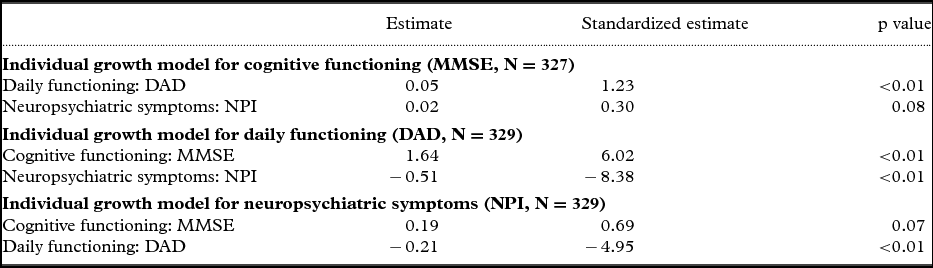
Over time, better daily functioning was significantly associated with better cognitive abilities. One standard deviation increase in DAD score corresponded to an average 1.23-point increase in MMSE at the same time point. In contrast, time-varying NPS showed no significant association with cognition at the same time point. The effects of the time-varying covariates on the growth model of MMSE are summarized in the top part of Table 3.
Multivariable effects of time-varying covariates in the three individual growth models of dementia domains: cognitive functioning, daily functioning and neuropsychiatric symptoms

MMSE = mini mental state examination; DAD = disability assessment for dementia; NPI = neuropsychiatric inventory.
Daily functioning
Over time, both cognition and NPS were significantly associated with daily functioning. Better cognitive abilities were associated with better daily functioning, with one standard deviation increase in MMSE corresponding to an average 6.02% increase in DAD score at that same time point. In addition, more NPS were associated with worse daily functioning over time, with one standard deviation increase in NPI corresponding to an average 8.38% decrease in DAD at that same time point. The effects of the time-varying covariates on the growth model for DAD are summarized in the middle part of Table 3.
Neuropsychiatric symptoms
Over time, increased daily functioning was significantly associated with fewer NPS. One standard deviation increase in DAD corresponded to an average 4.95-point decrease in NPI score at the same time point. Cognition showed no association with NPS at the same time points. The effects of the time-varying covariates on the growth model for NPI are summarized in the lower part of Table 3.
Associations between the domains and severity of dementia
All three domains were strongly associated with changes in dementia severity over time. More severe dementia was related to worse cognition and daily functioning and worse NPS (all p < 0.01). One standard deviation increase in CDR corresponded to an average 1.83-point decrease in MMSE, 8.99% decrease in DAD, and 1.83-point increase in NPI at the same time point.
Associations between dementia domains and quality of life
Both NPS and daily functioning were significantly associated with changes in perceived QoL over time, while cognition was not (β = −0.01, p = 0.92). Higher QoL was related to improved daily functioning and decreased NPS (both p < 0.01). One standard deviation increase in EQ-5D was associated with an average 2.97% increase in DAD score and a 2.41-point decrease in NPI at the same time point.
A more elaborate overview of the growth models after the addition of time-varying covariates is presented in Appendixes 1–3 (MMSE: Appendix 1; DAD: Appendix 2; NPI: Appendix 3).
Correlations between rates of change: parallel-process growth models
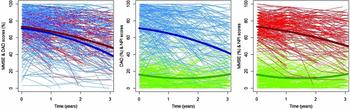
In order to quantify the correlation between the changes in the various dementia domains, parallel-process models were built for all pairs of the three dementia domains, as depicted in Figure 2. The parallel-process growth model for daily functioning and cognition showed significant correlation between the random slopes (r = 0.85, p < 0.01), just like the model for NPS and daily functioning (r = −0.60, p < 0.01). In the model for NPI and MMSE, the correlation between the random slopes was much smaller and did not reach statistical significance (r = −0.20, p = 0.06).
Parallel-process growth models for all pairs of dementia domains. MMSE = mini-mental state examination (lower is worse, red lines); DAD = disability assessment for dementia (lower is worse, blue lines); NPI = neuropsychiatric inventory (higher is worse, green lines). On the y-axes MMSE and DAD values are shown in percentages, while NPI scores were shown on their original scale (range: 0–144) to enhance visualization.

Discussion
The results show a marked lack of association between cognitive and neuropsychiatric progression in dementia. This lack of association was already observed at baseline and was persistent across different models over time. Decreased daily functioning was associated with both NPS and decreased cognitive abilities, where the association with cognition was strongest. These results are in line with those of a previous study (Tschanz et al., Reference Tschanz2011). Changes in all three domains correlated with the change in overall dementia severity as measured with CDR, which is unsurprising given the presence of cognitive and functional items in the CDR and the observed correlation between NPS and functioning. Associations between QoL and the three dementia outcomes were generally low, suggesting that QoL depends to a large extent on factors outside of these models. Baseline dementia outcomes were among themselves generally less correlated than their trajectories over time. This suggests that factors outside of the model influenced the starting position of an individual with dementia.
These results show that in order to provide accurate prognostic information, the current research perspective of dementia has to undergo at least two important changes.
First, the fact that not all dementia domains appeared to develop in the same manner over time, highlights the importance of using multiple outcome measures when examining the status and prognosis of dementia patients. The divergence of cognitive and neuropsychiatric trajectories underlines the importance of taking the multidimensionality of dementia into account. This is also emphasized by the fact that not all domains appeared to affect the person with dementia in the same manner, since daily functioning and NPS, but not cognitive functioning, were associated with QoL. When exploring the dementia phenotype it does not suffice to solely look at cognitive functioning, as progression in one domain may not be representative of progression on other domains. While prognostic models dominantly include disease characteristics, such as dementia severity and neurological deficits, these factors appear to be underrepresented in modeling of psychosocial outcomes. A recent literature review indicated that the lack of disease characteristics in the latter may lead to misinterpretation of the behavior of people with dementia (Zwijsen et al., Reference Zwijsen, van der Ploeg and Hertogh2016). Our results show that research on dementia prognosis may have an equally narrow focus, yet dominantly focusing on the inclusion of disease characteristics with an underrepresentation of social and other contextual factors on disease progression. Therefore, it is important to use a variety of outcome measures, covering all three dementia domains as well as other outcomes such as QoL, when examining dementia progression.
Second, the large heterogeneity between the different domains within persons as well as the limited associations between dementia domains and QoL indicate the need to look beyond disease-related variables when examining the prognosis of dementia. In addition, these results add to the growing body of evidence on discrepancy between brain pathology and phenotypes (Savva et al., Reference Savva, Wharton, Ince, Forster, Matthews and Brayne2009). Although all dementia domains were associated with dementia severity, their phenotypical presentation over time differed across subjects, indicating differences between subjects who supposedly suffered from the same syndrome. This was also noted in a review on NPS patterns in community-dwelling dementia patients (Borsje et al., Reference Borsje, Wetzels, Lucassen, Pot and Koopmans2015). These differences in disease presentation suggest that the heterogeneous development of dementia may rather emerge from an interplay of multiple factors than from a single, well-defined disease. As such, our observations fit directly into the dynamic polygon hypothesis, which states that the phenotype of dementia is influenced by a range of environmental and genetic factors (Fotuhi et al., Reference Fotuhi, Hachinski and Whitehouse2009). It goes far beyond the linear amyloid cascade hypothesis to include, for example, also the influence of cognitive reserve and comorbidities amongst many other personal factors. Besides the obvious influential factors, such as medication, engagement in social activities and the social network of a person with dementia may also play a role in dementia progression (Vernooij-Dassen and Jeon, Reference Vernooij-Dassen and Jeon2016). In the present study, the operationalization of daily functioning as (i)ADL relates to two dimensions of social health: “the capacity to fulfill one's potential and obligations” and “managing life with some degree of independency”. The other dimension of social health, relating to participation in social activities, is less well represented in our study, despite its likely influence on dementia progression (Dröes et al., Reference Dröes2017). For dementia onset, evidence of the importance of engaging in social activities is already available (Paillard-Borg et al., Reference Paillard-Borg, Fratiglioni, Xu, Winblad and Wang2012). The relatively weak associations between QoL and the three dementia domains, do not only indicate the influence of factors outside of the models, but might also reflect the variation in preference for either physical, cognitive, or social activities among individuals resulting in different priorities when assessing QoL. These results suggest that a broader perspective is crucial to understand the heterogeneity in the impact of dementia on the lives of persons coping with the disease and their relatives. This is in line with the shifting focus from the narrow-minded biomedical model of disease toward a “biopsychosocial model” of disease, including not only the patient, but also the social context and the society's system to deal with illness (Covinsky and Landefeld, Reference Covinsky and Landefeld1996). A broader perspective was also suggested for understanding the impact of chronic diseases in general with the introduction of the term “personomics.” This term emphasizes the influence of an individual's unique life circumstances such as social health on disease phenotype (Ziegelstein, Reference Ziegelstein2015).
Although clinicians are generally aware of the multidimensionality and the importance of personal characteristics, measures for these contextual factors are often lacking in longitudinal dementia research. Potentially influential factors of dementia progression are thus frequently ignored in research. This negligence is particularly worrisome since QoL in dementia patients is dependent on contextual factors in addition to disease-related changes and could particularly pose a problem in older populations with dementia, in which frailty and multimorbidity are extremely common. These results emphasize that it is essential to collect evidence that is broad enough to have meaning to patients in clinical practice. Thus, we should continue to remind ourselves that research models will always be a simplification of reality and therefore insufficient for the care of patients, especially so when a disease-oriented view is used and the patient's context is ignored (Heath, Reference Heath2016). Future studies on dementia prognosis should, therefore, aim to perform repeated measures of the individual's profile, including comorbidity, frailty, and social health status, besides the commonly used measures for dementia progression. To enhance generalization it would be preferable to collect a standardized set of contextual variables through sharing initiatives such as The Older Persons and Informal Caregivers Survey Minimum DataSet (TOPICS-MDS) (Lutomski et al., Reference Lutomski2013).
The present study used multiple dementia outcomes and included them simultaneously in multivariate parallel-process models. By modeling the quadratic trajectories of different dementia domains jointly, this study offers unique insight into the relatedness of the different domains over time. Data from a clinical cohort was used for this study, which means the results might not be representative for patients with dementia in the general population. At the same time, it is difficult to argue why the absence or presence of relationships between dementia outcomes would be completely different in more general populations of persons with dementia. Likely, the heterogeneity will only be larger, as clinical samples on average are selected, more uniform populations (Green et al., Reference Green, Fryer, Yawn, Lanier and Dovey2001). Moreover, our results may have been influenced by the choice of outcome measures, since e.g. MMSE is a global screening tool for cognitive functioning. Other scales for measuring cognition exist, which may be more sensitive to impairments in daily functioning (Giebel and Challis, Reference Giebel and Challis2016), so the correlation between cognition and daily functioning may be even stronger than observed in the present study. In addition, total scores were used, which prevents us from drawing conclusions about the interrelations between the different sub dimensions that are part of the global constructs measured with MMSE, DAD, and NPI. It should also be noted that, although the mean growth curves from this study provide an informative overview of the interrelatedness of the different dimensions of dementia, they do not provide an accurate representation of the individual trajectories for most patients. Growth mixture models, which accommodate the presence of latent subgroups, might therefore be more appropriate for this purpose. A latent variable analytic approach to investigate the heterogeneous disease course of dementia was already advocated by Tractenberg et al. (Reference Tractenberg, Aisen, Weiner, Cummings and Hancock2006), however, to date we are aware of only one study that used such methods in this context (Leoutsakos et al., Reference Leoutsakos2015). Future research might benefit from using a latent variable analytic approach.
This study demonstrated that while cognitive and functional trajectories exhibit correlated decline over the course of dementia, trajectories of NPS appeared to be unrelated to cognition and show more complex patterns of increasing and decreasing severity over time. Moreover, the present study illustrates that the narrow focus adopted in many prognostic studies, with regard to dementia outcomes as well as predictors of progression, may seriously impede the acquisition of knowledge on the course of dementia. To move towards a better understanding of the interindividual heterogeneity of dementia progression, a broader research perspective that embraces multidimensionality is needed, focusing not only on neurological, but also on physical, biological, psychological, and social factors.
Conflict of interest
None.
Description of author's roles
M.L. Haaksma analyzed the data and drafted the paper. J. Leoutsakos assisted with the statistical analysis, interpretation of the data, and critically revised the manuscript. J.A.E. Bremer critically revised the manuscript. P. Aalten, I. Ramakers, F. Verhey, and M. Olde Rikkert participated in the design of the study and critically revised the manuscript. R. Melis designed and supervised the study and assisted with writing the paper. All authors read and approved the final version of the manuscript.
Acknowledgments
This work was partially funded by an internship grant from Alzheimer Nederland.

Supplementary material
To view supplementary material for this article, please visit https://doi.org/10.1017/S1041610217000321