

In the current climate of managed care, the scope of psychologists’ practice has significantly increased. Currently, the role encompasses the treatment not only of mental health disorders but also of physical health conditions. Generalist psychologists are expected to address presentations including maladaptive behavioural patterns that influence the development and maintenance of chronic diseases and functional limitations resulting from physical illness (Davidson & Spring, Reference Davidson and Spring2006). In tandem with this increased role has come greater accountability for the quality of care with the requisites of third party providers being manifest in evidence-based practice (EBP) and treatment guidelines (Goodheart, Reference Goodheart2011).
EBP is defined as ‘the integration of best available research with clinical expertise in the context of patient characteristics, culture, and preferences’ (Force, Reference Force2006, p. 273). EBP is supported by systems, such as guidelines, which ‘nomothetically propose treatment recommendations’ to encapsulate the best research evidence for a condition or disorder (Spring, Reference Spring2007, p. 612). Theorists propose that EBP guidelines and standards have the potential to provide greater consistency in care and higher patient and healthcare practitioner satisfaction (Swinkels, Albarran, Means, Mitchell, & Stewart, Reference Swinkels, Albarran, Means, Mitchell and Stewart2002). In New South Wales (NSW), Australia, 50% of injuries covered by workers compensation (WC) and 46% of those paid under compulsory third party (CTP) motor vehicle accident insurance are musculoskeletal in nature (NSW Government, 2014; State Insurance Regulatory Authority SIRA, 2016). A number of these claimants develop secondary functional disabilities. As a consequence, SIRA, which governs the functions of both WC and CTP insurance schemes, has EBP treatment guidelines for psychologists based on the Clinical Framework for the Delivery of Health Services (Clinical Framework; Transport Accident Commission & WorkSafe Victoria, 2012). These treatment guidelines were developed in collaboration with the Australian Psychological Society (APS) and are supported by multiple professional associations (e.g., Australian Physiotherapy Association and Occupational Therapy Australia). In essence, the treatment guidelines contain a set of five guiding principles that are performance requirement initiatives aimed at improving psychologists’ practice when treating musculoskeletal injuries and improving patient outcomes (Transport Accident Commission & WorkSafe Victoria, 2012).
Principle 1 includes measuring and demonstrating treatment effectiveness by using standardised outcome measures (e.g., Depression Anxiety Stress Scale, Symptom Checklist), and is supported by research that has found that monitoring and feedback from outcome measures is associated with positive treatment outcomes (Gondek, Edbrooke-Childs, Fink, Deighton, & Wolpert, Reference Gondek, Edbrooke-Childs, Fink, Deighton and Wolpert2016). Principle 2 involves adopting a biopsychosocial approach in treating musculoskeletal injuries through collaboration and communication with key stakeholders and by identifying barriers to functioning (i.e., by using screening tools such as the Orebro Musculoskeletal Pain Screening Questionnaire). This guiding principle is supported by existing research that has shown multidisciplinary biopsychosocial interventions as being the gold standard in decreasing pain and disability arising from musculoskeletal injuries (Kamper et al., Reference Kamper, Apeldoorn, Chiarotto, Smeets, Ostelo, Guzman and van Tulder2015). Principle 3 advocates empowering the injured person to manage their injury through education, incorporating self-management strategies in the management plan and addressing beliefs that are counterproductive to recovery. The use of self-management practices among patients with musculoskeletal pain has been found to be related to improvements in psychosomatic symptoms (Damush et al., Reference Damush, Kroenke, Bair, Wu, Tu, Krebs and Poleshuck2016). Principle 4 calls for implementing goals that are specific, measurable, achievable, relevant and timed (SMART), and focused on optimising function, participation and return to work. Empirical evidence has shown that goal directed activity improves function and facilitates recovery of patients with musculoskeletal injuries (Sullivan, Adams, Rhodenizer, & Stanish, Reference Sullivan, Adams, Rhodenizer and Stanish2006). Principle 5 comprises basing treatment on best available research evidence and current research indicates that cognitive–behaviour therapy (CBT) is effective in treating musculoskeletal injuries with secondary psychological pathology (Richmond et al., Reference Richmond, Hall, Copsey, Hansen, Williamson, Hoxey-Thomas and Lamb2015; Schweikert et al., Reference Schweikert, Jacobi, Seitz, Cziske, Ehlert, Knab and Leidl2006). Additional studies have also found that EBP is pivotal in achieving positive patient outcomes (Weisz, Jensen-Doss, & Hawley, Reference Weisz, Jensen-Doss and Hawley2006). Although there are some conflicting results regarding the use of treatment guidelines in outpatient settings, research widely supports EBP and treatment guidelines as tools in promoting efficacious and cost effective treatment of musculoskeletal pain (Forsner, Hansson, Brommels, Wistedt, & Forsell, Reference Forsner, Hansson, Brommels, Wistedt and Forsell2010; Gatchel & Okifuji, Reference Gatchel and Okifuji2006). Overall, the five guiding principles have sound research support for their therapeutic efficacy in treating pain and improving function for patients suffering from musculoskeletal injuries.
Empirical research indicates that adherence to EBP guidelines within the mental health profession is associated with improved provider practice and enhanced patient outcomes (Bauer, Reference Bauer2002; Fortney, Rost, Zhang, & Pyne, Reference Fortney, Rost, Zhang and Pyne2001; Grimshaw & Russell, Reference Grimshaw and Russell1993; Melfi et al., Reference Melfi, Chawla, Croghan, Hanna, Kennedy and Sredl1998). EBP sceptics cite research by Bauer (Reference Bauer2002) that found adherence to EBP guidelines was associated with improved patient outcomes in only 46% of cases, but as this review did not report adherence rates, the findings should be interpreted with caution. Patients need to receive a sufficient ‘dose’ of treatment for it to be effective, and some propose that this dose be equated to adherence of at least 75% (Bauer, Reference Bauer2002; Fritz, Cleland, & Brennan, Reference Fritz, Cleland and Brennan2007; Rutten et al., Reference Rutten, Degen, Hendriks, Braspenning, Harting and Oostendorp2016). Supporting EPB, researchers have found that 13% of the total variance in patient outcomes is explained by the strength of the therapist and patient alliance and the use of techniques, guidelines or models (Ahn & Wampold, Reference Ahn and Wampold2001; Wampold, Reference Wampold2001). However, to achieve this outcome, the therapist has to apply ‘deep domain-specific knowledge’ and elicit systematic and ongoing feedback from the client to inform progressive treatment plans (Force, Reference Force2006; Miller, Hubble, Chow, & Seidel, Reference Miller, Hubble, Chow and Seidel2013). The principles included within the Clinical Framework espouse these concepts and are expected to guide and maximise outcomes for patients (Parry, Cape, & Pilling, Reference Parry, Cape and Pilling2003).
The findings of the review conducted by Bauer (Reference Bauer2002), found that in the field of mental health, clinicians’ adherence with practice guidelines was low (Parry et al., Reference Parry, Cape and Pilling2003). Barriers to adherence with guidelines have been found to include the ‘health care professional’s individual characteristics’ (Fabrissin, Garay, Keegan, Sarudiansky, & Korman, Reference Fabrissin, Garay, Keegan, Sarudiansky and Korman2014, p. 2; Forsner, Wistedt, Brommels, & Forsell, Reference Forsner, Wistedt, Brommels and Forsell2008) and individualised decision-making (Godin, Bélanger-Gravel, Eccles, & Grimshaw, Reference Godin, Bélanger-Gravel, Eccles and Grimshaw2008); awareness, knowledge, familiarity, self-efficacy, outcome expectancy, and inertia (Loisel et al., Reference Loisel, Buchbinder, Hazard, Keller, Scheel, Van Tulder and Webster2005, p. 512); and external factors perceived to be beyond the control of the individual (Cabana et al., Reference Cabana, Rand, Powe, Wu, Wilson, Abboud and Rubin1999; Grol & Wensing, Reference Grol and Wensing2004). However, clinicians’ ‘attitude’ towards EBP in clinical and health psychology settings has been identified as the top barrier (Pagoto et al., Reference Pagoto, Spring, Coups, Mulvaney, Coutu and Ozakinci2007). Specifically, it has been found that therapists who possessed negative attitudes towards the role of research in clinical practice were more likely to rely on intuition to guide their decision making (Gaudiano, Brown, & Miller, Reference Gaudiano, Brown and Miller2011). Thus, as resistance by practitioners to using EBP treatment guidelines within the mental health arena can result from various attitudes and beliefs, successful adoption will require not just publication of guidelines (i.e., didactic training) but identification and lowering of barriers to improve competence (i.e., competence training) and foster effective usage (McHugh & Barlow, Reference McHugh and Barlow2010, p. 74).
It is generally recommended that barriers to EPB be identified not just at the practitioner level but in the wider environment (Grol, Reference Grol1997; Grol & Grimshaw, Reference Grol and Grimshaw2003). Within the SIRA context, this environment would include stakeholders such as injured patients, insurers and general practitioners (GPs). However, understanding the barriers operating at the individual practitioner level is the first step in the process of understanding the challenges to psychologists’ adherence with treatment guidelines (Byham-Gray, Gilbride, Dixon, & Stage, Reference Byham-Gray, Gilbride, Dixon and Stage2005; Dysart & Tomlin, Reference Dysart and Tomlin2002; Grol, Reference Grol1997; Iles & Davidson, Reference Iles and Davidson2006; Transport Accident Commission & WorkSafe Victoria, 2012). Accordingly, the present study aimed to explore psychologists’ perceived barriers to the use of the Clinical Framework in treating functional impairment secondary to musculoskeletal injury within the SIRA compensation schemes.
Method
To obtain rich detailed data, a qualitative design was utilised. A face-to-face (F2F) focus group design was selected because the interaction process facilitates emergence of viewpoints otherwise absent in an individual interview (Efstathiou, Papastavrou, Raftopoulos, & Merkouris, Reference Efstathiou, Papastavrou, Raftopoulos and Merkouris2011; Harmsen et al., Reference Harmsen, Mollema, Ruiter, Paulussen, de Melker and Kok2013; Kroll, Barbour, & Harris, Reference Kroll, Barbour and Harris2007; Krueger & Casey, Reference Krueger and Casey2015; Nyamathi & Shuler, Reference Nyamathi and Shuler1990). The study also employed online focus groups via ZOOM video conferencing, which helped in overcoming constraints associated with timing, location and travel (Reid & Reid, Reference Reid and Reid2005). Ethics approval was obtained from the University of New England Human Research Ethics Committee (Approval number: HE16-095).
Participants
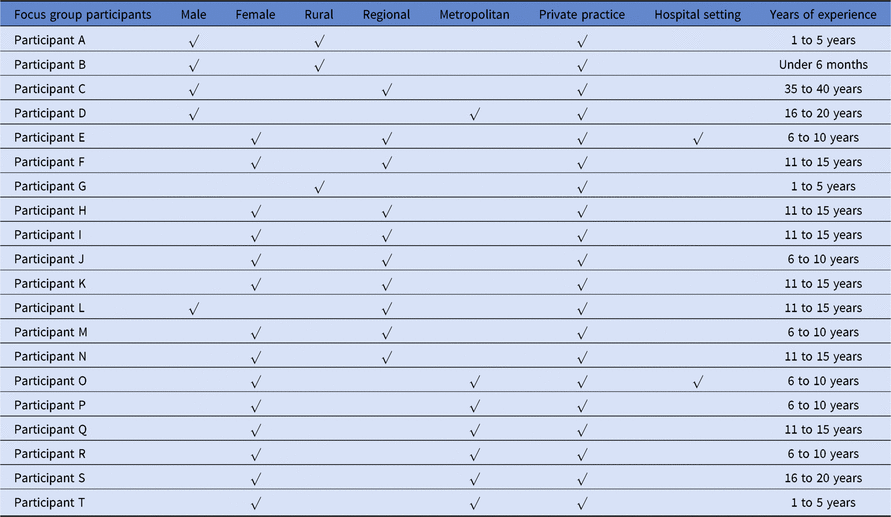
Between September 2016 and April 2017, four semistructured F2F and online focus groups were conducted with 20 psychologists. Table 1 provides the characteristics of the study participants. The 20 focus group participants consisted of 15 females and 5 males. Most were regional practitioners in private practice (n = 10). Participants’ years of experience in practice ranged from less than 6 months to more than 40 years; the modal range being 11 to 15 years. The selection criteria were developed a priori and were based on general and clinical psychologists (i.e., working in private practice) experience in treating injured patients with musculoskeletal injuries under SIRA compensation schemes (i.e., WC and CTP).
Demographic features of participants according to geographical location, years of experience and place of practice

Procedure
Participants for the study were searched and identified through a search engine (i.e., google) and NSW/SIRA database. An invitation to participate was emailed to 95 participants, and those who did not have their email address listed were contacted via telephone. Drop-out was due to conflict in dates and constraints in relation to time commitment. The first two focus groups were conducted F2F (i.e., at the University of New England premises in Parramatta and at the Coffs Harbour Education Campus in Coffs Harbour), whereas the third and fourth focus group interview were conducted online. The fourth focus group did not provide any new information in comparison with the previous three; therefore, additional interviews were not deemed necessary (Efstathiou et al., Reference Efstathiou, Papastavrou, Raftopoulos and Merkouris2011). The F2F and online focus group question protocol consisted of a semistructured format with open-ended questions, and each meeting lasted 90 minutes to 120 minutes (Harmsen et al., Reference Harmsen, Mollema, Ruiter, Paulussen, de Melker and Kok2013). All participants were paid A$180, the amount was reflective of the psychologist’s minimum hourly rate paid under SIRA compensation schemes; food and beverages were also served to psychologists participating in the F2 F focus group only.
Development of Interview Questions
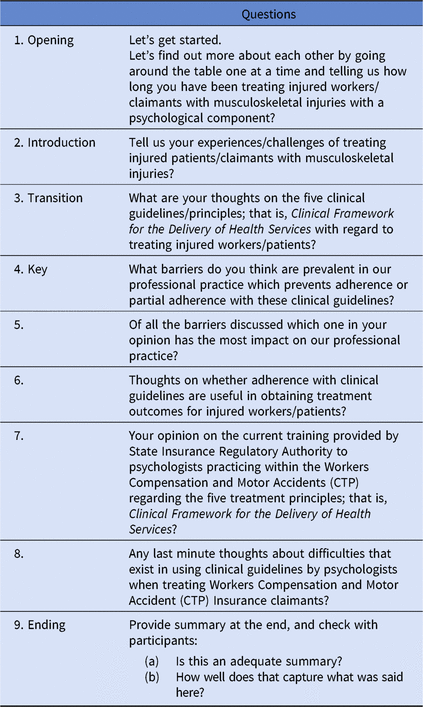
The questions were drafted by the first author and reviewed by the second author (see the Appendix). Focus group questions for psychologists were divided into (a) focus on the treatment of musculoskeletal injuries, (b) psychologist knowledge of the Clinical Framework, (c) barriers to compliance, and (d) the impact of application of the Clinical Framework on patient outcomes.
Data Analysis
The conceptual framework of the study was based on the ‘Clinical Framework for the Delivery of Health Services’. The focus groups were digitally recorded, and the recordings were transcribed verbatim with a professional transcription service (Pettigrew, Donovan, Pescud, Boldy, & Newton, Reference Pettigrew, Donovan, Pescud, Boldy and Newton2010). Transcripts were analysed using a deductive and theoretical approach to thematic analysis (Braun & Clarke, Reference Braun and Clarke2006). To manage data systematically, the interview transcripts were imported into QSR NVivo 11 (a qualitative data analysis software) for coding and analysis. The analysis of the transcripts was guided by predetermined codes (i.e., categories) that were entered as nodes, and the text was coded by matching the codes with sections of text selected as representative of the code, segments from the transcript ranged from a line to several paragraphs, and in some cases the same text segment was allocated to more than one code (Fereday & Muir-Cochrane, Reference Fereday and Muir-Cochrane2006; Reichstadt, Depp, Palinkas, & Jeste, Reference Reichstadt, Depp, Palinkas and Jeste2007). Recurrent patterns across the dataset were classified as themes, and once a theme was formed, it was reviewed and revised by the researchers independently to ensure that it accurately reflected the dataset (Braun & Clarke, Reference Braun and Clarke2006). The final themes were established by consensus amongst the researchers.
Results
Thematic analysis of participant responses regarding barriers to using EBP guidelines within the SIRA compensation schemes identified three main themes.
Theme 1: Lack of Trust in the Validity of EBP Guidelines
A lack of trust in the validity of the recommended treatment guidelines emerged in all focus groups and applied to all principles. For instance, standardised assessment measures (Principle 1) were criticised for not providing a holistic representation of the factors that might impact an injured patient’s recovery. As noted by a psychologist:
We know that overall, I mean, this is where our observation is more important than a clinical tool. While a clinical tool might pick up that they are lower, there are so many factors involved. This is also what you’d see with some of the personality problems, but you would also see it with someone with lots of variables like a chronic injury. I’ve got a guy that’s had back surgery for the third time. He’s 27 and he’s had a spinal fusion and there’s lots of factors affecting his recovery.
Screening for psychosocial risk factors (Principle 2) was considered to serve the interests of the insurers rather than the patient. For instance:
If there are historical pre-injury factors that are complicating recovery for the client, I find if that’s reported in the treatment plan, it puts the client at risk of having their sessions fixed.
Concerns were raised about the implementation of self-management strategies, such as activity scheduling (Principle 3), and potential negative consequences for injured patients if insurers are carrying out surveillance: As noted by one psychologist:
And that’s another big barrier, you try and get people to go and take a walk or whatever and they’re scared that someone’s going to be watching them doing this stuff — and I’ve got one right now and she regressed in terms of her treatment.
Some participants reported that formulating SMART goals (Principle 4) was a hindrance to adopting a client-centred therapeutic approach because it can make therapy ‘too goal-directed’ and instil in the client ‘a sense of failure and anxiety about achieving those goals’. As noted by a psychologist:
I never go straight for them [goals], and I find them, in truth, more of a hindrance. I sometimes just feel what it does is, if I start to work in that way, what respect would the client have for me? Because it would feel so mechanical and not correct. The other unwritten assumption about smart goals is that recovery comes as a linear progression over time, that is, you add more treatment, you get more recovery. But recovery fluctuates, individuals have bad days and good days and they need to be given the opportunity to recover at their own pace under their doctor’s direction.
Most participants reported a lack of trust in the validity of the guidelines and the likelihood that adherence would not lead to optimal care. There was also considerable scepticism about who the guidelines were intended to benefit. As noted by one psychologist:
A focus on use of evidence-based practice is clearly aimed at limiting client access to treatment. Recommendations for 6 to 12 sessions for treatment of trauma, for example, within the treatment guidelines are based for example on treatment of people who have experienced a simple or minor car accident without a physical injury.
Theme 2: Lack of Knowledge and Skills
A limited awareness of the guidelines included in the Clinical Framework, lack of knowledge of the psychologist’s role in this context, and insufficient knowledge and skills to fully apply the treatment principles, protocols and procedures, composed the second theme that emerged in all focus groups.
Discussions revealed that psychologists tended to focus on reducing psychological distress through supportive counselling, rather than viewing their role as identifying and assessing psychosocial barriers to the patient’s return to usual functioning and measuring, monitoring and supporting activities to enable that outcome. There were scant indicators that psychologists take a biopsychosocial approach to treatment or place any emphasis on behavioural activation or functional restoration. Participants declared having little knowledge about the importance and use of goal-setting or of taking a theoretical and structured approach to treatment. A common view was that client presentations are often ‘too complex [to] concrete, specific goals which can be broken down into behavioural descriptions’. As one psychologist explained:
If I’ve put that the problem is anxiety I wouldn’t normally put the goal is to decrease the anxiety … I don’t tend to think about it in those sorts of terms, I probably do in my mind somewhere, but it’s just not the way I would write it. So sometimes I find it’s like ‘What’s a SMART goal?’, but in principle I have no problem with it.
In contrast, there were frequent statements about supporting and ‘validating’ clients:
I think the hardest thing is you do have to validate them first because maybe they haven’t been validated and then after two years they want someone to say, ‘I understand you’ve had a hard time’.
Other participants described their clients as being in a state of ‘hypervigilance’, ‘hyperarousal’ or ‘freeze’ when they seek therapy. Therefore, their focus revolves around making the client feel safe, and their primary concern is to establish a therapeutic relationship.
I often find that a lot of my sessions are just dealing with practical sorts of things. So Maslow’s hierarchy of needs. You’re not exactly going to be able to look at those higher needs [re-engagement in functional activities] when they literally are trying to survive.
Some psychologists indicated that they struggle to operate in expected ways, such as prioritising communication with the treating doctor or other relevant parties. One stated: ‘It can be very hard for a psychologist to ring a GP, as they are always very busy’; another asked: ‘How do we get on the phone when we’ve got people in front of us all the time?’. Some reported challenges associated with ‘inconsistency’ in insurer expectations about how the allied health recovery request (AHRR) should be completed; others acknowledged that there can be negative ripple effects from their own inadequate reporting or failure to liaise with others:
Insurers are second guessing a lot of what we’re trying to say and because we’re sometimes seen as obstructive, I think. It could be because we’re not picking up the phone and talking to that insurer and just educating them a little bit about what we’re doing and what we’re seeing.
Many psychologists cited a lack of out-of-session remunerated time and a lack of knowledge of ‘what insurers want’ as barriers to complying with protocols and procedures. Again, this theme suggested a lack of knowledge of how to operate within the SIRA compensation schemes. For example, some participants claimed that the failure to submit a treatment plan was because they receive only ‘$25 for completing the first treatment plan and then nothing for subsequent plans’. With a focus on a counselling approach, these psychologists seemed unaware of the importance and collaborative value of completing the plan in-session and regularly reviewing it with the injured patient. For instance:
To expect the treatment plan to be filled out in the initial session as well as building rapport as well as just understanding the story, it’s not realistic, there’s not enough time.
To get the wording which can be accepted by the case manager is challenging [but] if you get the story … that would make much more sense, [however] the plan doesn’t allow for the story at all.
Theme 3: Poor Fit Between EBP Guidelines, Clients and SIRA Compensation Schemes
The third theme emerging in all psychologist groups was the poor fit between the treatment guidelines, injured patient presentations and circumstances, and SIRA compensation schemes. Psychologists reported that the guidelines imply that working with patients within the SIRA compensation schemes should be simple and straightforward, but their experience is that this is not the case.
Most psychologists reported that the clients they treat under the compensation schemes are complicated with ‘complex histories’ and are often referred only after all other medical treatments have failed. Then, the expectation of ‘a magic fix in six sessions is very challenging’. As noted by a psychologist:
I often find that the problems are more complex than just the specific secondary psychological injury. The late referral, complicating factors in their lives and problems that have developed in response to the injury.
A few psychologists noted that delays in insurer approval impaired their ability to deliver treatment in a timely manner or in accordance with the EBP treatment guidelines. Additionally, in some instances, providing an appropriate number of sessions was outside their control. As noted by a psychologist:
I’ve got some clients, this has happened with two, where they had a physical injury which became psychological as well, and you know how the insurance company like to exclude the secondary injury. They only like to look at the original. But in any case, they eventually declined the psychological injury. So, they had the six sessions with me, then it was declined.
Participants also reported that lack of provision of opportunities for injured patients to return to usual functioning, which included absence of retraining as an option, and the availability of fewer work options in rural areas was another barrier that was a poor fit with the treatment principles. As noted by a psychologist:
There are in fact fewer employers in rural areas, so fewer work options, with fewer variability factors. If you try and retrain them for jobs, well there’s nothing in Bowral and there’s nothing in Goulburn, to retrain these people. Often, they’ve lost their house, their car, whatever, so how are they going to do that? And then what are they going to train in? There’s a dearth of jobs. There just aren’t jobs. You can retrain to do what?
Some psychologists also reported that actions by some insurers seem to run counter to the rehabilitation process and create circumstances that distract from or derail the application of the treatment principles. As noted by a psychologist, ‘the compensation system itself is causing harm, and giving rise to secondary symptoms’.
DISCUSSION
The aim of the current study was to explore the barriers perceived by psychologists as impacting their adherence to EBP guidelines for treatment of functional disability following musculoskeletal injury. Three major issues in the application of the Clinical Framework were identified: (a) a lack of trust in the validity of the recommended EBP guidelines; (b) lack of knowledge of the psychologist’s role in this context and insufficient skills to fully apply the guidelines and comply with SIRA protocols and procedures; and lastly, (c) a poor fit between the EBP guidelines, client presentations and circumstances, and SIRA compensation schemes.
Lack of trust in the validity of the guidelines stemmed from a concern that the guidelines promote the insurers’ agenda rather than the welfare of the injured person. This view is consistent with the findings of other research in the mental health arena that has shown that limited uptake of EBP can be due to a belief that it supports the interests of administrators but not patients (Corrigan, McCracken, & Blaser, Reference Corrigan, McCracken and Blaser2003; Milne, Gorenski, Westerman, Leek, & Keegan, Reference Milne, Gorenski, Westerman, Leek and Keegan2000). In the current study, psychologists indicated negative attitudes and beliefs towards not only the overall approach but also components of EBP, such as the use of goal setting and outcome measurement. This finding, too, is consistent with the behaviour observed in other studies where psychologists were found to use outcomes measures approximately 37% of the time only, and even less frequently if they were in private practice (i.e., 29% of the time; Hatfield & Ogles, Reference Hatfield and Ogles2004). These findings sit in contrast to the large body of empirical research that indicates that evaluating and reviewing the effectiveness of treatment is necessary for achieving positive therapeutic outcomes (Barkham et al., Reference Barkham, Margison, Leach, Lucock, Mellor-Clark, Evans and McGrath2001; Kordy, Hannöver, & Richard, Reference Kordy, Hannöver and Richard2001; Lambert et al., Reference Lambert, Whipple, Smart, Vermeersch, Nielsen and Hawkins2001; Lambert et al., Reference Lambert, Whipple, Vermeersch, Smart, Hawkins, Nielsen and Goates2002; Lueger et al., Reference Lueger, Howard, Martinovich, Lutz, Anderson and Grissom2001; Whipple et al., Reference Whipple, Lambert, Vermeersch, Smart, Nielsen and Hawkins2003).
Comments made by psychologists in this study provided a further and deeper insight into why they might resist a structured EBP approach to intervention. Like clinicians in other studies, our participants expressed a fear that adherence with EBP guidelines could impede or rupture the therapeutic alliance (Addis, Reference Addis2002; Frueh, Cusack, Grubaugh, Sauvageot, & Wells, Reference Frueh, Cusack, Grubaugh, Sauvageot and Wells2006). However, once again, these cognitive and attitudinal barriers to EBP (Gaudiano & Miller, Reference Gaudiano and Miller2013) are not supported by the scientific literature. For instance, a 2011 study of the impact of the components of the therapeutic alliance has shown that therapist–patient agreement on ‘goals’ and ‘tasks’ are more effective in achieving treatment gains than the ‘bond’, which was found to be ‘more of a consequence than a cause’ of these gains (Webb et al., Reference Webb, DeRubeis, Amsterdam, Shelton, Hollon and Dimidjian2011, p. 279). Furthermore, our findings suggest that the concerns about therapeutic alliance may be related to the psychologists’ confidence in their capacity to deliver nondirective, client-focused counselling, and a lack of knowledge and skills in an EBP approach to disability management.
We found that psychologists’ adherence to EBP guidelines was impacted by a lack of awareness of their role within the SIRA context (i.e., to facilitate restoration of pre-injury functioning rather than to provide personal counselling) and insufficient knowledge and skills to use the principles contained in the Clinical Framework. With reference to their role, psychologists’ lack of knowledge of the critical importance of administrative tasks and a lack of skills to execute these in a timely manner (e.g., completing treatment plans or telephoning stakeholders in-session) led to reports of ‘lack of time’ and ‘lack of remuneration’ as barriers to adherence with EBP guidelines, protocols and procedures. The latter finding is consistent with previous research showing that financial disincentives are an impediment in the uptake of EBP by health practitioners (Addis, Reference Addis2002; Frueh, Grubaugh, Cusack, & Elhai, Reference Frueh, Grubaugh, Cusack and Elhai2009; Ganju, Reference Ganju2003; Schoenwald & Hoagwood, Reference Schoenwald and Hoagwood2001; Torrey et al., Reference Torrey, Drake, Dixon, Burns, Flynn, Rush and Klatzker2001). However, it was concerning to find the lack of knowledge of how to apply the biopsychosocial approach to injury management as proposed in the guidelines, an approach known to decrease pain, improve functionality and reduce claim costs following musculoskeletal injury (Flor, Fydrich, & Turk, Reference Flor, Fydrich and Turk1992; Kamper et al., Reference Kamper, Apeldoorn, Chiarotto, Smeets, Ostelo, Guzman and van Tulder2015; Scascighini, Toma, Dober-Spielmann, & Sprott, Reference Scascighini, Toma, Dober-Spielmann and Sprott2008; Transport Accident Commission & WorkSafe Victoria, 2012). Psychologists presented with what Pagoto et al. (Reference Pagoto, Spring, Coups, Mulvaney, Coutu and Ozakinci2007) have described as ‘naïve realism’: an over-confidence in ‘clinical experience’ at the cost of theory, critical thinking, and the application of an empirical base for effective treatment (Lilienfeld, Ritschel, Lynn, Cautin, & Latzman, Reference Lilienfeld, Ritschel, Lynn, Cautin and Latzman2013, p. 888). The implications of these findings are that training for psychologists working within the SIRA compensation schemes should involve not only the dissemination of treatment guidelines but also competence training in balance with didactic education (Hasson, Andersson, & Bejerholm, Reference Hasson, Andersson and Bejerholm2011; McHugh & Barlow, Reference McHugh and Barlow2010).
The final finding of this study was that there is a poor fit between the EBP guidelines, some client presentations, and the frameworks of the SIRA compensation schemes. Psychologists reported that the perceived ‘one size fits all’ approach of the guidelines fails to cater to the complex needs of the individuals being treated under the compensation schemes (Lilienfeld et al., Reference Lilienfeld, Ritschel, Lynn, Cautin and Latzman2013). In particular, they noted that application of the Clinical Framework was at times impossible due to a lack of timely referral by the GPs, delays in insurers’ approval to provide treatment, and the complexity of the compensation schemes, which adversely impacted injured patients’ participation and engagement. Given that psychological intervention to address the risk factors for long-term disability following musculoskeletal injury should be delivered 4-12 weeks post injury (Gatchel & Schultz, Reference Gatchel and Schultz2014; Schultz & Gatchel, Reference Schultz and Gatchel2006), hold-ups in this process make adherence with EBP guidelines challenging for psychologists and flag a poor fit between what psychologists are (Kilgour, Kosny, McKenzie, & Collie, Reference Kilgour, Kosny, McKenzie and Collie2015a) to do and what factors within the system will allow them to do (Gatchel et al., Reference Gatchel, Polatin, Noe, Gardea, Pulliam and Thompson2003; Littleton et al., Reference Littleton, Cameron, Poustie, Hughes, Robinson, Neeman and Smith2011; Murgatroyd, Casey, Cameron, & Harris, Reference Murgatroyd, Casey, Cameron and Harris2015; Rogerson, Gatchel, & Bierner, Reference Rogerson, Gatchel and Bierner2010; Whitfill et al., Reference Whitfill, Haggard, Bierner, Pransky, Hassett and Gatchel2010). This finding is consistent with existing research that has found healthcare providers’ professional recommendations can be ignored or contested by insurers whose focus is on determining liability and managing claims cost (Kilgour et al., Reference Kilgour, Kosny, McKenzie and Collie2015a). This can result in ineffective treatment by clinicians and impaired recovery and outcomes for injured patients (Kilgour et al., Reference Kilgour, Kosny, McKenzie and Collie2015a). Additionally, the ‘pathogenic relationships’ that can occur between insurers and injured patients create conflicts in motivation that can make it difficult for psychologists to implement treatment guidelines based on a biopsychosocial premise (Kilgour, Kosny, McKenzie, & Collie, Reference Kilgour, Kosny, McKenzie and Collie2015b, p. 176). Overall, these findings suggest that to increase psychologists’ adherence to EBP guidelines within various compensation schemes, barriers created by the actions of key stakeholders, which include lack of timely referral by GPs, delay in treatment approval by insurers and injured patients unwillingness to engage with treatment, need to be understood and addressed.
Strengths and Limitation
The study is the first to investigate barriers to psychologists’ compliance with EBP guidelines for the treatment of musculoskeletal injuries within personal injury compensation schemes in Australian. Although, limitations include a small sample size and the low response rate could be reflective of selection bias. Additionally, another limitation of the study is that the findings may be restricted to a cause-based compensation system.
Conclusion and Future Directions
This study has shown that both individual practitioner variables and stakeholder actions (i.e., contextual factors) pose barriers that negatively impact psychologists’ adherence with treatment guidelines. Barriers create personal and economic costs for injured patients, because high adherence with EBP treatment guidelines is needed for positive patient outcomes (Feuerstein, Hartzell, Rogers, & Marcus, Reference Feuerstein, Hartzell, Rogers and Marcus2006). Therefore, identification and understanding of the barriers to the uptake of EBP guidelines is a significant first step in bridging the gap between implementation and adoption (Pagoto et al., Reference Pagoto, Spring, Coups, Mulvaney, Coutu and Ozakinci2007). Efforts are needed to improve psychologists’ attitudes and beliefs about the value of the guidelines so that they are applied despite the presenting constraints. This can be undertaken by involving psychologists in the development of strategies to overcome identified barriers, thereby facilitating ownership (NHMRC, 2000). By viewing psychologists as active users and not merely passive recipients required to comply, and by providing in-depth active knowledge and skills training and engagement, adherence to EBP can be potentially increased (Tasca, Reference Tasca2015).
The recent introduction by the APS of ‘Masterclass Workshops’ for psychologists working within SIRA insurance frameworks is a step in the right direction. However, studies indicate that workshops alone are not enough and follow-up coaching (e.g., via telephone or through the web) is required to enable clinicians to modify behaviour and integrate EBP into routine clinical settings (Miller, Yahne, Moyers, Martinez, & Pirritano, Reference Miller, Yahne, Moyers, Martinez and Pirritano2004; Sholomskas et al., Reference Sholomskas, Syracuse-Siewert, Rounsaville, Ball, Nuro and Carroll2005). Implementation can also be improved by providing clinicians with personalised data that shows the impact of adherence on patient outcomes. Another recent initiative that has been undertaken by SIRA is the incorporation of the EBP guidelines into a computer based interactive treatment plan to remind busy clinicians about best practice principles when treating patients. The impacts of these initiatives will require evaluation.
Future research should explore recommendations to support a collaborative partnership between policymakers, researchers and practitioners (Davidson & Spring, Reference Davidson and Spring2006). The barriers emanating from the ‘poor fit’ between the EBP guidelines and the wider system in which they operate may be lowered by obtaining endorsement from the NHMRC: Australia’s leading authority on the development and maintenance of health standards. Lastly, to reduce the dissemination and implementation gap of EBP within the Australian compensation schemes, strategies that promote an alignment between insurers, GPs and psychologists in the treatment of musculoskeletal injuries should be considered.
Author ORCIDs
Tahira Haider, 0000-0002-0417-4564
Acknowledgement
This study was supported by State Insurance Regulatory Authority grant, SIRA reference number: MAA/438891/2015.
Appendix
Barriers Impacting Psychologists’ Use of EBP Treatment Guidelines When Treating Secondary Psychological Injuries (Questions Used by Facilitator)