Introduction
Laccases (EC 1.3.10.2) are redox enzymes from the multi-copper oxidase family that catalyse the oxidation of a wide variety of aromatic substrates, in particular those with nucleophilic substituents such as phenols and anilines. They do not require cofactors, contrary to other oxidases, and the main by-product of their reaction is water. This makes them very desirable as environmentally friendly biocatalysts (Yang et al. Reference Yang, Li, Ng, Deng, Lin and Ye2017). Laccases are also relatively promiscuous enzymes, and their substrate specificity varies significantly depending on their origin, which is why there is still interest in studying them more than a century after the first one was described by Yoshida (Reference Yoshida1883).
Laccases present three copper centres (T1, T2 and T3) in their structure that are responsible for their catalytic properties. The oxidation of the aromatic substrate happens in T1. The electrons yielded are transferred from T1 to the T2/T3 trinuclear cluster, where the coupled reduction of diatomic oxygen into water occurs (Jones & Solomon Reference Jones and Solomon2015). Laccases can only catalyse the direct oxidation of substrates whose redox potential is lower than that of the T1 copper. The oxidation of molecules not normally accepted as substrates by these enzymes has also been reported when redox mediators such as 2,2'-azino-bis(3-ethylbenzothiazoline-6-sulphonic acid) (ABTS), violuric acid or syringaldehyde are added to the reaction media (Claus Reference Claus2003). These mediator molecules undergo rapid oxidation and then leave the active site as free radicals, which in a second step oxidize a secondary substrate.
This type of enzyme is ubiquitous in nature, and although for many years they were thought to be exclusively of eukaryotic origin, in recent decades many laccases from bacteria have been described (Atalah et al. Reference Atalah, Cáceres-Moreno, Espina and Blamey2019). The physiological function of bacterial laccases is not entirely understood, but they seem to participate in the resistance to environmental metal ions, pigment production and morphogenesis (Prajapati et al. Reference Prajapati, Minocheherhomji and Scholar2018). Bacterial laccases are also active at more alkaline pH values compared to fungal laccases and are typically more resistant to denaturation. Several laccases have been described from thermophilic and hyperthermophilic microorganisms, some of them with extreme thermostability, such as the laccase from Thermus thermophilus, with a half-life of 14 h at 85°C and reaching its greatest activity at 92°C (Miyazaki Reference Miyazaki2005). This superior stability makes bacterial laccases interesting for biotechnological applications (Guan et al. Reference Guan, Luo, Wang, Chen and Liao2018).
There is indeed demand for laccases from many different industries, as a wide variety of applications have been found for them, including in paper production, bioremediation, biosensors, biofuel cells, the food industry and organic synthesis (Atalah et al. Reference Atalah, Cáceres-Moreno, Espina and Blamey2019). This diverse array of possible applications, coupled with the fact that there seems to be a significant amount of variation in substrate preference among different laccases (Morozova et al. Reference Morozova, Shumakovich, Shleev and Yaropolov2007), continues to fuel interest in the discovery and characterization of novel laccases with desirable properties.
With the aim of finding a novel thermostable laccase with a substrate specificity that would widen the applications of these interesting enzymes, we screened various thermophilic bacteria and found laccase activity in the crude extract of Geobacillus sp. ID17. This microorganism was isolated from a hot spring found on Deception Island, Antarctica (Muñoz et al. Reference Muñoz, Correa-Llantén and Blamey2013). The laccase activity was detected using syringaldazine (SGZ) as a substrate.
Bacteria from the Geobacillus genus are thermophilic, Gram-positive, aerobic or facultative anaerobic, spore-forming, rod-shaped microorganisms. Although two laccases have been described within this genus (Verma & Shirkot Reference Verma and Shirkot2014, Basheer et al. Reference Basheer, Rashid, Ashraf, Akram, Siddiqui, Imanaka and Akhtar2017), to date there are no available biochemical characterizations of laccases from Antarctic bacteria. This means that the laccase produced by Geobacillus sp. ID17 is a good candidate for a novel enzyme with interesting substrate specificity and desirable features for the industry. The current work describes the isolation and characterization of this enzyme.
Materials and methods
Bacterial culture
Geobacillus sp. ID17 was obtained from the bacterial collection of Fundación Biociencia, Chile. This microorganism was originally isolated from an environmental sample collected from a fumarolic emission on Deception Island during Chilean Antarctic expedition ECA 44. The isolate was found to be a thermophilic, aerobic, Gram-positive bacterium classified according to molecular criteria as a member of the Geobacillus genus. In a previous work (Muñoz et al. Reference Muñoz, Correa-Llantén and Blamey2013), its optimal growth conditions were found at pH values between 5.5 and 8.0 and at temperatures between 50°C and 70°C. Bacteria were grown in a modified marine media loosely based on Bacto Marine Broth (DIFCO 2216). Copper supplementation was necessary for the detection of laccase activity in the crude extracts.
Cell lysis
To obtain the bacterial crude extract, a pellet was generated by centrifuging inoculated culture media for 10 min at 9000 × g. The pellet obtained was re-suspended in 100 mM pH 7.5 phosphate buffer, to which 0.5 mM phenylmethylsulfonyl fluoride (PMSF; Winkler) was added, before sonicating. To achieve cell disruption, eight sequential 3 min ultrasonic pulses were applied using a Brandson 1510R-MT sonifier. After centrifuging for 15 min at 13 000 × g to eliminate the insoluble fraction, the obtained crude extract was used for further experimentation.
Laccase assay
Laccase activity was measured using SGZ as a substrate following the method described by Harkin et al. (Reference Harkin, Larsen and Obst1974). The reaction was carried out by adding 500 μl of enzyme solution to 2200 μl of 100 mM pH 7.5 potassium phosphate buffer that had been previously incubated for 5 min at 55°C. The reaction mixture was incubated for another 5 min before adding 300 μl of 0.216 mM SGZ (Sigma-Aldrich). The reaction progress was measured using a spectrophotometer, registering the increase in absorbance at 530 nm. The final volume used in the assay was 3 ml and the SGZ concentration in the reaction media was 0.02 mM. A unit of laccase activity was defined as a change of 0.001 absorbance units at 530 nm. Protein concentration was measured using the Bradford method (Bradford, Reference Bradford1976). The laccase activity values were measured in triplicate and averaged.
Optimization of laccase activity in Geobacillus sp. ID17 crude extract
Different compounds were added to the culture media to evaluate their effects on the laccase activity present in the crude extracts. Copper sulphate (Winkler) was used as a copper source, and it was added in concentrations ranging from 0 to 1.5 mM. The effects of ferrous sulphate (Winkler), guaiacol (Sigma-Aldrich) and lignin (Sigma-Aldrich) were also studied.
Enzyme purification
Purification of the enzyme was carried out using chromatographic techniques. Every purification step was performed at ambient temperature and controlled using a fast protein liquid chromatography (FPLC) system (Pharmacia Biotech). Laccase activity was measured in each of the fractions obtained for each purification step.
A total of 40 l of Geobacillus sp. ID17 culture grown for 24 h were concentrated using a tangential flow filtration system (Sartorius) to a final volume of 2 l. The concentrated culture was then centrifuged for 10 min at 9000 × g. The obtained pellet was treated as described in the ‘Optimization of laccase activity in Geobacillus sp. ID17 crude extract’ section to prepare a crude extract for purification. Before loading the chromatographic columns with the extract, it was centrifuged for 20 min at 18 000 × g (HIMAC CP80WX, preparative ultracentrifuge, HITACHI) to eliminate any possible insoluble contaminants or cell debris.
The supernatant obtained, containing laccase activity, was diluted in Tris-HCl 50 mM pH 7.5 buffer before loading it into a column (Pharmacia, C 16/20) packed with Q-Sepharose Fast Flow resin (Pharmacia Biotech) previously equilibrated in the same buffer. Proteins were eluted using a linear gradient of 1 ml/min from 0.1 to 1.0 M NaCl prepared in Tris-HCl 50 mM pH 7.5 buffer. The fractions that presented laccase activity were then loaded into a column (Pharmacia, C 10/10) packed with DEAE-Sepharose Fast Flow resin (Pharmacia Biotech) previously equilibrated in the same buffer. Proteins were eluted at 1 ml/min using a linear gradient from 0.3 to 0.7 M NaCl.
Finally, fractions in which laccase activity was detected were then concentrated to a final volume of 0.5 ml using a 30 kDa cut-off cellulose membrane (Amicon) and then loaded in a third chromatographic step into a column (GR Healthcare, Tricorn 10/600) packed with Superdex 200 resin (Pharmacia Biotech) previously equilibrated with NaCl 0.2 M in Tris-HCl 50 mM pH 7.5 buffer.
Sodium dodecyl sulphate polyacrylamide gel electrophoresis (SDS-PAGE) was used to estimate the purity of the fractions.
pH and temperature dependence of the laccase activity
The effect of pH on the activity of the purified enzyme was determined by incubating it at pH values between 6 and 9. Sodium acetate 100 mM buffer was used for preparing the solutions at pH 6 and 100 mM potassium phosphate was used for pH values between 7 and 9. The pH was corrected according to its d(pKa)/d(T) for each temperature used.
The dependence of activity with temperature was determined by performing the assay as previously described but incubating the enzyme in potassium phosphate buffer at different temperatures ranging from 40°C to 70°C. The temperature was kept stable throughout the reaction by using a spectrophotometer (Shimadzu) coupled to a thermoregulated bath.
Thermal stability assays
The thermal stability of the purified laccase was determined by incubating the enzyme at 55°C, 65°C and 80°C. Every 30 min when the enzyme was incubated at 55°C and 65°C or every 15 min when the enzyme was incubated at 80°C an aliquot was taken, and residual activity was measured at 55°C using SGZ as the substrate.
Enzyme kinetics
The apparent Michaelis-Menten constant (Km) and maximum rate of reaction (V max) were determined for the oxidation of SGZ by the purified enzyme. Laccase activity was measured as described above. Increasing concentrations of substrate were used to obtain the apparent kinetic parameters: 0.002, 0.01, 0.02, 1.00 and 2.00 mM.
Parameters were obtained through the adjustment of the experimental data to the graphical Lineweaver-Burk model.
Substrate screening
The capacity of the enzyme to oxidize different aromatic substrates was evaluated. The substrates used were obtained from Sigma-Aldrich and included SGZ, l-tyrosine, violuric acid, Remazol Brilliant Blue, Congo Red, guaiacol, caffeic acid, p-coumaric acid and gallic acid. A solution of the purified enzyme was incubated in potassium phosphate 100 mM buffer pH 7.5 with each of the different substrates, following the same assay used for SGZ that we described above.
The changes in absorbance over time were registered at the characteristic wavelength of each substrate used. The total change measured was then contrasted with the value obtained when the substrate was incubated in the same buffer in the absence of the enzyme. Each assay was carried out at 55°C, and the substrate concentration in the medium was 1 mM for each assay.
The results obtained with the purified enzyme were compared with those obtained when using a commercial Trametes versicolor laccase (Sigma). For the fungal enzyme, assays were carried out at 37°C in sodium acetate buffer at pH 4.5.
Results
Optimization of the activity measured in the crude extract
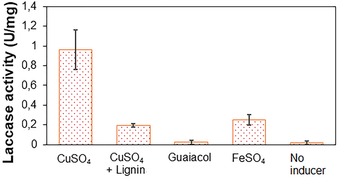
To achieve more efficient purification, we searched for the conditions at which the crude extract showed the greatest laccase activity. Different known inducers of bacterial laccases were assayed. The effect that each one had on the measured activity can be seen in Fig. 1.
Activity measured in the crude extract when the culture medium was supplemented with various possible inducer molecules.

These assays showed that supplementing the media with copper is not only the most efficient way to induce activity, but also necessary for the production of the enzyme. Crude extract prepared with culture media supplemented with guaiacol alone did not show laccase activity. Crude extracts from media in which lignin was added in addition to copper presented lower laccase activity than those supplemented with copper alone. Interestingly, ferrous sulphate acted as a mild inducer of the activity measured in crude extracts.
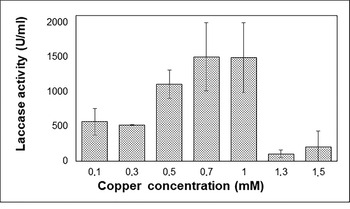
As the best effects were obtained when the media were supplemented with copper sulphate, different concentrations of copper sulphate were added to cultures of Geobacillus sp. ID17, and the effects on the measured activity were studied (Fig. 2). It was found that the greatest activity was measured when media were supplemented with copper sulphate concentrations of between 0.5 and 1 mM.
Effects of the copper concentration in the culture medium on the enzyme activity measured in the crude extracts.

Enzyme purification
Crude extracts were prepared from Geobacillus sp. ID17 cultures supplemented with 0.5 mM copper sulphate. These extracts were loaded onto a column containing Q-Sepharose resin and then eluted using a linear gradient from 0.1 to 0.9 M NaCl. The fractions that were eluted between 0.54 and 0.87 M NaCl all showed some level of laccase activity. These fractions were collected and then loaded onto a column packed with DEAE-Sepharose resin.
To elute the proteins from the DEAE-Sepharose resin, a linear gradient from 0.1 to 0.7 M NaCl was applied. Fractions eluted between 0.36 and 0.7 M NaCl showed SGZ-oxidizing activity. The greatest specific activity was found in the fraction between 0.36 and 0.42 M NaCl. This fraction was collected and concentrated then loaded onto a column packed with Superdex 200 resin for further purification.
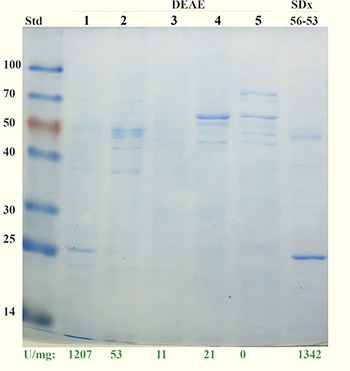
After this third chromatographic step, only one of the fractions collected showed laccase activity. The SDS-PAGE of this fractions shows a clear predominant band (Fig. 3), which was also present in the fractions of greatest specific activity.
SDS-PAGE of the fractions obtained in the last two chromatographic steps of the purification.

The enzyme showing laccase activity obtained using this purification protocol will be referred to hereinafter as LID17.
Biochemical characterization
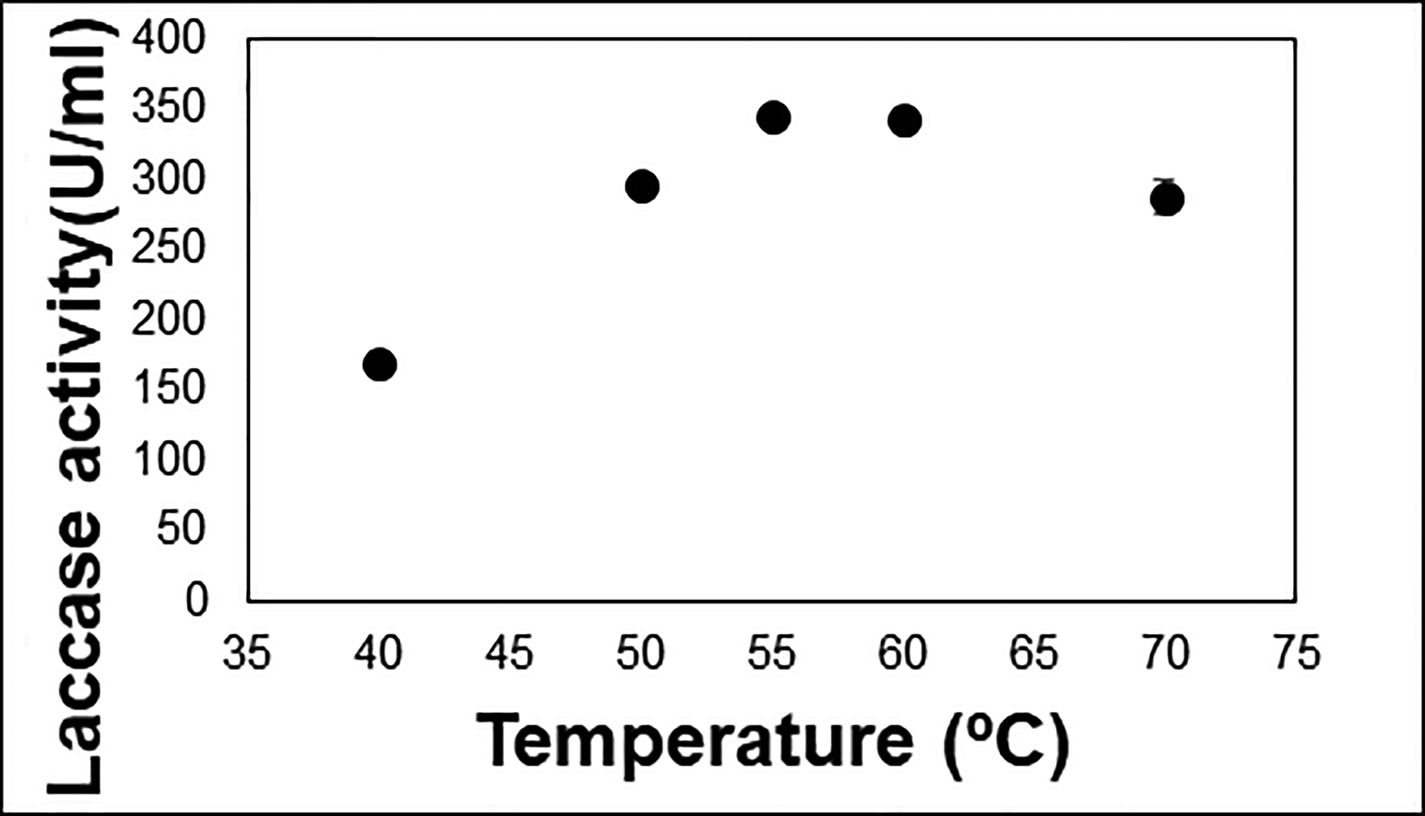
The catalytic behaviour of LID17 was studied at various temperatures and the greatest activity was found between 55°C and 60°C. The purified enzyme showed an abrupt decrease in activity at < 50°C, as can be seen in Fig. 4.
Temperature dependency of the enzymatic activity of LID17.

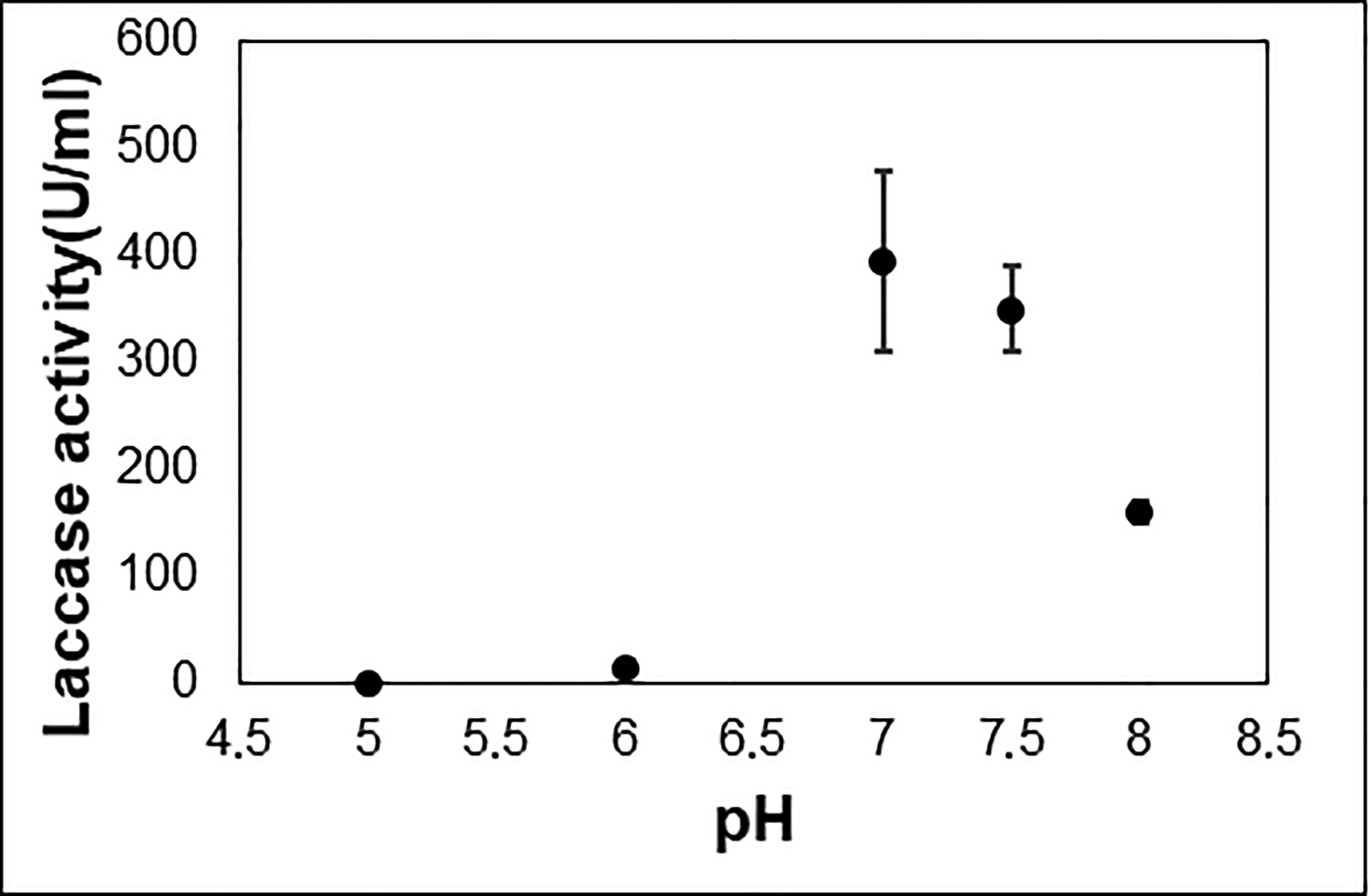
LID17 also showed the greatest activity between pH values of 7.0 and 7.5 (Fig. 5). The enzyme seems to be very sensitive to changes in pH. At pH values < 7.0, no activity was found. At pH values > 8.0, activity was also inhibited.
pH dependency of the enzymatic activity of LID17.

Thermal stability
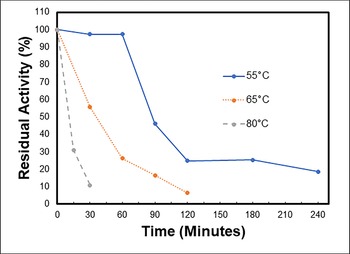
The thermal stability of LID17 was studied at 55°C, the temperature at which the measured activity was the greatest. The same measurements were also performed by incubating the enzyme at 65°C because this is the optimal growth temperature for Geobacillus sp. ID17, as well as at 80°C to assess its performance at hyperthermophilic temperatures. The results can be seen in Fig. 6. After 60 min of incubation at 55°C, the enzyme showed almost no activity loss, but at 90 min, the residual activity was 50%. The half-life at 60°C was ~30 min. When incubating at 80°C, activity decreased rapidly.
Thermostability of LID17.

Kinetic constants
The kinetic parameters for the purified LID17 using SGZ as the substrate were obtained at 50°C. The double reciprocal Lineweaver-Burk graphical method was used to obtain the constants. A value of 0.38 μM min-1 for the maximum catalytic rate (V max) and an apparent Km of 7.4 μM were obtained.
Substrate screening
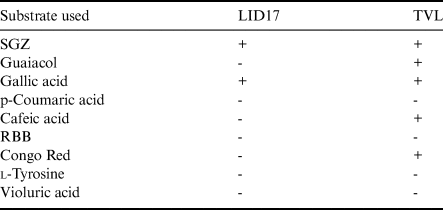
The capacity of LID17 to oxidize various aromatic compounds was studied by following a protocol analogous to the one described for the oxidation of SGZ but replacing the substrate with the various aromatic compounds studied (Table I). The enzyme showed surprising selectivity for the compounds that it accepted as substrates. Out of the nine compounds assayed, only SGZ and gallic acid showed oxidation in the presence of LID17. Both substrates share a 3,4,5-substitution pattern in the phenolic ring with a hydroxyl at the fourth carbon.
Substrate screening. A ‘+’ symbol indicates where there was an observed difference in the changes in absorbance with respect to the non-enzymatic controls. A ‘-’ symbol indicates where no activity was detected. The results obtained with LID17 were contrasted with those obtained with the commercial Trametes versicolor laccase (TVL).

RBB = Remazol Brilliant Blue; SGZ = syringaldazine.
As a comparison, the same substrates were assayed with a commercial laccase from T. versicolor as a catalyst. The main difference found was the preference of this laccase for catechols, which LID17 did not accept as substrates. Furthermore, the fungal laccase was also able to degrade Congo Red.
Discussion
As previously stated, bacterial laccases show interesting attributes that separate them from those of eukaryotic origin. A very relevant difference is the preference for more alkaline and neutral pH values (Claus Reference Claus2003), which expands the spectrum of applications for these enzymes by making them more suitable for certain processes. For example, at lower pH, the rate of textile dye discolouration decreases rapidly (Singh et al. Reference Singh, Singh and Singh2015), which is just one of the reasons for which it is advantageous to have laccases available that act at higher pH values.
Enzymes from extremophiles also have several well-known advantages over mesophilic enzymes, including better overall stability, activity at temperatures closer to those used in industrial processes and better tolerance of organic solvents. For these reasons, it is particularly beneficial to study this laccase from an Antarctic thermophile.
The physiological functions that laccases have in bacteria are not yet completely understood. However, judging from what we observed while studying possible inducers of the expression of LID17, it seems probable that this enzyme could be involved in metal ion resistance. It has been reported that some laccases confer copper resistance to the microorganisms that produce them, and their respective genes are located in operons related to metal resistance and oxidative stress (Grass & Rensing Reference Grass and Rensing2001, Rowland & Niederweis Reference Rowland and Niederweis2013). The fact that LID17 is expressed when the culture media is supplemented with copper and even with iron (Fig. 1) supports the claim that this enzyme is a resistance factor to the oxidative stress associated with environmental metal ions. Given that Geobacillus sp. ID17 is an Antarctic microorganism isolated from an island of volcanic origin with significant geothermal activity, it seems probable that this bacterium has evolved ways of combating exposure to metal cations.
LID17 was found to prefer neutral pH values. The temperatures at which SGZ oxidation was greatest were between 55°C and 60°C. It was also relatively thermostable at 55°C, with a half-life of 90 min. Therefore, this enzyme is more thermostable than commercially available fungal laccases, including T. versicolor laccase (Sigma) or the laccase from Aspergillus sp. (Novozym 51003). However, it was not as stable at higher temperatures, maintaining only 10% of its activity after 30 min of incubation at 80°C (Fig. 6). This limits its potential application for industrial processes that require high temperatures. Possible applications as a biocatalyst include paper pulp bleaching, where some laccases active in the range between 50°C and 60°C have been used successfully (Singh & Arya Reference Singh and Arya2019).
The most thermostable laccase reported to date was isolated from the thermophilic bacteria T. thermophilus, with a reported optimal temperature of 92°C and a half-life of 14 h at 80°C (Miyazaki Reference Miyazaki2005). Of the commercially available laccases, the most thermostable is the one from Myceliophtora thermophila, which has a half-life of 20 min at 60°C and is therefore less stable than LID17 (Berka et al. Reference Berka, Schneider, Golightly, Brown, Madden and Brown1997).
LID17 also seems to be very selective about the substrates that it uses. Of all the substrates assayed, oxidation of only SGZ and gallic acid was observed. Both compounds show electron-attracting substitutions in their aromatic rings in the para position with respect to the hydroxyl group. This theoretically stabilizes the radical that is formed during the oxidation of the OH group in the substrate, weakening the O-H bond, which makes the oxidation of these substrates more favourable. The preference of LID17 for these substrates would seem to indicate that it is a laccase of low redox potential. In comparison to the much better-characterized laccase from T. versicolor, LID17 shows much lower promiscuity.
Regarding its kinetic parameters, the apparent Km obtained using SGZ as a substrate was 7.4 μM, a value that is in the order of other bacterial laccases (Koschorreck et al. Reference Koschorreck, Richter, Ene, Roduner, Schmid and Urlacher2008) and is similar to the apparent Km of 6.8 μM reported for Geobacillus pakistanensis (Basheer et al. Reference Basheer, Rashid, Ashraf, Akram, Siddiqui, Imanaka and Akhtar2017).
Even though LID17 did not show any features that could make it more attractive for the industry than other thermophilic laccases, its high substrate specificity could be advantageous in certain contexts, such as organic synthesis, where specificity is very important for good yields. If this enzyme has any commercial value it would be as a very niche catalyst. A possible example would be the generation of gallic acid polymers. These compounds are semi-conductive materials and their enzymatic synthesis has been explored for the manufacturing of electrodes (Díaz-Sánchez et al. Reference Díaz-Sánchez, Rosas-Aburto, Vivaldo-Lima, Hernández-Alcántara, Gracia-Mora and Vázquez-Torres2017).
Conclusion
The Antarctic Geobacillus sp. ID17 produces a moderately thermostable laccase that retains its activity for 1 h at 55°C and functions at neutral pH values. This is similar to what has been reported for the laccases of non-Antarctic Geobacillus species. However, it shows greater substrate specificity when compared to other enzymes of its class, in accordance with the observation that laccases from different origins show wide variance in the substrates that they accept.
Acknowledgements
We would like to thank two anonymous reviewers for their feedback.
Financial support
We would like to thank the Instituto Antártico Chileno (INACH) for its contribution to the funding of this research.
Author contributions
JA: experimental work, writing (lead). JMB: project conceptualization, writing (reviewing and editing).