

INTRODUCTION
Establishment of large-scale intensive pig production systems is taking place in many parts of the world to meet increasing demands for pork. Disposal of the large volumes of pig manure generated, mainly as slurry may result in environmental problems like contamination with various pathogens, bad odour, leaching of nitrates and nutrient losses following land application (Watabe et al. Reference Watabe, Rao, Stewart, Xu, Millar, Xiao, Lowery, Dooley and Moore2003; Vera et al. Reference Vera, Daudén and Quílez2004). Recently, several techniques have been developed for chemical and mechanical separation of slurry into solid and liquid fractions to minimize nutrient losses and to reduce the odour and volume of the slurry. The solid fraction is rich in nutrients and can after storage or various treatments safely be used as fertilizer, e.g. on agricultural land and in horticulture, whereas the liquid fraction is typically used to irrigate field crops and is less polluting compared to the raw slurry because of lower contents of nitrogen and phosphorous (Møller et al. Reference Møller, Lund and Sommer2000; Fangueiro et al. Reference Fangueiro, Senbayran, Trindade and Chadwick2008).
Pig slurry may contain a variety of viral, bacterial and parasitic pathogens, some of which are zoonotic, e.g. Hepatitis E virus, Salmonella spp., Campylobacter spp., Giardia duodenalis, Cryptosporidium spp. and Ascaris suum (Hutchison et al. Reference Hutchison, Walters, Moore and Avery2005; Ziemer et al. Reference Ziemer, Bonner, Cole, Vinjé, Constantini, Goyal, Gramer, Mackie, Meng and Myers2010), and these may potentially contaminate the external environment when applied to fields without any pre-treatment. Survival of pathogens declines when the slurry is stored, depending upon storage conditions and resultant physico-chemical factors like temperature, pH, oxygen tension (aeration), dry matter, unionized ammonia and volatile fatty acids (Ajariyakhajorn et al. Reference Ajariyakhajorn, Goyal, Robinson, Johnston and Clanton1997; Davis et al. Reference Davis, Carrington, Aitken, Fenlon and Svoboda1999; Himathongkham and Riemann, Reference Himathongkham and Riemann1999; Nicholson et al. Reference Nicholson, Groves and Chambers2005; Nordin et al. Reference Nordin, Nyberg and Vinnerås2009). Ascaris suum eggs loose the viability if they are exposed to a pH> 12 for more than 3 months (Eriksen et al. Reference Eriksen, Andreasen and Ilsoe1996) or to unionized ammonia at a concentration ∼58 mm for 16 days and for 4·8 days at 30 °C at a pH of 12 (Pecson et al. Reference Pecson, Barrios, Jiménez and Nelson2007). Bacterial pathogens like Escherichia coli and Salmonella spp. can survive up to 3 months in slurry stored below 20 °C (Pell, Reference Pell1997; Hutchison et al. Reference Hutchison, Walters, Moore and Avery2005; Nicholson et al. Reference Nicholson, Groves and Chambers2005), while 74%, 64% and only 4% of A. suum eggs were found to survive in slurry at 4 °C, at room temperature (17–26 °C) and at 42 °C, respectively (Papajova et al. Reference Papajova, Juris, Sasakova and Vargova2005).
Compared to raw slurry little is known about the viability of pathogens in the liquid slurry fraction obtained from mechanical and/or chemical separation of raw slurry. Due to increased attention to the food-borne diseases and requirement to regulate environmental pollution worldwide, there is a need to assess the food safety and environmental hazards associated with the irrigation of agricultural fields with separated liquid slurry. This should be done by investigating the main chemical factors determining pathogen inactivation like ammonia and pH. Ascaris suum eggs are extremely resistant to environmental stress (Roepstorff and Murrell, Reference Roepstorff and Murrell1997) and hence viability of A. suum eggs is used as a conservative indicator and to assess sanitization of fecally contaminated liquid and solid wastes (O'Lorcain and Holland, Reference O'Lorcain and Holland2000). The aim of the present study was to investigate the survival of A. suum eggs in raw slurry in comparison with separated liquid slurry stored at 5 °C and 25 °C during a 10-month period.
MATERIALS AND METHODS
Ascaris suum eggs and slurry
Ascaris suum eggs were obtained by sequential sieving of feces collected from the large intestine of naturally infected pigs at a Danish slaughterhouse. An egg suspension was prepared by adding deionized water to make a final concentration of 6 eggs/μl of suspension. In total, 180 nylon bags (size 2·5 × 2·5 cm2) each containing 6000 un-embryonated eggs were prepared by placing 1 ml of egg suspension into nylon bags with mesh size 20 μm (Verseidag-Techfab Gmbh, Geldern, Germany) and then closing the bags with glue. The bags were stored in deionized water at 5 °C until use.
Raw pig slurry and separated liquid slurry were collected from a commercial pig farm where the slurry was separated into solid and liquid fractions by flocculation followed by mechanical separation (Kemira AgroSol™, Kemira Kemwater, Finland). Polyacrylamide polymer (Superfloc C-2260, Kemira Kemwater, Finland) was added so that dissolved and suspended solids were formed into flocs of 2–10 mm size. Flocs were then removed on a belt with 4 mm screen size and further dehydrated by screw press with a 1 mm screen size (Møller et al. Reference Møller, Hansen and Sorensen2007). Around 150 L of raw slurry was collected from a slurry storage tank connected directly to the animal house, while the same amount of liquid slurry was collected directly from the outlet of the separation unit when operational. Raw slurry and separated liquid slurry were collected in 6 plastic barrels (40–60 L each), transported within 8 h at ambient temperature by car (15–17 °C) to the laboratory and stored overnight at room temperature. After thorough mixing with a rod for 2 min, 700 g samples of raw slurry and separated liquid slurry were transferred into 1-L sterile glass bottles yielding a total of 60 bottles of each slurry type. One nylon bag with A. suum eggs was placed in the middle of each bottle by tying it with a thin aluminium wire around the neck of the bottle. The bottle was closed with Parafilm® and fixed with a rubber band creating semi-anaerobic conditions, as initial testing with screw-cap closed bottles increased the pressure to a level where the bottles were at risk of breaking. The concentration of A. suum eggs in a sample of liquid slurry used for the experiment was determined by sequential sieving of a 700 g representative sample of liquid fraction followed by counting the number of eggs in six 50 μl replicates of resultant suspension.
Experimental set-up
The A. suum egg survival experiment was conducted in triplicate at 5 °C and 25 °C with raw pig slurry and separated liquid slurry. The samples were collected (destructive sampling) at 10 different times (days 7, 14, 21, 28, 42, 56, 112, 168, 238 and 308). Apart from raw slurry and separated liquid slurry, Ascaris eggs were also stored in distilled water as unexposed controls at both temperatures for the entire duration of the experiment.
Analysis of pH and aqueous ammonia (NH3 (aq))
The pH was measured after mixing wet slurry samples with de-ionized water at a ratio of 1:5 (wt:wt) for all samples (Jorgensen and Jensen, Reference Jorgensen and Jensen2009). Raw and liquid slurries were centrifuged for 10 min at 4 °C and 10 000 g and filtered (Advantec TM No. 5). Ammonium was measured in the supernatant by a flow injector analyser system (Lachat Instruments Division, Milwaukee, WI, USA). NH3 (aq) concentrations were calculated using ammonium concentrations, pH and estimated ionic strength.
Viability testing of A. suum eggs
At each sampling time, nylon bags were removed from 3 bottles with raw slurry and separated liquid slurry, respectively and rinsed thoroughly with tap water. The individual nylon bags were opened, rinsed thoroughly with water and the eggs were collected in a 50 ml plastic tube and centrifuged at 253 g for 7 min. After discarding the supernatant, the sediment was washed 3 times by re-suspension in 0·1 N H2SO4 (pH 1) to 45 ml. After the final washing, the supernatant was removed and the sedimented eggs embryonated in 5 ml of sulphuric acid in the same plastic tubes at 22 °C for 6 weeks. Every week the lids were opened for a short period for aeration. Before and after the embryonation at least 100 eggs in each sample were examined under a compound microscope at 10X to determine the developmental stage of the egg. An egg with a fully developed larva after embryonation was considered to be viable and all the other eggs were considered as dead. At day = 0, eggs from 10 nylon bags were embryonated separately and the initial percentage of viable eggs was estimated by taking the average of all 10 samples.
Statistical analysis
The effect of temperature, slurry type and time on NH3 (aq) concentrations was analysed in a linear model with temperature and slurry type as categorical variables and time as a continuous variable (Proc mixed, SAS 9.2, SAS institute, Inc; Cary, NC). The percentage of viable eggs in raw slurry and separated liquid slurry stored at each of the two temperatures were compared by fitting the following modified sigmoidal function equation (1), modified from a simple sigmoidal function equation (2), to each of the 4 combinations of temperature and slurry type. This model was chosen as both the rate of decline and lag phase of egg viability can be fitted by the model. Time taken to inactivate 50% of eggs (T50) was calculated from Equation (3) and time taken to inactivate 99% of eggs (T99) calculated from Equation (4).
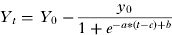 $$Y_t = Y_0 - \displaystyle{{y_0} \over {1 + e^{ - a*(t - c) + b}}} $$
 $$Y_t = \displaystyle{1 \over {1 + e^{ - t}}} $$
 $$T_{50} = c + \displaystyle{b \over a}$$
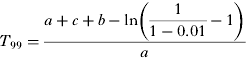 $$T_{99} = \displaystyle{{a + c + b - \ln \left( {\displaystyle{1 \over {1 - 0.01}} - 1} \right)} \over a}$$
Where
- Y t
is the percent viable eggs at time t
- Y 0
is the percent viable eggs at time 0
- a
is a parameter describing the slope of the egg viability curve
- c
is a parameter setting a time lag in the decay process of egg viability
- b
is an arbitrary parameter, which will displace the curve horizontally
The parameters c and b were estimated in the model, but set to be shared between treatments. Thus only the parameter a had to be fitted for the individual egg survival curve. Statistical differences in egg viability between the two slurry types were declared when the 95% confidence intervals of two a estimates did not overlap. The model was fitted by GraphPad Prism version 5.0 (GraphPad Software, San Diego, CA, USA). T50 was calculated for comparison of different egg survival curves and T99 was calculated as an indicator of inactivation of eggs.
RESULTS
The initial analysis of the liquid slurry collected at the farm showed that the concentration of A. suum eggs was 47 eggs per gramme.
Chemical parameters
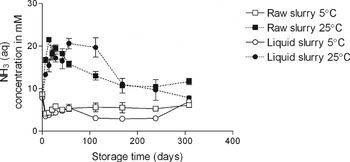
The pH of raw slurry gradually increased from 7·98 (day 0) to 8·22 and 8·32 (day 308) at 5 °C and 25 °C, respectively, while in separated liquid slurry it gradually increased from 8·00 (day 0) to 8·30 and 8·46 (day 308) at 5 °C and 25 °C, respectively. The NH3 (aq) concentrations obtained differed between the two temperatures (P < 0·0001) but there was no significant difference in NH3 (aq) found between raw and separated liquid slurry (P = 0·16). The interaction between time and temperature on NH3 (aq) was statistically significant (P < 0·0001) as the slope for the decline of NH3 (aq) over time was close to 0 at 5 °C, but was negative at 25 °C. This means that at 25 °C the NH3(aq) concentration declined significantly with time starting at 16·7 (±1·1) mm and 13·3 (±0·2) mm at 7 days declining to 11·7 (±1·3) mm and 7·8 (±0·8) mm at 308 days in raw slurry and separated liquid slurry, respectively. In contrast, at 5 °C the NH3 (aq) concentration ranged between 3·2–9·5 mm and 2·6–9·5 mm in raw slurry and liquid fraction respectively throughout the study (Fig. 1).
Changes in aqueous ammonia (NH3 (aq)) concentration during storage of raw and separated liquid slurry stored at 5 °C and 25 °C.

Survival of A. suum eggs
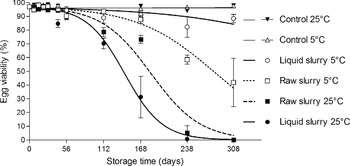
None of the A. suum eggs that were examined immediately (day 0) after collecting the nylon bags from the stored bottles of raw slurry and separated liquid slurry contained developed larvae. The same was the case for eggs kept as controls in distilled water at 5 °C throughout the study. At 25 °C, 92–99% of the eggs stored in distilled water showed different developmental stages from day 7 to 28, after which the eggs contained fully developed larvae. The viability profiles of the eggs in different treatments after embryonation are shown in Fig. 2. The viability of eggs at the start of the experiment was 97% and the control eggs stored in distilled water continued to have a high viability throughout the study, i.e. 97% ±1% (mean ± S.D.) and 98% ±2% at 5 °C and 25 °C, respectively. The estimates for the slope parameter (a); reduction in percentage egg survival per day, are given in Table 1 together with their 95% CI. There was no significant difference in the viability of eggs between the distilled water controls maintained at 5 °C and 25 °C and between raw and liquid slurry stored at 25 °C, but there was a significant difference in egg viability when the two slurry types were stored at 5 °C and between eggs in distilled water (controls) and separated liquid slurry at 5 °C. The reduction in percentage egg survival per day was ordered in the following sequence: distilled water control 5 °C = distilled water control 25 °C < liquid slurry 5 °C < raw slurry 5 °C < raw slurry 25 °C = liquid slurry 25 °C.
Viability of Ascaris suum eggs in raw and separated liquid slurry stored at 5 °C and 25 °C.

Estimation of the slope parameter a, T50 and T99 for different storage conditions of raw and liquid slurry

a The unit for ‘a’ is reduction in percentage egg survival per day.
DISCUSSION
The Commission of European Communities (CEC) recommends storing manure for a minimum of 60 days in summer and 90 days in winter (Kelly, Reference Kelly1978; Walton and White, Reference Walton and White1981) before application to land. But our results document that even storage for 3 months at 25 °C has little if any effect on the viability of eggs and confirm earlier studies that A. suum eggs can survive for more than 100 days in raw pig slurry at temperatures between 10 and 17 °C (Gaasenbeek and Borgsteede, Reference Gaasenbeek and Borgsteede1998; Papajova et al. Reference Papajova, Juris, Sasakova and Vargova2005). The practical implications of our observation is that raw and separated liquid slurries kept at 25 °C can be spread on pastures and crops only after a minimum of 8–10 months storage without contaminating with viable eggs. Raw and liquid slurry stored at 5 °C require even a longer storage time to inactivate helminth eggs and it is not advisable to apply such slurries to pastures e.g. with pigs and ready-to-eat crops as 41·9 (±30)% and 88·4 (±5)% of eggs, respectively were still found viable even after 10 months storage.
The chemical-mechanical slurry separation technique used in this study is based on adding flocculant as a pre-treatment followed by mechanical separation. Flocculant is added to aggregate small particles into larger masses (flocs) which are then removed by mechanical separators to the solid fraction. Flocculation followed by treatment in a screw press proved efficient in removing particles from raw slurry to the solid fraction (Hjorth et al. Reference Hjorth, Christensen, Christensen and Sommer2010; Peters and Jensen, Reference Peters and Jensen2011) and the liquid fraction is usually free of particles larger than 250 μm (Popovic et al. Reference Popovic, Hjorth and Jensen2012). As the size of A. suum eggs is 56–84 μm × 50–59 μm (Roberts, Reference Roberts1934) the liquid fraction obtained by slurry separation as done in this study will not be devoid of all A. suum eggs as documented by our findings and therefore other pathogens may also be present. However, other slurry separation techniques may impact the removal of pathogens differently. Information was not available about the amount of flocculant (polyacrylamide) used for slurry separation in the present study but the optimal dose for efficient total solid suspension (TSS) separation is 0·9–1·8 g/kg total solids (Walker and Kelley, Reference Walker and Kelley2003). Any effect of this chemical on the viability of eggs can be ruled out by the observed high viability of eggs in liquid slurry at 5 °C. According to the World Health Organization (2006) guidelines, the concentration of helminth eggs in waste water intended for irrigation should be ⩽1 egg/L of waste water. In the present study where liquid slurry contained more than 40 eggs per gramme, such liquid would not be safe for irrigation of high risk crops like vegetables.
pH was unlikely to be a main determinant of the inactivation of eggs as our observed pH values overall were only slightly alkaline. Eriksen et al. (Reference Eriksen, Andreasen and Ilsoe1996) showed that viability of A. suum eggs in lime-treated sewage sludge was effected only at a pH of >12 for at least 3 months while Gantzer et al. (Reference Gantzer, Gaspard, Galvez, Huyard, Dumouthier and Schwartzbrod2001) showed that sludge should be exposed to a pH above 11·5 for 6 months to produce sanitized sludge. Thus the inhibiting effect of raw and separated liquid slurry in the present study should be attributed to other physico-chemical factors. One such factor is NH3 (aq) which has been documented to impact the viability of helminth eggs when these are stored in ammonia-treated wastewater sludge (Ghiglietti et al. Reference Ghiglietti, Genchi, Di Matteo, Calcaterra and Colombi1997; Pecson et al. Reference Pecson, Barrios, Jiménez and Nelson2007) or exposed to ammonia in urine and feces (Nordin et al. Reference Nordin, Nyberg and Vinnerås2009).
Increased temperature increases the permeability of the helminth egg shell. Barrett (Reference Barrett1976) studied the permeability of A. lumbricoides to acid fuchsin by incubating eggs for 12 h at different temperatures and reported a marked increase in the egg permeability at 44 °C. Although the highest temperature in the present study was 25 °C, prolonged exposure to such a temperature might have caused the lipid membrane of A. suum egg, which acts as a barrier to toxic chemicals, to lose its integrity, allowing the toxic ammonia to penetrate the egg, resulting in death of 100% of the eggs in both slurry types after 8–10 months storage. Thus, inactivation of helminth eggs and pathogens in general is higher at high temperatures corresponding to summer conditions or tropical climates, than at low temperatures, e.g. seen during winter in temperate climates, which corroborate findings from studies of egg inactivation conducted under natural conditions (Larsen and Roepstorff, Reference Larsen and Roepstorff1999).
NH3 (aq) concentration was similar in both slurry types and depended on temperature with higher concentrations found at 25 °C than at 5 °C and a significant decline seen at 25 °C when the study was terminated (Fig. 1). The reason being that at high temperature and alkaline pH the equilibrium between nontoxic NH4+ (aq) and toxic NH3 (aq) shifts towards NH3 (aq) which is volatile and may evaporate as NH3 gas.
At 25 °C, we found that both high NH3 (aq) concentration and poor survival were associated, thus NH3 (aq) could be the causative factor, but this can't be proven directly from this experiment. Nordin et al. (Reference Nordin, Nyberg and Vinnerås2009) studied the inactivation of A. suum eggs in human feces and urine at 24 °C; a temperature comparable to our 25 °C experiment. At 24 °C, an NH3 (aq) concentration of 20 mm was measured on day 35 and a mean 99% inactivation time (T99) of 74 days was predicted. Though we observed similar NH3 (aq) concentrations at 25 °C (16·5–20·6 mm during 21–56 days storage of liquid slurry and 18·2 mm − 21·5 mm when raw slurry was stored between 14 and 42 days), total inactivation was observed at 238 days and 308 days in liquid and raw slurries respectively. The faster inactivation reported by Nordin et al. (Reference Nordin, Nyberg and Vinnerås2009) might be due to the use of eggs obtained from the uterus of adult female A. suum worms which had an initial viability of only 62%. We assume helminth eggs need exposure to the pig intestine environment to fully mature and become resistant to unfavourable conditions in the external environment as suggested by Fairbairn (Reference Fairbairn1957). The relative low percentage of initial egg viability (Nordin et al. Reference Nordin, Nyberg and Vinnerås2009) indicates that the eggs used were not fully matured therefore likely to be more susceptible to unfavourable conditions in the external environment. Pecson et al. (Reference Pecson, Barrios, Jiménez and Nelson2007) reported a T99 of 87 days at 1000 mg/l (∼58 mm) ammonia and 25 days at 5000 mg/l (∼294 mm) ammonia at pH 12 and 20 °C. The low ammonia concentrations found in the present study, i.e. 7·9–22·4 mm in raw slurry and 7·3–23·2 mm in liquid slurry, might explain the longer duration (238–308 days) needed for a total inactivation of the A. suum eggs. It should be noted that our bottles with slurry were closed with Parafilm® during storage and it is unknown to what extent NH3 gas evaporated from the bottles.
Although there was no significant difference in the NH3 (aq) concentrations between the two slurry types at 5 °C, the viability of A. suum eggs in liquid slurry was higher (88·4%) even after prolonged storage as compared to raw slurry (41·9%) indicating that there might be other physico-chemical factors than toxic ammonia in raw as opposed to liquid slurry responsible for the increased inactivation of eggs in stored raw slurry.
The present study found no embryonation or indication of development while the eggs were in the slurry under any storage conditions, which clearly indicates that the A. suum eggs may not be infective when present in different types of slurry. It is well known that embryonation of eggs would not take place at 5 °C as A. suum eggs require >16 °C to embryonate under controlled laboratory conditions (Seamster, Reference Seamster1950) and eggs only develop during the summer months in temperate climates (Stevenson, Reference Stevenson1979; Nilsson, Reference Nilsson1982). NH3 (aq) in slurry might also reversibly inhibit embryonation in a similar way as temperature, as is suggested by findings of non-embryonated eggs only following storage in urine (Nilsson, Reference Nilsson1982). Biological factors like the presence of ovicidal fungi may also play a role in inactivation of A. suum eggs. Lýsek and Krajcí (Reference Lýsek and Krajcí1987) reported that fungal species, Verticillium chlamydosporium penetrate and destroy A. lumbricoides eggs. Araújo et al. (Reference Araújo, Braga, Milani, Silva and Tavela2008) evaluated in vitro the effect of different nematophagous fungi on A. suum eggs and reported an ovicidal effect of Pochonia chlamydosporia. Little is known about the presence and survival of ovicidal fungi upon storage of pig slurry and their impact on egg survival warrants further investigation.
Earlier studies on A. suum egg viability have also used the ability of un-embryonated eggs to develop into fully larvated eggs upon embryonation as a criterion for viability (e.g., Pecson et al. Reference Pecson, Barrios, Jiménez and Nelson2007, Nordin et al. Reference Nordin, Nyberg and Vinnerås2009, Mun et al. Reference Mun, Lee and Yoon2011). The actual physiological status of the larvae is, however, not known and the eggs might be non-viable after reaching the fully larvated stage or have lost their infectivity. In addition, embryonation of eggs into fully larvated eggs cannot be used as a criterion for eggs already larvated prior to incubation. An egg hatch assay would presumably give a more valid status of viability and the results of such an assay might have provided different results in the present study, but none of the hatching techniques hitherto described (Fairbairn Reference Fairbairn1961; Han et al. Reference Han, Eriksen, Boes and Nansen2000) have worked consistently in our laboratory (unpublished data) and there is a clear need to develop a validated egg hatch assay.
Several non-linear regression models have been used to model microbial survival curves as a function of time (Membré et al. Reference Membré, Thurette and Catteau1997; Pecson et al. Reference Pecson, Barrios, Jiménez and Nelson2007). The advantage of our model was that only a single parameter was needed to describe the difference between the survival curves (i.e. the slope parameter a). The estimated survival functions described the observed egg survival curves well for 3 of the 4 datasets, whereas the fit was poorer for the dataset representing raw slurry at 25 °C.
In conclusion, our study demonstrated that under laboratory conditions at 5 °C, storage for 10 months does not affect the viability of A. suum eggs in liquid slurry and has a limited effect on viability of eggs in raw slurry, whereas at 25 °C all eggs lost their viability within this period of time irrespective of slurry type. Further studies are needed to investigate whether treatment of raw and liquid slurries (e.g. addition of lime or urea) may reduce the viability of helminth eggs and other pathogens. Recommendations are needed for safe application of liquid slurry to fertilize different crops used for animal and human consumption.
ACKNOWLEDGEMENTS
We thank Lise Lotte Christiansen for help preparing the nylon bags with helminth eggs and Anita Forslund for storage and collection of the slurry samples.
FINANCIAL SUPPORT
This research was supported by a grant from the PATHOS Project funded by the Strategic Research Council of Denmark (ENV 2104–07–0015). The Ph.D. fellowship of Kiran Kumar Katakam was jointly financed by the Faculty of Health and Medical Sciences, University of Copenhagen and its Ph.D. Research School, RECETO.