





Introduction
As ectotherms, bark beetles (Coleoptera: Curculionidae: Scolytinae) display both physiological and behavioural adaptations to survive lethal winter temperatures in seasonal environments (Danks Reference Danks1978; Lombardero et al. Reference Lombardero, Ayres, Ayres and Reeve2000; Bale and Hayward Reference Bale and Hayward2010). Physiologically, bark beetles produce cryoprotectants to minimise intracellular ice nucleation, and behaviourally, beetles may seek out thermally buffered microsites before the onset of winter (Gehrken Reference Gehrken1984; Lombardero et al. Reference Lombardero, Ayres, Ayres and Reeve2000; Thompson et al. Reference Thompson, Huber and Murray2020). In areas with cooler climates, such as those at higher elevations or latitudes, bark beetles tend to choose microsites that maximise thermal insulation, such as shallow galleries beneath the bark of main stems, or outside of the natal tree near the root collar beneath snow or in soil litter (Lombardero et al. Reference Lombardero, Ayres, Ayres and Reeve2000; Dworschak et al. Reference Dworschak, Meyer, Gruppe and Schopf2014; Schebeck et al. Reference Schebeck, Hansen, Schopf, Ragland, Stauffer and Bentz2017). In less extreme environments, bark beetles may overwinter in more exposed locations such as branch nodes (reviewed in Wertman et al. Reference Wertman, Borden and Carroll2022). Overwintering within or near natal trees may allow bark beetles to avoid fitness costs associated with dispersal to new locations (Bonte et al. Reference Bonte, Van Dyck, Bullock, Coulon, Delgado and Gibbs2012; Wijerathna and Evenden Reference Wijerathna and Evenden2019) and may result in larger beetles with greater flight capacity and higher fecundity (Nylin and Gotthard Reference Nylin and Gotthard1998; Foelker and Hofstetter Reference Foelker and Hofstetter2014; Kirkendall et al. Reference Kirkendall, Biedermann, Jordal, Vega and Hofstetter2015; Jones et al. Reference Jones, Shegelski, Marculis, Wijerathna and Evenden2019). Conversely, remaining in natal trees during winter may increase the risk of predation by woodpeckers (Fayt et al. Reference Fayt, Machmer and Steeger2005), subcortical predators, and other antagonists (Raffa et al. Reference Raffa, Grégoire, Lindgren, Vega and Hofstetter2015) that seek out infested trees. Ultimately, evolution of a particular overwintering strategy will be associated with selection for other life history traits, such as phenology, development rates, and body size (Nylin and Gotthard Reference Nylin and Gotthard1998; Danks Reference Danks2007; Bale and Hayward Reference Bale and Hayward2010).
The alder bark beetle, Alniphagus aspericollis (LeConte) (Coleoptera: Curculionidae: Scolytinae), is a subcortical herbivore that feeds and reproduces within the phloem of red alder, Alnus rubra Bongard (Betulaceae), trees throughout the Pacific Coast region of North America (Chamberlin Reference Chamberlin1958; Borden Reference Borden1969). Although the alder bark beetle was initially thought to be bivoltine, given its two dispersal flights observed during spring and summer (Borden Reference Borden1969), it has more recently been characterised as univoltine with two overlapping cohorts that overwinter either as adults inside branch nodes or as larvae within the main stems of host trees (Wertman et al. Reference Wertman, Borden and Carroll2022). A portion of each alder bark beetle population disperses to branches in early fall, expending critical energy that could otherwise be directed towards overwintering survival. Furthermore, beetles are vulnerable to biotic and abiotic mortality agents during their dispersal from thermally buffered habitats in the main stems of host trees to less-insulated branch sites, which may become exposed to lethal temperatures. The present study was conducted to identify potential evolutionary costs and benefits for the alder bark beetle associated with overwintering in the main stems of natal trees versus in branch nodes within the canopy of non-natal trees, particularly those that may lead to evolutionarily stable overwintering strategies in bark beetles in general.
Bark beetles carry a complex array of fungi and other microorganisms, both phoretically and in specialised cuticular structures located on or within their bodies (Klepzig and Six Reference Klepzig and Six2004). Many vectored organisms are apparently benign with respect to beetle fitness, and others may be beneficial mutualists or antagonists (Bleiker and Six Reference Bleiker and Six2007; Mann and Davis Reference Mann and Davis2021; Six and Klepzig Reference Six and Klepzig2021). Entomopathogenic fungi are antagonists of insects that affect fitness through sublethal effects (e.g., immune system toxicity, competition with mutualistic microorganisms) and direct mortality (Mann and Davis Reference Mann and Davis2021; Wang et al. Reference Wang, Peng, Li, Cheng and Gong2021; Mantzoukas et al. Reference Mantzoukas, Kitsiou, Natsiopoulos and Eliopoulos2022). Lee et al. (Reference Lee, Wertman, Carroll and Hamelin2023), and Wertman et al. (Reference Wertman, Hamelin and Carroll2025) found alder bark beetles to be associated with Beauveria Vuillemin (Ascomycota: Cordycipitaceae), which are well-known entomopathogens of many insect species (Wang et al. Reference Wang, Peng, Li, Cheng and Gong2021; Mantzoukas et al. Reference Mantzoukas, Kitsiou, Natsiopoulos and Eliopoulos2022), including bark beetles (reviewed in Mann and Davis Reference Mann and Davis2021). Beauveria spp., including the well-studied species B. bassiana (Balsamo) Vuillemin, can be dispersed via wind and water and transmitted among bark beetles, proliferating on and penetrating the cuticle of infected beetles and, potentially, growing endophytically in adjacent tree tissues (Kreutz et al. Reference Kreutz, Zimmermann and Vaupel2004; McKinnon et al. Reference McKinnon, Saari, Moran-Diez, Meyling, Raad and Glare2017; Mann and Davis Reference Mann and Davis2021; Wang et al. Reference Wang, Peng, Li, Cheng and Gong2021). Differential exposure of adult alder bark beetles to antagonistic Beauveria within either overwintering habitat is therefore possible and may impose selection for certain overwintering strategies that minimise the fitness effects of Beauveria infection.
Another indicator of beetle fitness that could differ between the two overwintering cohorts of the alder bark beetle is body size. Body size is positively correlated with many critical fitness attributes in bark beetles, including fecundity, cold tolerance, pheromone production, and dispersal capacity (Foelker and Hofstetter Reference Foelker and Hofstetter2014; Kirkendall et al. Reference Kirkendall, Biedermann, Jordal, Vega and Hofstetter2015; Jones et al. Reference Jones, Shegelski, Marculis, Wijerathna and Evenden2019); therefore, beetles with smaller body sizes may experience significant fitness costs relative to larger conspecifics. Indeed, for many insect species, every 1% increase in dry body weight is associated with a proportionate increase in fecundity (Honěk Reference Honěk1993). Some bark beetles perform maturation feeding following adult eclosion, either within the tissues of the natal tree before emergence or upon healthy tissues such as branches and twigs after emergence (McNee et al. Reference McNee, Wood and Storer2000). Maturation feeding in bark beetles may also contribute to pheromone production, increase female fecundity and dispersal capacity via augmentation of body fat reserves, and facilitate sclerotisation and juvenile hormone production (McNee et al. Reference McNee, Wood and Storer2000; Jones et al. Reference Jones, Shegelski, Marculis, Wijerathna and Evenden2019).
In this study, we conducted a series of field and laboratory investigations to determine whether (1) frequency of Beauveria on emergent beetles and (2) body size of adult beetles differs between the branch-overwintering cohorts and the bole-overwintering cohorts of the alder bark beetle. In addition, we performed dissections of adult beetles to ascertain whether maturation feeding occurs within either cohort and, if feeding within the branch-overwintering cohort was detected, whether the prevalence of winter feeding varies by sex and season (winter versus spring). Identification of overwintering cohort–driven trends in Beauveria exposure, body size, and maturation feeding in the alder bark beetle may help elucidate some of the potential biological factors influencing the evolutionary stability of alternative overwintering strategies in bark beetles.
Methods
Lifecyle of the alder bark beetle
In southwestern British Columbia, Canada, the alder bark beetle lifecycle comprises two separate cohorts characterised by distinct overwintering strategies (Fig. 1). In the first cohort, adults overwinter inside branch nodes in the crowns of red alder trees or in shallow overwintering galleries along tree boles, and in the second cohort, larvae overwinter in brood galleries within the phloem of the bole (Borden Reference Borden1969; Wertman et al. Reference Wertman, Borden and Carroll2022, Wertman et al. Reference Wertman, Hamelin and Carroll2025). Each spring, adult beetles from the first cohort emerge from overwintering sites and disperse to the boles of new host trees in which they lay eggs, producing offspring that complete development within the phloem throughout the summer. In late summer and early fall, adult offspring emerge and disperse to branch-overwintering sites. Conversely, as spring temperatures increase, larvae from the second, bole-overwintering cohort resume subcortical feeding and develop through several instars until pupation, which is followed by adult emergence and dispersal to new host trees. This cohort initiates attacks on new boles mid-summer, establishing broods that will feed until larval development ceases during winter, likely due to low temperatures. Lack of evidence of speciation indicates that gene flow occurs between these two apparently distinct cohorts, a likely result of a prolonged period of bole-colonisation activity by branch-overwintering beetles.
Schematic showing the univoltine lifecycle of the alder bark beetle, Alniphagus aspericollis, with overlapping cohorts, as observed in red alder, Alnus rubra, in southwestern British Columbia, Canada. The first cohort of branch-overwintering adults is represented by the lighter, outer ring, and the second cohort of bole-overwintering larvae is represented by the darker, inner ring. The blue arrows denote flights of beetles from branches to bole (F1), from bole to bole (F2), and from bole to branches (F3). The dashed blue line indicates potential opportunity for gene flow between cohorts. Figure adapted from Wertman et al. (Reference Wertman, Hamelin and Carroll2025).

Figure 1. Long description
A diagram of the lifecycle of the alder bark beetle, Alniphagus aspericollis, showing seasonal transitions and developmental stages for two groups of beetles (cohorts) that either spend winter as adults in branches or as larvae in the main stems (boles) of their red alder host trees. The diagram is divided into four sections representing different seasons: Spring, Summer, Autumn, and Winter. The lifecycle includes adults, eggs, larvae, and pupae. For the first cohort (light yellow outside ring), adult beetles that spent the winter in branches fly during spring to trees (F1) and lay eggs under the bark that hatch as larvae. During summer, larvae develop into pupae and then adults. At the end of summer, adults emerge from host trees and fly back to branches to spend the winter (F3). For the second cohort (dark yellow inner ring), larvae spend the winter under the bark of trees and in spring and early summer they develop into pupae and then adults. In late summer, the adults emerge from trees and attack new trees (F2) where they lay more eggs that hatch into larvae that remain there over the winter. The blue arrows denote flights of beetles from branches to bole (F1), from bole to bole (F2), and from bole to branches (F3). The dashed blue line indicates potential opportunity for gene flow between cohorts.
Alder bark beetle collections
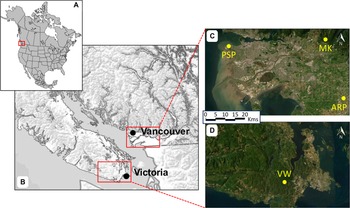
For our investigation of potential fitness trade-offs between alder bark beetle overwintering cohorts, we collected adult beetles from both red alder branches and boles from four sites in southwestern British Columbia, Canada (Fig. 2): Pacific Spirit Regional Park (PSP), Malcolm Knapp Research Forest (MK), Aldergrove Regional Park (ARP), and the Greater Victoria Water Supply Area (VW). These four sites featured mature, red alder–dominant stands and active alder bark beetle infestations. Beetles were collected from PSP, MK, and VW for screening for entomopathogenic fungi, and from PSP, ARP, and MK for assessment of physical (body size) and physiological (feeding status) differences between overwintering cohorts.
Alder bark beetle sampling locations in southwestern British Columbia, Canada shown A, in North America, B, with Victoria and Vancouver landmarks, and larger-scale maps of areas with sample sites marked: C, Pacific Spirit Regional Park (PSP), Aldergrove Regional Park (ARP), and Malcolm Knapp Research Forest (MK); D, the Greater Victoria Water Supply Area (VW). Maps were produced using Esri satellite world imagery in ArcGIS Pro, version 3.4.0 (Esri 2025).

Cohort 1: branch-overwintering beetles
To obtain alder bark beetles from the branch-overwintering cohort, adult beetles were either allowed to emerge (2019, for culturing), hand-collected (2019, for culturing), or manually extracted (2023, for body size and feeding status assessment) from branch-overwintering sites (Table 1). Lower crown or adventitious branches containing overwintering sites were removed from trees at all sites for the respective collection periods. Branches were returned to the laboratory and stored in sealed containers at cool, ambient temperature to discourage emergence before sectioning. Each overwintering site suspected to contain one or more adult bark beetles, based upon descriptions by Wertman et al. (Reference Wertman, Borden and Carroll2022; i.e., branch nodes with apparent entrance holes and callous tissue), was carefully cut away from the source branch.
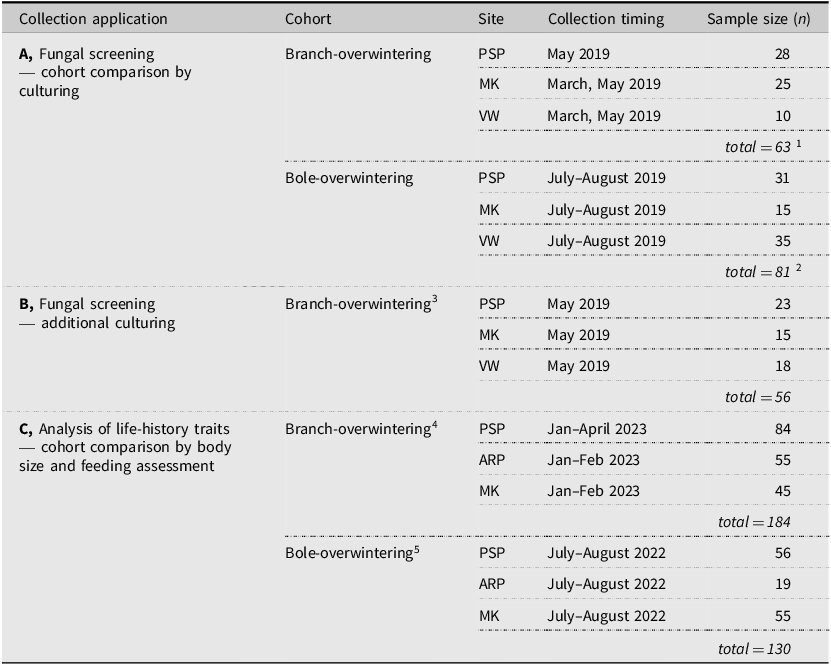
Summary of alder bark beetle, Alniphagus aspericollis, collections from four sites in southwestern British Columbia, Canada: Pacific Spirit Park (PSP), Malcolm Knapp Research Forest (MK), Aldergrove Regional Park (ARP), and the Greater Victoria Water Supply Area (VW). Beetles were collected for A, screening of antagonistic fungi by ulturing for cohort (i.e., branch- versus bole-overwintering) comparison and B, supplemental branch-overwintering data, and C, analysis of life-history traits including cohort comparison of body size and within-cohort (branch-overwintering) assessment of feeding status.

Table 1 Long description
A table detailing alder bark beetle collections from four sites in southwestern British Columbia. The table has three main sections: A, B, and C, each focusing on different collection applications. Section A includes fungal screening by culturing for cohort comparison, with data for branch-overwintering and bole-overwintering cohorts collected in May 2019 and July-August 2019 respectively. Section B covers additional fungal screening with data collected in May 2019. Section C presents analysis of life-history traits, including body size and feeding assessment, with data collected in January-April 2023 and July-August 2022. Each section lists the cohort, site, collection timing, and sample size.
1 Overall frequency of beetles from collection units of more than 1 individual = 25% (16/63).
2 Overall frequency of beetles from collection units of more than 1 individual = 46% (37/81).
3 Dispersing beetles were hand-collected from the bark surfaces of trees during flight 1 (see Fig. 1 for flight details).
4 Out of the 84 branch-overwintering beetles collected from PSP, 26 were collected in the winter (January) and 58 were collected in the spring (March to April), informing seasonal overwintering trends in body size and feeding status.
5 Bole-overwintering beetles used to assess body size only.
For culturing purposes, branches with overwintering sites were removed from five red alders at PSP and from eight trees at each of MK and VW in March and early May 2019. The isolated overwintering sites were placed individually into clean, ventilated plastic containers maintained inside of a growth chamber programmed with an approximately seasonally appropriate photoperiod (9 hours of darkness at night and 15 hours of light during the day) and thermoperiod (10 °C at night and 24 °C during the day) to encourage daytime emergence. Individual beetles were collected upon emergence at regular daily intervals from the rearing cups using bleach-cleaned forceps and placed into sterile sample tubes. The total number of beetles emerging from each overwintering site was recorded, and the beetle-containing tubes were stored at approximately 4 °C before culturing (Table 1A). Additional dispersing beetles from the branch-overwintering cohort were hand-collected, using forceps that were bleach-cleaned between captures, from the bark surface of host trees in early May 2019 to serve as a supplemental source of fungi by culturing (Table 1B).
For beetle body size and feeding status, 10–30 lower crown or adventitious branches with overwintering sites were collected from a minimum of five mature red alder trees at each sampling site (PSP, ARP, and MK) in the winter of 2023 (January–February). Additional sampling of beetle-containing branches from five trees at PSP was conducted in early April 2023 to determine whether feeding prevalence increased among overwintering beetles with warming temperatures in late winter and early spring (amounting to 58 beetles from 10 branches; Table 1C). Overwintering sites within branches were exposed by carefully cutting away external wood tissues, and live beetles within the sites were removed and placed in containers, grouped by site, in the freezer (∼ –15 °C) for a minimum of 48 hours to euthanise the insects and for storage until further assessment (Table 1C).
Cohort 2: bole overwintering beetles
To obtain adult alder bark beetles from the bole-overwintering cohort for culturing (2019) and body size and feeding status assessments (2022), beetles were collected using the methods of Wertman et al. (Reference Wertman, Hamelin and Carroll2025). Briefly, single fine-mesh emergence traps were fixed to trees with evidence of successful adult beetle attacks and larval feeding. Emergence traps were installed during spring (March–April) of 2019 and 2022, before the emergence and dispersal period of the bole-overwintering cohort. Each trap covered approximately 960 cm2 of bark area upon installation and featured three collection cups that were either dry for capture of live beetles for culturing (2019) or wet, containing propylene glycol for preservation of emergent insects for body size and feeding status assessment (2022). In 2019, nine traps per site were installed at each of PSP and VW, and six traps were installed at MK, with collections of live beetles made daily throughout peak emergence (July–August) and approximately weekly outside of peak emergence (April–June). Bleach-cleaned collection cups were replaced after each collection to minimise cross-contamination between samples, and the total number of beetles present in each cup at time of collection was recorded. Live beetles were placed individually into sterile, labelled sample tubes using bleach-cleaned forceps, returned to the laboratory, and maintained in a refrigerator at approximately 4 °C until processing. In 2022, three traps were installed at each of the three sites, PSP, ARP, and MK. Trap contents were collected weekly throughout the emergence period (July–August), and beetles were transferred from the propylene glycol into labelled preservation vials containing 70% ethanol.
Beauveria screening: bole- versus branch-overwintering beetles
To determine whether the frequency of Beauveria on emergent alder bark beetles differed between overwintering cohorts, fungi were cultured from the exoskeletons (i.e., phoretic fungi) of branch- and bole-overwintering beetles (Table 1A,B), following methods described by Wertman et al. (Reference Wertman, Tanney, Hamelin and Carroll2024). Suspected Beauveria isolates were identified within the culture sets from all branch- and bole-overwintering beetles by their distinctive white, chalky surfaces (Rehner Reference Rehner, Vega and Blackwell2005; Lee et al. Reference Lee, Wertman, Carroll and Hamelin2023; Wertman et al. Reference Wertman, Hamelin and Carroll2025). Five suspected Beauveria cultures were randomly selected for DNA extraction, polymerase chain reaction, and sequencing of the internal transcribed spacer regions of nuclear ribosomal DNA, also according to protocols by Wertman et al. (Reference Wertman, Tanney, Hamelin and Carroll2024). Sequences for each polymerase chain reaction product were pairwise aligned using MAFFT (Katoh et al. Reference Katoh, Misawa, Kuma and Miyata2002; Katoh and Standley Reference Katoh and Standley2013) in Geneious Prime, version 2020.2.5 (https://www.geneious.com), and consensus sequences were identified to the genus-level using BLASTn (Altschul et al. Reference Altschul, Gish, Miller, Myers and Lipman1990) and data by Lee et al. (Reference Lee, Wertman, Carroll and Hamelin2023). Resultant internal transcribed spacer sequences were trimmed and deposited in GenBank (accession numbers PX285850–PX285854), and long-term storage material for each of the five isolates was also prepared and is maintained in the Genomics and Forest Health Lab at the University of British Columbia (Vancouver, British Columbia, Canada).
Body size and feeding status: bole- and branch-overwintering beetles
We compared the body sizes of branch- and bole-overwintering adult alder bark beetles to ascertain whether this fitness metric differs between the two cohorts (Table 1C). We also determined the feeding statuses of these same beetles to assess whether maturation feeding occurred pre-emergence within natal trees or post-emergence within branch overwintering sites. Beetles obtained from boles and branches in 2022 and 2023 from PSP, ARP, and MK (see Alder bark beetle collections section) were measured and dissected. Beetles were segregated by sex, based on the number of abdominal tergites, males with eight and females with seven (Borden Reference Borden1969). Pronotum width, a widely used metric of beetle size (e.g., Anderbrant Reference Anderbrant1988; Bleiker and Six Reference Bleiker and Six2007), was measured for each beetle using an ocular micrometer that was fitted to a dissection microscope at 40× magnification.
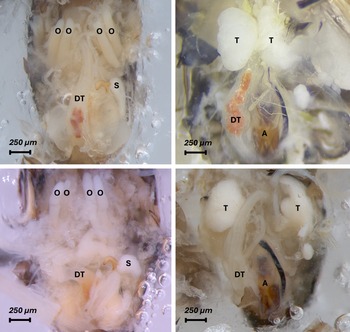
Each measured beetle was then dissected to determine if evidence of feeding was present in its digestive tract. Following methods described by Bleiker et al. (Reference Bleiker, Willsey and Smith2025), the elytra were removed from each beetle, and the beetles were gently pressed into a Petri dish containing semi-melted paraffin wax to be fixed dorsal side-up and covered with a drop of 0.9% saline for specimen hydration. Once the paraffin wax hardened, shallow vertical incisions were made transversely and then longitudinally in the midline of the abdominal integument with an upwards facing fine-tipped scalpel. Cuts were made from the midline of the metathorax to the posterior end of the abdomen. A section of the integument was then removed using fine-tipped forceps to expose the abdominal and thoracic cavities. The feeding status of each beetle was determined based on the presence or absence of red food particles (indicating consumption of red alder phloem) in the digestive tract, and the sex of each beetle was confirmed by the presence of the spermatheca and uterus in females and an aedeagus and testes in males (Fig. 3).
Dissected female (left) and male (right) alder bark beetle, Alniphagus aspericollis, abdomens showing presence (top) and absence (bottom) of feeding. Red particles in the digestive tract (DT) indicate recent feeding on red alder, Alnus rubra, phloem. Beetles were segregated by sex via the presence of indicative reproductive organs, such as the spermatheca (S) and ovaries (O) in females and the testes (T) and aedeagus (A) in males.

Statistical analyses
To evaluate whether the frequency of Beauveria differed between alder bark beetle overwintering cohorts, we conducted a logistic regression to test the proportion of Beauveria-positive alder bark beetles (replicate = tree) in relation to cohort, site, mean number of beetles per collection unit (i.e., per branch beetle collection container or single emergence trap cup collection; Wertman et al. Reference Wertman, Hamelin and Carroll2025), and all three two-way interactions. The analysis included data from branch- and bole-emerged beetles but excluded hand-collected beetles from the branch-overwintering cohort because these actively dispersing beetles may possess different microbial profiles than do beetles emerging directly from overwintering tissues. The mean number of beetles per collection unit per tree was included in the model to account for a potential effect of cross-contamination between individuals on the proportion of Beauveria-positive beetles. The number of beetles per collection unit was binned (1 = 1, 2 = 2 or more) to accommodate a data outlier. A supplementary logistic regression was constructed to test the effects of cohort, site, and the interaction of these terms on the proportion of Beauveria-positive beetles obtained from collection units of single beetles only (n = 91). A third logistic regression was performed to test for an effect of collection method (branch-emerged versus hand-collected) and site, and the interaction between collection method and site, on the proportion of Beauveria-positive beetles from the branch-overwintering cohort (replicate = collection method within site).
To test whether adult body size differed between the two overwintering cohorts, we performed a three-factor analysis of variance to test pronotum width in response to cohort, sex, collection site, and all two-way interactions. To evaluate whether winter feeding status varied by sex in branch-overwintering beetles, a logistic regression was used to assess feeding status (fed or unfed) in relation to sex, site, and sex × site. A second logistic regression was run to assess feeding status in relation to season (winter versus spring), sex, and season × sex for PSP samples only.
All statistical analyses were performed using R, version 4.5.0 (R Core Team 2025) in RStudio, version 2025.05.01 (Posit Team 2025). Significance levels (P-values, significance threshold P < 0.05) were obtained using Anova (test = “LR” for logistic regressions only) in the car package (Fox and Weisberg Reference Fox and Weisberg2019), and plots were produced using ggplot2 (Wickham Reference Wickham2016). The emmeans package (Lenth et al. Reference Lenth, Banfai, Bolker, Buerkner, Giné-Vázquez and Herve2025) was used to evaluate pairwise differences between sites (across cohorts, fixing the mean number of beetles per collection unit at the overall mean of 1.3) in the first cross-cohort Beauveria logistic regression.
Results
Beauveria screening: bole- versus branch-overwintering beetles
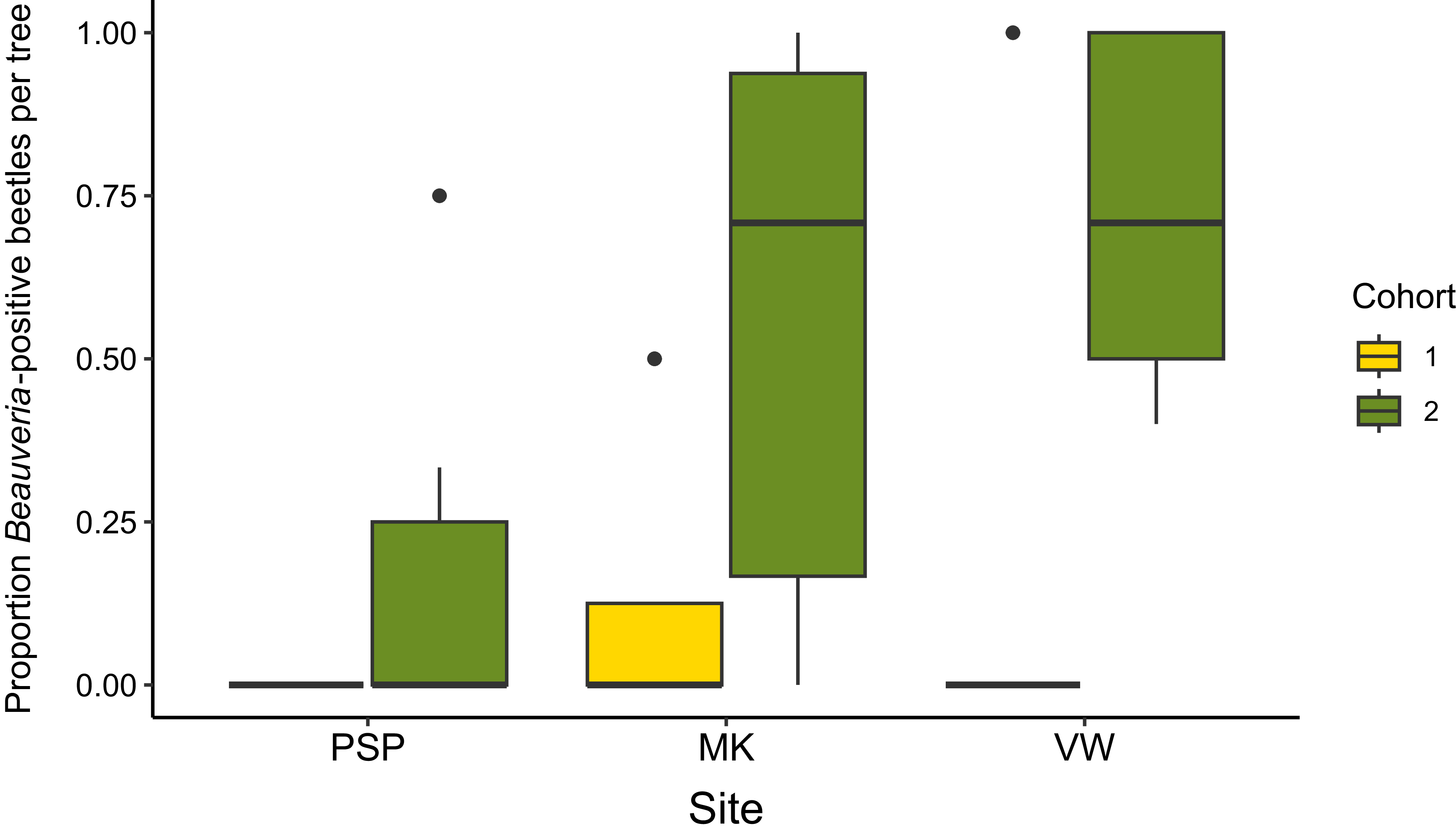
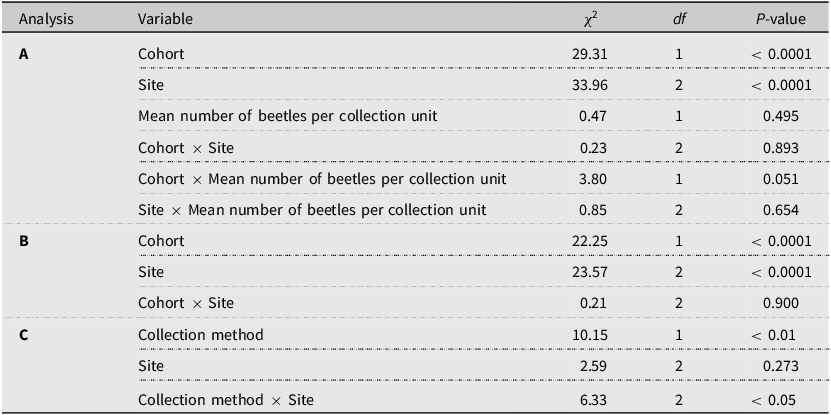
Based upon internal transcribed spacer sequencing confirmation of Beauveria identification, previous reports of Beauveria recovery from alder bark beetles by Lee et al. (Reference Lee, Wertman, Carroll and Hamelin2023), and the distinctive appearance of Beauveria in culture, we confirmed that all suspected Beauveria isolates in our collections were entomopathogenic Beauveria, and we considered the emergent beetles from which the isolates were derived as Beauveria-positive for the remainder of our analyses. The frequency of Beauveria was significantly higher among beetles from the bole-overwintering cohort than from the branch-overwintering cohort (Table 2A; Fig. 4). Approximately eight times as many beetles from the bole-overwintering cohort carried Beauveria on their exoskeletons (51.9%, 42/81 Beauveria-positive beetles; PSP = 5/31, MK = 11/15, VW = 26/35) compared to beetles from the branch-overwintering cohort (6.3%, 4/63 Beauveria-positive beetles; PSP = 0/28, MK = 3/25, VW = 1/10; Fig. 4). Site also significantly affected the proportion of Beauveria-positive beetles (Table 2A), with significant pairwise differences between PSP and MK (P < 0.01) and PSP and VW (P < 0.05) for the bole-overwintering cohort only. Neither mean number of beetles per collection unit (ranging from 1.0 to 2.0 (see Statistical analyses section); branch-overwintering mean ± standard error = 1.2 ± 0.07, bole-overwintering 1.4 ± 0.06) nor any two-way interactions were significant in this analysis (Table 2A). Furthermore, results of the supplemental analysis to test the effect of cohort, site, and cohort × site on proportion of Beauveria-positive beetles from collection units of single individuals reflect only those of the full model (Table 2B). Among the branch-overwintering cohort, beetle collection method (branch-emerged versus hand-collected) and the interaction of collection method and site affected the proportion of Beauveria-positive beetles (Table 2C). Dispersing (i.e., hand-collected) beetles from the branch-overwintering cohort carried Beauveria on their exoskeletons (30.4%, 17/56 Beauveria-positive beetles; PSP = 7/23, MK = 2/15, VW = 8/18) at a significantly higher frequency (∼4.8×) than branch-emerged beetles did.
Proportions of Beauveria-positive alder bark beetles, Alniphagus aspericollis, per red alder, Alnus rubra, tree, sampled from two overwintering cohorts (1 = branch-overwintering, 2 = bole-overwintering) across three sites in southwestern British Columbia, Canada: Pacific Spirit Regional Park (PSP); Malcolm Knapp Research Forest (MK); Greater Victoria Water Supply Area (VW). Horizontal black lines represent the median proportion of Beauveria-positive beetles per site, boxes span from upper to lower quartiles, whiskers show data beyond the quartiles within 1.5× of the interquartile range, and black points represent data outliers.

Analysis of deviance table (Type II tests) for logistic regressions analysing the following: A, the proportion of Beauveria-positive alder bark beetles, Alniphagus aspericollis, in relation to cohort (branch- or bole-overwintering), site (Pacific Spirit Regional Park, PSP; Malcolm Knapp Research Forest, MK; and the Greater Victoria Water Supply Area, VW), mean number of beetles per collection unit, and each two-way interaction term (replicate = tree); B, the proportion of Beauveria-positive beetles in relation to cohort (branch- or bole-overwintering), site, and cohort × site for beetles from collection units of single individuals only (replicate = tree); and C, the proportion of Beauveria-positive beetles in relation to collection method (branch-emerged versus hand-collected), site, and collection method × site (replicate = collection method within site) for the branch-overwintering cohort only. Beetles were collected from two locations in the Lower Mainland (PSP and MK) and one location on southern Vancouver Island (VW) in southwestern British Columbia, Canada.
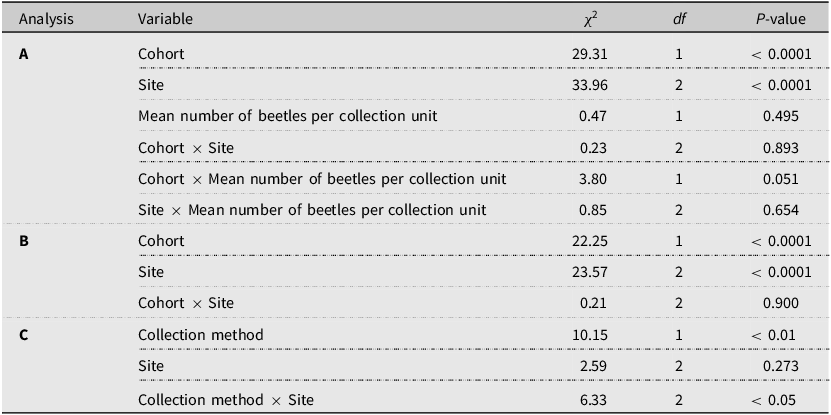
Table 2 Long description
A table with three analyses labeled A, B, and C. Each analysis has columns for Variable, Chi-squared, Degrees of Freedom, and P-value. Analysis A examines cohort, site, mean number of beetles per collection unit, and their interactions. Analysis B focuses on cohort, site, and cohort-site interaction for single-individual collection units. Analysis C looks at collection method, site, and collection method-site interaction for the branch-overwintering cohort. Each row lists specific variables and their corresponding Chi-squared values, degrees of freedom, and P-values.
Body size and feeding status: bole- and branch-overwintering beetles
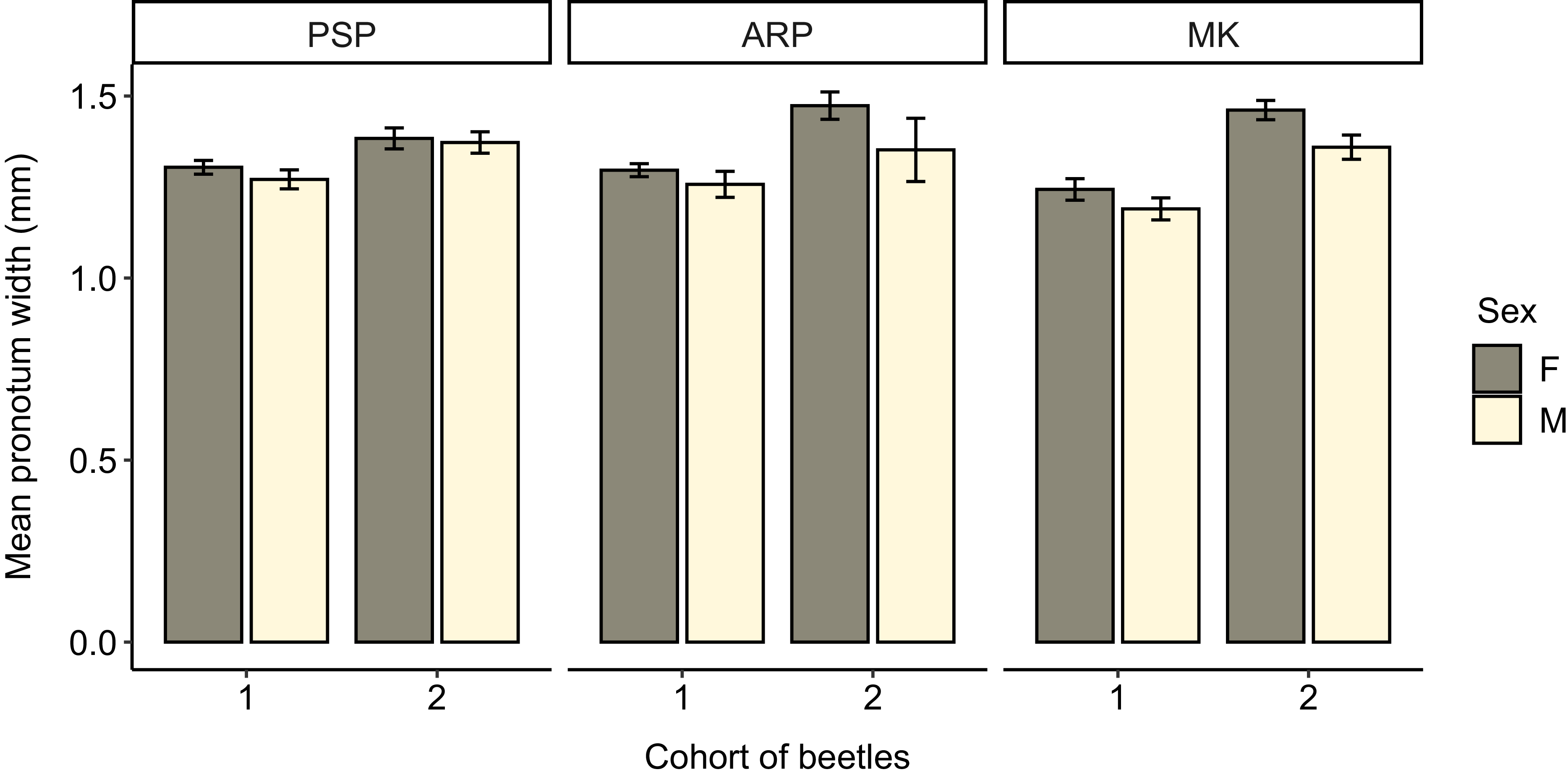
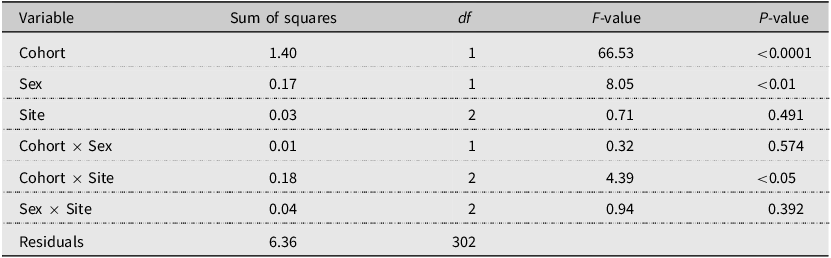
We found bole-overwintering beetles (n = 130) to be larger than branch-overwintering beetles (n = 184) by approximately 10%, with mean pronotum widths of 1.41 ± 0.01 mm and 1.27 ± 0.01 mm, respectively (Table 3; Fig. 5). The magnitude of the effect of cohort (bole- versus branch-overwintering) on body size, however, depended upon the population from which beetles were collected (i.e., site; Table 3). Body size also varied by sex, with the mean pronotum size of females (1.35 ± 0.01 mm) approximately 4% wider, on average, than that of males (1.29 ± 0.01 mm). The magnitude of differences in body size by sex was independent of cohort and site (Table 3).
Mean (± standard error) pronotum widths for female (F) and male (M) adult alder bark beetles, Alniphagus aspericollis, that overwintered inside branches (cohort 1) versus those that overwintered inside the main stems (cohort 2) of red alder, Alnus rubra, trees at each of three sampling locations in southwestern British Columbia, Canada: Pacific Spirit Regional Park (PSP); Aldergrove Regional Park (ARP); Malcolm Knapp Research Forest (MK).

Results of an analysis of variance (Type II tests) examining the influence of cohort (bole- versus branch-overwintering), sex (female or male), site (Pacific Spirit Regional Park, PSP; Aldergrove Regional Park, ARP; and Malcolm Knap Research Forest, MK), and all two-way interactions on the pronotum width of adult alder bark beetles, Alniphagus aspericollis.

Table 3 Long description
A table analyzing variance in pronotum width of alder bark beetles by cohort, sex, site, and interactions. The table has 8 rows and 5 columns. Column headers are Variable, Sum of squares, df, F-value, and P-value. Row 1: Variable, Cohort; Sum of squares, 1.40; df, 1; F-value, 66.53; P-value, <0.0001. Row 2: Variable, Sex; Sum of squares, 0.17; df, 1; F-value, 8.05; P-value, <0.01. Row 3: Variable, Site; Sum of squares, 0.03; df, 2; F-value, 0.71; P-value, 0.491. Row 4: Variable, Cohort x Sex; Sum of squares, 0.01; df, 1; F-value, 0.32; P-value, 0.574. Row 5: Variable, Cohort x Site; Sum of squares, 0.18; df, 2; F-value, 4.39; P-value, <0.05. Row 6: Variable, Sex x Site; Sum of squares, 0.04; df, 2; F-value, 0.94; P-value, 0.392. Row 7: Variable, Residuals; Sum of squares, 6.36; df, 302.
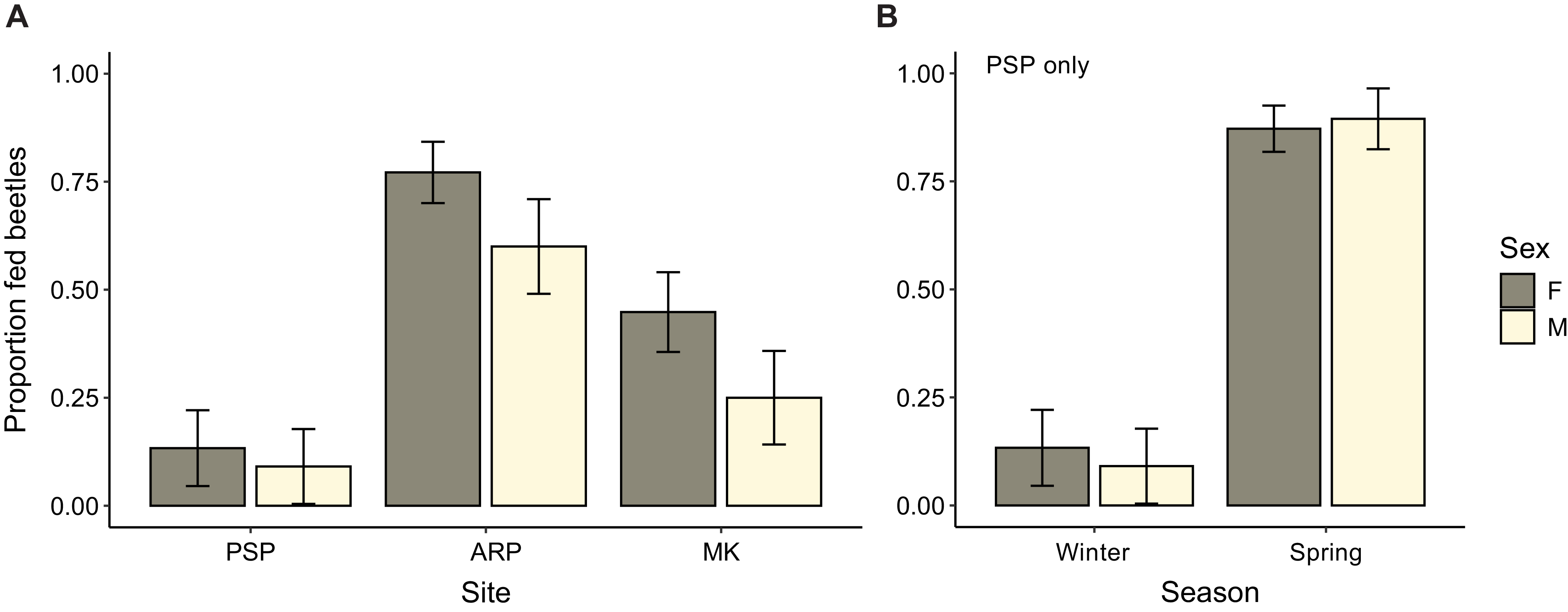
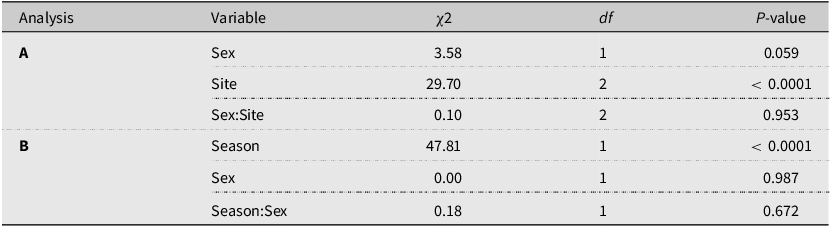
Overall, 47% (59/126) of branch-overwintering adult alder bark beetles were found to have food particles in their digestive tracts during winter. The proportion of alder bark beetles feeding within branches during winter varied significantly among sites (PSP, ARP, and MK), ranging from approximately 12% to 71% of beetles with food particles in their digestive tracts (Table 4A; Fig. 6A). The frequency of winter-feeding evidence did not differ between overwintering males (36% fed, 17/47) and females (53% fed, 42/79), a result that was not dependent upon site (Table 4A). For the comparison between winter and spring feeding for the subsample of beetles collected from PSP, feeding increased significantly as the season progressed, rising from 12% in winter (3/26) to 88% in spring (51/58; Table 4B; Fig. 6B). Following the trend observed for beetles sampled during winter, we found that feeding status did not differ significantly between the sexes (males 89% fed, 17/19; females 87% fed, 34/39). The influence of sampling season (winter versus spring) on beetle feeding status did not vary by sex. Feeding was not exclusive to branch-overwintering beetles because a relatively small proportion (26%, 34/130) of emergent bole-overwintering beetles collected in the summer had food particles in their digestive tracts.
Proportions of branch-overwintering alder bark beetles, Alniphagus aspericollis, with evidence of food particles in their digestive tracts (feeding) by sex (F, female; M, male) and by A, site (during winter) and B, season (winter and spring). Beetles were manually extracted from overwintering sites inside red alder, Alnus rubra, branches obtained from sites in southwestern British Columbia, Canada: Pacific Spirit Regional Park (PSP), Aldergrove Regional Park (ARP), and Malcolm Knapp Research Forest (MK).

Analysis of deviance table (Type II tests) for two logistic regressions analysing feeding status (fed or unfed) of branch-overwintering alder bark beetles, Alniphagus aspericollis: A, feeding status in relation to sex (female or male) and site, based on beetles obtained from red alder, Alnus rubra, branches collected at three sites in southwestern British Columbia, Canada (Pacific Spirit Regional Park, PSP; Aldergrove Regional Park, ARP; and Malcolm Knapp Research Forest, MK) during winter; B, feeding status in relation to season (winter or spring) and sex, based on the subset of beetles collected from PSP.

Table 4 Long description
A table with two analyses of deviance for logistic regressions on feeding status of alder bark beetles. Analysis A has three rows and four columns. Columns are labeled Analysis, Variable, χ2, df, and P-value. Row labels are Sex, Site, and Sex:Site. Values are: Sex, 3.58, 1, 0.059; Site, 29.70, 2, < 0.0001; Sex:Site, 0.10, 2, 0.953. Analysis B has three rows and four columns. Columns are labeled Analysis, Variable, χ2, df, and P-value. Row labels are Season, Sex, and Season:Sex. Values are: Season, 47.81, 1, < 0.0001; Sex, 0.00, 1, 0.987; Season:Sex, 0.18, 1, 0.672.
Discussion
Branch- and bole-overwintering cohorts of the alder bark beetle differ in the frequency of their association with Beauveria and body size, both factors with potential fitness implications (Foelker and Hofstetter Reference Foelker and Hofstetter2014; Mann and Davis Reference Mann and Davis2021). Beauveria was isolated more frequently from beetles that overwintered within and emerged from red alder boles than those that overwintered inside branches, and bole-overwintering beetles were larger in size than branch-overwintering beetles. These results suggest possible fitness trade-offs between the two overwintering strategies, where for the branch-overwintering cohort, the costs of dispersal to overwintering sites and reduced body size are outweighed by the benefit of avoiding Beauveria exposure within their natal galleries. The presence of food particles within the digestive tracts of branch-overwintering beetles of both sexes indicate that post-emergence maturation feeding occurred within this cohort. These findings provide insights into the selective pressures that may have given rise to the alternative overwintering habits of the alder bark beetle and their potential persistence as evolutionarily stable strategies (sensu Maynard Smith and Price Reference Maynard Smith and Price1973; Maynard Smith Reference Maynard Smith1982).
Dispersal by alder bark beetles to overwintering sites within red alder crowns before the onset of cool fall temperatures may be an adaptive strategy that reduces prolonged exposure to Beauveria beneath the bark of their natal trees during winter. Prior to emergence from their overwintering sites, branch-overwintering adult beetles had spent several months burrowed, usually individually, within living branch tissues (Wertman et al. Reference Wertman, Borden and Carroll2022), whereas bole-overwintering beetles had recently completed development to the adult stage within brood trees. In brood trees, beetles feed and develop in densely packed natal galleries in close physical contact with one another, potentially resulting in increased Beauveria transmission rates (Kreutz et al. Reference Kreutz, Zimmermann and Vaupel2004). That Beauveria was recovered from over half of bole-overwintering alder bark beetles indicates that these antagonists are present at high levels in the system and therefore may impose selection pressures on alder bark beetle populations (Mann and Davis Reference Mann and Davis2021; Wang et al. Reference Wang, Peng, Li, Cheng and Gong2021; Mantzoukas et al. Reference Mantzoukas, Kitsiou, Natsiopoulos and Eliopoulos2022). Interestingly, branch-overwintering beetles that were captured during dispersal (i.e., hand collected), with presumably more time to interact with conspecifics following emergence, were more likely to have Beauveria on their exoskeletons than those obtained directly from branch nodes, providing further support for horizontal transmission of the entomopathogen. The frequencies of Beauveria isolated from live adult bark beetles during our study are consistent with results reported for other scolytine systems (Reay et al. Reference Reay, Brownbridge, Cummings, Nelson, Souffre, Lignon and Glare2008; Wraight et al. Reference Wraight, Galaini-Wraight, Howes, Castrillo, Carruthers and Smith2018) and lend support to evidence of the ubiquity of fungal entomopathogens in forest ecosystems (Shimazu et al. Reference Shimazu, Sato and Maehara2002; Ormond et al. Reference Ormond, Thomas, Pugh, Pell and Roy2010; Mann and Davis Reference Mann and Davis2021).
There are three other, nonmutually exclusive, potential explanations for greater Beauveria frequency in bole-overwintering beetles compared to their branch-overwintering counterparts. Branch-overwintering beetles that seek out microsites within branch nodes of living red alder branches may experience cooler temperatures in the canopy than those that overwinter in the bole, as well as higher concentrations of host secondary metabolites – such as terpenes – than those found in the degraded phloem of natal trees, both factors that can theoretically impair Beauveria growth and disrupt the transition from phoretic association to systemic infection in this cohort (Mann and Davis Reference Mann and Davis2021). Seasonal differences in timing of beetle collection from the two cohorts (i.e., spring versus summer) could also have influenced the respective Beauveria frequencies, because growth and sporulation of Beauveria are known to fluctuate seasonally and in response to interaction between temperature and water availability (Hallsworth and Magan Reference Hallsworth and Magan1999; Ormond et al. Reference Ormond, Thomas, Pugh, Pell and Roy2010). Finally, because we evaluated Beauveria frequency based upon isolations from beetles that had actively emerged from their overwintering environments (i.e., were alive) and did not assess mortality rates due to Beauveria infection within either cohort, we cannot exclude the possibility that the differential frequencies we observed were due to higher Beauveria infection mortality rates in branch- versus bole-overwintering beetles. Observations by Wertman et al. (Reference Wertman, Borden and Carroll2022), however, indicate that dead beetles are found infrequently in branch-overwintering sites. That said, the potential for Beauveria exposure to contribute to selection for alder bark beetle overwintering strategies depends upon the virulence of the Beauveria that these beetles encounter and the circumstances in which they encounter the pathogens (Kreutz et al. Reference Kreutz, Zimmermann and Vaupel2004; Mann and Davis Reference Mann and Davis2021; Wang et al. Reference Wang, Peng, Li, Cheng and Gong2021; Mantzoukas et al. Reference Mantzoukas, Kitsiou, Natsiopoulos and Eliopoulos2022). Much variation exists in the ability of Beauveria to cause systemic infection and impact fitness in insects, and further research on the alder bark beetle system is needed to identify the pathogens to species-level, to characterise the virulence of different strains, and to quantify life stage-specific dosage effects of cuticular exposure on different aspects of beetle fitness. Future work should also aim to quantify the frequency of mortality due to Beauveria infection in either alder bark beetle cohort and across life stages.
The beetles that abandoned natal trees to overwinter inside branch nodes were smaller in size than beetles that overwintered as larvae within the main stems of host trees. This may be interpreted as a potential consequence of selection for accelerated development in the branch-overwintering cohort to limit exposure to natural enemies such as Beauveria at the cost of reduced opportunities for larval feeding and growth (Nylin and Gotthard Reference Nylin and Gotthard1998; Bentz et al. Reference Bentz, Régnière, Fettig, Hansen, Hayes and Hicke2010; Foelker and Hofstetter Reference Foelker and Hofstetter2014). An alternative, but not mutually exclusive, explanation for the difference in body size between the cohorts is faster development time under warmer conditions in the branch-overwintering beetles, which develop over the summer from eggs laid in the spring, compared to slower development by bole-overwintering beetles that develop at cooler temperatures over a longer period of time between summer egg hatch and the following spring (see Atkinson Reference Atkinson1994). Regardless of the underlying cause of the size difference, given that pronotal width is a good indicator of body weight in bark beetles (e.g., Anderbrant Reference Anderbrant1988) and that maximum fecundity of alder bark beetle females from the bole-overwintering cohort is approximately 69 eggs (Borden Reference Borden1969), then the potential fecundity of smaller branch-overwintering females is likely approximately 62 eggs, given a 10% reduction in body size between the cohorts.
We consistently found female alder bark beetles to be larger than males. Sexual size dimorphism is common in bark beetles because selection often favours larger females with increased potential fecundity (Foelker and Hofstetter Reference Foelker and Hofstetter2014; Kirkendall et al. Reference Kirkendall, Biedermann, Jordal, Vega and Hofstetter2015). Body mass is also linked to the amount of energy stored as lipids, such as triglycerides, which are required for flight (Foelker and Hofstetter Reference Foelker and Hofstetter2014; Jones et al. Reference Jones, Shegelski, Marculis, Wijerathna and Evenden2019). Therefore, female-biased size dimorphism in the alder bark beetle may also be an adaptation to promote the location of host trees and initiation of cooperative attacks through the release of aggregation pheromones as it is in other bark beetle species where females are the pioneering sex (Wood Reference Wood1982; Foelker and Hofstetter Reference Foelker and Hofstetter2014; Kirkendall et al. Reference Kirkendall, Biedermann, Jordal, Vega and Hofstetter2015). We found that body size difference between cohorts was not dependent on sex, suggesting that any potential fitness costs of overwintering in branches are consistent between male and female beetles.
Curiously, we observed alder bark beetles of both sexes feeding within branches throughout the winter months. This habit is uncommon in bark beetles because the risk of internal ice formation and resultant mortality during cold periods increases with the presence of food particles in the digestive system (Lombardero et al. Reference Lombardero, Ayres, Ayres and Reeve2000; Thompson et al. Reference Thompson, Huber and Murray2020). Some, if not most, bark beetles that are exposed to potentially lethal cold winter temperatures void their gut contents before the onset of winter as a strategy to endure unfavourable conditions and to minimise ice nucleation during dormancy (Barson Reference Barson1974; Danks Reference Danks2007; Thompson et al. Reference Thompson, Huber and Murray2020). The temperate, coastal climate of the Pacific Northwest, however, apparently allows branch-overwintering adult alder bark beetles to feed throughout winter, potentially offsetting some of the sex-independent fitness costs associated with dispersal to overwintering sites and reduced body size (McNee et al. Reference McNee, Wood and Storer2000; Bonte et al. Reference Bonte, Van Dyck, Bullock, Coulon, Delgado and Gibbs2012; Jones et al. Reference Jones, Shegelski, Marculis, Wijerathna and Evenden2019). Feeding frequency among branch-overwintering beetles differed among sampling locations, perhaps due to variable activity rates under site-specific biotic and abiotic conditions. In addition, we found that, as temperatures increased in spring, the frequency of feeding increased in both sexes of branch-overwintering beetles, which putatively functioned to augment fat reserves that aid in dispersal, host selection, aggregation, and reproduction (McNee et al. Reference McNee, Wood and Storer2000; Jones et al. Reference Jones, Shegelski, Marculis, Wijerathna and Evenden2019). Post-emergence branch-feeding has also been observed in hardwood-infesting bark beetles, including multiple Scolytus spp. (Smith and Hulcr Reference Smith, Hulcr, Vega and Hofstetter2015), the North American-native elm bark beetle, Hylurgopinus rufipes (Anderson and Holliday Reference Anderson and Holliday2003), and the olive bark beetle, Phloeotribus scarabaeoides (González and Campos Reference González and Campos1996), and in conifer-infesting species such as the pine shoot beetle, Tomicus piniperda (Långström Reference Långström1983) and the Douglas-fir pole beetle, Pseudohylesinus nebulosus (Stoszek and Rudinsky Reference Stoszek and Rudinsky1967) (all Scolytinae). That approximately 25% of emergent bole-overwintering beetles also had food in their digestive tracts suggests that relatively low rates of pre-emergence feeding also occur in this cohort, with potential fitness consequences similar to those of post-emergence maturation feeding (McNee et al. Reference McNee, Wood and Storer2000).
The ultimate benefit of alternative overwintering strategies in bark beetles is maximisation, via bet-hedging, of the likelihood of survival in fluctuating environments (Olofsson et al. Reference Olofsson, Ripa and Jonzén2009; Martín et al. Reference Martín, Muñoz and Pigolotti2019). The widespread occurrence of two overwintering behaviours, as observed for the alder bark beetle, suggests a mixed evolutionarily stable strategy, where two behavioural phenotypes persist in the population due to equivalent, context-dependent fitness benefits (Maynard Smith and Price Reference Maynard Smith and Price1973; Maynard Smith Reference Maynard Smith1982). We have uncovered key differences in Beauveria frequency and body size between overwintering cohorts of the alder bark beetle that may indicate fitness trade-offs between increased Beauveria exposure in bole-overwintering beetles and smaller body size in branch-overwintering beetles, although lack of data on the realised fitness consequences of these factors necessitates additional research on this topic. A fitness trade-off–based interpretation of our results is consistent with hypotheses by Kirkendall (Reference Kirkendall1983), however, who postulated that, when fresh material is available to adult bark beetles for feeding and reproduction, vacating degraded brood trees in favour of higher-quality substrates is advantageous in reducing susceptibility to adverse conditions beneath the bark. Considering that red alder is a nitrogen-fixing tree (Torrey Reference Torrey1978), the relative abundance of biologically available nitrogen in red alders succumbing to alder bark beetle infestation may facilitate rapid and extensive colonisation by microorganisms such as Beauveria that can negatively impact bark beetles through competition with beneficial microorganisms, reduction of phloem quality, and increasing risk of direct beetle mortality (Klepzig and Six Reference Klepzig and Six2004; Cardoza et al. Reference Cardoza, Klepzig and Raffa2006; Skelton et al. Reference Skelton, Loyd, Smith, Blanchette, Held and Hulcr2020; Mann and Davis Reference Mann and Davis2021). Although exposure to lethal low temperatures is considered the ultimate driver of pre-winter dispersal from natal host trees by bark beetles (Lombardero et al. Reference Lombardero, Ayres, Ayres and Reeve2000), in mild temperate environments where low temperatures are less constraining, we propose that alternate overwintering strategies may have evolved from selection against exposure to entomopathogens, such as Beauveria, that are widespread in forest ecosystems (Shimazu et al. Reference Shimazu, Sato and Maehara2002; Ormond et al. Reference Ormond, Thomas, Pugh, Pell and Roy2010; Mann and Davis Reference Mann and Davis2021).
Data availability statement
All data analysed in this study are archived on Dryad (Holt et al. Reference Holt, Wertman and Carroll2026; https://doi.org/10.5061/dryad.kd51c5bkx), and the Beauveria internal transcribed spacers of nuclear ribosomal DNA sequence data are deposited in GenBank (accession numbers PX285850–PX285854).
Acknowledgements
Physical and technical support for this project was provided by Richard Hamelin, Carmen Taylor, Erin Stewart, Alana Gonczar, Padmini Herath, Nico Feau, Hesther Yueh, Amanda Karaca, Greg Smith, Jamie You, Sichen Zhou, Julia Thain, Erika Dort, Holden Payne, Kate Kitchens, Stan Pokorny, Winston He, Wan “Alice” Yi, Courtney Neray, Fabienne Good, Alanna Love, Jessica Gee, Ella Hulme, Alex Hankins, Matthew Appelbaum, Annie Kim, Jennie Jiang, and Astrid Jolley. The authors thank Kathy Bleiker for dissection support. Sampling occurred on the territories of the xʷməθkʷəy̓əm (Musqueam), q̓ic̓əy̓ (Katzie), Stó:lō, MÁLEXEȽ (Malahat), Sc’ianew, T’Sou-ke, Cowichan, and Lək̓ʷəŋən (Lekwungen) peoples. Permitting was enabled by Metro Vancouver Regional Parks, Malcolm Knapp Research Forest, and the Capital Regional District/Greater Victoria Water Supply Area. This project was funded through a Natural Sciences and Engineering Research Council of Canada (NSERC) Discovery Grant to Allan L. Carroll (RGPIN-2015-04376).
Competing interests
The authors declare no competing interests.


 Open access

