Introduction
A growing body of animal, epidemiological and experimental evidence supports the existence of an important relationship between early nutrition and growth and the genesis of chronic disease later in life. Although the relationships are consistent, there is limited understanding of the mechanisms by which they may occur. Proposed mechanisms for which there is some evidence include the permanent structural alteration of tissues,Reference Garofano, Czernichow and Breant1 epigenetic modification of gene expressionReference Sandovici, Smith and Nitert2 and altered cellular aging. The importance of these mechanisms is challenging to explore in humans, and is the target of active investigation, but cannot yet inform intervention strategies.
In humans, the relationships between growth and health have been identified mainly from retrospective cohort studies, or from long-term follow-up of intervention trials. As such, the growth data available for analysis are generally limited to weight and height gain. However, given the well-known relationship between adiposity and health outcomes, it is reasonable to question whether body composition, rather than just body weight, might better explain or predict health risk. Furthermore, recent studies have shown that the quality, as well as the quantity, of weight gain is impacted by nutrient intake.Reference Amesz, Schaafsma, Cranendonk and Lafeber3–Reference Escribano, Luque and Ferre5 Therefore, if body composition showed a consistent relationship to health outcomes, it would be feasible to develop feeding regimes designed to optimize long-term health.
Measurement of infant body composition has been limited even in research settings, owing to the lack of available methodologies. Techniques such as dual-energy X-ray absorptiometry and isotope dilution are cumbersome and expensive to perform, and carry some associated risks. Over the past several years, a system for infant body composition measurement, based on air displacement plethysmography (ADP; PEA POD®, COSMED USA, Concord, CA, USA), has become commercially available. This technique allows for rapid, safe and accurate body composition measurement suitable for frequent studies. As such, there is an opportunity for rapid advancement in the understanding of the specific impact of nutrition and feeding on growth and body composition that may inform optimal feeding recommendations.
In order to enhance progress in this area, it would be valuable to develop a strategic research plan, taking into account data from published studies, analysis of their strengths and limitations and identifying gaps in knowledge that require priority attention.
Materials and methods
This two-part study consists of a review of published studies using the PEA POD® Infant Body Composition System and a survey assessment of current utilization of the PEA POD® in centers around the world. A literature review was conducted to identify all studies that measured infant body composition using the PEA POD® infant body composition system between 2004 and March 2012. Studies were retrieved from PubMed and Medline using search terms ‘PEA POD’ and ‘infants’ and ‘body composition’ and confirmed on the basis of title and abstract. References of relevant publications were reviewed to identify any additional studies. For each publication, relevant infant characteristics (health status, gestational age, gender, growth patterns and socioeconomic status) and study characteristics (main research question, sample size, type of infant feeding, timing of measurements and outcomes) were extracted. Primary research questions and study populations were used to identify research themes, and studies were grouped according to the appropriate theme. Within each research theme, we totaled the number of infants involved, compared outcomes and assessed strengths and limitations of individual studies. The total body of literature was summarized to provide a description of current knowledge and identify knowledge gaps.
An online survey was developed using Survey Monkey®. Survey questions were created to determine past, present and future research activity in each of the previously identified thematic areas, as well as in other additional areas. Questions regarding clinical applications v. research applications of the PEA POD®, frequency of use and the disciplines most frequently measuring body composition were also included. An information letter about the study and an invitation to participate were developed by the investigators and distributed by COSMED to all centers that had purchased at least one PEA POD® unit. On acceptance of the invitation, a member of the research team emailed the survey link to the participating center for completion. Survey results were compiled using the software provided by Survey Monkey® and exported to Microsoft Excel® for analysis.
Results
Part 1
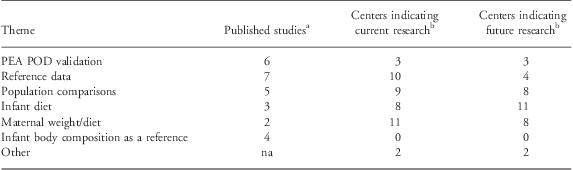
Literature Search: Twenty-seven articles were retrieved from the literature search, representing work done in 13 centers. Six research themes were identified: PEA POD® validation, establishing reference body composition data, comparison of body composition between different populations of infants, the effect of infant diet on body composition, the effect of maternal weight/diet on infant body composition, and studies using infant body composition as a reference method. Results are listed in Table 1. Data from over 2500 infants have been collected, with the majority of infants involved in establishing reference body composition changes (∼1100 infants) and comparison data between different infant populations (∼775 infants).
Number of published studies, number of centers indicating current research and number of centers indicating future research measuring infant body composition by ADP

ADP, air-displacement plethysmography.
aTwenty-seven studies retrieved (2004 to March 2012).
bData obtained from 16 of ∼60 centers returning completed surveys.
Six studies reported validation data for ADP.Reference Ellis, Yao and Shypailo6–Reference Yao, Nommsen-Rivers, Dewey and Urlando11 Five studies confirmed the accuracy and reliability of the PEA POD® through comparison with established body composition assessments (deuterium dilution, four-compartment model and chemical analysis). One study compared two formulas for calculating body composition (Fomon v. Butte) using total body water.Reference Eriksson, Lof, Eriksson, Hannestad and Forsum7
Seven studies collected pilot reference data to understand ‘expected’ body composition for a healthy infant population [term, appropriate for gestational age (AGA)] born to western and European women.Reference Andersen, Girma and Wells12–Reference Roggero, Gianni and Orsi18 Approximately 1100 male and female infants were tested in these seven studies. Although most studies described infants born to mothers of middle or higher socioeconomic status, one article studied 350 Ethiopian newborns to examine growth patterns of infants in low-income environments.Reference Andersen, Girma and Wells12 There was variability in the timing of body composition measurements, control for maternal body mass index (BMI) and diet and control for infant feeding. Four studies describe a time period in early infancy where % fat mass (%FM) increases rapidly (doubling the %FM at birth) and then plateaus,Reference Carberry, Colditz and Lingwood13, Reference Eriksson, Lof and Forsum14, Reference Fields, Gilchrist and Catalano16, Reference Roggero, Gianni and Orsi18 although the timing of the plateau differs to a certain extent between studies. One study focused specifically on body composition changes in the first 5 days of life. These results show a decrease in %FM on days 3 and 4, which is regained on day 5.Reference Roggero, Gianni and Orsi17 Three studies suggest that female infants have a higher %FM than male infants from 0 to 6 months postpartumReference Carberry, Colditz and Lingwood13, Reference Fields, Krishnan and Wisniewski15, Reference Fields, Gilchrist and Catalano16, but two studies show no statistical differences in %FM between male and female infants.Reference Eriksson, Lof and Forsum14, Reference Roggero, Gianni and Orsi18
Five papers (775 western and European infants) compared body composition changes between the following populations: growth restricted v. non growth restricted, small for gestational age (SGA) v. AGA and term v. preterm.Reference Giannì, Roggero and Taroni19–Reference Roggero, Gianni and Liotto23 Three studies (500 infants) compared preterm infants studied at term with term-born infants and concluded that %FM of preterm infants is greater than that of term-born infants.Reference Giannì, Roggero and Taroni19, Reference Ramel, Gray and Ode20, Reference Roggero, Giannì and Amato22 Two studies (230 infants) compared SGA and AGA preterm infants with different postnatal growth patterns.Reference Roggero, Giannì and Amato21, Reference Roggero, Gianni and Liotto23 Although the groups showed early differences in body composition, all infants trended toward similar body composition by 6 months corrected age.
Two studies investigated the effect of maternal body composition and diet on infant body composition.Reference Anderson, McDougald and Steiner-Asiedu24, Reference Hull, Dinger, Knehans, Thompson and Fields25 Approximately 160 Western and European infants and mothers participated in the studies. One study suggested that infants born to mothers with BMI > 25 kg/m2 have higher %FM compared with infants born to mothers with BMI < 25 kg/m2.Reference Hull, Dinger, Knehans, Thompson and Fields25 Anderson et al.Reference Anderson, McDougald and Steiner-Asiedu24 provided preliminary data suggesting that maternal intake of ⩾4.5 g trans-fatty acid per day increases the possibility (odds ratio = 2.13) of higher infant body fat mass.
Three studies investigated the effect of diet and its delivery method on ∼140 otherwise healthy European/Western infants.Reference Anderson26–Reference Roggero, Giannì and Amato28 These studies focused on diverse research questions and were not directly comparable. Preliminary data from one study show that higher protein intake resulted in greater lean mass in the 1st month of life.Reference Roggero, Giannì and Amato28 A second study confirmed more rapid weight gain of exclusively breast-fed compared with mixed-fed infants, and demonstrated a higher body fat in those exclusively breast-fed.Reference Anderson26 The final study compared babies fed breast milk by breast or bottle and found no significant differences in body composition.Reference Bartok27
Four studies used body composition measured by ADP as a comparison with other methods of assessment.Reference Lee, Balasubramaniam and Deter29–Reference Lingwood, Storm van Leeuwen and Carberry32 Two of these (∼140 infants) compared prenatal growth evaluation by ultrasound with postnatal infant body composition. Both suggested limitations in the predictive value of prenatal assessments in estimating fetal growth measured by postnatal body composition.Reference Lee, Balasubramaniam and Deter29, Reference Moyer-Mileur, Slater and Thomson30 Furthermore, two studies compared body composition estimates obtained using bioelectric impedance analysisReference Lingwood, Storm van Leeuwen and Carberry32 and anthropometric measurementsReference Deierlein, Thornton, Hull, Paley and Gallagher31 in comparison with reference values from ADP.
Part 2
Sixteen completed surveys were received from a possible ∼60 centers around the world (27% response rate). The majority of PEA POD® use was for research, with only two centers indicating clinical use. The greatest activity was reported in the areas of acquisition of reference data, exploration of the relationships between maternal factors and infant body composition and comparison of body composition among different populations of infants. Investigation of the influence of diet on infant body composition was being actively undertaken in several centers, and was the most commonly reported area of planned future research. Respondents also indicated planned future research in body composition of special populations of infants, such as those with congenital heart disease, short bowel syndrome and those affected by gestational diabetes or maternal obesity. Fourteen of the centers indicated interest in the creation of an online user forum/discussion board to enhance collaboration among the centers. No centers reported current or planned research regarding the relationships between growth, body composition and neurodevelopmental outcomes.
Discussion
Despite commercial availability of the PEA POD® for several years, the number of publications is extremely limited. In considering the utility of ADP in research or clinical applications, it is critical to evaluate the performance of the test in comparison with other techniques or standards. The existing data support the conclusion that this method is accurate and reliable and produces reproducible results. However, it should be noted that the only published study that compared PEA POD® data with that obtained using a four-compartment model utilized the density values of Butte in calculating body composition data.Reference Ellis, Yao and Shypailo6 Recent data comparing body composition obtained using the Butte model with those obtained using the Fomon model suggest that there are significant differences in FM obtained using the two models.Reference Eriksson, Lof, Eriksson, Hannestad and Forsum7 Furthermore, values obtained using the Fomon model more closely approximated those obtained by isotope dilution, suggesting that this model may be preferable in calculating infant body composition. To date, no published data compare body composition obtained using the four-compartment model with that obtained using the Fomon model on the PEA POD®. In-progress studies may provide this needed information.
There is also a need for additional data in other areas. The relationships between maternal weight, diet, fetal growth, infant health status, infant nutritional intake and growth and long-term health will undoubtedly be complex and difficult to interpret. Although it is biologically plausible that body composition may be an important contributor to, or marker for, long-term health risk, it must be interpreted in the context of a multitude of determinants involved. In most of the published studies, there is incomplete or absent reporting of factors that are known or suspected to influence growth and later health such as dietary intake and maternal BMI. Without this information, it is impossible to advance the understanding of how these factors work in concert to influence long-term health. Although it may be difficult to control for all of the various factors, detailed reporting will enable appropriate interpretation. Our survey indicates that much in-progress research activity is focused on understanding the influences of maternal diet and weight and infant diet on body composition and comparisons between groups of infants. Detailed reporting will greatly enhance the value of these studies as they become available.
As research in this area moves toward considering longer-term health outcomes, it will be important to consider neurodevelopmental outcomes and metabolic alterations. As all of the existing studies consider only short-term outcomes, assessment of neurodevelopmental markers has not been included in results published to date. However, given the apparent paradox in evidence from longer-term follow-up studies suggesting improved neurodevelopmental outcomes, but poorer metabolic outcomes associated with higher weight gain, this is a key factor to be included in future studies.
Finally, there is no information to date regarding growth and body composition in various disease states or treatment groups. In combination with various other metabolic and physiologic measures, body composition may provide important insights into mechanisms of disease manifestations, treatment effect and complications.
Although our survey attempted to obtain an ‘environmental scan’ of ongoing research activity using the PEA POD®, our conclusions are limited by the low response rate. COSMED contacted centers that had purchased a PEA POD® with information about the survey in order to preserve confidentiality of purchasers, and the survey data were collected in a blinded manner. As a result, it is not possible to determine whether survey data were obtained from centers with an established history of research and publication, from centers just beginning work in this area or from both.
Conclusion
The introduction of the PEA POD® enables a greater understanding of the early-life relationships between diet, metabolism and health. As dietary intake is a potentially modifiable determinant of health, it is of critical importance that this scientific inquiry move forward in a sound but efficient manner in order to develop infant feeding recommendations for optimal long-term outcomes. Reporting of specific data regarding a wide range of determinants of infant body composition will enable interpretation and comparison of data.
Acknowledgments
L.M.C. and L.J.M. designed the research, C.L. and L.M.C. conducted the research, analyzed the data and wrote the paper and L.M.C. had primary responsibility for final content. All authors read and approved the final manuscript. None of the authors have a conflict of interest. C.L. was supported by a Summer Studentship from Alberta Innovates Health Solutions.