INTRODUCTION
Visceral leishmaniasis (VL) caused by Leishmania (Leishmania) chagasi [syn Leishmania (Leishmania) infantum] is one of the most important emergent diseases in both tropical and subtropical areas. The disease can be particularly virulent, attaining a level of 98% mortality in certain non-treated human cases (Romero et al. Reference Romero and Boelaert2010).
Despite the recent advances in new anti-leishmanial compounds (Oliveira et al. Reference Oliveira, Schubach, Martins, Passos, Oliveira, Marzochi and Andrade2011), the first-line therapy for all disease forms is still based on painful multiple injections of pentavalent antimonials which invariably produce serious toxicity. The problem is further aggravated by the surge of antimonial resistance in some areas where the disease is endemic (Kulshrestha et al. Reference Kulshrestha, Singh, Kumar, Negi and Salotra2011), urging the development of effective anti-Leishmania vaccines.
Several vaccination strategies using the parenteral route have been tested with limited success in experimental leishmaniasis including whole parasites (killed or irradiated promastigotes) (Okwor and Uzonna, Reference Okwor and Uzonna2008), soluble extracts (Holzmuller et al. Reference Holzmuller, Cavaleyra, Moreaux, Kovacic, Vincendeau, Papierok and Lemesre2005), synthetic peptides (Bertholet et al. Reference Bertholet, Goto, Carter, Bhatia, Howard, Carter, Coler, Vedvick and Reed2009), crude and pure surface antigens (Pinheiro et al. Reference Pinheiro, Pinto, de Matos Guedes, Filho, de Mattos, Saraiva, de Mendonça and Rossi-Bergmann2007), recombinant antigens (Mizbani et al. Reference Mizbani, Taheri, Zahedifard, Taslimi, Azizi, Azadmanesh, Papadopoulou and Rafati2009), amastigote antigens (Fernandes et al. Reference Fernandes, Costa, Coelho, Michalick, de Freitas, Melo, Luiz Tafuri, Resende, Hermont, Abrantes and Gazzinelli2008), immunostimulating complexes (Tewary et al. Reference Tewary, Sukumaran, Saxena and Madhubala2004) and plasmid DNA (Basu et al. Reference Basu, Bhaumik, Basu, Naskar, De and Roy2005). On the other hand, mucosal vaccination is emerging as a potential administration route for eliciting both antigen-specific mucosal and systemic immunity, and has been widely used as an efficient and non-invasive route not only for inducing tolerance to Th2 response-associated allergens and other disease-promoting antigens (Czerkinsky et al. Reference Czerkinsky, Anjuere, McGhee, George-Chandy, Holmgren, Kieny, Fujiyashi, Mestecky, Pierrefite-Carle, Rask and Sun1997; Takagi et al. Reference Takagi, Hiroi, Yang, Tada, Yuki, Takamura, Ishimitsu, Kawauchi, Kiyono and Takaiwa2005), but also for eliciting active systemic immunity against the parasites (Arakawa et al. Reference Arakawa, Komesu, Otsuki, Sattabongkot, Udomsangpetch, Matsumoto, Tsuji, Wu, Torii and Tsuboi2005; Chabot et al. Reference Chabot, Brewer, Lowell, Plante, Cyr, Burt and Ward2005).
Previously, our laboratory reported the efficacy of both oral and intranasal (i.n.) vaccination with particulated leishmanial antigens and plasmid enconding the cytoplasmic LACK protein from L. chagasi (LACK-DNA) in protecting BALB/c mice against L. amazonensis and L. chagasi (Pinto et al. Reference Pinto, Pinheiro, Rayol, Larraga and Rossi-Bergmann2004; Gomes et al. Reference Gomes, Pinto, de Melo, Lima, Larraga, Lopes and Rossi-Bergmann2007). LACK-DNA intranasal (i.n.) vaccination induced the expansion of mixed Th1 and Th2 systemic responses associated with high production of IFN-γ and IL-4, a decrease of IL-10 and TNF-α and the induction of a long-lasting protective immunity (Gomes et al. Reference Gomes, Pinto, de Melo, Lima, Larraga, Lopes and Rossi-Bergmann2007).
Although human VL is characterized by a progressive disease, mouse models are able to control the infection and do not reflect the human disease symptoms (Melby et al. Reference Melby, Chandrasekar, Zhao and Coe2001a). Unlike mice, Syrian hamster (Mesocricetus auratus) reproduce clinicopathological features of human VL, with uncontrolled disease (Garg and Dube, Reference Garg and Dube2006), making it a better animal model to study L. donovani and L. chagasi infections. Hamsters also provide excellent models for vaccine studies and they have been used for selection of vaccine candidates prior to tests in dogs (Garg and Dube, Reference Garg and Dube2006).
In this study, we evaluated the intranasal LACK-DNA vaccine in an extremely sensitive animal model of VL, to ascertain its protective efficacy and potential application to humans.
MATERIALS AND METHODS
Animals, parasites and antigens
Female Syrian golden hamsters (Mesocricetus auratus) (4–6 weeks old), were reared in our departmental facility. Their use in this study was approved by the Ethics Committee on the Use of Experimental Animals at the Universidade Federal do Rio de Janeiro under the number IBCCF118. L. chagasi strain MHOM/BR/1974/M2682 was continuously maintained by repeated passage in hamsters and expanded in DMEM medium, pH 6.8 supplemented with 10% heat-inactivated fetal bovine serum, 2 mm l-glutamine, 25 mm HEPES, 50 μ m 2-mercaptoetanol and 20 μg/ml gentamicin (DMEM 20% SFB) at 25 °C. The L. chagasi antigen (LcAg) was prepared from late-log-phase promastigotes by centrifugation, washing 3 times in PBS and disruption by 5 rounds of freezing-thawing. The protein content was estimated by the Lowry method (Lowry et al. 1995). The recombinant LACK protein (rLACK) was obtained as described by Coelho et al. (Reference Coelho, Tavares, Carvalho, Chaves, Teixeira, Rodrigues, Charest, Matlashewski, Gazzinelli and Fernandes2003). The expression vector pCI-neo (Promega) encoding the LACK gene (LACK-DNA) was prepared as described previously, and was a kind gift from Dr Vicente Larraga (Gonzalez-Aseguinolaza et al. Reference Gonzalez-Aseguinolaza, Taladriz, Marquet and Larraga1999).
Vaccination and infection
Hamsters (5/group) were vaccinated intranasally by instillation with 30 mg of LACK-DNA with a fine tip attached to a micropipette, and boosted 7 days later with the same vaccine dosage. The controls received PBS or empty pCI-neo. One week after booster, the animals were challenged using the intracardiac (i.c.) route with 107 log-phase Leishmania chagasi promastigotes.
Determination of the parasite burden
Thirty days after infection, hamster spleens and livers were isolated for parasite burden determination by limiting-dilution assay. The whole organs were individually weighed and homogenized in a tissue grinder with DMEM medium containing 20% heat-inactivated fetal calf serum (HIFCS). Serial dilutions were done in quadruplicate followed by culture (15 days/25°C). The original number of parasites in each organ was calculated from the reciprocal of the highest dilution containing promastigotes.
Cutaneous hypersensitivity reaction
Twenty-four hours after infection, vaccinated and non-vaccinated hamsters were injected in the hind footpad with 20 μg of LcAg in 20 μl of PBS. Footpad swelling was measured with a dial caliper, and the results were expressed as the difference between the thickness of the injected and pre-injected footpads.
Nitric oxide production and parasite-specific antibodies
On day 30 of infection, splenocytes were re-stimulated in vitro with LcAg (50 μg/ml) for 48 h and the nitric oxide (NO) production measured in the supernatants using the Griess method (Green et al. 1982). Briefly, 50 μl of cell culture supernatants were mixed with 50 μl of Griess reagent (1% sulphanilamide and 0 1% N-1-naphthylethylenediamine dihydrochloride in 2 5% o-phosphoric acid) and incubated at room temperature for 10 min. The nitrite concentrations were determined at 540-nm wavelength using a standard sodium nitrite curve. The parasite-specific IgG, IgG1 and IgG2 levels were measured in the sera of individual hamsters by direct ELISA using LcAg-coated microplates as described by Gomes et al. (Reference Gomes, Pinto, de Melo, Lima, Larraga, Lopes and Rossi-Bergmann2007).
Lymphoproliferation assay
Hamster splenocytes were suspended in RPMI-1640 medium supplemented with 10% heat-inactivated fetal bovine serum (Sigma–Aldrich, USA). The cell concentration was adjusted to 5×10⁵ cells/well in 96-well culture plate in the presence of Concanavalin A (10 μg/ml, Sigma–Aldrich), LaAg (50 μg/ml) or rLACK (5 μg/ml). Cultures were incubated at 37°C in a CO2 incubator with 5% CO2 for 3 days followed by 3H-thymidine addition (1 μCi) for a further 18 h. The radioactivity was measured in a liquid scintillation counter (Beckman, USA) and the results were expressed as counts per minute (cpm).
Statistics
Data were statistically analysed using the GraphPad Prism software. Means of normally distributed variables were compared by ANOVA analysis simple factorial test and by one-way ANOVA-Tukey's honestly significant difference (Tukey's HSD) post-hoc method, and were considered significantly different when P<0 05.
RESULTS
Parasite burden
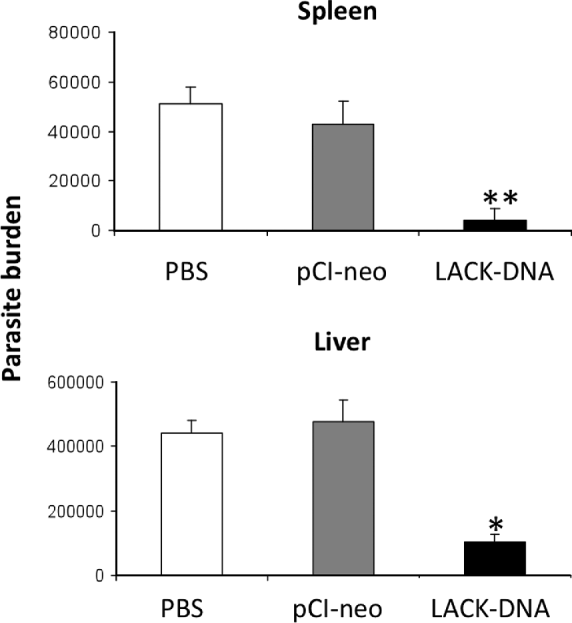
To investigate whether the protective effect of intranasal vaccination with LACK-DNA seen in mice could be reproduced in a susceptible model of VL, Syrian Golden hamsters were vaccinated with PBS, pCI-neo or LACK-DNA and challenged with L. chagasi promastigotes 1 week after the booster. LACK-DNA vaccinated hamsters exhibited significant parasite burden reduction in both liver and spleen when compared to PBS or pCI-neo control groups (Fig. 1). These findings were compatible with their healthier clinical signs and agility and contrary to prostrated animals receiving empty plasmid or PBS. On the other hand, no significant differences in spleen and liver parasite burden between pCI-neo and PBS groups were observed (Fig. 1).
Parasite burden in pre-vaccinated infected hamsters. Golden Syrian hamsters were intranasally vaccinated twice with 30μg of LACK-DNA and challenged by the intracardiac route with 1×10⁷ L. chagasi late-log-phase promastigotes 1 week after booster. Controls received empty pCI-neo vector or PBS. The parasite burden in individual organs was measured on day 30 of infection by limiting-dilution culture. Results are represented as arithmetic means±s.d. from 3 independent experiments. *P<0 05, ** P<0 01 as compared with both control groups.

Delayed-type hypersensitivity test
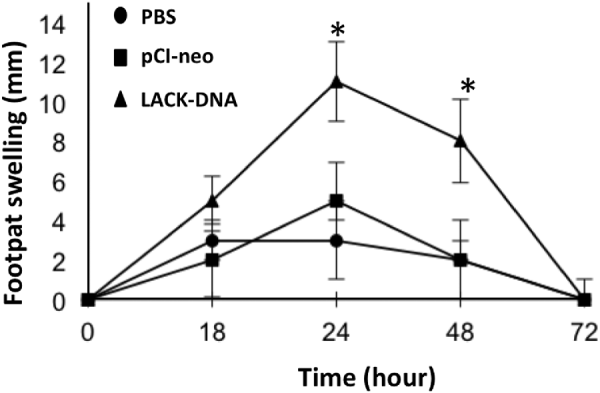
The acquisition of protective immunity following Leishmania infection is associated with the development of both positive DTH reaction and antigen-specific cell proliferation. The specific DTH response was evaluated by LcAg injection into the footpad 1 day after L. chagasi infection, followed by swelling measurement during 72 h. LACK-DNA – vaccinated hamsters showed the highest level of DTH 24 and 48 h after antigen challenge when compared to control groups (Fig. 2). No significant difference was observed between PBS or pCI-neo vaccinated animals upon LcAg challenge (Fig. 2).
Delayed-type hypersensitivity in hamsters pre-vaccinated with LACK-DNA. Hamsters were intranasally vaccinated and i.c.-infected as described for Fig. 1, and 24 h after infection, they were s.c.-challenged in the footpad with 25 μg of LaAg and the footpad swelling was recorded at the indicated times. The data are presented as means±s.d. of 3 independent experiments. *P<0 05 as compared with both control groups.

Splenocyte proliferation and nitric oxide production
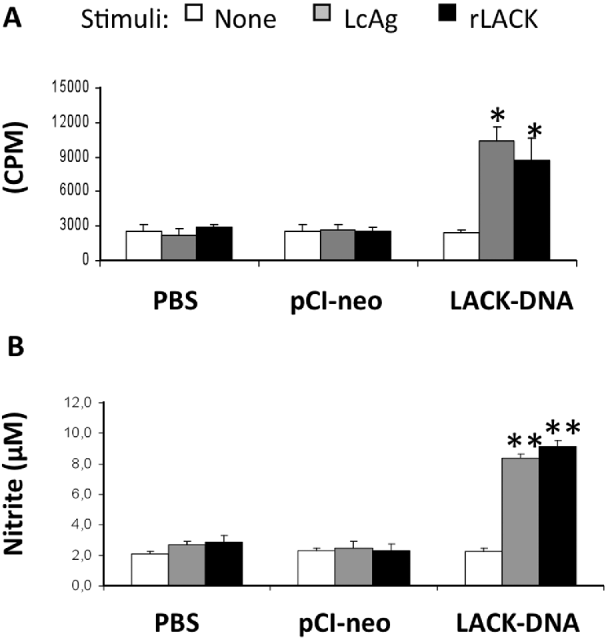
Splenocytes from LACK-DNA hamsters exhibited significantly higher proliferation upon in vitro re-stimulation with either LcAg or rLACK, when compared to PBS and pCI-neo control groups (Fig. 3A). Moreover, no significant increase in proliferation was observed in PBS and pCI-neo cells after antigen recall (Fig. 3A), compatible with the observed parasite burden and DTH results.
Parasite-specific lymphoproliferative responses and NO production. Animals were intranasally vaccinated and i.c.-challenged as described in Fig. 1. On day 30 of infection, their splenocytes were isolated. (A) The parasite-induced lymphoproliferative responses were determined by 3H-thymidine incorporation after in vitro re-stimulation with LcAg (50μg/ml), rLACK or none. The rate of 3 H-incorporation was expressed as cpm with means±s.d. from 3 independent experiments. *P<0 05 as compared with both control groups. (B) Nitric oxide production was determined in the splenocyte supernatants after in vitro re-stimulation with the same antigens as in (A). Means±s.d. from 3 independent experiments. *P<0 05, ** P<0 01 as compared with both control groups.

To speculate on the effective mechanism involved in the protection followed by LACK-DNA intranasal immunization, NO production on day 30 of infection was measured in the splenocyte supernatants stimulated with LcAg or rLACK. As seen in Fig. 3B, cells from LACK-DNA-vaccinated hamsters produced more NO than PBS and pCI-neo controls (P<0 01).
Humoral immune response
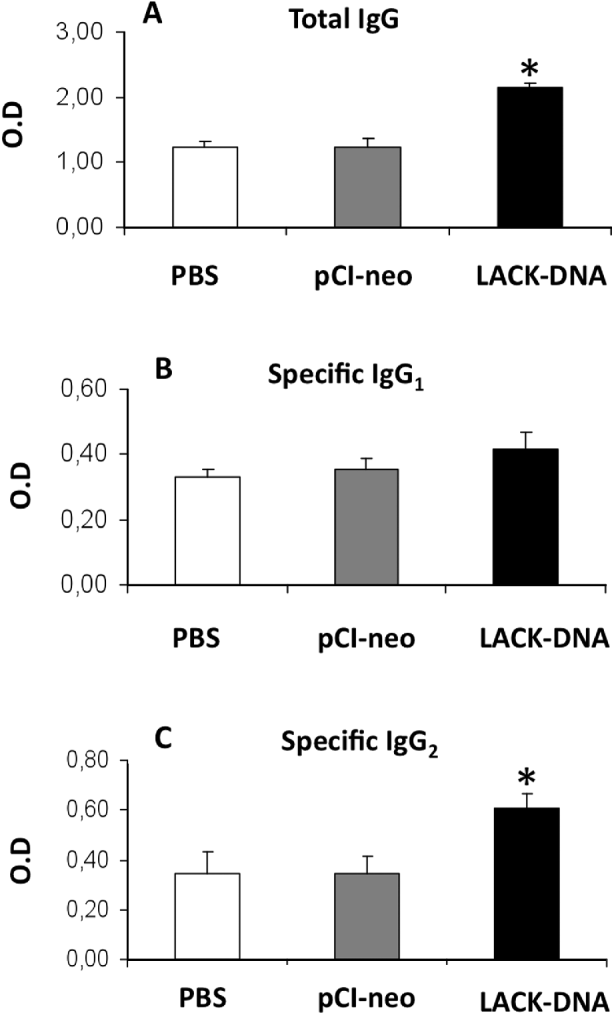
To understand whether the differential degree of protection obtained by intranasal LACK-DNA immunization correlated with a specific pattern of immunoglobulin production, we evaluated the leishmanial antigen-specific IgG and its isotype (IgG1 and IgG2) levels in the sera of control and vaccinated groups (Fig. 4). Sera from LACK-DNA hamsters presented a substantial increase in parasite-specific IgG and IgG2 levels as compared with control groups (Fig. 4A and C). Furthermore, no significant differences in IgG and IgG2 production were observed between control groups (PBS and pCI-neo) (Fig. 4A and C), also in the IgG1 levels between controls (PBS and pCI-neo) and LACK-DNA vaccinated group (Fig. 4B).
Pattern of antibody production during infection. Hamsters were vaccinated and infected as described in Fig. 1. On day 30 of infection, their sera were collected and assayed by ELISA for (A) total IgG, (B) IgG1 and (C) IgG2. Arithmetic means±s.d. *P<0 05 as compared with both control groups.

DISCUSSION
Previous studies from our laboratory have hinted towards the prophylactic potential of LACK-DNA intranasal administration to induce a significant immune response in experimental models of cutaneous and visceral murine leishmaniasis (Pinto et al. Reference Pinto, Pinheiro, Rayol, Larraga and Rossi-Bergmann2004; Gomes et al. Reference Gomes, Pinto, de Melo, Lima, Larraga, Lopes and Rossi-Bergmann2007). Syrian golden hamsters (Mesocricetus auratus) have proven to be the most susceptible and appropriate experimental model of rodents, reproducing with more fidelity the clinical and pathological features of human VL, including the continued parasitaemia, cachexy, hepatosplenomegaly and death (Bhowmick et al. Reference Bhowmick, Ravindran and Ali2007).
The parenteral use of LACK-DNA vaccine was not able to protect mice against challenge with L. donovani (Melby et al. Reference Melby, Yang, Zhao, Perez and Cheng2001b) and L. chagasi (Marques-da-Silva et al. Reference Marques-da-Silva, Coelho, Gomes, Vilela, Masioli, Tavares, Fernandes, Afonso and Rezende2005), unlike the protection achieved with intranasal vaccination against L. chagasi (Gomes et al. Reference Gomes, Pinto, de Melo, Lima, Larraga, Lopes and Rossi-Bergmann2007). In those studies, Melby et al. (Reference Melby, Yang, Zhao, Perez and Cheng2001b) and Marques da Silva et al. (Reference Marques-da-Silva, Coelho, Gomes, Vilela, Masioli, Tavares, Fernandes, Afonso and Rezende2005) tested vaccination efficacy between 4 and 12 weeks post-immunization, and demonstrated that long-term protection cannot be achieved. The present study evaluated, for the first time, the LACK-DNA vaccine in hamsters. Similar to observations in mice, hamsters doubly vaccinated with 30 μg of LACK-DNA (i.n.) showed an impressive reduction of parasite load in both the spleen and liver. Both our previous (mice) and present (hamster) studies evaluated vaccine efficacy at 1 week after booster. We recently investigated in mice the possibility that not only effector but also long-term memory immunity was established after i.n. vaccination. In that mouse study, both LACK mRNA tissue expression and protective immunity lasted for at least 12 weeks post-vaccination (manuscript submitted). Although the vaccine memory duration has not been yet evaluated in hamsters, it is worth noting that even a short-term memory vaccine can be of use, for instance when taken just prior to a visitation to an endemic area. This is particularly true if the vaccine is potentially self-administrable as is the case of an intranasal vaccine.
The vaccine success in humans and animal models has often been related to delayed-type hypersensitivity (DTH) and antigen-specific T-cell responsiveness (Mazumdar et al. Reference Mazumdar, Anam and Ali2005; Bhowmick et al. Reference Bhowmick, Ravindran and Ali2007). Although those parameters do not always correspond to protection efficiency (Velez et al. Reference Vélez, Gilchrist, Arbelaez, Rojas, Puerta, Antunes, Zicker and Modabber2005), strong antigen-specific cellular immune responses such as the DTH and the lymphoproliferative response are related to VL healing (Garg et al. Reference Garg, Gupta, Tripathi, Hajela, Sundar, Naik and Dube2006). Notably, LACK-DNA-vaccinated hamsters showed a significant DTH response at 24–48 h when compared to control groups. Hamsters infected with L. donovani by the subcutaneous route do not mount a DTH response, unlike intradermally-infected animals that display a healing-associated DTH response (Gifawesen and Farrell, Reference Gifawesen and Farrell1989). The induction of DTH following s.c. antigen challenge confirmed the peripheral cellular immunity promoted by the i.n. LACK-DNA. Moreover, splenocytes from these animals exhibited enhanced lymphoproliferative responses after LcAg or rLACK in vitro antigen recall, demonstrating the correlation between the cellular immune response and resistance to L. chagasi infection.
Active VL has been related to decreased cellular immune responses associated with high antibody production prior to parasite detection (Bhowmick et al. Reference Bhowmick, Ravindran and Ali2007). Like mice, hamsters show changes of IgG class to IgG1 or IgG2 influenced by IL-4 or IFN-γ production, respectively. Thus, the level of antibody response appears to be comparable with the extent of protection outcome observed in animals vaccinated prior to infection (Bhattacharjee et al. Reference Bhattacharjee, Gupta, Bhattacharya, Adhikari, Majumdar and Majumdar2009). Intranasal LACK-DNA vaccination induced an increase in IgG and IgG2 levels, but not of IgG1, suggesting that in these animals the cellular immune response was skewed to Th1, and correlated with the observed specific cellular immune response and lower parasitism. In conformity with these findings, we found elevated NO production in hamsters vaccinated with LACK-DNA while the control animals (PBS and pCI-neo) had baseline production, even under parasite antigen stimulation, suggesting nitrite-mediated induction of a macrophage mediator mechanism towards intracellular parasite control. The absence of NO production is associated with progressive disease in hamsters (Melby et al. Reference Melby, Yang, Zhao, Perez and Cheng2001b), while the induction of NO by LACK-DNA vaccination reverts the progressive disease as a mechanism of disease control. The NO production suggests IFN-γ activation and/or inhibition of IL-10 and TGF-β production which results in Th1 response involved in hamster protection.
Our study clearly demonstrates a high degree of protection accomplished with intranasal LACK-DNA in an extreme VL susceptibility model promoting systemic immunity that effectively protects hamsters against VL caused by L. chagasi. Besides its effectiveness and potential broad-spectrum efficacy against leishmaniasis, this vaccine offers a number of advantages over parenteral vaccines (Arakawa et al. Reference Arakawa, Komesu, Otsuki, Sattabongkot, Udomsangpetch, Matsumoto, Tsuji, Wu, Torii and Tsuboi2005; Chabot et al. Reference Chabot, Brewer, Lowell, Plante, Cyr, Burt and Ward2005). Since no needles are used, compliance is increased and blood transmissible diseases are avoided.