Hospital readmissions are associated with reduced quality of life and increased mortality.Reference Pearson, Stewart and Rubenach 1 – Reference Hicks, Tosoian and Craig-Schapiro 4 An improved understanding of risk factors for readmission is critical to develop targeted interventions to prevent readmissions. One major cause of readmissions is infection, which accounted for as many as 30% of 30-day readmissions.Reference Gohil, Datta and Cao 5 In addition, infections during hospitalization, particularly sepsis, are associated with frequent 30-day readmissions, with estimated rates ranging from 7% to 43%.Reference Prescott, Langa and Iwashyna 6 – Reference Mayr, Talisa, Balakumar, Chang, Fine and Yende 16
Although multidrug-resistant organism (MDRO) infections are known to increase the length of stay and healthcare costs,Reference Nathwani, Raman, Sulham, Gavaghan and Menon 17 their role as a risk factor for readmission has not been extensively studied. Data suggest that patients with MDRO infections are at higher risk of readmission, though causes of readmission in these cohorts are not well defined.Reference Andruska, Micek and Shindo 18 – Reference Duggal, Barsoum and Schmitt 25 Furthermore, infection as a reason for readmission in sepsis patients (with or without MDROs) is poorly characterized due to data limitations and heterogeneity among study designs, with estimates of readmission rates due to infection ranging from 20% to 70%.Reference Sun, Netzer and Small 7 , Reference Ortego, Gaieski and Fuchs 10 , Reference Donnelly, Hohmann and Wang 12 , Reference Goodwin, Rice, Simpson and Ford 13
Data concerning the rate of readmissions in patients who had an MDRO infection and the rate of MDRO infections during readmission in patients with a prior MDRO infection are lacking. We studied hospitalized patients with MDRO infections, confirmed by positive cultures from the bloodstream, bronchoalveolar lavage (BAL)/bronchial wash, or other sterile site to determine readmission rates and whether the same or a different MDRO was isolated in sterile site or BAL/bronchial wash cultures during a readmission. We did not use a comparison group of patients with non-MDRO infections because this population of patients tends to be different from patients with MDRO infections. 26 , 27 Understanding the rate of readmission with MDROs in patients with prior MDRO infections will help guide clinical decision making by improving the use of targeted empiric antimicrobials in readmitted patients, by facilitating readmission reduction interventions targeted toward patients at high readmission risk, and by improving infection prevention efforts by alerting personnel when patients at high-risk for MDRO infection are admitted so that proper isolation precautions can be initiated.
MATERIALS AND METHODS
Study Location and Patient Population
This study was conducted at Barnes-Jewish Hospital (BJH), a 1,250-bed academic medical center located in St Louis, Missouri. The study period was January 1, 2006 to October 1, 2015. Hospitalized patients with a positive sterile site or BAL/bronchial wash culture for Enterobacteriaceae, Enterococcus spp, Staphylococcus aureus, Pseudomonas aeruginosa, or Acinetobacter spp were analyzed for eligibility. Antimicrobial susceptibilities for all pathogens were determined using disc diffusion methodology. Sterile sites were defined as bloodstream; pleural, intra-abdominal, pericardial, cerebrospinal, and synovial fluids; bone marrow; and surgical specimens collected from lymph nodes; the central nervous system (CNS), liver, spleen, kidney, pancreas, ovary, or vascular tissue. The Washington University School of Medicine Institutional Review Board approved this study.
Study Design and Data Collection
Utilizing a retrospective cohort study design, the first hospitalization between January 2006 and October 2015 of all patients aged ≥18 years with multidrug-resistant Enterobacteriaceae, Enterococcus spp, S. aureus, P. aeruginosa, or Acinetobacter spp isolated from bloodstream, other sterile sites, or BAL/bronchial wash culture were identified. Patients with >1 of these MDROs were considered to have a polymicrobial infection. Other potentially drug-resistant organisms were not included in the analysis. The primary end points were any readmission and readmission during which an MDRO infection occurred. Baseline characteristics, including age, gender, race, Acute Physiology and Chronic Health Evaluation (APACHE) IIReference Neuner, Yeh and Hall 22 scores (calculated based on clinical data present during the 24 hours after positive blood cultures were drawn), Charlson comorbidity index, and medical comorbidities (based on International Classification of Disease, Ninth Revision, Clinical Modification [ICD-9-CM] diagnosis codes) were obtained. Patients who died during the index hospitalization or were discharged on hospice were considered to expire at the time of hospital discharge and were excluded from analyses related to readmissions.
Definitions
We assessed 30-day mortality using the BJC Healthcare Informatics database. Barnes-Jewish Hospital is the main adult teaching institution for BJC Healthcare, a large integrated healthcare system of both inpatient and outpatient care. The system includes 13 hospitals in a compact geographic region surrounding and including St Louis, Missouri. Barnes-Jewish Hospital has >50,000 admissions annually, and the BJC system has >140,000 admissions annually. All index hospitalizations used to define the cohort occurred at BJH. Readmissions to BJH or any other BJC acute-care facility were captured. All data were derived from the medical informatics database maintained by the Center for Clinical Excellence, BJC HealthCare. To be categorized as having an MDRO during a readmission, blood, BAL/bronchial wash, or sterile-site cultures positive for an MDRO could be obtained any time during the readmission. Patient death dates are included in the informatics database. For patients with <1 year of follow-up care at BJC HealthCare after index hospitalization, the Social Security Death Index (SSDI) was used to identify patient deaths. Patients without follow-up in the BJC system and who were not in the SSDI were considered lost to follow-up on their last date of care in a BJC facility. Index MDRO admission survivors were considered censored at their date of death or loss to follow-up.
Defining MDROs
We utilized multiple definitions of drug resistance as outlined by the Centers for Disease Control and Prevention (CDC) and European CDC (Supplemental Table 1).Reference Magiorakos, Srinivasan and Carey 28 – Reference Messina, Cober and Richter 30 Any Enterobacteriaceae was presumed to be an extended-spectrum β-lactamase (ESBL) producer if ceftriaxone or ceftazidime was intermediate or resistant. Patients were considered to have a vancomycin intermediate S. aureus (VISA) infection if S. aureus was isolated in culture and was determined to have a vancomycin minimum inhibitory concentration (MIC) of 4 or 8 µg/mL, in accordance with Clinical and Laboratory Standards Institute recommendations.Reference Allison, Muldoon and Kent 31
Statistical Analysis
Comparisons between index MDRO admission survivors and nonsurvivors were performed using the χ2 or the Fisher exact test for categorical values and using the Student t test or Mann-Whitney U test for continuous variables. Readmissions by index hospitalization pathogen group were analyzed using Kaplan-Meier curves. Continuous variables were reported as means with standard deviations or medians and interquartile ranges (IQRs). Categorical data were expressed as frequencies. In bivariate analysis, the relative risk of in-hospital mortality or discharge on hospice from index MDRO hospitalization was calculated using drug-resistant S. aureus as the reference group because it was the largest group and had the lowest mortality. For bivariate analysis of variables associated with readmissions or readmissions with an MDRO, a Cox proportional hazards model was used. The proportional hazards assumption was checked graphically using a log-log survival plot. A P value of <.05 was considered significant in all analyses. Multivariate Cox proportional hazards models were used to determine risk factors for readmission overall and risk factors for a readmission during which an MDRO was isolated. Factors associated with mortality in bivariate analysis (P < .20) were entered into a Cox proportional hazards model to determine hazard ratios (HRs) for readmission. Nonsignificant predictors were retained in final models if their P value was <.20 in bivariate analysis. All variables entered into the model were assessed for collinearity, and clinically plausible interaction terms were tested in the model (Supplemental Table 2). Model diagnostics included plotting of DFBETAs to detect influential cases and martingale residuals for a residuals pattern. Linearity of the Charlson comorbidity index for the outcome was confirmed prior to model entry. All analyses were conducted with SPSS version 24 software (IBM, Armonk, NY).
RESULTS
A total of 4,429 patients with MDROs from sterile sites or BAL/bronchial wash cultures were identified, and 976 patients (22.0%) died during the index hospitalization or were discharged to hospice. Nonsurvivors were older and had more underlying comorbidities and higher APACHE-II scores than survivors (Supplemental Table 3). In bivariate analysis, nonsurvivors were more likely to have any drug-resistant Enterococcus, Acinetobacter, or P. aeruginosa than survivors and less likely to have a drug-resistant S. aureus infection (Supplemental Table 3). Patients with any drug-resistant Acinetobacter had the highest index hospitalization mortality (n = 44, 41.1%), with a relative risk (RR) of death of 2.45 compared to patients with drug-resistant S. aureus (P < .0001) (Supplemental Table 4). There were significant differences in the APACHE-II scores among patients in the different index pathogen groups (P < .001) (Supplemental Table 5). Additional differences in patient characteristics among index pathogen groups are shown in Supplemental Table 5. Comorbidities, age, gender, ICU utilization, length of hospital stay, and the site from which an MDRO was isolated were all significantly different between groups (Supplemental Table 5).
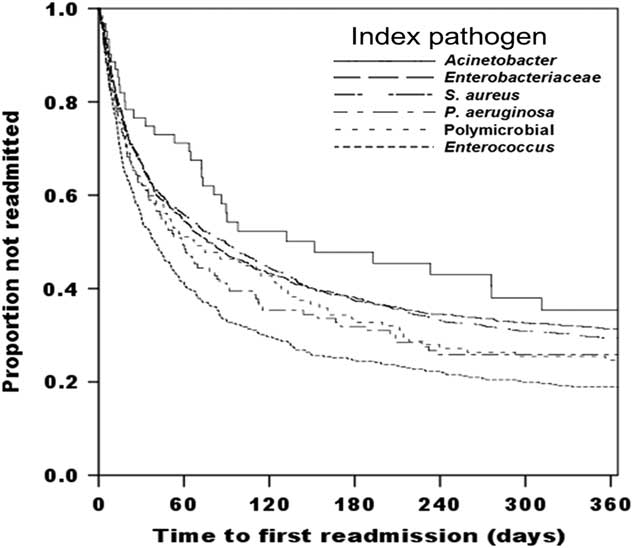
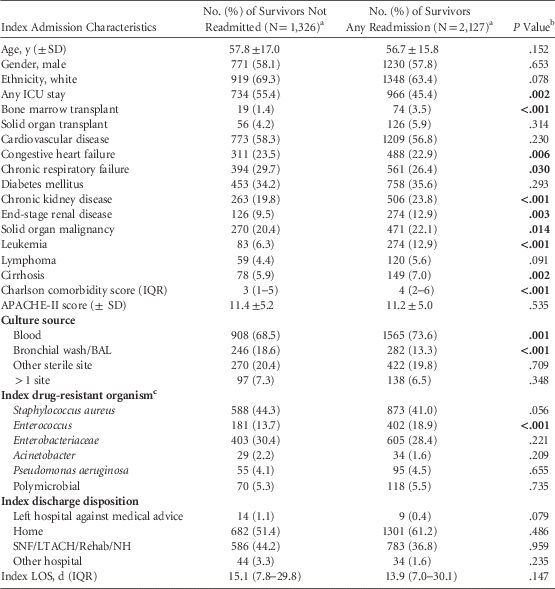
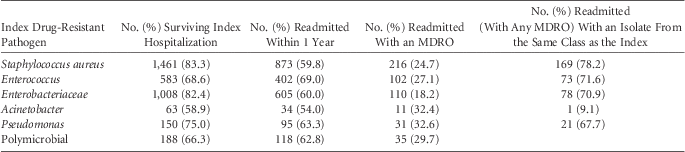
Among the 3,453 index MDRO hospitalization survivors, 1,121 (32.5%) were readmitted at least once within 30 days after discharge from the index hospitalization, and 2,127 (61.6%) were readmitted within 1 year. These 2,127 patients had a total of 5,849 readmissions within 1 year, with a median of 2 readmissions per patient (IQR, 1–4; range, 1–28). The median time to first readmission was 26.9 days (IQR, 9.9–76.9). Survivors infected with drug-resistant Acinetobacter were least likely to be readmitted, and those infected with drug-resistant Enterococcus most likely to be readmitted (Figure 1) (P < .001). Differences in baseline characteristics between survivors readmitted within 1 year and those who were not are shown in Table 1.
Time to first readmission by index multidrug-resistant organism (MDRO) hospitalization pathogen type. Patients censored at death or loss to follow-up. Log-rank, 44.340; P < .001; 5° of freedom. All index pathogens are drug resistant.

Comparison of Survivors of the Index MDRO Hospitalization Readmitted Within 1 Year to Those Who Were Not Readmitted Within 1 Year After Discharge From the Index MDRO Hospitalization

NOTE. MDRO, multidrug-resistant organism; APACHE-II, Acute Physiology and Chronic Health Evaluation; BAL, bronchoalveolar lavage; ICU, intensive care unit; IQR, interquartile range; LTACH, long-term acute-care hospital; LOS, length of stay; NH, nursing home; SNF, skilled nursing facility; SD, standard deviation.
a Unless otherwise specified.
b P values were obtained using univariate Cox regression.
c Drug resistance was defined according to the definitions in Supplemental Table 1.
Of the survivors who were not readmitted within 1 year, 500 (14.5%) were lost to follow-up. In bivariate analysis, patients lost to follow-up were significantly (P < .05) more likely to have cardiovascular disease, chronic respiratory failure, be older, have had an ICU stay during index hospitalization, and be discharged to a skilled nursing facility (SNF), a long-term acute-care hospital (LTACH), or a nursing home (NH) (data not shown).
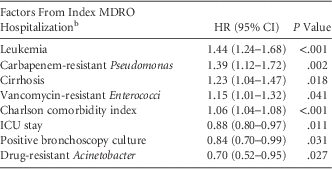
In a multivariate Cox proportional hazards model of survivors, any ICU stay during the index hospitalization was associated with a reduced HR for readmission (HR, 0.88) as was having a positive bronchoscopy culture (HR, 0.83) or infection with a drug-resistant Acinetobacter (HR, 0.71). Factors associated with increased risk of readmission were cirrhosis (HR, 1.24), leukemia (HR, 1.44), Charlson comorbidity index (HR, 1.06 per unit increase), VRE (HR, 1.15), and carbapenem-resistant P. aeruginosa during index hospitalization (HR, 1.40) (Table 2).
Index MDRO Hospitalization Factors Associated With Any Readmission Within 1 Year in a Multivariable Cox Proportional Hazards ModelFootnote a

NOTE. MDRO, multidrug-resistant organism; CI, confidence interval; HR, hazard ratio; ICU, intensive care unit; ESBL, extended-spectrum β-lactamase; MRSA, methicillin-resistant Staphylococcus aureus.
a Population = survivors of index hospitalization.
b Other variables included in the model that were not significant: age, ethnicity, receipt of a bone marrow transplant, congestive heart failure, cirrhosis, chronic kidney disease, chronic respiratory failure, end-stage renal disease, lymphoma, solid organ malignancy, blood culture with an MDRO, ESBL Enterobacteriaceae, MRSA, and length of stay.
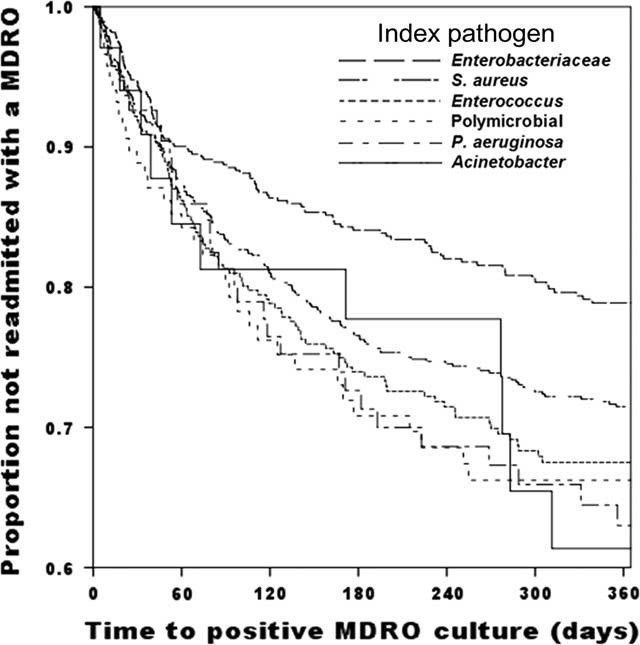
Of the 2,127 patients with at least 1 readmission within 1 year, 512 (24.1%) had an MDRO isolated during at least 1 readmission. The median time to a new positive MDRO culture after discharge from the index hospitalization was 61.9 days (IQR, 24.3–140.6). Patients with index drug-resistant Enterobacteriaceae were the least likely and patients with index drug-resistant Acinetobacter were the most likely to be readmitted with another MDRO infection (P = .001) (Figure 2). Differences in baseline characteristics between readmitted patients with and without another MDRO during readmission are shown in Supplemental Table 6. Patients with readmissions that did not end prior to 365 days after index hospitalization discharge could have had MDROs isolated after 365 days that were not captured by this study, though this involved only 14 patients (0.7%).
Time to first positive multidrug-resistant organism (MDRO) culture within 1 year of index MDRO hospitalization by index hospitalization pathogen. All index pathogens are drug resistant. Log-rank, 21.220; 5° of freedom; P=.001. Note y-axis scale from 0.6 to 1.0.

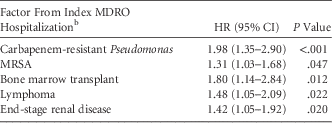
We performed a multivariate Cox proportional hazards model comparing patients with an MDRO during a readmission to patients without any MDROs during readmission. Bone marrow transplant (HR, 1.79), end-stage renal disease (HR, 1.43), lymphoma (HR, 1.49), methicillin-resistant S. aureus (MRSA) during index hospitalization (HR, 1.29), and carbapenem-resistant P. aeruginosa during index hospitalization (HR, 1.99) were all associated with a significantly increased risk of having an MDRO isolated during a readmission (Table 3).
Index MDRO Hospitalization Factors Associated With Readmission (Within 1 Year) in Which an MDRO Was Isolated Compared to Readmitted Patients Without MDROsFootnote a

NOTE. MDRO, multidrug-resistant organism; HR, hazard ratio; CI, confidence interval; MRSA, methicillin-resistant Staphylococcus aureus; VRE, vancomycin-resistant Enterococcus.
a Multivariable Cox proportional hazards model.
b Other variables included in the model that were not significant: ethnicity, sex, cardiovascular disease, congestive heart failure, chronic kidney disease, diabetes, leukemia, solid organ malignancy, Charlson comorbidity index, positive blood culture MDRO, positive other sterile site MDRO culture, VRE, drug-resistant Acinetobacter, discharge disposition, and index hospital length of stay.
In patients who had an MDRO isolated during readmission, the readmission MDRO was in the same pathogen class as the index hospitalization MDRO 68%–80% of the time, with 1 exception. For patients with drug-resistant Acinetobacter during index hospitalization, only 9.1% had drug-resistant Acinetobacter isolated during a readmission (Table 4), though numbers were small in this group. Discordant results between index and readmission cultures are shown in Supplemental Figure 1. To investigate why Acinetobacter was an outlier, we analyzed baseline characteristics of the cohort stratified by index hospitalization pathogen group. The proportion of patients who died or were discharged on hospice was significantly different between index pathogens, with Acinetobacter patients having the highest rate of death or discharge on hospice (P < .001) (Supplemental Table 5). Drug-resistant Acinetobacter patients were equally likely to have no bacterial cultures collected during readmissions (17.6%) and to be lost to follow-up (14.3%) as patients from other pathogen groups (data not shown).
Patient Survival, Readmission, and MDRO Recurrence Characteristics by Index Hospitalization Pathogen Group

NOTE. MDRO, multidrug-resistant organism.
DISCUSSION
All-cause readmissions within 1 year after index MDRO hospitalization were frequent in this study. The 30-day and 1-year all-cause readmission rates were higher than in previously published studies examining readmissions after systemic infections, suggesting a higher readmission rate in patients with MDRO infections.Reference Prescott, Langa and Iwashyna 6 – Reference Ortego, Gaieski and Fuchs 10 , Reference Donnelly, Hohmann and Wang 12 – Reference Chang, Tseng and Shapiro 15 , Reference Emerson, Eyzaguirre, Albrecht, Comer, Harris and Furuno 20 Although data are limited, other studies suggest rates of readmission for MDROs similar to those in our study (32%).Reference Yaw, Robinson and Ho 32 In the present study, the rate of readmission differed by type of MDRO isolated during the index hospitalization. Surviving patients with drug-resistant Acinetobacter were least likely to be readmitted within 1 year, and patients with drug-resistant Enterococcus were the most likely to be readmitted within 1 year. Independent risk factors for readmission within 1 year included certain comorbidities and certain pathogens (Table 2). These results suggest that patient and pathogen factors both contribute to all-cause readmission risk. Risk factors for mortality during the index MDRO hospitalization were less common as risk factors for readmission, which may explain why certain factors such as an ICU stay, which are associated with an increased risk of death, were thus associated with a reduced risk of readmission.
Almost 25% of patients readmitted within 1 year after an MDRO infection had an MDRO isolated during a readmission. The rate of readmissions during which an MDRO was isolated differed by the MDRO isolated at the index hospitalization. Few studies are available for comparison, but it appears that our readmission rate for MDRO patients may be similar to those of other cohorts.Reference Yaw, Robinson and Ho 32 , Reference Safdar and Maki 33 Whether drug resistance itself is a risk factor for readmission is not clear and is not addressed by this study. Previous work has shown higher rates of readmission for antibiotic-resistant (vs antibiotic-susceptible) pathogens.Reference Andruska, Micek and Shindo 18 , Reference Yaw, Robinson and Ho 32 A history of MRSA, VRE, or an ESBL gram-negative organism was associated with 1.6-fold increased odds for readmission in one cohort.Reference Butler, Olsen and Merz 34 Another study showed no difference in readmission rates between methicillin-sensitive and MRSA when adjusting for other comorbidities and severity of illness.Reference Palacios-Baena, Gutierrez-Gutierrez and De Cueto 35 In the context of our study, it is important to recognize that our patients were likely at high risk of readmission due to their high baseline severity of illness and their infections. Because we did not include a group of patients with non-MDRO infections as a comparator, the impact of drug resistance on readmission rates cannot be deduced from the present study. Multicenter studies will likely be required to address the impact of drug resistance on readmission rates and will need to consider factors such as the adequacy of source control and appropriateness of therapy in calculation of readmission risk.
In the present study, independent risk factors for MDRO isolation during a readmission included comorbidities (receipt of BMT, ESRD, lymphoma) and certain pathogens during the index hospitalization (VRE, MRSA, and carbapenem-resistant P. aeruginosa) compared with patients who were readmitted but had no MDROs isolated. These results suggest that patient and pathogen factors both contribute to the risk of readmission with an MDRO. In addition, we found that the MDRO isolated during a readmission is in the same class as the index hospitalization MDRO 67%–78% of the time, except for Acinetobacter (~9%), though numbers were small in the Acinetobacter group. Recognizing the heterogeneity of MDROs that occur during readmissions will help to better define patients in need of broad-spectrum empiric antimicrobial therapy at readmission.
Our study has several limitations. The retrospective design of the study makes it difficult to elucidate possible confounders that could have biased the outcome measures. This was a single-center study, and results may not be generalizable to other centers. However, the high rates of readmission and readmissions during which MDROs were isolated should be applicable to other tertiary-care referral centers with similar patient case mixes. We relied on clinical cultures to define MDRO recurrence, which likely underestimates the actual rate of readmissions with MDROs because we did not capture surveillance cultures that might identify colonization. It is possible that patients received antibiotics prior to having cultures collected during readmissions, which would also lower the apparent MDRO recurrence rate. As diagnostic microbiology methods continue to improve, the incidence of culture-negative sepsis will likely decrease, making it easier to more accurately assess populations at highest risk of readmissions with an MDRO recurrence.
We were limited by a lack of data on non-MDRO pathogens with which to compare readmission rates, but previous work has shown that patients acquiring MDRO infections are fundamentally different than patients with non-MDRO infections. 26 , 27 Therefore, it was more important to compare patients with different types of MDROs rather than compare patients with non-MDRO infections to those with drug-resistant infections due to the same organism.
Another limitation of our study is loss to follow-up. Some patients may have gone to a facility outside of the BJC Healthcare network where we were unable to capture their MDRO recurrence status. Patients censored at loss to follow-up were more likely to be discharged to a SNF, LTACH, or NH, where the local physicians could have diagnosed and treated MDRO infections without our knowledge. In addition, patients lost to follow-up were more likely to have had an ICU stay during their index MDRO hospitalization, which could explain why having an ICU stay was associated with a reduced hazard ratio for readmission. The study was also limited by a lack of treatment data to assess the appropriateness of antibiotic therapy as a potential reason for readmissions in this cohort.
In conclusion, all-cause readmissions and readmissions during which an MDRO was isolated are common among patients with MDRO infections. Patient characteristics and pathogen type both contribute to the risk of readmissions overall and readmissions during which an MDRO was isolated. By analyzing readmissions with MDROs, we aimed to elucidate risk factors for readmission in this population, to provide opportunities for targeted interventions to potentially prevent readmissions, and to help define the risk of MDRO infection during readmission so that infection prevention programs can initiate the proper isolation precautions and reduce the spread of MDROs within hospitals. In addition, our research gives providers guidance about which patients are most likely to need broad-spectrum antimicrobials when they are readmitted, based on the knowledge that MDRO recurrence is high in this population.
ACKNOWLEDGMENTS
Financial support: This work was supported by the Washington University Institute of Clinical and Translational Sciences (grant no. UL1TR000448) from the National Center for Advancing Translational Sciences (NCATS) of the National Institutes of Health (NIH) (to J.P.B.). The content is solely the responsibility of the authors and does not necessarily represent the official view of the NIH. This work was also supported by the Barnes-Jewish Hospital Foundation (to M.H.K.) and
by the Washington University Institute of Clinical and Translational Sciences grant (no. UL1TR000448, subaward no. KL2TR000450) from the National Center for Advancing Translational Sciences (NCATS) of the NIH (to J.H.K.).
Potential conflicts of interest: All authors report no further conflicts of interest relevant to this article.
SUPPLEMENTARY MATERIAL
To view supplementary material for this article, please visit https://doi.org/10.1017/ice.2017.254.