Implications
Information on expected production responses, when different forages are fed to dairy cows, is important for farmers and advisors in order to optimise forage and milk production. This meta-analysis, based on 43 previous experiments, shows that intake and milk production are higher when cows are fed legume-based diets compared with grass-based diets, and that different grass species similar in digestibility result in comparable intake and milk production. For optimal profitability, harvest yield, digestibility and production costs should be assessed and depending on local conditions, present results show that grass species can be selected freely, and legumes should be included.
Introduction
In many situations, the main energy source for dairy cows is plant cell walls (Wilson, Reference Wilson1994), but availability of nutrients from cell walls differs depending on their composition and structure (Buxton and Redfearn, Reference Buxton and Redfearn1997). To achieve a high efficiency in the dairy production, it is important to maximise the energy utilisation of the cell wall fraction in the diet (Wilson, Reference Wilson1994). The energy concentration of forages is often reflected in the digestibility, which is a measure of the overall quality of the forage (Allen, Reference Allen1996). Silages from grasses and legumes constitute usually a large part of the forage in feed rations for dairy cows, but growth of grasses and legumes differs due to seasonal differences, fertilisation strategy and management (Søegaard, Reference Søegaard2009; Eriksen et al., Reference Eriksen, Askegaard and Søegaard2014). Therefore, knowledge regarding feeding value of different grass and legume species is essential for combined optimisation of forage and milk production. Worldwide, several experiments comparing feed intake and milk production in dairy cows fed different grasses and legumes have been conducted during the last decades, but results from single experiments differ in effect size due to different genetic and physiological status of used animals, different experimental designs, variation in forage quality influenced by cultivation and weather conditions, etc. As examples, Vanhatalo et al. (Reference Van Soest, Mertens and Deinum2009) reported 1.1 kg/day reduction in total dry matter intake (DMI), whereas Al-Mabruk et al. (Reference Al-Mabruk, Beck and Dewhurst2004) reported 3.4 kg/day increase in total DMI when cow were fed red clover compared with grass. Therefore, a meta-analysis across experiments will give a more universal answer (Sauvant et al., Reference Sauvant, Schmidely, Daudin and St-Pierre2008) when evaluating the effect of different grass and legume species on feed intake and milk production in dairy cows.
Steinshamn (Reference Steinshamn2010) has nicely reviewed the effect of forage legumes on feed intake and milk production in dairy cows and concluded that feeding legumes resulted in higher feed intake and milk production compared with grasses. However, variation between experiments was accounted for using t-test statistics, and not by using experiment as random in a mixed model procedure as encouraged by St-Pierre (Reference St-Pierre2001). The variance between experiments often exceeds the variance within experiments by which it is important to include the experimental effect in the statistical model (Sauvant et al., Reference Sauvant, Schmidely, Daudin and St-Pierre2008).
The main objective of this meta-analysis, using mixed modelling procedures, was to compare feed intake and milk production in dairy cows fed different grass and legume species. The hypotheses were that feed intake and milk production are higher for cows fed legumes compared with cows fed grasses and within family, any differences in feed intake and milk production reflect differences in digestibility.
Material and methods
Published data from experiments with dairy cows fed diets containing grasses and legumes was collected to evaluate how different species affect DMI, milk production and milk composition, and to assess how species differ in organic matter (OM) digestibility. The compilation was done as a mix of database search (CAB Abstracts and Web of Science) and use of reference lists in already collected publications.
Criterion for inclusion of experiments in the meta-analysis was that the forage part of the diets consists solely of grasses, legumes or both. Further, within an experiment, the only difference allowed between diets was the forage source to ensure that responses were caused by the forage source and not by other diet changes. Therefore, within an experiment with total mixed ration (TMR) feeding, the forage : concentrate ratio had to be constant with a similar composition of the concentrate part between diets, and within an experiment using separate allocation of concentrate, all cows had to be offered the same amount of the same concentrate both within and between diets. If other factors were tested within an experiment (e.g. addition of vitamin E or fishmeal, or different levels of concentrate) in addition to the type of forage tested, a random treatment factor was added in the statistical analysis to ensure, that comparisons within an experiment were made between diets only differing in forage source. In addition, all cows should have had ad libitum access to the forage or TMR. In a few experiments, the cows were fed restricted in one period and ad libitum in another period, then only data from the ad libitum fed period was included.
All collected experiments reported data on DMI, milk yield and milk fat and milk protein concentration, whereas only some experiments reported data on milk lactose concentration. For all experiments, energy-corrected milk (ECM, 3.14 MJ/kg) was recalculated using the formula ECM (kg/day)=milk yield (kg/day)×((38.3×fat concentration (g/kg)+24.2×protein concentration (g/kg)+16.54×lactose concentration (g/kg)+20.7)/3140) if fat, protein and lactose concentrations were given, and the formula ECM (kg/day)=milk yield (kg/day)×((38.3×fat concentration (g/kg)+24.2×protein concentration (g/kg)+783.2)/3140) if only fat and protein concentrations were given (Sjaunja et al., Reference Sjaunja, Baevre, Junkkarinen, Pedersen and Setälä1991). For each diet, the feed efficiency was calculated as ECM (kg/day) divided by DMI (kg/day).
Several, but not all experiments reported data regarding OM digestibility of either the forage or the total ration. The method used to determine OM digestibility generally differed between experiments. If various methods were used and reported in the same experiment, the values obtained for the pure forages were used before values obtained for the total ration, and in vivo measurements were used before in vitro measurements. If D-values (digestible OM in DM) were reported, the values were converted to OM digestibility by correcting for the ash concentration.
Data sets
Four data sets were used to maximise statistical power for specific research questions. The purposes with the different data sets were to compare families (Data set 1), to compare different legume species and grass family (Data set 2) and to compare different grass species besides different legume species (Data set 3). The purpose with Data set 4 was the same as Data set 3, but the analytical approach differed allowing experiments with diets including mixes of grasses and legumes to be used to compare species, by which additional experiments could be included in the meta-analysis.
Data set 1 consisted of experiments comparing grasses and legumes in general. Diets with grasses contained either single grass species or mixes of different grass species, and diets with legumes contained either pure white clover (Trifolium repens L.), pure red clover (Trifolium pratense L.) or pure lucerne (Medicago sativa L.). No experiments included diets with mixes of different legume species. The data set included 62 treatment means from 18 experiments in 16 publications. Data on OM digestibility was reported in 15 experiments (52 diets).
Data set 2 consisted of experiments comparing grasses with specific pure legume species or comparing different pure legume species. As in Data set 1, diets with grasses included either single grass species or mixes of different grass species. The diets with specific legume species included pure white clover, pure red clover, pure lucerne or pure birdsfoot trefoil (Lotus corniculatus L.). The data set included 90 treatment means from 26 experiments in 21 publications. Data on OM digestibility was reported in 23 experiments (80 diets).
Data set 3 consisted of experiments comparing different pure grass species, comparing specific pure grass species with specific pure legume species or comparing different pure legume species. The specific pure grass species included were perennial ryegrass (Lolium perenne L.), orchardgrass (Dactylis glomerata L.), timothy (Phlenum pratense L.), meadow fescue (Festuca pratensis Huds.), tall fescue (Festuca arundinacea Schreb.) and festulolium (Festulolium braunii K.A.), and the specific pure legume species included white clover, red clover, lucerne and birdsfoot trefoil. The data set included 84 treatment means from 26 experiments in 19 publications. Data on OM digestibility were reported in 20 experiments (65 diets).
Data set 4 consisted of experiments with diets including mixes of grasses and legumes, mixes of different grass species, or pure grass or legume species, taking the proportion of single species in the forage part in each diet into consideration. In most experiments, mixes were made by mixing different species before feeding by which the exact proportions were known. In other experiments, the mixes were grown as mixtures in the field, and proportions based on botanical analysis before harvest were used. For all diets, the legume proportion was known. In 11 out of 43 experiments, botanical information was missing for grass mixtures grown in the field, and proportions based on seeding amount were used if reported (two experiments), otherwise an assumption on equal proportion of grass species was used in the analysis. Some experiments stated the proportion of weed contamination in the forage, and if so, this proportion was included as well. Annual ryegrass (Lolium multiflorum Lam.) was included in this data set, besides the species already included in Data set 3, because no available experiments had tested annual ryegrass pure against other pure species, but annual ryegrass was tested pure against mixes and also included in mixes with other species. The data set contained 161 treatment means from 43 experiments in 30 publications.
For all data sets, only diets within an experiment, fulfilling the prerequisites, were used. Therefore, not all diets within an experiment were necessarily included in the data for meta-analysis. If several diets within an experiment included the same forage type, but the forage differed in cut number or variety, these diets were handled as replicates within experiment.
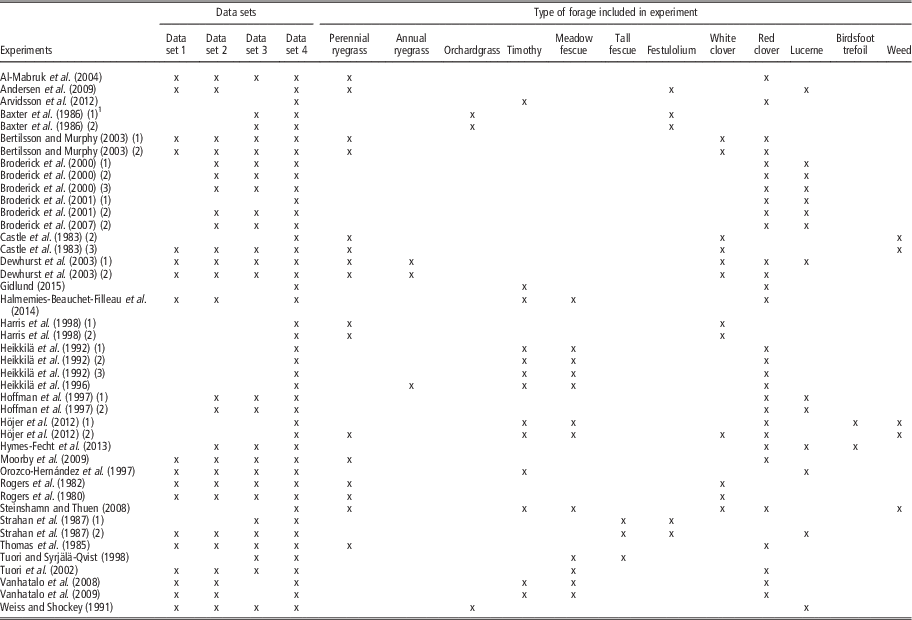
An overview of experiments included in each data set and type of forage included in each experiment is evident from Table 1, and the list of references is given in Supplementary Material S1. The forage : concentrate ratio, DMI and ECM as average across all experiments including additional tested factors were 67 : 33 (43 : 57 to 100 : 0, minimum to maximum), 19.5 kg/day (11.7 to 24.7) and 26.0 kg/day (11.8 to 34.3), respectively. Detailed information on the experiments used in the meta-analysis is given in Supplementary Table S1.
Overview of experiments included in each data set used for meta-analysis and type of forage included in each experiment

Full list of references is available in Supplementary Material S1 and detailed information on the experiments is given in Supplementary Table S1.
1 The number in brackets refers to experiment number within publication.
Statistical analysis
The statistical analyses were performed using the lmer function from the lme4 package (Bates et al., Reference Bates, Maechler, Bolker and Walker2015) in R 3.3.1 (R Core Team, 2016).
Data sets 1, 2 and 3 were analysed using the following linear random effect model fitted with restricted maximum likelihood (REML):
 $$Y_{{ijk}} {\,\equals\,}\mu {\plus}\alpha _{i} {\plus}A_{j} {\plus}B_{{k(j)}} {\plus}E_{{ijk}} $$
where Y is the dependent response variable, µ the overall mean, α the fixed effect of forage type (Data set 1, i=grasses, legumes; Data set 2, i=grasses, white clover, red clover, lucerne, birdsfoot trefoil; Data set 3, i=perennial ryegrass, orchardgrass, timothy, meadow fescue, tall fescue, festulolium, white clover, red clover, lucerne, birdsfoot trefoil), A the random effect of experiment (Data set 1, j=1 to 18; Data set 2, j=1 to 26; Data set 3, j=1 to 26), B the random effect of additional tested factors within an experiment nested in experiment (for all data sets, k=1 to 3) and E the random residual error assumed to be independent and normal distributed. Residuals were weighted by the square rooted number of cows in each treatment mean. Overall effect of forage type was tested by variance analysis using Satterthwaite approximation for degrees of freedom. Least square means (LSM) and standard error of mean of response variables for the different forage types are presented in Tables 2 to 4. In Data sets 2 and 3, differences between LSM were evaluated using Tukey’s method for comparing a family of 5 and 10 estimates, respectively.
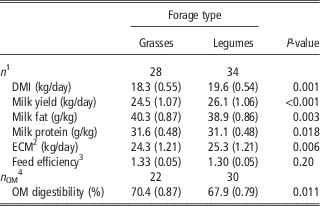
Effect of forage type (grasses or legumes) on dry matter intake (DMI), milk production and organic matter (OM) digestibility in dairy cows evaluated with Data set 1

Least square means given with SEM in brackets.
1 Number of treatment means included in the analyses of DMI and milk production.
2 Energy-corrected milk (ECM) (3.14 MJ/kg).
3 Calculated as kilogram ECM per day divided by kilogram DMI per day.
4 Number of treatment means included in the analysis of OM digestibility.
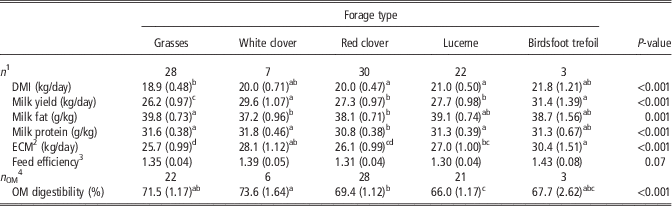
Effect of forage type (grasses, white clover, red clover, lucerne or birdsfoot trefoil) on dry matter intake (DMI), milk production and organic matter (OM) digestibility in dairy cows evaluated with Data set 2

Least square means given with SEM in brackets.
a,b,c,dValues in same line with different letters differ, P<0.05.
1 Number of treatment means included in the analyses of feed intake and milk production.
2 Energy-corrected milk (ECM) (3.14 MJ/kg).
3 Calculated as kilogram ECM per day divided by kilogram DMI per day.
4 Number of treatment means included in the analysis of OM digestibility.
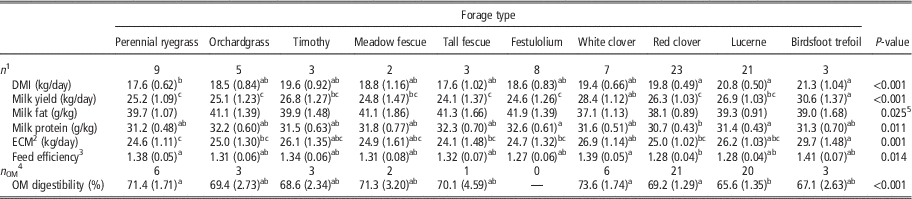
Effect of forage type (perennial ryegrass, orchardgrass, timothy, meadow fescue, tall fescue, festulolium, white clover, red clover, lucerne or birdsfoot trefoil) on dry matter intake (DMI), milk production and organic matter (OM) digestibility in dairy cows evaluated with Data set 3

Least square means given with SEM in brackets.
a,b,cValues in same line with different letters differ, P<0.05.
1 Number of treatment means included in the analyses of feed intake and milk production.
2 Energy-corrected milk (ECM) (3.14 MJ/kg).
3 Calculated as kilogram ECM per day divided by kilogram DMI per day.
4 Number of treatment means included in the analysis of OM digestibility.
5 The overall statistical test gave a significant result, whereas the Tukey method for comparing differences between means did not gave any significant differences.
Data set 4 was analysed using the following linear regression model with random intercepts fitted with REML:
 $$\eqalignno{ Y_{{fjk}} {\,\equals\,} & \beta _{1} f_{1} {\plus}\beta _{2} f_{2} {\plus}\beta _{3} f_{3} {\plus}\beta _{4} f_{4} {\plus}\beta _{5} f_{5} {\plus}\beta _{6} f_{6} {\plus}\beta _{7} f_{7} {\plus}\beta _{8} f_{8} \cr & {\plus}\beta _{9} f_{9} {\plus}\beta _{{10}} f_{{10}} {\plus}\beta _{{11}} f_{{11}} {\plus}\beta _{{12}} f_{{12}} {\plus}A_{j} {\plus}B_{{k(j)}} {\plus}E_{{fjk}} $$
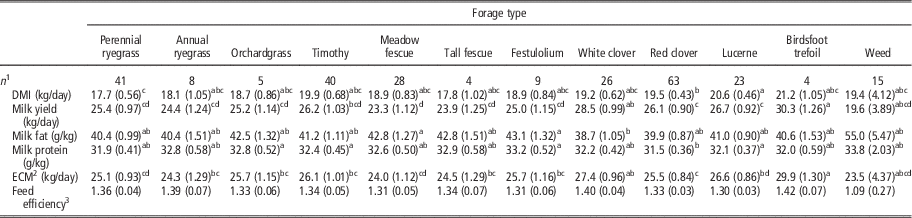
where Y is the response variable, β 1-12 the regression coefficients for the proportion (0 to 1) of perennial ryegrass (f 1), annual ryegrass (f 2), orchardgrass (f 3), timothy (f 4), meadow fescue (f 5), tall fescue (f 6), festulolium (f 7), white clover (f 8), red clover (f 9), lucerne (f 10), birdsfoot trefoil (f 11) and weed (f 12) in the forage part of the diet, respectively, A the random effect of experiment (j=1 to 43), B the random effect of additional tested factors within an experiment nested in experiment (k=1 to 4) and E the random residual error assumed to be independent and normal distributed. Residuals were weighted by the square rooted number of cows in each treatment mean. Weed was included in the analysis with proportions from 0 to 0.3, whereas all other species were included with proportions from 0 to 1. Values presented in Table 5 are the predicted responses, when proportion of the single forage is set to 1 and proportions of all other forages are set to 0, with the standard error of this response in brackets. Differences between values were evaluated by general linear hypothesis testing using the glht function from the multcomp package (Hothorn et al., Reference Hothorn, Bretz and Westfall2008), and P-values were adjusted according to the single step method. Statistical significance was declared by P⩽0.05.
Predicted effect of forage type (perennial ryegrass, annual ryegrass, orchardgrass, timothy, meadow fescue, tall fescue, festulolium, white clover, red clover, lucerne or birdsfoot trefoil), when proportion of the single forage is set to 1 and proportions of all other forages are set to 0, on dry matter intake (DMI) and milk production in dairy cows evaluated with Data set 4

Standard errors given in brackets.
a,b,c,dValues in same line with different letters differ, P<0.05.
1 Number of treatments in which the forage type is included with a proportion above 0. Total n=161. Weed was included in the analysis with proportions from 0 to 0.3, whereas all other species were included with proportions from 0 to 1.
2 Energy-corrected milk (ECM) (3.14 MJ/kg).
3 Calculated as kilogram ECM per day divided by kilogram DMI per day.
Results
Data set 1
Total DMI and milk yield were higher for cows fed legumes than for cows fed grasses, when comparing grasses with legumes in general (Data set 1, Table 2). The difference in ECM between legumes and grasses (1.0 kg/day) was lower than the difference in milk yield (1.6 kg/day) as both milk fat and milk protein concentrations were lower on legume-based diets than on grass-based diets. No difference was observed in feed efficiency, but OM digestibility was lower for legumes than for grasses.
Data set 2
Total DMI of lucerne and red clover were higher than of grasses when comparing grasses and specific legumes (Data set 2, Table 3). Total DMI of white clover and birdsfoot trefoil was not different from the other forages probably due to a smaller number of observations. Numerically, DMI of white clover was comparable with DMI of red clover. Milk yield was highest for white clover and birdsfoot trefoil, in between for red clover and lucerne, and lowest for grasses. No difference was observed in ECM between grasses and red clover, but the remaining three legume species resulted in a higher ECM than grasses, and white clover and birdsfoot trefoil resulted in a higher ECM than red clover. Milk fat concentration was lower for white clover and red clover than for grasses. Red clover resulted in a lower milk protein concentration compared with the other legume species and grasses. Feed efficiency did not differ between forages. The OM digestibility of lucerne was lower than that of red clover, which was lower than the OM digestibility of white clover. The OM digestibility of grasses was numerically in between the OM digestibility of white clover and red clover and higher than that of lucerne. Organic matter digestibility of birdsfoot trefoil did not differ from any of the other forages.
Data set 3
No differences in any of the evaluated responses were detected between grass species, when comparing specific grass species and specific legume species (Data set 3, Table 4). Total DMI of red clover, lucerne and birdsfoot trefoil was higher than of perennial ryegrass, whereas DMI of white clover did not differ from the other forages. Milk yield was higher for white clover than for the grass species except timothy and meadow fescue, while milk yield for red clover and lucerne did not differ from the grass species. Milk yield was higher for birdsfoot trefoil than for all grass species. No differences were observed in milk fat concentration between any of the forages. Milk protein concentration was higher for festulolium and lucerne than for red clover. The ECM for white clover was higher than for perennial ryegrass, while ECM for birdsfoot trefoil was higher than for red clover and the grass species except timothy and meadow fescue. No other differences in ECM were detected between the forage species. Perennial ryegrass and white clover resulted in a higher feed efficiency than red clover. The OM digestibility of perennial ryegrass, white clover and red clover was higher than of lucerne, with no difference in OM digestibility between the other forages.
Data set 4
When comparing different forages using the data set taking the proportion of each single species into account, no differences were observed between any of the included grass species (Data set 4, Table 5). Further, weed did not differ from any of the cultivated forage species in any of the evaluated responses, probably due to a high variation in the estimates for weed derived from proportions in the model only varying from 0 to 0.3. Nevertheless, milk yield was numerically lower (3.7 to 10.7 kg/day) for weed than for the other forage species. Total DMI of lucerne was higher than of red clover, which was higher than DMI of perennial ryegrass. Meadow fescue resulted in a lower milk yield than red clover and lucerne, which both resulted in a lower milk yield than white clover and birdsfoot trefoil. Milk yield was higher for birdsfoot trefoil and white clover than for all grass species, except timothy for white clover. Milk fat concentration was lower for white clover than for meadow fescue and festulolium, and milk protein concentration was lower for red clover than for orchardgrass, timothy, festulolium and lucerne. Perennial ryegrass and meadow fescue resulted in lower ECM than white clover and birdsfoot trefoil, and red clover resulted in lower ECM than the other included legume species. The ECM was higher for birdsfoot trefoil than for lucerne. No differences in feed efficiency were detected between any of the forages.
Discussion
Grasses v. legumes
Legume-based diets resulted in higher DMI and milk yield than grass-based diets when evaluated with Data set 1, but the difference between legumes and grasses was also evident when using the other data sets. Legumes contain less fibre than grasses but the fibre in legumes is generally more lignified (Buxton and Redfearn, Reference Buxton and Redfearn1997). Lignin is resistant to rumen digestion and is the main factor, which affects digestibility of cellulose, as lignin acts as a physical barrier limiting the microbes’ access to cellulose (Van Soest et al., Reference Vanhatalo, Kuoppala, Ahvenjärvi and Rinne1978). In legumes, it is only xylem and tracheary cells, which are lignified, whereas lignin also occurs in several other cell types, such as sclerenchyma and parenchyma, in grasses. Cells, which are lignified in legumes, are indigestible, whereas lignified cells in grasses are digestible to some extent making rumen digestion rate of potential digestible fibre higher for legumes than for grasses (Buxton and Redfearn, Reference Buxton and Redfearn1997). Further, the rumen passage rate is higher for legumes than for grasses (Dewhurst et al., Reference Dewhurst, Evans, Scollan, Moorby, Merry and Wilkins2003). The difference in fibre composition and passage rate can explain the higher DMI on legume-based diets compared with grass-based diets, despite the lower OM digestibility for legumes than for grasses. The higher DMI for legumes was reflected in the higher milk production, as no difference in feed efficiency between grass- and legume-based diets was detected.
Legume species
In Data sets 2, 3 and 4, the DMI of red clover and white clover was comparable, but white clover resulted in a higher milk yield and ECM, probably because of a higher OM digestibility in white clover compared with red clover. Higher digestibility enhances the energy intake from the forage, which causes a higher milk yield at comparable feed intake levels. This was also expressed in a higher feed efficiency for white clover than for red clover in Data set 3, even though the difference in feed efficiency only was numerical in Data sets 2 and 4. The difference in OM digestibility between white clover and red clover can be caused by differences in morphological growth. White clover has a stoloniferous growth, meaning that stem and stolon are growing along the soil surface (Black et al., Reference Black, Laidlaw, Moot and O’Kiely2009), and no stems will end up in the material used for feeding as long as white clover is in the vegetative stage. However, flowering in white clover will increase the lignin concentration substantially with a reduced OM digestibility in consequence (Weisbjerg et al., Reference Weisbjerg, Kristensen, Søegaard and Thøgersen2010). In contrast, red clover has a vertical positioned growth with stems growing upwards, by which stems will be harvested when cutting. The concentration of NDF is twice as high in the stems of legumes as in the leaf blade (Buxton and Redfearn, Reference Buxton and Redfearn1997).
The DMI of lucerne was higher than that of red clover when evaluated in Data set 4, but the same numerical difference between lucerne and red clover appeared as a tendency (P<0.1, data not shown) in Data sets 2 and 3. In Data set 4, lucerne also resulted in a higher ECM compared with red clover, with the same numerical difference in Data sets 2 and 3. None of the data sets showed a difference in feed efficiency between red clover and lucerne, indicating that the higher milk yield is due to the higher DMI. However, the OM digestibility was lower for lucerne than for red clover (Data sets 2 and 3), by which the energy intake between the two diets was comparable, and therefore a difference in milk yield was not expected. In this meta-analysis, BW changes were not considered, but some studies showed a lower BW gain in cows fed lucerne compared with cows fed red clover (Broderick et al., Reference Broderick, Brito and Olmos Colmenero2000 and Reference Broderick, Walgenbach and Maignan2001 and Reference Broderick, Walgenbach and Sterrenburg2007), resulting in more energy available for milk production.
Birdsfoot trefoil was not different from the other legume species in DMI, but was superior to red clover and lucerne in milk yield and ECM in both Data sets 2, 3, and 4. Woodward et al. (Reference Woodward, Laboyrie and Jansen2000) showed that the increased milk yield for birdsfoot trefoil is due to the activity of condensed tannins, and the effect is proportional to the concentration (Hymes-Fecht et al., Reference Hymes-Fecht, Broderick, Muck and Grabber2013).
Overall, both milk fat and milk protein concentrations were lower on legume-based diets compared with grass-based diets (Data set 1). However, when evaluating specific legume species in Data set 2, none of the legumes species differed in milk fat concentration, but only white clover and red clover were lower than grasses. As Steinshamn (Reference Steinshamn2010) reviewed, the lower milk fat concentration on legume-based diets is probably caused by an inhibition of the milk fat synthesis due to the combined effect of some intermediates from the bio-hydrogenation pathway and an increased supply of long-chain fatty acids to the mammary gland when cows are fed legumes compared with grasses. For milk protein concentration, red clover was lower than grasses, white clover and lucerne, whereas white clover and lucerne did not differ from grasses (Data set 2). The reduced milk protein concentration for red clover may be related to the presence of polyphenol oxidases in red clover, which can form complexes with plant proteins and protect proteins from degradation in the rumen (Lee, Reference Lee2014). However, these polyphenol oxidases can also affect bioavailability of sulphur containing amino acids (Lee, Reference Lee2014), resulting in a reduced apparent total tract digestibility and a reduced plasma concentration of methionine in cows fed a red clover diet compared with a grass diet (Lee et al., Reference Lee, Theobald, Tweed, Winters and Scollan2009; Vanhatalo et al., Reference Van Soest, Mertens and Deinum2009), and methionine can be limiting for milk protein synthesis.
Grass species
No differences were observed between grass species in any of the evaluated response parameters, neither when evaluated using Data set 3 nor Data set 4. For many of the grass species, there were only few observations where the species were fed pure (Data set 3), and this reduced the strength of the estimates. Further, only five of the included experiments from three publications have compared different pure grass species within experiment, which shows that knowledge regarding feed intake and milk production potential of different grass species is scarce in the literature.
Developmental stage of grass species at harvest will most probably affect the feeding value, as harvest date, and consequently developmental stage, has a substantial effect on chemical composition and digestibility (Weisbjerg et al., Reference Weisbjerg, Kristensen, Søegaard and Thøgersen2010). Digestibility is more comparable between experiments than developmental stage. As OM digestibility did not differ between the evaluated grass species, differences in DMI and milk production were not expected either. This indicated, for this level of OM digestibility, that different grass species have the same value for milk production.
Half of the experiments, where grass species were fed as the sole forage, were conducted before 1990. As breeding continuously improve quality traits regarding feeding and cultivation, the varieties included in the current meta-analysis are probably not representative for those used today. In north-western Europe, DM yield for perennial ryegrass has increased 4% to 5% per decade, whereas the improvement in digestibility is uncertain (Wilkins and Humphreys, Reference Wilkins and Humphreys2003; McDonagh et al., Reference McDonagh, O’Donovan, McEvoy and Gilliland2016). However, increased OM digestibility will affect level of DMI and milk yield positively, but the effect at an increased OM digestibility will most likely not differ between grass species.
Different approaches to the analysis
When using the approach taking the proportion of single species in mixes into account, as done in Data set 4, the number of treatment means used to predict the responses increased; especially for perennial ryegrass, timothy, meadow fescue, white clover and red clover, whereas the numbers only increased slightly for the other included species. Further, Data set 4 resulted in values for annual ryegrass and weed, as these only were fed in mixes with other species. For almost all parameters, the standard error of the estimates decreased when using Data set 4 compared with using Data set 3, indicating that linear regression including mixes strengthen the estimates. The reduced variation indicated that the variance around a linear relationship between the evaluated response parameters and the proportion of single species was low.
The DMI was on average predicted 0.2 kg/day higher for the grass species and 0.2 kg/day lower for the legume species, when using Data set 4 compared with using Data set 3. Contrary, ECM was on average across all species predicted 0.3 kg/day higher in Data set 4 than in Data set 3. The high level of agreement between the estimates using the two different approaches indicated that the response in DMI is linearly correlated to the proportion of single species. The increase in ECM from Data set 3 to Data set 4 could be caused by positive interactions between species. Moorby et al. (Reference Moorby, Lee, Davies, Kim, Nute, Ellis and Scollan2009) and Halmemies-Beauchet-Filleau et al. (Reference Halmemies-Beauchet-Filleau, Vanhatalo, Toivonen, Heikkilä, Lee and Shingfield2014) both reported a higher ECM for cows fed mixtures containing 33% or 67% red clover, compared with cows fed pure grass or pure red clover. The difference in estimated DMI between Data sets 3 and 4 cannot be explained by same positive interaction as for ECM, as this should have increased DMI for both grasses and legumes in Data set 4 compared with Data set 3, and not decreased DMI for the legume species. According to Huhtanen et al. (Reference Huhtanen, Rinne and Nousiainen2007), silage intake of dairy cows can only be predicted with reasonable accuracy if legume proportion is <0.5, presumably because of changed mechanism for regulation of feed intake for legume silages compared with grass silages. Whether this can explain the observed difference in DMI predictions between Data sets 3 and 4 is unknown.
For all included species, both milk fat and milk protein concentration were predicted higher (on average 1.5 and 0.7 g/kg, respectively) when using Data set 4 compared with using Data set 3. Whether these increases were due to more balanced diets, for example, fatty acid or amino acid profiles, when feeding more than one species at a time, or were caused by higher milk fat and milk protein concentrations due to genetic status of cows in the additional experiments included in Data set 4 compared with the experiments already included in Data set 3, is unknown. However, individual experiments do not indicate that mixed diets should be superior to diets of pure species regarding milk protein and milk fat concentration (Bertilsson and Murphy, Reference Bertilsson and Murphy2003; Vanhatalo et al., Reference Van Soest, Mertens and Deinum2009).
Organic matter digestibility
One of the intentions with this meta-analysis was to relate DMI and ECM to OM digestibility to determine the impact of increasing OM digestibility, and to compare the individual species at equal OM digestibility. However, a regression of DMI or ECM on OM digestibility was not possible with the data available, due to a lack of variation in parameters within grasses and legumes within experiment. A random regression within experiments across grasses and legumes would result in incorrect estimates as legumes generally resulted in higher DMI and ECM than grasses. On the contrary, a regression of feed efficiency on OM digestibility was possible across grasses and legumes, as Data set 1 showed that feed efficiency did not differ between grasses and legumes. The regression was conducted including a random slope within experiment. For Data sets 1, 2, 3 and 4 the feed efficiency increased by 0.009 kg ECM/kg DMI (P=0.08), 0.006 kg ECM/kg DMI (P=0.02), 0.007 kg ECM/kg DMI (P=0.007) and 0.004 kg ECM/kg DMI (P=0.14), with each percentage point increase in OM digestibility. Converted, the responses corresponded to 0.1 to 0.2 kg ECM/day with each percentage point increase in OM digestibility, which illustrated the importance of a high OM digestibility.
Conclusion
This meta-analysis confirmed that DMI and milk production is higher for cows fed legume-based diets compared with cows fed grass-based diets, and the milk yield reflected the intake of DM. Cows fed legumes yielded milk with a lower fat concentration compared with cows fed grasses, whereas the milk protein concentration only was lowered in cows fed red clover. White clover resulted in higher milk yield than red clover and alfalfa, probably due to higher OM digestibility. Different grass species similar in OM digestibility resulted in comparable DMI and milk production.
Acknowledgements
This meta-analysis was conducted as a part of the project ‘Optimal milk production with grasses and legumes’ funded by the Danish Milk Levy Fund (Mælkeafgiftsfonden) and Department of Animal Science, Aarhus University. Further, M.J. received grants from the Graduate School of Science and Technology (GSST), Aarhus University.
Supplementary Material
To view supplementary material for this article, please visit https://doi.org/10.1017/S1751731117001215