Introduction
The increase in human life expectancy and a growing older population worldwide has exacerbated an unprecedented demand on social welfare and health-care resources. With age, it is inevitable to experience gradual declines in physical health and cognitive function (Salthouse, Reference Salthouse2004, Reference Salthouse2009; Tucker-Drob and Salthouse, Reference Tucker-Drob and Salthouse2008), and increases in the incidence rates of various chronic illnesses (Wolff et al., Reference Wolff, Starfield and Anderson2002). Policy makers are struggling to tackle the ageing-related challenges that arise in medical and health-care systems to provide substantial resources for the ever-growing older population. Under the constraints of limited financial budgets, volunteerism in older adults comes in as a vital alternative resource and cost-effective means of maintaining health and wellbeing in late adulthood (Black and Living, Reference Black and Living2004; Schwingel et al., Reference Schwingel, Niti, Tang and Ng2009).
Other than increasing human and social capital, the benefits that volunteerism bring also include better physical and mental health outcomes, such as higher physical and cognitive functioning, and improved psychological wellbeing (Lum and Lightfoot, Reference Lum and Lightfoot2005; Schwingel et al., Reference Schwingel, Niti, Tang and Ng2009). Volunteering is also considered as a way to promote successful ageing (Rowe and Kahn, Reference Rowe and Kahn1997; Chen, Reference Chen2016). With its carrying benefits, studies have investigated ways to promote volunteering, such as delivering information about the benefits of volunteering and action planning to community-dwelling older adults (Jiang et al., Reference Jiang, Warner, Chong, Li, Wolff and Chou2020) to extinguish some of the barriers to volunteering, such as the lack of volunteer knowledge or relevant skills (Chou et al., Reference Chou, Chow and Chi2003). As such, there is a visible growing trend in the participation of volunteering activities throughout the past decade. In Hong Kong, the number of volunteers recorded by the Agency for Volunteer Service (2013, 2019) doubled from 53,360 in 2013 to 115,991 in 2019. Among them, 36 per cent were middle-aged and older adults, and this proportion is continually increasing. Currently, there are more than 7,500 charitable organisations in Hong Kong that promote and engage citizens to participate in volunteering activities (Law Reform Commission of Hong Kong, 2013). These organisations mainly offer volunteer services at schools, social service organisations and religious organisations (Hong Kong Federation of Youth Groups, 2001). Depending on the type of organisation, a variety of volunteering activities are offered to the public, including health and personal care services, befriending and mentorship services, community and cultural services, and professional services. According to a local survey, the most popular volunteering activities amongst middle-aged and older adults were fundraising, visiting (e.g. paying visits to local community-dwelling older adults) and personal care services (Agency for Volunteer Service, 2009).
The benefits of volunteering
The benefits of volunteering to middle-aged and older adults’ physical, mental and cognitive wellbeing have been well-documented in the literature (Tang et al., Reference Tang, Choi and Morrow-Howell2010; Sherman et al., Reference Sherman, Michel, Rybak, Randall and Davidson2011; Anderson et al., Reference Anderson, Damianakis, Kröger, Wagner, Dawson, Binns, Bernstein, Caspi and Cook2014; Proulx et al., Reference Proulx, Curl and Ermer2018). Compared with their non-volunteering counterparts, older volunteers are associated with better physical functioning, higher levels of life satisfaction and self-rated health, reduced depressive symptoms and lower mortality rates (van Willigen, Reference van Willigen2000; Morrow-Howell et al., Reference Morrow-Howell, Hinterlong, Rozario and Tang2003; Musick and Wilson, Reference Musick and Wilson2003; Lum and Lightfoot, Reference Lum and Lightfoot2005; Tang, Reference Tang2008; Tang et al., Reference Tang, Choi and Morrow-Howell2010; Sherman et al., Reference Sherman, Michel, Rybak, Randall and Davidson2011; Jiang et al., Reference Jiang, Warner, Chong, Li, Wolff and Chou2021). Moreover, a longitudinal study suggested that volunteering was predictive of better cognitive functioning, particularly in working memory and cognitive processing (Proulx et al., Reference Proulx, Curl and Ermer2018). In a recent local randomised controlled trial intervention study, older adults who were involved in a volunteer promotion intervention group showed greater participation in volunteering activities and reported lower depressive symptoms than their peers in the control group (Jiang et al., Reference Jiang, Warner, Chong, Li, Wolff and Chou2021). Despite vast amounts of literature suggesting the benefits of volunteering, many of the past studies only measured volunteering without considering the specific type of activity involved. This study thereby aims to fill this knowledge gap.
Types of volunteering activity
The health benefits that link with different types of volunteering activity remain largely unclear. In interventional studies such as the Experience Corps programme, volunteer duties are designed to provide all-around benefits for their volunteers (Fried et al., Reference Fried, Carlson, Freedman, Frick, Glass, Hill, McGill, Rebok, Seeman, Tielsch, Wasik and Zeger2004; Glass et al., Reference Glass, Freedman, Carlson, Hill, Frick, Ialongo, McGill, Rebok, Seeman, Tielsch, Wasik, Zeger and Fried2004). Yet available volunteering opportunities in the community are often less comprehensive. The variety of volunteering activities available to choose from is enormous, ranging from simple laborious activities such as food preparation, to activities that require greater cognitive load such as befriending, mentoring or teaching, with the latter requiring specific skill-sets to perform the volunteering task successfully.
Studies that explicitly examine the benefits of different types of volunteering have already been highly recommended as a direction for further research in the field of volunteerism (Anderson et al., Reference Anderson, Damianakis, Kröger, Wagner, Dawson, Binns, Bernstein, Caspi and Cook2014). Yet, the current literature on different types of volunteering are scarce and inconsistent. For example, in a study examining the differences between 11 volunteering duties (e.g. fundraising, teaching, coaching, preparing food), only women who volunteered in management or committee roles were associated with greater positive affect (Windsor et al., Reference Windsor, Anstey and Rodgers2008). However, Celdrán and Villar (Reference Celdrán and Villar2007) found elevations in self-esteem and mastery for volunteers in social services or cultural organisations, but not for those who volunteer in managerial organisations. Similarly, inconsistent results are seen with research involving volunteering with religious or non-religious purposes (McIntosh and Danigelis, Reference McIntosh and Danigelis1995; Oman et al., Reference Oman, Thoresen and McMahon1999; Morrow-Howell et al., Reference Morrow-Howell, Hinterlong, Rozario and Tang2003; Musick and Wilson, Reference Musick and Wilson2003). These findings imply that different types of volunteering activities may accompany varying personal benefits, though the exact effects await further investigation.
Theoretically, different types of volunteering can be conceptualised as different types of occupational work. In the field of occupation and health, volunteering can be analysed using the complexities of occupations, since both are similar in nature, with time spent in meaningful activities regardless of being paid or not (Black and Living, Reference Black and Living2004). For example, volunteer counsellors perform duties similar to a paid counsellor, and volunteer fundraisers perform duties similar to a paid sales worker. Therefore, past studies that investigate different occupations can provide insights into examining the health outcomes associated with different types of volunteering. According to the standard occupational code Dictionary of Occupational Titles (US Department of Labor, 1977) which is originally from the United States of America but is also applicable in the Hong Kong context (Lee and Chan, Reference Lee and Chan2003), occupational work can be categorised using its complexity relevance to data, people and things (Fine and Cronshaw, Reference Fine and Cronshaw1999). It was suggested that jobs with relevance to data and people, such as co-ordinating, mentoring or supervising, are high in social and cognitive complexity, are highly positively correlated with each other, and are associated with better cognitive functioning and protect older individuals against cognitive decline and dementia in late adulthood (Andel et al., Reference Andel, Crowe, Pedersen, Mortimer, Crimmins, Johansson and Gatz2005, Reference Andel, Finkel and Pedersen2016; Finkel et al., Reference Finkel, Andel, Gatz and Pedersen2009; Smart et al., Reference Smart, Gow and Deary2014). On the other hand, work with things, which refers to jobs that more frequently require motor skills and physical demands, such as manual handling operations, was associated with increased risk of cognitive impairment and Alzheimer's disease (Smyth et al., Reference Smyth, Fritsch, Cook, McClendon, Santillan and Friedland2004; Potter et al., Reference Potter, Plassman, Helms, Foster and Edwards2006, Reference Potter, Helms and Plassman2008). It was also associated with slower perceptual speed and mental status compared to those who work with data (Lane et al., Reference Lane, Windsor, Andel and Luszcz2017). Supporting this perspective, Carbonaro (Reference Carbonaro2005) suggested that occupations with high interpersonal and cognitive skill levels would benefit by having higher cognitive skill returns, whereas occupations with high manual skill levels may induce a lack of cognitive practice and result in a decrease in cognitive abilities. Adopting Black and Living's (Reference Black and Living2004) perspective, different volunteering activities should similarly require and activate different skills among the volunteers. Hence, parallel to the literature on occupational complexities, the health benefits associated with volunteering should theoretically vary according to the function and complexity of specific types of volunteering activity (Anderson et al., Reference Anderson, Damianakis, Kröger, Wagner, Dawson, Binns, Bernstein, Caspi and Cook2014). This study hence categorises two types of volunteering in relevance to its complexity of work with people and data, and with things, which are respectively labelled as cognitively demanding volunteering and instrumental volunteering. In particular, cognitively demanding volunteering consists of relatively complex social and cognitive activities, such as befriending, mentoring or teaching, whereas instrumental volunteering consists of volunteering activities of lower complexity and involving mainly manual work, such as gardening or food preparation. This study investigates the potential distinct effects of instrumental and cognitively demanding volunteering on the psychological, cognitive and physical wellbeing of middle-aged and older volunteers. With reference to previous studies in the field of volunteerism (e.g. van Willigen, Reference van Willigen2000; Lum and Lightfoot, Reference Lum and Lightfoot2005; Sherman et al., Reference Sherman, Michel, Rybak, Randall and Davidson2011; Chen et al., Reference Chen, Chang, Liang, Hsieh, Liu, Yen and Loh2020; Jiang et al., Reference Jiang, Warner, Chong, Li, Wolff and Chou2021), life satisfaction, depressive symptoms, cognitive functioning and hand-grip strength are measured in the present study as indicators of psychological, cognitive and physical wellbeing, respectively. Building on the findings on occupational complexities (e.g. Smyth et al., Reference Smyth, Fritsch, Cook, McClendon, Santillan and Friedland2004; Andel et al., Reference Andel, Crowe, Pedersen, Mortimer, Crimmins, Johansson and Gatz2005, Reference Andel, Finkel and Pedersen2016; Potter et al., Reference Potter, Plassman, Helms, Foster and Edwards2006, Reference Potter, Helms and Plassman2008; Finkel et al., Reference Finkel, Andel, Gatz and Pedersen2009; Smart et al., Reference Smart, Gow and Deary2014; Lane et al., Reference Lane, Windsor, Andel and Luszcz2017), the first hypothesis (H1) is formulated as follows:
• H1: A significant main effect of volunteer type will be observed on all health outcomes. Compared to those who only participated in cognitively demanding volunteering, individuals who only participated in instrumental volunteering will report lower life satisfaction and cognitive functioning, higher depressive symptoms but stronger hand-grip strength.
The effect of age
While much of the existing volunteering research had been conducted on the older population, the effects of volunteering or its magnitude may differ between middle-aged and older adults due to their differences in volunteering motives. In particular, younger adults seek knowledge and career advancement when taking part in volunteering, whereas older adults hold more social motives and emotional goals for compensating their losses of primary roles at middle age (Barlow and Hainsworth, Reference Barlow and Hainsworth2001; Ho et al., Reference Ho, You and Fung2012). Evidently, older volunteers above the age of 65 showed fewer depressive symptoms compared to those who were not volunteers (Musick and Wilson, Reference Musick and Wilson2003), yet this effect was not present among younger volunteers. Older volunteers were also suggested to experience greater increases in life satisfaction and self-rated health compared to their younger counterparts (van Willigen, Reference van Willigen2000). Distinctive effects of volunteering between middle-aged and older volunteers were also suggested in a number of past studies. For instance, participating in volunteering was associated with fewer depressive symptoms and better wellbeing in older adults, but not for middle-aged adults (Kim and Pai, Reference Kim and Pai2009; Huang, Reference Huang2019). Similarly, Li and Ferraro (Reference Li and Ferraro2006) also found that volunteering in older adults contributed to better mental health and slower declines in physical functioning, whereas this effect was not shown among middle-aged volunteers. As such, this implies that certain types of volunteering activities may be more beneficial to one age group compared with the other. Although some comparisons have been made between middle-aged and older volunteers in terms of overall volunteering benefits, little is known about whether the volunteering benefits vary by the work nature of the volunteer activity (i.e. instrumental versus cognitively demanding) and its interaction with these two age groups. In addition to specific differences in volunteering-induced health benefits observed between middle-aged adults and older adults (Li and Ferraro, Reference Li and Ferraro2006; Kim and Pai, Reference Kim and Pai2009), examining volunteering effects for middle-aged adults is also of high importance to allow preventive measures for physical and cognitive declines that are known to emerge at late middle adulthood or the beginning of late adulthood (Singh-Manoux et al., Reference Singh-Manoux, Kivimaki, Glymour, Elbaz, Berr, Ebmeier, Ferrie and Dugravot2012; Brown et al., Reference Brown, Diaz-Ramirez, Boscardin, Lee and Steinman2017). As a factor of successful ageing, middle-aged adults may volunteer to prepare for their upcoming retirement lives, as participating in volunteering is known to be able to enhance retirement satisfaction (van Solinge and Henkens, Reference van Solinge and Henkens2008; Pundt et al., Reference Pundt, Wöhrmann, Deller and Shultz2015). If only certain types of volunteering pose beneficial effects for middle-aged and older adults, it is indeed necessary to identify the suitable type of volunteering activity that can provide sustainable health benefits for middle-aged and older adults. Hence this study aims to compare the effects of different types of volunteering on middle-aged and older adults, and to identify suitable volunteering tasks that are beneficial to each age group. Acknowledging the differences in volunteering motives between the two age groups (Barlow and Hainsworth, Reference Barlow and Hainsworth2001; Ho et al., Reference Ho, You and Fung2012), the volunteer motives for middle-aged adults should theoretically be more difficult to achieve if they simply engage in instrumental volunteering, which involves simple instrumental tasks and thus provides limited knowledge enhancement. On the other hand, older adults’ social and emotional motives may be achieved in both types of volunteering. Moreover, the existing literature generally points towards a larger positive effect of volunteering on older adults as compared to middle-aged adults (Li and Ferraro, Reference Li and Ferraro2006; Kim and Pai, Reference Kim and Pai2009; Huang, Reference Huang2019), and suggests that occupational work with things of high physical complexity may inflict detrimental health effects (Smyth et al., Reference Smyth, Fritsch, Cook, McClendon, Santillan and Friedland2004; Potter et al., Reference Potter, Plassman, Helms, Foster and Edwards2006, Reference Potter, Helms and Plassman2008). As such, the second hypothesis (H2) is formulated as follows:
• H2: A significant moderating effect of age on the relationship between the volunteering types and the associated health outcomes will be found. Specifically, differential beneficial patterns of the four types of volunteering are observed in middle-aged adults but not in older adults.
The present study
Participating in volunteering activities is one of the effective means of promoting active ageing. The present study seeks to understand the benefits of two types of volunteering activities (i.e. instrumental and cognitively demanding) on middle-aged and older adults. Previous literature has broadly identified differences between middle-aged and older adults in their benefits from participating in volunteering activities (Li and Ferraro, Reference Li and Ferraro2006; Kim and Pai, Reference Kim and Pai2009; Huang, Reference Huang2019), yet no study has investigated this age effect by the type of volunteering activities. The present study applies the framework of occupational work catergorisation to the volunteering context, which categorises volunteering activities into two broad types according to its complexity with people and data, and things. These two broad categories are cognitively demanding volunteering and instrumental volunteering. Particularly, instrumental volunteering involves activities such as food preparation or fundraising, which are predominated by manual or physical labour instead of cognitive processes. On the other hand, cognitively demanding volunteering involves duties such as befriending or mentoring, which require higher and more-frequent uses of cognitive processing rather than physical labour. As such, comparisons among four volunteering groups will be examined. Specifically, we will compare the psychological, cognitive and physical wellbeing of middle-aged and older adults with (a) no participation in any volunteering activities, (b) only instrumental volunteering, (c) only cognitively demanding volunteering, and (d) both types of volunteering activities. We will also test whether age would moderate the effects of volunteering type on health outcomes. In addition to investigating its benefits on physical and mental wellbeing (e.g. Tang et al., Reference Tang, Choi and Morrow-Howell2010; Sherman et al., Reference Sherman, Michel, Rybak, Randall and Davidson2011; Anderson et al., Reference Anderson, Damianakis, Kröger, Wagner, Dawson, Binns, Bernstein, Caspi and Cook2014; Proulx et al., Reference Proulx, Curl and Ermer2018; Jiang et al., Reference Jiang, Warner, Chong, Li, Wolff and Chou2021), this study will also include cognitive wellbeing as one of the health outcomes. Accordingly, four outcome variables will be examined, namely life satisfaction, depressive symptoms, cognitive functioning and hand-grip strength.
Method
Participants and procedures
A total of 501 Hong Kong Chinese adults participated in this study. Five cases were excluded due to missing values in health outcome measures. Nine cases were also excluded as Stahel-Donoho outlyingness of the health outcomes indicated they were univariate outliers (Hubert and van der Veeken, Reference Hubert and van der Veeken2008; Hubert et al., Reference Hubert, Rousseeuw and Segaert2015). Thus, the final sample consisted of 487 participants, including 146 middle-aged (mean age = 53.08 years, standard deviation (SD) = 4.58, range = 45–60; 75.34% female) and 341 older adults (mean age = 70.42, SD = 7.32, range = 60–96; 74.19% female). Preliminary analyses reveal non-significant differences in the distributions of volunteering types, age group, gender, recruitment methods and education between the participants in the final sample and those who were excluded (all p > 0.05).
This study was approved by the Human Subject Ethics Sub-Committee of the affiliated university. Participants were mainly recruited through community centres or a local tertiary institute for senior adults, and through advertisements in traditional and social media platforms. Invitation letters were sent to the persons-in-charge of the community centres and tertiary education institute for older people to seek approval for inviting their senior members to take part in the survey. In addition, an advertisement was posted in a local newspaper which was freely distributed in Hong Kong metro stations. Eligible participants were invited after phone or online registration. Preliminary analyses revealed that the participants who were recruited through community centres were older (t(478.18) = 10.97, p < 0.001), had a greater female proportion (χ2(degrees of freedom (df) = 1, N = 487) = 12.86, p < 0.001) and had lower educational attainment (χ2(df = 2, N = 487) = 80.32, p < 0.001) than those who were recruited through advertisement.
Written consent was obtained from each participant at the beginning of the study. They were then asked to complete a self-reported questionnaire. Assistance was provided by trained interviewers to the participants who were illiterate. Their cognitive functioning and hand-grip strength were then assessed by trained interviewers. Upon successful completion, each participant received a total sum of HK $150 (approximately US $19.35) supermarket cash vouchers as an appreciation for his or her participation.
Measures
Types of volunteering activities
Participants were asked to indicate whether they had engaged in any of the four instrumental or seven cognitively demanding volunteering activities in the past year (1 = yes, 0 = no). Specifically, instrumental volunteering activities include fundraising, food preparation, driving and garden maintenance, whereas cognitively demanding volunteering included management, teaching, clerical work, befriending, coaching, art media production and personal care. In the case a volunteering activity may overarch between both social and cognitive activities and manual work, the complexity of the work and its main function were considered according to the Dictionary of Occupational Titles (US Department of Labor, 1977), whereby an activity that involves a relatively heavier manual and monotonous workload, or work with things, compared to cognitive workload, or work with data or people, were assigned into instrumental volunteering. Participants were then further categorised into four groups in terms of their engagements in the two types of volunteering, namely no volunteering, instrumental volunteering, cognitively demanding volunteering and both types of volunteering activities.
Life satisfaction
The validated Chinese version of the Satisfaction with Life Scale (Diener et al., Reference Diener, Emmons, Larsen and Griffin1985; Sachs, Reference Sachs2003) was adopted to measure participants’ general satisfaction with their life. It consists of five items, which were measured on a five-point Likert scale (1 = strongly disagree to 5 = strongly agree), with higher scores indicating higher life satisfaction. The Cronbach's alpha was 0.85.
Depressive symptoms
The validated Chinese version of the short form of the Center for Epidemiologic Studies Depression Scale (CESD-10) (Andresen et al., Reference Andresen, Malmgren, Carter and Patrick1994; Boey, Reference Boey1999) was used to measure the level of depressive symptoms in the past week. Responses were measured using a four-point Likert scale (1 = rarely to 4 = most of the time), with higher scores indicating more depressive symptoms. The Cronbach's alpha was 0.86.
Cognitive functioning
The Hong Kong version of the Montreal Cognitive Assessment (MoCA) (Nasreddine et al., Reference Nasreddine, Phillips, Bédirian, Charbonneau, Whitehead, Collin, Cummings and Chertkow2005; Wong et al., Reference Wong, Xiong, Kwan, Chan, Lam, Wang, Chu, Nyenhuis, Nasreddine, Wong and Mok2009) was used to evaluate participants’ cognitive functioning in seven domains, namely visuospatial/executive functions, naming, verbal memory registration and learning, attention, abstraction, five-minute delayed verbal memory, and orientation. MoCA total scores were calculated, ranging from 0 to 30, with higher scores indicating better cognitive functioning. The Cronbach's alpha was 0.74, which was comparable to that of a previous local study (Wong et al., Reference Wong, Xiong, Kwan, Chan, Lam, Wang, Chu, Nyenhuis, Nasreddine, Wong and Mok2009).
Hand-grip strength
Participants’ dominant hand-grip strength was used as a proxy for overall muscle strength and was measured using an electronic hand dynamometer (Rantanen et al., Reference Rantanen, Guralnik, Foley, Masaki, Leveille, Curb and White1999; Shinkai et al., Reference Shinkai, Watanabe, Kumagai, Fujiwara, Amano, Yoshida, Ishizaki, Yukawa, Suzuki and Shibata2000; Bohannon, Reference Bohannon2001; Wang et al., Reference Wang, Bohannon, Li, Sindhu and Kapellusch2018). Past studies have also demonstrated that hand-grip strength is a good indicator of health-related quality of life in old age (Musalek and Kirchengast, Reference Musalek and Kirchengast2017). Measurements were obtained in standardised conditions, where participants were in a standing position with their elbow placed at a 90° angle. After receiving explanation on the procedures and familiarisation with the instrument, participants were asked to apply their maximum grip strength on to the dynamometer for three to five seconds. The maximum reading for their dominant hand was recorded and presented in kilograms. About 93.61 per cent of the participants were right-handed, and the percentages did not differ significantly between the two age groups (χ2(df = 1, N = 501) = 0.04, p = 0.85).
Analytical plan
Henze-Zirker test on the four health outcomes indicated that the data were not multivariate normal (HZ = 4.18, p < 0.001). In addition, Bartlett's tests revealed heterogeneous variances of the four health outcomes across the volunteering types and age groups (p < 0.05). Thereby, univariate analysis was preferred over multivariate analysis. Furthermore, assumptions of normality and homoscedasticity were violated due to the skewed distribution of each of the four health outcomes. Thereby, robust statistical methods (Wilcox, Reference Wilcox2017) using the WRS2 package (Mair and Wilcox, Reference Mair and Wilcox2020) in R were adopted in the present analysis. Specifically, to examine the main effect of volunteering type on health outcomes (H1) and the moderating effect of age on the relationship between the volunteering type and health outcomes (H2), two-way between-subject robust analyses of variance (ANOVAs) using the t2way function were performed, which internally uses 20 per cent trimmed means and 20 per cent winsorised variances (Wilcox, Reference Wilcox2017; Mair and Wilcox, Reference Mair and Wilcox2020). Since the t2way function does not allow inputting of multiple covariates simitaneously, regression residuals of each of the four health outcomes were calucated with the effects of gender, recruitment method and education being controlled. In each model of ANOVAs, volunteering type and age group were inputted as independent variables, whereas regression residuals of health outcomes were used as dependent variables. Post-hoc tests to illustrate the interaction effects between volunteering types and age groups were conducted using the mcp2atm function (Mair and Wilcox, Reference Mair and Wilcox2020).
Results
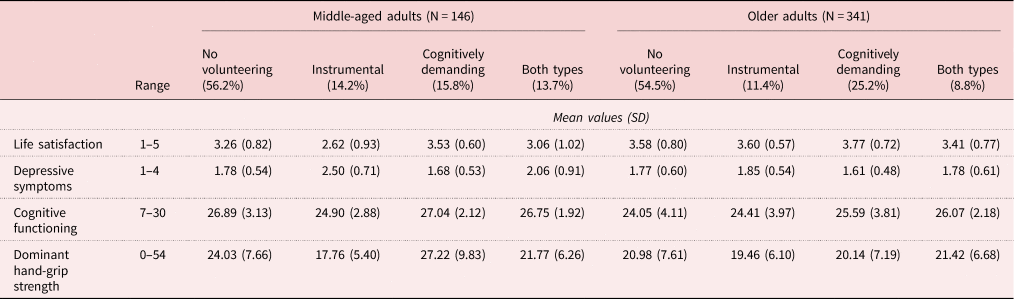
Table 1 presents the means and SDs of the four health outcomes by age and volunteering groups. To examine the effects of volunteering type and age on health outcomes, robust ANOVAs were conducted, with four volunteering groups (no volunteering versus instrumental volunteering versus cognitively demanding volunteering versus both types of volunteering activities) and age group (middle-age versus older adults) as independent variables, and regression residuals of each health outcome as dependent variables after controlling for gender, recruitment method and education. Results showed significant main effects of volunteering type on life satisfaction (Q = 21.76, p = 0.001) and depressive symptoms (Q = 14.66, p = 0.006), but not on cognitive functioning and hand-grip strength (see Table 2). Significant main effects of age group were also found on all health outcomes (all p < 0.05), except cognitive functioning (Q = 0.12, p = 0.73). Significant and marginally significant interaction effects of volunteering type and age group were found on life satisfaction (Q = 10.52, p = 0.03) and depressive symptoms (Q = 7.41, p = 0.08), respectively.
The means and standard deviations (SD) of health outcomes by age group and volunteering type

Results of robust two-way analyses of variance (ANOVAs)

Notes: Test statistics Q and p-values were obtained by the t2way function in the WRS2 package (Mair and Wilcox, Reference Mair and Wilcox2020) in R, with 20 per cent trimmed means and 20 per cent winsorised variances. Since the robust ANOVA uses adjusted critical values, the t2way routine does not report degrees of freedom (Wilcox, Reference Wilcox2017; Mair and Wilcox, Reference Mair and Wilcox2020).
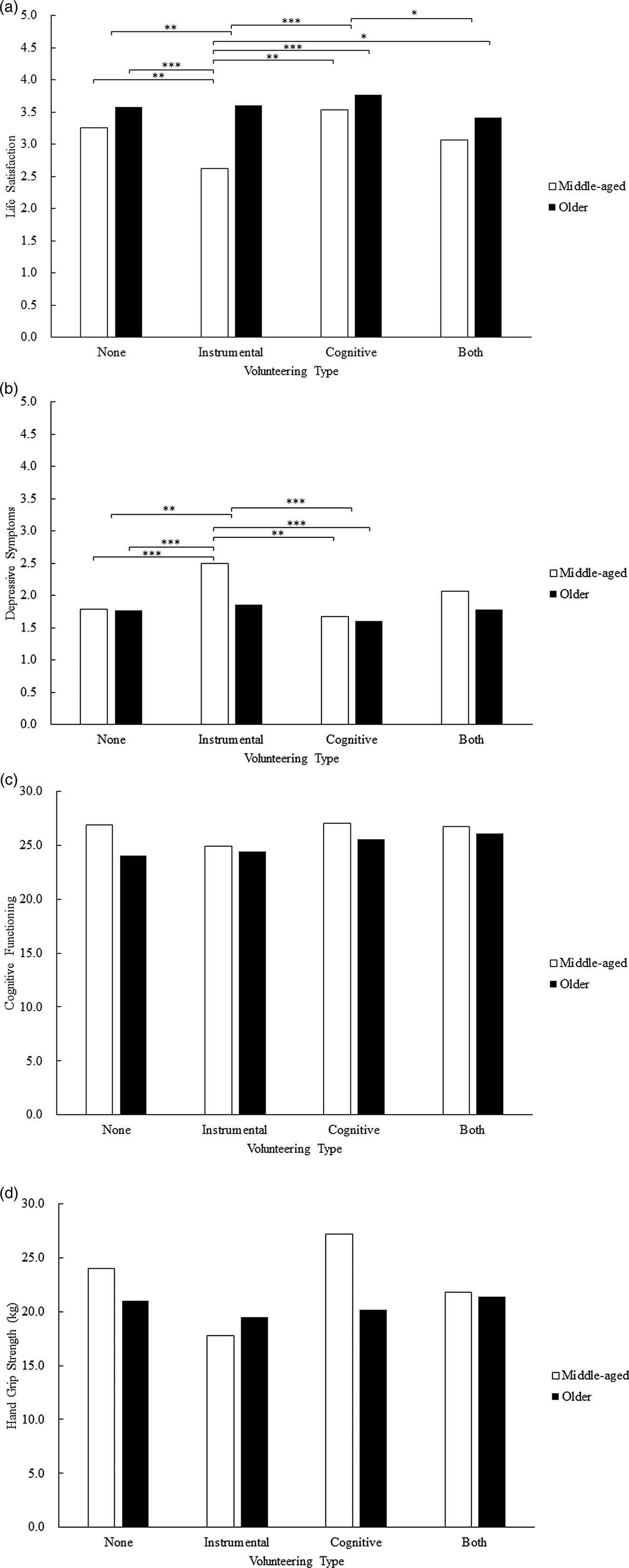
Post-hoc comparisons using the mcp2atm function were conducted to examine the effects of volunteering type on life satisfaction and depressive symptoms (H1). Figure 1 illustrates the differences in the four health outcomes across the volunteering types and age groups. The results indicate that individuals who had only engaged in cognitively demanding volunteering had higher life satisfaction than those engaged in instrumental volunteering (φ̂ = 1.13, p < 0.001) and both types (φ̂ = 0.66, p = 0.03). On the other hand, those who had only engaged in instrumental volunteering showed lower life satisfaction than those who did not volunteer at all (φ̂ = −0.81, p = 0.003) (Figure 1a). Similarly, individuals engaged in instrumental volunteering had more depressive symptoms compared to those engaged in cognitively demanding volunteering (φ̂ = 0.88, p < 0.001) and those who did not volunteer at all (φ̂ = 0.66, p = 0.005) (Figure 1b). These results suggested a positive effect of cognitively demanding volunteering and a negative effect of engaging in only instrumental volunteering, thus partially supporting H1.
The mean scores of (a) life satisfaction, (b) depressive symptoms, (c) cognitive functioning and (d) dominant hand-grip strength across the four volunteering types and two age groups. (a) Significant difference between each pair of groups was revealed from the robust two-way between-subject analyses of variance (ANOVAs) with residuals of life satisfaction as a dependent variable after controlling gender, recruitment method and education. (b) Significant difference between each pair of groups was revealed from the robust two-way between-subject ANOVAs with residuals of depressive symptoms as a dependent variable after controlling gender, recruitment method and education. kg: kilogram.
Significance levels: * p < 0.05, ** p < 0.01, *** p < 0.001.

Consistent with findings in the literature (Bohannon et al., Reference Bohannon, Peolsson, Massy-Westropp, Desrosiers and Bear-Lehman2006; Nilsson et al., Reference Nilsson, Leppert, Simonsson and Starrin2010), older adults in general showed higher life satisfaction (φ̂ = 1.43, p < 0.001), fewer depressive symptoms (φ̂ = −1.08, p = 0.002) and weaker hand-grip strength (φ̂ = −4.99, p = 0.04) than middle-aged adults.
Regarding the interaction effect between volunteering type and age group on life satisfaction, post-hoc tests revealed that there were significant age group differences in the effect discrepancies between instrumental volunteering and cognitively demanding volunteering (φ̂ = 0.78, p = 0.005), as well as between instrumental volunteering and no volunteering (φ̂ = 0.73, p = 0.007). Specifically, among the middle-aged volunteers, individuals who engaged in instrumental volunteering had lower life satisfaction than those who engaged in cognitively demanding volunteering and those who did not volunteer at all. However, such a pattern of differential health effects of volunteering types was not found in older volunteers (Figure 1a).
Similarly, significant age group differences in the effect discrepancies between instrumental volunteering and cognitively demanding volunteering (φ̂ = 0.52, p = 0.03), as well as between instrumental volunteering and no volunteering (φ̂ = 0.58, p = 0.01), were found on depressive symptoms. In particular, among the middle-aged volunteers, individuals who engaged in instrumental volunteering had more depressive symptoms than those engaged in cognitively demanding volunteering and those who did not volunteer at all. However, such a pattern was not found in older volunteers (Figure 1b). Thus, a negative effect of instrumental volunteering for middle-aged adults was suggested, and H2 was partially supported.
Discussion
The benefits of different types of volunteering are rarely examined and demands further investigation to understand the distinct effects of different volunteering activities on middle-aged and older adults. To explore the effects of different types of volunteering and its interaction effect with age, the present study examined and compared the health benefits of instrumental volunteering and cognitively demanding volunteering among middle-aged and older adults. The key findings of the study demonstrated that regardless of age, participating in cognitively demanding volunteering was associated with higher life satisfaction compared to the other three volunteering groups, and fewer depressive symptoms compared to those participating in instrumental volunteering. On the other hand, volunteering in instrumental activities was associated with lower life satisfaction and more depressive symptoms compared to those who participated in cognitively demanding volunteering, and those who did not volunteer at all. Hence, the findings of this study suggested a health-promoting effect of cognitively demanding volunteering and a health-damaging effect of instrumental volunteering on psychological wellbeing, thus H1 was partially supported. As evidenced with the present findings, age plays a moderating role in the relationship between instrumental volunteering and psychological wellbeing. Instrumental volunteering may have a detrimental effect that lowers life satisfaction and inflicts more depressive symptoms among middle-aged volunteers but not among older volunteers. Comparatively, no significant differences in psychological wellbeing were seen between middle-aged and older adults who participated in cognitively demanding volunteering, suggesting cognitively demanding volunteering to be beneficial to both age groups. Hence, H2 was partially supported. These findings contribute to the existing literature by disclosing the differential health benefits of various types of volunteering activities and providing implications for middle-aged adults to engage more in cognitively demanding volunteering.
Benefits of cognitively demanding volunteering
The beneficial effects of cognitively demanding volunteering support past evidence that indicate volunteering in activities requiring higher cognitive skill levels or in managerial and committee roles provide greater health benefits compared to their counterparts volunteering in other relatively physically laborious roles (e.g. Potter et al., Reference Potter, Helms and Plassman2008; Windsor et al., Reference Windsor, Anstey and Rodgers2008). Volunteering work that requires higher cognitive skill may have effectively enhanced psychological wellbeing through developing a sense of capability or from the rewards of contributing to society (Awan and Sitwat, Reference Awan and Sitwat2014).
Contradictory to previous studies (e.g. Li and Ferraro, Reference Li and Ferraro2006; Kim and Pai, Reference Kim and Pai2009; Huang, Reference Huang2019), the benefits of participating in only cognitively demanding volunteering between middle-aged and older adults did not show a substantial difference. Previous studies that indicated an age difference between the benefits of volunteering may be due to their differences in volunteering goals (Barlow and Hainsworth, Reference Barlow and Hainsworth2001). The volunteering motives of older adults are mainly to achieve emotional goals, whereas middle-aged adults aim to seek knowledge development. Since previous studies only looked at volunteering as a whole without distinguishing between instrumental and cognitively demanding volunteering activities, it is possible that cognitively demanding volunteering such as befriending, that is of higher complexity, may involve training or tasks that provide knowledge or practice for middle-aged adults, matching their volunteering goals (Hirst, Reference Hirst2001), and subsequently improving their psychological wellbeing. On the other hand, the emotional volunteering motives for older adults may be achieved regardless of the type of volunteering activity being participated in. As such, similar health benefits of engaging in cognitively demanding volunteering in middle-aged adults were observed relative to their older counterparts.
Adverse effects of instrumental volunteering
Middle-aged volunteers who participated only in instrumental volunteering reported worse psychological wellbeing than those who participated only in cognitively demanding volunteering, and even poorer psychological wellbeing than those who did not volunteer at all. Despite being a nascent finding in the current literature on volunteering, this finding is in line with the parallel literature of occupational complexities where higher physically demanding work was associated with worse health outcomes and cognitive functioning (Smyth et al., Reference Smyth, Fritsch, Cook, McClendon, Santillan and Friedland2004; Potter et al., Reference Potter, Plassman, Helms, Foster and Edwards2006, 2008; Lane et al., Reference Lane, Windsor, Andel and Luszcz2017). Interestingly, this detrimental effect was not found in older volunteers, which may be attributed to their differences in volunteering goals. The unfavourable effects for middle-aged adults participating in instrumental volunteering may be due to several reasons. Hirst (Reference Hirst2001) suggested that the benefits of volunteering are more notable in those who have had received training for the volunteer activity, or have had their volunteer contributions discussed and evaluated. Instrumental volunteering was categorised as work of low complexity mainly with things, consisting of activities such as food preparation that are easily conducted without the need of a high cognitive skill-set or practice (Fine and Cronshaw, Reference Fine and Cronshaw1999). As such, these duties are often monotonous, repetitive and may not involve considerable training or evaluation, and hence its effects on psychological wellbeing outcomes may be relatively weaker. Especially in middle-aged adults where their volunteering goals are oriented in knowledge development (Barlow and Hainsworth, Reference Barlow and Hainsworth2001), instrumental volunteering involving tasks without high complexity are therefore unable to provide substantial cognitive skill practice or any personal benefits such as knowledge gain. The unmatched expectations of having spent time in these activities but not being able to achieve their volunteering goals may have subsequently led to lower psychological wellbeing in these middle-aged adults. Volunteers who are engaged in these types of volunteering activities are also more prone to burnout and likely to obtain less satisfaction from the volunteering activity, thus resulting in lower psychological wellbeing (Yan and Tang, Reference Yan and Tang2003). However, these underlying reasons and the directionality for these detrimental effects remain to be empirically tested in future studies.
The adverse effects of instrumental volunteering among middle-aged adults is an intriguing finding and opens up a debatable discussion. While findings of this study suggest encouraging middle-aged adults to participate in cognitively demanding volunteering relative to other activites, instrumental volunteering activities often fulfil a significant societal function in the real world and cannot be simply neglected. Volunteering in general provides a large resource of human capital to many social service agencies (Chou et al., Reference Chou, Chow and Chi2003). As such, simply discouraging an entire population to commit to instrumental volunteering activities may significantly reduce human resources to perform these duties. Rather, since the benefits of volunteering may be linked to motives and goals of the volunteer and may vary with age (Barlow and Hainsworth, Reference Barlow and Hainsworth2001; Musick and Wilson, Reference Musick and Wilson2003; Ho et al., Reference Ho, You and Fung2012; Huang, Reference Huang2019), policy makers may consider developing a platform to identify the volunteering goals of different individuals and provide suitable types of volunteering activities that can match their personal expectations, as such fulfilling their volunteering motives and promoting psychological wellbeing from the volunteering activity. However, to the best of our knowledge, there is currently no study that examines the effects of volunteering under volunteer goal-matching circumstances. Therefore, future studies could explore the effects of volunteering goal matching on different types of volunteering activities to investigate the potential effectiveness of such policies.
Limitations and future directions
There are a number of limitations that should be considered when interpreting the results. Firstly, different types of volunteering activities were categorised into instrumental volunteering and cognitively demanding volunteering. However, this study did not include the extent of social interaction involved in the volunteering activities. Past studies have suggested that the beneficial effects of volunteering are attributable to the increase in social interaction during the volunteering experience (Freedman and Fried, Reference Freedman and Fried1999; Fried et al., Reference Fried, Carlson, Freedman, Frick, Glass, Hill, McGill, Rebok, Seeman, Tielsch, Wasik and Zeger2004; Glass et al., Reference Glass, Freedman, Carlson, Hill, Frick, Ialongo, McGill, Rebok, Seeman, Tielsch, Wasik, Zeger and Fried2004; Tan et al., Reference Tan, Rebok, Yu, Frangakis, Carlson, Wang, Ricks, Tanner, McGill and Fried2009). Future studies can consider incorporating the social aspect when obtaining relevant information about volunteering habits in examining the effects of different types of volunteering, and examine how different levels of social interaction during different types of volunteering may play a role in its beneficial outcomes. Secondly, factors such as volunteering frequency, hours, goals, number of roles and religious purposes were not assessed in the current study. Several studies have indicated a positive relationship between the number of volunteer hours and its associated benefits with a threshold ceiling (Thoits and Hewitt, Reference Thoits and Hewitt2001; Proulx et al., Reference Proulx, Curl and Ermer2018; Huang, Reference Huang2019), as well as a detrimental effect of too much volunteering on wellbeing (van Willigen, Reference van Willigen2000; Morrow-Howell et al., Reference Morrow-Howell, Hinterlong, Rozario and Tang2003). Volunteering goals have also been suggested to vary between individuals (Barlow and Hainsworth, Reference Barlow and Hainsworth2001; Musick and Wilson, Reference Musick and Wilson2003; Ho et al., Reference Ho, You and Fung2012; Huang, Reference Huang2019) and may influence perceived benefits of volunteering. Moreover, the number of volunteering roles and whether there was a religious motive of volunteering were also suggested to have associations with volunteering benefits (Musick and Wilson, Reference Musick and Wilson2003; Huang, Reference Huang2019). As such, the consideration of these factors would be recommended in future research in comparing the effects of different types of volunteering. Thirdly, while the volunteering types in this study were largely categorised according to the complexity of its work related to people, data and things (Fine and Cronshaw, Reference Fine and Cronshaw1999), this categorisation compiles several specific volunteering activities into two broad categories, so may lack precision in identifying the benefits of each independent type of volunteering activity. Future studies are recommended to adopt research designs such as randomised controlled trial studies to objectively examine the effects of different types of volunteering activity on health outcomes. Furthermore, some activities may overarch between the two categories of volunteering identified in the present 2005 study, such as clerical work. Although additional analyses of different groupings did not reveal substantial changes to the result patterns reported above, future research is recommended to validate this categorisation framework using both quantitative and qualitative measures. Lastly, it is important to note that the findings were drawn from a cross-sectional study and no longitudinal effects can be identified. Future research can consider utilising a longitudinal approach or an interventional approach in exploring causal relationships between types of volunteering and its associated health benefits.
Nonetheless, the present study provides valuable implications to understand the different associated health outcomes with instrumental and cognitively demanding volunteering in middle-aged and older adults. Policy makers and health professionals aiming to improve the psychological wellbeing of middle-aged adults can encourage and provide more cognitively demanding volunteering opportunities such as befriending and mentoring. Related populations can also incorporate more cognitively demanding volunteering activities in their lifestyle as a means to maintain good health and practice in achieving successful ageing.
Conclusion
This study re-examined the effects of volunteering in a sample of Chinese middle-aged and older adults. Among middle-aged adults, engagements in instrumental volunteering were associated with poorer psychological wellbeing than those who were not volunteering at all. On the other hand, engagements in cognitively demanding volunteering were found to provide greater beneficial health effects to middle-aged adults. The findings of this cross-sectional study lay a good foundation for further investigation to explore the longitudinal effects of various volunteering activities to maximise their potential health benefits on middle-aged and older adults.
Financial support
This work was supported by an internal grant of City University of Hong Kong (DYY, project number 9610403); and Public Policy Research (DYY, project number 9211234).
Conflict of interest
The authors declare no conflicts of interest.
Ethical standards
The study was approved by the Human Subjects Ethics Sub-committee of the affiliated university (reference number 3–4–201809_01).