Human communication involves linguistic knowledge (grammar, lexicon, and sound structure), as well as knowledge about the context within which it is used (what can be inferred about the speaker's intentions, etc.). This latter type of knowledge, pragmatics, has received considerable attention in studies on autism, and impairment in this domain is considered a core feature of autism spectrum disorder (ASD; see Baron-Cohen, Reference Baron-Cohen1988; Boucher, Reference Boucher2003). By contrast, formal aspects of language (those concerning sound, word, and sentence structure) have been much less investigated in ASD, especially in languages other than English. This is despite consensus among scholars regarding the existence of frequent formal language impairment in children with ASD (for overviews, see Boucher, Reference Boucher2012; Eigsti, de Marchena, Schuh, & Kelley, Reference Eigsti, de Marchena, Schuh and Kelley2011; and Groen, Zwiers, Van der Gaag, & Buitelaar, Reference Groen, Zwiers, Van der Gaag and Buitelaar2008), though rates and underlying nature of this impairment have been understudied. Recent work has brought this issue to the forefront in the context of the question of whether the language difficulties observed in some children with ASD are similar to those found in children with specific language impairment (SLI; for a review, see Williams, Botting, & Boucher, Reference Williams, Botting and Boucher2008).Footnote 1 Moreover, it has been suggested that an “inverse” production–comprehension dissociation characterizes language in children with ASD, with comprehension difficulties overshadowing production difficulties (for a review, see Boucher, Reference Boucher2012), and persistence of comprehension problems constituting a significant difference with SLI (Rutter, Mawhood, & Howlin, Reference Rutter, Mawhood, Howlin, Fletcher and Hall1992), though the validity of this characterization remains unclear (Kwok, Brown, Smyth, & Cardy, Reference Kwok, Brown, Smyth and Cardy2015). This paper aims to contribute to this inquiry with a study comparing children with ASD to children with SLI on alternative ways of forming wh-questions in French. Our goal was to determine if production and comprehension of wh-questions show the same patterns of relative avoidance/preference in production and difficulty in comprehension in these two populations.
LANGUAGE DEVELOPMENT IN ASD AND SLI
According to the International Classification of Diseases, 10th edition (ICD-10; World Health Organization, 2010), both ASD and SLI are disorders of psychological development. ASD is characterized by impaired communication and social interactions and by restricted, repetitive, and stereotyped behavior (see DSM-5; American Psychiatric Association, Reference Association2013). A large proportion of children with ASD also have intellectual deficits. Regarding language skills, there is considerable variation among children with ASD. In addition to the well-known pragmatic difficulties experienced by children with ASD, some children also experience varying degrees of semantic, morphosyntactic, and/or phonological impairment (Lord, Risi, & Pickles, Reference Lord, Risi, Pickles, Rice and Warren2004; Tager-Flusberg, Reference Tager-Flusberg2006; Wilkinson, Reference Wilkinson1998). SLI is a disorder affecting language in the absence of any primary disorder such as intellectual disability, auditory/perceptual impairment, or obvious neurological dysfunction. One language domain particularly affected in children with SLI is morphosyntax (Leonard, Reference Leonard2014). Because morphosyntax may also be impaired in children with ASD, the question arises as to the extent, the nature, and the implications of the intersection between ASD and SLI (see Bishop, Reference Bishop2010; Kjelgaard & Tager-Flusberg, Reference Kjelgaard and Tager-Flusberg2001; Tager-Flusberg, Reference Tager-Flusberg, Rice and Warren2004, Reference Tager-Flusberg2006; Tomblin, Reference Tomblin2011). ASD-SLI studies that have sought to elucidate these questions through direct, comparative investigation of these two populations are relatively few in number. These began with Bartak, Rutter, and Cox's (Reference Bartak, Rutter and Cox1975) study, and the large clinical cohort studies undertaken by Allen and Rapin (Reference Allen, Rapin, Naruse and Ornitz1992), Rapin (Reference Rapin1996), and Tuchman, Rapin, and Shinnar (Reference Tuchman, Rapin and Shinnar1991; for an overview and an integrative analysis of these, see also Rapin & Dunn, Reference Rapin and Dunn2003). These have been followed by a dozen other, smaller studies published in the last decade, which have also focused on English-speaking children (Leyfer, Tager-Flusberg, Dowd, Tomblin, & Folstein, Reference Leyfer, Tager-Flusberg, Dowd, Tomblin and Folstein2008; Lloyd, Paintin, & Botting, Reference Lloyd, Paintin and Botting2006; Loucas et al., Reference Loucas, Charman, Pickles, Simonoff, Chandler, Meldrum and Baird2008, Reference Loucas, Riches, Charman, Pickles, Simonoff, Chandler and Baird2010, Reference Loucas, Riches, Baird, Pickles, Simonoff, Chandler and Charman2013; Pickles et al., Reference Pickles, Simonoff, Conti-Ramsden, Falcaro, Simkin, Charman and Baird2009; Whitehouse, Barry, & Bishop, Reference Whitehouse, Barry and Bishop2008; Williams, Payne, & Marshall, Reference Williams, Payne and Marshall2013), with few exceptions (Demouy et al., Reference Demouy, Plaza, Xavier, Ringeval, Chetouani, Perisse and Robel2011; Durrleman & Delage, Reference Durrleman and Delage2016; Geurts & Embrechts, Reference Geurts and Embrechts2008; Zebib, Tuller, Prévost, & Morin, Reference Zebib, Tuller, Prévost, Morin, Stavrakaki, Konstantinopoulou and Lalioti2013). Ultimately, identifying the nature of language deficits that some children with ASD have could lead to the identification of specific subgroups of children with autism, which in turn would contribute to better understanding of autism and the development of appropriate care.
The principal objective of this paper is to explore aspects of structural language in children with ASD in both production and comprehension, as part of the overarching goal of documenting language profiles in these children. It has often been reported that children with ASD have higher abilities in expression than in reception (Boucher, Reference Boucher2003, Reference Boucher2012; Charman et al., Reference Charman, Baron-Cohen, Swettenham, Baird, Drew and Cox2003; Lloyd et al., Reference Lloyd, Paintin and Botting2006; Rutter et al., Reference Rutter, Mawhood, Howlin, Fletcher and Hall1992), and these reports echo observations frequently made by clinicians. In a recent review, Kwok et al. (Reference Kwok, Brown, Smyth and Cardy2015) found that the (few) studies directly comparing receptive/expressive modalities did not all show an advantage for production over reception, with some showing the opposite dissociation, and some no dissociation at all. Furthermore, their meta-analysis of 74 studies reporting on either receptive or expressive language found no evidence for a typical expression-over-reception pattern in children with ASD. This was true for studies of vocabulary, as well as for studies that included measures of global language ability. However, Kwok et al. underlined several important lacuna in the literature, concluding that the number of studies reporting measures of structural language made it impossible for them to run a separate analysis for this domain, and thus to determine whether there might be some kind of receptive–expressive dissociation for this aspect of language. One of the major conclusions for their study was the need for further exploration of grammar and syntax.
Moreover, Kwok et al. (Reference Kwok, Brown, Smyth and Cardy2015) found that the participants in the extant literature did not form a representative sample, and specifically that low-functioning children were underrepresented in studies of children after age 6, making it probable, in their view, that language abilities in school-age children and youth might be overestimated. The underlying assumption here is that it is reasonable to imagine that language should be more affected in children with ASD who have intellectual disability than in those who do not, and perhaps comprehension might be even more affected in children with this profile. If this is the case, then potential receptive–expressive language gaps may not have been adequately explored in these children. It might further be supposed that, more generally, performance on specific aspects of language could be more affected by nonverbal ability. A few studies have reported on difficulties in comprehension of particular morphosyntactic constructions, such as object relative clauses (Durrlemann & Zafferey, Reference Durrleman, Zufferey, Stavrakaki, Lalioti and Konstantinopoulou2013), accusative clitics (Terzi, Marinis, Kotsopoulou, & Konstantinos, Reference Terzi, Marinis, Kotsopoulou and Konstantinos2014), passives (Perovic, Modyanova, Hanson, Nelson, & Wexler, Reference Perovic, Modyanova, Hanson, Nelson and Wexler2007; Terzi et al., Reference Terzi, Marinis, Kotsopoulou and Konstantinos2014), and binding (Perovic, Modyanovs, & Wexler, Reference Perovic, Modyanova and Wexler2013a, Reference Perovic, Modyanova and Wexler2013b). However, these did not all include children from the entire autism spectrum (some only included high-functioning children), which suggests that the question of the relationship between nonverbal ability and language comprehension/language performance in ASD is still very much an open, empirical question.
The relationship between language skills and cognitive development in ASD has received attention in the literature. Some studies suggest that children with ASD have language skills similar to typically or atypically developing children of the same cognitive level (Howlin, Reference Howlin1984; Tager-Flusberg et al., Reference Tager-Flusberg, Calkins, Nolin, Baumberger, Anderson and Chadwick-Dias1990); others argue that linguistic deficits in children with ASD may be specific, independent of their nonverbal ability (Eigsti, Bennetto, & Dadlani, Reference Eigsti, Bennetto and Dadlani2007; Kjelgaard & Tager-Flusberg, Reference Kjelgaard and Tager-Flusberg2001; Perovic et al., Reference Perovic, Modyanova and Wexler2013b). These latter studies appear to go in the same direction as studies investigating SLI, which is, by definition, independent of nonverbal IQ, and so-called nonspecific language impairment, children with language impairment and low cognition, but no other developmental disability (see Rice, Reference Rice2016, for recent discussion). The question of a possible overlap between SLI and ASD is in this way tightly connected to the issue of whether low nonverbal IQ can be regarded as “the driver for language impairments in children” (Rice, Reference Rice2016). ASD-SLI comparative studies differ in how this question is approached. Some studies have focused on whether there are children with ASD who resemble children with SLI in having both normal nonverbal IQ and impaired structural language (Geurts & Embrechts, Reference Geurts and Embrechts2008; Leyfer et al., Reference Leyfer, Tager-Flusberg, Dowd, Tomblin and Folstein2008; Loucas et al., Reference Loucas, Charman, Pickles, Simonoff, Chandler, Meldrum and Baird2008, Reference Loucas, Riches, Charman, Pickles, Simonoff, Chandler and Baird2010, Reference Loucas, Riches, Baird, Pickles, Simonoff, Chandler and Charman2013; Riches, Loucas, Baird, Charman, & Simonoff, Reference Riches, Loucas, Baird, Charman and Simonoff2010, Reference Riches, Loucas, Baird, Charman and Simonoff2011; Whitehouse et al., Reference Whitehouse, Barry and Bishop2008; Williams, Payne, & Marshall, Reference Williams, Payne and Marshall2013). Others have sought to document language profiles in verbal children with ASD, regardless of nonverbal cognitive profiles and to explore the incidence of structural language impairment more widely (Demouy et al., Reference Demouy, Plaza, Xavier, Ringeval, Chetouani, Perisse and Robel2011; Durrleman & Delage, Reference Durrleman and Delage2016; Lloyd et al., Reference Lloyd, Paintin and Botting2006; Pickles et al., Reference Pickles, Simonoff, Conti-Ramsden, Falcaro, Simkin, Charman and Baird2009; Rapin Reference Rapin1996; Rey, Tardif, Delahaie, Thomas, & Massion, Reference Rey, Tardif, Delahaie, Thomas and Massion2001; Tuchman et al., Reference Tuchman, Rapin and Shinnar1991). We will be pursuing this second approach, bearing in mind, however, the possible influence of nonverbal ability, which will be directly addressed, as will the question of how ASD language profiles might best be explored.
SYNTACTIC COMPLEXITY AND LANGUAGE DEVELOPMENT: WH-QUESTIONS IN FRENCH
In this paper, we address the question of the nature of structural language impairment, and, more specifically, of the reported receptive disadvantage in verbal children with ASD, by focusing on the complexity of syntactic computation in children with ASD. Recent research shows that both typical and atypical language development is constrained by computational complexity, with more complex constructions emerging later than constructions involving less complexity (Chillier et al., Reference Chillier, Arabatzi, Baranzini, Cronel-Ohayon, Deonna, Dubé and Zesiger2001; Friedmann, Belletti, & Rizzi, Reference Friedmann, Belletti and Rizzi2009; Hamman, Tuller, Monjauze, Delage, & Henry, Reference Hamann, Tuller, Monjauze, Delage, Henry, Caunt-Nulton, Kulatilake and Woo2007; Jakubowicz & Nash, Reference Jakubowicz and Nash2001; van der Lely, Reference van der Lely2005). Among proposals that have aimed at characterizing particular aspects of complexity, Jakubowicz's (Reference Jakubowicz2011) computational complexity hypothesis postulated that accumulation of the operations involved in linguistic computation, in particular internal merge and external merge, is quite challenging for young children and individuals with language pathology. We focus in this study on this specific aspect of computational complexity. Children may in effect avoid a complex structure by producing an alternative sentence involving fewer operations, or by adopting compensatory strategies, such as omission or substitution, which reduce the computational complexity of a derivation. Computational complexity may also impact on comprehension. A clear example is that of object relative clauses, which have been argued to involve a high degree of complexity, and are exceedingly difficult for young children and for children with SLI, yielding subject relative interpretations, in comprehension, and, in production, alternative structures that are simpler, though sometimes inappropriate or ungrammatical (Friedmann et al., Reference Friedmann, Belletti and Rizzi2009).
Wh-questions are a particularly useful area of French syntax for assessing computational complexity and its impact on language development, in that several grammatical constructions varying in complexity are available, from wh–in situ to wh-fronting with V-to-I movement followed by I-to-C movement (which we refer to by the traditional term subject/verb inversion), some of which are illustrated in (1), where wh-constructions are listed according to increasing complexity, and which are all ways of asking a question about the object of the verb push.Footnote 2
-
(1)


In (1a), the object wh-word qui “who” follows the verb pousses “push,” the so-called in situ position. This matches the canonical verb–object order in French. In contrast, the sentences in (1b)–(1e) all display the object wh-word qui in a preverbal position, which renders them more complex than the wh–in situ strategy in (1a). Specifically, it is assumed that the wh-word moves from its base-generated postverbal position via internal merge to a higher position in the structure of the sentence (Chomsky, Reference Chomsky1995).Footnote 3 A dependency relation is therefore established between the wh-word and its base-generated position, and it is precisely this kind of relationship that children with SLI are assumed to have difficulties with (see, e.g., van der Lely, Reference van der Lely2005). Under this assumption, wh-questions with wh-fronting and subject/verb inversion (which involves a subject clitic), as in (1f), or wh-fronting and stylistic inversion (which involves a full lexical subject DP), as in (1g), represent the most complex types since they involve two internal merge operations: that of the wh-word to the front of the sentence as well as that involved in the noncanonical order of the verb with respect to its subject: I-to-C in the case of subject/verb inversion and overt movement of the subject to a position higher than SpecVP in the case of stylistic inversion (see Kayne & Pollock, Reference Kayne, Pollock, Hulk and Pollock2001). In these sentences, two dependency relationships must be established, which is particularly difficult for children with SLI (see van der Lely, Reference van der Lely2005). As to (1b) and (1c), both involve wh-fronting, but (1c) is more complex than (1b) since it also includes external merge of a question marker est-ce que (ESK; also part of the derivation of (1g)). Jakubowicz (Reference Jakubowicz2011) argued that clefts ((1d)–(1e)) are more complex, as they entail both external merge (of the wh-word in the matrix clause) and internal merge (of an empty operator, identified by the overt wh-word). Firthermore, (1e) includes a cleft construction and movement of the clefted wh-word, which makes it more complex than (1d).
Some of the interrogative strategies, wh–in situ, plain wh-fronting, and wh-fronting with ESK, are very frequent in spoken French, while wh-fronting with subject/verb inversion is much rarer (see Coveney, Reference Coveney1996; Quillard, Reference Quillard2000, for some quantitative findings), but not altogether absent from the input received by children (see Prévost, Tuller, Galloux, & Barthez, in press). In particular, it is part of high-frequency fixed expressions (e.g., Que veux-tu? “What do you want?”) and can be found in literature for children. It is also associated with a more formal register, in contrast to the other strategies that are more neutral (although they can occur in formal contexts; see Coveney, Reference Coveney1996; Quillard, Reference Quillard2000).
Several studies on the development of wh-questions in French by typically developing (TD) children and children and adolescents with SLI (aged 3 years, 10 months [3;10] to 14;0) have shown that wh–in situ is largely favored in the earliest stages of acquisition, be it in spontaneous production or elicited production. In contrast, wh-fronting with subject/verb inversion is extremely rare in the production data of young children and children with SLI (for typical development, see Hamann, Reference Hamann2006; Hulk, Reference Hulk, Jordens and Lalleman1996; Hulk & Zuckerman, Reference Hulk, Zuckerman, Howell, Fish and Keith-Lucas2000; Plunkett, Reference Plunkett, Greenhill, Littlefield and Tano1999; Strik, Reference Strik2007; for SLI, see Hamann, Reference Hamann2006; Jakubowicz, Reference Jakubowicz2011).
Studies on the comprehension of wh-questions in French are quite rare, and their objective has not been to compare performance across wh-strategies. For instance, Plunkett (Reference Plunkett, Guijarro-Fuentes and Dominguez2010) looked at object versus subject wh-questions and showed, in different experiments, that object wh-questions with wh–in situ and with wh-fronting + ESK were well understood. In patients suffering from agrammatic aphasia, however, van der Meulen (Reference van der Meulen2004) showed that object questions with wh–in situ were significantly better understood than questions involving wh-fronting. Studies looking at both production and comprehension of other complex structures in French have generally reported low rates of production despite good comprehension, including in children with SLI. Such is the case of object clitics, which appear in a (noncanonical) preverbal position in French (e.g., Pierre la pousse “Peter her pushes”; Grüter, Reference Grüter2005; Jakubowicz, Nash, Rigaut, & Giraud, Reference Jakubowicz, Nash, Rigaut and Giraud1998; see Jakubowicz & Tuller, Reference Jakubowicz, Tuller and Ayoun2008, for review of other such cases).
Some studies suggest that complex sentences are problematic for children with ASD. For instance, Condouris, Meyer, and Tager-Flusberg (Reference Condouris, Meyer and Tager-Flusberg2003) found that interrogatives are affected in autism. In an analysis of spontaneous speech of 44 individuals with ASD (mean age = 7;3 and normal and impaired nonverbal IQ), they found low scores on the question/negation subscale of the Index of Productive Syntax, a measure assessing the child's emergent use of particular structures (Scarborough, Reference Scarborough1990). Durrleman and Zufferey (Reference Durrleman and Zufferey2009), analyzing production data from two high-functioning children with ASD (aged 3;9 and 5;8), argue that complex structures are affected by truncation, namely, the top layers of the structural representations are not systematically projected (Rizzi, Reference Rizzi, Friedemann and Rizzi2000). In a study specifically investigating the effect of complexity in language performance, Riches et al. (Reference Riches, Loucas, Baird, Charman and Simonoff2010) reported that both high-functioning adolescents with ASD and language impairment (mean age = 14;8, n = 16) and adolescents with SLI (mean age = 15;3, n = 14) were affected by complexity, but more so in the latter. Although individuals with ASD and individuals with SLI tended to make more errors than age-matched TD adolescents in the production of subject and object relative clauses, individuals with SLI struggled even more than individuals with ASD on object relative clauses (deemed to be more complex).
Our goal in the study presented here was to explore the issue of ASD-SLI similarities/differences by focusing on a comparison of production and comprehension of structures involving varying degrees of computational complexity. We sought to provide concrete answers to the following specific questions:
-
(2)
-
a. Do children with ASD resemble children with SLI in avoiding complex strategies when they produce wh-questions? Are favored wh-strategies and error types similar or different in the two groups?
-
b. Are children with ASD sensitive to complexity in their comprehension of wh-questions like children with SLI are? Are the same types of questions difficult/easy to understand in the two groups?
-
c. Does the nonverbal ability of children with ASD correlate with their performance on the production and/or comprehension of wh-questions, with lower levels corresponding to greater difficulty with complex wh-questions?
-
GENERAL METHOD
Participants
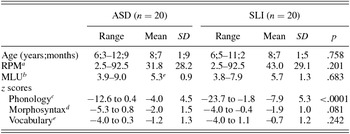
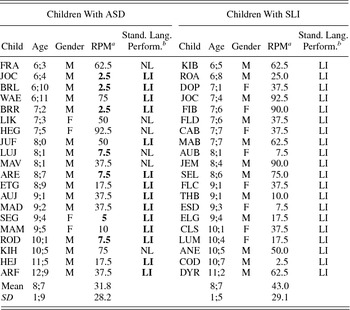
Twenty verbal children with ASD aged 6;3 to 12;9 (M = 8;7, SD = 1;9) and 20 age-matched children with SLI (range = 6;5–11;2, M = 8;7, SD = 1;8) were recruited from medical records of specialized sections of French hospitals for this study (see Appendix A for a detailed presentation of these two groups, and Table 1 below for a summary). All children with ASD had been diagnosed according to ICD-10 criteria via the Autism Diagnosis Interview—Revised (Lord, Rutter, & Le Couteur, Reference Lord, Rutter and Le Couteur1994) and confirmed by the Autism Diagnostic Observation Schedule, module 2 or 3 (Lord, Rutter, DiLavore, & Risi, Reference Lord, Rutter, DiLavore and Risi1989).Footnote 4 This group was composed of 4 girls and 16 boys. Although all the children had language (children who did not produce three-word utterances regularly were excluded), they differed in terms of verbal and nonverbal ability, as shown in the Appendix A.Footnote 5 Available nonverbal IQ scores, which came from different tests administered at time intervals ranging from a few months to several years prior to testing time, varied from 48 to 108. In order to have comparable nonverbal scores, Raven's Coloured Progressive Matrices (RPM; Raven, Court, & Raven, Reference Raven, Court and Raven1986) was administered to all children. Seven of the 20 children with ASD (6 boys, 1 girl) had scores below the ninth percentile, which corresponds to a standard score of 80, and were therefore considered low functioning (LF). These 7 children were aged 6;4 to 10;2 (M = 8;1, SD = 1;5), compared to an age range of 6;3 to 12;9 (M = 8;10, SD = 1;10) for the 13 other children, who were high functioning (HF).Footnote 6
Characteristics of the participants in the ASD and SLI groups and ASD-SLI comparisons (Mann–Whitney tests)

Note: ASD, autism spectrum disorder; SLI, specific language impairment; RPM, Raven's Progressive Matrices; MLU, mean length of utterance.
a Percentile ranges were converted into midpoint percentiles (e.g., 5th to 10th percentile was transformed into percentile 7.5), as suggested by Botting and Conti-Ramsden (Reference Botting, Conti-Ramsden, Verhoeven and van Balkom2008).
b Based on 16 children with ASD and on 17 children with SLI.
c (Real) word repetition subtest from Bilan informatisé de langage oral au Cycle III et au collège (Khomsi et al., Reference Khomsi, Khomsi, Parbeau-Guéno and Pasquet2007).
d Sentence completion subtest from Bilan informatisé de langage oral au Cycle III et au collège.
e Receptive vocabulary from Batterie d’évaluation du langage oral de l'enfant aphasique (De Agostini et al., Reference De Agostini, Metz-Lutz, Van Hout, Chavance, Deloche, Pavao-Martins and Dellatolas1998).
Performance on standardized tests assessing phonology (real-word repetition from Bilan informatisé de langage oral au Cycle III et au collège; Khomsi, Khomsi, Parbeau-Guéno, & Pasquet, Reference Khomsi, Khomsi, Parbeau-Guéno and Pasquet2007), morphosyntax (sentence completion from Bilan informatisé de langage oral au Cycle III et au collège), and receptive vocabulary (Batterie d’évaluation du langage oral de l'enfant aphasique; De Agostini et al., Reference De Agostini, Metz-Lutz, Van Hout, Chavance, Deloche, Pavao-Martins and Dellatolas1998) showed that 6 children with ASD did not display severe language impairment (set at the –1.65 SD threshold, a cutoff often used in clinical settings in France; Ramus et al., Reference Ramus, Rosen, Dakin, Day, Castellote, White and Frith2003) in any of the three domains tested. This included 5 HF children and 1 LF child (see Appendix A). Low scores were obtained by the rest of the children. In particular, 10 of the 20 children had severe difficulties in both morphosyntax and phonology, while 4 had severe difficulties in one and moderate or no difficulties in the other. (See Tuller et al., Reference Tuller, Ferré, Prévost, Barthez, Malvy, Bonnet-Brilhault and Naigle2017, for discussion of phonological impairment in ASD, its incidence, and its nature.)
Crossing performance on nonverbal and verbal standardized tests identified children in each of the logically possible profiles: (a) children with HF autism and normal language abilities (n = 5), (b) children with HF autism and language impairment (n = 8), (c) children with LF autism and normal language abilities (n = 1), and (d) children with LF autism and language impairment (n = 6).Footnote 7
However, no significant correlations were found between nonverbal and verbal performance in the ASD group (receptive vocabulary: rs = .171, p = .485, df = 17; morphosyntax: r s = .273, p = .243, df = 18; phonology: r s = .397, p = .083, df = 18). Throughout this paper, we will report on the performances of the ASD group as a whole, but also of particular subgroups.
The children with SLI were recruited from neuropediatric units of university teaching hospitals in France. They all had had a conventional diagnosis based on severely impaired language performance on standardized language batteries commonly used by speech and language therapists in this country, in conjunction with usual exclusionary criteria, including intellectual disability (as measured by the Wechsler Intelligence Scale for Children [performance IQ < 80], or an equivalent evaluation). The SLI group was composed of 12 boys and 8 girls (see Table 1 and Appendix A for details).
The children with SLI were administered the same standardized language tests as the children with ASD, as well as RPM. All RPM scores were within norms, except in three cases (see Appendix A). It was decided to nonetheless keep these children in the SLI group as they had obtained normal nonverbal ability scores during clinical assessment. With respect to language, all children with SLI were severely impaired in at least morphosyntax or phonology, with 12 of 20 having severe difficulties in both domains. In contrast, only 2 children had z scores below norms in receptive vocabulary. This pattern of results, that is, mean z scores well below norms on phonology and morphosyntax, and only moderate difficulties in vocabulary, was similar to that observed in the ASD group.Footnote 8 Mann–Whitney tests showed no significant difference between the ASD group and the SLI group on receptive vocabulary, U (38) = 156, p = .242, and morphosyntax, U (39) = 135, p = .081.Footnote 9 Regarding phonology, the children with SLI performed significantly worse than the children with ASD, U (39) = 75, p < .001, r = –.535, though strong correlations arose between phonology and morphosyntax in both groups of children (ASD: r s = .560, p = .012, df = 18; SLI: r s = .731, p < .0001, df = 18). The same tendencies were found when comparing the subgroup of 8 children with high-functioning autism and language impairment (the HFA-LI subgroup) to a subgroup of 8 children with SLI matched on nonverbal ability and age.
Finally, our study involved two control groups of TD children, one comprising 17 4-year-olds (M = 4;3, SD = 0;2), approximate language controls for the SLI group, and the other 12 6-year-olds (M = 6;5, SD = 0;2), who were the same age as the youngest children in the SLI and ASD groups.
Procedure
Written consent was obtained from the parents of the children who participated in the study. Testing was organized individually and took place in a quiet room. The experimental protocol contained standardized measures of language (as seen above), nonverbal ability (via RPMs), and memory abilities (via forward digit span and backward digit span, which will not be reported on here). Experimental tasks included a task of elicited production of clitic pronouns (reported elsewhere) and two tasks focusing on wh-questions: a production task and a comprehension task (see below). The protocol, whose total duration was about 2 hr, was divided into two 1-hr sessions. As the tasks targeting production and comprehension of wh-questions were relatively long (see below), they were each divided into two equal parts, which were randomly assigned to the first or second testing session (with the production part always preceding the comprehension part). For the ASD group, the number of testing sessions varied from one child to another, due to behavior issues.
EXPERIMENT 1: ELICITED PRODUCTION OF WH-QUESTIONS
Method
In the wh-question production task (Jakubowicz, Reference Jakubowicz2005, an adaptation of an experiment created by Naama Friedmann), the examiner showed the child a picture containing a character performing an action and a hidden part, as illustrated by Figure 1a. The child was then told to ask the character a question about the hidden part (e.g., “Look, here the rabbit is pushing someone, but we can't see who. To know who the rabbit is pushing, ask him”). Following the child's response, the hidden part was then revealed, as shown in Figure 1b.
Sequence of pictures for an item eliciting production of an (animate) object wh-question.

Different types of questions were elicited in this task, which were presented in (pseudo)randomized order: subject (n = 12), object (n = 24; 12 animate and 12 inanimate), and adjunct questions (with comment “how,” où “where,” and pourquoi “why”; n = 18), for a total of 54 items. The task contained 5 training items, which followed the same format as the test items. Note that after the 5 training items and the first 4 test items, the stimulus only included a description of the picture (e.g., “Here, the rabbit is pushing someone but we can't see who”) followed by “Ask him/her.” In other words, it stopped including an embedded question (e.g., “To know who the rabbit is pushing”), making the stimulus less complex.
In this probe, each interrogative strategy illustrated in (1) used by the children was analyzed (wh–in situ, plain wh-fronting, wh-fronting + est-ce que, or wh-fronting + subject/verb inversion) in order to determine whether the children tended to avoid constructions involving more complex computation.
Results
General success on the task, that is, the number of wh-questions produced by each child that were appropriate in that they consisted of a wh-question of the type elicited, provided a base measure upon which use of particular wh-strategies was explored. We also compared error typologies in the wh-questions produced by the children.
Appropriate responses and wh-strategies
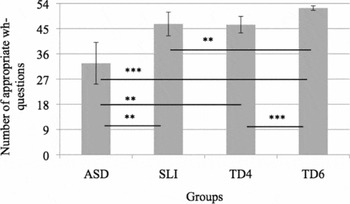
Figure 2 presents the results concerning the number of appropriate responses produced by the different groups of children (/54). The difference between the four groups was significant, χ2 (3, N = 69) = 25.830, p < .0001. The children with ASD produced significantly fewer appropriate questions than the children with SLI (ASD: M = 32.7, SD = 14.9 vs. SLI: M = 46.7, SD = 6.0); U (39) = 87.5, p = .002, r = –.482, the TD4 children (M = 46.4, SD = 5.9); U (36) = 78.5, p = .005, r = –.459, and the TD6 children (M = 52.3, SD = 1.6); U (31) = 17.5, p < .0001, r = –.708. In particular, 8 children with ASD (out of 20) produced fewer than 27 expected wh-questions (less than 50%), compared to 1 child with SLI. The ASD/SLI difference held when the subgroup of 8 children with HFA and LI was compared to an RPM- and age-matched subgroup of children with SLI, U (15) = 2, p = .002, r = –.788. More generally, there was no significant correlation between the number of appropriate wh-questions produced and nonverbal ability in the ASD group (r s = .111, p = .643, df = 19).
Elicited production of wh-questions: number of appropriate wh-questions (/54). *p < .01, **p < .001.

This difference between the children with ASD and the children with SLI can be attributed, we argue, to the well-known pragmatic deficit associated with ASD. Specifically, the children with ASD may have had difficulties with the pragmatics of a task requiring them to address a character in a picture on a computer screen. One child explicitly asked if we wanted him to talk to the computer, for example. Instead of wh-questions, they used yes/no questions, or they tried to guess the answer to the question they were being asked to formulate (see Sukenik, Friedmann, Tuller, & Morin, Reference Sukenik, Friedmann, Tuller and Morin2015).
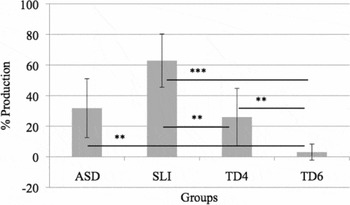
When appropriate wh-questions were produced, we sought to determine, first of all, if children with ASD avoided complex wh-strategies, in the same way as children with SLI. We begin with the wh–in situ strategy (e.g., Tu pousses quoi? “You push what?”), a strategy that entails avoidance of wh-movement. Figure 3 displays the rate of wh–in situ found in the appropriate wh-questions produced by the different groups. Note that the calculations did not include subject wh-questions (to which we return below) as these include structures that are ambiguous between wh–in situ and wh-fronting, since the subject position is sentence initial in French, the same linear position as that of wh-fronted constituents (e.g., Qui te pousse? “Who pushes you?”), and wh-questions with pourquoi “why” since it has been argued that pourquoi is base generated in the fronted position (and thus not subject to overt wh-movement; Rizzi, Reference Rizzi1990).
Elicited production of wh-questions: percentage of questions with wh–in situ. *p < .01, **p < .001.

The difference across groups was significant, χ2 (3, N = 69) = 23.312, p < .0001. As can be seen in Figure 3, the children with ASD, like the children with SLI, used wh-in situ, the least complex strategy, more frequently than the TD 6-year-olds. Wh–in situ was found in 31.8% (SD = 38.5) of the appropriate questions produced by the ASD group and in 62.8% (SD = 34.8) of those produced by the SLI group, compared to 3% (SD = 10.5) in the TD6 group. The differences between the TD 6-year-olds and the children with ASD and SLI were significant, ASD/TD6: U (31) = 51.5, p = .003, r = –.520; SLI/TD6: U (31) = 11.5, p < .0001, r = –.767. This suggests that, like the children with SLI, many children with ASD avoided constructions that entail complex syntactic computation. Although the children with SLI used wh–in situ questions more frequently than the children with ASD, the difference between the two groups was not significant, after corrections for multiple comparisons were applied, U (39) = 114.5, p = .02, r = –.367. The children with ASD seemed to behave similarly to the TD4 group, who produced 25.9% (SD = 37.5) of questions with wh–in situ; the difference between the two groups was not statistically significant, U (36) = 149.5, p = .520. In contrast, the children with SLI seemed to avoid constructions that entail complex syntactic computation even more often than the TD4 group, U (36) = 72, p = .003, r = –.493. These tendencies were maintained when comparing the performance of children of the HFA-LI subgroup (M = 36.9%, SD = 42.8) to that of the matched children with SLI (M = 66.9%, SD = 37.4), although the difference was not statistically significant, presumably due to the small size of the samples, U (15) = 22, p = .293. It is also worth mentioning that no significant correlations were found between nonverbal ability and percentage of questions with wh–in situ in the ASD group (r s = .256, p = .276, df = 19). Finally, since the wh-questions investigated in the comprehension probe all targeted animate objects, we also looked at the rate of wh–in situ in qui “who” object questions produced by the children (e.g., Il pousse qui? “He pushes who?”). The same tendencies reported above were observed.
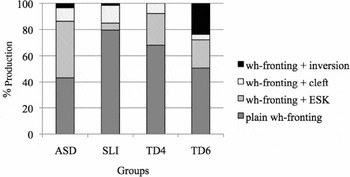
Another way of determining whether the children with ASD resembled the children with SLI in avoiding complex wh- production strategies was to see if they avoided the most complex of the fronting strategies in questions produced with wh-fronting, that involving wh-fronting and subject/verb inversion. This was the case, as is seen in Figure 4, which displays the incidence of the different wh-fronting strategies with respect to the total of questions produced with wh-fronting (excluding subject questions, since these may be produced with structures that are ambiguous as to whether wh-fronting has occurred or not, and why-questions, because why occurs only clause initially). Significant differences were found across groups, χ2 (3, N = 69) = 28.055, p < .0001. Both groups of atypically developing children produced significantly fewer questions with wh-fronting + subject/verb inversion (e.g., Qui pousses-tu? “Who do you push?”) than the TD 6-year-olds. Subject/verb inversion was found in 2.4% of all wh-fronted questions produced by the children with ASD (SD = 10.8) and in 1.1% (SD = 3.4) of those produced by the children with SLI, compared with 22.2% (SD = 27.5) in the TD6 group, ASD/TD6: U (31) = 49, p < .0001, r = –.616; SLI/TD6: U (31) = 48, p = .001, r = –.603. Very few children in the ASD and SLI groups produced wh-questions with subject/verb inversion, including 1 child with ASD (a high-functioning child with no language impairment) and 2 children with SLI, versus 8 (out of 12) in the TD6 group. The children with ASD and those with SLI were more comparable to the TD 4-year-olds, who did not produce any questions with subject/verb inversion at all. No significant differences were found between the ASD and SLI groups, U (39) = 191, p = .594.
Elicited production of wh-questions: types of nonsubject wh-fronting strategies used by the four groups.

The children in the ASD and SLI groups not only avoided the most complex fronting strategy but also mainly used the least complex strategy, plain wh-fronting (e.g., Où tu caches les bonbons? “Where you hide the candy?”), as did the TD children. The difference across groups was significant, χ2 (3, N = 69) = 11.1, p = .011, which was due to a difference between the SLI and TD6 groups, U (31) = 27.5, p < .0001, r = –.642. The rate of plain wh-fronting in the ASD group did not differ significantly from that of the TD groups, ASD/TD4: U (36) = 92.5, p = .092; ASD/TD6: U (31) = 90, p = .616. However, the children with ASD produced less plain wh-fronting (M = 58.6%, SD = 39.7) than the SLI group (M = 87.6%, SD = 15.5), although the difference was not significant, U (39) = 132, p = .068. Whereas the children with SLI used plain wh-fronting far more frequently than any other fronting strategy, the children with ASD produced wh-questions with ESK (e.g., Comment est-ce que tu mélanges la pâte? “How ESK you mix the batter?”) relatively often (M = 31.2%, SD = 37.5), and to a significantly larger extent than the children with SLI (M = 4%, SD = 8.9), U (39) = 110, p = .006, r = –.435. In this respect, the children with ASD behaved similarly to the TD 4-year-olds (M = 19.8%, SD = 22.2); U (36) = 151.5, p = .560, and the TD 6-year-olds (M = 18.5%, SD = 14.3); U (31) = 116, p = .874. In contrast, the differences between the children with SLI and the TD children on use of ESK were significant, SLI/TD4: U (36) = 97, p = .011, r = –.419; SLI/TD6: U (31) = 44.5, p = .001, r = –.573.
The children with ASD, then, did not seem to favor exactly the same strategies as the children with SLI. This apparent difference is due to their high use of the ESK strategy. The status of this strategy for many of the questions produced by the children with ASD, however, may have been the result of adoption of a single, rigid wh-strategy, applied over and over again. Out of the 12 children with ASD who produced ESK questions, 7 of these children did so in over 50% of their questions with wh-fronting, and only in a fixed form qu'est-ce que “what+ESK,” which they generalized to all of their wh-questions. For example, AUJ (age 9;2) used qu'est-ce que in all of his wh-questions, except for 4, without distinguishing between different wh-words, as shown in (3). In some cases, the wh-questions that he produced were (fortuitously) appropriate (10/50 questions produced with qu'est-ce que), as in (3a), but most of the time (37/50) they were not, as in (3b). With adjunct questions, use of qu'est-ce que was both inappropriate and ungrammatical, as in (3c).
-
(3)

It would seem therefore plausible that for at least some of the children with ASD qu'est-ce que was used as a kind of unanalyzed wh-form and thus that their ESK questions did not constitute evidence for greater complexity than that involved in wh-questions with plain wh-fronting. The high rate of ESK is furthermore likely to be a reflection of perseveration, which was observed for several of the children with ASD in this task (see Sukenik et al., Reference Sukenik, Friedmann, Tuller and Morin2015). We also note that perseveration of “qu'est-ce que,” which involves wh-fronting, had a mechanical consequence on the lower rate of wh–in situ in the ASD group when compared to the SLI group (see above).
Finally, production of clefted wh-questions (e.g., C'est qui que tu pousses? “It is who that you push?”) did not yield any significant difference across groups, χ2 (3, N = 69) = 3.555, p = .314. In the ASD and SLI groups, these constructions were used less often than wh-questions with plain wh-fronting, but more often than wh-fronting with subject/verb inversion (ASD: M = 7.8%, SD = 22.6; SLI: M = 7.3%, SD = 11.7), which matches the predictions of the computational complexity hypothesis since clefting is more complex than plain-fronting but less complex than wh-fronting with subject/verb inversion. Likewise, in the TD4 group, clefting (M = 6.1%, SD = 15.1) was less frequently produced than plain wh-fronting (M = 74.1%, SD = 23.6), but more frequently than wh-fronting with subject/verb inversion (M = 0%), whereas, for the older TD6 children, the rate of clefting (M = 3.6%, SD = 8) was lower than that of subject/verb inversion (M = 22.2%, SD = 27.5).
With respect to the six children with ASD and no severe impairment on the standardized language tests, we found that two of them used plain wh-fronting in almost all of their questions involving wh-movement (at least 75%), whereas for the four others the rate of plain wh-fronting was below 40%. It was interesting that this group of six children included the only child with ASD who produced wh-questions with subject/verb inversion (KIH, age 10;5), and most of these children (five/six) did not make frequent use of wh-fronting + ESK (less than 30% of the time), compared to six children in the rest of the children with ASD for whom wh-fronting + ESK represented at least 80% of their questions with wh-movement (half with normal nonverbal ability). This suggests that the children with ASD and no severe language impairment tended to perseverate with qu'est-ce que? less than the other children. Finally, in the ASD group, no significant correlations were found between nonverbal ability and use of plain wh-fronting (r s = –.073, p = .760), wh-fronting + ESK (r s = .131, p = .583), and clefting (r s = .082, p = .732) (all dfs = 19). Note that correlations were not calculated with wh-fronting and subject/verb inversion as this strategy was produced by only one child.
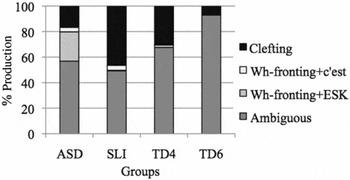
Did the production of subject wh-questions follow the same trends just reported for object and adjunct questions, with the ASD group generally resembling the SLI group in displaying avoidance of the most complex wh- strategies, and high rates for the least complex strategies? Four different strategies were used by children in the production of subject wh-questions (see Figure 5): those structurally ambiguous between plain wh-fronting and wh–in situ (e.g., Qui te mord? “Who bites you?”), and questions with wh-fronting + ESK (e.g., Qui est-ce qui te mord? “Who is it that bites you?”), with wh-fronting + c'est (e.g., Qui c'est qui te mord? “Who it is that bites you?”), and with clefting (e.g., C'est qui qui te mord? “It is who that bites you?”).Footnote 10 The first type of questions is the least complex since these questions involve either a subject wh-phrase in situ or a plain-fronted subject wh-phrase, whereas the other types of questions involve at least an additional operation besides wh-fronting.
Elicited production of wh-questions: types of subject wh-questions used by the four groups.

Significant group differences were found for subject wh-questions structurally ambiguous between wh–in situ and wh-fronting, χ2 (3, N = 69) = 8.945, p = .030, and clefts, χ2 (3, N = 69) = 12.120, p = .007, but not for questions with ESK, χ2 (3, N = 69) = 5.767, p = .124. As shown in Figure 5, structurally ambiguous subject wh-questions were used to a greater extent (M = 56.9%, SD = 47.2) than other subject questions by the children with ASD, in particular wh-fronting + ESK (M = 23%, SD = 41.7) and clefts (M = 16.8%, SD = 33.9). This trend was observed in all of the children with ASD, including the six children who did not display severe impairment on the standardized language tests. The children with SLI also used structurally ambiguous wh-questions most of the time (M = 49.2%, SD = 41.6), at about the same rate as the children with ASD, U (39) = 150.5, p = .538. Clefting was, however, more frequent in the SLI group (M = 46.4%, SD = 40.7) than in the ASD group, U (39) = 90, p = .010, r = –.423. However, the clefts produced by the children with SLI were largely ungrammatical, and their syntax was probably more akin to the syntax of wh–in situ, the least complex strategy. Wh-fronting + ESK was again less frequent in the SLI group (SLI: M = 0.5%, SD = 2). Only one child with SLI produced any such subject questions (representing 9.1% of the total of his subject questions), whereas five children with ASD did, and four of them repeatedly (at least 80% of their subject questions). These same children, three of them HF, also used wh-fronting + ESK in all of their object questions, lending support to the hypothesis these high rates are due to perseveration of this strategy. Note that the differences between the ASD and SLI groups on subject wh-questions displaying ESK or clefting held when comparing the HFA-LI group and their matched group of children with SLI.
No significant differences were found between the children with ASD and the TD children with respect to subject questions syntactically ambiguous between wh–in situ and plain wh-fronting, and clefts; however, significant differences arose when the children with SLI and the TD6 children were compared, syntactically ambiguous questions: U (31) = 45.5, p = .002, r = –.545; clefts: U (31) = 45, p = .002 r = –.554.
Finally, no significant correlations were found between nonverbal ability and the production of the different subject wh-questions in the ASD group (structurally ambiguous questions: r s = –.282, p = .272, df = 19; wh-fronting + ESK: r s = .425, p = .089, df = 19; clefts: r s = –.278, p = .280, df = 19).
Error analysis
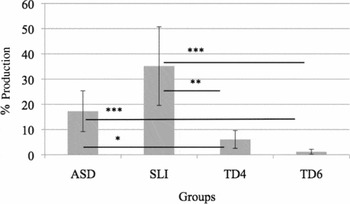
Figure 6 reports, for each group, the percentage of appropriate wh-questions produced in each group that contained at least one error. Significant differences were found across groups, χ2 (3, N = 69) = 31.227, p < .0001. As can be seen in Figure 6, the rate of erroneous questions found in the ASD group (M = 17.3%, SD = 16.2) was significantly higher than in the two younger TD groups, TD4: M = 6.1%, SD = 7.1; U (36) = 87, p = .011, r = –.418; TD6: M = 1.2%, SD = 2; U (31) = 18, p < .0001, r = –.711. The same pattern was observed in the children with SLI, whose mean rate of erroneous wh-questions was 35.2% (SD = 31.2), SLI/TD4: U (36) = 60.5, p = .001, r = –.551; SLI/TD6: U (31) = 14.5, p < .0001, r = –.737.Footnote 11 The incidence of errors was higher in the SLI group than in the ASD group, although the difference was not significant, U (39) = 138.5, p = .096. As expected, the 6 children with ASD who did not display severe impairment on the standardized language tests produced very few errors in their wh-questions; their rate of erroneous questions was 6.2% (SD = 5.3), compared to 22% (SD = 17.1) for the 14 other children with ASD. Eight of these other children, who formed the HFA-LI subgroup, had a comparable rate of erroneous wh-questions as the matched SLI subgroup (25.4% versus 32.4% respectively); U (15) = 28.5, p = .713. Finally, no significant correlations were found between nonverbal ability and the percentage of erroneous questions produced by the children with ASD (r s = .089, p = .709, df = 19).
Elicited production of wh-questions: mean percentage of erroneous wh-questions. *p < .05, **p < .01, ***p < .001.

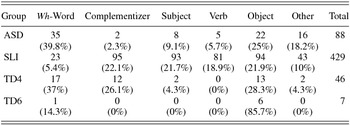
Were the error types found in the children with ASD similar to those found in the SLI group? The same error types were found in each of the groups: errors on the wh-word, on the subject, on the object, on the verb, and on the complementizer (C). However, the frequency of these error types was quite different, as can be seen in Table 2, which reports the number of errors for each type and the percentage these errors represent based on the total number of errors for each group.
Number (percentage) of errors in each group

Note: ASD, autism spectrum disorder; SLI, specific language impairment; TD, typically developing.
Errors on wh-words were the most frequent error type observed in the children with ASD; they were much less frequent in the SLI group. It was argued in the previous section that in the children with ASD, many of these may be due to perseveration: some children with ASD started using a wh-word in one question, and kept using the same wh-word in the questions that followed (see (3) above). There were also five instances of fronted quoi “what” (four in the same child, ARE), which is ungrammatical in French and likely to be a result of repetition of the task stimulus, which contained the target wh-word as an object (“The woman is washing something, but we can't see what”).Footnote 12 This is illustrated in (4).
-
(4)

Neither of these types of perseveration/repetition errors was found in the SLI group.
Complementizer errors, in contrast, were very frequent in the SLI group, but rare in the ASD group. These errors, illustrated in (5), occurred when children appeared to have attempted production of a subject cleft question, and omitted C or substituted it with a central vowel, a so-called protoform. Clefts were rare in the ASD group, and hence the opportunity to make C errors was rare as well.
-
(5)

Two other errors were frequent in the SLI group, but not in the ASD group: errors on the subject and errors on the verb. The former, like the C errors, consisted of either omission or substitution of the subject clitic by a protoform, as illustrated in (6). Errors on the verb were mostly due to use of infinitival morphology, as in (7). Restricted to a subset of the most severely impaired children with SLI (e.g., three children with SLI omitted the subject and used infinitival forms in over 30% of their wh-questions), the rarity of these two error types in the children with ASD suggests that language impairment in this group was less severe (e.g., no child with ASD used protoforms).
-
(6)
-
(7)


Errors on the object were frequent in both the ASD and the SLI groups. These were most notably due to object omission, as in (8).
-
(8)

Errors on objects also included three errors committed by the children with ASD in which an object trace was lexicalized. In other words, in addition to the object wh-word, an object was found to occur after the verb, in the form of a quantifier (quelque chose “something” or quelqu'un “someone”), as illustrated in (9).
-
(9)

This error may again be due to repetition of part of the stimulus by these children with ASD (e.g., Le lapin pousse quelqu'un mais on ne voit pas qui “The rabbit is pushing someone but we can't see who”). Such errors were not found in the other groups.
An error on objects that was largely restricted to the SLI group, and that was relatively frequent, involved the substitution of an object clitic with a strong pronoun (28/94 = 29.8%, vs. 2/22 = 9.1% for the children with ASD). These occurred in subject wh-questions in which the second person singular clitic te “you” was expected (e.g., Qui te mord? “Who bites you?”). Instead, the corresponding strong pronoun toi was produced, as shown in (10). In the same context, the children with ASD omitted the object, as shown in (11).
-
(10)
-
(11)


Although morphosyntactic errors were less frequent in the ASD group, it should be pointed out that when they occurred, they tended to be found in the subset of children with LI. In particular, four children in the HFA-LI subgroup produced subject omission, object omission, and root infinitives in over 10% of their wh-questions, versus none in the subgroup of five children with HFA and no language impairment.
Finally, we compared error rates on the production of wh-questions with two measures of morphosyntactic development: mean length of utterance (MLU) and the standardized measure of morphosyntax (sentence completion). Significant negative correlations were found between the number of erroneous wh-questions and the standardized score for morphosyntax in the ASD group (r s = –.512, p = .021, df = 19) and MLU in the SLI group (r s = –.725, p < .0001, df = 19).
Discussion
The children with ASD tended, like the children with SLI, to use questions with wh–in situ, which corresponds to the least complex structure, significantly more often than the TD 6-year-olds (see Jakubowicz, Reference Jakubowicz2005; Jakubowicz & Tuller, Reference Jakubowicz, Tuller and Ayoun2008; Zebib et al., Reference Zebib, Tuller, Prévost, Morin, Stavrakaki, Konstantinopoulou and Lalioti2013). With questions entailing wh-fronting, both the ASD group and the SLI group favored plain wh-fronting over more complex structures. In particular, they produced significantly fewer questions with subject/verb inversion, the most complex structure, compared to the TD 6-year-olds. In other words, the children with ASD and the children with SLI, whose mean age was 8;7, used computationally less complex derivations significantly more often than younger TD6 children.
The tendency to avoid computational complexity was found more frequently in the children with SLI than in the children with ASD. We suggest that this result is due to more generalized difficulties in the SLI group, whereas the ASD group is more heterogeneous, which is reflected by the fact that while all the children with SLI produced at least one wh-question with wh–in situ, only 13 children with ASD (out of 20) used this strategy. This nonetheless suggests that a large proportion of the ASD group behaved similarly to the children with SLI. Most ASD-SLI differences, in both frequency of particular wh-strategies deployed and error types, were due to behaviors having to do with perseveration of a specific wh-word/strategy (e.g., wh-fronting + ESK) or repetition of the task stimulus for eliciting wh-question production (ungrammatical fronting of object “what” and filled object gaps) on the part of the children with ASD. Other differences were found with respect to morphosyntactic errors, in particular a more frequent rate of complementizer omission and nonfinite verbs in the SLI group than in the ASD group. Some of these errors would appear to be manifestations of severely immature syntax (subject omission, complementizer omission, use of protoforms, and use of infinitival verb forms in place of a finite verb) on the part of a few children with SLI. It is not at all clear, however, that these errors are indicative of fundamental differences between the two groups. First, complementizer omission was observed in clefted wh-questions, and these were mainly produced by the children with SLI, thus preventing any direct comparisons between the two groups about use of complementizers. Second, analysis of spontaneous production on a subgroup of 17 children with ASD and 18 children with SLI did not reveal any notable differences for errors on verb inflectional morphology, including root infinitives (Morin, Reference Morin2011).
Finally, no significant correlations were observed in the ASD group between nonverbal ability and any measures of production taken from this task, including number of expected wh-questions, rate of the different wh-strategies, and rate of erroneous questions. This echoes the lack of correlations found between RPM scores and performance on the three standardized tasks (receptive vocabulary, morphosyntax, and phonology).
EXPERIMENT 2: COMPREHENSION OF WH-QUESTIONS
Method
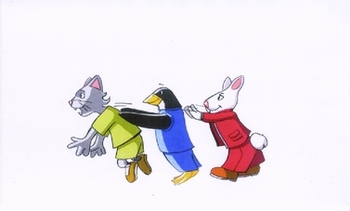
In the comprehension task, there were 72 pictures each displaying three characters who were performing the same action on each other. One of the characters appeared in the middle, one was located on its right, and one on its left, as shown in Figure 7. For each picture, a subject or object wh-question was asked about the central character, targeting one of the two other characters (e.g., “Look here! There's a cat, a penguin, and a rabbit. Tell me: Who is the penguin pushing?”). The participants were invited to answer the question by pointing to the appropriate character. All question words were animate (with the wh-word qui “who”).
Example of a picture from the wh-question comprehension task.

There were 48 object questions, 12 with wh–in situ (e.g., Le pingouin pousse qui? “The penguin pushes who[m]?”), 12 with plain wh-fronting (e.g., Qui le pingouin pousse? “Who[m] is the penguin pushing?”), 12 with wh-fronting and ESK (e.g., Qui est-ce que le pingouin pousse? “Who[m] is the penguin pushing?”), and 12 with wh-fronting, ESK, and stylistic inversion (e.g., Qui est-ce que pousse le pingouin? “Who[m] ESK pushes the penguin?”). The latter construction was deemed the most complex. There were also 24 subject questions: 12 were ambiguous between wh–in situ and wh-fronting (e.g., Qui pousse le pingouin? “Who pushes the penguin?”) and 12 displayed wh-fronting and ESK (e.g., Qui est-ce qui pousse le pingouin? “Who ESK pushes the penguin?”). The different question types were presented in (pseudo)randomized order.
Results
In the comprehension task, as we have seen, the non-wh-word in the question was always represented by the central character in the picture, and the picture in Figure 7 was used to test comprehension of questions such as “Who is the penguin pushing?” as well as “Who is pushing the penguin?” Notice that selection of the central character amounted to the child interpreting the question as a reflexive. Children in all groups only very rarely gave such answers (less than 1.5% of all answers, in each group). In other words, children interpreted the questions in this task as either (nonreflexive) subject wh-questions or object wh-questions, a binary choice. Accordingly, we analyzed each child's performance for chance, using the results of a binomial test based on a binary choice. This analysis revealed that one of the children with ASD and one of the children in the TD4 group performed at chance on every question type (between 4 and 8 correct responses out of the 12 possible items), and thus it was impossible to conclude anything about their ability to comprehend the different wh-strategies tested. These children were therefore excluded from any further analyses of the wh-question comprehension task. None of the children with SLI or those in the TD6 group had uniformly chance performance.
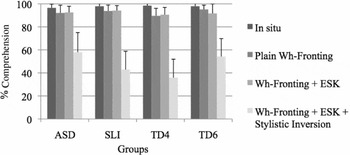
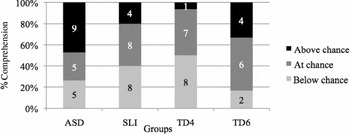
Beginning with the proportion of correct responses for comprehension of object wh-questions, presented in Figure 8, the children in all four groups performed very well on questions involving wh–in situ (e.g., Le pingouin pousse qui? “The penguin pushes who?”), plain wh-fronting (e.g., Qui le pingouin pousse? “Who the penguin pushes?”), and wh-fronting with ESK (e.g., Qui est-ce que le pingouin pousse? “Who ESK the penguin pushes?”) strategies. No significant differences were observed between the different groups for any of these types of object wh-questions.Footnote 13 Performance was significantly worse, in each group, on the most complex type, namely, questions whose derivation involves wh-fronting, ESK, and stylistic inversion (e.g., Qui est-ce que pousse le pingouin? “Who ESK films the penguin?”); a Kruskal–Wallis test, corrected for tied ranks, showed no significant group effect on comprehension accuracy on these questions, χ2 (3, N = 66) = 4.048, p = .256. As can be seen in Figure 9, most children in the SLI, TD4, and TD6 groups displayed performance either at chance or below chance on these items (16 out of the 20 children with SLI, 15/16 TD4, and 8/12 TD6). However, while the proportions in the SLI group appear to resemble most closely those in the TD4 group, in the ASD group, about half of the children (9/19) displayed above chance performance (3 of them LF); we return to this result below in relation to the relatively poor results on subject questions found in the ASD group.
Comprehension of object wh-questions.

Comprehension of object wh-questions with wh-fronting + ESK + stylistic inversion: number and proportion of children above chance, at chance, and below chance.

In addition, there was no significant negative correlation between the production of wh-questions with wh–in situ and the comprehension of object wh-questions with wh-fronting. In other words, there was no relationship between the tendency to use the wh–in situ strategy, the least complex, in production, and difficulties in understanding wh-questions that did not use this strategy (but rather wh-fronting), in either the ASD group or the SLI group. While many children in the SLI group (16/20) and the ASD group only rarely (or never) used the wh-fronting + ESK strategy in production (i.e., in less than 10% of the wh-questions displaying wh-fronting), comprehension of this construction was basically at ceiling.
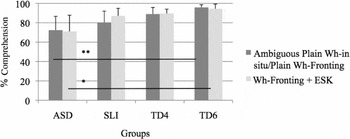
With respect to subject wh-questions, group differences were found on structurally ambiguous constructions, χ2 (3, N = 66) = 8.389, p = .039, but not on questions with ESK, χ2 (3, N = 66) = 4.43, p = .070. Figure 10 shows that the children with ASD scored lower than the TD6 children on both ambiguous wh–in situ/wh-fronting questions (ASD: 70.2% vs. TD6: 95.6%); U (30) = 52, p = .009, r = –.468, and wh-fronting + ESK (ASD: 70.1% vs. TD6: 94.4%). No significant differences were found on structurally ambiguous subject questions between the children with SLI and the TD 6-year-olds following corrections for multiple comparisons, U (30) = 61.5, p = .026, and between the SLI and ASD groups, U (37) = 158, p = .504. There were likewise no significant differences between the accuracy rates on the two subject wh-question types, in any group.
Comprehension of subject wh-questions. *p < .05, **p < .01.

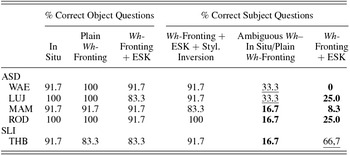
As reported above, children almost never selected the central character in the comprehension task (the ungrammatical reflexive interpretation), and thus error analysis on subject wh-questions revealed that almost every time children gave an erroneous answer, they pointed to the character corresponding to the object of the verb. We believe that these errors could be due to a perseveration strategy adopted by some children in this task. As the task involved a large majority of object wh-questions (48/72), the children with ASD may have surmised that the task involved asking questions about the character toward whom the action was directed by the character located in the middle. This strategy also entails the fact reported above that these children had relatively high performance on the most difficult object wh-questions (wh-fronting + ESK + stylistic inversion). This pattern is particularly visible in four children with ASD, whose comprehension scores are given in Table 3 (WAE, LUJ, MAM, and ROD), who were below (<26%) or at chance for subject questions, and well above chance (>74%) for all object questions, including those with stylistic inversion. Only one child with SLI displayed this pattern (THB). In the TD groups, all children displayed above chance performance on both types of subject questions, except for two TD4 children who performed at chance on structurally ambiguous questions.
Children (n = 5) with above chance performance for all types of object questions, but not for either type of subject question

Note: Bold values indicate below chance performance, and underlined values indicate at chance performance. ESK, est-ce que; ASD, autism spectrum disorder; SLI, specific language impairment.
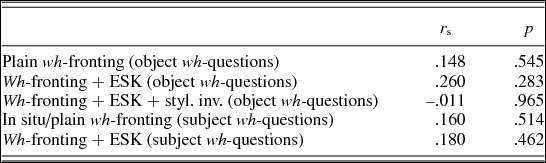
Finally, correlation analyses, reported in Table 4, revealed that nonverbal ability was not significantly correlated with measures from the wh-question comprehension task in the ASD group, including those involving the most complex derivations.
Correlation coefficients (Spearman rho) for Raven's Progressive Matrices and measures of comprehension of wh-question in the autism spectrum disorder group

Note: The group excludes BRL, the child who had uniformly chance performance on this task. ESK, est-ce que.
Discussion
The comprehension task results point to overall similarities in performance between the children with ASD and the children with SLI. Both groups had ceiling performance on the same object wh-questions, those involving wh–in situ, plain wh-fronting, and wh-fronting + ESK. These results show clearly that the children had no difficulties understanding object wh-questions involving a certain degree of complexity, including wh-fronting and ESK insertion. Both groups of children displayed poorer performance on the most complex wh-constructions (with wh-fronting, stylistic inversion, and ESK). These constructions were also problematic for the TD children. This illustrates that when complexity is very high, comprehension may also be affected, not only in populations with pathology, but also in TD children.
Some differences were also found between the ASD group and the SLI group that concerned comprehension of subject wh-questions. Accuracy was lower in the children with ASD than in the children with SLI, which we have argued could be due to a perseveration strategy on the part of some children with ASD to point to the character corresponding to the object of the verb, a strategy that also accounts for the extremely high scores in these same children for comprehension of the most difficult object wh-questions. Alternatively, or perhaps in addition, the object interpretation could be taken to be evidence for rigid adherence to information structure considerations on the part of children with ASD, as the direct object is the canonical position for new information (and hence the wh-phrase) and the subject, particularly in a language like French, is almost exclusively reserved for old information. Clefting, which highlights new information, provides subjects with structural salience that they would not have in situ. Children with SLI used this strategy in subject questions far more often than children with ASD.
One of our goals in looking at comprehension in children with ASD was to see whether nonverbal ability in these children was linked to comprehension performance, which, if so, would provide support for the assumption that children with low nonverbal reasoning might have more difficulty with comprehension than children with unimpaired nonverbal reasoning. No support for such a relationship was found for any of the wh-structures tested in the comprehension task, and in particular not for the structure that was computationally the most complex. This result suggests that comprehension of complex syntax may not be related to nonverbal reasoning in verbal children with ASD.
SUMMARY AND CONCLUDING DISCUSSION
The overall objective of this study was to examine the structural language of children with ASD, in both production and comprehension, and to explore the nature of potential similarities/differences between language performance in ASD and in SLI. Seeking to contribute to knowledge of language profiles in children with ASD, formal aspects of language were analyzed in a group of 20 verbal school-age children with ASD, which included children with and without intellectual disability, through comparison with a group of 20 age-matched children with SLI. On baseline language measures, a large proportion of children in both groups scored substantially below norms in phonology and morphosyntax. All of the children with SLI scored below the 5th percentile (–1.65 SD) on one or both of these tests, whereas 6 children with ASD were above this threshold on both (and on receptive vocabulary), and thus the children with ASD included children with seemingly impaired structural language and children with seemingly normal structural language.
Children in the ASD and SLI groups (and TD controls of the same age as the youngest children in the two clinical groups, and younger TD controls aged 4) were administered two tasks designed to examine the effects of the computational complexity entailed in the production and comprehension of wh-questions in French, which encompass a wide variety of syntactic strategies ranging in complexity as measured by the number of internal and external merge operations involved in their derivation. We sought, first of all, to see whether children with ASD resembled children with SLI in avoiding the more complex strategies and thus favoring in the production task those strategies that were the simplest. Overall, this was the case. Children in both groups tended to more often use the least complex strategies, wh–in situ, and avoid the most complex strategy, wh-fronting + subject/verb inversion, than younger TD children aged 6. This result is consonant with Riches et al.’s (Reference Riches, Loucas, Baird, Charman and Simonoff2010) finding that syntactic complexity affected in similar ways children with ASD-LI and children with SLI, though they also found that difficulties were greater in the SLI group compared with the ASD group, which they interpreted as a contradiction for the claim that there may be strong phenotypic overlap between the two. Some differences were also found between the ASD and SLI groups we studied, with respect to use of some types of wh-questions, in particular a larger use of wh-fronting + ESK by the children with ASD; we return to these differences below, arguing for a different conclusion from that put forth by Riches et al.
Our objective in focusing on wh-questions in French was to explore the question of relative performance on production versus comprehension from the angle of computational complexity in syntax. It has often been held that one of the notable features of language in ASD, and one that putatively distinguishes language impairment in these children from that in children with SLI, is that reception is comparatively more impaired than production. Thorough cross-study comparison (Kwok et al., Reference Kwok, Brown, Smyth and Cardy2015) has shown that this has not been established, at least for vocabulary and composite language measures, and for structural language, studies were too sparse to draw any conclusions. We did not uncover any evidence for an expression-over-reception bias, or a weak reception bias, in syntax in children with ASD. Accuracy in understanding most object wh-questions was very high (over 90%), including object wh-questions involving some degree of complexity, such as wh-fronting and ESK. Accuracy was found to decline when complexity was the highest, for most children. However, this was also the case for most children in each of the other groups, and the children with SLI. This decline cannot therefore be attributed to general failure, on the part of children with ASD, to understand what they were told. This shows that like production, comprehension may be affected by computational complexity. The difference between production and comprehension regarding the effect of complexity is that in comprehension, a higher level of complexity may be necessary before a breakdown is observed (and thus, as we found, plain wh-fronting and wh-fronting with ESK were equally well understood, but the former was produced much more frequently than the latter), while avoidance of complexity may be found in production with less complex structures as production involves not only the grammatical mechanisms necessary for the building of sentences but also other factors such as articulatory planning and coordination, which are not involved in comprehension (Lobley, Baddeley, & Gathercole, Reference Lobley, Baddeley and Gathercole2005). The children with ASD, overall, did not behave any differently from the children in the other groups in this regard. For some children with ASD, however, difficulties also arose in comprehension of subject wh-questions, but, as seen above, this may be due to a tendency to perseverate in the kinds of answers given, rather than to a deficit in receptive syntax. If it were a deficit in receptive syntax, these children should have had difficulties on all wh-questions types, and certainly not just subject questions, which are clearly syntactically the simplest.
Our third research question was whether language performance, and comprehension in particular, is related to nonverbal ability in children with ASD. This is a fundamental part of the wider question of the nature and prevalence of different language profiles in ASD. Are there children who, like children with SLI, have language impairment and normal nonverbal ability (Eigsti et al., Reference Eigsti, Bennetto and Dadlani2007; Kjelgaard & Tager-Flusberg, Reference Kjelgaard and Tager-Flusberg2001), or is language impairment in ASD dependent on general cognitive ability (Howlin, Reference Howlin2003; Tager-Flusberg et al., Reference Tager-Flusberg, Calkins, Nolin, Baumberger, Anderson and Chadwick-Dias1990)? We reasoned that any effects of low nonverbal ability ought to be visible in the most complex formal aspects of language, if it is true that low nonverbal ability can be a cause of structural language impairment. The results revealed that language performance in the children with ASD was not related to their nonverbal ability as measured via Raven's Progressive Matrices (for which midpoint percentile scores ranged from 2.5 to 92.5, as shown in Table 1 above). This was true for performance on elicited production of wh-questions, and thus whether children favored more or less complex wh-strategies in producing wh-questions did not depend on their nonverbal ability. This was also true for comprehension of wh-questions, including the most complex strategy tested. This result suggests that nonverbal reasoning is not related to (at least these manifestations of) formal language impairment in children with ASD, and more specifically, that performance on these measures of complex language does not appear to depend on nonverbal level in verbal children with ASD, even in comprehension. In short, our results support the hypothesis of a “specific” language disorder in children with ASD, one that can occur independently of nonverbal ability. More generally, this conclusion was also supported by performance on standardized language measures (see Appendix A). Perovic et al. (Reference Perovic, Modyanova and Wexler2013b) reached the same conclusion, through comparison of an ASD-LI group including children both with and without intellectual disability not only to a group with ASD and normal language but also to mental-age-matched children with William syndrome and to TD children matched in raw scores for nonverbal reasoning: the children in the first group all displayed impairment not found in the other three groups.
However, it is important to emphasize the need for investigation of the intersecting relationships between structural language impairment and nonverbal ability in ASD through studies of four groups with adequate numbers of verbal children with ASD: (a) children with normal language and normal nonverbal ability, (b) children with normal language and impaired nonverbal ability, (c) children with LI and normal nonverbal ability, and (d) children with LI and impaired nonverbal ability. We have explored language in a group of children with ASD that did not exclude any of these categories, but each of them was not equally represented.Footnote 14 The relative prevalence of these profiles constitutes an empirical question that remains to be explored. While our results support the finding that language profiles may vary in ASD, independently of nonverbal ability, and that one of these profiles appears to coincide with the SLI profile (language impairment in the absence of impaired nonverbal IQ), it is premature to conclude that children with this latter profile have comorbid ASD and SLI.
Alongside the overwhelming similarities in structural language performance displayed by the ASD group and the SLI group, it must be emphasized that rather striking, recurring differences were also found between the two groups. The children with ASD produced inappropriate answers more frequently than the children with SLI did on the wh-question production task. Moreover, when they did produce wh-questions, wh-strategy frequency and error patterns were sometimes affected by perseveration. Thus, wh-fronting with ESK was found in the majority of questions produced by seven children, sometimes resulting in ungrammatical constructions; this was not found in children with SLI. Similarly, some ASD-specific error patterns could be attributed to repetition of parts of the elicitation prompt given by the experimenter. In comprehension, one child with ASD performed at chance on all types of wh-questions, whereas no child with SLI did. Four children with ASD interpreted nearly all wh-questions as object questions, which resulted in low scores for subject wh-questions and surprisingly high scores for the object wh-questions that caused difficulties for nearly all children, in all groups (only one child with SLI displayed this behavior). As there were twice as many object wh-questions than subject wh-questions in the task, these children may have generalized the former to the latter, displaying perseveration, once again. Using an experimental task with a balanced number of subject and object wh-questions would help us confirm this hypothesis (in which case a bias for object wh-questions would not be expected), or, should the bias for object wh-questions persist, it would be indicative that children with ASD tend to rely on information structure considerations, as suggested above.
Taken together, these differences between the children with ASD compared to the children with SLI seem to point in the same direction, namely, that difficulties in appropriate use of language in context, pragmatics, may have an effect on performance on tasks designed to assess structural language, and may partially obscure fundamental similarities in the structural language difficulties in the two populations. These difficulties also raise the complementary question of the extent to which low structural language performance could be the result of pragmatic difficulties, in some children with ASD. Disentangling these factors could profitably be explored through studies based on both focused measures of structural language (including eye tracking and other online processing techniques (see Léger, Prévost, & Tuller, Reference Léger, Prévost, Tuller, Hamann and Ruigendijk2015) and thorough assessment of aspects of pragmatics.
APPENDIX A
Age, gender, nonverbal scores, and language performance of the children with ASD and children with SLI

ACKNOWLEDGMENTS
This research was supported by French National Research Agency Grant BLAN-0328-01. We are grateful to the clinicians at autism centers at university teaching hospitals in Tours and in Brest: C. Bartheĺeḿy, M. Bataille, P. Dansart, E. Lemonnier, and J. Rozec. The comparison with SLI was possible thanks to E. Sizaret and A.-G. Piller, and A. Galloux at the Language Reference Center of the Children's Hospital in Tours. We also thank the students and postdoctoral researchers involved in this study: S. Galès, E. Morin, M. Scheidnes, and R. Zebib.