1. Introduction
Increased input of CO2 into the ocean–atmosphere system has triggered crises in reefs and carbonate platforms, both ancient and modern, attributed to increases in temperature and/or ocean acidification (Kleypas et al. Reference Kleypas, Buddemeier, Archer, Gattuso, Langdon and Opdyke1999; Gattuso & Buddemeier, Reference Gattuso and Buddemeier2000; Weissert & Erba, Reference Weissert and Erba2004; Iglesias-Rodriguez et al. Reference Iglesias-Rodriguez, Halloran, Rickaby, Hall, Colmenero-Hidalgo, Gittins, Green, Tyrrell, Gibbs, von Dassow, Rehm, Armbrust and Boessenkool2008; Zachos et al. Reference Zachos, Dickens and Zeebe2008; Trecalli et al. Reference Trecalli, Spangenberg, Adatte, Föllmi and Parente2012). The Tethyan region contains substantial sedimentary deposits formed in carbonate platforms of Triassic–Tertiary age, hence providing a natural laboratory for investigation of comparable phenomena in the geological past (Bernoulli & Jenkyns, Reference Bernoulli, Jenkyns, Dott and Shaver1974; D'Argenio, Reference D'Argenio1974; Bernoulli, Reference Bernoulli, Vai and Martini2001). With regard to the Cretaceous, a number of environmental changes have been reported in such platforms (Wissler et al. Reference Wissler, Funk and Weissert2003; Weissert & Erba, Reference Weissert and Erba2004; Immenhauser et al. Reference Immenhauser, Hillgärtner and Van Bentum2005; Parente et al. Reference Parente, Frijia and di Lucia2007; Amodio et al. Reference Amodio, Ferrere, D'argenio, Weissert and Sprovieri2008), but similar changes have also been increasingly recognized in other stratigraphic intervals.
Toarcian carbonate platforms experienced one of the major perturbations of global carbon cycling, namely the early Toarcian oceanic anoxic event (T-OAE; Jenkyns, Reference Jenkyns1985, Reference Jenkyns1988, Reference Jenkyns2010). During the T-OAE, Tethyan carbonate platforms display contrasting behaviour: some areas show evidence for deepening and development of darker-coloured, more clay-rich and siliceous facies, while other carbonate platforms exhibit only minor facies changes, probably related to their maintenance in shallow-water environments as a consequence of very subdued crustal subsidence rates (Woodfine et al. Reference Woodfine, Jenkyns, Sarti, Baroncini and Violante2008).
The T-OAE is one of the best-studied oceanic anoxic events, as indicated by the global development of broadly coeval organic-rich facies (Jenkyns, Reference Jenkyns1988; Jenkyns et al. Reference Jenkyns, Jones, Gröcke, Hesselbo and Parkinson2002; Mailliot et al. Reference Mailliot, Mattioli, Guex and Pittet2006). Sequestration of this reduced carbon, with its relative enrichment in 12C, resulted in a broad positive excursion in carbon-isotope values of marine carbonate and marine and terrestrial organic matter and broadly contemporaneous positive nitrogen-isotope and sulphur-isotope excursions recording the development of water-column denitrification/anammox and local euxinic conditions, respectively (Jenkyns & Clayton, Reference Jenkyns and Clayton1986, Reference Jenkyns and Clayton1997; Jenkyns, Reference Jenkyns1988, Reference Jenkyns2003; Jenkyns et al. Reference Jenkyns, Gröcke and Hesselbo2001, Reference Jenkyns, Jones, Gröcke, Hesselbo and Parkinson2002; Jones & Jenkyns, Reference Jones and Jenkyns2001; Röhl et al. Reference Röhl, Schmid-Röhl, Oschmann, Frimmel and Schwark2001; Kemp et al. Reference Kemp, Coe, Cohen and Schwark2005; Hesselbo et al. Reference Hesselbo, Jenkyns, Duarte and Oliveira2007; Woodfine et al. Reference Woodfine, Jenkyns, Sarti, Baroncini and Violante2008; Sabatino et al. Reference Sabatino, Neri, Bellanca, Jenkyns, Baudin, Parisi and Masetti2009; Gill et al. Reference Gill, Lyons and Jenkyns2011; Gröcke et al. Reference Gröcke, Hori, Trabucho-Alexandre, Kemp and Schwark2011; Kafousia et al. Reference Kafousia, Karakitsios, Jenkyns and Mattioli2011; Suan et al. Reference Suan, Nikitenko, Rogov, Baudin, Spangenberg, Knyazev, Glinskikh, Gorycheva, Adatte, Riding, Fôllmi, Pittet, Mattioli and Lécuyer2011). This overarching positive carbon-isotope excursion is subdivided into two segments by an abrupt characteristically stepped decrease in δ13C values, commonly interpreted as due to an influx of isotopically light carbon from dissociation of gas hydrates and/or metamorphism of Gondwanan coals and/or volcanism (Hesselbo et al. Reference Hesselbo, Gröcke, Jenkyns, Bjerrum, Farrimond, Morgans Bell and Green2000, Reference Hesselbo, Jenkyns, Duarte and Oliveira2007; Pálfy & Smith, Reference Pálfy and Smith2000; McElwain et al. Reference McElwain, Murphy and Hesselbo2005; Svensen et al. Reference Svensen, Planke, Chevalier, Malthe-Sørensen, Corfu and Jamveit2007; Hermoso et al. Reference Hermoso, Minoletti, Le Callonnec, Jenkyns, Hesselbo, Rickaby, Renard, de Rafelis and Emmanuel2009, Reference Hermoso, Minoletti, Rickaby, Hesselbo, Baudin and Jenkyns2012; Hesselbo & Pienkowski, Reference Hesselbo and Pienkowski2011). Older interpretations of the early Toarcian negative δ13C carbon shift as the result of a combination of local upwelling together with a density-stratified anoxic watermass are not sustainable in the light of discovery of a coeval excursion variously in marine black shales and terrestrial wood in Argentina and Canada (cf. Küspert, Reference Küspert, Einsele and Seilacher1982; van de Schootbrugge et al. Reference van de Schootbrugge, McArthur, Bailey, Rosenthal, Wright and Miller2005; Al-Suwaidi et al. Reference Al-Suwaidi, Angelozzi, Baudin, Damborenea, Hesselbo, Jenkyns, Manceñido and Riccardi2010; Caruthers et al. Reference Caruthers, Gröcke and Smith2011).
Indeed, this distinctive positive–negative–positive carbon-isotope signature has become diagnostic for the lower ammonite zones of the early Toarcian and numerous biostratigraphically calibrated reference carbon-isotope curves are in place, derived from shelf-sea and pelagic marine shales and limestones. Recognition of these characteristic shifts in the carbon-isotope ratios of shallow-water carbonates therefore provides a stratigraphic tool in platform carbonates that typically lack useful fossils such as ammonites and coccoliths.
In this paper, the study of Woodfine et al. (Reference Woodfine, Jenkyns, Sarti, Baroncini and Violante2008) is extended to evaluate whether the chemostratigraphy established for Early Jurassic carbonate platforms in the Southern Alps and Southern Apennines of Italy can be applied throughout the Tethyan region. To this end, detailed δ13C curves for three different sections of Lower Jurassic shallow-water carbonates sampled in the Croatian AdCP are presented and discussed: Velebit-A, Velebit-B and Gornje Jelenje (Fig. 1). The stratigraphic distribution of the redox-sensitive metal Mn is examined through the Velebit-A section because this element has proven to be a sensitive marker for redox changes during OAEs (Jenkyns, Reference Jenkyns2010; Lu et al. Reference Lu, Jenkyns and Rickaby2010). The Mn profile of the Velebit-A section is compared with that of a carbonate platform in the Southern Apennines (Lu et al. Reference Lu, Jenkyns and Rickaby2010) and that of an organic-poor clay-rich carbonate sequence from Peniche (Lusitanian Basin, Portugal), representing a hemipelagic environment (Hermoso et al. Reference Hermoso, Minoletti, Le Callonnec, Jenkyns, Hesselbo, Rickaby, Renard, de Rafelis and Emmanuel2009).
Location maps (a and b) of the studied geological sections: Velebit-A, Velebit-B and Gornje Jelenje. The shaded area represents recent distribution of the Adriatic Carbonate Platform (AdCP) deposits based on outcrops and offshore well data (SW and NE platform boundaries after Grandić et al. Reference Grandić, Boromisa-Balaš, Šušterčić and Kolbah1999 and Dragičević & Velić, Reference Dragičević and Velić2002, respectively).

2. Geological setting and stratigraphy
The Mesozoic Adriatic Carbonate Platform (AdCP) was one of the largest carbonate platforms of the Tethyan region (Vlahović et al. Reference Vlahović, Tišljar, Velić and Matičec2005). The AdCP remained as a shallow-water area when major tectonic disintegration of the huge Early Mesozoic carbonate platform, present along the northern Gondwana margin, took place during late Pliensbachian – early Toarcian time (Bernoulli, Reference Bernoulli, Hollister and Ewing1972; Bernoulli & Jenkyns, Reference Bernoulli, Jenkyns, Dott and Shaver1974; Dercourt et al. Reference Dercourt, Ricou and Vrielynck1993) (Fig. 2). The Adriatic Basin, a trough connecting the Ionian Basin of Greece with the Umbria–Marche and Belluno pelagic basins of Italy, was formed during this event along the SW margin of the AdCP (in present-day geographic orientation), whereas a Bosnian–Slovenian trough formed along its NE margin (Bernoulli, Reference Bernoulli and Végh-Neubrandt1971, Reference Bernoulli, Vai and Martini2001; Jelaska, Reference Jelaska1973; Zappaterra, Reference Zappaterra1990, Reference Zappaterra1994; Grandić et al. Reference Grandić, Boromisa-Balaš, Šušterčić and Kolbah1999; Dragičević & Velić, Reference Dragičević and Velić2002; Tišljar et al. Reference Tišljar, Vlahović, Velić and Sokač2002; Velić et al. Reference Velić, Vlahović and Matičec2002). This important palaeotectonic episode coincided with the early T-OAE. The exact role of this event in the drowning of only some carbonate platforms is controversial, but changes in water temperature, acidity, redox and nutrient levels were potentially involved in triggering carbonate crises (Hallock & Schlager, Reference Hallock and Schlager1986; Rosales et al. Reference Rosales, Quesada and Robles2006; Cohen et al. Reference Cohen, Coe and Kemp2007; Dera et al. Reference Dera, Pellenard, Neige, Deconinck, Pucéat and Dommergues2009, Reference Dera, Brigaud, Monna, Laffont, Pucéat, Deconinck, Pellenard, Joachimski and Durlet2011; Suan et al. Reference Suan, Mattioli, Pittet, Lécuyer, Suchéras-Marx, Duarte, Philippe, Reggiani and Martineau2010). However, the T-OAE was clearly recorded in the inner platform area of the AdCP by deposition of a specific lithological unit, usually referred to as the ‘spotted limestones’.
Schematic palaeogeographic frame of the studied area (modified from Mattioli et al. Reference Mattioli, Pittet, Bucefalo Palliani, Röhl, Schmif-Röhl and Morettini2004 after Bassoullet et al. Reference Bassoullet, Elmi, Poisson, Cecca, Bellion, Guiraud, Baudin, Dercourt, Ricou and Vrielynck1993) with location of discussed Toarcian sections: 1 – Gornje Jelenje (Croatia); 2 – Velebit-A and Velebit-B (Croatia); 3 – Monte Sorgenza (southern Italy); 4 – Peniche (Portugal); 5 – Yorkshire (England).

Generally, Lower Jurassic rocks from the Velebit and Gornje Jelenje sections are divided into three informal units (Fig. 3; Nikler & Sokač, Reference Nikler and Sokač1968; Velić, Reference Velić1977, Reference Velić2007; Tišljar et al. Reference Tišljar, Vlahović, Sremac, Velić, Veseli, Stanković, Vlahović and Velić1991), which is typical for the Lower Jurassic of the Dinarides, a mountain belt connecting the Southern Alps with the Albanides/Hellenides along the NE Adriatic coast (Vlahović et al. Reference Vlahović, Tišljar, Velić and Matičec2005).
Schematic stratigraphic column showing typical Lower Jurassic units in the Karst Dinarides and main index fossils.

2.a. Lower part of Lower Jurassic: alternation of limestones and dolomites
The oldest Jurassic unit, directly overlying the Upper Triassic Main dolomite, is composed of alternations of limestones and late-diagenetic dolomites, the latter especially abundant in the lower part (Fig. 3). Limestones contain numerous dasyclad algae with different species of the genus Palaeodasycladus. The succession is characterized by shallowing-upwards cycles composed of 20–90 cm thick layers of calcareous mudstones and skeletal wackestones capped by 10–70 cm thick oolitic–bioclastic packstones and grainstones. Cyanobacterial laminites and fenestral fabrics are locally found in the uppermost parts of cycles, as well as some discontinuity surfaces indicating short-term depositional breaks (Martinuš et al. Reference Martinuš, Bucković and Kukoč2012). The microfossil content (mainly including benthic foraminifera: Palaeodasycladus mediterraneus, Lituolipora termieri, Lituosepta recoarensis, Planisepta compressa, Amijiella amiji, Haurania deserta and Orbitopsella primaeva) spans a stratigraphic range from Hettangian to early Pliensbachian. This unit, usually ascribed to the Hettangian and Sinemurian stages, is c. 250 m thick.
2.b. Middle part of Lower Jurassic: lithiotid limestones
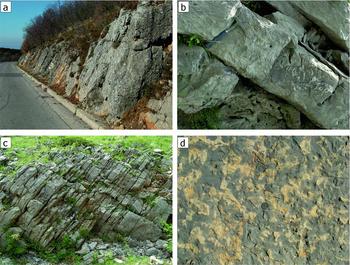
The second unit of the Lower Jurassic is usually referred to as the ‘lithiotid limestones’ (Figs 3, 4a, b) because of the presence of abundant bioclasts and complete shells of lithiotid bivalves. Lithiotids are more common in the middle and especially the upper part of this unit where they represent, together with brachiopods, very important rock constituents. This unit, c. 200 m thick, includes rhythmic alternations of 20–80 cm thick layers of calcareous mudstones or pelletal wackestones with ooid packstones/grainstones and rare lithiotids in its lower to middle part, and wackestones/packstones and lithiotid or lithiotid/brachiopod floatstones/rudstones primarily in the upper part. Most of the lithiotid shells are reworked and in subparallel orientation, although in places they can be found in growth position. Microfossils found in the lithiotid limestones (from the stratigraphic viewpoint the most important are Palaeodasycladus mediterraneus, Lituolipora termieri, Lituosepta recoarensis, Planisepta compressa, Orbitopsella primaeva, O. praecursor, O. dubari, Pseudocyclammina liassica, Agerina martana, Amijiella amiji, Everticyclammina praevirguliana and Duotaxis metula) indicate a Pliensbachian – early Toarcian age.
(a) Steeply inclined beds of Pliensbachian lithiotid limestones at the Gospić–Karlobag road 400 m WNW of Kubus (Velebit-A section) with numerous white lithiotid shells, both transported and in life position. (b) Outcrop of the upper part of the lithiotid limestones (Toarcian) showing shells in growth position along the Sveti Rok – Obrovac road (Velebit-B section). (c) Typical bedding of Toarcian spotted limestones along the Sveti Rok – Obrovac road (Velebit-B section). (d) Typical upper bedding plane of Toarcian spotted limestones showing lightly coloured bioturbated zones within the dark-coloured host rock at the Gospić–Karlobag road 300 m WSW of Kubus (Velebit-A section).

2.c. Upper part of Lower Jurassic: spotted limestones
The youngest unit of the Lower Jurassic consists of the traditionally named ‘spotted limestones’ (Figs 3, 4c, d). Since the 19th century, Austrian geologists used the German term ‘Fleckenkalk’ for these rocks, which are similar to coeval rocks cropping out in the Alps, because of their spotted appearance largely resulting from very intense bioturbation of the soft sediment (only Thalassinoides-type trace fossils may be recognized locally; G. Mikša, pers. comm.). This unit, generally 100–130 m thick, contains 5–20 rarely up to 60-cm-thick limestone layers with irregular bedding planes which are especially prone to weathering. The spotted limestones are mostly composed of more or less recrystallized calcareous mudstones and pelletal wackestones including interbeds of wackestones/packstones with bivalve bioclasts, centripetally micritized cortoids, peloids, echinoderms, ostracods, benthic foraminifera and some ooids. The grainy intervals are more common in the lowermost part of the unit. The transition from the lithiotid limestones is abrupt, although commonly a narrow transitional zone indicating a gradual change of facies is recognizable. The fossil assemblage, poor in number of species (benthic foraminifera: Haurania deserta, Agerina martana, Pseudocyclammina liassica, Duotaxis metula, Meandrovoluta asiagonensis, Placopsilina sp.; the pelagic crinoid Saccocoma sp. and undetermined Favreina pellets), only indicates a wider stratigraphic range from younger Pliensbachian to older Toarcian for the lower part of the unit. However, according to the overlap between underlying upper Pliensbachian/lower Toarcian lithiotid limestones and overlying Aalenian thick-bedded lagoonal calcareous mudstones/wackestones, a Toarcian age is generally attributed to the spotted limestones. Although intense bioturbation has destroyed most sedimentary structures, very rarely there are some relics indicating possible hummocky cross-stratification.
2.d. Middle Jurassic: massive micritic limestones
The spotted limestones are overlain, with a sharp boundary, by thick-bedded to massive mostly micritic limestones of Middle Jurassic age.
2.e. General depositional trends during the Early Jurassic and the problem of the Pliensbachian−Toarcian boundary in the study area
Comparing the sedimentary succession in the studied area with that elsewhere in the Dinarides, a gradual deepening trend can be recognized. In the lower part of the Lower Jurassic sediments, the tops of carbonate cycles show fenestral fabrics or cyanobacterial laminites as well as structures indicating short-term depositional breaks (Martinuš et al. Reference Martinuš, Bucković and Kukoč2012). The microfossil assemblage is typical for shallow protected parts of the carbonate platform (see Section 2.a). In the lithiotid limestones there is clear evidence of storm-induced reworking of the mostly shallow subtidal sediments (as witnessed by micro- and macrofossil assemblages) and a lack of peritidal elements (see Section 2.b). Further relative deepening resulted in deposition of the spotted limestones, characterized by deposition probably below the fair-weather wave-base, i.e. in the offshore-transition zone. In addition to the typical subtidal carbonate-platform microfossil assemblages (see Section 2.c), rare pelagic crinoids may be found, indicating more open-marine conditions.
Because of the relatively low stratigraphic resolution of shallow-marine fossil assemblages, it is impossible to define the Pliensbachian–Toarcian boundary on biostratigraphic grounds. Lithiotid limestones were traditionally considered as being Pliensbachian, while the spotted limestones were ascribed to the Toarcian (e.g. Sokač et al. Reference Sokač, Nikler, Velić and Mamužić1974 for the area of the Velebit-A profile, and Ivanović et al. Reference Ivanović, Sakač, Marković, Sokač, Šušnjar, Nikler and Šušnjara1973 for the area of the Velebit-B profile) or even Pliensbachian–Toarcian (e.g. Savić & Dozet, Reference Savić and Dozet1984 for the area of the Gornje Jelenje profile). However, more and more forms with stratigraphic ranges stretching into the early Toarcian have been found within the lithiotid limestones (Velić, Reference Velić2007).
Three stratigraphic sections (Velebit-A, Velebit-B and Gornje Jelenje) of Lower Jurassic carbonates from the inner part of the ancient AdCP have been selected for this study (Fig. 1b). These sections focused on intervals recording the T-OAE, namely the interval between the younger part of lithiotid limestones and the older part of the spotted limestones.
3. Methods
Each of the three stratigraphic sections was sampled in detail (with a mean frequency of about one sample every metre) throughout a thickness of 139.5 m for Velebit-A, 122.5 m for Velebit-B and 101.1 m for Gornje Jelenje. Using a micro-drill, samples were drilled from bulk rock with micritic matrix being preferentially sampled and skeletal fragments and veins being avoided (on the assumption that these components would be more prone to vital effects and diagenesis). Samples were analyzed isotopically for δ13C and δ18O using a VG Isogas Prism II mass spectrometer with an on-line VG Isocarb common acid bath preparation system. Samples were cleaned with hydrogen peroxide (H2O2) and acetone ((CH3)2CO) and dried at 60 °C for at least 30 min. In the instrument they were reacted with purified phosphoric acid (H3PO4) at 90 °C. Calibration to PDB standard via NBS-19 was made daily using the Oxford in-house (NOCZ) Carrara marble standard. Reproducibility of replicated standards was typically better than 0.1‰ for both δ13C and δ18O.
Manganese concentrations were determined on 60 selected samples from the Velebit-A section by inductively coupled plasma optical-emission spectrometry (ICP–OES) using a Perkin-Elmer Optima 3000 ICP (Welltech Enterprises, Inc., Capitol Heights, MD, USA). Each 0.25 g sample was digested with hydrofluoric acid followed by a mixture of nitric and perchloric acids; following this process, controlled heating cycles were performed to bring samples to dryness. After dryness was attained, samples were brought back into solution using hydrochloric acid. Certified reference materials (GXR–1, GXR–4, GXR–6, SCO–1, SDC–1, DNC–1) were used for quality control. Analytical error was below 3% for Mn.
4. Geochemistry of the sections
4.a. Velebit-A
The Velebit-A section is located along the ridge extending south of the Kubus Pass on the road between Gospić and Karlobag. The starting point of sampling is situated at N 44° 31.549′, E 15° 8.639′; the last point is at N 44° 31.447′, E 15° 8.594′. The section is 139.5 m thick and the samples collected represent two informal lithostratigraphic units: (1) lithiotid limestones of Pliensbachian – early Toarcian age (the lower 26.9 m of the section), and (2) the spotted limestones of Toarcian age (from 27 to 139.5 m).
4.a.1. Isotope geochemistry
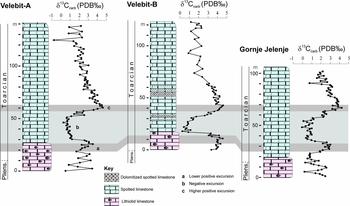
Carbon-isotope ratios for the Velebit-A section are shown in Table 1 and Figure 5. In the lower part of the section (0–26 m) δ13Ccarb values fluctuate between 0.5 and 3.5‰, defining a slight positive trend (lower positive excursion, a in Fig. 5), interrupted by an abrupt sharp decrease in values at 30.4 m (negative excursion c. 1.4‰, b in Fig. 5), quasi-concomitant with the top of the lithiotid-rich beds and the base of the spotted limestones.
Values of carbonate stable isotopes for samples from both Velebit sections

Schematic lithology and carbonate carbon-isotope stratigraphy logs for Velebit-A, Velebit-B and Gornje Jelenje sections. Shaded areas labelled a, b and c highlight key levels that can be correlated (see text). The Pliensbachian–Toarcian boundary is placed on the basis of chemostratigraphic correlation with coeval sections elsewhere (see text).

Throughout the interval between 30.4 and 52.7 m, the carbon-isotope signal shows slight oscillations around a mean value of 0.85‰. The negative shift in δ13Ccarb is followed by an increase in values up to 4.6‰ at c. 60.7 m (higher positive excursion, c in Fig. 5). Values gradually decrease down to 2.5‰ at c. 78 m, and continue to decline with values oscillating between –0.7 and 2‰ up to the top of the section.
The δ18Ocarb values from each section do not show any distinct correlation with the carbon-isotope ratios (see section on diagenesis). At the Velebit-A section, the δ18Ocarb values decrease between 0 and 56.7 m from –2.3 to –4.2‰. The values increase to –3.16‰ at 57.7 m, and then remain stable up to the top of the section around a mean value of –2.71‰ (Table 1).
4.a.2. Manganese content
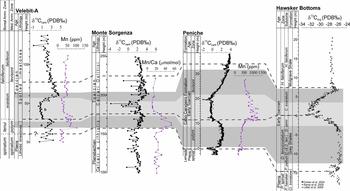
The manganese content of the Velebit-A section is shown in Table 2. The Mn profile (Fig. 6) displays a sharp increase at 18.5 m reaching a value of 107 ppm. It is noteworthy that this rise in Mn coincides with the beginning of the stratigraphically lower δ13Ccarb positive shift (a in Fig. 5). The Mn values oscillate around a mean value of 68 ppm between 18.5 and 38.6 m and decrease to 22 ppm at 56.7 m; above this level they continue to fluctuate around a mean value of 47 ppm up to the top of the section.
Mn content in selected samples from the Velebit-A section

Stratigraphic correlation based on carbon-isotope curves for Velebit-A (this study), Monte Sorgenza (Woodfine et al. Reference Woodfine, Jenkyns, Sarti, Baroncini and Violante2008), Peniche (Hesselbo et al. Reference Hesselbo, Jenkyns, Duarte and Oliveira2007) and Hawsker Bottoms (Cohen et al. Reference Cohen, Coe, Harding and Schwark2004; Kemp et al. Reference Kemp, Coe, Cohen and Schwark2005; Littler et al. Reference Littler, Hesselbo and Jenkyns2009) sections. Manganese data are reported where they are available: Velebit-A (this study), Monte Sorgenza (Lu et al. Reference Lu, Jenkyns and Rickaby2010) and Peniche (Hermoso et al. Reference Hermoso, Minoletti, Le Callonnec, Jenkyns, Hesselbo, Rickaby, Renard, de Rafelis and Emmanuel2009). Boreal and Mediterranean ammonite zonal boundaries ascribed to the Velebit-A section are only notional and based on comparative carbon-isotope stratigraphy. Shaded areas labelled a, b and c as in Figure 5.

4.b. Velebit-B
The Velebit-B section is located along the old road connecting Sveti Rok and Obrovac via Mali Alan Pass. The first point of sampling is sited at N 44° 17.258΄, E 15° 38.405′; the last point is at N 44° 17.180′, E 15° 38.379′.
The section is 122.5 m thick and the collected samples represent two informal lithostratigraphic units: (1) the lithiotid limestones of Pliensbachian – early Toarcian age (0–17.8 m), and (2) the spotted limestones of Toarcian age (17.8–122.5 m). A number of levels in the spotted limestones have been affected by late-stage dolomitization.
4.b.1. Isotope geochemistry
Carbon-isotope ratios of the Velebit-B section are shown in Table 1 and Figure 5. The occurrence of a fault at the base of the section precluded sampling of a greater thickness of the lithiotid-rich interval. In the lower part of the section (0–13.8 m), δ13Ccarb values fluctuate between 3.05 and 4.6‰, delineating a slight positive trend (lower positive excursion; a in Fig. 5) interrupted by a sharp decrease in values (negative excursion of c. 3.9‰). The stratigraphic interval between 15.8 and 35.8 m coincides with the δ13Ccarb negative carbon-isotope excursion where values initially fall to c. 0.25‰ (b in Fig. 5); above this level they oscillate around a mean value of c. 0.9‰ up to 31.8 m. This negative trend ends with an abrupt positive excursion (c in Fig. 5) and a δ13Ccarb maximum value of 4.6‰ is attained, identical to that determined for Velebit-A. Stratigraphically higher, δ13C values decrease to c. 1‰ at the top of the section (122.5 m).
Throughout the record, oxygen-isotope ratios show high-amplitude fluctuations between –4.92 and –1.0‰ (see Table 1).
4.c. Gornje Jelenje
The Gornje Jelenje section is located along the regional road connecting Delnice and Rijeka. The first sampling point is sited at N 45° 22.301′, E 14° 36.259′; the last sampling point is at N 45° 22.267′, E 14° 36.117′.
The section is 101.10 m thick. The samples collected here also represent two informal lithostratigraphic units: (1) the lithiotid limestones of Pliensbachian – early Toarcian age (the lower 18.10 m of the section), and (2) the spotted limestones of Toarcian age (19.10–101.10 m).
4.c.1. Isotope geochemistry
The carbon-isotope values of the Gornje Jelenje section are shown in Table 3 and Figure 5. The lower part of this section is characterized by high-amplitude fluctuations of δ13Ccarb values (between 0.2‰ and 2.6‰). Beginning at c. 22 m, the spotted limestones exhibit a rise in δ13Ccarb values from 0.8 to 3.0‰ extending to 31 m (lower positive excursion; a in Fig. 5) followed by an abrupt shift down to –0.04‰. Small oscillations around a mean value of 0.70‰ persist throughout the interval between 35 and 57 m (b in Fig. 5). Stratigraphically upwards, an increase in δ13C values is documented by a maximum value of 4.2‰ at 66 m (higher positive excursion; c in Fig. 5). From this level, the carbon-isotope data gradually return to values of c. 2‰ and then step down to a minimum close to 0‰, confirming a negative trend already seen in the Velebit sections.
Values of carbonate stable isotopes for samples from the Gornje Jelenje section

The δ18Ocarb values fluctuate widely (between –2.27 and –4.2‰) from 0 to 18.1 m. From 19.1 to 63 m the δ18Ocarb values decrease from –3.35 to –4.2‰ and increase at 64 m to –3.6‰. They then remain stable until the end of the section with mean values of –3.8‰ (Table 3).
5. Discussion
5.a. Diagenesis
Bulk carbonate carbon-isotopic data can potentially be used as a tool for correlating carbonate successions in which critical fossil species are lacking with others that are biostratigraphically well dated, but it is important to consider the effects of post-depositional alteration. Shallow-water limestones are generally composed of skeletal and non-skeletal grains, matrix and marine and/or meteoric cements (early to late diagenetic products). Bulk isotopic values can be influenced by skeletal grains that exhibit non-equilibrium isotopic fractionation, the presence of void-filling secondary calcite or the diagenetic alteration of originally aragonitic material (Grötsch et al. Reference Grötsch, Billing and Vahrenkamp1998; Davey & Jenkyns, Reference Davey and Jenkyns1999; Yang, Reference Yang2001; Swart & Eberli, Reference Swart and Eberli2005).
The magnitude of oxygen- and carbon-isotope exchanges between carbonate sediments and meteoric water is controlled by the duration of meteoric diagenesis and parameters of the water–rock system (James & Choquette, Reference James, Choquette, Macillreath and Morrow1990; Yang, Reference Yang2001; Swart & Eberli, Reference Swart and Eberli2005). Interaction with meteoric fluids bearing organic-derived carbon may lead to very negative δ13C and δ18O values in diagenetic carbonates (Hudson, Reference Hudson1977; Dickson & Coleman Reference Dickson and Coleman1980; Brand & Veizer, Reference Brand and Veizer1981; Veizer, Reference Veizer, Arthur, Anderson, Kaplan, Veizer and Land1983; Dickson, Reference Dickson, Brenchley and Williams1985; Marshall, Reference Marshall1992). However, such ‘Caribbean-style’ meteoric-water diagenesis is typical for an ‘icehouse world’, characterized by climatically modulated glacio-eustatic sea-level changes, and should have been much less important during ‘greenhouse periods’ such as the Jurassic, when emergence of any part of the carbonate platform would have been less frequent and less prolonged (Woodfine et al. Reference Woodfine, Jenkyns, Sarti, Baroncini and Violante2008). Some authors (Guex et al. Reference Guex, Morard, Bartolini and Morettini2001; Morard et al. Reference Morard, Guex, Bartolini and De Wever2003; Suan et al. Reference Suan, Mattioli, Pittet, Lécuyer, Suchéras-Marx, Duarte, Philippe, Reggiani and Martineau2010, Reference Suan, Nikitenko, Rogov, Baudin, Spangenberg, Knyazev, Glinskikh, Gorycheva, Adatte, Riding, Fôllmi, Pittet, Mattioli and Lécuyer2011) have, however, attributed the latest Pliensbachian relative sea-level lowstand registered in northern Europe (Hallam, Reference Hallam1981; Hesselbo & Jenkyns, Reference Hesselbo, Jenkyns, de Graciansky, Hardenbol, Jacquin, Farley and Vail1998) to a build-up of continental ice. Zakharov et al. (Reference Zakharov, Shurygin, Ilyina and Nikitenko2006) and Suan et al. (Reference Suan, Nikitenko, Rogov, Baudin, Spangenberg, Knyazev, Glinskikh, Gorycheva, Adatte, Riding, Fôllmi, Pittet, Mattioli and Lécuyer2011) suggest that the putative pre-T-OAE icecap would most probably only have been located in the high-latitude landmasses of the southern hemisphere, but no definitive evidence exists that sea-level fall was caused by glacio-eustasy. If sea level was controlled by changes in ice volume, the amplitude would certainly not have been on a scale resembling that of the Quaternary (Miller et al. Reference Miller, Wright and Browning2005). Furthermore, based on palaeotemperature data, a rapid return to greenhouse conditions has necessarily been postulated for the early Toarcian (Suan et al. Reference Suan, Mattioli, Pittet, Lécuyer, Suchéras-Marx, Duarte, Philippe, Reggiani and Martineau2010).
Although the absence of correlation between δ18O and δ13C (R 2 = 0.05) in all studied Pliensbachian–Toarcian sections from Croatia suggests a limited influence of diagenesis on the isotopic records (see Hudson & Anderson, Reference Hudson and Anderson1989), in this work discussion is restricted to trends in carbon-isotope values. The detailed δ13C values and trends are comparable to those reported from well-preserved coeval pelagic successions elsewhere (i.e. Peniche, Portugal, and Valdorbia, Italy; sections studied by Hesselbo et al. Reference Hesselbo, Jenkyns, Duarte and Oliveira2007 and Sabatino et al. Reference Sabatino, Neri, Bellanca, Jenkyns, Baudin, Parisi and Masetti2009, respectively), indicating that rock-forming calcite essentially precipitated at or near carbon-isotopic equilibrium with seawater and was not greatly modified subsequently. Large carbon-isotope excursions associated with OAEs, reflecting global environmental change, have also been recognized in Cretaceous Tethyan carbonate platforms (Vahrenkamp, Reference Vahrenkamp1996, Reference Vahrenkamp, van Buchem, Al-Husseini, Maurerand and Droste2010; Ferreri et al. Reference Ferreri, Weissert, D'Argenio and Buonocunto1997; Grötsch et al. Reference Grötsch, Billing and Vahrenkamp1998; Davey & Jenkyns, Reference Davey and Jenkyns1999; Wissler et al. Reference Wissler, Funk and Weissert2003; Parente et al. Reference Parente, Frijia and di Lucia2007; Di Lucia et al. Reference Di Lucia, Trecalli, Mutti and Parente2012). It seems that carbon-isotope values in calcareous sediments formed in the Mesozoic ‘greenhouse world’ did not greatly change during diagenesis (unlike oxygen-isotope values); the mass of carbon within the carbonate rock was vastly greater than that in the pore-water reservoir and there was little fractionation between dissolved bicarbonate and diagenetically precipitated calcium carbonate (Scholle & Arthur, Reference Scholle and Arthur1980).
5.b. Correlation of δ13C trends
The carbonate carbon-isotope profiles from the studied sections in Croatia show a comparable geometry across the early Toarcian interval: the stratigraphic position, thickness and amplitude of δ13Ccarb excursions are relatively similar at all three locations (Fig. 5). The characteristic negative carbon-isotope excursion occurs in correspondence with the facies change in both Velebit sections (near the top of lithiotid-rich beds). This is contrast to the Gornje Jelenje section located within the spotted limestones 15 m above the abrupt facies change, indicating that the isotopic trends are not facies dependent. Assuming that the distinctive negative excursion in the carbon-isotope curves is synchronous across the AdCP, the contact between the lithiotid-rich beds and spotted limestones therefore appears diachronous within the study area, although the facies succession is comparable at all studied localities.
Overall, the carbon-isotope curves of the Croatian sections are in fact characterized by two large excursions: an initial positive trend interrupted by the pronounced negative carbon-isotope shift. The negative shift in the δ13Ccarb profiles of both Velebit (A and B) and Gornje Jelenje sections (Fig. 5) is very similar to those reported for several other coeval sections and is manifestly a distinctive feature of the T-OAE. In the lower Toarcian, the carbon-isotope signature of stratigraphically complete sedimentary sequences in Tethyan and Boreal realms (from Peniche in Portugal to Sancerre in France and Hawsker Bottoms in UK) shows a broad positive excursion divided into two segments by a pronounced stepped negative shift (Jenkyns & Clayton, Reference Jenkyns and Clayton1997; Jenkyns, Reference Jenkyns2003; Hesselbo et al. Reference Hesselbo, Gröcke, Jenkyns, Bjerrum, Farrimond, Morgans Bell and Green2000, Reference Hesselbo, Jenkyns, Duarte and Oliveira2007; Kemp et al. Reference Kemp, Coe, Cohen and Schwark2005, Reference Kemp, Coe, Cohen and Weedon2011; Woodfine et al. Reference Woodfine, Jenkyns, Sarti, Baroncini and Violante2008; Hermoso et al. Reference Hermoso, Minoletti, Le Callonnec, Jenkyns, Hesselbo, Rickaby, Renard, de Rafelis and Emmanuel2009, Reference Hermoso, Minoletti, Rickaby, Hesselbo, Baudin and Jenkyns2012). Such steps are discernible in the Croatian sections (Fig. 5). The thickness of band a is relatively thin and the drop into the lowest values of the negative carbon-isotope excursion most abrupt in the Velebit-B section, suggesting that the other two localities could be marginally more complete around this stratigraphic level. In both Velebit sections, the negative shift more or less coincides with the lithological boundary between the lithiotid limestones and the spotted limestones, while in the Gornje Jelenje section it occurs within the spotted limestones. However, neither the carbon-isotope profile itself nor the sedimentary record give any evidence for a major hiatus around the Pliensbachian–Toarcian boundary in the Velebit area, as postulated for some other coeval European sections (cf. Maillot et al. Reference Mailliot, Mattioli, Bartolini, Baudin, Pittet and Guex2009). Such a hiatus would necessarily have caused a reduction in the thickness of the lower part of the spotted limestones unit, but the boundary between this unit and the underlying lithiotid limestones is not sharp but gradual. Indeed, several intensely bioturbated beds occur within the uppermost part of the lithiotid limestones that are lithologically similar to the spotted limestones.
The positive excursion is conventionally attributed to massive burial of marine organic matter during the T-OAE, whereas the negative excursion has been related to the dissociation of gas hydrates and/or metamorphism of coals and/or igneous activity (Jenkyns, Reference Jenkyns1988, Reference Jenkyns2010; Hesselbo et al. Reference Hesselbo, Gröcke, Jenkyns, Bjerrum, Farrimond, Morgans Bell and Green2000; Pálfy & Smith, Reference Pálfy and Smith2000; Röhl et al. Reference Röhl, Schmid-Röhl, Oschmann, Frimmel and Schwark2001; Beerling et al. Reference Beerling, Lomas and Gröcke2002; Jenkyns et al. Reference Jenkyns, Jones, Gröcke, Hesselbo and Parkinson2002; Kemp et al. Reference Kemp, Coe, Cohen and Schwark2005; McElwain et al. Reference McElwain, Murphy and Hesselbo2005; Svensen et al. Reference Svensen, Planke, Chevalier, Malthe-Sørensen, Corfu and Jamveit2007). These similarities between the studied sections and other coeval hemipelagic/pelagic sections are significant because carbonates from carbonate-platform environments might be considered to have a high potential for modification related to local variations in sea-water chemistry, restricted circulation or incomplete records due to unconformities caused by relative sea-level fall and exposure to meteoric water (Jenkyns, Reference Jenkyns, Winterer, Sager, Firth and Sinton1995; Vahrenkamp, Reference Vahrenkamp1996; Ferreri et al. Reference Ferreri, Weissert, D'Argenio and Buonocunto1997; Grötsch et al. Reference Grötsch, Billing and Vahrenkamp1998; Davey & Jenkyns, Reference Davey and Jenkyns1999; Jenkyns & Wilson, Reference Jenkyns and Wilson1999; Immenhauser et al. Reference Immenhauser, della Porta, Kenter and Bahamonde2003; Wissler et al. Reference Wissler, Funk and Weissert2003; Swart and Eberli, Reference Swart and Eberli2005; Parente et al. Reference Parente, Frijia and di Lucia2007; Woodfine et al. Reference Woodfine, Jenkyns, Sarti, Baroncini and Violante2008).
In order to verify that lower Toarcian shallow-marine carbonates of Croatia register the global δ13C signal, the trend of the δ13C curve for the Velebit-A section was compared with those of shallow-water limestones from Monte Sorgenza (Campania–Lucania Carbonate Platform, Southern Italy), of deep-water ammonite-bearing clay-rich limestones exposed at Peniche (Lusitanian Basin, Portugal) and of well-preserved, unbioturbated and laminated ammonite-bearing organic-rich mudrocks from Hawsker Bottoms (North Yorkshire, UK) (Fig. 6). The Peniche and Hawsker Bottoms sections are representative of a different latitudinal expression of the T-OAE and provide the most stratigraphically complete and accurate record of this global event.
The chemostratigraphic correlation with Monte Sorgenza shows that the lithiotid-rich interval is broadly equivalent in both Adriatic and Campania–Lucania Platforms, the upper horizons coinciding with rising δ13C values characteristic of the equivalent level of the polymorphum zone, basal Toarcian, in sections dated by ammonite biostratigraphy. The spotted limestones of the AdCP have their equivalent in oolitic deposits of the Campania–Lucania Platform and changes in facies occur in both areas coincident with the pronounced negative excursion (Fig. 6).
The Peniche section in Portugal presents a complete succession of marine hemipelagic marls and limestones of late Sinemurian to middle–late Toarcian age, which were deposited in one of the deepest parts of the Lusitanian Basin (Duarte, Reference Duarte1998; Duarte & Soares, Reference Duarte and Soares2002; Duarte et al. Reference Duarte, Oliveira and Rodigues2007). Because of its well-developed ammonite biostratigraphy, this section was proposed as a candidate for the Global Stratotype Section and Point (GSSP) for the base of the Toarcian Stage (Elmi, Reference Elmi2006). Correlation of the Pliensbachian–Toarcian boundary between the Peniche and Yorkshire sections is determined on the basis of ammonite stratigraphy and by the sharp negative excursion present in carbonate and bulk organic matter records, respectively (Fig. 6; Littler et al. Reference Littler, Hesselbo and Jenkyns2009). The second major negative δ13C excursion occurring at Peniche (amplitude 1.5‰) higher in the stratigraphy is located around the polymorphum–levisoni zonal boundary (i.e. tenuicostatum–falciferum zonal boundary in the Yorkshire section; Kemp et al. Reference Kemp, Coe, Cohen and Schwark2005; Hesselbo et al. Reference Hesselbo, Jenkyns, Duarte and Oliveira2007). Comparison between carbon-isotope curves of the AdCP and the Peniche section allows the negative carbon-isotope excursion in Croatia to be correlated with the polymorphum–levisoni zonal boundary (see notional ammonite zones in Fig. 6), whereas defining the Pliensbachian–Toarcian boundary is more problematic. Comparing the carbon-isotope profile from Velebit-A with the Yorkshire section, the return of δ13Ccarb to background values (c. 2‰) above the higher positive excursion in the Croatian section suggests an interval equivalent to the exaratum and falciferum subzones (Fig. 6). Effectively, the spotted limestones can be correlated with stratigraphic levels dated as the falciferum or levisoni zones of northern and southern Europe, respectively.
Identification of the Toarcian OAE by means of its well-defined chemostratigraphic signature can contribute towards a better stratigraphic resolution of shallow-marine sections in the Dinarides, where traditional stratigraphy is still encountering difficulties in placing the Pliensbachian–Toarcian boundary. On this basis, it is possible to conclude that the Pliensbachian–Toarcian boundary lies within the lithiotid limestones and not at the lithological boundary between the lithiotid limestones and the spotted limestones (Fig. 6). This stratigraphical attribution confirms the relevance of some fossils found in the lithiotid limestones and in the lower part of the spotted limestones, the stratigraphic range of which was reported to stretch into the early Toarcian of the wider Mediterranean region (e.g. benthic foraminifera Pseudocyclammina liassica, Agerina martana, Amijiella amiji, Everticyclammina praevirguliana, Duotaxis metula, etc.).
5.c. Stratigraphic variation in manganese contents
The lower positive δ13C excursion recorded in the Croatian Velebit-A section is accompanied by an evident enrichment in manganese (Fig. 6). The correlation between the δ13C excursion and the Mn trend reflects changes in Toarcian palaeoceanography, particularly regarding redox conditions in the water column, at the sea floor and below the sediment–water interface. A similar trend can be observed at Monte Sorgenza, Campania–Lucania Platform (Lu et al. Reference Lu, Jenkyns and Rickaby2010; Fig. 6), where the manganese enrichment occurs in a similar stratigraphic position below the level of the negative carbon-isotope excursion. To what extent this relative enrichment is due to increased supply of Mn in the water column and/or to decreased oxygenation in ambient waters is not clear. The effect is, however, local as shown by the fact that the relative Mn enrichment occurs stratigraphically higher at Peniche, coincident with the negative carbon-isotope excursion itself (Fig. 6). An enhanced global oceanic Mn flux could have characterized the early Toarcian as a result of hydrothermal activity during rapid sea-floor spreading and enhanced continental weathering (Corbin et al. Reference Corbin, Person, Iatzoura, Ferré and Renard2000). Cohen et al. (Reference Cohen, Coe, Harding and Schwark2004) reported an 187Os/188Os excursion to more radiogenic values during the T-OAE and inferred an increase in global weathering in the order of 400–800%. However, redox conditions are probably critical for mobilization and transport of soluble divalent Mn (Jenkyns et al. Reference Jenkyns, Géczy and Marshall1991, Reference Jenkyns, Gröcke and Hesselbo2001). Near-coincident peaks in Mn and δ13C have also been documented in different lower Toarcian pelagic carbonates from Europe (Jenkyns, Reference Jenkyns1985; Jenkyns et al. Reference Jenkyns, Géczy and Marshall1991, Reference Jenkyns, Jones, Gröcke, Hesselbo and Parkinson2002; Vetö et al. Reference Vetö, Demény, Hertelendi and Hetényi1997; Ebli et al. Reference Ebli, Vetö, Lobitzer, Sajgò, Demény and Hetényi1998; Bellanca et al. Reference Bellanca, Masetti, Neri and Venezia1999; Hermoso et al. Reference Hermoso, Minoletti, Le Callonnec, Jenkyns, Hesselbo, Rickaby, Renard, de Rafelis and Emmanuel2009; Lu et al. Reference Lu, Jenkyns and Rickaby2010; Sabatino et al. Reference Sabatino, Neri, Bellanca, Jenkyns, Masetti and Scopelliti2011).
During the early stages of the T-OAE, the oxygen minimum zone likely expanded along the Tethyan continental margin (Jenkyns et al. Reference Jenkyns, Géczy and Marshall1991) and any Mn oxides previously deposited under oxygenated bottom water were remobilized. This enhanced flux of Mn2+, transported through diffusion and advection, was then incorporated into the lattice of early diagenetic carbonates (Jenkyns et al. Reference Jenkyns, Géczy and Marshall1991; Huckriede & Meischner, Reference Huckriede and Meischner1996; Heiser et al. Reference Heiser, Neumann, Scholten and Stüben2001). During the most intense phases of the T-OAE, Mn may have been recycled back into the ocean rather than being fixed in early diagenetic carbonates, as suggested by the Mn profiles from the Velebit and Monte Sorgenza sections. Because the carbon-isotope signature is a global phenomenon, the Mn ‘spike’ in the limestones of the AdCP is the only geochemical signature recording a drop in dissolved oxygen levels in the shallow-water carbonate platform during the OAE.
Trace fossils are generally poorly preserved in the Croatian sections, probably due to the originally soupy consistency of sediment. Although the sporadically well-preserved examples of Thalassinoides in the spotted limestones type do not indicate significant anoxia in the water column, microfossil assemblages in this facies are definitely composed of fewer taxa than in underlying and overlying units, which might have been a response to lower oxygen levels in the bottom waters.
5.d. The impact of the T-OAE on the Croatian AdCP
The shallow-water deposits from the studied part of the AdCP show no clear stratigraphic evidence of anoxia (e.g. laminated organic-rich facies) spanning the T-OAE. Indeed, chemostratigraphic records indicate that the lower boundary of this event is independent of lithology (Fig. 5). Further, the upper boundary of the T-OAE event is marked by a higher positive excursion that, in all three sections, occurs contemporaneously within the same facies of bioturbated spotted limestones, apparently without any significant lithological change. Manifestly the Croatian AdCP did not completely drown and relative deepening resulted only in deposition of the spotted limestones during most of the OAE. A similar behaviour is recorded in the Campania–Lucania Platform of southern Italy with the deposition of the Calcari Oolitici Formation at the onset of the Toarcian (Woodfine et al. Reference Woodfine, Jenkyns, Sarti, Baroncini and Violante2008). Assuming that the supposed increase in water depth at the contact between the lithiotid-rich beds and spotted limestones was not isochronous within the study area, deepening occurred first at the Gornje Jelenje section, followed by the Velebit-A and -B sections. These trends suggest that the different behaviour within the AdCP was due to differential tectonic subsidence as well as the eustatic deepening postulated for this interval (e.g. Hallam, Reference Hallam1981).
The concurrent influences of the early Toarcian OAE (which probably slowed production of sediment in the shallow-water carbonate factory) and the synsedimentary tectonics that triggered local accelerated subsidence caused deeper marine pelagic deposition to be established in some areas, including the Adriatic Basin that connected the Ionian Basin of Greece and Albania with the Umbria–Marche and Belluno pelagic basins in Italy (Bernoulli, Reference Bernoulli and Végh-Neubrandt1971; Jelaska, Reference Jelaska1973; Zappaterra, Reference Zappaterra1990, Reference Zappaterra1994; Grandić et al. Reference Grandić, Boromisa-Balaš, Šušterčić and Kolbah1999). The early Toarcian is therefore recognized as the time of origin of more isolated carbonate platforms in the Periadriatic realm, including the AdCP itself.
6. Conclusions
Carbon-isotope stratigraphy from three different sections of the Croatian Adriatic Carbonate Platform records the distinctive positive–negative–positive carbon-isotope signature of the early Toarcian oceanic anoxic event, indicating a similar geochemical imprint in the water masses of both Tethyan and Boreal realms. In the studied sections, a gradual deepening trend has been recognized in the Early Jurassic, which resulted in a change from lithiotid-bearing limestones to so-called spotted limestones. Shallow-water Toarcian deposits are relatively light coloured and well bioturbated, indicating that anoxic conditions did not impact the sea floor of this part of the carbonate platform during the Toarcian oceanic anoxic event. However, an increase in manganese concentrations in the Velebit-A section occurs in correspondence with the lower positive carbon-isotope excursion that characterizes the T-OAE, interpreted as coincident with the onset of accelerated marine organic matter burial in a global context. A similar Mn increase is documented in different pelagic and near-shore sections from Europe. In all cases, this relative enrichment of Mn in the carbonate phase indicates relatively lower dissolved oxygen contents and is a local geochemical index of the onset of the OAE.
The similarities in character and amplitude of all the δ13C profiles of the Croatian sections to those from more fossiliferous deeper-water sections elsewhere confirm that such signals are faithfully preserved in platform-carbonate facies and that major excursions provide key intervals of correlation. Such an exercise greatly improves the stratigraphic resolution obtainable using microfossils and indicates the diachronous nature of certain regional facies changes across the shallow-water carbonate platform.
Acknowledgements
The authors would like to thank Norman Charnley (Earth Sciences Department) for isotope analyses performed at Oxford University. We are grateful to Dr Emanuela Mattioli and an anonymous reviewer for their constructive suggestions that improved the quality of the original manuscript. Dr K. Littler is thanked for providing isotope data from the Hawsker Bottoms section and Dr G. Mikša for discussion on trace fossils in the spotted limestones. Financial support was provided by a CoRI grant to RN, a MIUR grant to GS and the Croatian Ministry of Science, Education and Sports through Project Nos 195–1953068–0242, 195–1953068–2704 and 181–1811096–1093.