Introduction
There currently exists a consensus that parasite species represent a large fraction of the Earth's total biodiversity (Dobson et al., Reference Dobson, Lafferty, Kuris, Hechinger and Jetz2008; Lafferty, Reference Lafferty2012; Poulin, Reference Poulin2014), even though several questions remain about the magnitude of parasite diversity and their worldwide distribution. Luque & Poulin (Reference Luque and Poulin2007) pointed out that studies on the biodiversity of fish parasites have intensified during past decades, but these organisms remain an underestimated component of the total biodiversity in many regions of the planet, suggesting that regional differences may reflect true biological patterns, which should be taken into account when selecting the target for local fish parasitology research. This situation is significantly increased when, in addition to taxonomic aspects, studies on the ecology of parasitic fauna are included.
South America is a region that includes six countries of megadiversity, with several regions of marine and freshwater environments. According to Miloslavich et al. (Reference Miloslavich, Klein, Díaz, Hernandez, Bigatti, Campos, Artigas, Castillo, Penchaszadeh, Neill, Carranza, Retana, Díaz de Astarloa, Lewis, Yorio, Piriz, Rodriguez, Yoneshigue-Valentin, Gamboa and Martín2011), marine areas of South America include almost 30,000 km of coastline and contain three different oceanic domains – the Caribbean, the Pacific and the Atlantic – including five marine subregions. The total number of marine fish species in South America has not been determined, but information about fish diversity by subregion is available (Miloslavich et al., Reference Miloslavich, Klein, Díaz, Hernandez, Bigatti, Campos, Artigas, Castillo, Penchaszadeh, Neill, Carranza, Retana, Díaz de Astarloa, Lewis, Yorio, Piriz, Rodriguez, Yoneshigue-Valentin, Gamboa and Martín2011), with three subregions having the highest number of species, namely the tropical east Pacific (1212), Humboldt Current System (1167) (Pacific Ocean) and the Brazilian Shelf (1294) (Atlantic Ocean). Concerning freshwater environments, larger river basins such as the Amazon, Orinoco, Paraguay and Paraná (among others) support a huge and complex network of tributaries that contains a high fish species biodiversity. According to Reis (Reference Reis2013), there are 6025 freshwater fish species in South America. This high regional fish biodiversity leads us to expect a high diversity of fish parasites as well. In this context, the study of South American fish parasites is of increased relevance in understanding their key roles in ecosystems, regulating the abundance or density of host populations, stabilizing food webs and structuring host communities. This knowledge could also be relevant to other topics of an applied nature, such as the impact of parasitism on regional pisciculture and fish-borne parasitic zoonoses. Thus, good knowledge of South American fish parasite diversity would be a useful tool for proper environmental management and conservation of global biodiversity.
Much of the research on this subject is dispersed, and several papers have been published in regional, local and unindexed journals; however, some checklists published during the past decade highlight the preliminary idea that fish helminth parasite biodiversity is clearly underestimated (Thatcher, Reference Thatcher2006; Kohn et al., Reference Kohn, Fernandes and Cohen2007; Muñoz & Olmos, Reference Muñoz and Olmos2007, Reference Muñoz and Olmos2008; Santos et al., Reference Santos, Gibson, Tavares and Luque2008; Luque et al., Reference Luque, Aguiar, Vieira, Gibson and Santos2011; Cohen et al., Reference Cohen, Justo and Kohn2013; Paschoal et al., Reference Paschoal, Cezar and Luque2015). This situation was reinforced by Luque & Poulin (Reference Luque and Poulin2007) who stated that the number of host species with at least one parasite record was less than 10% of the total known fish species in the majority of countries of South America and the Caribbean, and pointed out that Brazil is a hotspot of parasite species biodiversity in South America, but they mentioned the possibility that these pattern differences may reflect regional discrepancies in study effort and local priorities for fish parasitology research.
This review provides an historical background and analysis of the current state of research on helminth parasites of fish in South America, and thence tries to point out some perspectives for future research in the region.
Historical background
The studies on helminth parasites from South America date back to the beginning of the 19th century, when the Portuguese court was transferred to Rio de Janeiro, together with the granting of permission for Austrian and Bavarian expeditions to collect specimens of invertebrates and vertebrates in the former Brazilian territory (Mason, Reference Mason2015).
Sellow (1789–1831) and von Olfers (1798–1872) were important naturalists who collected helminths from vertebrates in South America, most of them described by Rudolphi (1771–1832) in his classical work Entozoorum Synopsis (Rudolphi, Reference Rudolphi1819). However, the most remarkable naturalist/collector was Natterer (1787–1843), who surveyed vertebrate hosts during a period of 18 years (from 1817 to 1835) in Brazil, crossing the whole country (Santos et al., Reference Santos, Gibson, Tavares and Luque2008). He sent to the collection currently known as the Naturhistorisches Museum, Vienna more than 1700 vessels containing parasitic helminths (Mason, Reference Mason2012), a large number of them being collected from fish. Later, Diesing (1800–1867) described the majority of these species (unknown at the time) in the Systema Helminthum (Diesing, Reference Diesing1850, Reference Diesing1851, Reference Diesing1856), several of which are still recognized as valid. Rudolphi (1819) also worked on Natterer's material. During the same period, only a few putative species were described from fish in other countries, e.g. Benedenia hendorffii Linstow, 1889 and Lophocotyle cyclophora Braun, 1896, both from marine fish in Chile (Cohen et al., Reference Cohen, Justo and Kohn2013).
It is possible to outline the substantial and valuable contributions of some researchers to the development of South American helminthology throughout the 20th century, such as Travassos (1890–1970) and his students, who described several species of helminths, mainly of nematodes and trematodes from freshwater fish in Brazil (Dias et al., Reference Dias, Castro, Pedroso and Calaza1990); Thatcher (1929–2011), who published more than 150 papers and several books on helminths and other metazoan parasites of fish from Amazonia (Boeger, Reference Boeger2011); Szidat (1892–1973), who was very important in Argentinian helminthology because, besides his description of more than 60 species, he introduced biogeographic concepts in his studies on fish parasites for the first time in South America (Ostrowski de Núñez, Reference Ostrowski de Núñez1994; Choudhury & Pérez-Ponce de León, Reference Choudhury, Pérez-Ponce de León, Llorente Bousquets and Morrone2005); Tantaleán and Carvajal, who have increased our knowledge of helminth parasites from fish in Peru and Chile, respectively, and who are still publishing work focused on the taxonomy and ecology of these worms.
Taxonomy and systematics of the helminths parasitic in fish from South America
This section summarizes our knowledge on the parasitic flatworms (Platyhelminthes – Monogenea, Trematoda, Cestoda), roundworms (Nematoda) and spiny-headed worms (Acanthocephala) from South American fish, based on an extensive literary search gathered from different databases, i.e. Google Scholar, Web of Science and Biological Abstracts, and also supplemented from the Host–Parasite Database of the Natural History Museum, London, UK (Gibson et al., Reference Gibson, Bray and Harris2005). Furthermore, some checklists were considered: Cohen et al. (Reference Cohen, Justo and Kohn2013) for monogeneans; Kohn et al. (Reference Kohn, Fernandes and Cohen2007) for trematodes; Santos et al. (Reference Santos, Gibson, Tavares and Luque2008) for acanthocephalans; Moravec (Reference Moravec1998), González-Solís & Mariaux (Reference González-Solís and Mariaux2011) and Luque et al. (Reference Luque, Aguiar, Vieira, Gibson and Santos2011) for nematodes; and Muñoz & Olmos (Reference Muñoz and Olmos2007, Reference Muñoz and Olmos2008) for helminths from Chile.
Data on host–parasite associations (HPAs) from each country of South America (table 1) were considered, excluding hosts and parasites not identified at species level, as well as larval stages.
Geographical distribution of host–parasite associations, according to the main helminth taxa parasitic in South American fish (parasites and hosts with no specific identification, and parasite larvae were not considered).

FW, freshwater; MAR, marine; Con, Chondrichthyes; Ost, Osteichthyes.
*Including the Argentine–Uruguayan Common Fishing Zone. **Including the Galapagos Archipelago.
The following acronyms are used throughout the text: EMBRAPA, Empresa Brasileira de Pesquisa Agropecuária, Brazil; FIOCRUZ, Fundação Instituto Oswaldo Cruz, Brazil; INPA, Instituto Nacional de Pesquisas da Amazônia, Brazil; IPCAS, Institute of Parasitology, Biology Centre of the Academy of Sciences of the Czech Republic, České Budějovice; ISU, Idaho State University, USA; MHNG-PLAT, Muséum d'Histoire Naturelle, Geneva; MNHN, Muséum National d'Histoire Naturelle, Paris; SUNY, The State University of New York, USA; UA, Universidad de Antofagasta, Chile; UBA, Universidad de Buenos Aires, Argentina; UC, Pontificia Universidad Católica de Chile; UConn, University of Connecticut, USA; UEM, Universidade Estadual de Maringá, Brazil; UFPA, Universidade Federal do Pará, Brazil; UFPR, Universidade Federal do Paraná, Brazil; UFRA, Universidade Federal Rural da Amazônia, Brazil; UFRRJ, Universidade Federal Rural do Rio de Janeiro; UFRS, Universidade Federal do Rio Grande do Sul, Brazil; UFSC, Universidade Federal de Santa Catarina, Brazil; UNLP, Universidad Nacional de La Plata, Argentina; UNMdP, Universidad Nacional de Mar del Plata; UNMSM, Universidad Nacional Mayor de San Marcos, Peru; UofT, University of Toronto, Canada; USP, Universidade de São Paulo, Brazil; WBSR, Wellcome Bureau of Scientific Research, London, UK.
Monogenea
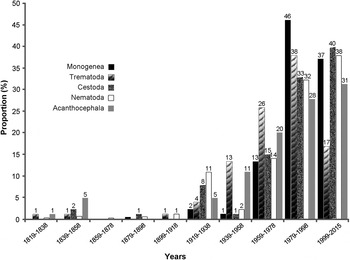
Monogeneans represent the most diverse group, with 835 species reported from the different countries and 1133 HPAs (tables 1 and 2). The first species to be described was B. hendorffii (Capsalidae) from the skin of Coryphaena hippurus Linnaeus, 1758 in Chile, followed by a long absence of studies (Cohen et al., Reference Cohen, Justo and Kohn2013). With a few exceptions, not until 1965 did the number of publications steadily increase (fig. 1), starting with a series of papers entitled ‘Studies on monogenetic trematodes’ (Mizelle & Price, Reference Mizelle and Price1965; Mizelle et al., Reference Mizelle, Kritsky and Crane1968; Mizelle & Kritsky, Reference Mizelle and Kritsky1969a, Reference Mizelle and Kritskyb).
Proportion of descriptions of new species and/or new geographic records (by countries) according to the main helminth taxa parasitic in fish from South America since 1819.

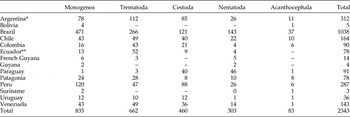
Geographical distribution of parasite richness according to the main helminth taxa parasitic in South American fish (parasites with no specific identification and larval stages were not considered).

*Including the Argentine–Uruguayan Common Fishing Zone. **Including the Galapagos Archipelago.
Freshwater monogeneans exhibited the major number of species, representing almost 64% of the HPAs. Of these, members of the family Dactylogyridae are by far the best known group, mostly parasitizing characiform fish in the Amazon River basin; even though gyrodactylids are also a species-rich group, being constantly the target of systematics and taxonomical studies (Boeger et al., Reference Boeger, Vianna, Thatcher, Adis, Arias, Rueda-Delgado and Wantzen2006; Vianna et al., Reference Vianna, Boeger and Dove2007, Reference Vianna, Boeger and Silva-Souza2008; Kritsky et al., Reference Kritsky, Boeger, Mendoza-Franco and Vianna2013). It is also worth mentioning the efforts to document the diversity of monocotylids of the genus Potamotrygonocotyle Mayes, Brooks & Thorson, 1981, specific parasites of potamotrygonid stingrays (Potamotrygonidae), which contains 12 species, 11 of which have been described only recently (Domingues & Marques, Reference Domingues and Marques2007, Reference Domingues and Marques2011).
Concerning the marine monogeneans, they also have representatives from both cartilaginous (4% of HPAs) and bony fish (32% of HPAs) hosts. The families with the highest number of reports are Diclidophoridae and Monocotylidae in osteichthyan and chondrichthyan hosts, respectively. The Atlantic Ocean exhibited the major number of HPAs (67%) compared to Pacific waters, these results are mainly due the numerous studies on marine teleost as hosts from the Brazilian coastal zone (Luque & Poulin, Reference Luque and Poulin2007; Justo & Kohn, Reference Justo and Kohn2015).
The uneven diversity of monogeneans, biased toward species parasitizing freshwater fish, is largely due to the efforts of an international partnership between Thatcher (INPA), Kritsky (ISU) and Boeger (UFPR), among other researchers (Boeger et al., Reference Boeger, Vianna, Thatcher, Adis, Arias, Rueda-Delgado and Wantzen2006). They started a series of studies entitled ‘Neotropical Monogenoidea’ (currently in its 59th publication), which may be considered the benchmark series for any study focused on the taxonomy and systematics of this group in the South American hydrological drainages. Likewise, the substantial achievements of this research team contributed heavily to the geographical distribution of parasite richness, corresponding to their prolific taxonomic activities in Brazil (table 2).
Molecular phylogenetic reconstructions have been performed recently in systematics studies of Neotropical monogeneans (Boeger et al., Reference Boeger, Ferreira, Vianna and Patella2014a; Sepúlveda et al., Reference Sepúlveda, González and Oliva2014; Mendoza-Palmero et al., Reference Mendoza-Palmero, Blasco-Costa and Scholz2015) and the use of this tool could shed light on the evolutionary history of this extraordinarily diverse group, as yet far from being completely known.
Trematoda
The second-richest group of helminths is represented by trematodes, i.e. digeneans and aspidogastreans, species of which have been reported from all countries of South America (662), apart from Bolivia, Guyana and Suriname. Physochoerus tubulatus (Rudolphi, 1819) was the first species reported in South America from the large eel Muraena sp., although, due to an inadequate description, the genus is considered inquirendum (Madhavi, Reference Madhavi, Bray, Gibson and Jones2008). Later, the number of publications increased, with a peak between 1979 and 1998 (fig. 1) when numerous helminthologists worked intensively; for example, Amato (UFRS), Kohn (FIOCRUZ), Fernandes (FIOCRUZ) and Thatcher, who mostly surveyed Brazilian fish hosts; Lunaschi (UNLP) who published a series of papers focused on freshwater fish hosts in Argentina; and Oliva (UA) who worked on marine fish hosts off the Chilean coast (Kohn et al., Reference Kohn, Fernandes and Cohen2007). The earlier achievements of Manter and Travassos, whose contributions include the description of several species from marine fish in Galapagos and the neighbouring Pacific, as well as freshwater fish in Brazilian river basins, respectively (Manter, Reference Manter1940; Dias et al., Reference Dias, Castro, Pedroso and Calaza1990), are also notable.
So far, trematodes have been reported from marine (65% of HPAs) and freshwater teleosts (32% of HPAs). Only a few representatives have been found in chondrichthyans, i.e. two holocephalids harboured two species of aspidogastreans, and 12 elasmobranchs were parasitized mainly by members of the genus Otodistomum Stafford, 1904.
Regarding the HPAs, the trematodes showed the highest number (1227), even more than the most species-rich group (Monogenea), which seems to be greatly influenced by ‘generalist’ species that infect a wide spectrum of hosts, sometimes unrelated ones. For instance, Aponurus laguncula Looss, 1907 has been reported from 11 marine hosts belonging to nine families within four orders (Kohn et al., Reference Kohn, Fernandes and Cohen2007). However, a re-assessment of the taxonomical status of this species from the western Mediterranean, combining morphological and molecular methods, suggested the presence of at least two morphologically distinct species of the ‘A. laguncula species complex’ (Carreras-Aubets et al., Reference Carreras-Aubets, Repullés-Albelda, Kostadinova and Carrassón2011; Pérez-del-Olmo et al., Reference Pérez-del-Olmo, Kostadinova and Gibson2016). In the same way, Oliva et al. (Reference Oliva, Valdivia, Chavez, Molina and Cárdenas2015) demonstrated that the opecoelid Helicometrina nimia, a common digenean in marine fish from Chile, is in fact two different species. Thus, these ‘generalist’ species may correspond to more than a single taxon, and a higher diversity is expected rather than a euryxenic specificity (Miller et al., Reference Miller, Bray and Cribb2011).
In a special issue of the journal Systematic Parasitology (March 2016, Issue 3, pp. 219–306), distinguished trematodologists provided a comprehensive series of papers summarizing knowledge on the biodiversity of fish trematodes (Cribb, Reference Cribb2016). For marine species of Atlantic and eastern Pacific Oceans, Bray et al. (Reference Bray, Diaz and Cribb2016) compiled an extensive database of records, where they found a lower diversity of fauna in South America (through the ecoregions of Spalding et al., Reference Spalding, Fox, Halpern, McManus, Molnar, Allen, Davidson, Ferdaña, Finlayson, Halpern, Jorge, Lombana, Lourie, Martin, McManus, Molnar, Recchia and Robertson2007) compared with the richest areas (Caribbean, Gulf of Mexico and Mediterranean sea). Nevertheless, part of the south-western Atlantic (somewhere from Cabo Frio, Brazil to the northern limit of the Patagonian coast, Argentina) presented the maximum number of records from the South America coastal zone, which is in accordance with our results (table 1). Freshwater trematodes from the Americas were reviewed by Choudhury et al. (Reference Choudhury, Aguirre-Macedo, Curran, Ostrowski de Núñez, Overstreet, Pérez-Ponce de León and Santos2016), in particular by Núñez (UBA) and Santos (FIOCRUZ) for South American taxa. They outlined the lowest proportion of host species examined for parasites in this region (less than 5% of potential hosts) and stated that two hydrological systems in Brazil and Argentina are the main source of information, similar to the present results (87% of HPAs are derived from these two countries).
Experimental infections have been performed to elucidate trematode life cycles in South America (Choudhury et al., Reference Choudhury, Aguirre-Macedo, Curran, Ostrowski de Núñez, Overstreet, Pérez-Ponce de León and Santos2016), but molecular tools have shown a remarkable capacity for linking life-cycle stages, mainly when the larvae are morphologically distant from the adult forms (Jensen & Bullard, Reference Jensen and Bullard2010; Locke et al., Reference Locke, McLaughlin, Lapierre, Johnson and Marcogliese2011; Womble et al., Reference Womble, Orélis-Ribeiro and Bullard2016). Despite several records of metacercariae from freshwater fish in South America (Ostrowski de Núñez & Gil de Pertierra, Reference Ostrowski de Núñez, Gil de Pertierra, Ranzani-Paiva, Takemoto and Lizama2004), few data are available using an integrated morphological and molecular approach, e.g. Austrodiplostomum compactum (Lutz, 1928) (= A. mordax) has been isolated from more than 30 fish hosts (see references in Rosser et al., Reference Rosser, Alberson, Khoo, Woodyard, Pote and Griffin2016); however, several of these larval diplostomids may corresponds to A. ostrowskiae Dronen, 2009. Sequences of mitochondrial genes from metacercarie in Satanoperca spp. from Brazil and Peru matched those from both larval and adult stages of A. ostrowskiae from eight fish (Cichlidae, Heptapteridae) and one species of fish-eating bird in Mexico, El Salvador and Venezuela (Locke et al., Reference Locke, Al-Nasiri, Caffara, Drago, Kalbe, Lapierre, McLaughlin, Nie, Overstreet, Souza, Takemoto and Marcogliese2015; García-Varela et al., Reference García-Varela, Sereno-Uribe, Pinacho-Pinacho, Domínguez-Domínguez and Pérez-Ponce de León2016). Most likely, these species are sympatric in South America (García-Varela et al., Reference García-Varela, Sereno-Uribe, Pinacho-Pinacho, Domínguez-Domínguez and Pérez-Ponce de León2016).
Hence, as advocated by Choudhury et al. (Reference Choudhury, Aguirre-Macedo, Curran, Ostrowski de Núñez, Overstreet, Pérez-Ponce de León and Santos2016), we agree that further robust taxonomic studies on fish trematodes should address an integrative approach rather than one based on a singular method of circumscription.
Cestoda
The tapeworms represents the third species-rich group, with 460 species found in all but four countries (table 2), even though they showed only 15% of HPAs (table 1). Diesing (Reference Diesing1850) described several species collected by Natterer in Brazil and, seemingly, this is the first account on the group in fish from South America. The number of studies has increased regularly since 1919, reaching a peak between 1999 and 2015 (fig. 1). The National Science Foundation-Planetary Biodiversity Inventories (NSF–PBI) project ‘A survey of the tapeworms (Cestoda: Platyhelminthes) from vertebrate bowels of the Earth’ (2008–2014) has contributed largely for this growth, aiming to expand knowledge on the global diversity of tapeworms (see http://tapewormdb.uconn.edu). The project funded long-term studies on South American fish hosts from both freshwater and marine systems, which were carried out mainly by de Chambrier (MHNG) and Gil de Pertierra (UBA), both focusing on teleost hosts, as well as by Ivanov (UBA) and Marques (USP), both targeting elasmobranch hosts, together with other recognized cestodologists, e.g. Reyda (SUNY, Oneonta), Caira (UConn) and Scholz (IPCAS). Prior this period, the contributions of Woodland (WBSR) and Brooks (UofT) are also noteworthy; the former described 32 new species of proteocephalideans belonging to eight new genera from specimens collected in the early 1930s in the Amazon River, Brazilian streams (de Chambrier et al., Reference de Chambrier, Scholz and Kuchta2014), whereas the latter and partners have described more than 35 new species, 15 of which belong to the genus Acanthobothrium Blanchard, 1848 (Brooks et al., Reference Brooks, Mayes and Thorson1981; Marques et al., Reference Marques, Brooks and Barriga1997). The studies of Rego (FIOCRUZ) and Pavanelli (UEM) in the 1980s and 1990s are worth mentioning, due to their contribution on the taxonomy of proteocephalideans in Brazil (Rego et al., Reference Rego, Chubb and Pavanelli1999). Recently, de Chambrier et al. (Reference de Chambrier, Kuchta and Scholz2015) updated a previous list of adult proteocephalidean tapeworms parasitizing freshwater teleosts from the Peruvian Amazon, and Alves et al. (Reference Alves, de Chambrier, Scholz and Luque2015) proposed a new genus and a new species parasitic of an endemic Amazonian siluriform fish.
Among the extant orders of tapeworms, assuming that Proteocephalidea is not included in the Onchoproteocephalidea (Arredondo et al., Reference Arredondo, Gil de Pertierra and de Chambrier2014), 13 have been recorded in fish from South America, making the Proteocephalidea the most representative group so far, with over 100 species within 37 genera, primarily infecting freshwater siluriforms (81% of HPAs) in the Amazon and Paraná River basins. For instance, the second-richest order, Onchoproteocephalidea (pro parte), has only about 44 described/reported species, parasitizing marine and freshwater elasmobranchs (only Acanthobothrium chilensis Rego, Vicente & Herrera, 1968 is known from a teleost fish).
Despite the richest fauna of cestodes being in freshwater teleosts (45% of HPAs; table 1), the species infecting elasmobranchs from marine and freshwater systems are relatively well documented (295 HPAs) when compared with other helminth taxa (a total of 133 HPAs), exhibiting a large variety of forms and usually oioxenous (i.e. species-specific) associations with their hosts (Caira & Jensen, Reference Caira and Jensen2014). Marine teleosts, including two diadromous fish hosts (Galaxias spp.) showed the least number of records (6% of HPAs), being parasitized almost exclusively by botriocephalideans. The frequency of these cestodes varies between different depths of the ocean, and those infecting bathypelagic fish, living deeper than 1000 m, harbour a rather diverse fauna (Kuchta & Scholz, Reference Kuchta and Scholz2007). Since hosts at such depths are poorly studied for their parasites, together with several other obstacles involved in the study of botriocephalidean systematics (Kuchta et al., Reference Kuchta, Scholz and Bray2008), a higher diversity is to be expected off the South American coast.
Although marine teleosts are poorly known as definitive hosts of cestodes in South America, they are commonly reported as second intermediate or paratenic hosts for larval stages (metacestodes), mainly of diphyllobothriideans, ‘tetraphyllideans’ and trypanorhynchs (Palm, Reference Palm1997; Luque & Poulin, Reference Luque and Poulin2004; Kuchta et al., Reference Kuchta, Serrano-Martínez and Scholz2015). The accurate identification of these forms is generally problematic, because they lack key morphological traits that are present in their adult counterparts, and studies dealing with genetic characterization are scarce (Jensen & Bullard, Reference Jensen and Bullard2010; Rozas et al., Reference Rozas, Bohle, Sandoval, Ildefonso, Navarrete and Bustos2012); the only exceptions are the larval trypanorhynchs that may be identified precisely based on their tentacular armature (Jensen & Bullard, Reference Jensen and Bullard2010). Tetraphyllidean larvae tentatively termed Scolex pleuronectis Müller, 1788 and S. polymorphus Rudolphi, 1819 that have been reported widely in the south-western Atlantic Ocean (Luque & Poulin, Reference Luque and Poulin2004) are, in fact, a group of species that share morphological features (Jensen & Bullard, Reference Jensen and Bullard2010). Maybe this collective group name even represents species from different taxa other than the artificial Tetraphyllidea (Jensen & Bullard, Reference Jensen and Bullard2010).
The great diversity of cestodes from the Amazon and Paraná River basins, corresponding to the territories of Argentina, Brazil, Paraguay and Peru (table 2), mirrors the extraordinary diversity of the freshwater fish fauna inhabiting these river systems (Reis, Reference Reis2013; Poulin, Reference Poulin2014), but the true species richness is rather far from being well known.
Nematoda
Despite the high general diversity of the phylum Nematoda, those worms parasitic in fish from South America represent the fourth taxon in terms of species reported from different countries, after Monogenea, Trematoda and Cestoda (table 2). However, the HPAs for Nematoda (21%) outperform those of Cestoda (15%) and Acanthocephala (3%). The first record of a nematode parasitizing fish in South America dates from 1819, represented by the description of Oncophora melanocephala (Rudolphi, 1819) (= Trichocephalus gibbosus) (Camallanidae) from Thunnus thynnus (Linnaeus, 1758) off the Brazilian coast (Luque et al., Reference Luque, Aguiar, Vieira, Gibson and Santos2011). One century later (1819–1919) just a few species had been described (see fig. 1), mainly due to the efforts of Diesing, Molin and von Drasche, working on helminth fauna of fish from Brazil (Moravec, Reference Moravec1998; Luque et al., Reference Luque, Aguiar, Vieira, Gibson and Santos2011). The taxonomic studies rose again during 1920–1935, a period of extensive research by Travassos, working on nematodes from freshwater fish in Brazil.
From the early 1980s until the later 1990s, the number of new species proposals increased dramatically compared with the historical trend of Nematoda parasitic in fish until this period (fig. 1). This scenario was possible because of the collaborations between European and South American researchers (or institutions), e.g. Petter (MNHN) working mainly in the north of the subcontinent, but also in Paraguay, where she described seven species of nematodes in freshwater fish during the year of 1984 (Petter & Cassone, Reference Petter and Cassone1984; Petter, Reference Petter1984). It is also worth mentioning the work of Moravec (IPCAS) during the 1990s, in partnership with some Brazilian researchers from the FIOCRUZ, as well as with Thatcher from the INPA, resulting in the description of several new taxa (about 16 new species and four new genera) (Moravec, Reference Moravec1998; Moravec & Thatcher, Reference Moravec and Thatcher1999); thereby contributing much to our knowledge on the biodiversity of nematodes from fish in the Neotropics.
In the past decade, the number of taxonomic papers has continued to increase, mainly as a result of the efforts from Argentinean and Brazilian research groups on fish parasites (Timi et al., Reference Timi, Rossin and Lanfranchi2006, Reference Timi, Lanfranchi, Tavares and Luque2009; Pereira et al., Reference Pereira, Tavares, Scholz and Luque2015a; Vieira et al., Reference Vieira, Pereira, Pantoja, Soares, Pereira, Timi, Scholz and Luque2015). Furthermore, during this same period, the checklist of González-Solís & Mariaux (Reference González-Solís and Mariaux2011) on nematodes parasitic in fish from Paraguay also contributed to the number of new locality records (27), according to our data compilation (fig. 1).
The numbers of HPAs for Nematoda in table 1 reflect the fact that the parasite fauna from freshwater systems (HPA = 661, representing 80% of the total) is better studied than that from marine zones (HPA = 167, representing 20% of the total), which is a trend noted in all South American countries (Luque & Poulin, Reference Luque and Poulin2007). The total number of HPAs is highly influenced by those from Brazil, a wide and diverse territory, retaining a highly diverse freshwater fish fauna. The obvious explanation is that sampling efforts (mainly taxonomic) have concentrated on the parasite fauna from freshwater fish throughout the continent (similar to that of the previous analysis by Poulin, Reference Poulin2004); however, why the researchers have concentrated their efforts on the freshwater ichthyofauna is hard to answer. Possibly, the high availability of fresh, or even alive, fish from freshwater environments could influence the choice of the taxonomists, since the freshness of a parasite when fixed is fundamental for the preservation of its real morphological traits. Nevertheless, the greater diversification of freshwater than marine parasites of fish (Poulin, Reference Poulin2016) cannot be discarded as an influencing factor.
Finally, regarding the phylum Nematoda, the primary problems concerning its general taxonomy are related mainly to the taxa richest in species, such as Anisakidae Railliet & Henry, 1912, Camallanidae, Railliet & Henry, 1915 and particularly Cucullanidae Cobbold, 1864. These families retain a high number of species with poor description, lacking important data on their characterization, and some of them parasitize a wide spectrum of hosts (e.g. Procamallanus (Spirocamallanus) inopinatus Travassos, Artigas & Pereira, 1928 and Cucullanus pinnai Travassos, Artigas & Pereira, 1928 and its subspecies) (Moravec, Reference Moravec1998; Luque et al., Reference Luque, Aguiar, Vieira, Gibson and Santos2011). The problem is even worse within cucullanids, due their rather uniform morphology (Vieira et al., Reference Vieira, Pereira, Pantoja, Soares, Pereira, Timi, Scholz and Luque2015). The lack of molecular data is also a barrier to the elucidation of these taxonomic issues, as recently observed by Pereira et al. (Reference Pereira, Tavares, Scholz and Luque2015a, Reference Pereira, Tavares, Paiva, Scholz and Luqueb), these problems including the detection of possible cryptic or sibling species, as in the case of those host-generalist parasites.
This situation would also be applicable to the taxonomy of larval stages common in marine teleost fishes, e.g. Anisakidae species, with zoonotic importance and widely distributed in South America (Tavares & Luque, Reference Tavares, Luque and Silva-Souza2006). Recent papers by Borges et al. (Reference Borges, Cunha, Santos, Monteiro-Neto and Santos2012, Reference Borges, Cunha, Miranda, Monteiro-Neto and Santos2015), Pantoja et al. (Reference Pantoja, Borges, Santos and Luque2015, Reference Pantoja, Pereira, Santos and Luque2016) and Mafra et al. (Reference Mafra, Mantovani, Borges, Barcelos and Santos2015) have demonstrated the importance of molecular data for adequate diagnosis.
Acanthocephala
The fauna of acanthocephalans in fish from South America is the most depauperate compared with other helminth taxa, with only 83 species reported from the different countries, representing less than 5% of the total HPAs (tables 1 and 2). Rhadinorhynchus pristis (Rudolphi, 1802) was apparently the first species reported in the subcontinent, parasitizing marine fish off Rio de Janeiro, Brazil (Santos et al., Reference Santos, Gibson, Tavares and Luque2008). Later, some helminthologists contributed to our knowledge of acanthocephalans; for example, Travassos, Machado-Filho (among other researchers of the Laboratório de Helmintos Parasitos de Vertebrados, FIOCRUZ) and Thatcher. They described about 20 species, mainly from characiform fish in the Amazon and Paraná River basins (Santos et al., Reference Santos, Gibson, Tavares and Luque2008), which is reflected in the proportion of species reported during their respective periods of contribution (from 1923 to 2001; fig. 1) and in the geographical distribution of parasite richness (the majority of species being reported from Brazil; table 2). In a review of Acanthocephala in the Neotropical region, Amin (Reference Amin, Salgado Maldonado, García-Aldrete and Vidal-Martínez2000) suggested that this uneven distribution is due to the biased sampling efforts of research teams for some particular group of hosts or parasites, as we have already stated for the other groups of helminths.
Acanthocephalans are parasites of freshwater (74% of HPAs) and marine teleosts (25% of HPAs), except for Megapriapus ungriai (Gracia-Rodrigo, 1960) described exclusively from the freshwater stingray Potamotrygon sp. (reported as P. hystrix) in Venezuela (Weaver & Smales, Reference Weaver and Smales2014). Elasmobranchs are considered occasional/accidental or paratenic hosts rather than definitive ones, but there is no conclusive evidence on the host spectrum of the group (Weaver & Smales, Reference Weaver and Smales2014).
Members of Polymorphidae, largely reported from marine teleosts in South America, i.e. representatives of Bolbosoma Porta, 1908, Corynosoma Lühe, 1904 (sensu Van Cleave 1945), Polymorphus Lühe, 1911 and Hexaglandula Petrochenko, 1950 (see García-Varela et al., Reference García-Varela, Pérez-Ponce de Léon, Aznar and Nadler2013 for the controversial status of the latter genus), were not included in our dataset, because they are found only as larvae (cystacanths) from paratenic fish hosts (García-Varela et al., Reference García-Varela, Pérez-Ponce de Léon, Aznar and Nadler2013). Studies dealing with molecular characterization to link the larval forms and adults are limited in South America (Sardella et al., Reference Sardella, Mattiucci, Timi, Bastida, Rodríguez and Nascetti2005), not allowing an accurate species-level identification.
Since acanthocephalans do not (or rarely) cause significant human or veterinary disease, they are commonly neglected by helminthologists worldwide (Kennedy, Reference Kennedy2006), which is corroborated by our dataset. Nevertheless, even though at a slow rate, recent efforts have been undertaken to depict the diversity of this group in South American fish (fig. 1; Vieira et al., Reference Vieira, Felizardo and Luque2009; Arredondo & Gil de Pertierra, Reference Arredondo and Gil de Pertierra2010, Reference Arredondo and Gil de Pertierra2012; Lanfranchi & Timi, Reference Lanfranchi and Timi2011; Braicovich et al., Reference Braicovich, Lanfrachi, Farber, Marvaldi, Luque and Timi2014; Lisitsyna et al., Reference Lisitsyna, Scholz and Kuchta2015; Mello et al., Reference Mello, Jerônimo, Tancredo, Brol, Almeida, Martins and Tsuzuki2015).
The data gathered from the literature proved to be useful to estimate roughly the species richness of helminths from South American fish, even though some problems are associated with the interpretation of this database: (1) the reliability of information is reliant on accurate species identifications; (2) the lack of knowledge on life cycles matching larvae and adults; (3) the discovery of increasing numbers of cryptic species, i.e. morphologically similar but genetically distinct; (4) the geographically biased number of studies. Therefore, the closest true estimation of species diversity and HPA patterns will rely on further studies combining both molecular and morphological approaches with ecological data, such as host specificity, geographical distribution and life cycles.
Searching for and detecting macroecological patterns
One of the foci of fish parasitology research that has received increasing attention in South America in recent years is macroecology – using fish as a model to test a set of ecological hypotheses aimed at detecting large-scale ecological patterns of diversity and distribution of the fish parasites as a result of evolutionary processes and biogeographical events.
Initially, fish parasitology research in South America was exclusively taxonomic. However, numerous papers on quantitative descriptions of fish parasite communities, especially marine species, have been published since the 1980s and 1990s, and many authors of these papers are researchers with significant taxonomic expertise from Argentina, Chile, Brazil and Peru. This characteristic of the former quantitative descriptive papers gave rise to extensive datasets suitable for testing macroecological hypotheses, in collaboration with overseas researchers. Later, a significant increase in the number of studies of macroecological patterns, using fish parasites as models, was observed in South America.
Therefore, numerous papers on a wide variety of fish parasite ecology topics, using various methodological approaches and large databases on host–parasite associations, have been published in recent years. We can highlight those on the biodiversity of parasite species distribution and its determinants (Luque et al., Reference Luque, Mouillot and Poulin2004; Takemoto et al., Reference Takemoto, Pavanelli, Lizama, Luque and Poulin2005; Luque & Poulin, Reference Luque and Poulin2007, Reference Luque and Poulin2008); on patterns of distribution of parasite populations, structure of parasite communities and nestedness (Poulin & Luque Reference Poulin and Luque2003; Timi & Poulin, Reference Timi and Poulin2003, Reference Timi and Poulin2008; Poulin et al. Reference Poulin, Luque, Guilhaumon and Mouillot2008; González & Oliva, Reference González and Oliva2009; Timi et al., Reference Timi, Luque and Poulin2010; Amarante et al., Reference Amarante, Tassinari, Luque and Pereira2015), also including a quantitative approach to the structure and patterns of parasite specialization in host–parasite networks (Bellay et al., Reference Bellay, Oliveira, Almeida-Neto, Pereira, Takemoto and Luque2013, Reference Bellay, Oliveira, Almeida-Neto, Abdallah, Azevedo, Takemoto and Luque2015a, Reference Bellay, Oliveira, Almeida-Neto, Mello, Takemoto and Luqueb). Special mention can be made of the research on the use of parasites as biological tags for discrimination of stocks of marine species of economic importance. Research groups from Chile, Argentina and Brazil have demonstrated how the South American Pacific Ocean (George-Nacimento & Oliva, Reference George-Nascimento and Oliva2015) and South American Atlantic Ocean (Cantatore & Timi, Reference Cantatore and Timi2015) are areas where parasites can be used to consistently discriminate fish stocks.
The profusion of studies on parasitic macroecology by South American researchers, using fish as a model, demonstrates the great possibility of building more databases in order to test, with consistency, different assumptions on biodiversity and species distribution of the helminth parasites in the Neotropical fishes.
Current research groups and their geographic distribution
Interest in helminths from fish in South America has increased greatly during the past 20 years (fig. 1). In this section, the most active research groups from the subcontinent, who have published many papers on the taxonomy and ecology of helminth parasites of fish during the past 6 years, are introduced briefly. However, it is worth mentioning that there are many other researchers working on these subjects, who are not presented here.
Currently, Brazil includes the majority of the research groups in South America; they are distributed mainly in the north, south-east and south of the country. In the State of Pará, two groups have contributed mainly to helminth taxonomy, one resident in the UFPA, focusing on monogeneans (Branches & Domingues, Reference Branches and Domingues2014; Santos et al., Reference Santos Neto, Rodrigues and Domingues2015), and the other in the UFRA, working on some other taxa (Melo et al., Reference Melo, Costa, Giese, Gardner and Santos2013a, Reference Melo, Silva, Gonçalves, Furtado, Giese and Santosb) including the poorly known Aspidogastrea (Giese et al., Reference Giese, Silva, Videira, Furtado, Matos, Gonçalves, Melo and Santos2014). In the south-east, some groups belonging to three different institutions have contributed to taxonomic knowledge, as follows. In the UFRRJ, research in the Laboratory of Fish Parasitology has focused on nematodes (Vieira et al., Reference Vieira, Pereira, Pantoja, Soares, Pereira, Timi, Scholz and Luque2015), besides other taxa (Paschoal et al., Reference Paschoal, Scholz, Tavares-Dias and Luque2016), including recent insights using an integrated taxonomic approach (Pereira et al., Reference Pereira, Tavares, Scholz and Luque2015a, b). Research by some groups from FIOCRUZ has dealt with the taxonomy of several helminth taxa (Justo & Kohn, Reference Justo and Kohn2012; Leão et al., Reference Leão, São Clemente and Cohen2015), including molecular characterization and diagnosis (Borges et al., Reference Borges, Cunha, Miranda, Monteiro-Neto and Santos2015; Mafra et al., Reference Mafra, Mantovani, Borges, Barcelos and Santos2015). Finally, the Laboratory of Evolutionary Helminthology from USP includes a productive group focusing on the taxonomy of cestodes parasitic in Chondrichthyes (Marques et al., Reference Marques, Jensen and Caira2012; Marques & Reyda, Reference Marques and Reyda2015). It is also important to highlight the activity of researchers from UFRRJ in several studies on the ecology of parasites from fish (Amarante et al., Reference Amarante, Tassinari, Luque and Pereira2015; Soares & Luque, Reference Soares and Luque2015), which is a subject equally explored by the research group from the Laboratory of Ichthyoparasitology, UEM, State of Paraná (southern Brazil) (Bellay et al., Reference Bellay, Oliveira, Almeida-Neto, Abdallah, Azevedo, Takemoto and Luque2015a, b). Also in Paraná, the group formed by researchers from the Department of Zoology of the UFPR, have produced one of the most impressive collections of literature on the morphological and molecular taxonomy of monogeneans (Boeger et al., Reference Boeger, Kritsky, Domingues and Bueno-Silva2014b, Reference Boeger, Pariselle and Azambuja2015).
Aspects concerning the pathology caused by helminths in fish are still poorly explored in South America, as well as their management and control. Just a few researchers are currently working on this subject. In Brazil two groups can be cited: one from the EMBRAPA, State of Amapá (Soares et al., Reference Soares, Neves, Oliveira, Chaves, Dias, Chagas and Tavares-Dias2016), and one from the Department of Aquiculture of the UFSC, State of Santa Catarina (Mello et al., Reference Mello, Jerônimo, Tancredo, Brol, Almeida, Martins and Tsuzuki2015; Hashimoto et al., Reference Hashimoto, Marinho Neto, Ruiz, Acchile, Chagas, Chaves and Martins2016).
The Argentinean research groups are mainly from the UNMdP as well as from the UBA. Some members of these groups are specialists on parasite ecology (Braicovich & Timi, Reference Braicovich and Timi2015; Cantatore & Timi, Reference Cantatore and Timi2015) who have published many papers on parasites as biological tags for stock discrimination (Alarcos et al., Reference Alarcos, Pereira, Taborda, Luque and Timi2016; Cantatore et al., Reference Cantatore, Irigoitia, Holzer and Timi2016). These researchers have also contributed to the taxonomic knowledge about some taxa, such as Monogenea (Irigoitia et al., Reference Irigoitia, Cantatore, Delpiani, Incorvaia, Lanfranchi and Timi2014), Nematoda (Timi et al., Reference Timi, Paoletti, Cimmarutta, Lanfranchi, Alarcos, Garbin, George-Nascimento, Rodriguez, Giardino and Mattiucci2014) and Acanthocephala (Braicovich et al., Reference Braicovich, Lanfrachi, Farber, Marvaldi, Luque and Timi2014). In Buenos Aires there are two groups working on helminths from fish, one that has been studying the taxonomy of cestodes (Gil de Pertierra et al., Reference Gil de Pertierra, Arredondo, Kuchta and Incorvaia2015; Menoret & Ivanov, Reference Menoret and Ivanov2015), and one that has been working on digeneans, including their taxonomy (Arredondo & Ostrowski de Núñez, Reference Arredondo and Ostrowski de Nuñez2013) and life-cycle surveys (Quintana & Ostrowski de Núñez, Reference Quintana and Ostrowski de Núñez2016).
The research group from the UA, Chile, has dealt with different subjects concerning helminths parasitic in fish, including ecological (Oliva et al., Reference Oliva, Espinola and Ñacari2016) and taxonomic studies (molecular and morphological characterization) of some taxa (Oliva et al., Reference Oliva, Sepulveda and González2014, Reference Oliva, Valdivia, Chavez, Molina and Cárdenas2015).
It is worth noting the network of interactions between the current research groups in South America. Researchers from Chile, Argentina and Brazil have been actively working in partnerships during recent years (Luque et al., Reference Luque, Cordeiro and Oliva2010; Vieira et al., Reference Vieira, Pereira, Pantoja, Soares, Pereira, Timi, Scholz and Luque2015; Alarcos et al., Reference Alarcos, Pereira, Taborda, Luque and Timi2016), which represents an important step forward for knowledge of helminth biodiversity from this large and species-rich subcontinent.
Final comments
South America is undoubtedly a region where parasite biodiversity is clearly underestimated. The great ichthyological diversity of the region shows the huge dimension of the challenge for basic knowledge of helminth fauna from fish in this continent. This challenge is noticeably due to two major problems: lack of sufficient financial resources (funding) and the small number of research groups with excellence to address this task. It is important to mention at this point that, although most countries of South America do not have consolidated research groups on helminth parasites of fish, some early problems, such as the absence of interchangeable data, effort duplicity and the significant volume of unindexed publications, are clearly decreasing in the region.
Recently, Poulin (Reference Poulin2014) mentioned the impossibility of making an inventory of all groups of parasites, for various reasons or limitations, but mainly due to taxonomic impediments and the presence of cryptic species. He suggested that it may be more advantageous in terms of knowledge of parasite biodiversity, to select consistent models, so as to take the opportunity to deepen some studies, e.g. taxonomy, host–parasite relationships and ecological aspects. South America has several promising and little-studied regions in this respect, with great fish-host diversity and peculiar ecological characteristics, e.g. the Amazon River basin, Pantanal wetlands and rivers of the Peruvian Andes, where there is a high degree of endemism and it is more likely to be possible to survey the entire parasite fauna of fish. From this perspective, significant advances in the study of parasite biodiversity could be achieved.
Interestingly, Scholz & Choudhury (Reference Scholz and Choudhury2015) list some problems that prevented the further development of studies of freshwater fish parasites in North America, which are repeated in South America. Thus, international collaboration has been an essential feature of fish parasitology in the region. We would like to emphasize the strategic importance of increasing collaboration and expanding networks at the regional level and, fundamentally, with research groups with greater experience from other continents. The increase of exchanged information and research networks in the global context allows us to visualize a promising and productive future for fish parasitology in South America.
Financial support
J.L.L. was supported by a Research fellowship from CNPq (Conselho Nacional de Desenvolvimento Científico e Tecnológico do Brasil). P.V.A. was supported by a Doctoral fellowship from CNPq. F.B.P. was supported by a Postdoctoral fellowship from PNPD-CAPES (Programa Nacional de Pós-Doutorado, Coordenação de Aperfeiçoamento de Pessoal de Nível Superior, Brazil).
Conflict of interest
None.