Post-rebel party formation is very common (Manning and Smith Reference Manning and Smith2016; Matanock Reference Matanock2018; Soderberg Kovacs and Hatz Reference Soderberg Kovacs and Hatz2016). Carrie Manning and Ian Smith (Reference Manning and Smith2016) found that in civil wars ending in 1990 or later, rebel groups formed political parties more than half the time. Moreover, nearly 65 per cent of these parties have contested every available post-war election, giving some of these parties more than two decades of electoral experience. Unlikely long-term contenders include parties as different as Mozambique’s Renamo, Hezbollah (Lebanon), four different parties in Iraq, SDS and HDZ (Bosnia), FMLN (El Salvador), Sinn Féin (Northern Ireland) and ALCOP (Liberia).Footnote 1
With so many disparate post-rebel parties consistently participating in elections, what do we know about their electoral performance? Scholars have begun to examine these parties’ electoral fortunes and the implications for lasting peace and democratic outcomes (Allison Reference Allison2006, Reference Allison2010; Dresden Reference Dresden2015; Ishiyama and Marshall Reference Ishiyama and Marshall2015; Ishiyama and Widmeier Reference Ishiyama and Widmeier2013, Reference Ishiyama and Widmeier2017; Manning Reference Manning2008; Manning and Smith Reference Manning and Smith2016; Marshall 2017; Matanock Reference Matanock2018; Ogura Reference Ogura2011; Sindre Reference Sindre2016a, Reference Sindre2016b, Reference Sindre2018; Sindre and Soderstrom Reference Sindre and Soderstrom2016; Soderberg Kovacs and Hatz, Reference Soderberg Kovacs and Hatz2016; Sprenkels Reference Sprenkels2018; M. Whiting Reference Whiting2016; S. Whiting Reference Whiting2016; and the contributions to this special issue). However, very few comparative studies have investigated the correlates of these parties’ electoral performance systematically over an extended period of time, particularly in a larger-N comparative context (these include, to our knowledge, Dresden Reference Dresden2015; Ishiyama and Widmeier Reference Ishiyama and Widmeier2017; Manning and Smith Reference Manning and Smith2016).
In this article, we present new research tracking the participation of post-rebel parties in national legislative elections from 1990 to 2016.Footnote 2 The parties in our data set have participated in two to eight electoral cycles. We include all post-rebel parties formed after conflicts ending in 1990 or later – including any parties that formed as breakaways or ‘secondary parties’ from the original post-rebel party. Our full data set covers 77 parties and 286 elections in 37 countries. It includes parties formed after conflicts of varying length and intensity, with different incompatibilities, in every region of the world, and in countries with disparate political histories.
We study both the initial and long-term impacts on party electoral performance in a large-N study using both OLS and cross-sectional time series models to test the significance of a set of environmental and party-related factors. We find that environmental factors, from the characteristics of the wartime party system to electoral rules, interact in complex ways with post-rebel parties’ organizational strengths and weaknesses. Rather than providing a firm, cut and dried answer about the kinds of parties that do best or the competitive environments that are most conducive to post-rebel party electoral success, our analysis focuses on finding the key pathways to success or failure in post-war elections.
The rest of the article proceeds as follows. In the next section, we advance a theoretical argument to explain the long-term performance of post-rebel parties, one that is grounded in the literature on post-rebel and other types of successor parties, and on political party development more broadly. We put inter- and intra-party competition at the core of our theoretical explanation. In brief, more competitive electoral environments place higher demands on parties to identify and invest in new strategies and tactics to win elections. We expect that for a given level of challenge (for a given political environment), the organizational history and other characteristics of a post-rebel party will shape the risk–reward ratio for party leaders contemplating whether and how much to invest in adapting their party’s ideological appeals, collective identity or organizational routines, such as candidate selection procedures, in order to win seats. After describing the data, we present the results of our quantitative analysis and conclude by reflecting on the theoretical and policy implications of our findings.
Explaining the electoral performance of rebel successor parties
Which post-rebel parties adapt successfully to electoral politics over the long term? Winning seats in the legislature consistently over time is indicative of successful adaptation to electoral politics. The argument we advance to explain variation in the electoral performance of post-rebel parties is driven by both environmental and organizational factors, which together determine the risk–reward ratio for parties adapting to and investing in electoral politics over time. Our argument generally follows Angelo Panebianco’s (Reference Panebianco1988) claim that party performance is a factor of either how well the party can adapt to political conditions or how well it can adapt politics to its needs.
We begin with the following assumptions. First, rebel groups and political parties are not unitary actors, but, as Giovanni Sartori (Reference Sartori2005) has said of parties, they are composed of subgroups whose membership and interests may shift over time. These subgroups might be based on deeply rooted ideological differences or on differences over tactics or strategy arising from the functional role of some groups over others.
Second, as Panebianco (Reference Panebianco1988: 10) notes, parties are both voluntary associations and bureaucracies: ‘Parties are bureaucracies requiring organizational continuity and hierarchical stability, and at the same time voluntary associations which rely on at least a minimum of non-obligatory participation.’
To attract candidates, cadres to run the central party or its regional wings, parties provide selective incentives. These are material rewards that can be allotted to particular individuals to induce effort and loyalty. The provision of selective incentives satisfies the rational interests of those who work for the party, while collective incentives increase organizational loyalty.
But, as voluntary associations, parties attract followers by offering ‘collective incentives’ that appeal broadly to followers in terms of ideology or identity, or both, thus creating what Panebianco calls ‘an electorate of belonging’ or a ‘community of fate’. To win elections, parties need to offer a compelling set of ideas, a collective identity that can help form a clear partisan boundary. Where a party effectively monopolizes a collective identity, it gives the party’s leaders an advantage over its followers. Party leaders have more room to manoeuvre, in terms of tweaking ideology or party goals, ‘the more the party is a “community of fate”, a community defined by a specific identity that has no equivalent in the external market’ (Panebianco Reference Panebianco1988: 31).
Finally, like most organizations, rebel groups and political parties seek both to achieve particular goals and to sustain themselves as organizations. Their leaders face a similar two-level game as they seek to maintain their leadership positions and preserve the organization itself. These goals are sometimes in tension with one another. A major change in environment (from battlefield to electoral arena) might pose challenges to organizational cohesion and to incumbent organizational leaders. The pursuit of elected office could require changes to the party’s identity or ideological foundations. It might lead the party to court new voter groups or recruit leadership cadres with different skill sets from those that were prized in wartime. Such changes sometimes generate challenges to the party’s incumbent leadership from within.
At a given level of competitiveness, some organizations will be able to weather the organizational challenges of consistent electoral competition, and others will not. We expect that organizations, and their leaders, will resist change unless they find their own survival or primary goals threatened by the failure to change – most likely in more highly competitive political arenas. At low levels of electoral competitiveness, parties can more easily win seats at relatively low cost. They don’t have to risk losing followers by changing their collective incentives, for example. Or they might not have to change their leadership style or structure in order to accommodate the demands of rigorous campaigning.
Consistent, solid electoral performance by post-rebel parties does not necessarily indicate that these parties are becoming more institutionalized, or more internally democratic, or contributing to the growth of democracy. Indeed, even the weakest parties might perform well in an environment in which the wartime political cleavage around which they mobilized followers is alive and well, or where there are few older parties from a previous era of multiparty politics.
By contrast, where environments are competitive, and especially where external guarantors enforce the rules to some extent, we would expect to see party adaptation. What makes a political environment competitive? One answer is rival parties, especially those that appeal to a similar electoral base (ethnic or ideological rivals). We also expect that the presence of older, pre-war parties will crowd out newer, post-rebel parties, diminishing their long-term electoral performance. Where a party’s ideological appeals or collective identity face strong competition from rival parties, it may need to adapt its own strategies in order to compete. Finally, electoral systems based on proportional representation (PR) present a lower barrier to winning representations than majoritarian electoral systems, and we would expect that post-rebel parties may do better in systems with proportional representation.
Our quantitative analysis thus focuses on two broad sets of factors: the party’s endowments as an organization, including the capacity developed during a period of wartime territorial governance, any prior political experience, ideological bonds forged with supporters, or leadership or organizational coherence; and second, the political environment into which these post-rebel parties emerged after war, including characteristics of the party system (the presence of various kinds of rival parties), the degree to which the democratic rules of the game are enforced and the institutional framework governing political competition.
Organizational Endowments
A party’s organizational endowments include both organizational capacity (the ability to mobilize and deploy resources, make authoritative decisions, perform core administrative functions or recruit and select candidates) and ideational capital (the ability to mobilize followers around a collective identity or ideology). Our approach acknowledges that the two are intertwined – our hypotheses might be driven by either or both kinds of capacities.
Drawing on a broader literature on post-communist successor parties, recent research finds that prior political experience has a positive impact both on post-rebel party formation and on electoral performance. Parties with prior political experience may have retained some organizational structures, such as consensual decision-making organs and mechanisms for gathering input from the party base, that can facilitate the transition to party politics after the war. The CPN (M) in Nepal, for example, benefited from prior political experience, as did the FMLN (El Salvador) (Allison Reference Allison2010; Ishiyama and Widmeier Reference Ishiyama and Widmeier2013; Sprenkels Reference Sprenkels2018). Jennifer Dresden (Reference Dresden2015) and Manning and Smith (Reference Manning and Smith2016) find the relationship holds true more generally for post-rebel parties.
In addition to prior peacetime experience, organizational dynamics forged in wartime may affect post-war political formations. For example, research on cases as seemingly disparate as Aceh, Burundi, East Timor and Liberia have pointed to the enduring influence of intra-organizational networks formed in wartime – including but not limited to networks of combatants – in shaping the behaviour of post-rebel parties (Alfieri Reference Alfieri2016; Dresden Reference Dresden2015; Sindre Reference Sindre2016a, Reference Sindre2016b; Soderstrom Reference Soderstrom2016; Wittig Reference Wittig2016). Scholars of post-communist party transformations similarly emphasize the importance of connections and rivalries among internal party subgroups for later electoral performance (Ishiyama Reference Ishiyama1995; Tavits Reference Tavits2012).
Dresden (Reference Dresden2015) points out that the ability of rebel groups to mobilize support from the population during wartime does not always translate into post-war political performance. Instead, parties must build ‘convertible capacities’ that include an effective ideology or ‘networks of ethnic support’ as well as political organization. She emphasizes that ‘building political organizing capacity may be one of the best investments that a rebel group can make’ to secure electoral success later on.
A substantial literature on rebel governance suggests that administering territory may also create capacities likely to affect governance and political participation by these groups (Arjona Reference Arjona2014; Clapham Reference Clapham1998; Huang Reference Huang2012; Ishiyama and Widmeier Reference Ishiyama and Widmeier2017; Mampilly Reference Mampilly2011). Using the cases of El Salvador and Nepal and Tajikistan respectively, Michael Allison (Reference Allison2010) and John Ishiyama and Michael Widmeier (Reference Ishiyama and Widmeier2013) find that rebel control of specific regions impacts local election results. Ishiyama and Widmeier (Reference Ishiyama and Widmeier2017) extend their research to a large-N study and find, as in their case studies, that the key may lie not in the specific organizational competencies that territorial administration generates, but rather in the connections that rebel groups must forge with civilians in their areas of control to extract the resources on which they depend for their survival. This resonates with the work of scholars of insurgency who find that the basis and strength of such connections affects rebel success in wartime (Christia Reference Christia2013; Staniland Reference Staniland2014). Taken together, this work indicates that one of the key legacies of wartime experience is a party’s ability to connect with supporters by offering a shared identity and by developing specifically political capacities.
Hypothesis 1: Prior political experience (coded as pre-war party) will have a positive effect on post-war electoral performance by former-rebel parties.
Similarly, leadership continuity during the transition from rebel to party can contribute to organizational stability and voter recognition of the party immediately after the war. Continuity in leadership may also indicate that there have not been major leadership disputes and splits between the end of the fighting and the first elections. Over the longer term, however, the sustained presence of the wartime leader at the political helm could either signal a failure by the organization to adapt to new circumstances (in competitive settings) or indicate that the post-war political environment does not pose significant organizational challenges. The latter might be true when the party is able to continue trading on its wartime identity, as when the political space is still polarized around the wartime cleavage. Leadership continuity is captured by the term ‘warleader’ in our data set.
Hypothesis 2: Leadership continuity will have a positive effect on performance in the first post-war elections, and a negligible or negative effect thereafter.
If parties accrue advantages from prior experience and continuity, then it stands to reason that parties formed as a breakaway from a bigger party might find it harder to compete. Comparative literature on party branding suggests support for this hypothesis (Ahmed et al. Reference Ahmed, Lodhi and Ahmad2017; Lupu Reference Lupu2014). Allison (Reference Allison2016) finds that such parties performed poorly in Nicaragua, El Salvador and Guatemala.
Hypothesis 3: Parties formed by breaking away from one of the major post-rebel groups will perform less well in elections.
Finally, inspired by scholarship suggesting that how a conflict ends affects post-war politics, we also expect that a group’s military position at the end of the war may affect its performance in elections (Toft Reference Toft2010). The impact of this variable on post-rebel electoral performance could be driven by either environmental or organizational factors, or a combination of both. Rebel groups that win a military victory are in a position to set peace terms that already disadvantage other parties, while losing groups will likely have little bargaining power over the institutional setting. Groups that sign a separate peace, we suspect, may do so out of military or other organizational weaknesses that cause leaders to cut their losses and try their luck in the political arena. If wartime competencies transfer to the political arena, these parties will suffer. We thus include dummies for whether the war ended with a given party as the military victor or as militarily defeated, as well as whether the group signed a separate peace, suing for peace while other rebel groups continued to fight.
Hypothesis 4: A party’s military position at the end of the war will make a difference to how it performs in elections.
Environment
Environmental factors influencing party performance include the effects of formal institutions and the party system as well as the war itself.
A rich comparative literature on parties and party system development points to the importance of electoral system design in new democracies, including in post-conflict cases (Reynolds et al. 2008; Shugart and Carey Reference Shugart and Carey1992). Different electoral environments present distinctive challenges to the collective and selective incentive strategies that post-rebel parties developed during wartime. Elections can empower internal challengers to incumbent party leaders. And they may engender internal struggles over the party’s platform or identity that threaten entrenched interests but promise to bring in new voters. These challenges are likely to increase when parties enter political arenas in which they must compete against older, more experienced opposition parties. Ishiyama (Reference Ishiyama1997) found crowd-out to be a factor for post-communist party development in Eastern Europe; we also expect this to matter for post-rebel parties. These parties are coded as ‘rivals’ in our data set.
Hypothesis 5: All else being equal, the presence of older parties dating from before the post-war period will have a negative (‘crowd-out’) effect on the electoral performance of post-rebel parties.
A party’s ability to formulate a coherent collective identity is influenced in part by factors internal to the party itself. Sometimes the organizational challenges presented by post-conflict electoral politics lead to tensions between the ideational appeals that sustained the organization in wartime and those that are likely to secure electoral majorities in the post-war period. When parties act in ways counter to what they say they stand for, it weakens voter loyalty.
Environmental factors also affect the strength and utility of the party’s popular appeal. For example, when the collective identity – the community of shared fate – articulated by a party becomes less compelling because of changed economic or social conditions, or if it becomes less politically salient as other parties more effectively present themselves as champions of the same cause, then the party is likely to lose support.
These challenges are likely to be less consequential when the wartime cleavage remains relevant, as for Renamo in Mozambique, HDZ in the Bosnian-Croat Federation of Bosnia and Herzegovina, or CPN (M) in Nepal (Ishiyama and Batta Reference Ishiyama and Batta2011; Manning Reference Manning2008). By contrast, where this cleavage is no longer politically salient, parties will have to rethink their ideological or identity-based appeals, which can also put a strain on the party’s organizational capacities, as in the Serb Republic of Bosnia and Herzegovina (see Sindre 2019).
We partially capture this by coding for the presence of co-ideological parties. The presence of co-ideological parties could potentially cut both ways. On one hand, it may follow a pattern observed in post-communist Europe in which successor parties need open space in their ideological neighbourhood in order to succeed (Bunce Reference Bunce2002; Grzymala-Busse Reference Grzymala-Busse2002; Ishiyama Reference Ishiyama1997). Alternatively, the presence of these parties may indicate the continued relevance of wartime cleavages and room for the rebel group to move into electoral politics. A sizeable comparative literature deals with the stability of politically salient cleavages (Birnir Reference Birnir2007; Lipset and Rokkan Reference Lipset and Rokkan1967).
Hypothesis 6: All else being equal, the presence of co-ideological rivals, or parties staking out the same ideological territory as post-rebel parties, will have a negative effect on the electoral performance of post-rebel parties.
The timing of post-war elections might affect electoral outcomes. Immediate elections may well have advantages for post-rebel parties: fresh memories of their capacity for violence may intimidate voters into supporting them, particularly in areas they control. The post-rebel party may be the only or the most familiar party on the ballot, as with Fretilin in East Timor. Alternatively, more time means time for less well-known parties to marshal resources to contest elections.
Hypothesis 7: Longer delays between the end of war and the first election will disadvantage post-rebel parties and hurt their electoral performance in the first election.
There are also some more straightforward institutional features of the post-war political environment, such as environmental rules, that may affect the parties’ electoral performance. Newer, smaller parties may have a better chance of gaining legislative representation under systems of proportional representation than in winner-takes-all settings (Reynolds et al. 2008; Shugart and Carey Reference Shugart and Carey1992). On the other hand, in newer democracies, wartime cleavages may prove resistant to institutional incentives, as in Mozambique where a polarized, two-party system prevails despite proportional election rules for the legislature (Birnir Reference Birnir2007; Manning Reference Manning2008).
Hypothesis 8: Post-rebel parties will perform better in post-war elections under systems of proportional representation, as compared to systems based on single member districts.Footnote 3
Controls
Actors’ strategies in respect of electoral politics are also likely to vary with their expectations about the stability of the rules in place. We control for this through the use of Freedom House political freedom and civil liberties measures and code the involvement of an international peacekeeping mission (or other influential international actors overseeing the transition).
Subnational elections might also change the dynamics of national elections. As George Tsebelis (Reference Tsebelis1991) has pointed out, when a game is played out in multiple arenas, players’ strategies will be affected in ways that could impact their electoral performance. Examples include El Salvador, where mayoral elections generated internal challenges, and Mozambique, where municipal elections gave rise to a new party formed as a breakaway from Renamo (Manning Reference Manning2008). We therefore code for whether or not a country holds subnational elections during the period of our study.
Finally, it is possible that the nature of the conflict affects post-conflict politics. For example, Terrence Lyons (Reference Lyons2016) argues that rebel groups that fought longer wars, in smaller territories, and with less external support are more likely to build strong, coherent (and authoritarian) party organizations after the war. We include measures of war duration and battle deaths to proxy the potential destructive effects of war on the social fabric and party organizational cohesion.
We also include additional controls for the goal of the conflict (secession or national); whether the political system is parliamentary or presidential; the timing of legislative elections relative to presidential or subnational votes; and regional dummies.
Variables
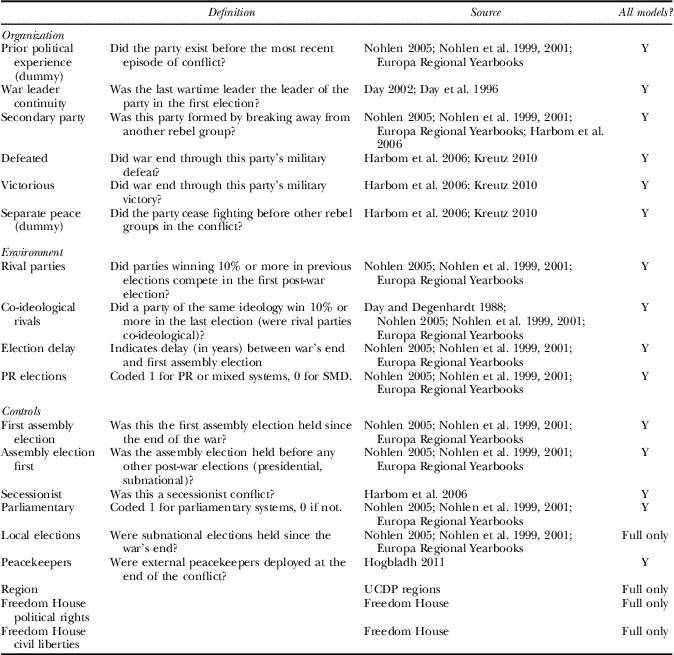
Table 1 lists our independent and control variables. Our dependent variable, electoral performance, is operationalized as the percentage of lower house seats won by a post-rebel party in a given election.Footnote 4 Using lower house elections allows us to maximize the number of cases as well as variation in outcome, since post-rebel parties winning executive power is relatively rare.
Independent Variables

Overview of Data
We constructed an original data set that covers national legislative elections held between 1990 and 2016, in countries that experienced intrastate conflict episodes ending between 1990 and 2009.Footnote 5 We include only those cases where rebel groups formed a political party. This yields a set of 77 post-rebel parties, representing 37 countries and every region of the world.
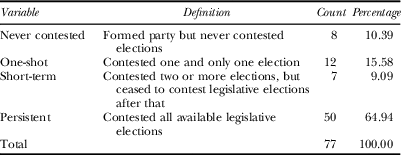
As noted earlier, post-rebel party formation in conflicts that ended in 1990 or later is very common, occurring in more than half of the cases where that option is available. Table 2 presents descriptive statistics on electoral participation by individual parties in our data set. These data show that once these parties are formed, the vast majority of them (nearly 65 per cent) continue to participate in subsequent elections over the long term.
Participation in Elections Over Time (n=77 parties)

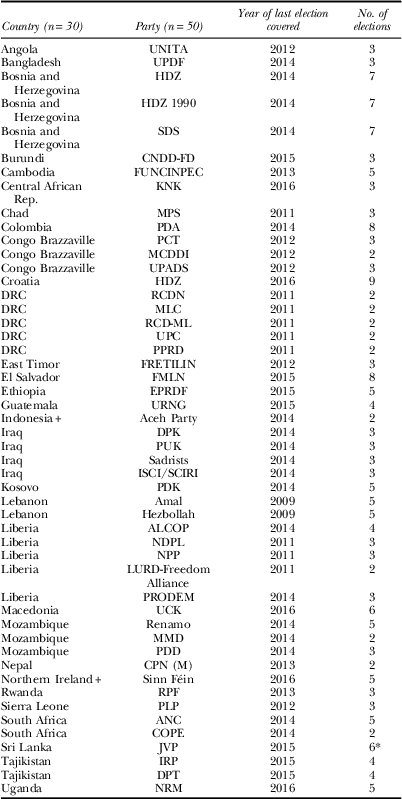
The data set captures post-rebel parties formed after conflicts of varying length and intensity, with different incompatibilities, in every region of the world, and in countries with disparate political histories and levels of post-war democracy and economic development. Table 3 lists parties that competed in all available elections. During the period covered in our study, there were 286 national legislative elections in which the parties in our data set could have participated.
Parties Competing in All Available Elections

Notes: * Includes active boycott in 2004.
+ Results are for assembly in autonomous region/province.
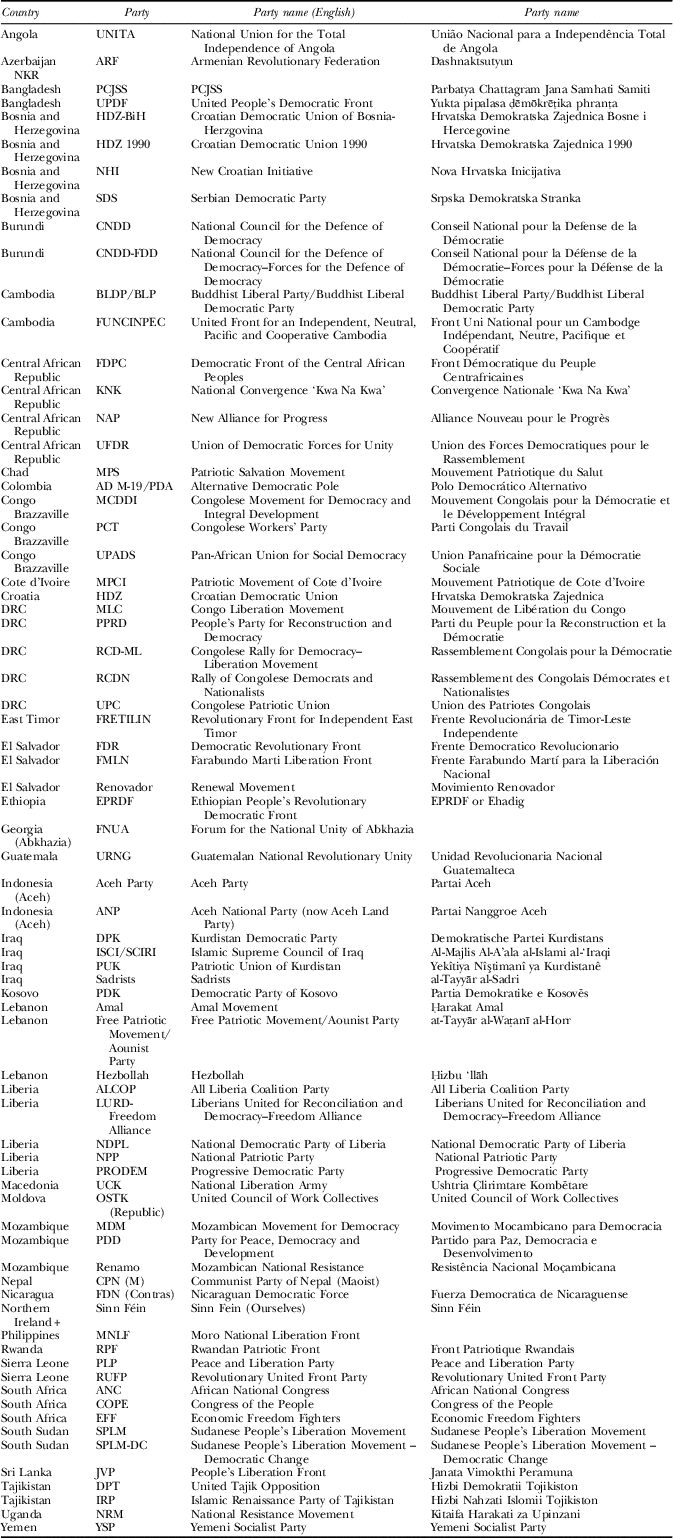
See Appendix for full list of party names.
Our data include parties that formed as breakaways or ‘secondary parties’ from the original post-rebel party. These parties’ participation and performance is coded from the first available election after they broke away from the original party. Except in cases of rebel victory, rebel successor parties have rarely won executive power, so using legislative elections gives us access to considerably more observations.Footnote 6
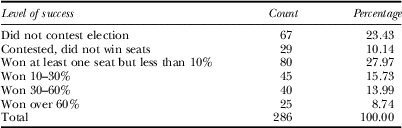
Table 4 provides an overview of performance. We find that parties failed to contest an election about 23 per cent of the time. This includes both skipped elections (where parties participated in the contests before and after the election they skipped) and parties that eventually stopped contesting elections altogether.
Performance Over Time in National Legislative Elections (Lower House) (n=286 elections)

In around 10 per cent of the elections held in the period covered by our study, post-rebel parties contested but did not win seats. Liberia’s second civil war (1993–2003) gave rise to two of the parties in this category: LURD-Freedom Alliance and PRODEM, both secondary to the main rebel faction LURD. These two parties faced competition both from other pre-war parties and from former rebel parties formed out of Liberia’s prior conflict (1990–7).
In 28 per cent of elections, parties won at least one seat, but no more than 10 per cent of the total seats. This group includes a large number of secondary parties (for example, HDZ 1990 and NIH, both secondary to HDZ-BiH in Bosnia; RCDN and RCD-ML in the Democratic Republic of Congo (DRC), from RCD). These secondary parties all faced strong competitors in the form of their parent party and provide a good example of the ‘crowd-out’ phenomenon.
Countries with more than one original rebel faction are also clustered in this performance group. They include opposition parties in Lebanon, Iraq, Congo and DRC. In these cases, multiple rebel factions created a fragmented and crowded party system and divided the opposition vote between themselves.
In more than 15 per cent of elections, post-rebel parties won between 10 and 30 per cent of the legislative seats, and in 14 per cent of elections they won between 30 and 60 per cent. In almost 9 per cent of elections, post-rebel parties won more than 60 per cent of the seats. These are largely victors of armed struggle: either nationally in the cases of the EPRDF (Ethiopia), RPF (Rwanda), CNDD-FDD (Burundi), KNK (Central African Republic); or in secessionist conflicts: Fretilin in East Timor and the Aceh Party (GAM) in Indonesia. Several of these parties (MPS, CNDD-FDD, NRM, PCT) consolidated semi-authoritarian rule after taking power.
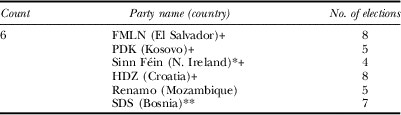
Only six parties are in a ‘consistently competitive’ zone. Their electoral fortunes may rise and fall somewhat over time, but on average they consistently poll around 20 per cent of seats. We think this is the most interesting group in our data set, one that bears further investigation.Footnote 7 Table 5 lists these parties.
Consistent Competitors

Notes: * Results shown are for Northern Ireland Assembly elections.
+ Also won executive power at least once.
** Results for Bosnia are for Republika Srpska, lower house.
Analysis and Discussion
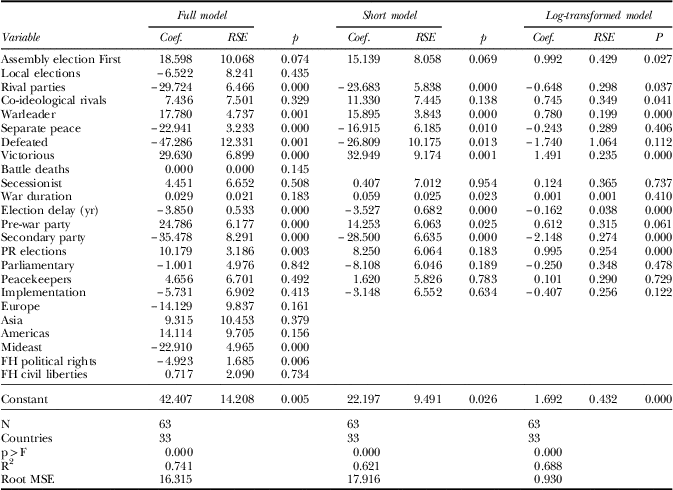
In this section, we present the results of our analysis for each of our eight hypotheses. In the conclusion, we discuss the broader theoretical implications, contribution to the current state of the literature, and policy implications. We use several different approaches to analyse the data. First, we run a number of time series models, before isolating first elections for study. All elections in which a party competed are included in this analysis. Prior to analysis, we had to address two problems with the data. The first was a high degree of multicollinearity between some of our key indicators.Footnote 8 We only include the corrected models in the text of the article, but we show both the full and corrected models in the Appendix.
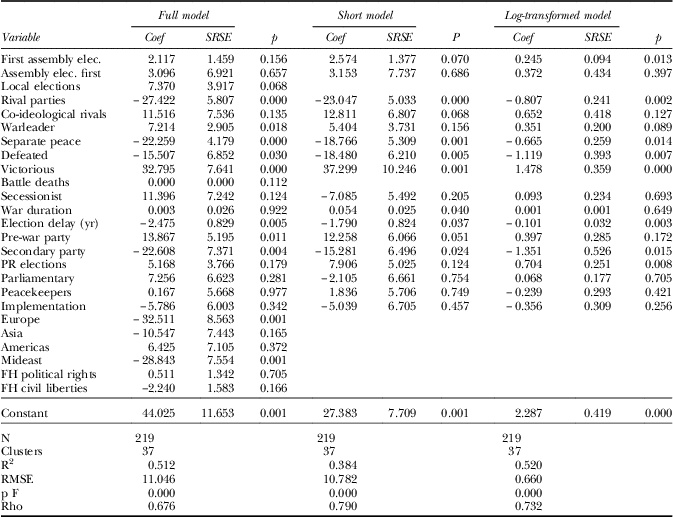
The second issue was a high degree of autocorrelation in electoral performance. This indicates considerable stability in party performance, likely due to factors such as incumbency advantages and name recognition.Footnote 9 To address this concern, we have taken two approaches. The first is to use Prais–Winsten AR1 autoregression-corrected regressions with standard errors clustered on 37 countries to look at longer-term performance. Due to the presence of a large number of time-invariant factors and high degrees of autocorrelation in the time series model, we also isolate first elections for analysis in an OLS regression.
Performance Over Time: Time Series and First Elections Models
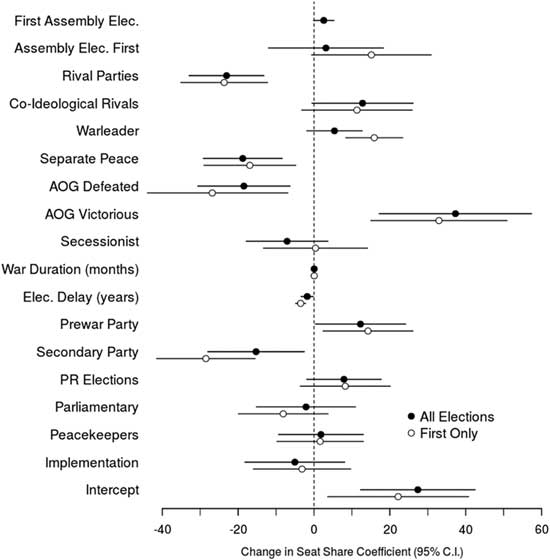
Figure 1 presents our two primary models (time series and first elections) as a side-by-side comparison. The plots shown in Figure 1 indicate a point estimate for the regression coefficient surrounded by line segments indicating a 95 per cent confidence interval for the estimate. Both models include standard errors clustered on country. Detailed tables of these models can be found in the Appendix. The model including all elections is the Prais–Winsten regression described above, with 219 total elections in 37 countries. The other model includes only the first elections, with 63 observed elections in 33 countries.Footnote 10
Primary Model Comparison

Organizational Variables
In some important respects, the story told by the time series model is similar to that of first elections. Patterns established in the first elections generally tended to be sustained over all subsequent elections in which a party participated.
We find strong support for Hypothesis 1: both in first elections and over the longer term, there are real payoffs for rebel groups with prior political experience. Interestingly, this includes parties with a wide range of experience, from cases in the former Yugoslavia that had a very brief pre-war existence as parties and competed in only one election, to broad fronts with a well-developed ideological agenda like the FMLN in El Salvador. It also includes parties with a long history but no electoral experience, such as the Dashnaks of Nagorno-Karabakh, and rebels that experienced intermittent episodes of conflict and relative peace such as the PIRA, ANC and Iraqi Kurds. This suggests that the performance of post-rebel parties is being driven by something other than organizational competencies – perhaps the identity or ideology the group represents, or the absence of other viable alternatives for those opposed to the incumbent. This finding bears further investigation.
We also find support for Hypothesis 2, which predicts that leadership continuity will have a positive impact on electoral performance. In the first elections, maintaining the wartime leader at the head of the party has a positive impact, with a performance difference of around 10 per cent. But, as expected, the presence of the wartime leader has no discernible impact on performance when we look beyond the first election. Maintaining the party’s wartime leader in the first elections may provide ideational and organizational continuity that minimizes internal disruption and allows the group to capitalize on a well-known leader during the challenging initial transition to politics. But keeping the wartime leader over multiple electoral cycles might indicate that an organization is unable to adapt to new circumstances.
We find support for Hypothesis 3, which predicts that secondary parties will perform less well than the parent party. While the effect of being a secondary party is negative and significant in both models, it appears to be much more important for secondary parties that were formed prior to the first post-war elections. Splits occurring between the end of the war and the first election appear to be more damaging than splits that occur after the first election. Perhaps name recognition, for both parties and leaders, is critical in first elections, but after that other organizational competencies come into play. Together with our findings on Hypothesis 2, this suggests that organizational continuity is particularly important in the first election, and less so thereafter.
Finally, we found support for Hypothesis 4, which predicts that a party’s military position at the end of the war will affect its performance in post-war elections. Military defeat and victory have very strong and significant effects on performance in both models. Parties that emerge from the war as military victors have a clear and enduring electoral advantage, while the opposite is true for parties that were defeated in war. Making a separate peace with the government also has a negative impact on party performance as expected.
Environmental Variables
We also find that the competitive environment parties enter after war is important for their electoral performance. We find strong evidence for Hypothesis 5, which predicts a ‘crowding-out’ effect on party performance when older parties formed in a previous era are present in the first post-war election. The presence of rival parties that won 10 per cent or more of seats in the last election – whether that election was held before or during the war – has a strong negative impact on party performance, reducing estimated performance by around 25 per cent in both of our models.
Hypothesis 6 predicts that the presence of co-ideological rivals will have a negative effect on post-rebel parties’ electoral performance. We find instead that co-ideological rivals have a positive but not significant effect. This is somewhat puzzling in light of the finding that rival opposition parties more generally have a crowding-out effect on post-rebel party performance. If some or all of these co-ideological parties are breakaways from the post-rebel party, then – consistent with Hypothesis 3 – the main party should still do well in comparison. On the other hand, the presence of numerous parties competing for the same ideological space might indicate that the cleavage that served as a mobilizing frame for rebel groups during the war remains the primary political cleavage in the post-war period. This finding is tentative and indicates a potentially promising area for future research.
Timing of the first post-war election is also important, as predicted in Hypothesis 7. We find that delaying the first election has a negative impact on the ability of post-rebel parties to win seats both in first elections and over time. Former rebel parties appear to gain an advantage when they can cement their position in electoral politics early on. In a few cases, post-rebel parties sat out first elections or performed very poorly, and then managed to win seats in later elections, but that was very unusual. By and large, parties that competed in the first elections continued to compete, and continued to win similar seat shares, in all subsequent elections.
It stands to reason that post-rebel parties are most likely to succeed in the immediate aftermath of conflict for several reasons. First, transitional elections may be viewed by voters and by incumbents as part of the peace process itself. Voters may vote for post-rebel parties out of fear, or in hopes of buying their quiescence. Also, the organizational challenges of peacetime politics for these organizations are likely to multiply over time. Without elections to provide a source of resources (through government subsidies or access to patronage), parties will struggle to find the resources they need to survive and mount effective campaigns.
Among our control variables, only the duration of the conflict has some degree of impact on the electoral success of post-rebel parties, although it is relatively minor. Both in first elections and over time, the length of conflict has a positive and statistically significant impact on post-rebel electoral performance. This effect is not substantively very significant. It increases the seat share won by around 0.05 per cent for every additional month the war lasted (0.6 per cent per year). We are not sure why more time on the battlefield translates into better electoral results, but it might be related to name recognition or the development of organizational competencies that help the party adapt to the challenges of electoral politics.
Log-Transformed Models
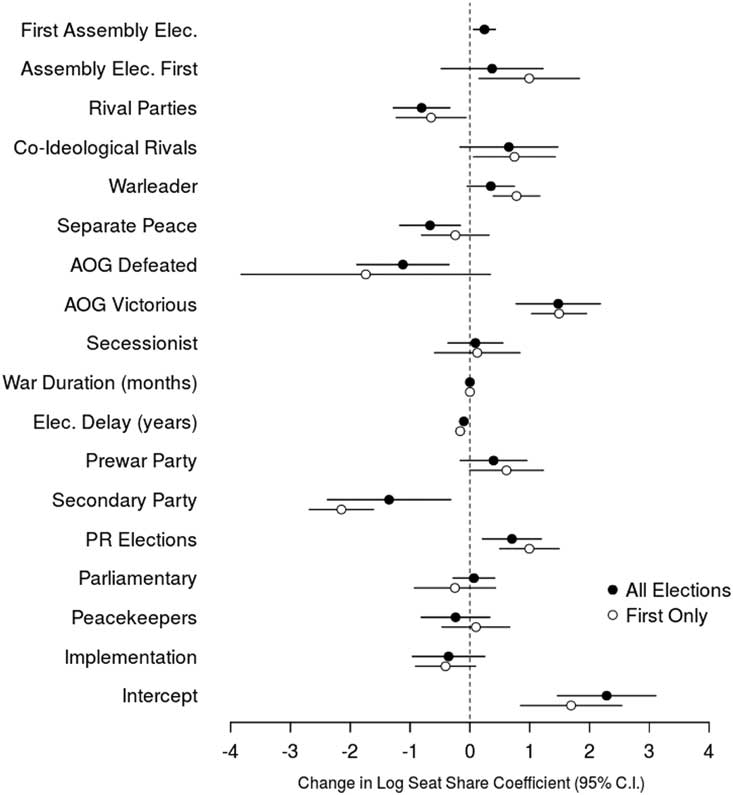
Electoral performance for a considerable number of parties in our data set is consistent but fairly weak, with many parties winning minimal seat shares. Due to the unbalanced nature of the performance data, as noted in Figure 2, we also look at a log transformation of the dependent variable. This transformation makes clearer the factors that affect parties at the low end of the performance spectrum, particularly those winning 10 per cent of seats or less.
Log-Transformed Model Comparison

While the overall pattern that emerges in the log-transformed model is similar to that in the non-transformed models, there are a few interesting exceptions. For example, in the log-transformed models, pre-war party organization (Hypothesis 1) loses significance, remaining marginally significant for first elections only. The way the war ended also loses some explanatory power. Military defeat (Hypothesis 4) ceases to be significant in the first election model, although this is due to the fact that only three instances of defeated parties are represented in the model.Footnote 11 The impact of making a separate peace (Hypothesis 4) also changes. While it remains a negative factor in all models, in the log-transformed model it no longer has a significant negative impact on first elections but does lead to a loss of performance in subsequent elections.
Environmental variables become more important in these models. The presence of co-ideological rivals (Hypothesis 6) has a more significant, and positive, effect on the performance of former rebels in first elections than it did in the linear models, although its impact becomes less certain as parties participate in more elections.
Another major difference that we see in both log-transformed models is the increased impact of PR electoral systems (Hypothesis 8). Electoral rules are not statistically significant in the linear interpretation of performance, but proportional elections do appear to make a major difference for parties at the bottom end of the performance spectrum. Parties with a better baseline performance are not significantly affected by the proportionality of the electoral system.Footnote 12
In these models, the impact of leadership continuity, secondary party status and timing of elections are broadly similar to those from the linear models: parties that change leaders or are secondary parties tend to perform less well, as do parties in cases where first elections have been delayed.
Together, these findings suggest that parties at the lower end of the performance spectrum are more influenced by environmental factors such as electoral rules than are parties at the higher end of the spectrum. The positive finding here on co-ideological rivals is again intriguing and reinforces our suspicion that this finding is worthy of additional research to unearth possible causal mechanisms. In many of our cases, well-defined ideologies were rare in both rebel and non-rebel parties – we coded ideology according to the parties’ self-descriptions. It is hard to know whether these labels themselves are meaningful to voters, but they do appear to represent a common understanding of what the party stands for.
Conclusion
This study examined the electoral performance of 77 parties in 37 countries over up to eight electoral cycles. We examined organizational and environmental factors associated with electoral performance in the first post-war elections, and in all subsequent available national legislative elections. To our knowledge, this is the first large-N study to do so.
Across very disparate contexts, we found some striking patterns. An overarching finding is that the first post-war elections are crucial – party participation and performance in first elections set enduring patterns. Parties that do not participate in first elections very rarely go on to participate regularly or to win seats later on. But 65 per cent of post-rebel parties that participated in the first post-war election went on to contest all subsequent national legislative elections, and 90 per cent of the time they win at least one seat.
This finding has important policy implications. Regardless of either organizational endowments or environmental challenges, when elections mediate the transition from war to peace, rebel groups are likely to gain and sustain a foothold in politics. And their participation and performance in the first transitional elections from war to peace is a very strong predictor of their ability to survive as political actors. The policy literature has begun to reconsider the value of putting elections at the centre of peace processes as well as the timing and sequencing of political transitions (World Bank 2011). Our research shows that holding transition elections does tend to promote the long-term integration of rebel groups into political life over the longer term.
First elections cast a long shadow, but they do not wholly determine party performance over time. Our findings suggest first that post-rebel parties perform best over the longer term if they had prior experience as a party and if they are able to sustain ties to a support base through politically salient ideational appeals. Interestingly, neither the length nor the type of prior party experience (for example, whether electoral or not), seemed to matter. This was surprising. There is an emerging debate in the broader literature on civil wars and on post-conflict politics about the relative importance of rebel groups’ organizational strengths and their ties to a community. Our findings provide tentative support for the notion that, as rebel groups transition into politics, their ideational appeals may be particularly significant.
Second, we found that post-rebel parties did better when they faced a less crowded field of competitors, and where institutional barriers to gaining representation were relatively low. The parties in our data set cluster around two poles of performance – very low (parties routinely win representation, but at less than 10 per cent of seats) and very high (winning 30 per cent or more of seats in every election). Interestingly, both poles are marked by less competitive arenas.
At the high end, we suspect that consistently strong election results are more likely a function of relatively weak competition than of organizational strengths. Low performers, on the other hand, find themselves in environments with relatively low barriers to representation, but they fail to adapt in ways that could improve their electoral performance. This interpretation is supported by our finding that electoral rules are particularly important for parties at the low end of the performance spectrum.
But the real theoretical payoff lies in the middle of the spectrum, with a small but interesting group – the ‘consistent competitors’. The parties in this disparate group have participated in at least four consecutive elections and win on average around 20 per cent of seats across all elections. This group – which includes competitors as disparate as Sinn Féin and Kosovo’s PDK, the FMLN and Renamo – includes variation on nearly every dimension.
This group highlights what is perhaps our most important finding: that similar outcomes in terms of electoral performance can be produced by different combinations of organizational and environmental factors. Further investigation of these categories promises to provide additional theoretical insights. And each of these performance groups contains potentially rich case studies against which to test and further develop our theoretical framework as well as other hypotheses from the literature.
Our study began with a theoretical framework built on intra- and inter-party competition. We explored hypotheses suggested by the existing literature about the relative importance of organizational and environmental factors and how these interact. We think our findings support the basic theoretical frame of our study – that incumbent party leaders will strive to minimize the adaptations necessary to compete; that more competitive environments will create greater pressure on them to adapt; and that a party’s organizational experience will mediate the kinds of adaptations that get made. We approached our study from the point of view of party elites, their preferences and their likely behaviour, even viewing ideological appeals to followers as largely instrumental.
But this research suggests a new question with intriguing policy and theoretical implications. What about voters? How should we interpret post-rebel party electoral performance? Over time, is the performance of post-rebel parties best read as an artefact of organizational advantage gained through wartime or pre-war experience? As a reflection of more, or less challenging political arenas shaped by institutional design? Or as a measure of the extent to which the party reflects voters’ preferences?
Scholars of post-rebel parties have spent considerable time on the first set of factors, investigating the organizational capacities and adaptations of these groups during wartime and in the transition. There is also a sizeable literature on the second set of factors, perhaps because setting the institutional environment that will shape party incentive structures is something that external interveners could affect most directly. The next frontier is to explore more fully the relationship between these parties and the people who vote for them.