Introduction
There are 16 bilingual inscriptions in Latin and neo-Punic from Roman Tripolitania, three of which are in fact trilingual texts in neo-Punic, Latin and Greek.Footnote 1 Two of the bilingual inscriptions are funerary,Footnote 2 six are building dedications,Footnote 3 and the remaining eight are dedications to people or gods.Footnote 4 Of these 16 multilingual texts, 11 are from the city of Lepcis Magna, five of which are the focus of the following discussion. These five inscriptions contain Punic honorific titles that have been calqued into Latin – amator concordiae, amator civium, ornator patriae, ornator civium and servator civium – Footnote 5 seemingly in order to describe local success and honours,Footnote 6 but using language that had significance in a Latin-speaking, rather than Punic, context. To these, for the purpose of the present study, can be added five further inscriptions which, although only inscribed in Latin, also contain the Punic titles in their Latin form.Footnote 7 These titles are unique to Lepcis Magna (with the exception of one text from Sabratha),Footnote 8 and appear only in public dedications involving Latin text; they do not appear in the funerary record nor are they used to describe individuals in public or monumental inscriptions recorded only in Punic text.Footnote 9 Their appearance in Latin has, however, been interpreted as evidence for the successful ‘Romanization’ of North Africa, particularly with respect to the programme of public building, the adoption of Latin, and the emergence of monumental public epigraphy, all of which have been characterised as a singular phenomenon of the Augustan period there (Cooley Reference Cooley2012, 253).Footnote 10 The titles have repeatedly been cited as indicative of the reception of Augustan imperial ideology, especially concordia and the importance of the ‘fatherland’, which David Mattingly has interpreted as an effort by the Tripolitanian elites to ‘identify themselves strongly with the imperial project’ (Mattingly Reference Mattingly2011, 239). Rather than interpreting these Latinised forms of the Punic titles as calques of Punic to Latin,Footnote 11 or as attempts to represent concepts that engaged with or attempted to emulate Rome, this paper suggests that the process by which these Punic titles were rendered into Latin owes more to Hellenistic expressions of friendship than to the influence of Roman political and imperial virtues. By focusing on examples from the Greek-speaking eastern parts of the Roman world, as well as the ways in which such communities expressed friendship and alliances with Rome, the nuance with which these honorific titles were deployed in Lepcis Magna can be better determined. These so-called honorific titles are argued to be a continuation of the Hellenistic tradition in Tripolitania, not only evident in the choices made in the construction of certain buildings, but also here in the epigraphic record, where their translation from neo-Punic to Latin is suggested to be closer in concept to Greek notions of philia and homonoia than the Roman imperial virtues to which they have been traditionally attributed.
Homonoia and Philia in the face of Rome
The concept of homonoia is first attested in the writings of the Sophists, and then in the work of those who opposed them, apparently in response to the turmoil of the Peloponnesian War and civil conflict that existed between the city states of the Greek world.Footnote 12 Initially conceived of as a counter to stasis, it intimated the absence of factions and a common sense of identity and one-mindedness amongst citizens (Gray Reference Gray, Moloney and Williams2017, 67). For the later Classical and Hellenistic Greeks, the use of the expression homonoia to describe true civic reconciliation required more than the bringing together of conflicting individuals in a peaceful coexistence, but the incorporation of all in a complex but defined political structure that was ‘itself grounded in political and ethical standards of justice and local cultural values’ (Gray Reference Gray, Moloney and Williams2017, 68). A cult of homonoia is attested in inscriptions in Olympia and Athens from the fourth century BC (Shapiro Reference Shapiro and Ackermann1981, 477), and coinage bearing the ideal were minted throughout the Greek world; although the word homonoia rarely appears on the coins themselves, iconography representing the concept does with some regularity, and well into the second century AD, particularly in Asia Minor where the depiction of clasped hands represented the unity between two cities (Price Reference Pera1984, 127).Footnote 13 The concept found a place in the Roman world too, under the name concordia; a cult to the goddess Concordia may have been introduced as early as the fourth century BC,Footnote 14 and by the late Republic the concept had become central to both political and social ideals of harmony, and was used to express stability between citizens and political equals (Cornwell Reference Cornwell2017, 20). Homonoia and Concordia both reflected the harmonious state of the body politic, which also signified the success of the political system, bringing together opposing elements under one ideal of unity, cooperation and even friendship.
This point is made clear if we consider how common actual declarations of friendship were, particularly in the Greek-speaking eastern part of the Mediterranean, and especially those declarations of friendship with Rome in areas where the promise of an alliance was used to deal with the tensions that sprang up between cities (Price Reference Price1985, 126–132). As Roman influence grew, so did the practice of rewarding Hellenistic kings and dynasts with benefits such as lodging in Rome, gifts and the official recognition given by the appellatio as ‘friend and ally of the Roman people’ (socius et amicus populi Romani) by the Senate, which began to be extended to eastern Kings from the second century BC onwards.Footnote 15 As Andrea Raggi has noted, to be declared a ‘friend and ally’ of Rome was desirable because it helped to secure a ‘protection of their position against the arbitrary exercise of Roman power, and as a moral and substantial support against their neighbours’ (Raggi Reference Raggi, Kaizer and Facella2010, 82). It was, in short, a way of promoting a good relationship with one's overseers, to them directly, but also to those communities in the immediate vicinity, whose potential challenges of power might be checked by the knowledge that Rome recognised these kings and dynasts favourably.
In return, these kings might represent their relationship with Rome to their subjects through the adoption of certain epithets in their royal titulature; from the middle of the second century BC the titles philorhomaios and philokaisar began to appear, joining other philos compounds such as philandros, philopator, philadelphos, and philometor in the official titles of the kings, which had traditionally been used to describe familial and friendly concepts in both private and official dedications (Braund Reference Braund1984, 105). Kings such as Mithridates I of Parthia, Aretas III of Nabataea, Tigranes of Armenia and Ariobarzanes of Cappadocia all adopted philorhomaios as an official epithet in the late Hellenistic period, although they were not expressed frequently in regular inscriptions such as dedications, and were instead reserved for moments of ‘dynastic self-stylisation’ in which the status of the king was being advertised both to local neighbouring dynasts, and indirectly to Rome (Versluys Reference Versluys2017, 163–164). Philos compounds were not reserved solely for royalty either; other combinations, such as philodoxos and philotimos were used to describe members of the local elite who acted as benefactors of their cities, either through earning merit for their cities, or through acts of generosity. Philopatris was commonly awarded by acclamation in cities of the Greek-speaking east, to honour an individual for an act of patriotism, a tradition that was to continue, indeed to enjoy particular popularity, in the imperial period under Rome.Footnote 16
With the advent of the principate, philorhomaios and philokaisar were gradually replaced in a civic context by philosebastos, to express the loyalty of an individual to the emperor and the imperial project as a whole, with a number of studies arguing for the title to be indicative of the individual's engagement with the imperial cult (Heller Reference Heller, Muñiz Grijalvo, Cortés Copete and Lozano Gómez2017, 1).Footnote 17 The introduction of philorhomaios, philokaisar and philosebastos into the list of Hellenistic titles advertised ‘the friendly attitude towards Rome on the part of a king’ and their ideological investment in the imperial project (Braund Reference Braund1984, 106), and in the case of individuals a definition of identity and social status within their communities (Heller Reference Heller, Muñiz Grijalvo, Cortés Copete and Lozano Gómez2017, 1).
amator concordiae, ornator patriae
It is in such a context that the Lepcitan titles amator concordiae, amator civium, ornator patriae, ornator civium and servator civium might also be considered. Appearing in 11 inscriptions in the city, five of which are bilingual and six in Latin alone, the titles appear to have been used alongside other municipal honours in public dedications that advertised the municipal and cultural prestige of those who dedicated them. Although the epigraphic habit was well-established in northern Africa before Rome's presence in the region,Footnote 18 the Punic and neo-Punic texts were largely funerary or votive in nature, and it was only through contact with Rome that epigraphic culture developed to include building inscriptions in neo-Punic for the first time (Wilson Reference Wilson, Mullen and James2012, 269). The earliest ‘bilingual’ text in Lepcis Magna is a building dedication that dates to 8 BC, and which records the construction of the Macellum building in the northern centre of the city by a local dignitary. The dedicatory inscription is in Latin and neo-Punic, but the texts are not on the same stone; the Latin inscription is found on the exterior of the building, and the Punic within.Footnote 19 In the Latin text, the dedicator of the inscription is named as Annobal Tapapius Rufus, in what appears to be an adoption of the tripartite naming structure that belonged to Roman male citizens.Footnote 20 However, the nomenclature actually represents a convergence of two different traditions. Punic and neo-Punic names in Tripolitania were typically formulated of two parts, the first a personal name and the second a family name, followed by their filiation, indicated by the Punic BN, or ‘son of’, but in the case of the earlier dedication, Annobal – the Punic name – is supplemented with the Latinisation of his family name, plus the adoption of a Roman name – Rufus – in place of a cognomen.Footnote 21 It is tempting to read Annobal Tapapius Rufus as tria nomina, the naming system used by all male citizens of Rome, but that does not appear to be the case at the Macellum. Firstly, there is no evidence to prove that Annobal Tapapius Rufus had acquired citizenship; second, in this inscription the Punic element is retained in the inclusion of the family name, Taphpi, which is Latinised to Tapapius, plus the addition of a Roman name – Rufus – in place of a cognomen, to give something that looks like the Roman tria nomina naming system. He makes reference to Rome without fully assimilating to her practices.Footnote 22 Comparison with other building dedications from Lepcis makes this clear; a Punic name and filiation is always given, but the addition of a Roman-style cognomen is far more sporadic (Quinn Reference Quinn2010, 63).
The Punic version of the inscription is found only inside the building; it also begins with the Roman-style dating formula, using the name and full titulature of the emperor, but it is not a simple transliteration of Latin into Punic. Instead, the Latin imperial titles have been rendered by existing Punic titles, bringing the Roman terms in line with positions of authority that had meaning in Libyan society. For example, imperator has been rendered as MYNKD, which Giorgio Levi della Vida identified as being related to the Tuareg amanukal, a term which indicated the paramount authority of one leader over all tribal leaders.Footnote 23 Consul has been replaced in the Punic by RB MḤNT, often translated as ‘chief of the army’, pontifex maximus as ‘DR KHNM, or ‘priest in chief’. Tribunicia potestas is indirectly explained as ‘having the authority of ten rulers’, and flamines as ZBḤM, or ‘sacrificers’. Interestingly, Caesar and Augustus are transliterated in the Punic – QᶜYSR ᶜWGSṬS – indicating that they were understood as names, and not as honorific titles or magistracies. The rationale behind such a correlation between Latin and Punic titles appears to have been the desire to express a similar sense of authority in a local context (Wilson Reference Wilson, Mullen and James2012, 277–279); however, this may also indicate a ‘linguistic ideology’, which sought to avoid the inclusion of any Latin vocabulary in the Punic version of the text, even when in reference to distinctively Roman institutions (Adams Reference Adams2003, 222). The honorific Latin terminology had meaning in front of a Roman audience, but the Punic inhabitants of Lepcis Magna were acknowledged through the conversion of these institutions and titles into forms that resonated with that local population; in 8 BC, the autonomy of Lepcis was represented by describing the power structure of Rome in titles of local relevance and meaning.
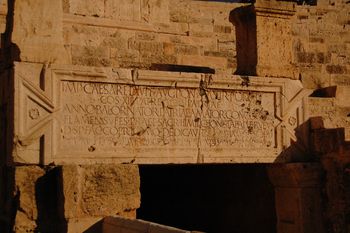
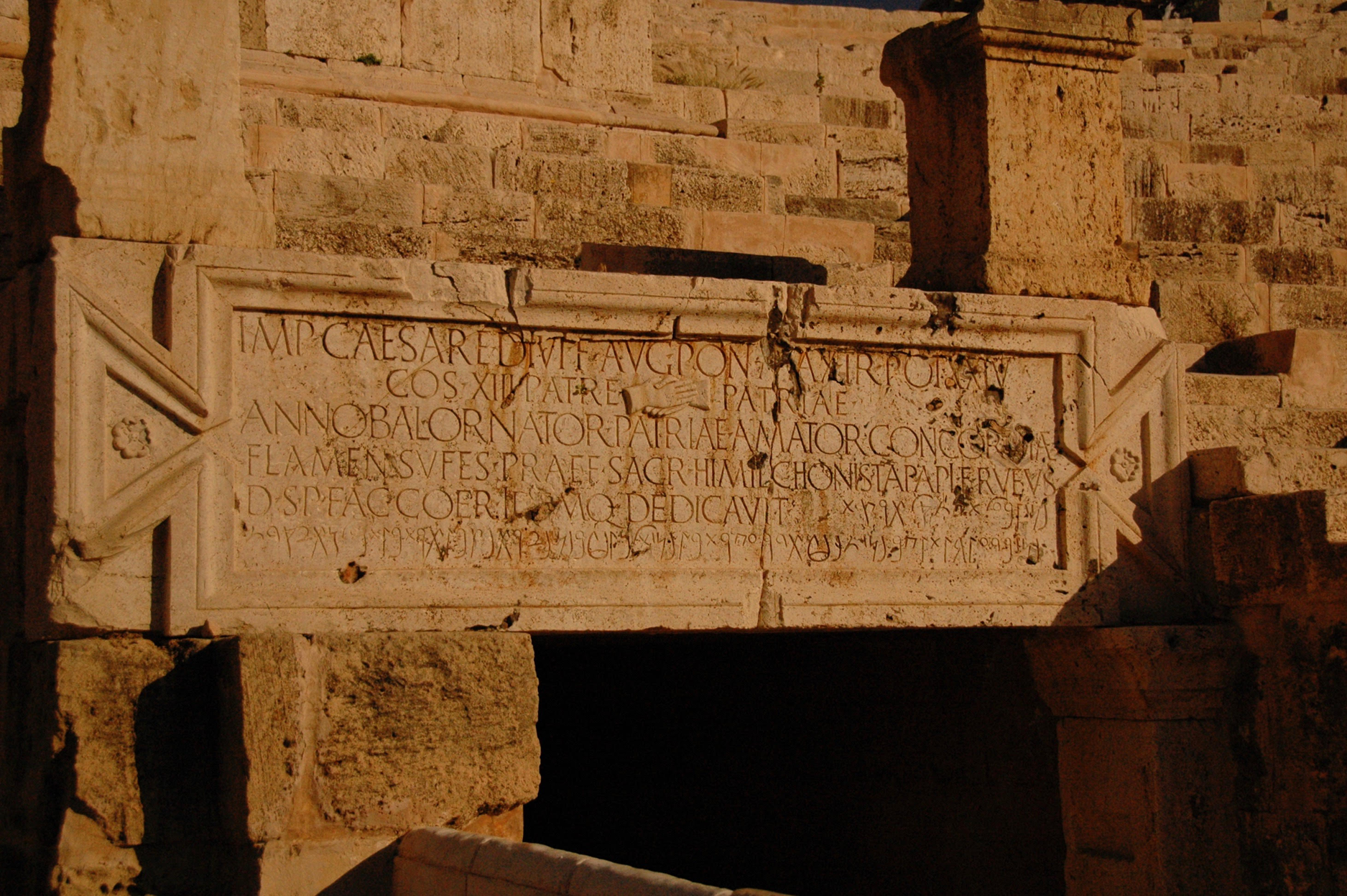
The best-known example of a bilingual inscription at Lepcis Magna is found on one of the city's most prominent monumental features: the Theatre (Figure 1). Built on the slope of the hill previously occupied by a fifth to third century BC cemetery, the Theatre followed a Roman plan. The semi-circular seating, the lower part of which was built directly into the rock, with the upper tiers resting on artificial embankments, was contained by a plain semi-circular wall with regular vertical pilasters. Five arched doorways in the base provide access, via internal staircases, to the different tiers of seating, which faced the orchestra and stage (Di Vita et al. Reference Di Vita, Di Vita-Everard and Bacchielli1999, 63–64).Footnote 24 The Theatre had been paid for and dedicated in 1–2 AD by the same Annobal Tapapius Rufus, who had previously also donated the Macellum building to the city. Three near-identical inscriptions were set up at the Theatre within monumental moulded tabulae ansatae: one on the exterior,Footnote 25 found reused and replaced above the street door of the East dressing room, and two interior texts, which remain in situ, above the lateral aditus maximus arches that lead to the orchestra.Footnote 26 The inscription now on the exterior of the building was recorded only in Latin, but the two interior texts record the same Latin inscription as the exterior, with slight variation, followed by two lines of text in neo-Punic immediately after:
Latin text:
Imp(eratore) Caesare Divi f(ilio) Aug(usto) pont(ifice) max(imo) tr(ibunicia) pot(estate) XXIV
co(n)s(ule) XIII patre patr(iae)
Annobal ornator patriae amator concordiae flamen
sufes praef(ectus) sacr(orum) Himilchonis Tapapi [f(ilius)] Rufu[s] d(e) s(ua) p(ecunia) fac(iendum) coer(avit) idemq(ue) dedicavit
Neo-Punic text:
ḥnbᶜl myšql ᵓrṣ mḥb dᶜt htmt zbḥ špṭ ᵓdr
ᶜzrm bn ḥmlkt ṭbḥpy rᵓps bn ᵓrm btm pᶜl wᵓyqdš.
English translation of Latin:
When Emperor Caesar Augustus, son of the deified (Caesar), chief priest, (was) holding tribunician power for the twenty-fourth time, consul for the thirteenth time, father of the country, Annobal Rufus, adorner of the fatherland, lover of concord, flamen, sufete, in charge of sacred things, son of Himilcho Tapapius, saw to the construction at his own expense and also dedicated it.
English translation of neo-Punic:
Annobal, adorner of the fatherland, lover of complete knowledge, sacrifice, sufete, lord of the ᶜzrm offering, the son of Imilco Tapafi Rufus, made it according to plan at his own expense and consecrated it
IRT2009 322. In situ above the door from the orchestra into the east lateral corridor at the Theatre in Lepcis Magna (Photo: Dr Sophie Hay).
Several points on the bilingualism of the inscription should be noted here; by the early first century AD, the epigraphic record contained dedications in which the local Lepcitan elite – many of whom were Libyophoenicians, descended from the marriages of Phoenician settlers with local Libyans – had begun to Latinize their Punic names (Mattingly Reference Mattingly2011, 238–239).
In the text from the Theatre, however, the Latin reverts to Punic practice, naming him as Annobal Rufus, son of Himilcho Tapapius, in a further mixing of both systems; Annobal identifies himself personally with the addition of a Roman name, Rufus, but maintains a Punic identity through the traditional statement of familial lineage that follows. Although Augustus’ titles are given prominence at the beginning of the Latin text, they are omitted entirely from the neo-Punic version, which focuses on Annobal Rufus and the ‘local significance of his public offices’ (Cooley Reference Cooley2012, 258). These titles are described in the Latin as ornator patriae (‘adorner of the fatherland’) and amator concordiae (‘lover of concord’). Patria and concordia were keystones of Augustan social and political ideology which focused on the peace that Augustus had brought to the Roman world, and their replication here has been understood to be indicative of Annobal Rufus' desire to represent himself as a loyal ally in the language and vocabulary of the principate. A parallel might be drawn here with the inscription of the so-called Building of Eumachia in Pompeii, which dedicated the structure to Concordiae Augustae Pietati, in imitation of the shrine to Concordia Augusta dedicated in the porticus Liviae in Rome and using the same language and form as that employed by the imperial household.Footnote 27
This concept of Roman concordia is not reflected in the Punic version of the titles. Amator concordiae is a very liberal rendering of the Punic mḥb dᶜt htmt; the first part of this – mḥb – derives from the verb ḥbb, ‘to love’,Footnote 28 and the second part dᶜt htmt; ‘of perfect knowledge’.Footnote 29 ‘Of perfect knowledge’ was first suggested as the parallel translation by Giorgio Levi della Vida and Maria Amadasi Guzzo, who argued that a ‘perfect knowledge’ implied a necessary harmony – concordia or homonoia – which led to the Latin version of the title. It was not a literal translation of the Punic concept, but it worked on a ‘spiritual’ level in both languages.Footnote 30
The other Latin titles follow a similar pattern, although are perhaps closer to their Punic counterparts in meaning than amator concordiae: amator patriae and amator civium both use the same Punic verb ḥbb, ‘to love’, with ᵓrṣ, ‘earth’,Footnote 31 for patria and bnᵓ ᶜm for ‘citizens’ or cives. Footnote 32 Ornator represents the Punic myšql, which more uncertainly is believed to belong to the yiph'il causative verb šql, ‘to lay out money for’ which has been equated with ‘to adorn’.Footnote 33 Finally, servator civium, ‘saviour of the people’, does not correspond easily to its Punic equivalent; while civium is represented by the above noted bnᵓ ᶜm, mšlk may be a pi'el participle of šlk, which is more commonly found in proper names,Footnote 34 but appears to have been used as a verb here with the sense ‘to save’.Footnote 35 They are not, therefore, perfect translations of the Punic concepts into Latin; amator concordiae is a particularly divergent rendering, and one that appears to have been motivated by what the Latin would mean to an audience outside of Lepcis, perhaps in Rome. As Maria Gabriella Bertinelli Angeli remarked in her study of the nomenclature of Semitic inscriptions, as these titles (or names, as she prefers them), exist epigraphically only within the Latin inscriptions of this part of north Africa, it is possible that they represent the true Punic honorifics, according to an inverse process of reception of the local titles in Latin, which have been adapted as much as possible to fit a Roman mentality (Bertinelli Angeli Reference Bertinelli Angeli1970, 52).
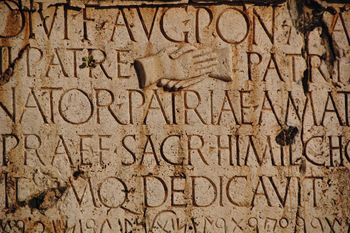
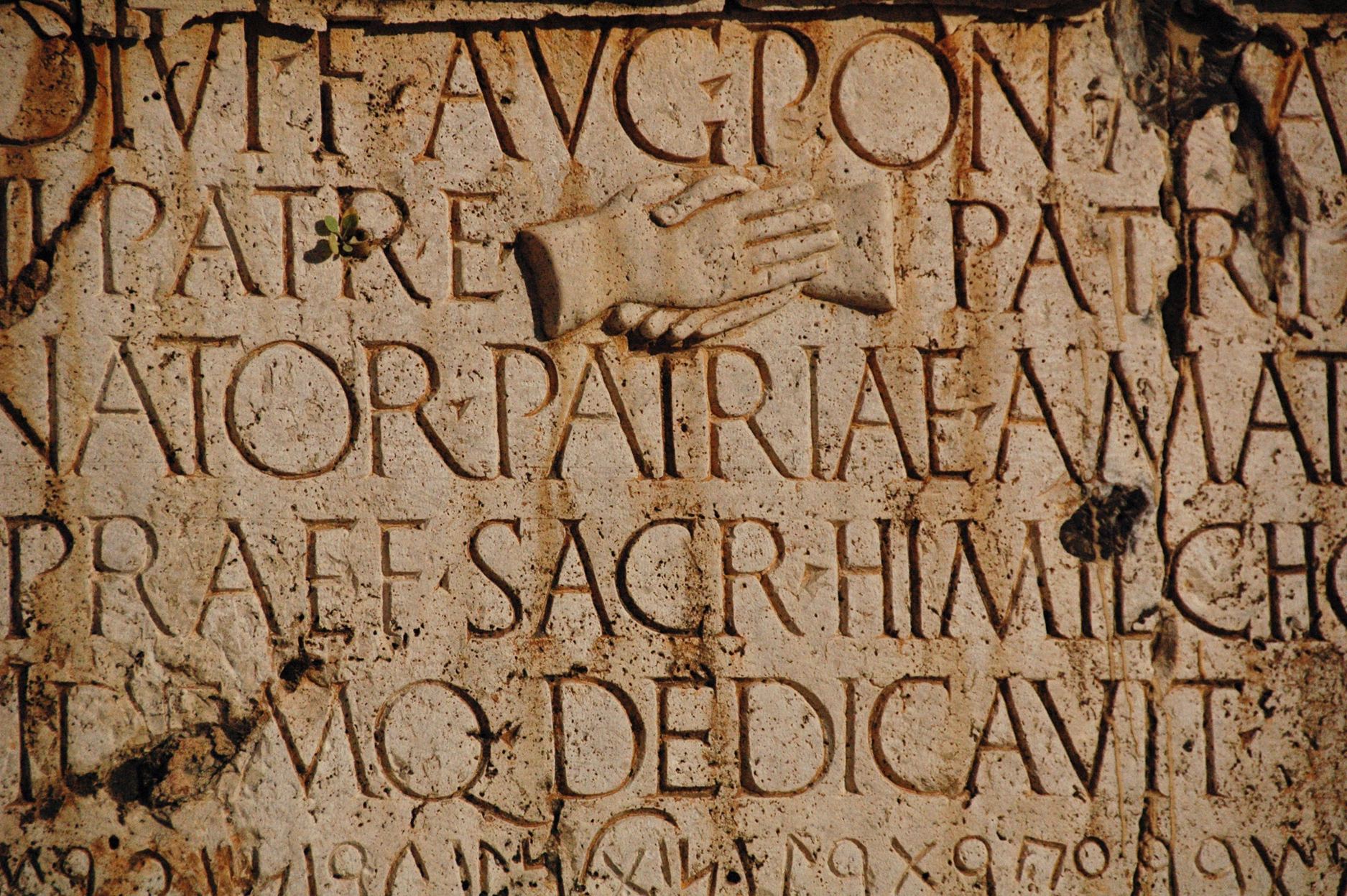
Annobal Tapapius Rufus’ engagement with Roman imperial concepts could be further emphasised by the presence in the middle of line 3 of one of the interior inscriptions, IRT 322 – of a relief carving of two hands, clasping each other (Figure 2). This symbol had appeared on coinage in the late Republican period and had come to symbolise the union between potential political rivals and the subsequent harmony within the state that their union produced (Noreña 2011, 132).Footnote 36 The symbol became most popular in the period following the death of Julius Caesar, when it was paired with the deity Concordia, to emphasise the new peace brought to Rome by Augustus.Footnote 37 The depiction of the clasped hands in the middle of the inscription at the Theatre could be understood as representing the harmony that existed between Rome and Lepcis; in an example of visual code-switching, the bilingual inscriptions of the Theatre are set within giant tabulae ansatae, indicating knowledge of how epigraphic text was presented at Rome, and the clasped hands demonstrated an engagement with the full cultural repertoire of the capital by employing current and meaningful iconography. Later examples too appear to support the link between the titles and the Augustan principate. In 35–36 AD, a shrine to Ceres Augusta was dedicated by the proconsul Caius Rubellius Blandus in the upper tiers of the cavea of the Theatre; the inscription was recorded only in Latin, and detailed that although dedicated by the proconsul, the structure had been paid for by Suphunibal, wife of Annobal Ruso, an ornatrix patriae.Footnote 38 That the shrine contained a statue of Ceres Augusta, with the features of Livia and wearing a crenelated mural crown,Footnote 39 again supports the earlier arguments for a programme of Augustan imperial iconography and language in the Theatre, and the desire of these members of the local elite to exhibit traditional Roman euergetic behaviour in order to display their loyalty to the imperial administration.
Clasped hand detail from IRT2009 322. In situ above the door from the orchestra into the east lateral corridor at the Theatre in Lepcis Magna (Photo: Dr Sophie Hay).
The titles continued to be used in inscriptions, in bilingual neo-Punic and Latin texts, and in Latin alone. In c. 79 AD a dedication to the gods of Lepcis Magna was set up, perhaps near its findspot close to the temple of Liber Pater, in which Marcus Vipsanius Clemens was celebrated as amator patriae, amator civium and ornator patriae, the latter of which is perhaps especially fitting given he is also named in the inscription as a marble merchant (redemptor marmorarius).Footnote 40 Under Domitian, in c. 92 AD, an octagonal altar – discovered on the raised pavement near the centre of the orchestra of the Theatre – was set up with inscriptions on three faces of the shaft, two of which are in Latin and the third in neo-Punic.Footnote 41 The name of the benefactor does not survive in the Latin inscription, but is given by the Punic as Tiberius Claudius Sestius, with both the Latin and neo-Punic texts describing him with four of the five honorific titles: amator patriae, amator civium, ornator patriae, and amator concordiae. Giorgio Levi della Vida's initial assessment of the titles proposed that these were ‘municipal honours, of a principally national character’, which might explain why they continued to be used – albeit infrequently – beyond the first century AD (Levi della Vida Reference Levi della Vida1935, 105).Footnote 42 Indeed, amator civium suorum is suggested in a fragment from the first/second century AD,Footnote 43 and amator patriae ac civium in two inscriptions that date to the third/fourth centuries AD,Footnote 44 meaning that the titles continued to resonate with the local community beyond their Augustan context.
Such an argument fits with the proposal advanced by Andrea Giardina, who claimed that the use of amator in the inscriptions in Lepcis Magna was representative of the Roman ideology of ‘civic love’, which immediately became, because of its use in a very specific epigraphic Roman tradition, part of a formula of civic laudatio, a qualification of virtue and not therefore a residual official title of the Punic institutional framework (Giardina Reference Giardina and Donati1988, 77–78). He noted a ‘precision’ in the encounter between the Lepcitan and Italian epigraphic traditions in this respect, and stated that the hypothesis of a direct Hellenistic influence had only ‘analogical value’, concluding that the origin of the way in which the Punic phrases were translated into Latin had to be found in the ideological sphere of Roman urbanism (Giardina Reference Giardina and Donati1988, 76–77).Footnote 45 The differences between the Latin vocabulary and the concepts expressed by the Punic were explained away as ‘reformulations and paraphrasing’, which attempted to specify otherwise ‘foreign’ concepts (Giardina Reference Giardina and Donati1988, 77). However, such easy dismissal of the Hellenistic influence as ‘analogous’ is an oversimplification, and does not take into consideration the wealth of material evidence within the city that also attests to the continued use of certain building styles in Lepcis that were taken directly from Alexandrian and Cyrenean forms, and adapted to fit the buildings that they adorned. For example, an Alexandrian style of column capital, which featured interwoven, S-shaped helices, was known in Lepcis Magna and later replicated further inland in the mausoleum of Gasr Doga in Tarhuna Gebel in the first century AD, demonstrating not only the continued relevance of these Hellenistic and Alexandrian models in Tripolitania, but their status and value too, which led them to be communicated and replicated away from the more cosmopolitan coastline.Footnote 46 Indeed, the foliage of the Corinthian capitals from the Chalcidicum of Lepcis Magna has been identified as a ‘good quality reproduction’ of the same vegetal form known from Hellenistic Egypt, although the total form of the capitals of the Chalcidicum is rather that of a ‘pastiche’ of influences, from both Alexandria and Edfu, dating from the third century BC to the first century AD (Bigi Reference Bigi, Akerraz, Ruggieri, Siraj and Vismara2006, 2364–2366). Such Alexandrian influences may also have been transmitted to Tripolitania through their use and adoption in neighbouring Cyrene, where a number of Egyptian features have been identified from the Republican period in buildings such as the strategeion (Rocco Reference Rocco2010, 31). Hellenistic Alexandrian influences have also been identified in the architecture of the mausolea at Sabratha.Footnote 47
Of course, there is also evidence for the influence of Italic architectural forms in Lepcis,Footnote 48 as well as the continued use of Punic styles, particularly in the bulky palmettes of the column capitals in the Temple of Roma and Augustus.Footnote 49 The Hellenistic and Cyrenean-Alexandrian influences on Punic urbanism and building are, it seems, as visible as any Roman model, and demonstrate that there was no single over-riding influence on building in Lepcis Magna; the forms introduced by contact with Italy were certainly replicated throughout the city, but indigenous Punic designs as well as those imported much earlier from the Hellenistic metropoleis of Egypt and North Africa nonetheless remained as prevalent, making it harder to follow Giardina's logic that Roman municipal practice provided the sole inspiration for the translation of the Punic titles into Latin. Although the form of dedication – monumental public inscription – certainly had more in common with Roman practice than indigenous Punic or Hellenistic tradition, the concepts expressed by the honours ascribed to individuals such as Annobal Tapapius Rufus are closer in kind to the notions of philia and homonoia than Giardina's argument allows. There may not be a direct relationship, or ‘filiation’ between the Greek and Punic vocabulary in each case, but it is hard to ignore the parallel of the Greek soter with its Latin counterpart servator in Greek inscriptions that honour individuals who act beneficially on behalf of their cities. For example, in Aphrodisias in the first century BC C. Julius Zoilos was honoured as soter kai euergetes (σωτὴρ καὶ εὐεργέτης) for a building he erected to Aphrodite (InsAph2007 1.2), and in Halicarnassus Augustus himself was celebrated in an inscription as the soter of the ‘common race of men’ (σωτῆρα τοῦ κοινοῦ τῶν ἀνθρώπων γένους) who had brought homonoia to the world.Footnote 50 A first century BC decree from Sagalassos honours one Manesas, a citizen of Termessos, for helping to reconcile the Sagalassians with his polis after a period of discord; he is described as ‘offering advice like a saviour’ (συμβουλεύων σοτηρίως), resulting in ‘peace and concord’ (εὶρήνης καὶ ὁμονοίας) (TAM III 1 7, l. 1-15).Footnote 51 Kosmos is equally found with frequency in building inscriptions in reference to their decoration and ornament, which might again find a parallel with the Latin ornator given in these inscriptions. The similarity of homonoia and concordia and what they meant to civic experience under Rome also cannot be denied, with the positive relationship between Lepcis and the imperial capital possibly understood and exploited at a local level through the lens of the Hellenistic cities’ friendship with Rome, where philia was applied to express cordial alliances. Homonoia was also commonly applied to describe interstate relations between the Greek cities, and later between them and Rome, though as Benjamin notes, ‘it was usually chosen with specific intention to emphasise the richness, strength and closeness of the relevant bonds’ (Gray Reference Gray, Moloney and Williams2017, 73). As a thriving emporium, Lepcis would have come into contact with these examples of philia and homonoia between Rome and the eastern cities through trade, the same mechanism by which Hellenistic architectural practice had also spread in popularity. The integration of the Greek world in such friendly terms also introduced the Tripolitanian cities to a new way of recognising figures of special status and honour, through the awarding and adoption of honorific titles, which the Lepcitan community sought to achieve by transforming them into Latin using vocabulary that had a contemporary resonance with the period in which they were first used (Heller Reference Heller, Muñiz Grijalvo, Cortés Copete and Lozano Gómez2017, 19). The philos compounds used by the communities of the Greek-speaking world created a system that worked both for Rome and for the kings, dynasts and individual members of those communities who expressed them; the notion of philia, whether in regards to the fatherland, to Rome or to the emperor himself reflected positively on all concerned, and as such acted as a qualifying attribute that was meaningful to all. It is worth noting perhaps that as the honorific titles of the Roman world in the early principate were largely either military or municipal in nature, they did not themselves communicate the same concepts of friendship, harmony and loyalty achieved by the Greek. By using the framework of Hellenistic friendship to construct the honorific titles such as amator concordiae and ornator patriae, Lepcis Magna created new expressions that appear to have satisfied both Rome and local community alike.
However, it cannot be ignored that in the context of the Punic cities of North Africa more broadly, the creation of these new titles at Lepcis was unique, both in the vocabulary used to define them and in the practice of honouring individuals for acts of benefaction. Building dedications and honorific attestations are rare in the epigraphic record for North Africa before the first century BC, with much of the available evidence for Carthage and the immediate vicinity being funerary or votive texts (Bonnet Reference Bonnet, François, Moret and Péré-Noguès2006, 368–369).Footnote 52 The neo-Punic texts that were inscribed after 146 BC are also all votives, to the ‘lord Bal Amun’ and to the ‘lady Tinnit Fane Bal’; the inscriptions name those who make the dedications, but there is no reference to local offices or honorific titles.Footnote 53 A similar picture can be drawn from the epigraphic sources in Mauretania too; at Volubilis, Punic, and later neo-Punic, had been used by local elites in public inscriptions and coinage since the second century BC, but their texts are again mostly funerary and concerned with the genealogy of the deceased (Papi Reference Papi, Quinn and Vella2014, 216). Although they, contain titles such as, sufete, the terms used are dynastic rather than honorific acclamations.Footnote 54 The Mausoleum at Dougga may originally have been dedicated with an inscription that recorded the titulature of the person to whom it was dedicated, but the bilingual Libyan-Punic inscription that survives from it today records only the names of the architect, stone masons and associated craftsmen who were involved in its construction, none of whom are honoured with special titles or epithets.Footnote 55
The honorific titles were irregular creations, unique to Tripolitania which, as discussed above, appear to have used the model of friendship declarations with Rome that had proven successful in the cities of the eastern Mediterranean, and which had arrived at Lepcis through the city's trade contacts as an emporium, rather than any epigraphic tradition extant in North Africa at the time that they were set up.Footnote 56 However, one further aspect should be considered, which may demonstrate that North Africa – or at least the region's most notable city, Carthage – did have some effect on the language of at least one of the titles, amator concordiae. Carthage had been re-founded as a Roman colony following the death of Julius Caesar in 44 BC, as the colonia Iulia Karthago, to which had been added the epithet Concordia by Octavian in 29–28 BC (Mokni Reference Mokni2008, 74).Footnote 57 The new colonia Concordia Iulia Karthago, often abbreviated in inscriptions to C.C.I.K. made Octavian's dynastic intention clear,Footnote 58 but it also appears to have been part of a more general plan to establish a more permanent state of peace and concord in Carthage, between the Roman colonists and the remaining Punic citizens, as well as those foreigners who had arrived in Carthage in the period since the destruction of the city in 146 BC. As Azedine Beschaouch noted, this was a policy put in place by Octavian – also implemented by him at Uthina and Uchi Maius – which went beyond simple benevolentia to pronounce an impartiality between all the various components of the citizen body, from Roman veterans, to Italians who had been ‘transplanted’ to Africa, to native Punic inhabitants, all of whom became Roman citizens (Beschaouch Reference Beschaouch2004, 17). By returning Carthage to her former position of dominance in the region, reinstating full economic and territorial rights, and confirming that status by making the new colony the capital of the province, Octavian initiated a new state of peaceful coexistence between Rome and Carthage, appearing as the ‘restorer’ of consensus in a new golden age, which was recorded in the addition of Concordia to the city's name (Beschaouch, Reference Beschaouch2004, 18). As well as extending these privileges to Carthage, in 28 BC Octavian also elevated the fiscal status of the city to that of civitas libera et immunis, a ‘free community’ over which the Roman governor exerted little control (Mokni Reference Mokni2008, 71). It may be that Lepcis had seen the economic and territorial benefits extended to Carthage in this period, and was seeking to attract similar attention from Rome; Lepcis had been brought under Roman control following the end of the Third Punic War in 146 BC, later appealing for alliance of societas, or friendship, against the Numidians during the Jugurthan War. This had been rescinded during the civil war between Julius Caesar and Pompey when the city allied with Juba, resulting in a fine of three million pounds of olive oil from the victorious Caesar, but an alliance was struck again during the early principate, with Augustus declaring Lepcis also a civitas libera et immunis in 7–5 BC (Quinn Reference Quinn2010, 52).Footnote 59 Although the honorific titles employed in the inscriptions in Lepcis undoubtedly owe their creation to the friendship declarations made between Hellenistic kingdoms and Rome in the eastern Mediterranean, it is equally plausible that Lepcis was also looking west to Carthage, where Concordia was presented in the name of the Roman colony there as a tangible concept, and one that brought evident political and fiscal benefits to the community there.
Conclusion
The bilingual inscriptions from Roman Tripolitania have generated much attention in the epigraphic corpus and have been celebrated for the example they provide for the multilingual experiences and exchanges that interaction with Rome brought to the new lands under her control. They have been promoted as evidence of the fluidity of language, and the multiple identities, statuses and prestige that language choice could communicate to different audiences, as well as the ‘strategic deployment’ of those identities in different contexts (Wallace-Hadrill Reference Wallace-Hadrill2008, 85). It is possible that the decision to use one language instead of another may be ‘due to idiomatic or lexical gaps’ in either tongue (Mullen Reference Mullen, Mullen and James2012, 24), but it is equally likely that the choice represented a symbolic value that enhanced or contained some other, societal context (Myers-Scotton Reference Myers-Scotton2006, 143). In the case of Lepcis Magna, the multilingual environment and its presence in the epigraphic record has been understood as a response to the rapid expansion of the city in the first century AD, in which it became the ‘major and dominating urban centre in the region’ (Mattingly Reference Mattingly2011, 238); the impressive edifices that were constructed and their accompanying dedications in Latin have been promoted as indications of the popularity of Roman models and behaviours amongst the leading families of the city, who embraced them as markers of cultural prestige and prosperity. Their choice to begin recording the construction and dedication of public buildings in epigraphic form – and the inclusion of Latin, sometimes in visual preference to the neo-Punic in bilingual inscriptions – has been used as further evidence for the engagement of the local elite with Roman models, using their form to communicate their position to both a local and external audience.
While it cannot be disputed that the public inscriptions set up in Lepcis, which employed the above honorific titles, are indicative of the city attempting to advance a good relationship with the the imperial capital, the creation of the honorific titles in the Latin and neo-Punic texts is not a simple case of one community – Lepcis – responding to a more powerful one – Rome. The earliest of the inscriptions were set up at a crucial moment in the relationship between the city and Roman power, and it may be that the creation of the titles fit the Hellenistic model of declaring ‘friendship’ in order to advertise the status of the city and its elite to its neighbours. Although the titles appear in singular, Latin-only dedications in Lepcis Magna as late as the fourth century AD, they were infrequently used, and even less so beyond the middle of the first century AD, indicating that their meaning was especially relevant at a period in which the city's relationship with Rome was expanding. Just as philorhomaios, philokaisar and philosebastos were introduced as honorific epithets in the Greek-speaking world in the middle of the second century BC, at a time when the power of Rome was visibly increasing, so too did the honorific titles in neo-Punic and Latin emerge in Lepcis Magna at a time when the relationship of the city and the imperial capital was at a crucial moment of coalition. Lepcis had supported Rome in campaigns against local Libyans and their victory against the Gaetulians in 6 AD,Footnote 60 the result of which was the presence of Roman generals and proconsuls in the region, who were actively engaged in Roman expansion (Cooley Reference Cooley2012, 254). The tangible result of that expansion and presence was evident close to home, in the form of the refoundation of the colony at Carthage under Octavian, who had confirmed the significance of the concept of concordia by adding it to the name of the new city, to emphasise the stability of the relationship between it and Rome. Old hostilities were forgotten, and Carthage was elevated to the status of free city with all of the associated benefits. As well as looking east to a long successful example of friendship with Rome, Lepcis Magna could look west and see the tangible improvements that declaring such a relationship – and in the language seemingly preferred by Rome – might bring.
The deployment of the honorific titles in such specific municipal and euergetic instances such as the construction of the Theatre, as well as the use of decorative forms such as the tabula ansata within which the inscription was placed and the motif of the clasped hands, is indicative of the ambitions of Lepcis Magna and her leading citizens to engage with and be received by Rome and her official representatives in friendly terms; however, rather than simply replicating Roman forms of this, local Punic traditions, such as the titles m˚ḥb bnᵓ ᶜm (amator civium) and mḥb dᶜt htmt (amator concordiae) were adapted according to the model already successfully implemented in the Greek-speaking cities of the eastern part of the empire.
An appendix containing a table of concordance for, as well as full texts and translations of all the bilingual inscriptions from, Tripolitania, as well as those 5 additional Latin texts in which the honorific Punic titles have been translated into Latin, is available in the online edition of this Journal, published by Cambridge Core. An up to date bibliography for each inscription is also given.
Supplementary material
The supplementary material for this article can be found at https://doi.org/10.1017/lis.2020.7.