1 The changing role of the modern welfare state. The case of the Central and Eastern Europe (CEE)
Welfare state regimes in the CEE countries are very much influenced by solutions from the past. The socialistic approach in pension scheme meant low disproportion in the amount of benefits, which required strong redistributive mechanisms. Average replacement rate used to be relatively high, but due to low overall level of salaries, the pension benefits were far from generosity. However, in many CEE countries last period of socialistic governments resulted in substantial increase of future entitlements. Pessimistic demographic perspectives, low employment ratio and dysfunctions within the labour markets questioned the role of the welfare state in provision of pension benefits.
The ageing of populations is considered to be the main reason for reforms within pension schemes, especially in developed countries (OECD, 2001). There is no exception in this case to the CEE countries; although, thanks to younger demographic structure, the volume of the ageing phenomenon is smaller compared to the old EU member states. Within the new political and economical system, CEE countries started remarkable and in-depth reforms of their public pension schemes. The most underestimated change implemented in these countries was a shift from defined benefit (DB) to define contribution (DC) formula. Consequently, substantial portion of final result risk, especially in funded pillar, was transferred from the state to pensioners. That is why the pension reforms in the CEE countries results in decreasing replacement rate and lower redistribution.
What can be surprising is that such substantial reforms (changes) did not trigger off the discontent of the society (Chlon and Mora, Reference Chlon, Mora, Holzmann, Orenstein and Rutkowski2003). However, the leadership in pension reforms results from something other than civic responsibility and high economic consciousness. Lack of knowledge about possible consequences in society resulted in huge support at the beginning. In the last period, because of financial crisis and growing constraints within public finance there is more and more opposition against reformed pension scheme, but often this resistance is connected with little understanding of functioning of pension schemes.
The reforms in the CEE have shifted different risks directly on the individualsFootnote 1. In effect the insured are facing not only the higher investment risk (due to greater reliance on funded pillars) but also the risk of taking wrong decisions (related to the choice of a pension fund, its life-cycle portfolio, choice of retirement product and its provider as well as to the timing of these decisions).
There are many different taxonomies of pension plans, pension funds and pension entities (Yermo, Reference Yermo2002: 16–17; Gillion, Reference Gillion1999: 8; World Bank, 1994: 15–16). Most of them use a three pillar approach; however, there is also a five-pillar typology developed by the World Bank (Holzmann and Hinz et al., 2005: 10). To avoid potential misunderstanding, in this paper, we use the modified OECD approach, where
• the first pillar is a public PAYG pension scheme (both DB or DC);
• the first pillar bis is a funded part of public scheme, managed by private entities and guaranteed by the state.
First pillar, and if exists, first pillar bis provides basic pension within public mandatory pension system.
• The second pillar consists of privately managed institutions providing pension benefits as part of an employment contract.
• The third pillar consists of voluntary personal pension plans in the form of saving and annuity schemes.
Our paper analyses technical aspects of safety measures present in the CEE pension systems. However, particular regulations depend on general elements of pension system design, which can be analysed from the point of economicsFootnote 2. The main aim of pension reforms in the CEE countries was to improve financial soundness of the schemes; however, economic and social backgrounds in these countries varied, sometimes substantially. These backgrounds obviously had the influence on particular safety regulations. We are not aware of any research that would study rationales and economic constrains underlying the introduction and changes of safety measures in the CEE pension systems. Nevertheless, based upon our experience in legislation process in Poland we can conjecture four other (apart from simple economic capacity of each country) hypothetical factors that might have had comparable impact in other countries of the region. The first one simply relates to the inertia or lack of political will (for instance, it could be the case with such measures as minimum pension or first pillar indexation). Secondly, one may expect that some of such regulations did not change because of the reformers’ inability to tackle all problems at once or their reluctance to change something that was considered to work properly. The third factor might be associated with analyses and forecasts taken at the outset of pension reform that indicated financial stability of particular solutions such as for example minimum pensionsFootnote 3. Fourth, countries in the region would follow some ‘trendy’ solutions that were widely accepted (see minimum return guarantee in mandatory funded pillars) at that time. The World Bank approach to pension reform was transmitted to many countries; one can argue that sometimes without deeper reflection or analysis, and was believed to be a universal solution, accurately designed, deeply analysed and well testedFootnote 4.
An additional comment can be made upon the state-versus-pensioners framework, when we analyse particular guarantees. The state is just an intermediary that organises the pension system for both parties, i.e., workers and pensionersFootnote 5. Nevertheless, in the CEE countries, pension provision is still delivered predominantly by public statutory pension systems. In result, the power of the state for shaping particular solutions in these systems and the state's responsibility for pension provision seem to be of much bigger concern than in some other European countries where private corporate pensions counterweight (partly or significantly) benefits received from state-organised pension systems.
2 Main types of guarantees in the CEE pension systemsFootnote 6
The ‘traditional’ safety mechanisms present in pension systems in the region before the collapse of communism regime had rested on very strong redistributive DB formula. The pension benefit would depend on remuneration in the very late (sometimes very short) periods of employment, where workers with low salaries tended to receive relatively higher benefits compared to those with higher wages. In result, the income discrepancy during the retirement was much lower than during the professional activity.Footnote 7 However, this particular egalitarian approach (there are many discussions on different egalitarian approaches, see for example Sen (Reference Sen1979), created also strong disincentives to longer work career and to show higher salaries.
Nowadays, the protection mechanism present in unfunded pillars of the CEE countries include minimum pensions (dependent on the earnings or flat-rate based), indexation of pension benefits and social assistance. Also, the typical solution is to treat special periods of occupational inactivity (maternity, parental leave, unemployment, service in the army, etc.) as years that contribute to insurance history.
2.1 Minimum pensions and social assistance
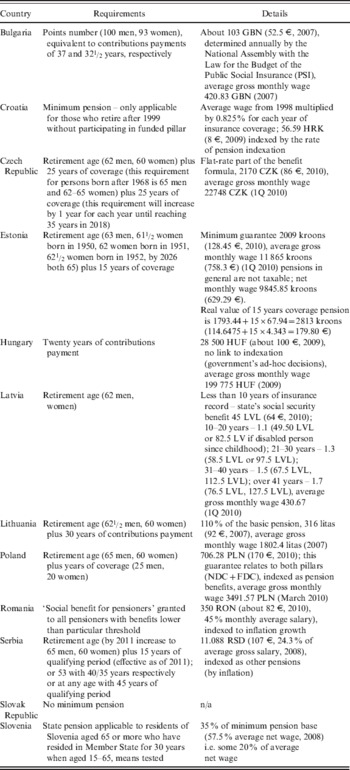
In all surveyed countries, with the exclusion of Croatia and the Slovak Republic, the state offers a minimum pension (Table 1). In the Czech Republic, its function is performed by the flat-rate part of the benefit formula. Usual requirements concern the retirement age and the length of insurance history. Value of benefit is specified either as a particular fixed amount or as an amount multiplied by the number of insurance history (Croatia for participants in old system) or the parameter related to it (Latvia). An interesting case is the state pension in Slovenia, that is, a means-tested benefit granted on the basis of residence in the country or in any other EU member state.
Summary of minimum pensions in selected CEE countries

Notes: Values in € are as of July 2010 and serve for general comparison purpose only.
Source: Own compilation of information from the questionnaire, European Commission (2012), Czech Ministry of Labour and Social Affairs, Guardiancich (Reference Guardiancich2010), Hirose (Reference Hirose2009), PensioniKESKUS, US. Social Security Online and various National Reports on Strategies for Social Protection and Social Inclusion 2008–2010.
If indexed, minimum pensions are linked to wages (Slovenia and Croatia), prices (Romania and Serbia), or the combination of the two (Poland). Indexation to wages is very costly to the budget, whereas indexation to prices tends to constantly erode the replacement value of this benefit. For example, the minimum pension in Serbia is expected to reach mere 8.5% in 2050 (Guardiancich, Reference Guardiancich2010: 183), whereas in Poland (with CPI indexation enhanced by one-fifth of wage funds’ real growth) this value is likely to fall from current 22% to 10% (calculations of the Polish Ministry of Labour and Social Policy). Notwithstanding the financial costs and the current tendency for separating social assistance from pension systems, it seems that due to its fundamental role of alleviating poverty, minimum pension benefits should be linked to wages rather than prices.
All countries offer some sort of social assistance on the general basis. However, in Bulgaria, Estonia and Lithuania, there are social pensions paid to those elderly who cannot meet eligibility criteria for ordinary pensions. Social old age pensions are financed by a special fund, mainly sourced by state budget transfers. Non-contributive pensions are flat rate and means tested (the average income per person (at the age of 70+) in the family is below the minimum guaranteed monthly income (35 EUR – 2008). In Hungary, within a universal social assistance scheme ensures a minimum level of income for the elderly who is 62 or older and can demonstrate that their total income falls below 80% of the minimum old age pension (95% for couples). The allowance is a means-tested benefit and tax-financed, i.e., the budget tops up the difference to the minimum threshold (Guardiancich, Reference Guardiancich2010). In general, the role of social assistance increases in countries that do not offer any legal minimum of retirement income. According to Guardiancich (Reference Guardiancich2010: 174), 15% of pensioners in Croatia received social assistance benefits.
2.2 Indexation of pension entitlements and pension benefits in the first pillar
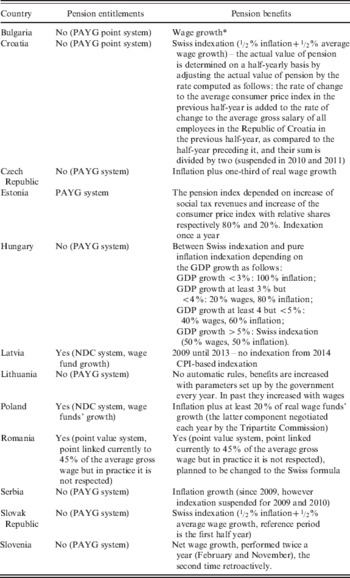
Depending on the type of pension reform, in analysed countries, the pension entitlements during the contribution period are indexed (NDC systems in Poland and Latvia; point system in Romania) or not (the rest of countries). The detailed information is presented in Table 2. Regarding the NDC system, the ‘rate of return’ on notional capital is equal to the growth rate of contributions which results in an important effect. The pension entitlements growth reflects ‘not only the growth of productivity and the wage rate, but also the effect of changes in fertility, the net migration of working age persons, and the gradual transition from the informal to the formal economy’ (Palmer et al. Reference Palmer, Stabin, Svensson, Vanovskap, Holzmann and Palmer2006: 400). This can become an issue under the scenario when young and skilled workers decide to leave a country.
Summary of indexation rules in unfunded first pillars of selected CEE countries

Note: Values in € are as of July 2010 and serve general comparison purpose only.
* In Romania, indexation of pension benefits is done via points whose value relate to the gross average wage in the economy (45%); however, this law formula is yet to be respected in practice (the current point's value is about 35%). The revised pension legislation to be adopted by the end of 2010 foresees a Swiss formula indexation. The law is still in the Parliament and can undergo significant changes (information courtesy of Mr M. Bobocea).
Source: Own compilation of information from the questionnaire, Guardiancich (2010: 169), Hetteš (Reference Hetteš2009), Hirose (Reference Hirose2009), World Bank (2009: 10).
Experts show that the issue of indexation of pension benefits is a subject of diverse solutions depending on the country and the rules tend not to be stable (Piggott and Sane, Reference Piggott and Sane2009). However, recent financial crises strengthened the problems of statutory systems’ financial sustainability. In result, more and more countries, not only in the CEE region, have introduced or are considering launching a mechanisms based on mixed indexation rather than on wage growth itself. Several countries suspended for a moment indexation of pension benefits (Croatia, Latvia and Serbia) or even reduced them (Latvia). Hungary has recently introduced a system where pension benefits are valorised with the speed depending on the real GDP growth – the higher the economic progress, the more generous indexation (tilted towards wages) becomes. The Latvian indexation mechanism provides a protection of purchasing power only to pensioners with low (<135 LVL, 190 €) or medium benefits (<225 LVL, 320 €); in the case of ‘rich’ ones, the indexation does not work (US Social Security, 2008). When left to the ad-hoc decisions of government (Lithuania and Poland) the decision becomes a subject of hot political debate.
2.3 Legal and supervisory framework of funded pillars
The common guarantee facilities in funded markets in CEE region is legal separation between the pension fund and its manager (except the Czech Republic and Hungary), licensing process (with requirements towards the quality and value of initial capital of pension fund managers, quality conditions for managing staff), the institution of banks–depositaries (controlling everyday investment activity of pension administrators and protection of pension savings) and supervisory office (controlling everyday investment activity, solvency, information disclosure, etc.) and information requirements (both to the public, members and supervisory office).
Also, very important are investment limits. In all surveyed countries, pension fund managers have strictly defined asset allocation constraints (especially regarding the maximum investment in equity) and concentration limits (relating to investment in single company or single issue). These investment limits specify strategic asset allocation and in turn, the long-term performance of pension funds (cf. Stańko, Reference Stańko2009). In our opinion, they not only reflect the risk taking preferences expressed by regulators but also the potential (depth and liquidity) of local capital markets and economic policy preferences (limits on foreign investment). As the markets develop, one could argue that the limits should be subject to gradual loosening, especially if the system of lifecycle portfolios is to be introduced.
The legal and supervisory provisions are aimed at ensuring financial solvency of private entities, rational decision making by customers and compliance with other regulations.
2.4 Guarantees of return in funded pillars
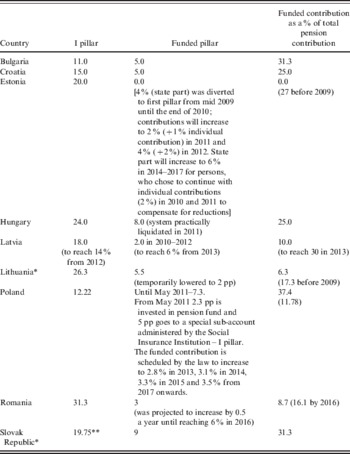
The biggest part of the workers’ gross salary in absolute terms is invested in funded systems of the Slovak Republic and HungaryFootnote 8 (Table 3). Pension funds have the biggest relative role in old-age security systems of the Slovak Republic and Bulgaria; money invested in capital markets of these countries exceeds 30% of total pension contribution. Workers face there investment and decision risks that have impact on relatively high portion of their pension benefits. This effect will be mitigated for the nearest 10–20 years by higher pace of growth of assets accumulated in capital market in comparison with the pace of indexation of pension entitlements in unfunded pillars of the CEE countries. Nevertheless, funded pension systems put on their members new types of risks compared to the old PAYG systems. These risks must be addressed by the state.
Pension contribution rates (% of gross salary) in CEE countries with funded first and first-bis pillars as of 2010

* Funded pillars in Lithuania and Slovak Republic are of voluntary character, i.e., they can be classified as voluntary first pillar bis systems. In Slovakia from 2009 new entrants to the labour market can choose whether to join funded pension funds.
** Total pension contribution rate in Slovak Republic 28.75% consists of old-age pension contribution = 18% (9% unfunded I pillar + 9% funded first pillar bis) + disability contribution 6% (only unfunded I. pillar) + 4.75% solidarity reserve fund (only unfunded I. pillar, is paid by everybody who is pension insured)
Source: The questionnaire and World Bank (2009: 8).
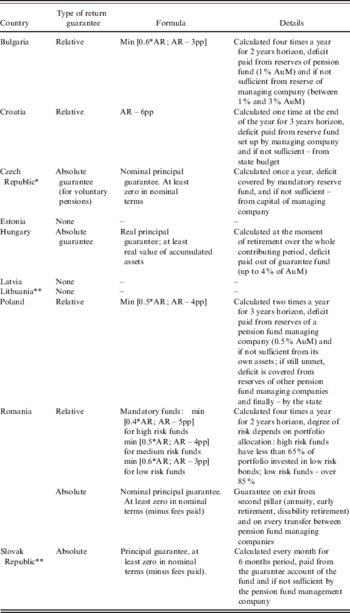
Excluding the Baltic States, the regulators in CEE countries offer some protection to the insured by imposing on pension managing companies the guarantees of return (Table 4). Most of them have the relative character, i.e., the minimal required rate of return is calculated on the basis of industry's average. Such solutions function in Bulgaria, Croatia, Poland and Romania. The peer benchmark is an idea copied, with local modification, from the Chilean pension system. The Czech Republic, Romania, the Slovak Republic and Hungary offer absolute return guarantees either in the form of protection of nominal rate of return (first free countries) or real rate of return (Hungary).
Return guarantees in funded (first-bis) pillars of CEE countries as of 2010

Note: * Czech Republic – voluntary (third) pillar;
** Lithuania and Slovak Republic – voluntary (first-bis) pillar, AR – average rate of return of pension industry, usually calculated as a market share weighted average of returns of individual pension funds. In Poland, the market share is capped at 15%, whereas in Romania – 20%. AuM – value of assets under management. pp – percentage points.
Source: The questionnaire.
However, even within the same type of an investment result guarantee, there are substantial differences related to the frequency of its calculation and the length of assessment horizon. The relative return calculations are done on quarterly basis (Bulgaria and Romania), twice a year (the Slovak Republic and Poland) or only once a year (Croatia), whereas the assessment length varies from 2 years (Bulgaria and Romania) to 3 years (Croatia). The absolute return guarantees were introduced first in the Czech Republic (1998), Hungary (2001), and quite recently in Romania (at the start of the system in 2008) and the Slovak Republic (July 2009). They cover either the very short period like half a year (Slovak Republic), one year (Czech Republic) or the whole accumulation phase (Hungary and Romania).
In Estonia, according to the Guarantee Act Fund (in force from July 2002), even though there are no direct guarantees a pension managing company is obliged to cover losses to members of its pension fund on the basis of prudent men.
The investment protection in CEE funded pillars is not perfect. One should remember that, obviously, any guarantee has its costs embedded in it. Either it is direct cost of capital used as collateral or indirect cost of potential payout (or both). Another type of the cost, however, is the cost related to lost opportunities due to suboptimal behaviour of companies managing the pension savings due to their reaction to potential cost of exercising the guarantee option.
Short horizon of absolute investment guarantee first of all creates high indirect costs due to conservative investment. It is worth mentioning that initially the assessment horizon for the Slovak system was meant to be 60 months. It was not earlier than during the Parliamentary discussions when the length of the horizon was shortened to 6 months. This has had very bad impact on the investment behaviour of managing companies, since with such a short assessment horizon investment managers had to sell off risky assets such as equity (because of investment risk and poor properties of this asset class to be a hedge against the inflation in the short run) and even long-term Treasury bonds (due to their higher duration, i.e., the interest risk exposure). In result their conservative portfolios began even more cautious which has long-run impact on the future value of pension benefitsFootnote 9. In the context of the Czech Republic, the mutual insurance characteristics of administrating companies enhanced by the performance guarantee were the reasons for conservative investment policy and quite low results (Stańko, Reference Stańko2009: 28).
Relative investment guarantees offer only partial protection to fund members – namely that their results will not deviate too much from the average. In times of financial distress like the one experienced in 2008 such protection mechanism ends up at providing only slightly reduced negative rates of return. Similarly to the absolute guarantees, the current relative guarantees are associated with negative impact on the investment policy. It is so because of usage of the peer benchmark (internal benchmark) which, along with strong asymmetry between potential rewards (performance fees) and potential penalty (very difficult to manage catastrophic risk of underperformance guarantee) brings about investment herding (see for instance Stańko, Reference Stańko2004) and suboptimal investment.
In Romania, if a particular pension managing company for two consecutive quarters records returns lower than required, the fund goes into special management of the supervisor. In the case of another two consecutive quarters of underperformance (four in total), the pension fund company loses its licence. This facility is another measure strengthening the conservatism among investment managers. An interesting feature in Romanian system are also varying benchmarks according to risk taken by a particular fund. The voluntary segment of pension funds works in similar way (there are risk classes, minimum rate of return for standard risk is the lowest value of the average minus 4 pp or half of it).
Another issue noticed in the practical application of the absolute return guarantees is the question whether it should be based on the nominal values or the real ones. Obviously, the real protection seems more rational; however, it can be difficult to calculate in the case of switchovers of members between various funds during their working career. The Romanian absolute guarantee was supposed to kick in once a particular person leaves the second pillar (whether for ordinary, early or disability pension). However, in practice, this rule has been extended also to cases when a person leaves a particular fund. The outcome of this application is the moral hazard created to the pension fund managers. Similar problem can be noticed also in systems offering relative returns – a smart pension fund member may consider moving to the fund doomed to pay the performance penalty just before the benchmark has been calculated. In this vein he or she would receive a compensation increasing the investment unit even though this person has not been in the fund during the whole calculation period.
Such examples show that any guarantee mechanism, apart from obvious costs, creates also some unintentional expenditure which is not contributing to the increase of the common social welfare.
Financing of performance promises is usually done from special reserve funds and, if the deficit exceeds the value of reserves – from capital of pension managing company. The reserve fund is financed either via contributions set up as a specified percentage of net AuM (asset under management) or by setting aside part of the financial results during periods of good performance. Usually part of the result goes to the fund members, whereas another part is located in the buffer fund until it reaches pre-defined level of assets. Only then the money can be withdrawn by the managing company as a realized profit. This profit sharing mechanism is present in the Czech Republic (at least 90% of the profit must be distributed to fund members, being at the same time shareholders of the managing company) or the Slovak Republic (94.4% of the profit is distributed to pension members).
2.5 Guarantee funds in funded pillars
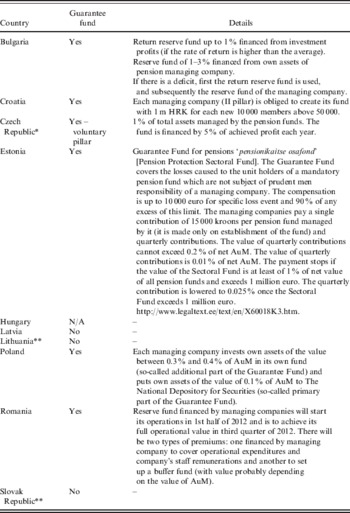
In half of surveyed countries, some guarantee or reserve funds are implemented in their funded pension pillars (Table 5). There are no such institutions in Latvia, Lithuania, Hungary and Romania; however, at least in two latter countries the governments are considering their introduction. In Bulgaria, Croatia, the Czech Republic and Poland each managing company is obliged to create its own reserve fund. In Estonia, the Guarantee Fund covers the losses that are not subject of prudential responsibility of pension fund managing companies. This fund is a wide financial market guarantee facility covering not only pensions but also insurance and banking sector. In Poland, the Guarantee Fund consists of two layers.
Guarantee funds in funded (first-bis) pillars of CEE countries as of 2010

Note: * Czech Republic – voluntary (third) pillar;
** Lithuania and Slovak Republic – voluntary (first-bis) pillar, AuM – value of assets under management. n/a – data not available.
Source: The questionnaire and http://www.legaltext.ee/text/en/X60018K3.htm.
Setting up the proper level of reserve funds is a difficult task. The solution that relates the amount of reserve funds to the size of assets under management could be seen reasonable if only there had been no unmanageable risk of minimum rate of return. Under current regulations, even though the probability of incurring in a deficit that would require from managing company a payment of underperformance penalty is getting low (due to herding behaviour), the expected value of such a payoff is getting catastrophic in its size (due to increasing pension assets in the market and in consequence the steady growth of value of 1 percentage point of the underperformance). One of the solutions would be to eliminate the minimum required rate of return and to create guarantee funds that would operate on the basis that resemble solvency requirements in insurance industries.
2.6 Coverage of periods of professional inactivity (acknowledging and financing pension contributions)
Another type of protection mechanism offered by the state to members of pension systems is the coverage of specific periods when members are economically inactive. Usually such time relate to periods of receiving unemployment benefit, on maternity leave, while upbringing and caretaking of children (child care leave and parental leave), or during sickness and disability.
According to SPC (2008: 35) the time of receiving unemployment benefit was treated as non-contributory period in DB unfunded pension systems of Bulgaria, Hungary, Lithuania and Romania. The contribution base was related either to the minimum wage value (Bulgaria), former wages (Hungary) or value of unemployment benefit (Romania). Countries such as Estonia and the Slovak Republic do not recognize these spells as non-contributory input to the system. In Poland and Latvia which have introduced individual accounts in the unfunded pillars and the NDC (notional defined benefit) formula workers are credited by state contributions on the basis of unemployment benefit. Entitlements for these periods are added to the notional capital which is then indexed according to the rules described in section 2.2. Coverage of maternity leave in first pillar is recognized in all the above-mentioned countries except Estonia (SPC, 2008: 35). Child care is treated as non-contributory period in PAYG systems of Estonia, Latvia, Romania and the Slovak Republic, whereas parental leave – in Bulgaria, Estonia, Hungary, Latvia, Poland, Romania and the Slovak Republic (SPC, 2008: 35). What is interesting, the periods of sickness are credited with pension contributions in PAYG systems only in Latvia, Romania and Slovak Republic.
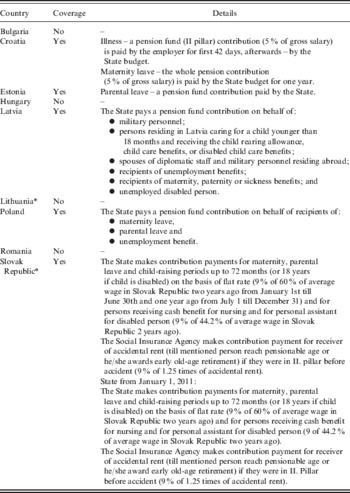
Regarding the funded pillars, the cases when contributions to pension fund are paid on behalf of members are specified in Table 6. There is no crediting contribution in Bulgaria, the Czech Republic (due to lack of mandatory pension system), Hungary, Lithuania and Romania. It is usually the state that acts as a sponsor of pension fund contributors; however, in Croatia, for first 42 days the illness contribution is paid by the employer. Mostly, the governments try to protect financially fund members (or at least to lower opportunity costs) during the periods of maternity, parental leave and in some cases (Latvia and Poland) – insured unemployment.
Financing of pension fund contributions during periods of economic inactivity in funded (first-bis) pillars of CEE countries as of 2010

Note: * Lithuania and Slovak Republic – voluntary (first-bis) pillar.
Source: The questionnaire and SPC (2008: 35). n/a – data not available.
2.7 Life cycle portfolios (multifunds)
Several countries that introduced mandatory funded pension pillars in Latin America and CEE Europe have already launched systems of so-called ‘multifunds’. Their purpose is to adjust the investment risk borne by pension fund members to their specific characteristics. Usually it is the age of a member that determines his or her optimal investment exposure. The general rule is to gradually lower the equity holdings in their retirement portfolios in line with decreasing time to their retirement.
While the optimal investment strategy is a result of various factors (for instance education, personal family situation and risk aversion, correlation of stock returns with labour income, etc.), the most important and the easiest factor to implement in mandatory funded pension systems is the age of participant. The first system of ‘multifondos’ appeared in Chile on 27 September 2002. Five various investment portfolios were introduced with the most aggressive A-fund and the most conservative E-fund.
This solution has been followed by the Baltic States. In 2005, three types of investment funds started in Estonia: ‘conservative’, ‘balanced’ and ‘active’ ones. Pension fund members can choose one of them. As of July 2010 conservative portfolios were offered by seven pension fund administrators, balanced by five and aggressive by seven. Since 2009, there are also aggressive portfolios; currently they are run by three institutions (PensioniKESKUS, 2010). In the Latvian system, there are three types of investment strategies offered since 2003 by five pension administrators, whereas Lithuanian voluntary pension funds offer four strategies (Arthur, Reference Arthur2009). Multifund system emerged also in the Slovak Republic and Hungary. Since 2005, there are three types of Slovak pension funds: conservative, balanced and aggressive ones. Hungary followed the same route – pension fund administrators could optionally offer such funds since 2008 whereas mandatory start of this system was foreseen in 2009; however, due to financial crisis the deadline of mandatory introduction of multifund system was postponed until 2010. Similar systems are currently being under consideration in other countries of the region (Bulgaria, Poland and Romania).
In the Baltic States, the most aggressive policy is possible in Lithuania; however, it is partly due to the fact that pension funds there are of voluntary character. It is worth to recall that in these countries there is no institution of minimum required rate of return. In Estonia, there is no minimum pension. Therefore, these limits can be considered as quite courageous bearing in mind the degree of risk borne by fund members. On the other hand, the standard funded contribution levels in Estonia and Latvia are relatively low. In both countries, there are no limits for foreign investment (Stańko, Reference Stańko, Wiktorow and Wyżnikiewicz2010). In the Slovak Republic, multifunds can invest quite aggressively in equity (but actually do not do that – see the discussion in section 2.4) and can freely invest abroad. In the Hungarian system, aggressive funds are authorised to invest in real estate, venture capital and derivates and their equity exposure should be at least 40% of AuM.
It can be noted that in the surveyed countries the investment limits for conservative portfolios are quite similar and practically eliminate possibility to invest in shares, however, investment policies aimed at younger savers are quite aggressive.
Apart from setting up strategic asset allocation limits, the biggest issues in the mandatory multifund system relate to what age brackets for pension fund members should be and how to set up the default option for a member in case he or she does not choose actively. One can argue that designing the default option is a crucial element of mandatory multifund pension systems.
Regarding the asset allocation, in the Baltic State systems, there are no constraints for age limits. In Slovakia, persons who are 15 years before retirement age cannot choose aggressive portfolio, while at 7 years before retirement they can save only in conservative fund. In Hungary, the insured aged 57 or more cannot participate in aggressive funds (Stańko, Reference Stańko2010).
As behavioural finance shows, people tend to be very passive regarding the decision taking and are not very rational in their choicesFootnote 10. For instance, many people do not choose actively pension funds when entering labour market or are under strong influence of marketing agents. Usually people tend to accept the default options (regarding the value of pension contribution or the way it is invested; Blake et al. Reference Blake, Alistair and Dowd2005: 2). This effect is enhanced in mandatory pension systems in the CEE countries. Pension fund members in such systems believe they do not have to take interest in their pension savings due to its mandatory character and some possibility to shift the responsibility for bad outcomes (at least mentally) to the State. That is why usually the good approach in life cycle systems is to use the peoples' inertia and to move them to the default investment option unless they explicitly opt for another choice. Of course, one can see such an approach as a conflict between the market-based pension mechanism, freedom of individual choice and State paternalism motivated by a desire to improve rationality of individual choices and to avoid political and fiscal responsibility for wrongful decisions.
There are three approaches to default option in the CEE region. In Hungary, if a person does not choose a fund (once entering labour market or moving to another age bracket) he or she is automatically transferred to the fund that corresponds to his or her age. These are: aggressive fund for persons aged less than 47 years, balanced fund for members aged 47–57 and conservative fund in the case of people aged above 57 years (Stańko, Reference Stańko2009). In the Baltic States, such a member is moved to the conservative fund which does not seem to be a good solution. While it offers an investment protection it also can drastically lower future expected pension benefit, bearing in mind that people are passive. Thus most of young members transferred in such a way to conservative fund might never correct their decision and stick up with low-return option until the retirement age. Finally, in the Slovak Republic, an insured person who does not choose funded pillar is automatically qualified as a person saving only in the PAYG pillar.
2.8 Safety measures in the payout stage
As pension reforms in CEE countries took place quite recently, there is practically no fully fledged payout market in the region. However, some of the countries have set up by now regulations describing this market and few of insured have already become eligible to pension benefits from funded pillars.
Main security issues that are of concern during the payout stage relate to protection against the risk of longevity, solidarity mechanism to safeguard value of pensions obtained by females and solutions that would protect pension benefits against inflation. Additionally, there is a problem with the so-called transition shock that occurs while converting accumulated pension savings into lifelong stream of retirement payments. To some extent, the range of products available to a pensioner has also impact on rationality of his decisions; the wider such a choice becomes, the higher is the likelihood of wrong decision.
Risk that a person outlives his or her pension resources is addressed by mandating life annuity products. Life annuities are mandatory in Bulgaria, Croatia, Hungary, Latvia, Lithuania and Poland. Since the funded system in the Czech Republic is voluntary, savers can opt for single or joint life annuities, programmed withdrawal or lump sum. In practice 99% of retirement payments are done in the form of lump sums. The issue of retirement products is not decided yet in Romania; however, it seems that regulators will follow the track of mandatory CEE countries. In Lithuania, it is possible to have lump sums or phased withdrawals in the case of small amounts (half of the amount of the state social insurance basic pension) or high amounts (300% of the basic pension). The Polish legislation foresees single life annuities for retirees aged 65 and programmed withdrawals between ages 60 and 65; the latter are being paid out since 2009 while the former are going to appear in 2014. First payouts in Bulgaria are to start in 2015.
Second measure, the value of women pensions, relates to the problem that females tend to work shorter (due to periods of maternity and child caretaking and earlier retirement), whereas they live longer on retirement. They are also disadvantaged at labour market as they usually receive lower salaries. Thus, in DC systems, their pension benefits are inclined to be substantially lower than males. That is why most of the countries introduce the calculation mechanism of pensions from funded pillar based on the unisex life tables. These tables use the average of life expectancies of both sexes which results in overestimating future life expectancy for males and underestimating it for females. In effect a strong income redistribution mechanism from male pensioners toward female pensioners occurs (cf. Owczarek, Reference Owczarek2010). Unisex life tables are mandated in Croatia, Latvia and Poland. In Bulgaria, it can be separate life tables or unisex tables are not prohibited. Separate life tables are used in Hungary and Lithuania.
The inflation protection is yet a subject of discussion in most of countries of the region. In the Slovak Republic, annuities from funded system are not to be indexed (Hetteš, Reference Hetteš2009). In Poland, experts proposed to use investment profit-sharing mechanism where there were to be no inflation protection but annuitants and life annuity providers were to participate in positive returns (at least 90% for a retiree). However, due to the veto of the president, the law on annuity providers was rejected in 2008 and currently there is no regulation in this area.
Inflation protection is very costly and significantly reduces the value of annuity paid by a provider. Direct cost of such a guarantee is thus clearly visible. Such guarantee can be offered by the State either directly or indirectly. The first option perceives transferring funded savings to the unfunded pillars in return for paying out benefits or establishment of public pension annuity fund. However, the latter solution can bring about various negative side effects (Stańko, Reference Stańko2008). The second alternative for the State is to issue inflation-index bonds that would be purchased by private annuity providers as a hedge against inflation.
As the design of pension payout phase and its products is practically not done yet, nothing much can be said about the possible solutions to protect families of annuitants from adverse effects of prompt death after the moment of annuitisation. The classic solutions such as guarantee period have been proposed (Croatia, Hungary and Lithuania – obligatory guarantee periods); however, the Polish regulators proposed the new solution based on the idea of decreasing life insurance. Under this framework, vetoed by president in 2008, relatives of a retiree who dies within a 3 years horizon since the moment of annuitisation would be entitled to reimbursement of annuity premium, where the potential value of pension savings paid back to relatives would linearly decrease in time elapsed from the moment of annuitisation.
2.9 Reserve funds in statutory pension systems
Public reserve funds are to provide some financial support for pension systems once negative demographic results appear with full strength. Nevertheless, such institutions exist only in two surveyed countries – Bulgaria and Poland. The state fund guaranteeing sustainability of the PAYG system in Bulgaria has currently assets of 3.2 billion BGN (some 1.6 billion €) and is to be used in the case of structural deficit after the decision made by the Parliament. The Polish Demographic Reserve Fund (FRD) has been set up at the beginning of this century and in 2009 had over 6 billion PLN (almost 1.5 billion €). However, due to difficult financial situation of the state's social security system, its resources were used by PAYG administrator in 2010. There is no such fund in Croatia because the regulator did not establish the rules. Neither it functions in Latvia, even though this issue was discussed in the past.
3 Assessment of the protection mechanisms in CEE systems and some recommendations
It is said that DB pension schemes provide more protection than DC ones. However, due to parametric reforms that have recently been introduced, the level of protection could vary substantially even within DB plans. DC systems in CEE countries have protection mechanisms based on minimum pension benefits. In result they actually incorporate DB mechanisms. The question is to what extent DB systems with modest replacement ratio and DC systems with minimum pension benefits represent equivalent solutions. DC plans seem to be better in activating labour force, but available evidence shows that essentially this is the elimination or reduction of early pensions that increases labour participation ratios.
The length of contributory periods is crucial in DC systems in CEE countries and some simulations show that in the case of low-income employees even very long contribution periods (35–40 years) could be insufficient and that there would be a need to provide minimum pension (Owczarek, Reference Owczarek2010). This protection mechanism will be frequently coming into operation in CEE systems in the nearest future. However, minimum pensions are likely to decrease due to the fact that benefits are indexed on the basis of prices, not wages. Therefore, stronger protection mechanism of women and low-paid workers ought to be introduced. This can be achieved by introduction or extension of the coverage mechanism, i.e., paying (by the state or social partners) funded contributions to pension funds on behalf of persons whose economic activity was disturbed. This solution, applied during the ‘input stage’, seems to have an advantage of not inferring with market mechanism and incentives for saving for retirement. However, to find resources to finance such a device one needs to cut on the direct protection facilities. It can be done partly by further lowering expenditures on minimum pension guarantees (in the ‘output phase’) or rationalizing social expenditures in other areas.
The issue of choice of pension fund administrators and pension investment portfolio (multifunds) has practically not been addressed by regulators yet. The systems in CEE countries require from their members making financial decisions and this problem will be exacerbated once pension fund members reach annuity phase. To increase efficiency of consumer choices, the regulators perhaps should introduce some sort of financial education curricula at secondary and/or tertiary level that would be joined with pension education. Also, in our view, members of funded system should be given a homogenous set of information and preferably an Internet platform for choosing funds and annuity providers. Such solutions would be proposed and supervised by financial supervisory offices.
As future replacement rates are expected to decline the issue of investment risk protection becomes even more crucial. Therefore reforms should aim at increasing investment efficiency of funded pillars. With this respect, the internal benchmarks should be changed for the external ones and life cycle portfolios should be introduced. Because of negative impact of minimum require rate of return and its high (indirect and direct) costs, governments should consider replacing it with guarantees based on external performance indicators while remuneration of pension administrators should be based on parameters linked to the economic growth and capital market developments.
Requirements for minimum pension could be quite influential for labour activity giving incentives for working at least for minimal requirements period. However, perhaps a single set of requirements with single value of minimum pension could be replaced with several different lengths of required contributing period levels and corresponding to them several levels of protection. Such a solution is already offered in Latvia. Introduction of partial minimum pension for shorter periods would not discourage workers in informal economy from participating in formal pension systems. In most of the CEE countries state pension to residents (without requirements regarding contribution period) would increase the evidences of moral hazard and decrease incentives to work in formal economy.
One of possible solutions could be to run a hybrid DB–DC pension plan. First part of contribution would be used to buy the guarantee of minimum (‘floor’) level of future benefits and another one would be invested on the pure DC scheme basis. In the case of underperformance, a retiree would be granted a payment to supplement their benefit to the minimum level; this difference would be financed by other cohorts of savers from their DB premiums. In the case of overperformance, the DB-related contribution would be put aside to the guarantee fund.
Compulsory life annuities seem to be an optimal protection in mandatory funded schemes against the risk of outliving somebody's pension savings. As females generally tend to work shorter, earn less and live longer their benefits are calculated based on unisex tables. This approach can be viewed as an intentional redistribution, similar to redistributive elements in DB formula.
We might argue that in the CEE context, to preserve financial market mechanisms, the inflation risk could be addressed by the government in an indirect way; that is the State should be an issuer of inflation-indexed bonds dedicated to annuity providers. In effect some degree of redistribution between taxpayers and annuitants (in favour of the latter) would occur. Regarding the longevity risk (related to the increasing uncertainty as to the future demographic parameters) faced by annuity providers could be hedged with the use of longevity bonds according to the idea proposed first by Blake and Burrows (Reference Blake and Burrows2001). Whether it is the State or private institutions that should issue such financial instruments is a subject of debate (Blake et al. Reference Blake, Cairns, Dowd and MacMinn2006); however, this solution seems to be a promising proposal to lower the degree of uncertainty of pension providers and thus, lowering the costs.
Indexation seems to be one of the most difficult issues within protection mechanisms for both, unfunded and funded schemes. As the indexation is extremely expensive and politically sensitive the indexation formula changes quite often and sometimes suspended due to economic difficulties (Croatia and Serbia in 2010). There is a wide range of possible formulae from pure inflation growth to wage growth, but some countries diversify indexation formula regarding GDP growth (Hungary) or pension amount (Latvia).
The existing level of protection of pension benefits purchasing power is not satisfactory in the CEE region. Decumulation within funded pension scheme will require that annuities offer at least some inflation indexation for pensioner households. Indexation in funded scheme demands existence of appropriate Treasury bonds or other state guarantees that would lower the risk of annuity providers. Nowadays, this risk becomes more and more unpredictable for commercial insurers, imposing therefore higher risk premium load on pensioners. However, it should be underlined that such bonds or guarantees would be finally financed by taxpayers.
People in the CEE countries would get used to state protection; however, this attitude is changing gradually. They are getting more aware of the need and problems related to financing their own pensions and to the relationship between their contributions and their future benefits. Decreasing role of the state, one of the main features of pension reforms should rather not result in ceasing the protection mechanisms. These should strengthen incentives for contributing among pension fund members by giving them assurance against systemic risks. We believe that participation in a pension scheme should be profitable for the insured and that they should be offered solvency funds, minimum pensions, inflation guarantees, etc.
Capital market is quite new for citizens in the CEE countries and, what is more, human nature is biased by different psychological premises like: status quo, naïve diversification, narrow framing, anchoring or overconfidence (Kawiński, Reference Kawiński2010). It should be taken into account in funded schemes with some freedom of choice for citizens. To solve some of these mentioned problems, paternalistic pension policy is implemented in many countries to reduce investor errors. However, more and more interest is shifted to informed savings and investing decisions as it may also serve to increase participation ratio and future pensions. It requires broad educational action and professional support (Kawiński and Stańko, Reference Kawiński and Stańko2009).