The brush-clawed shore crab Hemigrapsus takanoi Asakura & Watanabe, Reference Asakura and Watanabe2005 was initially identified as H. penicillatus (de Haan, 1835) and first recorded along the French coast in 1994 at La Rochelle on the Atlantic coast of France (Noël et al., Reference Noël, Tardy and d'Udekem d'Acoz1997). At the end of December 1996, the presence of the species extended from Laredo (Spain) in the southern part of the Bay of Biscay to Fromentine in the Vendée (France) in the northern part of the Bay of Biscay. The species was present on 700 km of the intertidal zone, but some areas were only colonized by very few individuals (Noël et al., Reference Noël, Tardy and d'Udekem d'Acoz1997). Later, Noël & Gruet (Reference Noël and Gruet2008) showed that the species had extended its distribution to the north to Lorient in the Morbihan in southern Brittany (France) in 2007. At that time, the species was absent in the Finistère region (France), especially in the Bay of Brest. In the Bay of Biscay, the species remains located in sheltered zones in the mud (rarely with gravel) underneath large boulders.
In the English Channel, H. takanoi was first reported in Le Havre harbour in 1997 (Breton et al., Reference Breton, Faasse, Noël and Vincent2002). In an extension study of both Hemigrapsus crabs—respectively, H. sanguineus (de Haan, 1853) and H. takanoi (Asakura & Watanabe, Reference Asakura and Watanabe2005)—in the eastern part of the English Channel (Dauvin et al., Reference Dauvin, Tous Rius and Ruellet2009) and along the Cotentin coast (Normandy, western English Channel) (Dauvin, Reference Dauvin2009a, Reference Dauvinb), we showed that H. takanoi was present under boulders on muddy gravel at Saint-Vaast-La-Hougue in the east Cotentin and in the three harbours along the Opal coast (Boulogne-sur-Mer, Calais and Dunkerque). The exposed intertidal zone was only colonized by the second species H. sanguineus. Both species occupied very different habitats: muddy sediment in sheltered harbours, bays and estuaries for H. takanoi and exposed sandy-gravel habitats for H. sanguineus (Dauvin et al., Reference Dauvin, Tous Rius and Ruellet2009).
The sampling of one male of H. takanoi on the western coast of north Cotentin (Normandy, western English Channel) in May 2010 permits us to wonder about the extension of the species along the French coast of the Channel.
Location of the sampling specimen
A single male with a greyish carapace measuring 19.2 × 17.2 mm (width × length) was collected on 2 May 2010 at Blainville-sur-Mer (49°03′51″N 01°37′11″W), where the shore is a mix of rocky and sandy areas. The sampling was done about 1.5 km from the water-line in an area with sandy-gravel sediment and a few stones covered only by barnacles, without algae. The zone is exposed over a long period at each tide, especially during spring tides, but is always submerged at each high tide.
The species is easily identified by the presence of a characteristic patch of fur on the inner and outer surface near the base of the pereiopods, or legs. The specimen has only one leg; the other three legs were missing. Nonetheless, the specimen was vigorous and survived at least one day in the air before it was fixed in ethanol prior to its collection.
The specimen was deposited at the National Museum of Natural History at Paris, Crustacean Collection.
DISCUSSION
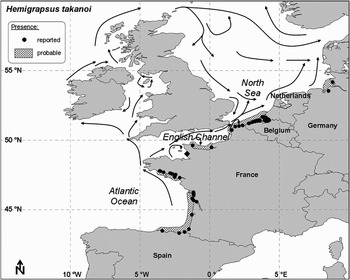
This is the first record of Hemigrapsus takanoi in the western part of the English Channel (i.e. in the Normanno-Breton Gulf). The collection zone corresponds to the exposed sandy-gravel habitats with little muddy sediment, which is usually considered to be adverse conditions for the colonization of this crab. This Normanno-Breton region is relatively isolated from the other parts of the western Channel in terms of residual water circulation, due to the Channel Islands, which create gyres all around the islands (Salomon & Breton, Reference Salomon and Breton1991, Reference Salomon and Breton1993) (Figure 1). For this reason, it appears difficult to imagine a larval dispersion of this species from the populations on the south Brittany coast about 400 km away. Not only is the distance between the populations incompatible with the larvae drift, which requires a maximum of four weeks in the plankton stage, but also the presence of an isolated water mass in the Normanno-Breton Gulf opposes the idea of larval dispersion. The nearest Channel population is the one in Saint-Vaast-La-Hougue, in the eastern part of the Cotentin in the Bay of Seine, separated by a distance of about 100 km. This zone is also affected by a gyre created by the Barfleur Cape.
Distribution of Hemigrapsus takanoi along the north-eastern Atlantic coast, from its introduction in Europe in 1994 to July 2008 (from Noël & Gruet, Reference Noël and Gruet2008; Dauvin et al., Reference Dauvin, Tous Rius and Ruellet2009), and the surface currents redrawn from Turrell (Reference Turrel1992), Bailly du Bois et al. (Reference Bailly du Bois, Germain, Rozet, Solier, Strand, Borretzen and Jolle2002) and Brown et al. (Reference Brown, Carrillo, Fernand, Horsburgh, Hill, Young and Medler2003).

Lefebvre et al. (Reference Lefebvre, Ellien, Davoult, Thiébaut and Salomon2003) simulated the dispersion of the planktonic larvae of the bristle star Ophiothrix fragilis (26 days of larval development) in the Channel from several sources of adult populations, using a numerical submodel inserted inside a wider 2-D model of the whole North European shelf (between 47°N and 63°N latitude and between 12°W and 12°30′E longitude). The model running under a different assumption supposed that the Normanno-Breton population of O. fragilis was isolated from other Channel populations and that the permanence of the population was guaranteed by the retention of larvae from the local population. Only few larvae from the Roscoff population were able to colonize the western and northern part of the Normanno-Breton Gulf. Ophiothrix fragilis larvae released in the western Bay of Seine (Barfleur gyre) first showed a significant westward drift but were then trapped in a clockwise gyre located off the Cotentin peninsula. Because of intense eddy-diffusion, the larval cohort was largely dispersed and reached the southern coasts of England, off the Isle of Wight, but did not reach the Normanno-Breton Gulf. These results make improbable the hypothesis of a H. takanoi colonization through larval transport from other established Atlantic and Channel populations.
Whereas, we cannot completely eliminate the hypothesis of a transport by the fouling of boats (either large ships to Granville or small yachts); at this time, we suggest that the presence of H. takanoi is probably due to professional transportation of the Crassostrea gigas oyster. However, we have no arguments to prove whether the crab comes from the Saint-Vaast-La-Houge population, the Arcachon population or Marennes-Oléron population because transfers between oyster zones are significant between these production oyster centres. Nor do we have arguments to prove whether the source of the colonization is larvae, a juvenile or an adult. In this context, genetic studies will be needed to validate the hypotheses about the importance of hydrodynamics on larval crab dispersal and the degree of connectivity between the Atlantic and eastern English Channel populations.
As suggested before (Noël & Gruet, Reference Noël and Gruet2008; Dauvin et al., Reference Dauvin, Tous Rius and Ruellet2009; Dauvin, Reference Dauvin2009a, Reference Dauvinb), it will be necessary to rapidly encourage methodical regular observations along the metropolitan French coast to survey the spreading of both Hemigrapsus species. Nowadays, H. takanoi has a wide geographical distribution extending from Spain to Germany (see Figure 1), but it forms primarily sporadic populations along the French coast, except some hot spots, such as Dunkirk harbour (Dauvin et al., Reference Dauvin, Tous Rius and Ruellet2009), Le Havre harbour (Breton et al., Reference Breton, Faasse, Noël and Vincent2002), and the estuaries and harbours around La Rochelle and Arcachon Bay (Noël et al., Reference Noël, Tardy and d'Udekem d'Acoz1997).
ACKNOWLEDGEMENTS
This sighting was made accidentally during field observations for the Sabellaria alveolata reefs extension in the framework of the SURCOTE LITEAU project financed by the French Ministry of Ecology, Energy, Sustainable Development and Sea. The authors thank L. Spencer for her help with the English text, Clément Garcia for the figure, and very useful comments and suggestions from two anonymous referees on the first version of the manuscript.