Introduction
The aphid species Brevicoryne brassicae (L.), Lipaphis pseudobrassicae (Davis), and Myzus persicae (Sulzer) are cosmopolitan pests that cause substantial damages to plants in the Brassicaceae family (Blackman & Eastop Reference Blackman and Eastop2000; Micic, Reference Micic2005; Collier & Finch, Reference Collier, Finch, van Emden and Harrington2007; Gu et al., Reference Gu, Fitt and Baker2007).
Aphid–parasitoid interactions on Brassica crops constitute a complex system that has been much studied because of its importance to biological control (Waterhouse & Sands, Reference Waterhouse and Sands2001, Cividanes, Reference Cividanes2002; Akhtar et al., Reference Akhtar, Dey, Usmani and Choudhury2010). For instance, the endoparasitoid Diaeretiella rapae (McIntosh) (Braconidae, Aphidiinae) may significantly affect the biotic regulation of aphid populations (Pike et al., Reference Pike, Starý, Miller, Allison, Graf, Boydston, Miller and Gillespie1999; Sullivan & Völkl, Reference Sullivan and Völkl1999) including those of B. brassicae, L. pseudobrassicae, and M. persicae, all known hosts of D. rapae (Starý et al., Reference Starý, Sampaio and Bueno2007). Nonetheless, it is well known that both abiotic and biotic factors regulate insect populations (Price et al., Reference Price, Denno, Eubanks, Finke and Kaplan2011) and so assessing the relative effects of these factors on natural pest populations is as difficult as it is essential for improving future controls of these aphid species (Dent, Reference Dent1995). For example, studies aimed to establish whether or not hyperparasitoids interfere with the impact of primary parasitoids on aphid populations (Höller et al., Reference Höller, Borgemeister, Haardt and Powell1993), works dealing with the effect of environmental conditions on the parasitism rate (Zamani et al., Reference Zamani, Talebi, Fathipour and Baniameri2006), and research into the feasibility of the Integrated Pest Management of certain parasitoids that naturally occur under fluctuating conditions (Desneux & Ramirez-Romero, Reference Desneux and Ramirez-Romero2009) have all been widely conducted in the Northern Hemisphere. However, a broader perspective of the maintenance of natural aphid–natural enemy interactions in tropical regions is lacking. Thus, the study of Brassica aphids appears to be a suitable model for further exploring the effect of abiotic conditions on aphid–parasitoid interactions. This approach is particularly interesting, as few studies have ever been carried out under field conditions in the Tropical region.
The research reported here aimed to examine the influence of abiotic and biotic variables on Brassica aphids under field conditions. We first investigated the influence of leaf position, precipitation (estimated as 7-day accumulated values), and average temperature on populations of L. pseudobrassicae, M. persicae, and B. brassicae. We hypothesized that the response of aphid species to temperature would follow the same gradient in the field as it had under laboratory conditions. In addition, we expected that leaf position would also have an effect on aphid distribution and that species colonizing the lower leaves of the plant would be less affected by precipitation than those colonizing upper leaves. Secondly, we investigated the influence of abiotic and biotic variables on the communities of L. pseudobrassicae, M. persicae, and B. brassicae parasitoids in collard fields.
Materials and methods
Experiment setup
Our study was conducted in the fields of the Glória Experimental Farm of the Federal University of Uberlândia in southeastern Brazil (18°57′07″S, 48°12′27″W). This farm is in the Triângulo Mineiro region and lies in the Brazilian Savannah ecosystem, locally known as the Cerrado. This ecosystem occupies about 20% (206 million ha) of Brazil's land surface, although in the past 30 years 50% of the natural vegetation has been replaced by agricultural crops and cultivated pastures (Assunção & Chiavari, Reference Assunção and Chiavari2015). The agriculture of the Cerrado provides 60% of Brazilian grain (mainly soybean and corn), 75% of its cotton, and 19% of its sugar cane, and also harbors 50% of its cattle, which demand large areas of pastureland (CONAB, 2015). The Cerrado includes a great diversity of habitats, from open fields to dense forest formations, and has two well-defined seasons (dry winter and rainy summer). Although its soils’ morphological and physical characteristics vary widely, the predominant soils (about 54%) are latosols that are generally nutrient-poor (especially phosphorus) and highly weathered, and have a low cation exchange capacity and high acid and aluminum toxicity (Malavolta & Kliemann, Reference Malavolta and Kliemann1985).
The farm's fields are surrounded by cropland (corn and soybean) and pastures. The crops are rotated and the position of each crop is changed every year. The rotation schedule includes collard greens, cabbages, cauliflowers, lettuces, beet and carrots. Taking into account the crop rotation system adopted in the fields, the study was conducted in a similar matrix structure in two enclosed areas (100 m apart) inside the fields. Collard greens Brassica oleracea var. acephala L. was chosen as the aphids’ host plant due to its importance as a food crop in Brazil and the peculiarities of the disposition of its leaves. This species constantly produces new leaves from the top of the plant, which allows the plant's aphid distribution to be observed for longer than on other Brassica crop species. By contrast, other Brassicae crops such as cabbage, cauliflower and broccoli stop producing new leaves in order to form flowering heads (Filgueira, Reference Filgueira2003).
Seedlings were taken from the lateral shoots of the mother plants of the Talo Roxo cultivar and kept in 2-liter plastic bags with organic substrate in a greenhouse for 1 month. Afterwards, seedlings were transplanted into the field. The plants in the experiment in area 1 were planted in July 2005 and sampling was carried out in August 2005–March 2006. This experimental field consisted of two rows, each of 35 plants, and one row of 19 plants, giving a total of 89 collard green plants. The second study site (area 2) was planted in September 2006 and sampling was carried out in October 2006–January 2008. In this case, the experimental field had three rows, each of 25 plants, giving a total of 75 collard green plants. In both areas, the spacing between plants was constant: one meter between rows and 0.5 m between plants.
In both experimental areas, only organic fertilizer was applied (at 10 kg cattle manure per meter) and no insecticides were used. Sprinkler irrigation was performed daily and lateral shoots were manually removed each week.
In southeastern Brazil, where this study was conducted, the highest temperatures and rainfall occur in September–March (IBGE, 2010). We counted aphid populations in 101 samples taken in the hot rainy season, since the chief aim of the study was to assess the effects of high temperatures and precipitation on aphid populations. Climatic data were obtained from a meteorological station located about 500 m from the experimental areas.
Sampling of insects and species identification
To quantify aphid population dynamics, samples were taken on a weekly basis (32 samples over the course of the experiment for area 1 and 69 for area 2). Each sample consisted of three randomly selected plants, one from each row in each plot. A total of three leaves per plant were removed and examined, one from each of the three positions (upper, middle, and lower). Upper leaves were considered to be upright and still expanding; middle leaves were fully expanded but not yet senescent; and lower leaves had already reached senescence. All samples were taken from plants that had been in the field for at least 1 month, enough time to permit aphid colonization. In order to guarantee the independence of the samples taken from a plant, the sampling design includes a restriction that the same plant would not be sampled again for another 4 weeks.
In the laboratory, the parasitized and non-parasitized individuals of each of the three aphid species were counted and studied under a stereoscopic microscope. After identifying the parasitized aphid species, including mummified individuals and empty mummies (bearing the parasitoid's exit hole), mummies were removed from leaves and placed in separate Eppendorf tubes. These tubes were kept for up to a year to allow primary and secondary parasitoids to hatch. However, practically all parasitoids and hyperparasitoids emerged within 2 weeks and were identified to family, genera, or species levels whenever possible following (Pike et al., Reference Pike, Starý, Miller, Allison, Boydston, Graf and Gillespie1997; Powell, Reference Powell1982).
Data analyses
Since aphids tend to congregate, when monitoring aphid population dynamics in crops it is not unusual to find no aphids on successive samples, but then find a very large concentration once a colony is encountered (Maunder & Punt, Reference Maunder and Punt2004). One solution to this clumping is to adopt what are generally known as ‘hurdle models’ since sampling rates of zero can complicate calculations and, in addition, if not properly modeled the presence of many zero rates can invalidate an analysis’ assumptions and jeopardize the integrity of the inferences (Potts & Elith, Reference Potts and Elith2006). The use of hurdle models is particularly suited to data sets with many zeros (Maunder & Punt, Reference Maunder and Punt2004; Mayer et al., Reference Mayer, Roy, Robins, Halliday, Sellinet, Zerger and Argent2005).
Hurdle modeling combines two components that are simply two particular examples of generalized linear models (McCullagh & Nelder, Reference McCullagh and Nelder1989). For the binary component of the conditional model, we used a logistic model assuming a binomial distribution given the binary nature (presence/absence) of the zero catch rates (O'Neill & Faddy Reference O'Neill and Faddy2003; Mayer et al., Reference Filgueira2005; Potts & Elith, Reference Potts and Elith2006). By contrast, for the second component of the conditional model we used a log-normal distribution (conditional upon their presence), the most commonly selected distribution model (Maunder & Punt, Reference Maunder and Punt2004; Potts & Elith, Reference Potts and Elith2006), after checking the normal distribution of the residuals of the obtained data set.
In order to meet the assumption of the dependence of simultaneously taken observations, the analyses of the biotic and abiotic factors affecting aphids’ density and parasitism rates were tested using generalized linear mixed models (Bates et al., Reference Bates, Maechler and Dai2008).
Analyses were conducted for the three main aphid species, B. brassicae, L. pseudobrassicae, and M. persicae. In all analyses, leaf position (upper, middle, and lower), average weekly temperature, 7-day accumulated precipitation, and the interaction between average temperature and accumulated precipitation were included as fixed factors. The sampling period was included as a random effect term to account for the fact that samples taken at the same time were not independent.
In the analyses, aphid density was taken as the number of parasitized aphids + the number of non-parasitized aphids, while the parasitism rate was the number of mummified aphids/aphid density. All mummified aphids are used in the analyses, including both empty mummies and mummies from which parasitoids did not emerge.
Ad hoc contrasts from ANOVA variance were evaluated for the three species of aphid to compare their relative abundance after adjusting for leaf position.
All analyses were performed on R 3.0.2 (R Development Core Team, 2013); library lme4 (Bates et al., Reference Bates, Maechler and Dai2008) was used for model fitting and library lmerTest (Kuznetsova et al., Reference Kuznetsova, Brockhoff and Christensen2013) was used for inference methods with mixed models.
Results
Aphid, parasitoid and hyperparasitoid abundance
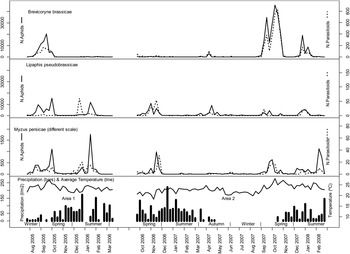
A total of 469,795 Brassicae aphids were counted during the 101 sampling sessions. With a total individual of 303,200, B. brassicae was the most abundant aphid species found, followed by L. pseudobrassicae (153,364) and M. persicae (13,231). In terms of the average population density of the three aphid species, B. brassicae was more abundant than both L. pseudobrassicae (t = −3.58, P < 0.001) and M. persicae (t = −6.93, P < 0.001); the population of L. pseudobrassicae was greater than that of M. persicae (t = 3.35, P < 0.002). The population dynamics of each aphid species was distinct: while L. pseudobrassicae was abundant throughout the sampling period, B. brassicae was all but absent in October 2005–August 2007 and M. persicae in December 2006–August 2007. Aphid species have their own endogenous intra-annual rhythm: B. brassicae is mostly unimodal, while M. persicae and L. pseudobrassicae are both bimodal (fig. 1).
Total weekly population of Brevicoryne brassicae, Lipaphis pseudobrassicae and Myzus persicae (in a lower scale) on collard green (black straight lines) in relation to their primary and secondary parasitoids (dotted black line), to precipitation (bars) and average temperature (line) from August 2005 to March 2006 and from October 2006 to January 2008 in Uberlândia-MG (Brazil).

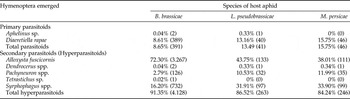
The relative abundance of the hyperparasitoids that emerged from the mummies of the three aphid species was greater than that of the primary parasitoids (table 1). The most abundant primary parasitoid was D. rapae, while Alloxysta fuscicornis (Hartig) was the most abundant hyperparasitoid. However, a large number of Syrphophagus hyperparasitoids also emerged from L. pseudobrassicae and M. persicae mummies. Hyperparasitoids belonging to the genus Pachyneuron were infrequent and parasitoids of the genus Aphelinus and hyperparasitoids of the genera Dendrocerus and Tetrastichus only occurred sporadically (table 1).
Relative and absolute abundances (in brackets) of primary parasitoids and hyperparasitoids (Hymenoptera) emerging from mummified B. brassicae, L. pseudobrassicae, and M. persicae.

Uberlândia-MG, Brazil, August 2005–March 2006 and October 2006–January 2008.
Aphid parasitism of B. brassicae averaged 16.2 ± 2.28%, with a maximum of 87.5% from a single sampling sessions. For L. pseudobrassicae, parasitism averaged 0.8 ± 0.19%, with a maximum parasitism of 11.1%, while for M. persicae parasitism averaged 8.5 ± 1.44%, with a maximum of 72.2%.
Influence of climatic factors on aphids and parasitism
During the sampling period, climatic conditions followed the typical pattern for southeastern Brazil in the rainy season (September–March). The highest temperatures were registered during this period (fig. 1). A common feature of the three aphids’ populations was the occurrence of a population peak between September and November (spring) at the beginning of the rainy season. Aphid population patterns are also correlated with peaks in the populations of primary and secondary parasitoids, which was especially obvious in the case of B. brassicae (fig. 1).
Responses to temperature and precipitation in these Brassica aphids varied according to species. Higher temperatures benefited the presence of B. brassicae and M. persicae, and favored their abundances whenever they were present (tables 2 and 3). Similarly, precipitation positively affected the presence of B. brassicae and M. persicae, although only the abundance of B. brassicae seems to be determined by precipitation patterns. By contrast, the presence and range of abundance of these two species was negatively related to the interaction between temperature and precipitation (tables 2 and 3). Variation in L. pseudobrassicae colonies was not significantly related to any of those climatic variables.
Brevicoryne brassicae abundance: hurdle models.

Two complementary models were used: a logistic model to test for presence/absence and a lognormal model to assess the type of abundance of count data. In both models the effects of leaf position were assessed: [M leaf = Aphid density on middle vs. upper leaves], [B leaf = Aphid density on bottom vs. upper leaves], average temperature (Av. temp), accumulated precipitation (PPT), and the interaction between average temperature and PPT (Av. temp × PPT). Statistically significant results are indicated in bold text (<0.05).
Myzus persicae abundance: hurdle models.

Two complementary models were used: a logistic model to test for the presence/absence and a lognormal model to assess the type of abundance of count data. In both models, the effects of leaf position were assessed: [M leaf = Aphid density on middle vs. upper leaves], [B leaf = Aphid density on bottom vs. upper leaves], average temperature (Av. temp), accumulated precipitation (PPT), and the interaction between average temperature and PPT (Av. temp × PPT). Statistically significant results are indicated in bold text (<0.05).
In turn, parasitism rates of the three species varied in relation to climatic variables. Although both precipitation and temperature increased the parasitism rates in these species, the interaction between these two climatic variables had a negative effect on the parasitized aphids’ presence (tables 5–7).
Intra-plant distribution effects on aphids and parasitism
Both L. pseudobrassicae and M. persicae populations were significantly related to leaf position. The logistic model showed that there was a greater probability of finding colonies of both species on the middle and lower leaves than on the upper leaves. Nevertheless, the lognormal model indicates that when colonies of these species are present the number of individuals is also positively related with those positions, with greater populations on middle and lower leaves than on upper leaves (tables 3 and 4). The presence of parasitized aphids of these two species followed the same pattern as for the aphid species themselves: more on middle and lower leaves than on upper leaves (tables 6 and 7).
Lipaphis pseudobrassicae abundance: hurdle models.

Two complementary models were used: a logistic model to test for the presence/absence and a lognormal model to assess the type of abundance of count data. In both models, the effects of leaf position were assessed: [M leaf = Aphid density on middle vs. upper leaves], [B leaf = Aphid density on bottom vs. upper leaves], average temperature (Av. temp), accumulated precipitation (PPT), and the interaction between average temperature and PPT (Av. temp × PPT). Statistically significant results are indicated in bold text (<0.05).
Brevicoryne brassicae parasitism rate: hurdle models.

Two complementary models were used: a logistic model to test for presence/absence and a lognormal model to assess the type of abundance of count data. In both models the effects of leaf position were assessed: [M leaf = Aphid density on middle vs. upper leaves], [B leaf = Aphid density on bottom vs. upper leaves], average temperature (Av. temp), accumulated precipitation (PPT), and the interaction between average temperature and PPT (Av. temp × PPT). Statistically significant results are indicated in bold text (<0.05).
Myzus persicae parasitism rate: hurdle models.

Two complementary models were used: a logistic model to test for presence/absence and a lognormal model to assess the type of abundance of count data. In both models the effects of leaf position were assessed: [M leaf = Aphid density on middle vs. upper leaves], [B leaf = Aphid density on bottom vs. upper leaves], average temperature (Av. temp), accumulated precipitation (PPT), and the interaction between average temperature and PPT (Av. temp × PPT). Statistically significant results are indicated in bold text (<0.05).
Lipaphis pseudobrassicae parasitism rate: hurdle models.

Two complementary models were used: a logistic model to test for presence/absence and a lognormal model to assess the type of abundance of count data. In both models the effects of leaf position were assessed: [M leaf = Aphid density on middle vs. upper leaves], [B leaf = Aphid density on bottom vs. upper leaves], average temperature (Av. temp), accumulated precipitation (PPT), and the interaction between average temperature and PPT (Av. temp × PPT). Statistically significant results are indicated in bold text (<0.05).
By contrast, neither the presence nor density of B. brassicae was significantly affected by intra-plant location, a phenomenon that might be explained by the greater abundance of B. brassicae, a species that forms larger colonies with more individuals than the other two species. Nonetheless, intra-plant locations do explain the greater range of B. brassicae parasitism on the bottom leaves than on the upper ones, as the significant effect indicates (table 5). However, the probability of finding parasitized individuals showed no significant relation to leaf position.
Discussion
Our results add to a growing body of work that indicates that both abiotic and biotic factors play an important role in Brassica aphid regulation (Waterhouse & Sands, Reference Waterhouse and Sands2001; Cividanes & Souza, Reference Cividanes and Souza2004; Micic, Reference Micic2005; Akhtar et al., Reference Akhtar, Dey, Usmani and Choudhury2010). However, the particular effects of these factors differed between species.
During each of the 101 weekly sampling periods 303 plants and 909 leaves were inspected and in total 469,795 Brassicae aphids were counted. Of the three aphid species monitored, B. brassicae and L. pseudobrassicae were the most abundant. Although B. brassicae reaches higher population levels than the other two aphid species, its populations may decline in number and even disappear for several months. According to Micic (Reference Micic2005), B. brassicae tends to colonize heavily single plants or small groups of plants and create ‘hot spots’ within crops. High aphid populations may reduce plant quality and, according to Dixon (Reference Dixon1977) and Karley et al. (Reference Karley, Parker and Pitchford2004), such a reduction may negatively influence aphid population size.
Effects of intra-plant distribution on aphids
B. brassicae was the only species that was evenly distributed across all three plant strata. Both L. pseudobrassicae and M. persicae were more abundant in the middle and lower regions of the collard plants. A greater concentration of defensive compounds is expected to exist in young upper-region collard leaves due their importance in areas with greater photosynthetic activity (Brown et al., Reference Brown, Tokuhisa, Reichelt and Gershenzon2003; Reifenrath & Müller, Reference Reifenrath and Müller2007). Thus, their ability to avoid Brassicaceae defense compounds, i.e. glucosinolates (MacGibbon & Beuzenberg, Reference MacGibbon and Beuzenberg1978; Weber et al., Reference Weber, Oswald and Zollner1986; Bridges et al., Reference Bridges, Jones, Bones, Hodgson, Cole, Bartlet, Wallsgrove, Karapapa, Watts and Rossiter2002), may explain differences in the intra-plant distributions of the aphid species that colonize Brassica species. Both B. brassicae and L. pseudobrassicae can synthesize the enzyme myrosinase and thus hydrolyze glucosinolates as a defense against their toxic effects (MacGibbon & Beuzenberg, Reference MacGibbon and Beuzenberg1978; Weber et al., Reference Weber, Oswald and Zollner1986; Bridges et al., Reference Bridges, Jones, Bones, Hodgson, Cole, Bartlet, Wallsgrove, Karapapa, Watts and Rossiter2002); conversely, M. persicae cannot (Weber et al., Reference Weber, Oswald and Zollner1986). According to MacGibbon & Beuzenberg (Reference MacGibbon and Beuzenberg1978), B. brassicae has higher levels of myrosinase activity than L. pseudobrassicae, which may allow it to colonize young leaves with greater glucosinolate levels. Other feasible explanations for the presence B. brassicae on higher leaves is that its greyish-white powdery wax covering offers greater waterproofing, or that the color of its wax makes it less obvious to would-be predators (Pope, Reference Pope1983).
These varying intra-plant distributions of the aphid species that colonize Brassica indicate that the upper leaves of these plants are the best for searching for and monitoring B. brassicae populations; on the other hand, the middle leaves are the most useful for searching for populations of all three aphid species.
Abiotic factors effects on aphids
A rise in temperature provoked a population increase in B. brassicae and M. persicae without seeming to affect L. pseudobrassicae. Constant-temperature laboratory studies of the biology of aphids that attack Brassica suggest that L. pseudobrassicae has a greater tolerance (Liu & Meng, Reference Liu and Meng2000; Godoy & Cividanes, Reference Godoy and Cividanes2002) to higher temperatures than either M. persicae (Liu & Meng, Reference Liu and Meng1999; Kanegae & Lomônaco, Reference Kanegae and Lomônaco2003) or B. brassicae (Cividanes, Reference Cividanes2003; Satar et al., Reference Satar, Kersting and Ulusoy2005). However, at a constant temperature of 30°C, M. persicae did not develop and all individuals died (Kanegae & Lomônaco, Reference Kanegae and Lomônaco2003). At the same temperature, B. brassicae merely showed a reduction in its development speed that did not affect its relative mortality rate (Cividanes, Reference Cividanes2003). By contrast, at 30°C the development rate of L. pseudobrassicae continued with no negative effects (Godoy & Cividanes, Reference Godoy and Cividanes2002), thereby suggesting that L. pseudobrassicae has the greatest tolerance of these three aphid species to high temperatures. That there was no negative effect of high temperature on these three aphid species indicates that the average temperature during the sampling period was optimal for the development of Brassica aphids.
As in the case of temperature, a rise in precipitation increased the populations of both B. brassicae and M. persicae but did not influence those of L. pseudobrassicae. The mechanical effect of precipitation – for example, during intense rainstorms – may cause aphid populations to fall or even disappear from a crop (Pinto et al., Reference Pinto, Bueno and Santa-Cecília2000; Karley et al., Reference Karley, Parker and Pitchford2004), and is likely to affect most of all the species that use the plant's apical leaves (Hughes et al., Reference Hughes1962) since the upright position of these leaves offers little protection. Although other studies have observed a reduction in B. brassicae populations coinciding with an increase in precipitation (Dixon, Reference Dixon1977; Cividanes, Reference Cividanes2002), we observed no such reduction in B. brassicae in our study. Thus, the effect of rain and its relationship with upper leaf colonization needs to be more fully investigated for this aphid species.
The significant negative interaction between temperature and precipitation indicating that the combination of high temperatures and precipitation has a negative impact on aphid populations could be interpreted in biological terms (as we discuss below) or from a more technical standpoint.
In spring and summer, heavy rains and high temperatures are common in the study region. The positive effect of precipitation and temperature on aphid populations suggests that increases could be represented by a straight line. However, this pattern is only true for a certain range of values and will not increase indefinitely, since extreme temperatures will not have a positive effect on any aphid population. Thus, when these continually increasing variables begin to approach an asymptote, their interaction should be understood as a small negative correction or adjustment of their sum.
Population dynamics of aphids and parasitoids
B. brassicae peaked once a year between the second week of September and the second week of October. Conversely, L. pseudobrassicae and M. persicae peaked twice a year, with one peak in September–November and another in January–March.
It is impossible to determine when aphid species reach the fields in Uberlandia because they are almost always there and so it is rare to fail to find aphids in, for example, a 2-week sampling period. Unlike in temperate regions, where aphids disappear for some months, this pattern is common in the Tropics. Of the total of samples taken, in 67% L. pseudobrassicae was present, in 48% B. brassicae was present, and in 33% M. persicae was present. Similarly, Auad et al. (Reference Auad, Bueno, Kato and Gamarra1997) found aphids on peach leaves throughout the year in Brazil, while Jenkins et al. (Reference Jenkins, Brill and McCaffery2011) report that aphids could be a problem in canola in Australia in autumn, winter and spring, that is, almost the whole year.
A whipsaw effect in parasitoid populations can generally be explained by fluctuations in host populations (Haddad et al., Reference Haddad, Tilman, Haarstad, Ritchie and Knopa2001; Caballero-López et al., Reference Caballero-López, Blanco-Moreno, Pérez, Michelena, Pujade-Villar, Guerreri, Sánchez-Espigares and Sans2012); thus, the response of D. rapae to temperature and precipitation was quite similar to patterns in their hosts. Likewise, the spatial distribution of parasitism across plants followed the same trend as that of the host aphid, with an increase in the percentage of parasitism wherever aphid density was greatest. These findings can be linked to observations that the parasitoid D. rapae prefers to search and increase patch time on plant parts with hosts or where they find cues such as honeydew indicating the presence of hosts (Ayal, Reference Ayal1987; Sheehan & Shelton, Reference Sheehan and Shelton1989). Additionally, as Shaltiel & Ayal (Reference Shaltiel and Ayal1998) have reported, the number of aphids attacked by D. rapae is greater in large host populations. Nonetheless, the emergence rates of primary parasitoids for L. pseudobrassicae is very low, 11% parasitism being much lower than the 60% previously reported (Jeon et al., Reference Jeon, Kim, Lee, Chang and Yiem2005; Akhtar et al., Reference Akhtar, Dey, Usmani and Choudhury2010). Conversely, emergence rates of secondary parasitoids are astonishingly high. Thus, our findings support previous studies that suggest that primary parasitoids may be constrained by the presence of secondary parasitoids (Mackauer & Völkl, Reference Mackauer and Völkl1993; Sullivan & Völkl, Reference Sullivan and Völkl1999), which may also significantly affect the biotic regulation of aphid populations. According to our results, the impact of D. rapae on aphid regulation is limited due to the abundance of secondary parasitoids such as A. fuscicornis. The low parasitism rate of L. pseudobrassicae could be explained by a resistance effect in the aphid population to D. rapae. Laboratory studies have detected high mortality rates in immature D. rapae, which seems to indicate the presence of aphid clones of L. pseudobrassicae that are resistant to this parasitoid (Oliveira et al., Reference Oliveira, Sampaio, Ferreira, Ribeiro and Tannús-Neto2013). Aphid resistance to certain parasitoid species has been attributed to the presence of a secondary symbiont (Leclair et al., Reference Leclair, Pons, Mahéo, Morlière, Simon and Outreman2016; Rothacher et al., Reference Rothacher, Ferrer-Suay and Vorburger2016) but in some cases the cause of this resistance remains unknown because it occurs in the absence of any secondary symbiont (Martinez et al., Reference Martinez, Ritter, Doremus, Russell and Oliver2014). Nonetheless, we were unable to identify which was the most relevant factor for explaining the pattern of secondary parasitoid dominance or the low rate of parasitism on L. pseudobrassicae.
Conclusions
Our results show that an increase in either precipitation or temperature favors an increase in aphid populations. Nevertheless, high levels of precipitation combined with high temperatures did seem to act as a brake on Brassica aphid populations. The close match between the distribution of parasitoids and that of their hosts also suggests that there is an important biotic element in aphid population control. Thus, an efficient monitoring system taking both abiotic and biotic factors into account has the potential to improve Integrated Pest Management strategies and reduce the risk of Brassica aphid outbreaks.
Acknowledgements
We are thankful for the financial support of FAPEMIG (Research Support Foundation of the State of Minas Gerais – PROJECT N° EDT-286/07).
We are grateful to Dr Ayres de Oliveira Menezes-Júnior for the identification of the Chalcidoidea. We would also like to thank the National Council of Scientific and Technological Development (CNPq) and the São Paulo Research Foundation (FAPESP) for providing financial support to the INCT-HYMPAR/SUDESTE, and the Coordination of Improvement of Higher Education Personnel (CAPES) for the Post-Doctorate scholarship for Ana Paula Korndörfer and the graduate scholarship for Samira Evangelista Ferreira. Two anonymous referees are also acknowledged for their constructive comments on an earlier draft. The Natural Sciences Museum of Barcelona funded the English revision of this paper.
Author Contribution
M.V.S. conceived and designed the research. M.V.S., J.E.A.H., S.E.F., S.O.A., D.M.B., and C.M.G. conducted the experiments. M.V.S. and J.P.V. identified the insects. B.C.L. and J.A.S.E. analyzed the data. M.V.S., A.P.K., and B.C.L. wrote the manuscript. All authors have read and approved the manuscript.