


Background
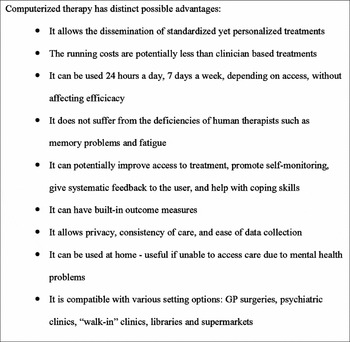
In a UK survey of cognitive behavioural therapists, computerized self-help was regarded as a supplement rather than as a replacement to traditional clinician lead treatment. Indeed, less than 4% reported actually using computerized self-help in their practice, and only 1.5% used it as an alternative to traditional patient-therapist contact (NICE, 2004). This is perhaps surprising given the potential advantages of using computers to deliver therapy, and in particular for computers to deliver a structured therapy like cognitive behavioural therapy (CBT). These advantages are summarized in Figure 1 (based on NICE, 2004).
Advantages of computerized therapy (based on NICE, 2004)

Cognitive behaviour therapy is an effective face-to-face intervention for adults with depression (Dobson, Reference Dobson1989), but its availability is limited by the lack of suitably trained therapists. Alternative modes of CBT delivery have therefore been developed. For example, Proudfoot and colleagues developed an interactive computerized CBT (CCBT) program, “Beating the Blues” as a treatment for depressed and anxious adults. Studies have shown that Beating the Blues is not only clinically efficacious, but is cost-effective and also acceptable to patients (Proudfoot et al., Reference Proudfoot, Ryden, Everitt, Shapiro, Goldberg, Mann, Tylee, Marks and Gray2004; McCrone et al., Reference McCrone, Knapp, Proudfoot, Ryden, Cavanagh, Shapiro, Ilson, Gray, Goldberg, Mann, Marks, Everitt and Tylee2004). Together with “Fearfighter” (for phobias and panic, Marks et al., Reference Marks, Mataix-Cols, Kenwright, Cameron, Hirsch and Gega2003), a recent NICE review identified Beating the Blues as one of two CCBT programmes with enough evidence to be recommended in a stepped-care model of treatment (NICE, 2005), and it is now in use in several NHS Mental Health or Primary Care Trusts in the UK. Other CCBT packages are also beginning to undergo evaluation and recommendation for clinical practice (Whitfield, Hinshelwood, Pashely, Campsie and Williams, 2006; NICE, 2005).
Development of CCBT for adolescents has lagged behind that for adults. Depression is prevalent in adolescents, with a 12-month period prevalence estimated at around 5% (Merry, McDowell, Hetrick, Bir and Muller, Reference Merry, McDowell, Hetrick, Bir and Muller2004), and a substantial body of randomized control trial evidence (e.g. Reinecke, Ryan and Dubois, Reference Reinecke, Ryan and Dubois1998; Lewinsohn and Clarke, Reference Lewinsohn and Clarke1999) shows that face to face CBT is an effective intervention for mild to moderate cases (NICE, 2005). However, as with adults, there is a lack of suitably trained professionals to deliver face to face CBT. This has led to the development and evaluation of other modes of delivery, including interactive computer programs.
In addition to the arguments around accessibility and delivery delineated in Figure 1, there are many other reasons why children and adolescents might be particularly good candidates for CCBT. These include the fact that this population is particularly comfortable interacting within the computer environment, and in our experience many young people, particularly teenagers, would sometimes rather interact with a computer than have to talk to a therapist.
“Stressbusters” is a project that has developed a novel CCBT for teenagers suffering with depression. The intervention is an interactive computer program that is an implementation of a clinically effective manualized CBT for children and adolescents with depression (Wood, Harrington and Moore, 1996; Kroll, Harrington, Gowers, Frazer and Jayson 1996). Once the computer program had been developed, the computer software CD-Rom was initially evaluated in youth clubs through focus groups. The development, beta test and preliminary data about participants’ views of the program will be published elsewhere (as this is beyond the scope of this paper). In addition, we also evaluated its clinical use in an extended case series in which appropriate referrals to CAMHS departments were offered the treatment. This paper describes these results in terms of reductions in depression symptoms and changes in other relevant clinical variables after the case series group had received the Stressbusters treatment.
Method
Participants and recruitment
Potential participants were identified by CAMHS clinicians in Manchester and South London as part of their routine assessment of new referrals. Participants could be referred if their main presenting problem was depression, were aged between 12 and 16 years, and had a reading age of at least 8 years. Referrals were excluded from the study if they were markedly suicidal or self-harming, had evidence of past or current psychosis, had learning difficulties (clinical estimate of IQ <70), had recently started medication for mental health problems, or were receiving other psychological treatment. There were no other exclusion criteria. In order to increase the sample size, one exclusion criteria was relaxed for five of the subjects (one young person was on medication, two had been seen in CAMHS before, and two were slightly out of the age range).
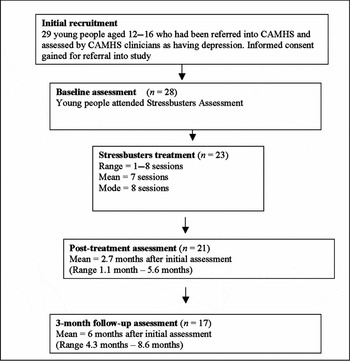
The participant pathway through the study is detailed in Figure 2. The whole process spanned almost 24 months (January 2005 to December 2006). Twenty-eight cases initially fulfilled the inclusion criteria for the study following assessments by local CAMHS clinicians. Twenty-three of these subjects completed part or all of the treatment and 21 subjects completed post-treatment assessments about 12 weeks after the baseline assessment. Seventeen subjects completed follow-up assessments about 6 months after the initial assessment. Relative to the 23 participants who completed all or part of the program, the 5 participants who did not receive the treatment did not differ in their levels of depression (mean Long MFQ scores of 33.83 compared to 35.48 respectively), and were of comparable ages (14.87 years for the 23 participants compared to 15.35 years for those who did not take part, non significant on Mann-Whitney U test, U = 57, p > 0.05).
Study design flow chart of participants' pathway through the study

Participants who met the research criteria were given information about the study (including written information and a consent form). If the subject was interested and gave informed consent to participate in the study, they were assessed on a battery of measures (see below). A parent or carer was also asked to complete some questionnaires and to give consent if the child was under 16 years old. If the assessment confirmed that the young person was suitable for the study, weekly appointments were arranged at the clinic. The young person at all times remained under the care of the CAMHS team and was monitored weekly by a clinician. The extent of the clinician's involvement was monitored throughout the study.
In terms of the demographic characteristics, there were 13 participants at the Manchester site (11 females), whose mean age at initial assessment was 15.18 years (SD 1.33) and whose mean Long MFQ score was 37.23 (SD 8.65). The 15 young people who were recruited in London were comprised of 13 females, with the mean age at assessment 14.76 years (SD 1.69) and mean Long MFQ score 31.60 (SD 11.75). The recruited participants across the two sites were similar in terms of age and gender. The severity of depression as determined by the long MFQ score was slightly higher in Manchester but this did not reach significance on an independent t test (p > 0.05, 2-tail). The age of participants across the sample ranged from 12 to 16, with two participants who received the treatment just outside of the age range (an 11 year old male, and a female who had just turned 17 at the time of assessment) and one 18-year-old girl who did not take part in treatment. Participants tended to be at the upper end of the recruiting age band, and were predominantly females.
Assessment
The Stressbusters assessment package contained the following measures and took under 2 hours in total to administer:
1. Rater/clinician completed. a) K-SADS. Interviewers from the Stressbusters team or a privately commissioned researcher administered the depression, anxiety (panic, social phobia, agoraphobia, specific phobias, generalized anxiety), and conduct disorder modules of the Schedule for Affective Disorders and Schizophrenia for School-Age Children – Present and Lifetime version (K-SADS-PL) (Kaufman et al., Reference Kaufman, Birmaher, Brent, Rao, Flynn, Moreci, Williamson and Ryan1997). The K-SADS is a well-known semi-structured interview schedule for diagnostic assessment (DSM criteria) of depression and other psychiatric disorders in young people aged 6 to 17 years. Severity of current depressive episode is also assessed. The interview is carried out directly with the young person and their parent or carer and reliability and validity indicators are good (e.g. Kaufman et al., Reference Kaufman, Birmaher, Brent, Rao, Flynn, Moreci, Williamson and Ryan1997). The K-SADS was employed in order to check DSM-IV diagnoses, particularly for depression. At follow-up assessments, the K-SADS-PL was administered again to assess continuing or new disorders since the previous interview.
b) CGAS. The Children's Global Assessment scale (C-GAS) (Shaffer et al., Reference Shaffer, Gould, Brasic, Ambrosini, Fisher, Bird and Aluwahlia1983) was also completed by the interviewer in order to assess participants’ global adjustment and functioning. On the C-GAS an overall rating of global functioning across a variety of domains (scholastic, relationship, and vocational) on a scale of 0–100 is given by the interviewing clinician. The scale shows good inter-rater reliability and discriminant validity, and is sensitive to change over time and after treatment (e.g. Steinhausen, Reference Steinhausen1987).
2. Participant completed. a) MFQ-L. The Moods and Feelings Questionnaire Long version (MFQ-L) (Angold, Costello, Pickles and Winder, Reference Angold, Costello, Pickles and Winder1987) was completed in order to gain a measure of depressive symptoms before and after treatment. The clinical cut-off is 26 (Park, Goodyer and Teasdale, Reference Park, Goodyer and Teasdale2002). This 33-item questionnaire is intended for use with young people aged 8–17 years and covers a broad range of symptoms of depression, rated on a 3-point Likert scale. It has been used extensively in community and clinical studies (e.g. Cooper and Goodyer, Reference Cooper and Goodyer1993; Goodyer, Herbert, Tamplin and Altham, Reference Goodyer, Herbert, Tamplin and Altham2000; Angold, Erkanli, Silberg, Eaves and Costello, Reference Angold, Erkanli, Silberg, Eaves and Costello2002). Reliability is excellent (internal, test-retest, and inter-rater), and the measure possesses good predictive and criterion validity (against K-SADS) (e.g. Daviss et al., Reference Daviss, Birmaher, Melhem, Axelson, Michaels and Brent2006).
b) SDQ YP. The self-report version of the Strengths and Difficulties Questionnaire (SDQ) (Goodman, Reference Goodman1997) was also completed by participants to provide an index as to whether the young person felt they were experiencing problems in various domains. The SDQ has five separate sub-scales for different aspects of problems or behaviours: emotional problems, conduct/behaviour problems, inattention/hyperactivity, relationships with peers, and pro-social behaviour. The first four scales can be added together to produce a score for total difficulties, and this measure (Total SDQ score) was used as an outcome variable in the current study. It has been shown to be highly reliable and to correlate extremely well with other, more complex indicators (e.g. Goodman, Reference Goodman2001).
c) RCMAS. To assess levels of reported anxiety, subjects completed the Revised Children's Manifest Anxiety Scale (RCMAS) (Reynolds and Richmond, Reference Reynolds and Richmond1978). The RCMAS is 37-item self-report measure that assesses anxiety in children and adolescents. Each item contains a feeling or action that reflects an aspect of anxiety. It has been subjected to rigorous study revealing impressive reliability and validity (e.g. Muris, Merckelbach, Ollendick, King and Bogie, Reference Muris, Merckelbach, Ollendick, King and Bogie2002).
d) The Cognitive Triad Inventory for Children (CTI-C), (Kaslow, Stark, Printz, Livingston and Tsai, Reference Kaslow, Stark, Printz, Livingston and Tsai1992) was completed in order to assess the three aspects of the negative cognitive triad postulated by Beck (Beck, Reference Beck1976) as being central to depression; view of self, view of world, view of future. The CTI-C is scored out of 72, with a low score denoting negative cognitions in the form of the existence of the negative triad.
e) Children's Attributional Style Questionnaire – Revised (CASQ-R) (Thompson, Kaslow, Weiss and Nolen-Hoeksema, Reference Thompson, Kaslow, Weiss and Nolen-Hoeksema1998). This instrument assesses how children attribute causality to good and bad events. The dimensions of the attributions in the CASQ-R are computed (internal-external, stable-unstable, global-specific), with the lower the difference in score between good and bad events (composite score) signalling a more depressinogenic attributional style. Composite scores were used as an outcome measure in the current study and scores below zero on the CASQ-R are associated with depression.
f) Automatic Thoughts Questionnaire (ATQ) (Kendall, Hollon, Corcoran and Fischer, Reference Kendall, Hollon, Corcoran and Fischer1987). Participants indicate the number of negative automatic thoughts (associated with depression) that they are currently experiencing. A high score on this measure therefore denotes the presence of many negative automatic thoughts.
In addition to the measures that were employed at the three main assessment intervals (baseline, post-treatment and follow-up) participants completed a slightly modified version of the Mood and Feelings Questionnaire – Short version (MFQ-S) (Thapar and McGuffin, Reference Thapar and McGuffin1998) immediately before each Stressbusters session. Two items from the long version of the MFQ pertaining to suicidal ideation were added to the MFQ-S in order to monitor for suicidality. Completing the MFQ-S in a serial fashion allowed for a micro-assessment of change in the participants’ depressive symptoms on a session-by-session basis.
3. Parent completed. The parent or carer who accompanied the young person to the assessment completed the Beck Depression Inventory (BDI) (Beck, Steer and Brown, Reference Beck, Steer and Brown1996). This was in order to measure depression symptoms in the parent of a participant. They were also given a State Trait Anxiety Inventory (STAI Spielberger, Reference Spielberger1983) to monitor their own level of anxiety symptoms. The parent or carer also filled in a General Health Questionnaire (GHQ-28) (Goldberg, Reference Goldberg1972), which provides information about the parent's self-reported physical and mental health. An observer-rated Strengths and Difficulties Questionnaire (SDQ-P: parent version) was also given in order to rate the perception of their child's functioning in the peer, prosocial, emotional, hyperactive-inattentive and conduct domains. A total SDQ score on this measure was used as an outcome measure in this study.
The treatment setting
The services that offered Stressbusters are located in inner-city conurbations with high levels of deprivation. The CCBT was offered and delivered in a clinic session, within one to two weeks of the initial Stressbusters assessment. In Manchester, the CCBT was offered by the Stressbusters research team, usually from within the CAMHS department where the referral had originated. In London, the referring clinician was sometimes responsible for administering and organizing the CCBT. At both sites, the young person had a clinician on hand nearby to answer enquiries or support them in the use of the programme, although there was no additional therapeutic input.
Stressbusters program
Twenty-three of the participants received at least one session of Stressbusters; 16 completed the full 8 sessions, and the average number of sessions completed was 7. Reasons for drop-out were not investigated thoroughly as they were usually from lack of attendance at appointments and subsequent difficulty in contacting the participant to arrange further appointments.
The Stressbusters software application is a CD−ROM consisting of eight 30–45 minute sessions of CBT designed for 12–16 year olds. The program is based on a well established and successful manualized therapist-client CBT package designed for children and adolescents (Wood et al., Reference Wood, Harrington and Moore1996; Kroll et al., Reference Kroll, Harrington, Gowers, Frazer and Jayson1996). Each Stressbusters session is an interactive multi-media presentation featuring audio narration synchronized with videos, animations, graphics and printouts.
The program has a narrator to guide the user. The eight sessions are in a linear progression, with each session building on the knowledge gained in previous sessions and on the tasks carried out at home. A session or part of a session can be repeated whenever necessary. Sessions contain flexible “add-ons” such as written fact sheets (e.g. about anxiety, bullying, depressive thinking styles), which can be printed out and taken away together with other handouts (e.g. mood diary sheets) produced by the programme.
The video inserts (case vignettes) are of three teenagers who feature throughout the 8 sessions. They are student actors who play the roles of depressed teenagers, specially scripted and created for the project. Stressbusters participants hear about their lives and watch the teenagers themselves using the program in a combination of short video sequences, talking heads and voiceovers. As the narrator talks, key words and simple illustrations appear on the screen. The teenager inputs information that is stored and used throughout the program, having the option to either drag/select text from lists or use free-text entry.
The session content is organized into the following format: Introduction to the programme and goal setting (Session 1); Getting activated (Session 2); Emotional recognition (Session 3); Noticing thoughts (Session 4); Thought challenging (Session 5); Problem solving (Session 6); Improving social skills (Session 7); Relapse prevention (Session 8).
Analyses
The data for the five participants who did not receive treatment were excluded from the analyses. Planned paired t tests compared the 23 participants’ outcomes before and after treatment on the questionnaire outcome measures. In addition, a repeated measures ANOVA was performed on the session-by-session short MFQ scores only. A non-parametric technique (McNemar test) was used to analyse the changes of K-SADS diagnoses within the sample across the three time points.
Due to the unavailability of subjects for certain assessments and due to the fact that some young people did not receive treatment, the data have been analysed in two ways for the questionnaire data analyses. The first is an intention to treat analysis, which is a more conservative assessment of treatment gains. This is where the last observation for the participant is carried forward when there are no data for the participant. The rationale for this is to avoid losing the responses from people who have dropped out and means that no data are lost.
The second method is a completer analysis, which does not use all available data as it only includes the outcomes of participants for whom there are data at more than one data point (i.e. baseline and post-treatment and/or baseline and follow-up).
Results
Observer rated measures
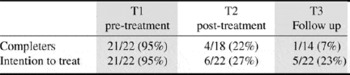
K-SADS outcome data are displayed in Table 1, and there are data for 22 young people at baseline (i.e. one K-SADS assessment data was missing). Twenty-one of the 22 initially gained a depression diagnosis. However at post-treatment, of the 18 young people assessed with the K-SADS only four had retained their depression diagnosis. At follow-up, for the 14 young people for whom there are data, only 1 was still depressed. On McNemar tests, the reduction in depression diagnoses for the completers was significant between baseline and post-treatment (n = 18, p < .001) and also between baseline and follow-up (n = 14, p <.001).
Numbers (%) diagnosed with depression (K-SADS)

At baseline, five of the 21 participants who registered for the K-SADS depression diagnosis also had additional diagnoses. Of these, three had one additional diagnosis (generalized anxiety disorder, social phobia, overanxious disorder), one had two additional diagnoses (separation anxiety, agoraphobia) and one had three additional diagnoses (panic, agoraphobia and social phobia). The one participant who did not receive a K-SADS depression diagnosis at baseline had no other diagnoses pre-treatment, and did not develop depression or another diagnosis at post-treatment (however K-SADS data were not available for her at follow-up).
Of the 4 subjects who received depression diagnoses on the K-SADS at follow-up, 1 had generalized anxiety disorder, and 3 of those who were not depressed on the K-SADS reached threshold for one or two anxiety disorders. Finally, only one of the 14 non-depressed young people had a comorbid diagnosis on the K-SADS at follow-up (social phobia).
In terms of the intention to treat analyses displayed in Table 1, McNemar tests still confirmed that the reduction in depression diagnoses was significant between pre- and post-treatment (n = 22, p < .001) and between pre-treatment and follow-up (n = 22, p < .001).
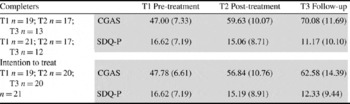
Table 2 displays the significant improvements found for both analyses of global functioning, as indexed by the mean observer rated CGAS scores. It also displays the mean parent/carer ratings of their child's difficulties as measured by the total SDQ (parent version) score. The improvement in global functioning (CGAS) between baseline and post-treatment, and between baseline and follow-up was highly significant on both methods of analysis (completer – T1 to T2 p < .001 t (16) = 4.40; T1 to T3 p < .001 t (12) = 5.44; intention to treat – T1 to T2 p < .001 t (18) = 4.13; T1 to T3 p < .001 t (18) = 4.69). However, the improvements on the general difficulties (SDQ) were more modest, and although they did not reach significance at post-treatment, they were significant at follow-up (completer – T1 to T2 p > .05 t (16) = 1.78; T1 to T3 p < .005 t (11) = 3.39: intention to treat – T1 to T2 p > .05 t (20) = 1.76; T1 to T3 p < .002 t(20) = 3.32).
Mean (SD) observer rated outcome for general functioning (CGAS) and general difficulties (SDQ-P)

Self-ratings of participants
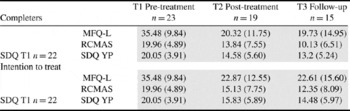
Primary clinical measures. Symptom measures completed by young people are displayed below in Table 3. Significant improvements between baseline and post-treatment, as well as between baseline and follow-up were reported by the young people in their depression (completer – T1 to T2 p < .001 t (18) = 4.85; T1 to T3 p < .001 t (14) = 4.41; intention to treat – T1 to T2 p < .001 t (22) = 4.49; T1 to T3 p < .001 t (22) = 3.84) and anxiety (completer – T1 to T2 p < .001 t (22) = 4.27; T1 to T3 p < .001 t (14) = 6.06: intention to treat – T1 to T2 p < .001 t (22) = 4.13; T1 to T3 p < .001 t (22) = 5.28) levels. They also reported significant overall improvements in the peer, prosocial, conduct, emotional or hyperactive-inattentive domains reflected in the total SDQ (completer – T1 to T2 p < .001 t (18) = 4.16; T1 to T3 p < .001 t (14) = 5.67; intention to treat – T1 to T2 p < .001 t (21) = 3.92; T1 to T3 p < .001 t (22) = 5.50).
Mean (SD) self-report scores for depression (MFQ-L), anxiety (RCMAS) and general difficulties (SDQ YP)

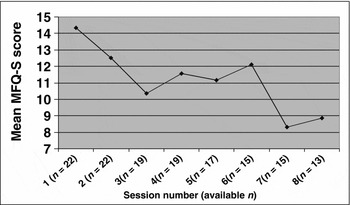
Short MFQ data collected serially over 8 sessions are displayed in Figure 3, showing the mean score per session, with number of subjects for whom the data represent. A repeated measures ANOVA on these data showed a significant effect of time (p < .001, F (7, 84) = 7.94) with a drop of about 6 points on the short MFQ, between the first and last session. Within subjects contrasts suggested that the main treatment gains appear to have occurred between sessions 2 and 3, and then between session 6 and 7 (session 2 vs. session 3 p < .01, F (1, 12) = 3.27; session 6 vs. session 7 p < .004, F (1, 12) = 13.71) with the other differences between mean short MFQ successive session scores not reaching statistical significance (p > .05).
Mean depression scores (MFQ-S) before each session

Cognitive measures
Both the ATQ and the CTI-C showed significant improvements between baseline and post-treatment, and baseline and follow-up using both methods of analysis (all p < .001). The CASQ outcomes did not reflect significant improvements between baseline and post-treatment; however there was nevertheless a modest but significant improvement between baseline and follow-up on this measure (completer – p < .05 t (14) = 2.55: intention to treat p < .01 t (22) = 2.94).
Parent/carer self-ratings of health, anxiety and depression
On the GHQ, there were some reductions in scores after treatment and at follow-up reflecting improvement, although this only reached significance for the completer analysis, which specifically compared scores at baseline and follow-up (p < 0.05 t (11) = 2.21). On the BDI, parental levels of depression did not change, except on the completer analysis comparing baseline to follow-up scores, which approached statistical significance on a paired t test (p = <0.06, t (11) = 2.18). There were no changes in parent/carer self-reported anxiety levels on the STAI, apart from a small decrease between baseline and follow-up that approached statistical significance (p <.09, t (11) = 1.88) in a completer analysis.
Discussion
The current study is a preliminary evaluation of the clinical outcomes of participants referred by local CAMHS in Manchester and London for the treatment of their depression with a new computerized CBT treatment called Stressbusters. Inasmuch as the current study was not a randomized control trial it cannot provide absolute evidence that any treatment gains were due to the intervention (as they may have resulted from selection biases in the sample's group characteristics such as severity of disorder or risk factors). However, it can provide information on whether the referred sample were depressed, whether immediately following Stressbusters their clinical symptoms had improved, and then whether the improvements were still evident 3 months later. As discussed above, the results of this study suggest that the sample did indeed appear to have been depressed before treatment and strongly suggest that they had much improved 8 to 12 weeks later after treatment; they had also maintained these clinical improvements 3 months later. This indicates that the participants benefited from receiving the Stressbusters intervention.
The depression diagnoses made by the referrers were nearly all confirmed by K-SADS diagnoses and the high mean MFQ score of the group suggests that the sample encountered significant levels of depression before treatment. Many very marked clinical improvements were evident in analyses that included participants’ scores who received the treatment, and the extent of these improvements was so strong that the differences remained when conducting more conservative intention to treat analyses.
One of the most dramatic examples of these improvements is the fact that whereas almost the entire sample had symptoms of depression that elicited a K-SADS diagnosis of major depression, almost 80% had no diagnosis after treatment, and 3 months later only one young person in the follow-up sample received a depression diagnosis. These changes were also reflected in significant improvements in CGAS global functioning scores. Mean MFQ-L scores likewise reduced markedly from baseline to post-treatment, and from baseline to follow-up.
Participants also reported less anxiety symptoms after treatment, and the mean RCMAS scores fell to normal levels of anxiety that have been found in normative samples (Reynolds and Richmond, Reference Reynolds and Richmond1978). The Stressbusters program includes targeted information on anxiety reduction techniques and it is possible that this in particular contributed directly to helping the young people address their levels of anxiety. Improvements in emotional and behavioural difficulties were also reported by the adolescents. This reduction in emotional and behavioural problems was only reflected in parents’ ratings at follow-up, which may either mean that because these were more secondary difficulties to the depression they took more time to reduce, or that the impact on parents’ perceptions of these difficulties took longer to occur.
Parents’ ratings of their own anxiety showed no change at all following treatment, and although no changes in their health or depression symptoms were evident immediately after treatment, the parents appeared to show some reduction in their levels of depression and mental health problems by follow-up. The specific State and Trait components of parents’ anxiety were not available for analysis, but it would be interesting to explore the hypothesis that the reduction in their child's depression mediated an improvement in the parents’ health, own depression and State (but not Trait) anxiety.
Changes on the participants’ self-reported cognitive measures seemed to reflect the marked reduction in depressive symptomatology. The ATQ and CTI-C in particular seemed particularly sensitive to post-treatment changes in our sample and would suggest that subjects’ negative attributions and their negative beliefs about the world, themselves, and others had undergone positive changes. Given that the ATQ is actually a measure designed for adults and was not adapted for the teenagers, the results suggest that it might be a tool that can be directly applied to younger samples. In addition, the data at baseline suggested that the ASQ and CTI-C have a strong negative correlation (r = −0.71) as high scores on the ATQ and low scores on the CTI-C are associated with depression.
The changes in the Short MFQ scores over the course of the treatment were similar to those found in the (adult) CCBT study by Whitfield et al. (Reference Whitfield, Hinshelwood, Pashely, Campsie and Williams2006), with a sudden reduction in depressive symptoms occurring early in treatment. However, whereas the subjects in the study by Whitfield et al. (Reference Whitfield, Hinshelwood, Pashely, Campsie and Williams2006) benefited from a gradual reduction in depression over the course of the remainder of the treatment, the present results suggest that the further reduction in symptoms comes online after the sixth session. The hypothesis derived from this, therefore, is that although the full complement of eight sessions of Stressbusters is advisable, at least the first six sessions, or at the very least the first two sessions, should be completed by prospective users. A further idea is to investigate the cognitive changes during CBT treatment by asking participants to complete the ATQ and CTI-C in the middle of treatment and to compare changes in these measures to matched participants who are treated with medication. In this way, the assumption that CBT specifically operates on changes in cognition, which result in changes in symptoms, can be examined. This finding has been documented in adult studies (e.g. DeRubeis, Evans, Hollon, Garvey, Grove and Tuason, Reference DeRubeis, Evans, Hollon, Garvey, Grove and Tuason1990) but has not been replicated in a younger age group.
Other areas of future research with the Stressbusters software includes the examination of whether the results obtained in the predominantly female group in the current study can be generalized to males, and also whether the effects are comparable with a slightly younger age range. More generally, other areas of future research include: identifying individuals most suited to Stressbusters in preference to traditional CBT, exploring the use of Stressbusters as an adjunct to traditional CBT, quantifying the level of facilitator involvement in Stressbusters needed to produce optimal outcomes, comparing the cost effectiveness of Stressbusters with traditional CBT and “treatment as usual” in CAMHS, and establishing the optimum site of delivery (e.g. clinic, health centres, schools, home). The issue of whether Stressbusters might be usefully used from home (e.g. through the internet) is a particularly interesting avenue of research, and would require particular attention to the way in which risk could be managed.
In conclusion, the results of this extended case series have provided preliminary indications that the participants responded very positively to Stressbusters, and it appears to be an effective and accessible CCBT intervention that is particularly suited to adolescents. NICE has called for the further evaluation of computerized CBT interventions (NICE, 2005, p.168) and although the program is currently being licensed for general release to CAMH services, we would suggest that Stressbusters is an excellent candidate for even more stringent tests of its effectiveness in a randomized control trial.
Disclosure of Interests
The same group who ran the case series have also developed the programme, and are currently seeking to licence it.
Acknowledgements
This work was funded by the Healthcare Foundation. The input of Bronwyn Raykos and Eleri Holmes was invaluable in running the case series, and we are very grateful for all their work.



Comments
No Comments have been published for this article.