Introduction
The discourse in entrepreneurship has highlighted the need for more knowledge on venture survival, as entrepreneurial ventures are relatively more susceptible to deaths in comparison to larger firms (Bullini Orlandi, Zardini, & Rossignoli, Reference Bullini Orlandi, Zardini and Rossignoli2021). Such discourse is also increasingly more crucial given the extent of globalization threatening the survivability of small and medium firms, including socio-economic shifts and the recent Covid-19 pandemic. In this aspect, entrepreneurial survival is as important, if not more important than, the process of starting a venture. These environmental shocks make firms such as transnational migrant-owned ventures more vulnerable to entrepreneurial death, given their relative positions as non-local firms in a host country (Abd Hamid, O’Kane, & Everett, Reference Abd Hamid, O’Kane and Everett2019; Arslan, Kamara, Zahoor, Rani, & Khan, Reference Arslan, Kamara, Zahoor, Rani and Khan2022; Mata & Alves, Reference Mata and Alves2018). This study contributes to these discussions by focusing on the way entrepreneurs’ resources influence their transnational ventures in achieving long-term survivability in a host country, using the background of Korean transnational entrepreneurs (KTEs) and their ventures in a host country, Malaysia. The outcome of this research is a set of configurations of entrepreneurs’ resources that lead to venture survivability.
The entrepreneurship discourse has largely focused on opportunity development and business creation processes, leaving a gap to understand how ventures survive, especially in dynamic, unfavourable environments such as a foreign country, a nation under political instability or within a minority entrepreneurship context (García-Lillo, Seva-Larrosa, & Sánchez-García, Reference García-Lillo, Seva-Larrosa and Sánchez-García2023; Lee, Wiklund, Amezcua, Bae, & Palubinskas, Reference Lee, Wiklund, Amezcua, Bae and Palubinskas2022). Ventures owned and operated by minorities such as transnational migrants are relatively more reliant on the decisions made by the entrepreneurs in comparison to their local counterparts, as such ventures operate in a dynamic environment, usually at the margins of societal opportunities in addition to lack of inclusion conventionally experienced by minority-owned ventures (Abd Hamid, Pidduck, Alex, Hanifah, & Sidek, Reference Abd Hamid, Pidduck, Alex, Hanifah and Sidek2023). As such, in extending the discourse of individual-opportunity-venture nexus within the scope of venture survivability, this study pays closer attention to the entrepreneur’s role in the survival of their ventures, as the trajectory of their ventures is primarily influenced by their decisions, which are informed by their resources (Branzei & Fathallah, Reference Branzei and Fathallah2021). To understand the way entrepreneurs and environments interact for venture survival, this study focuses on transnational migrants in entrepreneurship, zeroing in on the entrepreneurs’ individual resources given their critical value in a venture’s growth (Bullini Orlandi, Zardini, & Rossignoli, Reference Bullini Orlandi, Zardini and Rossignoli2021).
Transnational migrants are more likely to start a venture in the host country in comparison to locals, given their lack of inclusion with the labour market and the advantages that they possess based on the duality of their identities (Abd Hamid, O’Kane, & Everett, Reference Abd Hamid, O’Kane and Everett2019). Transnational entrepreneurs, or TEs, are in an especially advantageous position for global sourcing and trading activities, given their multiple-country embeddedness (Rodgers, Vershinina, Williams, & Theodorakopoulos, Reference Rodgers, Vershinina, Williams and Theodorakopoulos2019; Terjesen & Elam, Reference Terjesen and Elam2009). However, transnational migrant-owned ventures are relatively more susceptible to entrepreneurial failures, as they operate in a foreign and often uncertain environment, exposing them to liability of foreignness (Aluko, Ott, Siwale, & Odusanya, Reference Aluko, Ott, Siwale and Odusanya2022; Mata & Alves, Reference Mata and Alves2018). For transnational migrant-owned firms, liability of foreignness can be addressed through TEs’ networks and knowledge (Gurău, Dana, & Light, Reference Gurău, Dana and Light2020).
Research on transnational migrant ventures has emphasized the role of TEs’ networks and unique knowledge in ensuring venture development and survival (Dabić et al., Reference Dabić, Vlačić, Paul, Dana, Sahasranamam and Glinka2020). Such networks can be categorized into home country-based and transnational-based. Home country-based networks provide TEs with trusted relationships, allowing for cheap sourcing and manufacturing activities in their home countries, while transnational networks facilitate entrepreneurial opportunities (Patel & Terjesen, Reference Patel and Terjesen2011; Pruthi, Basu, & Wright, Reference Pruthi, Basu and Wright2018; Qin & Estrin, Reference Qin and Estrin2015). TEs’ knowledge on the other hand facilitates mobilization of resources through multiple-country embeddedness, in which their knowledge on multiple-country cultural and institutional environment encourages transnational opportunity development (Dheer & Lenartowicz, Reference Dheer and Lenartowicz2018; Lundberg & Rehnfors, Reference Lundberg and Rehnfors2018), thus reducing their liability of foreignness in the host country (Sui, Morgan, & Baum, Reference Sui, Morgan and Baum2015). Their multiple-country networks and knowledge are further enhanced with TEs’ geographical mobility, which enables travelling for opportunity development in transnational spaces (Rodgers et al., Reference Rodgers, Vershinina, Williams and Theodorakopoulos2019; Terjesen & Elam, Reference Terjesen and Elam2009). However, such aspects have not been discussed at length within the context of venture survivability for transnational ventures. Therein lies an understudied gap on what contributes to the venture survivability of transnational ventures. This research thus asks: ‘What are the combinations of multiple-country networks, multiple-country experience, and geographical mobility in enabling venture survival?’.
To address this gap, this study (1) examines the strategies adopted by TEs in ensuring their ventures’ survivability and (2) investigates the configurations of multiple-country networks, multiple-country knowledge, and geographical mobility that contributes towards entrepreneurial survivability. The contributions of this paper for the discourse of individual-opportunity-venture in the scope of business survival are twofold: (1) identifying TEs’ resource mobilization roles in influencing their ventures’ survivability and (2) clarifying the combinations of human capital, networks and geographical mobility in transnational venture survivability. Anchored by the capital approach through Bourdieu’s Forms of Capital model, this study is further outlined by the concepts of human capital and social capital in entrepreneurship. Specifically, this study’s findings speak to the discourse of individual-opportunity-venture discourse by focusing on the entrepreneur’s role in shaping their venture survivability in the context of transnational markets, which are largely dynamic and can be threatening to a venture’s lifespan. Practice-wise, the findings of this research will be particularly useful for TEs operating ventures in multiple countries and policymakers involved in developing such ventures.
To answer the research question, this study uses a configurational approach through the background of KTEs in Malaysia. The usage of qualitative comparative approach (QCA) as a tool offers a clearer visualization of the way specific variables interact to produce an outcome of interest. KTEs in Malaysia as a context on the other hand provide an interesting background of the way TEs from a more developed economy leverage development differences in capturing transnational opportunity; thus encourage a clearer depiction of entrepreneurs operating in dynamic environments. As the crux of transnational entrepreneurship lies on individuals arbitraging resources and opportunities through country differences, such differences carry with them challenges that threaten a venture’s survival.
This research is structured as follows. This paper begins with a discussion on the main concepts outlining the study. This is followed by a clarification of this study’s contextual background, then an explanation of the data collection and analysis approach. Then, the findings are presented and further articulated in the discussion section. This paper concludes with the theoretical and practical implications of the research.
Literature review
In light of the individual-opportunity-venture nexus view in entrepreneurship (Shane & Venkataraman, Reference Shane and Venkataraman2000; Venkataraman, Reference Venkataraman and Katz1997) which states that individuals materialize entrepreneurial opportunities by mobilizing resources (Gumpert & Stevenson, Reference Gumpert and Stevenson1985), this study defines entrepreneurs as ‘individuals who discover and exploit entrepreneurial opportunities’; in particular, this study is focused on individuals who started a business venture and able to sustain the venture. Within this nexus is the venture as the outcome of the individual-opportunity interaction, and in particular, this research is focused on the survival of the venture, which is an increasingly crucial topic especially after the recent pandemic (García-Lillo, Seva-Larrosa, & Sánchez-García, Reference García-Lillo, Seva-Larrosa and Sánchez-García2023). In this aspect, this study speaks to the call for (1) the entrepreneur-opportunity-venture discourse and (2) entrepreneurial survivability through the background of migrant transnational entrepreneurship. Venture survival is referred to as continued existence of the venture (Josefy, Harrison, Sirmon, & Carnes, Reference Josefy, Harrison, Sirmon and Carnes2017) with regard to the venture’s dynamic environment (Motley, Eesley, & Koo, Reference Motley, Eesley and Koo2023). As the conceptualization of venture survival is complex and context-dependent (Josefy et al., Reference Josefy, Harrison, Sirmon and Carnes2017), this study defines venture survival as ventures that have continued to exist for at least 10 years, as ventures typically exit their category (in other words, experience failure) within the first 6 years after their conception (Mata & Alves, Reference Mata and Alves2018; Motley, Eesley, & Koo, Reference Motley, Eesley and Koo2023).
Venture survival is complex, as the nature of entrepreneurship is largely a combination of risks and opportunities, in interaction with entrepreneurs’ resources and characteristics, the venture, and the environment. Small businesses generally achieve long-term survivability through consistent ‘wins’ or standing out against their competitors in a specific category for more than 6 years (Coad, Frankish, Roberts, & Storey, Reference Coad, Frankish, Roberts and Storey2013). The entrepreneur plays an important part in determining a venture’s survivability, as they decide on which projects to undertake and resource configuration in the opportunity development process (Motley, Eesley, & Koo, Reference Motley, Eesley and Koo2023).
The individual resource perspective in entrepreneurship posits that the opportunity process is primarily facilitated by the entrepreneur’s individual resources. In extending this perspective, this study is outlined by the Forms of Capital Model (Bourdieu, Reference Bourdieu and Richardson1986) which argues that an individual’s human, social, and financial resources interact to produce an intended output, and such resources convertible. Here, the creation and development of a venture are a result of the entrepreneur’s resources. This study places emphasis on the entrepreneur’s human and social capital as (1) both are convertible to financial resources as outlined by the Forms of Capital Model and (2) to further understand the way such resources interact with global mobility in ensuring venture survivability, especially in the context of transnational ventures.
In general, ventures created by migrants are documented to have a lower rate of survival in comparison to that of founded by natives, due to liability of foreignness (Arslan et al., Reference Arslan, Kamara, Zahoor, Rani and Khan2022; Mata & Alves, Reference Mata and Alves2018). Additionally, transnational, migrant-owned firms are more likely to be exposed to country risk given their positions as non-local firms (Abd Hamid, Reference Abd Hamid2020) – this further pushes firms to be more vulnerable to the environmental uncertainties in the host country. However, these disadvantages are somewhat compensated for by the uniqueness of the firms, which are a manifestation of their founder’s dual-country and transnational identity (Abd Hamid, O’Kane, & Everett, Reference Abd Hamid, O’Kane and Everett2019), which facilitates transnational entrepreneurial opportunity processes difficult to be engaged by their local counterparts.
Transnational entrepreneurs
TEs are defined as foreign-born entrepreneurs who travel back and forth between their home and host countries (Drori, Honig, & Wright, Reference Drori, Honig and Wright2009; Patel & Conklin, Reference Patel and Conklin2009; Terjesen & Elam, Reference Terjesen and Elam2009). TEs are embedded in multiple countries and intercultural contexts and engage in entrepreneurship activities between their home and host countries. One of the unique characteristics of TEs lies in their capabilities in mobilizing both social networks and unique cognitive resources across multiple institutional environments (Abd Hamid, Ayob, & Sidek, Reference Abd Hamid, Ayob, Sidek and Che Senik2024; Drori, Honig, & Wright, Reference Drori, Honig and Wright2009). Transnational entrepreneurship activities primarily consist of TEs’ active involvement in (1) trade between their home and host countries and (2) transportation of money and goods (Patel & Conklin, Reference Patel and Conklin2009). Their ability to mobilize resources encourages the creation and development of ventures across transnational spaces, including financial services, import-export of goods or raw materials, cultural enterprises, and manufacturing firms (Pruthi, Basu, & Wright, Reference Pruthi, Basu and Wright2018).
For transnational ventures, their survivability primarily stands on their multiple-country characteristics adopted from the entrepreneurs’ resources, as TEs are able to conjure resources and take advantage of opportunities across borders (Mata & Alves, Reference Mata and Alves2018). Transnational activities tend to consist of manufacturing, import-export, or sourcing from TEs’ home countries for their services in the host country. The host country on the other hand is instrumental in providing TEs with an avenue to commence and strategize their business through planning and the facilities available in the host country. In this regard, TEs balance home-host country differences through knowledge and networks in both countries, which are facilitated by their ability to move beyond geographical borders, while maintaining and developing ties in their home countries.
The coordination of multiple-country networks, multiple-country knowledge, and geographical mobility can be observed in TEs of various country settings. For example, Colombian TEs in the manufacturing sector employ their home country knowledge and networks for inexpensive labour source to manufacture goods to be sold in the host country, the US, while the host country is employed for its favourable institutional environment, which includes a relatively more efficient financial environment and infrastructure enabling transnational business start-up and maintenance (Santamaria-Alvarez, Sarmiento-Gonzalez, & Arango-Vieira, Reference Santamaria-Alvarez, Sarmiento-Gonzalez and Arango-Vieira2019). Additionally, a study on Chinese TEs in Australia and New Zealand by Duan, Kotey, and Sandhu (Reference Duan, Kotey and Sandhu2021) illustrated the ways in which TEs leverage on the home countrymen in the host country as their clients while expanding their operations through the unique knowledge that they have of their home country (such as funding opportunities and institutional loopholes). As the entrepreneurial process is facilitated by the interaction of entrepreneurs’ resources and the transnational entrepreneurship process is shaped by the ability to recognize and exploit opportunities across borders (Aluko et al., Reference Aluko, Ott, Siwale and Odusanya2022), this research focuses on TEs’ networks and experiences in assisting them to constantly engage in the opportunity process in transnational markets.
Multiple-country networks
According to the Forms of Capital model, social capital through networks enables the flow of information and financial resources, thus further encourages the opportunity development process (Patel & Conklin, Reference Patel and Conklin2009). In transnational markets, TEs combine capital in host and home environments to create unique combinations of capital from both (Aluko et al., Reference Aluko, Ott, Siwale and Odusanya2022; Patel & Conklin, Reference Patel and Conklin2009), through pursuing a modern middleman role that transcends the multiple institutional environments in which they are embedded (Gurău, Dana, & Katz-Volovelsky, Reference Gurău, Dana and Katz-Volovelsky2020; Terjesen & Elam, Reference Terjesen and Elam2009). Firms owned and operated by TEs internationalize to obtain economies of scale through their networks (Crick & Chaudhry, Reference Crick and Chaudhry2010), and through internationalization, firms owned and operated by TEs are able to balance the risks and opportunities in such contexts. Specifically, TEs’ embeddedness within their sectors across borders equip them with access to resources and information, allowing for continued opportunity process in multiple countries (Tabares, Chandra, Alvarez, & Escobar-Sierra, Reference Tabares, Chandra, Alvarez and Escobar-Sierra2021). International business activities such as exporting, sourcing, and marketing require nation-specific information and financial resources; thus, multiple country networks facilitate TEs’ venture survivability by feeding the process with the information that would be difficult to access without.
With regard to resource management, TEs’ multi-country embeddedness enables the formation of teams and ventures across multiple countries which encourages business growth by accumulating resources from multiple sources. TEs’ transnational social capital (Rodgers et al., Reference Rodgers, Vershinina, Williams and Theodorakopoulos2019), which includes links with co-national communities in the host country and industry-based communities in their home countries, enables knowledge transfer and increase of legitimacy of their ventures in their home and host countries. In relation to their perceived liability of foreignness, TEs usually form purposeful strategic networks to compensate their lack of inclusiveness within the host country (Santamaria-Alvarez, Muñoz-Castro, Sarmiento-González, & Marín-Zapata, Reference Santamaria-Alvarez, Muñoz-Castro, Sarmiento-González and Marín-Zapata2018).
Perhaps one of the most crucial aspects of TEs’ home countries is their connections to their home countries’ networks. Such networks allow TEs to oversee their transnational operations through trusted links in their homelands, ensuring venture growth. For example, as TEs are largely based in the host country, their home country manufacturing operations are usually manned by trusted ties, such as family members or close friends. Such ties are instrumental as they link TEs with other networks in the home country (including potential venture capitalists, investors, and clients) and provide TEs with information that they are missing while working in the host country (Crick & Chaudhry, Reference Crick and Chaudhry2010; Pruthi, Reference Pruthi2014; Santamaria-Alvarez et al., Reference Santamaria-Alvarez, Muñoz-Castro, Sarmiento-González and Marín-Zapata2018) which allow for transfer and cultivation of ideas important for venture development (Pidduck & Zhang, Reference Pidduck and Zhang2022; Stoyanov, Woodward, & Stoyanova, Reference Stoyanov, Woodward and Stoyanova2018a). The combination of networks from multiple contexts allows for readiness to anticipate, observe, and capture opportunities in the multiple countries, which leads to consistent successful opportunity development process, thus reducing the venture’s possibility for failure in the transnational market (Motley, Eesley, & Koo, Reference Motley, Eesley and Koo2023).
Multiple-country experiences
The Forms of Capital approach suggests that human capital, accumulated through formal and informal educational experiences, is useful as they can be used for productive purposes, such as employment and building a venture (Bourdieu, Reference Bourdieu and Richardson1986). For entrepreneurs conducting transnational operations, TEs’ dual or, in some case, multiple-country knowledge is instrumental in recognizing and exploiting international entrepreneurial opportunities (Dheer & Lenartowicz, Reference Dheer and Lenartowicz2018; Lundberg & Rehnfors, Reference Lundberg and Rehnfors2018) and assists in reducing TEs’ liability of foreignness (Mata & Alves, Reference Mata and Alves2018; Müller, Kirst, Bergmann, & Bird, Reference Müller, Kirst, Bergmann and Bird2023; Sui, Morgan, & Baum, Reference Sui, Morgan and Baum2015). Within this perspective, TEs are in a unique position in recognizing and exploiting international entrepreneurial opportunities as their multicultural characteristics and experiences influence entrepreneurial intentions through their cultural intelligence, which facilitates cultural cognitions in assisting them to spot novel international opportunities (Dheer & Lenartowicz, Reference Dheer and Lenartowicz2018). Through such knowledge and skills, TEs are able to introduce processes or products unavailable in the host country but available in their host countries or vice versa (Lundberg & Rehnfors, Reference Lundberg and Rehnfors2018).
Based on the human capital approach, experiences useful for transnational entrepreneurship opportunity process are derived from TEs’ (1) education, (2) employment experience, and (3) entrepreneurial experience (Abd Hamid et al., Reference Abd Hamid, Pidduck, Alex, Hanifah and Sidek2023). Formal educational experiences, including that of in their home country or abroad, through teaching and learning, allow TEs to cultivate problem-solving skills and critical thinking skills crucial for opportunity identification (Del Sarto, Di Minin, Ferrigno, & Piccaluga, Reference Del Sarto, Di Minin, Ferrigno and Piccaluga2021). Furthermore, formal education especially those undertaken in prestigious opportunities facilitates accumulation of transnational high-value social networks, including with high-ranking government officers and managers, which support business start-up processes (Terjesen & Elam, Reference Terjesen and Elam2009; Yague-Perales, Perez-Ledo, & March-Chorda, Reference Yague-Perales, Perez-Ledo and March-Chorda2019) which are in general more complex in international markets.
The human capital approach in entrepreneurship argues that employment experiences influence the creation and growth of ventures through exposing entrepreneurs with industry-specific knowledge and contacts, which facilitates the opportunity process as experience as an employee encourages the development of organizational competencies (as examples, leadership qualities and administrative knowledge) (Staniewski, Reference Staniewski2016) serving as fundamental internal source of competitive advantage for the venture. In international markets, such competencies are valuable given the complexity of dealing with foreign culture and institutions (Pidduck, Clark, & Busenitz, Reference Pidduck, Clark, Busenitz, Caputo, Pellegrini, Dabić and Dana2021).
Some TEs are equipped with multi-country entrepreneurial experience, which enables them to handle administrative issues in complex environments and accumulate transnational contacts (Crick & Chaudhry, Reference Crick and Chaudhry2010; Gruenhagen Jan, Reference Gruenhagen Jan2019). As entrepreneurial experience is highly regarded as one of the aspects influencing venture growth by encouraging creativity and innovation, international entrepreneurial experience allows for culmination of international network, creativity in introducing new products in foreign markets, and dealing with government bodies, customers, and suppliers from different cultures (Johanson & Vahlne, Reference Johanson and Vahlne2009; Tabares et al., Reference Tabares, Chandra, Alvarez and Escobar-Sierra2021).
Geographical mobility
One of the values of international mobility for TEs is the development of personal capabilities from overseas experiences to mobilize resources. Geographic mobility, or the flexibility to move across borders through an individual’s formal and informal national backgrounds (as examples, passports and visa) (Choudhury, Reference Choudhury2022), provides individuals with the agility to change their professions across borders – a competitive advantage that set TEs apart from their local or host country competitors. In this aspect, TEs’ geographical mobility assists in promoting venture survival as it encourages opportunity identification across borders and the growth of venture in transnational spaces through facilitating the process of venture creation, which includes the marketing, operation, and administrative tasks involved.
Opportunities from geographical mobility
In a similar manner of how multinational firm managers’ global mobility contributes towards the growth of the firm by integrating knowledge, as the main decision-maker of their ventures, TEs’ global mobility encourages the consolidation of resources and knowledge across transnational spaces. TEs’ geographical mobility exposes them to opportunities across borders; here, TEs are largely in an advantageous position to exploit such opportunities in comparison to their local and home country counterparts (Vandor & Franke, Reference Vandor and Franke2016). In this aspect, TEs are able to ensure that their ideas are materialized as they are able to leverage the resources that they have in multiple countries. Additionally, such mobility allows for international expansion – as geographical mobility enables TEs to physically oversee their multi-country operations (Abd Hamid et al., Reference Abd Hamid, Pidduck, Alex, Hanifah and Sidek2023), even though they are stationed in a specific location.
Operational advantages from geographical mobility
TEs’ home country labour market and consumer market characteristics encourage such mobilization, in which countries with relatively economical labour market are leveraged for manufacturing purposes, while more developed host countries are adopted as TEs’ strategic offices. In general, most of the transnational activities consisted of manufacturing, import-export, or sourcing from TEs’ home countries for their services in the host country. The host country on the other hand is instrumental in providing TEs with an avenue to commence and grow their business through planning and facilities available in the host country. In this regard, TEs balance home-host country differences through knowledge and networks in both countries, which are accumulated through their experience in the host country, while maintaining and developing ties in their home countries. TEs’ geographical mobility enables TEs to perform arbitrage activities through leveraging the differences between countries, as the convention from the migrant entrepreneurship literature suggests that TEs are able to use their dual-country mobility to take advantage of the more prosperous host countries to grow the ventures that they have developed in their home countries.
Research focus
In general, firms owned and operated by transnational migrants are more exposed to low venture survivability as they are susceptible towards liability of foreignness and resource limitations relative to larger, multinational firms (Aluko et al., Reference Aluko, Ott, Siwale and Odusanya2022; Mata & Alves, Reference Mata and Alves2018), inherent by their non-local and size characteristics. However, there are many indications of the way TEs’ multi-country characteristics induce their firms’ growth thus contributing towards venture survivability (Vandor & Franke, Reference Vandor and Franke2016). The contradicting ideas surrounding it provoke the question of: ‘What are the combinations of multiple-country networks, multiple-country experience, and geographical mobility in enabling venture survival?’. We investigate this issue using a configurational approach through case studies, in clarifying the role of entrepreneurs’ networks, experiences, and mobility in shaping a venture’s survivability in dynamic environments.
Methods
The research question is addressed through a case-based methodology, namely QCA. QCA refers to a set of theoretic method employing Boolean algebra and algorithms (Fiss, Reference Fiss2011), focusing on cases which can be in the format of firms, individuals, or other units of analysis. Set theoretic methods, and QCA in particular, aim to identify and test combinations of conditions that lead to outcomes of interest. This study is specifically interested in set membership in entrepreneurial survival.
Here, a fuzzy set allows membership in the interval between 0 and 1 while retaining the two qualitative states of full membership and full non-membership (Ragin, Reference Ragin2008). This is applicable through a process of calibration, in which the researcher identifies the following value for all outcomes between: (1) fully in set (whereby the condition/outcome will have the value of 1) and (2) fully out set (value of 0) and a crossover point (value of 0.5). The conditions and outcomes are rescaled, ranging from 0 to 1. For this study, the calibration is based on the percentile approach as it is appropriate for continuous data (Ragin, Reference Ragin2008). In accordance to this approach, the ‘fully in’ set is defined as the 95th percentile, while the ‘fully out’ set is defined as the 5th percentile and the ‘crossover’ or ‘neither in nor out’ point is defined by the median. The same criterion is used for all conditions and outcomes considered in this study.
The setting and sample of this study
The context of this study is KTEs in Malaysia. Such a unique context warrants a further examination as they represent (1) entrepreneurial individuals from a minority group in the host country and (2) entrepreneurs from a relatively more developed country than the host country. Specifically, this research primarily focuses on entrepreneurs from one home country to eliminate the need to examine moderating factors from entrepreneurs’ home nations. Ten cases of entrepreneurs were selected to examine the conditions, a number considered adequate for this study as QCA is context-dependent, depending on the conditions and contexts to be examined (Pappas & Woodside, Reference Pappas and Woodside2021). Here, it is hypothesized that venture survival, termed as long-term transnational entrepreneurship (LTE), is a result of entrepreneurs’ multiple-country networks (MUNET), multiple-country experience (MUNEX), and geographical mobility (GEOM), summarized as:
MUNET*MUNEX*GEOM -> LTE
The sampling for this study is anchored by the following criteria:
• Transnational ventures that have been operating in the host country for at least 10 years
• Transnational ventures that are registered in the host country
• Transnational ventures owned and operated by migrants
With regard to the on the contextual nature of the research, this study compares 10 KTVs articulated as ‘cases,’ which is regarded the units of analysis for this research.
Data sources
Primary data sources
This study’s primary sources of data include the founders as the main primary source of data, two home country community leaders and a home country business association director. Whenever possible, this research includes the firm’s operation manager to gauge more information on the phenomenon. For the ten companies studied, the main researcher interviewed seventeen respondents, including nine entrepreneurs, two home country community leaders, two home country association directors, and four operation managers. The participants were able to review the interview topics before the interview sessions began, and all names were coded for confidentiality and consistency reasons.
Interviewees were contacted by phone prior to interviewing and were given details about the study to encourage them to prepare for the interviews, thereby facilitating informative interview sessions. The decision-makers of each firm were asked to describe their journeys towards developing ventures in the host country, followed by questions regarding the way their networks, experiences, and mobility influence the survival of their venture. Interviews within the duration of 30–100 min were recorded on tape, with the consent of the interviewees. In total, 811 min of face-to-face interviews were conducted in 10 interview sessions. All interviews were held at the interviewees’ business/formal premises to gain richer information, thereby enabling the interviewer to understand their firms’ operations. Interviews were done in English and Bahasa Malaysia and were recorded then carefully transcribed. The interview narratives were then transcribed and analysed using a qualitative analysis software, QSR NVivo.
Secondary data sources
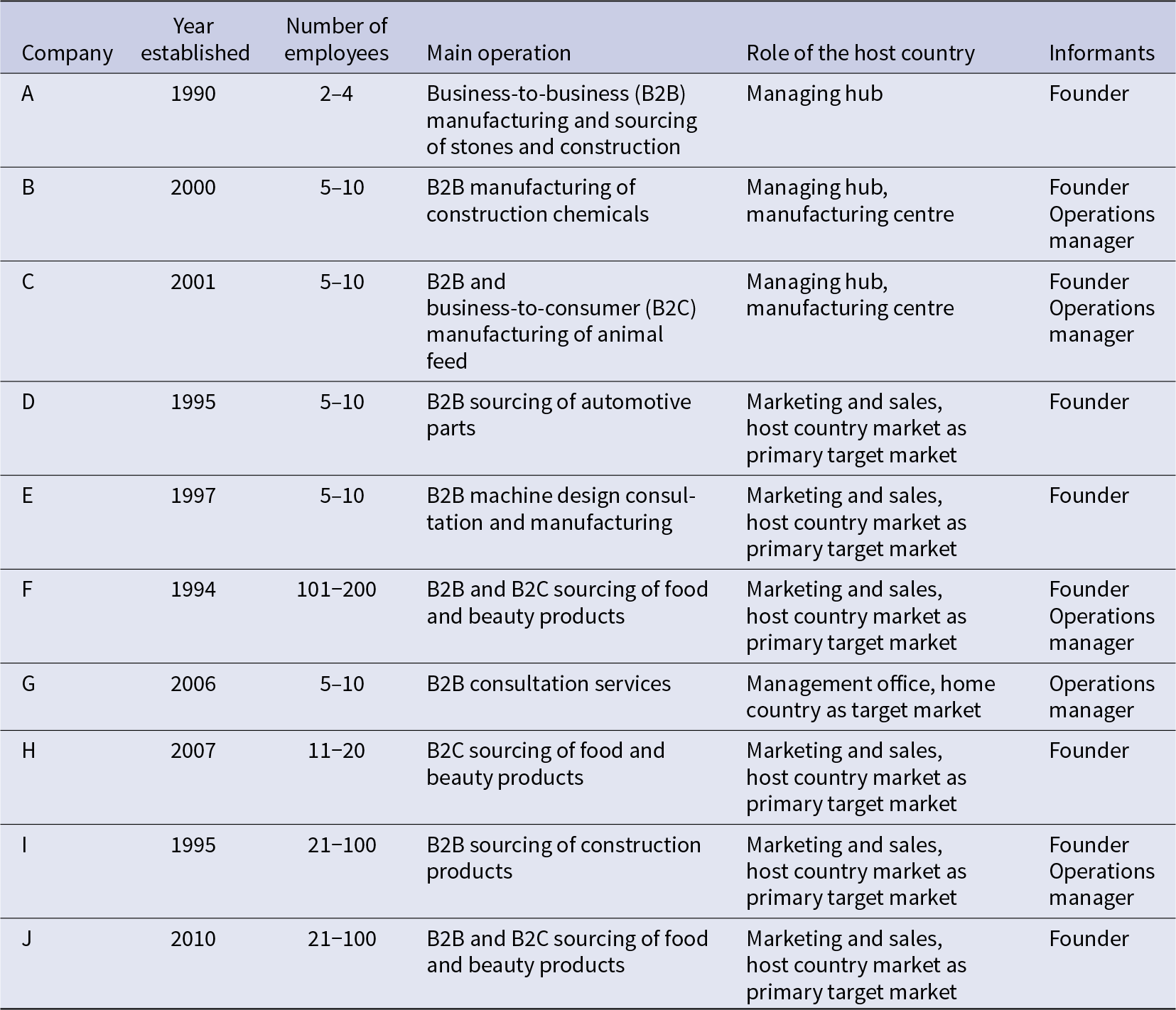
Secondary data sources were used to enrich the primary data of this study, through validating the findings from the interviews. This was done during and after data collection, whereby information from company websites, pamphlets, and business association magazines was used to supplement the findings. All of the ventures studied in this research are involved in Korean-Malaysian transnational operations. Specifically, these ventures focus on B2B sourcing and B2C operations. Table 1 describes the details of the participants and their ventures.
Details of participants and their ventures

Data analysis
We first code the interview narratives to make sense of the data. Based on the core interview topic, which covers the TEs’ journey in cross-border business and the role of their networks, experiences, and global mobility in leading to their venture survivability, we coded their responses into several categories combining different configurations of the variables of interest. For example, responses pertaining to opportunities that were captured resulting from TEs’ networks, informed by their experience in the industry, and made possible by their presence in a specific country are coded as Configuration 1, which contains all variables. In this process, this study was able to gauge which aspects are instrumental in contributing towards a transnational venture’s survivability, by looking into the configurations of the variables, then cross-checked with the interview narratives, providing nuance to the findings.
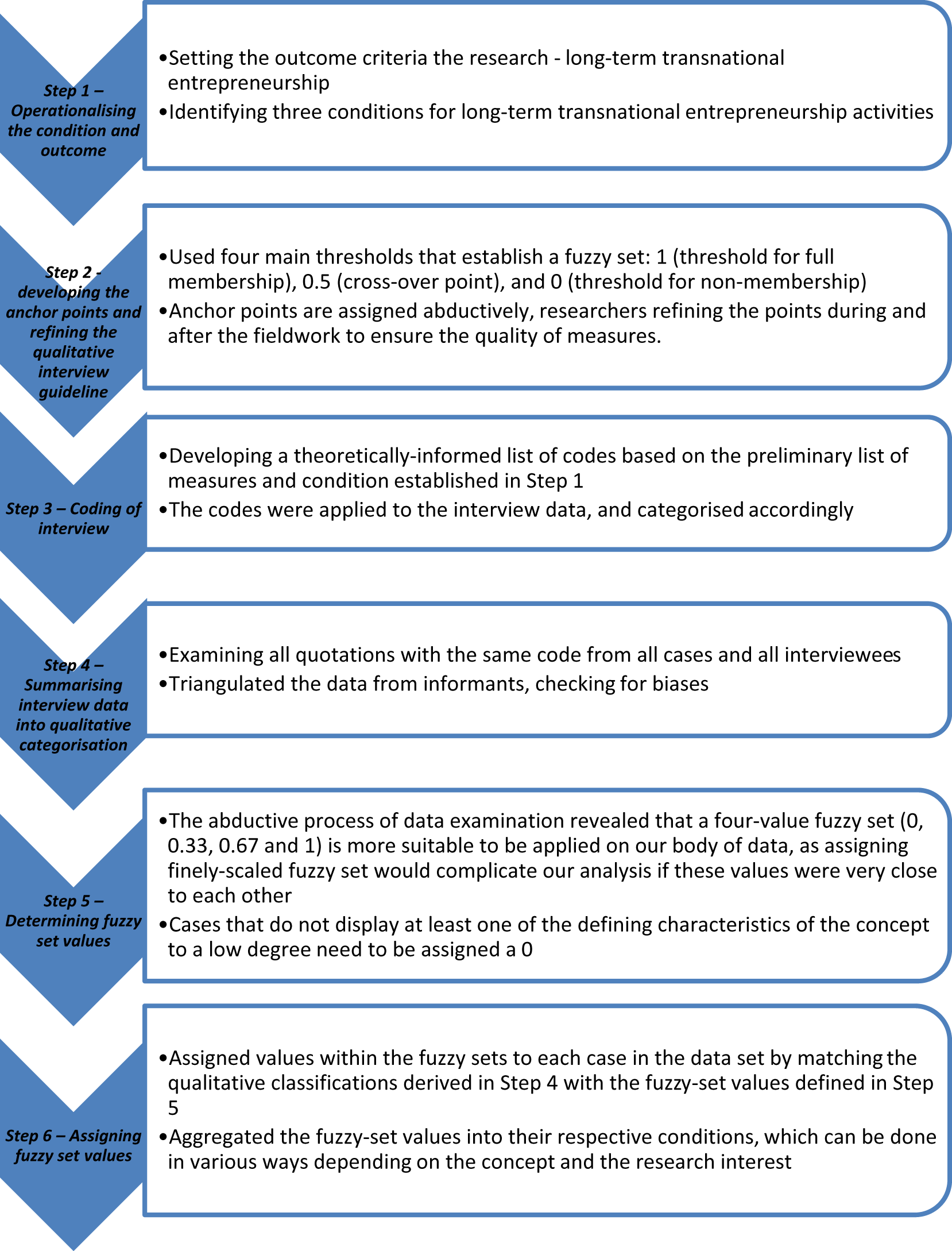
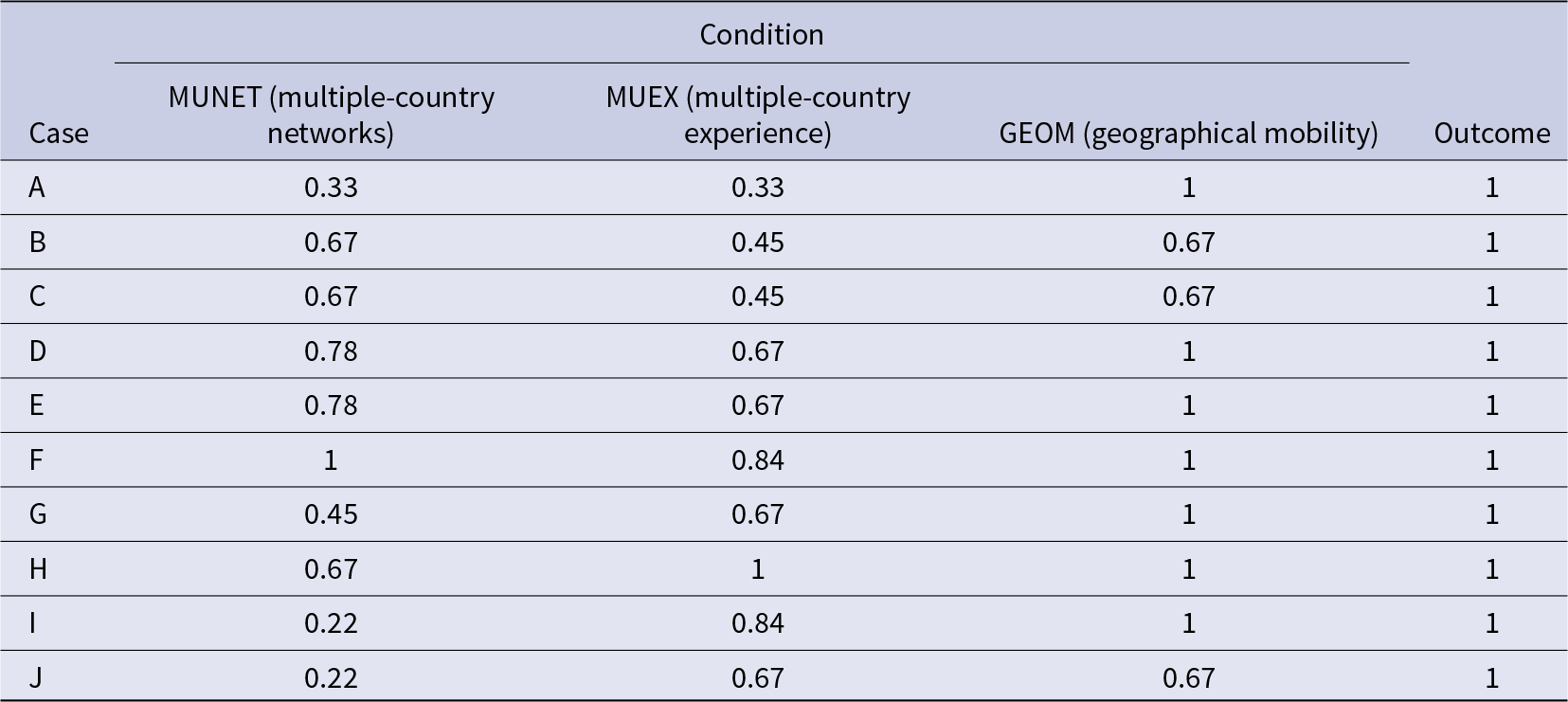
Then, a six-step approach (Basurto & Speer, Reference Basurto and Speer2012) is employed in analysing the data. The procedure to calibrate qualitative interview data to gauge fuzzy-set values include (1) operationalizing the conditions and outcomes; (2) developing the anchor points and refining the qualitative interview guideline; (3) making sense of the data obtained from the fieldwork; (4) clarifying the code output; (5) determining the fuzzy-set scale and values; and (6) assigning and revising the fuzzy-set values of the conditions and the outcomes for each case. The theoretically relevant explanatory factors, or ‘conditions’ in QCA terminology, and the outcome to be observed were identified before analysis procedure begins. The steps of data analysis for this study are summarized in Fig. 1, and the six steps taken in the data analysis phase are included in a summary table in Table 2.
Steps taken in data analysis.

Summary table of the cases

Findings
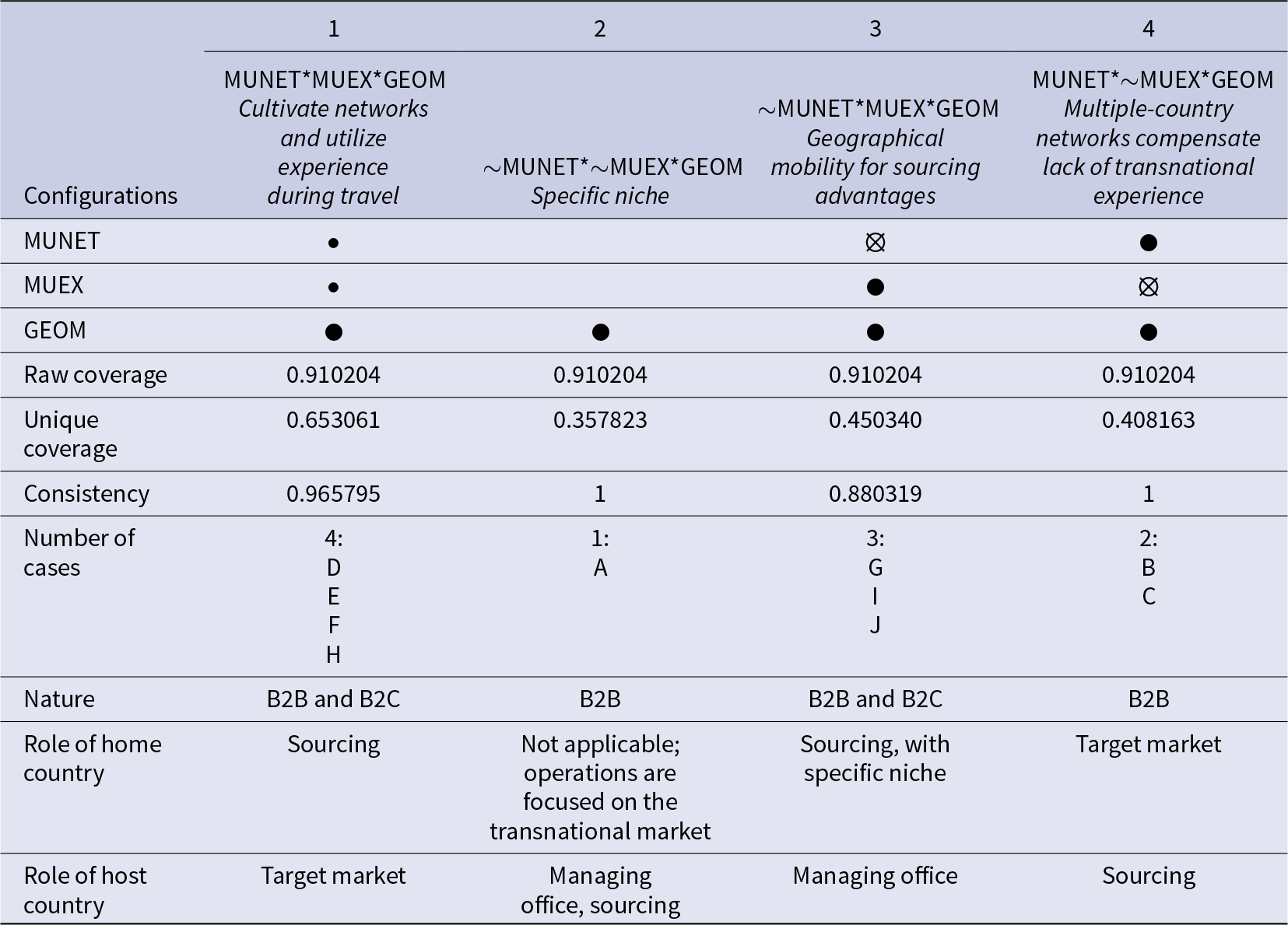
As this study adhered to the sample criteria during the early stages of the fieldwork, all ventures owned and operated by the KTEs satisfy the outcome of interest, which is long-term entrepreneurial survival. This is shown Table 3, which reports the solutions generated by the fs/QCA software. Each of the columns in the tables reporting sufficiency represents a distinct configuration associated with the outcome of interest. In coherence with the convention of studies employing QCA, the presence of a condition is represented with a solid black dot (●) and the absence of a condition with a hollow circle with an x through it (ⓧ). Blanks symbolize a ‘do not care’ state for a particular condition within a configuration, meaning that the condition may be either present or absent.
Solutions generated by the fs/QCA software

Raw coverage for all configurations is 0.910204, meaning that the outcome for each configurations is covered by 91%, unique coverage means the specific paths lead to the outcome by the coverage stated.
⚫Indicates presence of core condition.
●Indicates presence of peripheral condition.
⦻Indicates absence of a core condition.
⦻Indicates absence of peripheral condition.
Blanks indicate a do not care scenario.
The theoretically driven assumption guiding this study is that the presence of multiple-country networks, multiple-country experience, and geographical mobility are each associated with long-term entrepreneurial survival in a host country. Based on these solutions, core conditions appear in both parsimonious and intermediate solutions, while peripherals can only be removed when theoretically driven assumptions about remainders are relaxed (Fiss, Reference Fiss2011; Ragin, Reference Ragin2008). The findings indicate that no conditions (networks, experience) on their own were necessary for long-term survivability, except for geographical mobility.
The configurations associated with long-term entrepreneurial survivability for KTEs are presented in Table 3. There are four out of eight configurations or paths associated with the outcome of this study, which are (1) MUNET*MUEX*GEOM, (2) ∼MUNET*∼MUEX*GEOM, (3) ∼MUNET*MUEX*GEOM, and (4) ∼MUNET*∼MUEX*∼GEOM.
For this study, coverage is a measure of the empirical importance and relevance for each paths to achieve the outcome of interest (Schneider & Wagemann, Reference Schneider and Wagemann2012), which is long-term entrepreneurial survivability. Coverage sufficiency describes the extent to which the outcome is covered or explained by a specific condition. Raw coverage indicates the extent to which membership in the outcome is covered by membership in a single path. Unique coverage conversely indicates the extent to which single path uniquely explains the outcome. Finally, solution coverage expresses how much is covered by the entire solution term (Schneider & Wagemann, Reference Schneider and Wagemann2012).
Consistency is the central measure for the assessment of set relations to assess whether a truth table row, or path, is sufficient for the outcome (Schneider & Wagemann, Reference Schneider and Wagemann2012). As shown in Table 3, this study’s overall solution coverage and consistency scores are over 0.8, which falls under the 0.8–1.00 scores, which are considered acceptable (Fiss, Reference Fiss2011; Ragin, Reference Ragin2008).
Configuration 1: Cultivate networks and utilize experience during travel (MUNET*MUEX*GEOM)
The first configuration is characterized by the TEs’ diverse and trusted networks and expertise, as cultivated through work and entrepreneurial experiences that allow travel and observation opportunities. This is shown in Cases D, E, F, and H. Cases D, E, and F focus on B2B sourcing, while Case H focuses on B2C sourcing of food and beauty products. Entrepreneurs from these cases are equipped with transnational employment and entrepreneurial experience, allowing them to develop relationships and cultivate industry knowledge.
In this configuration, KTEs’ multiple-country network, multiple-country experiences, and geographical mobility interact in facilitating the development of entrepreneurial opportunities across borders, through their formative years of schooling and working. This is highlighted by the following quotations from the director of Case D (B2B sourcing of automotive parts), Case F (B2B and B2C sourcing of food and beauty products), and Case H (B2C sourcing of food and beauty products) in elaboration of their ventures’ journey in a foreign country:
Actually my previous job is in some construction, as a translator because many workers go to middle east countries …. That time is 1986 … 1988, 1985 to 1988 around this country. The construction industry was booming around the time, the easier you can get the chance to work if you can speak Arabic and English. (Founder, Case D)
Because I, when I was in Malaysia during my student time, I mixed around the friends all over here; so, I getting to know about them, we are exchanging, we are sharing and discuss. So, while we are discussing; I can hear about their interest and I found out that Malaysians are very friendly to overseas, I mean, foreigners. (Founder, Case F)
Firstly, I grew up in Malaysia, when I was 11 until 17 years old, around 7 and a half years, I studied here. Then, I returned to Korea for the further studies, also the military and I decided to come back after married. Then, the product-related business started. First, we started with the K-pop entertainment which was growing period during the time, the K-wave. My local partner here … actually it’s my friends, I live in Malaysia for a long time. (Founder, Case H)
Configuration 2: Specific niche (∼MUNET*∼MUEX*GEOM)
The second configuration’s outcome primarily relies on the entrepreneur’s transnational geographical mobility in a specific niche, as shown in Case A, which specializes in B2B supply and manufacturing of luxury construction stones, and is not primarily reliant the host country market. Instead, Case A as a venture in the construction industry focuses on multiple countries in South East Asia, with Malaysia as their main centre of operation, through supplying high-value stones such as marble and granite. As such, while networks and experience instrumental for this venture, its survivability is largely dependent on its owner’s mobility to cater for the venture’s market, which are luxury construction companies. The quotations by the founder of Company A illustrate the way geographical mobility influences transnational venture growth, with the absence of the entrepreneur’s transnational networks and experiences:
So myself, we also have some other items that we change the supply from, the natural material, all of European countries … China, they also have a lot of the natural stones, and they manufacture them. So we imported from them and distribute for Malaysia or surrounding countries. Right now like I said I have been operating in this industry for 30 years in Malaysia. Also although this is only small business I can say that I am quite knowledgeable of our products. (Founder, Case A)
Configuration 3: Geographical mobility for sourcing advantages (∼MUNET*MUEX*GEOM)
Cases G, I, and J exemplify that transnational ventures’ survivability rests on transnational networks and geographical mobility. Case G is a venture specializing in B2B consultation services for Korean firms that wish to internationalize their operations to Malaysia and South East Asia, while Case I operates a B2B venture sourcing construction products and Case J handles B2B and B2C sourcing of food and beauty products. Due to the nature of their ventures, the entrepreneurs or the decision-makers of such firms are required to have area knowledge and knowledge on product selection. In that regard, multiple-country networks facilitate information flow, while geographical mobility enables travelling for quality checks; this is instrumental in ensuring sourcing of raw materials, indirectly contributing towards their ventures’ survival in the host country. In particular, KTE of Case G benefitted from his experience and geographical mobility to conduct a Korean-Malaysian consulting venture in the host country, and KTE of Case I benefits from his experience and mobility to source for the host country’s road system. The importance of geographical mobility for sourcing advantages is exemplified by the following quotations:
He (the founder) actually … he worked in CJ, a Korean company and then actually he … he did project in the overall work and especially in Indonesia, he has lot of experience and then reference, so, after he retire and so he wants to conduct business in Malaysia. (Operations Manager, Case G)
Actually, I want to survey the market. But after that maybe couple … couple of years, didn’t find the job. Not job, it is didn’t find the business; maybe go come back to two … two times back, but like this one the highway. That time they saying Malaysia not much in the highway, the safety item. (Founder, Case I)
Configuration 4: Multiple-country networks compensate lack of multiple-country experience (MUNET*∼MUEX*GEOM)
The ventures categorized in Configuration 4, Cases B and C, primarily rely on their home-host country networks and their decision-makers’ ability to travel and back and forth between the home and host country. Ventures in Cases B and C operate B2B manufacturing of construction chemicals and animal feed, respectively. Malaysia and other countries with low labour cost, including Thailand and Indonesia, are employed as manufacturing bases for their products, while they export the finished goods to their main clients, which are larger companies in Korea. In that aspect, the entrepreneurs are required to cultivate strong networks to oversee such transnational operations and have mobility to ensure the quality of their products. The ways in which multiple-country networks influence the growth of transnational ventures are depicted in the following quotations, as explained by KTE of Case B in how his transnational networks helped him to build a venture in the host country and KTE of Case C, in how his Malaysian networks within the same industry assisted him in his venture’s multi-country operations:
Actually first time partner is Singapore, Korea …. Before coming I actually working with the company, invested to the Malaysia. (Founder, Case B)
And then, long time ago, I … I went checking the material in Asia, and I go to Indonesia, Malaysia, Vietnam, Philippines, Cambodia, Thailand, many place but at that time, … So, Malaysia, Malaysian-Chinese, Malaysian-Indian also helped me and then, I sometimes I use to go to them. (Founder, Case C)
Summary of the configurations
In combination to KTEs’ resources, after linking the characteristics of the ventures and the owners, the cases indicate that the configurations for transnational survival are also influenced by the operations of the ventures and the extent of the niche market held by the venture. Further, all configurations include an element of geographical mobility in achieving the outcome of interest.
Discussion
The findings indicate that there are four configurations associated with long-term transnational venture survival. In addition to the role of TEs’ multiple-country networks, knowledge, and geographical mobility, the configurations associated with venture survival are shaped by the firms’ operations and extent of specialization in their specific fields.
Transnational networks for multi-country venture support
According to this study’s data, there are two configurations associating networks with the outcome of venture survivability. Six out of ten cases indicate that their decision-makers’ networks are associated with long-term venture survivability, namely Cases D, E, F, and H for Configuration 1 and Cases B and C for Configuration 4.
For Configuration 1 (MUNET*MUEX*GEOM), TEs cultivate networks and utilize their experiences during their travels for employment and entrepreneurial endeavours. KTE for Case D, for example, has an extensive transnational experience given his multi-country employment and entrepreneurial experiences and took such opportunities to build transnational networks that would benefit the development and survivability of his venture. KTEs for Cases B and C are mainly reliant on their networks in their home country as the relationships that have been cultivated in their home country act as buyers for the products and services offered by their ventures, while their transnational networks are instrumental for their firms’ product development and sales.
The literature pertaining to transnational entrepreneurship posits that TEs’ multi-country networks enable their access to multi-country resources (Abd Hamid et al., Reference Abd Hamid, Pidduck, Alex, Hanifah and Sidek2023; Gurău, Dana, & Katz-Volovelsky, Reference Gurău, Dana and Katz-Volovelsky2020; Terjesen & Elam, Reference Terjesen and Elam2009) by facilitating knowledge transfer (Rodgers et al., Reference Rodgers, Vershinina, Williams and Theodorakopoulos2019) and balancing liability of foreignness (Santamaria-Alvarez et al., Reference Santamaria-Alvarez, Muñoz-Castro, Sarmiento-González and Marín-Zapata2018). In this regard, transnational networks allow TEs to oversee their transnational operations through trusted links in multiple counties. Such ties are instrumental as they link TEs with other networks in the home country (including potential venture capitalists, investors, and clients) and provide TEs with information that they are missing while working in the host country (Crick & Chaudhry, Reference Crick and Chaudhry2010; Pruthi, Reference Pruthi2014; Santamaria-Alvarez, Sarmiento-Gonzalez, & Arango-Vieira, Reference Santamaria-Alvarez, Sarmiento-Gonzalez and Arango-Vieira2019), allowing for the transfer and cultivation of ideas (Stoyanov, Woodward, & Stoyanova, Reference Stoyanov, Woodward and Stoyanova2018a) and consolidation of multiple-country resources (Keen, Sanchez-Famoso, & Dana, Reference Keen, Sanchez-Famoso and Dana2022). TEs’ transnational social capital, including links with co-national communities in the host country and industry-based communities in their home countries, enables knowledge transfer and increase of legitimacy of their ventures (Rodgers et al., Reference Rodgers, Vershinina, Williams and Theodorakopoulos2019; Stoyanov, Woodward, & Stoyanova, Reference Stoyanov, Woodward and Stoyanova2018b). The cases within the configurations show that multi-country networks are especially important for sourcing, as the ventures are heavily involved in multiple-country procurement and sourcing (true to its nature, to take advantage of economical sourcing and access to resources).
Development contrasts and the utilization of networks
Ventures in Configuration 1, cases D, E, F, and H and Configuration 4, Cases B and C benefit from the development contrasts of Malaysia and Korea, in which companies in the configurations either (1) conduct their manufacturing processes in the host country and nearby countries to take advantage of the low-cost manufacturing facilities and (2) offer sourcing of specialty Korean products to the host country and countries nearby. TEs’ home country links encourage access to buyers, as many of them are conducting B2B operations sourcing from an emerging market (Malaysia) to a more prosperous home country. As arbitrageur of contrasting countries, such networks ensure the availability of products, buyers, and suppliers thus facilitating the viability of the venture as TEs are not reliant on a limited number of buyers and suppliers. Further, as the context of this study is TEs from a more developed country operating in a less developed country, transnational networks are mainly utilized to enable resource arbitration, to satisfy the demands of their more prosperous home country.
As TEs operate in a complex and dynamic environment considering the overlapping of the cultural and institutional environments of multiple countries, the diversity of their relationships (which results from a combination of home country networks, host country networks, and networks beyond the two) facilitates flexibility and dynamism in resource configuration (Motley, Eesley, & Koo, Reference Motley, Eesley and Koo2023). Consistently utilizing such diverse networks in responding to changing environments and opportunity gaps encourages venture growth in transnational markets, thus leading to venture survival for the cases in this study.
Multiple-country experiences in enabling transnational venture development
Experience is a sufficient condition for Configurations 1 and 3, as exemplified by Cases D, E, F, and H for Configuration 1 and Cases G, I, and J for Configuration 3. The similarities of the cases under these configurations are their reliance on the host country’s local market knowledge, regardless of their B2B or B2C operations. All ventures under this category focus on the local market, with the exception of Case G, as they are operating a consultation business for Korean companies planning to internationalize to Malaysia or other countries in South East Asia. In this aspect, multiple-country experience is essential as it provides the decision-makers with a sense of knowledge with regard to what is accepted or not accepted by local clients and the knowledge of the host country environment in general.
An interesting feature of this study’s context is that there is relatively small cultural distance between the TEs’ home country and the host country. However, there are still differences that can only be detected through experience; in this regard, entrepreneurial experiences which enable comparisons thus inform entrepreneurial choices (Branzei & Fathallah, Reference Branzei and Fathallah2021; Li, Reference Li2017). For the cases in this study, TEs’ host country knowledge is mainly acquired through their educational and employment experiences in the host country. Such exposure enables TEs with access to more diverse ideas, knowledge, and processes, which can be imparted to their home country operations.
To ensure their ventures’ survivability in multiple countries, TEs are required to consistently introduce new products and/or services, and such situations demand TEs and their ventures to go through a legitimation process in order to overcome liability of foreignness typically experienced by foreign firms (Mata & Alves, Reference Mata and Alves2018; Müller et al., Reference Müller, Kirst, Bergmann and Bird2023). In this aspect, TEs’ industry-specific and cross-cultural experiences assist in increasing the legitimacy of their ventures, thus easing liability of foreignness, and as this process occurs consistently, TEs in this study are able to sustain their ventures, thus retaining their ventures’ survival in the host country.
Multiple country experiences encourage refinement of ideas in contrasting contexts
Through the contrasting environments and conditions of the countries that they are operating in, TEs are able to introduce process or products unavailable in the host country but available in their host countries or vice versa (Lundberg & Rehnfors, Reference Lundberg and Rehnfors2018). Our findings highlight the importance of cross-cultural experience for TE venture survivability as it encourages the process of combining and refining entrepreneurial opportunity ideas (Pidduck, Reference Pidduck2022; Vandor & Franke, Reference Vandor and Franke2016). As constant refinement of ideas improves the quality and quantity of venture output, ventures are more likely to survive especially in a more challenging foreign environment.
The similarities of the cases under these configurations are their ventures’ nature of operations which are focused on marketing and sales within their B2B or B2C categories. Furthermore, the cases’ ventures are intertwined within the host and home country market. Thus, multiple-country experience is crucial to navigate the complex transnational environment (Czinkota, Khan, & Knight, Reference Czinkota, Khan and Knight2021; Pidduck & Zhang, Reference Pidduck and Zhang2022; Terjesen & Elam, Reference Terjesen and Elam2009). Such experiences assist TE ventures’ survivability as they provide TEs with a sense of knowledge with regard to what is accepted or not accepted by local and home country clients (which is instrumental to product development and marketing strategies), and the knowledge of the regulative environments of the home and host country in general, contributing towards the management and administrative aspects influencing venture survival in the host country. Here, TEs’ experiences assist in their venture survival through enabling them to recognize novel opportunities through constant comparison of the environments and reducing liability of foreignness through consistent process of legitimization.
Geographical mobility in facilitating the growth of venture
Geographical mobility is a condition present for all configurations associated with long-term venture survivability in the host country. The cases in this study indicate the importance of geographical mobility in enabling the development of transnational networks and multi-country knowledge, which assist in venture development and survivability in the host country. It is important to note the contrasting development context of this study; according to our findings, the role of TEs’ home country is instrumental in providing TEs with the establishment of strategic resources, primarily product/service and process knowledge enabling sales in the host country. Here, the more developed home country offers TEs with knowledge-based resources and high-value demand, while the host country serves both as a market and source for economic procurement.
One of the values of international mobility for TEs is the development of personal capabilities from overseas experiences to mobilize resources. Here, geographical mobility or the ability of individuals to mobilize resources from their local contexts (Choudhury, Reference Choudhury2022; Frederiksen, Wennberg, & Balachandran, Reference Frederiksen, Wennberg and Balachandran2016) is useful for the entrepreneurial opportunity development process through constant comparing and refining ideas in relation to TEs’ network and knowledge resources (Yang et al., Reference Yang, Peng, Wang, Guan, Jiang, Xu and Chang2020).
In this study, geographical mobility presents as a necessary condition associated with long-term venture survivability, with presence in all four configurations. Based on the results, geographical mobility is an important factor to achieve long-term venture survivability regardless of ventures’ operations and locality focus. In essence, the ventures studied in this research conduct operations in multiple countries spanning sourcing, manufacturing, and service activities. As such, TEs’ ability to travel back and forth within multiple countries mainly ensures that they are ready to recognize and capture opportunities (resulting from knowledge through multiple-country experience) and resources are being coordinated properly (through their diverse networks). In this aspect, TEs’ geographical mobility, through their formal and informal national backgrounds, ensures that their experience and networks are utilized for consistent opportunity development process which ensures venture survivability in the complex and dynamic transnational market.
This is shown in the ventures studied in this research; TEs from Case A (Configuration 2) constantly travel back and forth within multiple countries to look for new and cheap materials for his construction venture, TEs from Cases B and C (Configuration 4) utilize their ability to travel from Korea to Malaysia to seal and reseal deals as well as oversee their manufacturing operations, TEs from Cases D, E, F, and H (Configuration 1) benefit from their travels in terms of obtaining new knowledge and trends in their specific industries, while TEs from Cases G, I, and J (Configuration 3) obtain information on sourcing from their TEs’ geographical mobility.
TEs as resource arbitrageur through geographical mobility with contrasting development contexts
The transnational entrepreneurship discourse is cognizant with the idea of utilizing contrasting home and host countries for specific entrepreneurial activities, specifically manufacturing in countries with high manufacturing efficiency and marketing the output to a service-based country (Crick & Chaudhry, Reference Crick and Chaudhry2010; Dimitratos, Buck, Fletcher, & Li, Reference Dimitratos, Buck, Fletcher and Li2016). TEs are resource and environment arbitrageur in this aspect as they balance home-host country differences through knowledge and networks in both countries, which are accumulated through their experience in the host country, while maintaining and developing ties in their home countries. Through such mobility, TEs are able to procure and inject resources from multiple sources while maintaining their ventures’ operations by balancing the differences of multiple geographical, cultural, and regulative contexts (Stoyanov, Reference Stoyanov2018; Stoyanov, Woodward, & Stoyanova, Reference Stoyanov, Woodward and Stoyanova2018b).
More importantly, TEs’ geographical mobility encourages the employment of networks and experiences to constantly engage in the entrepreneurial development process and refine ideas, ensuring (1) the acceptance of their ventures and (2) the suitability of their outputs in the transnational market. The cases in this study demonstrate that TEs’ geographical mobility and multi-embeddedness encourage the entrepreneurial opportunity development process and ensuring the smoothness of transnational manufacturing, procurement, and sales operations by combining their knowledge and utilizing their transnational networks. Such process contribute towards venture survivability as TEs are not reliant on one market or supplier, and they are in constant state of being able to develop entrepreneurial opportunity.
This study’s main focus: How do transnational ventures survive in a host country?
Firms owned and operated by transnational migrants are, in general, more exposed to low venture survivability, yet there are many indications of the way TEs’ multi-country characteristics induce their firms’ growth. The contradicting ideas surrounding it provoke the question of: ‘What are the combinations of transnational network, experience, and mobility in enabling venture survival?’. Outlined by the individual resources perspective through the Forms of Capital Model (Bourdieu, Reference Bourdieu and Richardson1986), we place special attention to TEs’ networks and knowledge to understand how they interact with TEs’ geographical mobility to achieve venture survivability in the host country. Our findings indicate that geographical mobility is a necessary condition in ensuring the survivability of a transnational venture, through enabling the activation of TEs’ individual resources, namely transnational networks and experiences.
Conclusion
In general, the survival rates of entrepreneurial ventures are lower than larger firms (Bullini Orlandi, Zardini, & Rossignoli, Reference Bullini Orlandi, Zardini and Rossignoli2021), and ventures owned and operated by transnational migrants are more exposed towards entrepreneurial death given the ventures’ and owners’ liability of foreignness (Abd Hamid, O’Kane, & Everett, Reference Abd Hamid, O’Kane and Everett2019; Arslan et al., Reference Arslan, Kamara, Zahoor, Rani and Khan2022; Mata & Alves, Reference Mata and Alves2018). As such, this research investigates how such ventures achieve long-term survivability by focusing on the way TEs’ resources influence venture survival. In particular, we aim to add a layer of understanding towards the discourse of individual-opportunity-venture nexus, particularly focusing on the way entrepreneurs’ decision-making and resources contribute towards the venture survivability, as much of the discussion in entrepreneurship has primarily focused on business creation and the opportunity process (Lee et al., Reference Lee, Wiklund, Amezcua, Bae and Palubinskas2022). In addressing the research focus, this study examined the way TEs’ networks, experiences, and global mobility contribute towards venture survival as such context offers a perspective that highlights the way TEs play the role of resource arbitrageur, in the setting of minority businesses in transnational markets, a context characterized by its volatility and susceptibility to entrepreneurial death. To do so, this study is outlined by the Forms of Capital Model, arguing that venture creation, development, and survivability are partly a result of the interaction of TEs’ resources. Through a qualitative approach using a configurational design, this study’s findings revealed four configurations associated with venture survivability, with geographical mobility featured as the main condition for all four configurations.
Implications
This study speaks to the discourse of individual-opportunity-venture nexus in entrepreneurship, within the scope of venture survivability in dynamic environments by (1) highlighting the way entrepreneurs’ resources shape and influence their venture survivability and (2) identifying the combinations of entrepreneurs’ resources and geographical mobility in ensuring venture survivability. Specifically, this study’s findings suggest the importance of geographical mobility in the utilization of TEs’ social and human capital (individual resources important for venture resilience) for venture growth and survivability through the four configurations revealed from the results. Practice-wise, the configurations revealed in this study be useful for policymakers and entrepreneurs in tailoring their resources and embedding them into their strategies for venture survivability, especially within the transnational market.
Limitations and future research
Adopting a qualitative approach using a configurational design and interview data was useful in lending nuance and rigor to our research. However, as our findings are still limited within the context of study, this paper’s findings should be interpreted sensibly. To this end, in reference to the possible interview bias that typically occurs in qualitative interviews, we suggest that future research could investigate into the topic of interest using a quantitative lens, perhaps through surveys or secondary data. We also placed primary focus on TEs’ resources as contributors for venture survival, but as there are several firm-based aspects that assist in a venture’s survivability (Cheng, Yuan, & Jiang, Reference Cheng, Yuan and Jiang2023; Coad et al., Reference Coad, Frankish, Roberts and Storey2013), we suggest that future research could observe the way entrepreneurs’ resources and the venture interact in ensuring survivability. The limitations of this study would be a fruitful area for future research; thus, we encourage further exploration on the role of nations, family backgrounds, and professional networks in influencing venture growth, in particular for ventures operating in challenging environments.
Acknowledgements
This research was partly supported by the Fundamental Research Grant Scheme, Ministry of Higher Education Malaysia (FRGS/1/2020/SS01/UKM/03/1), and the Malaysian Palm Oil Grant (MPOB-UKM-2020-011).