Recent scholarship has radically revised our understanding of nineteenth-century American political authority, pointing to ways in which traditional Weberian concepts of the state as a unitary locus of coercion in a territory simply fail to apply in the case of the United States.Footnote 1 Rather than being housed in autonomous centralized bureaucracies, as they were in much of Europe, state capacity often operated (and continues to operate) through the fragmented nature of American governing institutions. This includes the long-standing collaborative link, for instance, between public authority and private associations aiding in the enforcement and articulation of policy, the multiple and overlapping federal and local institutional domains providing pathways through which those policies could be implemented, and the process of territorial segmentation via Western expansion affording opportunities for state expansion that were precluded in the East.Footnote 2 Indeed, even the key domain of federal criminal law enforcement in the late nineteenth-century United States—putatively under the control of the relatively small U.S. Marshal’s force—depended to a considerable degree on informal collaboration between public and private actors, including detective agencies and citizens’ groups, who were frequently involved in pursuing and prosecuting federal criminals.Footnote 3
At the same time, these revisionist accounts nevertheless tend to downplay the conditions that allowed pragmatic, collaborative strategies of state building to become the tools of choice for American policy entrepreneurs.Footnote 4 Indeed, in the case of federal policing, Congress actually made an important attempt at avoiding precisely this kind of fragmentation with the formation of the Department of Justice (DOJ) in 1871. Congressional reformers intended the new agency to coordinate, centralize, and professionalize the enforcement of the new criminal statutes that emerged in the aftermath of the Civil War and Reconstruction and hoped that the formation of an independent department would serve as a check on corruption and inefficiency. This article argues that the failure of this attempt at creating an autonomous bureaucracy actually allowed for the growth of federal policing in the midst of intensive opposition, since agents from throughout the federal government, many of whom were unattached to the unpopular DOJ, began to build alliances across institutional divides inside the central administration as well as with local law officers. In other words, the use of collaboration as a model of state building depended on the foreclosing of an alternative, more professional policing agency.
In particular, two such collaborative practices, derived from traditional policing power of the local government, provided federal actors with a powerful means of directly fusing the enforcement of federal criminal law with local authority: the common-law procedures of citizens’ arrest and deputization (or deputation). These practices, which I explore below, facilitated policing collaboration across the federal administration, allowing the expanded corps of investigators emerging from the Civil War and located throughout the federal bureaucracy to engage directly in arrest in concert with U.S. Deputy Marshals (USDMs). At the same time, they also provided the DOJ with an opportunity to expand its power more directly in the Western territories, where USDMs were able to participate directly in policing with local alliances that were often missing in the Reconstruction South.
These practices help explain why American federal policing was able to thrive in the absence of a central, autonomous bureaucracy in the 1880s and 1890s. Most federal efforts at enforcement during this period, as Gary Gerstle points out, arose from the attempt to link state power to already authorized federal powers of taxation and establishing a postal system.Footnote 5 Deputation and citizens’ arrest meant that seemingly unrelated developments in U.S. state capacity (such as, for instance, in revenue collection or postal delivery) could also provide an opportunity for federal policing to expand as well in a manner that was “hidden” from the view of potential opponents.
Moreover, deputation and citizens’ arrest helped preserve the fundamentally local nature of American policing, even as the federal government increased its reach. Indeed, as municipalities and counties began professionalizing their police forces in the 1870s and 1880s, federal authorities were able to participate in arrests using these strategies without directly challenging local authority.Footnote 6 Collaborative ties among enforcement agents in local jurisdictions and across the federal bureaucracy made it possible for federal law enforcement to become more prevalent in everyday life than many who opposed the DOJ in the late 1870s had anticipated.Footnote 7 By the end of the nineteenth century, this fragmented system set the stage on which the more significant later reforms in federal policing—such as the founding of the FBI—would play out.
I make this argument in several steps. First, after reviewing some misconceptions about federal law enforcement in the late nineteenth century, I demonstrate the ways in which the Reconstruction experience fragmented the original vision of a professional and autonomous Department of Justice. Next, I explore how the investigative special agents found in the Post Office and the Revenue and Pension Bureaus themselves began to take on much of the policing burden, while also examining how the DOJ’s deputy marshals found new opportunities to expand their influence in the trans-Mississippi West. Finally, I trace how deputation and citizens’ arrest facilitated this relatively active and effective trend of federal policing, and paved the way toward cross-agency and cross-jurisdictional collaboration. It was this tradition, I conclude, that set up the conditions for twentieth-century transformations in federal law enforcement.
Reconstruction, Federal Policing, and the Emergence of Fragmentation
Despite some important exceptions, scholars have paid little attention to the overall shape of federal policing in the period between the Civil War and the turn of the century.Footnote 8 There are very few investigations into the creation of the DOJ in the early 1870s, for instance, and the majority of works addressing the U.S. Marshal’s force—that entity most associated with federal criminal enforcement—tend to marginalize the importance of other agencies or ignore relations between local and federal authorities. Moreover, scholars that do address other agencies involved in federal enforcement prioritize central-state activity rather than interdepartmental links or local collaboration.Footnote 9 Even Stephen Cresswell’s excellent history of federal law enforcement, which does address collaboration among federal agencies and demonstrates the geographically uneven nature of such enforcement, views local and private policing primarily as a source of resistance to federal authority rather than a locus for collaboration.Footnote 10
The notion that federal policing was deeply shaped by local resistance is rooted in the failures of federal law enforcement to gain what Dan Carpenter has termed bureaucratic autonomy during the 1860s and 1870s, when the most significant reform in federal criminal law in the nation’s history to that point occurred.Footnote 11 In particular, scholars usually focus on the failed state-building experiments of the Civil War and Reconstruction, when a series of new statutes, coming on the heels of the Fourteenth and Fifteenth Amendments, seemingly revolutionized the extent to which federal power could be used to protect individual citizens, only to collapse in the wake of sectional intransigence, political apathy, and judicial undermining.Footnote 12 Of particular importance are the Enforcement Acts, passed in 1870 and 1871, which made it a federal crime to interfere with voting and expanded the capacity of the federal government to use its coercive powers of arrest to prosecute violators.
Because of local resistance on the part of southerners, enforcement of voting rights—and federal criminal law in general—was fraught throughout Reconstruction, engendering political opposition to DOJ activity and emboldening Democrats to investigate and criticize the agency.Footnote 13 Meanwhile, a series of court decisions in the mid- and late 1870s (most significantly, the Slaughterhouse and Cruikshank decisions) decisively rolled back the capacity of the federal government to police local voting.Footnote 14
Although this traditional view of the decline of voting enforcement has been called into question by recent scholarship, most agree the heyday of a powerful, politically motivated federal police presence had come to an end by the early 1880s.Footnote 15 The DOJ, especially, is usually viewed as a relatively weak and often corrupt agency in the period following the 1870s, unable to attain the kind of autonomy from private interest that would allow it to become a professional, modern policing entity.Footnote 16 And this, in turn, has led into a more general assessment of federal policing as moribund. Friedman summarizes the conventional wisdom well when he claims that “federal law enforcement . . . did not amount to much before 1900.”Footnote 17
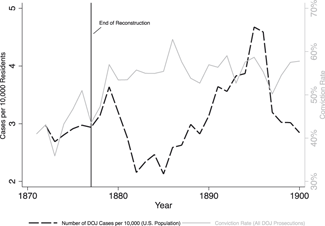
These characterizations miss several trends. First, with an important exception at the end of Reconstruction, overall national rates of federal criminal prosecution actually grew relative to the population of the nation from the early 1880s through the realignment of the mid-1890s, precisely that period when we would most likely expect a post-Reconstruction retrenchment of the federal state. This can be seen by the black dashed line in Figure 1, which traces the rate of prosecutions nationwide and which, after a significant dip at the end of the 1870s, grows almost through the end of the century.
Activity and Effectiveness of Federal PolicingFootnote 18.

Second, federal prosecutorial activity continued to be quite effective throughout the postwar years. The light gray line in Figure 1 shows that the conviction rates for prosecuted federal crimes also increased slowly but steadily during the mid-1880s, after which it more or less held steady at nearly 60 percent of prosecuted cases, a rate found throughout most of the country. When prosecutorial activity as a whole is examined, it becomes clear that federal policing at the end of Reconstruction was a temporary setback rather than a permanent reversal in trajectory initiated during the Civil War.
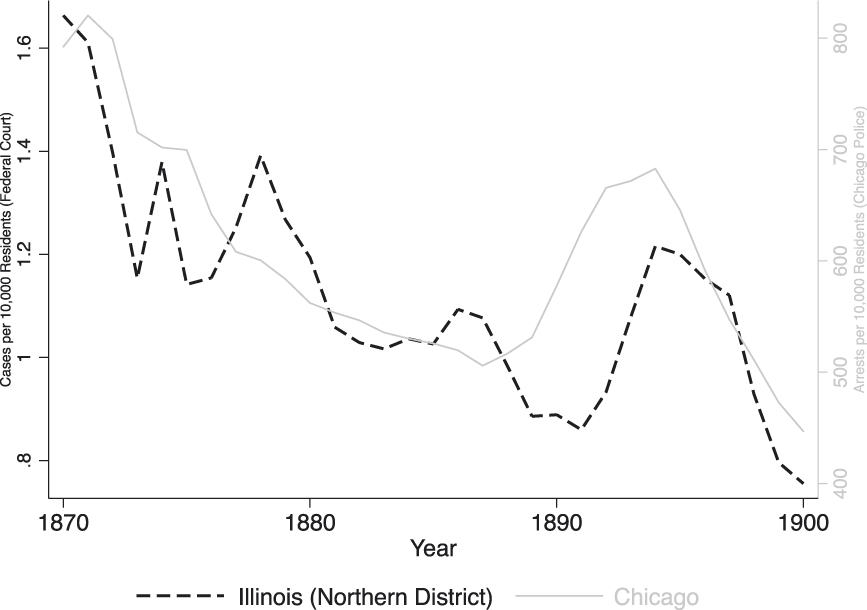
Third, the relationship between federal and local policing was more complex than most scholars acknowledge, particularly in areas outside the South. Despite some well-known exceptions, for instance, local law enforcement did not always compete with or resist federal policing.Footnote 19 Figure 2 explores the rates of prosecution for all crimes in Northern Illinois’ Federal District Court and compares them to arrests in Chicago, the major urban center of the district.Footnote 20 Intriguingly, though the actual rates differ tremendously (a resident was, as one would expect, much more likely to be arrested by local police than to face federal prosecution), the patterns are strikingly similar—in both cases, a general decline in activity held through the early 1890s, when both federal prosecution and local arrest rates spiked. This suggests that larger social structural concerns with disorder and crime (a product of the increase in labor violence associated with Haymarket in 1886 and Pullman in 1894) were driving both local and federal criminal activity in northern Illinois in the late nineteenth century.Footnote 21 Indeed, even though professionalization reshaped policing across governmental jurisdictions in the Gilded Age and federal law enforcement remained minuscule relative to local policing throughout this period, both forms of law enforcement seem to have operated together—the expansion of one form did not result in a decline in the other.Footnote 22
Law Enforcement in Illinois (1870–1900)Footnote 24.

Moreover, although federal prosecution rates did contract in large urban areas in the late nineteenth century along with local patterns of arrests, in rural areas in the North and Midwest—precisely in those areas most peripheral to the voting enforcement efforts in the South—federal law enforcement became increasingly active during the same period. From 1870 through 1885, Northern Illinois’ Federal District Court (where 48 percent of the population lived in urban areas) prosecuted an average of 1.22 cases per 10,000 residents, while the Southern District—an area in which an average of only 14 percent or so of the total population lived in cities—had a rate of only 1.13 cases. From 1886 through 1900, by contrast, although the Southern District remained significantly more rural than the Northern District (approximately 80 percent lived in rural areas versus 30 percent in the north), the rates of prosecution in the South rose to double the rates in the Northern District, increasing to an average rate of two cases per 10,000 residents.Footnote 23 The kinds of local resistance to federal authority assumed by many scholars to characterize the response to federal policing in remote areas did not seem to prevent an expanded presence in those regions.
In other words, while for certain crimes and in urban locales, federal law enforcement did decline after Reconstruction, this decline was offset by an overall increase in absolute levels of policing effectiveness and activity, particularly in remote areas. Moreover, rather than reflecting a battle between local and federal law-enforcement agencies, trends in policing capacity across federal and local agencies reflect similar patterns throughout the century. The DOJ was, somewhat paradoxically, both expanding—in terms of its presence in many Americans’ lives—while becoming more constrained in some of its specific, core activities.
Explaining Federal Policing
How do we explain this paradox? While voting enforcement was the most important responsibility of the DOJ, it was only one of the many policing activities expanding after the Civil War. Just as the attempt to consolidate federal policing under the DOJ was crumbling, investigators housed in other federal agencies began to arrest suspects directly, while the U.S. Marshal’s force increasingly turned its attention to policing western territories. The system that emerged, fragmented across institutions and regions, was propped up by the flexibility of arrest law—in particular, the availability of citizen’s arrest and deputation. These two practices, as I show below, facilitated collaborative relationships among federal and local officers, dampened local resistance to federal policing, and allowed a broad scope for who, exactly, was entitled to act as an agent of federal coercion. They served as a mode of linking traditional, local forms of police power to a federal framework that lacked such enforcement infrastructure.
Federal Law-Enforcement Reform During the Civil War and Reconstruction
This fragmented system was not intended to be; instead, it arose from the failure of the attempt to reform federal law enforcement in the aftermath of the Civil War. For the bulk of the early and mid-nineteenth century, the U.S. Marshal’s force had served as a catchall for executing legal process throughout the federal government. Though operating officially under the Secretary of State for much of the early part of the century, in reality the force was highly decentralized, appointed by presidents, but with little direct supervision and most frequent interaction with federal judges and local U.S. Attorneys.Footnote 25 Until the Civil War, the Marshal’s force was involved in the struggle against filibusters, counterfeiters, spies, and runaway slaves, though the bulk of the actual activities of the force involved administering court paperwork and legal process.
The war dramatically altered the scope and scale of federal policing in several ways. For one, the Marshal’s force was charged with new tasks directly related to the war effort. Most notoriously, this involved aiding the military in arresting suspected traitors without habeas corpus, but individual deputies and marshals were also involved in surveillance and counter-espionage activities.Footnote 26
For another, during the war, Congress expanded resource extraction efforts—in particular, by founding a new Bureau of Internal Revenue in 1862—which placed new burdens for monitoring compliance on the federal bureaucracy. Federal officers were responsible not only for arresting those accused of evading the expanded liquor and tobacco excises imposed by Congress in 1862, but were also involved in the confiscation of property held by those accused of aiding the rebellion. Growth in the service was explosive; by 1863, there were already more than three thousand assessors and collectors active in the field.Footnote 27
Furthermore, the war precipitated an increase in investigative services in other areas in the federal government. Crucial, for example, to identifying traitors, counterfeiters, or tax dodgers—criminals who now posed existential threats to the federal war effort—was the ability to monitor local populations. Departments throughout the central administration expanded or created investigative corps in response to wartime demands—the Revenue service, for instance, expanded its collection apparatus in 1863, a new battery of postal inspectors were hired to examine suspicious or subversive packages, a small corps of Provost Marshals and private investigators were appointed as a detective service in the Department of War to investigate potential spies, chase draft dodgers, and so forth.Footnote 28
Finally, Congress turned to the Marshal’s office to enforce the new federal laws regarding voting and civil rights passed in the late 1860s. Often working with state militias or the U.S. Army, USDMs monitored contracts between freed slaves and employers, protected rights of assembly, and attempted to guarantee general civil liberties in addition to voting enforcement.Footnote 29
As a result, in part, of the spiraling costs and complications of Civil War–era policing, congressional reformers began calling for the creation of a new executive department responsible for managing federal law enforcement. In June 1870, after a protracted effort by William Jenckes from Rhode Island (among others) in the House of Representatives, the DOJ was established.
Congress wanted the new department to accomplish two aims. First, it was supposed to eliminate redundancy and overlapping layers of accountability—in other words, to transform the already fragmented system of policing inherited from the Civil War into a more autonomous, high-capacity organization. Most significantly, this meant bringing the Attorney General (AG), the Marshal’s force, and all of the legal officers in other agencies under a single hierarchy, so that the AG could coordinate enforcement and information sharing more easily.Footnote 30 The DOJ was to become responsible for the full gamut of legal prosecutions for the federal government—and, through the Marshal, the executive officer of the federal courts—of the arrest of those accused of everything from revenue evasion to customs violations.
Second, the establishment of the DOJ was also an attempt to reform and professionalize the corps of attorneys working for the federal government. Sponsors like Jenckes were less concerned with broadening federal enforcement power than they were undermining what they considered rampant corruption and waste in federal legal activity. New norms of professional conduct inculcated by groups like the American Bar Association directly guided the hand of the reformers and indicate, as Shugerman persuasively argues, that the new department was supposed to be a model of bureaucratic autonomy and efficiency.Footnote 31
The DOJ was also to take charge of policing efforts that were not in the purview of other agencies. During Reconstruction, this meant voting enforcement. The choice to rely on the judiciary to help facilitate Reconstruction opened the question of how, in the absence of cooperative local institutions in the South, such rights could be secured.Footnote 32 In passing the Enforcement Acts and the Civil Rights Act of 1866, congressional Republicans had adopted a statutory framework that more or less revolutionized policing by empowering the U.S. Marshal to take on much expanded role. The DOJ, in turn, was envisioned by the Radical Republicans to be both the center of a new, invigorated notion of federal police power and an efficient agency capable of redressing the lack of local cooperation in enforcing federal criminal statutes.Footnote 33
As is well known, by the late 1870s this vision was largely unrealized. Not only did the DOJ fail to become a powerful bureaucratic center for federal policing, but voting enforcement also became a source of intense political opposition to the notion of any centralized federal law enforcement.
Most significantly, voting enforcement engendered local resistance. Interfering in elections brought the DOJ squarely into conflict with local law enforcement—which had traditionally monitored voting activity—as well as with white elites in the South. Most of the Democratic press in states such as Mississippi and Louisiana interpreted the prosecution of enforcement violations as a form of tyranny, claiming that complaints about intimidation were the work of revenge on the part of freed slaves.Footnote 34 It also led to violence and resistance. Marshals and their deputies repeatedly complained about being unable or rely on local cooperation in their activities against enforcement violators, while whites in local communities celebrated those who managed to flee federal justice.Footnote 35
In addition, voting rights enforcement posed a threat to the broader political interests of Democrats. Voting enforcement was a mode of expanding participation by those most opposed to a return to pre–Civil War politics and was clearly viewed as such. By the mid-1870s, Democratic resurgence and exhaustion among white voters with the costs and violence of Reconstruction led to a newly powerful demand for reform of Reconstruction policies in general and DOJ practice in particular. Former Confederates like Alexander Stephens called for clemency for those convicted of enforcement act violations, while in a speech before the Senate in May 1879, Democrat William Wallace from Pennsylvania supplied a litany of testimony detailing federal enforcement activity as wasteful and biased.Footnote 36 The DOJ itself came under near constant budget scrutiny, as a series of investigations were launched in 1883 into suspected frauds and corruption in the department.Footnote 37 Moreover, the budget for the department, relative to the size of the federal government, declined precipitously, while in 1878, DOJ expenses accounted for approximately 2.7 percent of total congressional allocations; by 1888, that figured declined to less than 1.7 percent.
As a result of these factors, by early 1873 the Grant administration began to shift its focus away from Civil Rights. AG George H. Williams, for instance, noted in an 1872 letter to the South Carolina U.S. Attorney his “desire . . . is that the pending prosecutions be punished only as far as may appear necessary to preserve the public peace and prevent future violations of the law.”Footnote 38 Williams was partly concerned about the abuses of prosecutorial discretion, which had been highly publicized by the Democratic press. But he, like the Grant administration as a whole, was also highly sensitive to Democratic complaints about the costs of DOJ and its propensity for corruption.Footnote 39
At the end of Reconstruction, the partisan attack on the DOJ as an institution reached its zenith. For instance, the Democrats began to use the power of the purse to curtail the department. In the 1878 appropriations bill, Congress refused to authorize funds for the employment of the military to serve as special deputies.Footnote 40 And in a remarkable series of debates in response to Hayes’s veto of the funding bill, Democratic congressmen attacked the use of special deputies in service of voting enforcement as a tyrannical abuse of the law and a presumption of the work of local law officers.Footnote 41 This political conflict, in turn, kept the budgets of the DOJ constrained throughout the following decades. The vision of a bureaucratically autonomous, professional DOJ was in deep jeopardy.
In addition, through the Posse Comitatus Act of 1878, Congress banned the federal military from participating in local law enforcement except under very special conditions.Footnote 42 This, in effect, meant that U.S. Marshals could no longer rely on the military to serve as regular deputies, undercutting a major resource in areas where local whites were generally unwilling to help out in arresting voting-law violators.Footnote 43 The end of the 1870s had terminally weakened in practice, if not in jurisprudence, the marquee policing activity of the DOJ.
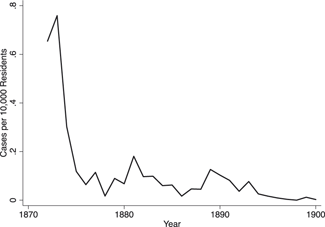
Finally, as Republicans lost their control over Congress and the presidency in the 1880s and early 1890s, voting enforcement became part of what James and Lawson have interpreted as a national reorientation of party competition to cities in swing states in the North rather than as a mode of expanding federal power in the South.Footnote 44 Voting enforcement overall declined during the late nineteenth century (see Fig. 3), but when it was used, it was a matter of shoring up votes rather than expanding federal power.Footnote 45 While Republicans did not give up on trying to advance African American voting in the South until the mid-1890s, these efforts were largely fruitless—hence, when Henry Cabot Lodge proposed a reinvigorated enforcement act in 1890, the Democratic press was very successful in casting the effort as a “force” bill.Footnote 46 As a result, DOJ enforcement of voting rights as a means of expanding suffrage in the South was a dead letter by the turn of the century.
The Decline of Enforcement Prosecutions.

The Growth of Fragmented Policing
Curtailing voting enforcement not only undercut the most important policing mission for which the DOJ was uniquely responsible. It also undermined the capacity of the DOJ to consolidate its control over federal policing more generally. Most significantly, in most of the country, the department’s actual policing force remained very small, even in large districts—in 1880, for instance, the U.S. Marshal’s office for the District Court of Illinois had only three permanent field deputies, while the Chicago police had 326 regular patrol officers that same year.Footnote 47 Moreover, Congress did not strip other federal agencies of their capacity to control in house policing officials, despite opportunities to do so in 1874 and 1875; instead, it added small but significant numbers of new investigative examiners and special agents throughout the 1870s and 1880s in the Departments of Treasury, the Post Office, and the Interior, often leaving relatively unclear the specific relationship of those agencies to the DOJ.Footnote 48
In this sense, defying the intentions of Jenckes and other reformers, federal policing, always somewhat incoherent, became ever more fragmented during the 1880s and 1890s, reflecting the complex dynamics between reform and patronage that characterized the “patchwork” administration found throughout the Gilded Age.Footnote 49 Not only did the collapse of voting enforcement pave the way for a regional reorientation of policing, but it also allowed bureaucratic entrepreneurs in institutional sites outside the DOJ to take advantage of the lack of an autonomous centralized policing agency and manage enforcement work in-house, using collaboration across agencies and with local officers. There were many such sites—including the Secret Service and the Customs Service, both in the Department of Treasury, and the new Special Agents for forest management in the Department of Agriculture—but I focus here on three exemplary agencies.
The first is the Revenue Bureau, housed in the Treasury Department. As with the DOJ, during the Civil War and Reconstruction, Congress dramatically enlarged the infrastructure of assessors and collectors, which had long been responsible for collecting taxes on liquor and tobacco, and created a new solicitor of internal revenue, who was to work under the AG.Footnote 50 Collectors, in particular, played the key role investigating and identifying infractions, the scope of which had grown considerably since the passing of new revenue laws in 1862.
After the war, revenue enforcement was primarily directed toward illegal moonshining, much of which took place in areas in the Mountain South.Footnote 51 This was dangerous, often grueling work, which provoked a great deal of local resistance. The primary tactic was the joint raid, which involved a deputy marshal, a deputy revenue collector, and a number of special deputies (often drawn from nearby towns) coordinating a surprise attack on a still complex.Footnote 52
Although moonshine raids provoked plenty of local resistance—between 1878 and 1890, for instance, seventy-eight officers of the Internal Revenue Bureau were killed or wounded in raiding, largely in the Mountain South—unlike voting enforcement, once in power in the early 1880s Democrats did very little to actually roll back revenue efforts. Indeed, revenue collection became a “bipartisan concern,” a way for Democrats, too, to enjoy the expanded opportunities a robust revenue system brought.Footnote 53 Moreover, collection of federal excises offered a substitute to the tariff so hated by the party and by many agricultural elites in the South.
Bipartisan support for revenue enforcement was most apparent during the appointment of Green B. Raum, a former general for the Union, as commissioner of the Internal Revenue Bureau in 1876. Raum’s efforts marked a shift in the Grant administration toward a more aggressive form of revenue policing, one that proved popular even with Democrats (Raum’s tenure continued through the Democratic congressional resurgence of the late 1870s until 1883). Raum considerably ramped up the intensity and frequency of raiding, provoking something of a small war in moonshine country in lower Appalachia. For instance, in 1877, the first year Raum began recording seizure statistics, 744 stills were seized and 1,335 people arrested in raids against moonshiners. Two years later, those figures rose to 1,495 stills seized and 3,281 arrests.Footnote 54 Raum also introduced a series of organizational changes intended to bolster coordination of raiding parties across state lines and began to collect data to demonstrate the magnitude of lost revenue entailed in moonshining.Footnote 55 Most significantly, Raum appears to have taken over a great deal of tactical control from the U.S. Marshal’s office, dictating when and how raids should be carried out.Footnote 56
By the late 1880s, then, an infrastructure for revenue policing had become a permanent component of the Treasury Department. Though the DOJ remained involved in these efforts, the Revenue Bureau had largely succeeded in creating an “in-house” policing apparatus.
A second quasi-independent arena for federal policing had to do with pension fraud. The dramatic expansion of military pensions in 1862 also created a massive flow of claims in the years after the Civil War—the federal government responded by bolstering the administrative ambit of the Pension Office in the Department of Interior. In practice, this entailed the Pension Office in investigative activity and the detection of fraud, providing pension examiners with opportunities to exercise their own authority to interpret vague codes and making discriminatory judgments.Footnote 57
Pension fraud was a serious issue, which motivated a number of congressional inquiries and became a flashpoint for budgetary conflict. Contemporaries argued that up to one-quarter of pension cases involved some form of fraud, although this amount is hard to verify.Footnote 58 Since the pension system was such a huge proportion of the federal budget in the latter half of the nineteenth century (41 percent, for example, in 1893) and a crucial site for the interaction between the bureaucracy and citizenry, the suspicion that fraud was widespread mobilized support for a robust policing effort.Footnote 59 In cases where fraud was suspected or where other irregularities required additional investigation, review passed to a special examiner, who could call witnesses and make inquiries about the veracity of the claim.Footnote 60 It was the special examiner who became the key figure responsible for identifying potential criminal cases and initiating policing activity.
Special examiners were supposed to work with U.S. Attorneys and the Marshal’s Office in securing arrests for pension fraud. According to official regulations, if criminal behavior was suspected, the special examiner would gather evidence and submit a report to the Commissioner of Pensions; in “urgent cases,” evidence would be provided to the District Attorney or U.S. Commissioner, who could then issue warrants, to be served by a field deputy.Footnote 61 In practice, the special examiner often participated in every stage of the policing process, up to and including arrest.
The Pension Bureau was a target for partisan attack, in large measure because of its close relationship with the Grand Army of the Republic (GAR), a powerful veterans’ lobby group active in Republican Party politics. Under President Harrison, in particular, the Pension Bureau developed a reputation for “liberality” with veterans, creating a crisis for Commissioner James Tanner, whose close relationship with the GAR had become a major focus of attack by Democratic congressmen. Through the 1880s, Congress launched investigations into the department in response to reports of corruption and fraud.Footnote 62
Partisan attacks on the pension system, however, did not lead to the collapse of the policing function of the bureau; if anything, it bolstered it. Special examiners were considered a source of internal surveillance for pension practices and a means to avoid precisely the illegitimate forms of pension distribution for which the bureau became famous. Moreover, special examiners were notorious for their vigilance against African American pension claims, denying them at higher than expected rates and being aggressive in their pursuit of perceived violators.Footnote 63 Democratic lawmakers, of course, supported this activity. As a result, special examiners were able to use their leverage to carve out a permanent place in the Department of Interior for investigation and enforcement.Footnote 64
A third institutional site in which federal policing was found was the Post Office Department. Postal inspection and policing antedated the Civil War—indeed, since the founding of the postal system in 1792, Congress had been concerned about securing its infrastructure as well as ensuring that certain obscene, illicit, and fraudulent materials would remain “unmailable.” In 1810, the Postmaster General was granted the authority to appoint up to five “Special Agents,” who would serve an ad hoc investigative function, including supervising and monitoring those titans of patronage, the local postmasters.Footnote 65 The special agent system was used—in conjunction with the aid of the War Department—to detect and censor the circulation of “disloyal” publications during the Civil War.Footnote 66 Despite this expansion in its scope of activity, the system remained organizationally unchanged until 1875, when, in response to a rash of new obscenity laws, the investigative function became the purview of a new Division of Postal Inspectors and Mail Depredations.Footnote 67 Meanwhile, the number of Special Agents employed by the Department doubled from twenty-six in 1865 to fifty-three ten years later.Footnote 68
Crucial to the growth of inspection were the policing expectations placed upon the service by the expanding scope of federal crime. Postal Inspectors were primarily investigators and used a variety of techniques, including undercover and clandestine operations, to identify fraudulent or obscene material moving through the postal system.Footnote 69 In cases where they did not witness the crime itself, inspectors were to report suspicions to U.S. Commissioners or District Attorneys, who would secure a warrant for DOJ or local law-enforcement officers to arrest suspected violators. In practice, however, the actual arrest typically involved collaboration by the postal inspector, a law officer, and, occasionally, an official responsible for authorizing the arrest.Footnote 70
Post-Reconstruction postal inspectors were politically popular officials. Much of the support derived from the vigorous foray of the Postal Inspection service into suppressing obscenity and access to information about abortion, which was supported by Progressive reformers and rural conservatives alike. The inspector corps’ vigor in pursuing mail robbers and con artists was also well known, as was its investigation into post office corruption in the famed Star Route cases in the 1870s, in which postmasters reported inflated contracts for specific postal routes and pocketed the excess.Footnote 71
As Dan Carpenter demonstrates, the Postal Inspection thus bolstered the political independence of the Post Office, which became a model for civil service and innovation in the early twentieth century.Footnote 72 As a result, one of the most vigorous forms of federal law enforcement was largely independent from the policing efforts of the DOJ.
In short, federal policing was increasingly housed in disparate and far-flung agencies in the post-Reconstruction period, fragmenting policing along institutional lines and forcing the small corps of permanent policing officials to develop relationships with local and other federal agents. The DOJ, no longer capable of consolidating policing functions, was just one among many law-enforcement agencies. At the same time, rather than simply coordinate federal law enforcement, the DOJ began to specialize in particular regions of the country. Policing, in other words, fragmented geographically as well. Most significant were the policing duties the department pursued in western states and territories, where the U.S. Marshal’s force found an opportunity to expand its institutional clout.
In particular, the legal and policing infrastructure of local jurisdictions in western territories depended heavily on the U.S. Court system to a degree not found in states. Thus, while the Marshal’s force and legal staff of the territories were often severely underpaid and overworked, they were also able to pursue a large number of law-enforcement activities denied them elsewhere. This took several forms.
For one, in unorganized areas of territories, the Marshal’s force was often the only available form of law enforcement—this meant, in essence, that USDMs acted as local sheriffs, policing criminal activities that would normally fall under the jurisdiction of county or municipal government.Footnote 73 And, unlike the deep resistance to voting enforcement on the part of economic elites in the Reconstruction South, in the West, many white propertied interests—particularly in border areas—requested aid from the DOJ for the pursuit of bandits or thieves, even when the crimes they had committed only tangentially fell under federal jurisdiction.Footnote 74
For another, USDMs were responsible for policing a class of behaviors prohibited by federal statute—in particular “bigamy,” Chinese exclusion, and intercourse act violations with Native populations—found primarily in territorial settings. The Morrill Act of 1862, which outlawed polygamous relationships, was explicitly directed toward increasing federal control over Utah territory, but directly involved USDMs in the policing of family life in Arizona and New Mexico Territories as well. Similarly, the Chinese Exclusion Act of 1882 charged the Marshal’s force in areas with large concentrations of Chinese immigrants—not just California, but also Washington and Arizona Territories—with identifying and deporting illegal immigrants.Footnote 75
Closely related, the Marshal’s office increasingly helped coordinate policing in Native communities, particularly in the Indian Territories. Since prior to the creation of the Oklahoma Territory in 1890, the Indian Territories were, technically, “unorganized,” Marshals possessed local law-enforcement powers in the region, though tribes such as the Cherokee had their own recognized policing and court systems to manage criminal activity involving only Native participants. USDMs, instead, primarily got involved in cases involving U.S. citizens. This often provoked jurisdictional clashes, including, most tragically, the Going Snake events of 1872, in which a feud involving the relationship between a Native woman and a White American citizen boiled over into a violent confrontation at the Courthouse in Tahlequah. Increasingly, bipartisan calls in Congress were made to bring Indian communities under federal supervision, culminating in the Major Crimes Act of 1885. A landmark expansion of federal police power, this act defined a set of criminal activities occurring on reservations that, regardless of participant, had to be adjudicated in the federal courts.Footnote 76 While this act did not fundamentally alter the relationship of the federal government to local police power, it did considerably broaden the scope of crimes that could be considered in federal court.
Oklahoma, within the jurisdiction of the Western District Court of Arkansas, thus became the scene of intense marshal activity in the 1880s and 1890s. USDMs working under the aegis of Isaac Parker, the famous “hanging judge” who oversaw the district from 1875 to 1896, essentially took over responsibility for many of the policing activities of the Indian Territory. USDMs in Oklahoma such as Bill Tilghman, Heck Thomas, and Chris Madsen (the so-called three guardsmen) became famous for their aggressive pursuit of bank and train robbers, moonshiners, and other criminals, gaining the strong backing of the federal courts and enjoying a broad interpretation of their jurisdictional ambit.Footnote 77 Between 1865 and 1900, at least 1,200 individuals served as USDMs in the district.Footnote 78
The presence of the federal policing in everyday life was thus most pronounced in the West. In 1897, for example (the first year for which comprehensive information on field deputies is available), there were approximately 4.2 deputies per 100,000 residents in the region, as opposed to only 2.6 in the South. In the territories, in turn, there were around 22.9 deputies per 100,000 residents.Footnote 79
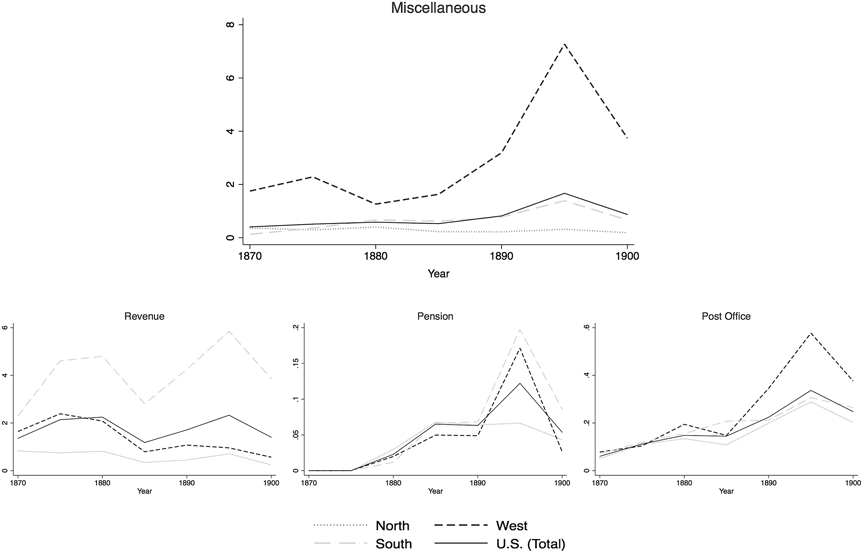
The regional reorientation of the Marshals’ force to the West can be seen most clearly by focusing on the category of federal crimes reported in the Annual Reports of the Attorney General as “miscellaneous.” Miscellaneous crimes included, for instance, the murders, robberies, and so-called depredations adjudicated by courts with Native reservations in their jurisdictions. It also included any hard-to-classify criminal prosecution that ended up in federal court, a frequent result in the territories, where the legal boundaries between the local and federal courts were particularly murky.Footnote 80 Over the course of the nineteenth century, miscellaneous prosecutions took up a larger and larger slice of the overall caseload—whereas in the early 1870s, such prosecutions represented only about 20 percent of DOJ cases, by the 1890s well over 40 percent of the cases prosecuted by the DOJ were classified as miscellaneous.
Moreover, policing of miscellaneous crimes was consistently highest in the West. Figure 4 includes information about rates of prosecutions for various federal crimes per 10,000 residents of the region from 1871 through 1900 (in five-year increments).Footnote 81 As is clear in the top panel of Figure 5, the rates of miscellaneous prosecutions in the West exceeded even the highest rates recorded elsewhere.
Federal Prosecutions (per 10,000 Residents) by Region.

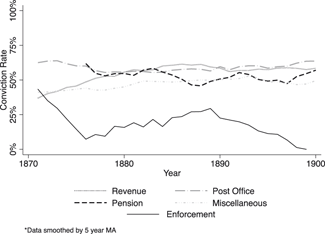
Conviction Rates by Case Type*.

The graphs in the bottom panel in Figure 4 also reveal the geographical fragmentation of other forms of federal policing. Revenue enforcement, for example, was most pronounced in the South; the long dashed gray line in the Revenue graph demonstrates that as rates of prosecutions declined elsewhere after the mid-1880s, raiding on moonshining stills and attacks on illicit tobacco distribution actually became relatively more common, particularly during the years of Democratic resurgence in national politics in the early 1890s.
By contrast, as seen in the other two graphs of Figure 4, pension fraud and postal crime were less clearly associated with specific regions, though by the end of the century postal crimes were more frequently prosecuted in federal courts in the West than they were elsewhere. This was likely due to the fact that states in the East increasingly included their own obscenity statutes, permitting groups like the Anthony Comstock’s New York Society for the Suppression of Vice (NYSSV)—a law-and-order society charged by the state government with identifying and prosecuting obscenity violators—to charge offenders in local courts, where they might possess more influence. For instance, while the society prosecuted only 30 percent of obscenity prosecutions in the state court system in 1876, that figure had risen to 80 percent by 1897.Footnote 82
The slope of the trend lines in all the graphs of Figure 4 also reveal how active the federal policing system was until the very last years of the nineteenth century, when the newly fiscally conservative Republican majority seems to have tamped down on federal policing temporarily. Though not every region saw the same increase in the case rate, for most categories of crime the national prosecution rates increased or remained constant until after the mid-1890s.
The exception, of course, was voting enforcement, which not only saw a decline in absolute rates of prosecution but also witnessed a decline in the convictions. While, as seen in Figure 5, around 60 percent of prosecuted cases resulted in convictions regardless of whether they were initiated in the DOJ or not, for Enforcement cases this rate was significantly lower throughout the period.
Deputation, Citizens’ Arrest, and Interagency Collaboration
Federal policing was, in short, deeply fragmented—policing varied across region, different agencies housed policing officials, and the responsibilities of the DOJ were often unclear. Moreover, the department could not establish a firm financial footing, instead remaining vulnerable to congressional budgetary threats throughout the century. This was exactly what the congressional supporters of the department had feared. How, then, did this not erupt into a dysfunctional trajectory of interservice rivalry and inefficiency? How, despite such a stagnant budget and a minuscule corps of full-time policing officers, did the justice system manage so many effective prosecutions?
The answer, I contend, had to do with the availability of deputation—the transferring of ministerial authority to others for some specific period or placeFootnote 83—and citizen’s arrest—the legal right for nonofficials to detain certain violators. These two practices enabled ad hoc mobilization of police capacity and dampened interservice rivalries, promoting collaboration instead of competition. As the DOJ continually failed to live up to the promise of bureaucratic autonomy, these two practices allowed federal policing to diffuse widely throughout the central administration and permitted actors otherwise lacking official arrest powers to cultivate relationships with local law officers and participate in arrests.
The capacity for U.S. Marshals and Judges to depute—a capacity encoded in the Judiciary Act of 1789—provided access to the expanded powers of arrest on a provisional basis to virtually anyone.Footnote 84 Deputation was primarily used to extend local law-enforcement capacity, however, and was deeply rooted in the common law of arrest.Footnote 85 Private detectives, family members, railroad employees, and party allies could all be granted deputy status based on the discretion of qualified officials. Indeed, local deputation had proven extremely useful for federal law enforcement for years. The founder of the famous Pinkerton Detective Agency, Allan Pinkerton, for instance, was made a Special Agent of the Post Office while holding a Deputy Sheriff’s commission in Cook County, Illinois, in 1853–54.Footnote 86 Both federal and local officers relied on the law of posse comitatus, which permitted officers to enlist the aid of bystanders in the execution of legal process.Footnote 87
Closely related to deputation was the common law of arrest, which provided a great deal of flexibility over the conditions under which a suspect could be seized. Private individuals, in addition to officers of the peace, possessed the legal authority to arrest those committing felonies or involved in a breach of the peace in their presence.Footnote 88 Indeed, the two main differences between police and citizen’s arrest were that citizens were not usually allowed to serve warrants and could be liable for false detention.Footnote 89
The law of citizen’s arrest was crucial for federal officers not in immediate possession of a commission allowing them to serve as deputy.Footnote 90 It allowed postal inspectors or revenue agents, for instance, to link their investigative activities—which increasingly involved clandestine surveillance—to the act of arrest, since felonies being “investigated” in such a manner would often be performed in the presence of the agent. As a result, the ability to arrest was inherent in the expansion of the capacity of federal agents merely to gather information about potential crimes—though technically they possessed no arrest powers, the boundary between the ability to exploit common-law principles of arrest and the jurisdiction of investigative agents was quite blurry.Footnote 91 In the words of E. G. Rathbone, chief of the Postal Inspection service in 1890, investigations provided the opportunity to “lay violent hands on guilty persons without awaiting the formality of a warrant.”Footnote 92
Thus, with the rise of investigative agencies in the federal bureaucracy, deputation and citizen’s arrest allowed the now-fragmented system of federal policing to evolve in an ad hoc, flexible manner. This was important because many Democrats were willing to expand the federal criminal law to include Indian Affairs and Revenue collection even as they remained suspicious of voting enforcement; as long as such techniques were available, policing could be extended to specific places or institutional settings without also reviving the threat of a tyrannical DOJ.Footnote 93 If the DOJ had become the centralized, efficient entity envisioned by its founders, these collaborative strategies would have likely been much less important.
But deputation and citizen’s arrest also meant that federal policing could expand without threatening local law-enforcement traditions. Indeed, quite the opposite—federal policing, particularly in rural areas, depended heavily on local cooperation. Because the deputation of law officers explicitly did not forbid multiple commissions, local sheriffs, railroad guards, tax collectors, and others could continue to serve their own parochial interests, while gaining the additional imprimatur of federal powers of arrest.Footnote 94 Moreover, at least in part because the DOJ’s core voting-enforcement function had degraded, deputies working for the U.S. Marshal’s force did not necessarily see themselves as uniquely federal officials. The Attorney General left appointments of deputies up to the Marshal (even at the height of the Civil Service reform era in the 1890s) and frequently declined to get involved in what was considered a local matter.Footnote 95 Moreover, marshals and their deputies were often considered by DOJ officials to be effective precisely because of their connections to local politics.Footnote 96
Cross-deputation—the simultaneous holding of multiple deputy commissions—was vitally important for both the DOJ and other federal agencies in both states and territories. USDMs and other federal officers in the West frequently possessed affiliations with local law-enforcement agencies. Thomas Broderick, for example, not only was deputized as a federal marshal in the late 1890s, but also served concurrently as Deputy Sheriff and City Marshal in Arizona. Footnote 97 And Isaac Lee, a deputy sheriff in Presidio County, Texas, in the early 1890s was also a USDM, which allowed him to expand his jurisdiction and work closely with Texas Rangers (which possessed statewide arrest powers) in policing the area around Laredo.Footnote 98 Cross-deputation was not only a flexible way to increase the capacity to arrest across multiple jurisdictions, but it was also an important way for law officers in the West to bolster their earnings, as the fees from a single office were rarely enough to make a comfortable living.
How widespread was cross-deputation between federal and local law officers? In Arizona Territory, we have commission records for 113 deputy marshals, special deputies, or field deputies appointed between 1867 and 1900.Footnote 99 Of those USDMs, around 27 percent held concurrent appointments as sheriffs, deputy sheriffs, or town marshals while serving in the federal government. Moreover, at least 43 percent of the Arizona deputy force held local law-enforcement roles during their careers, often becoming sheriffs after serving as USDMs. Not only were the boundaries between federal and local law-enforcement roles unclear, but one role was frequently seen as an avenue to the other.Footnote 100
Cross-deputation was also used to link federal agencies together. Occasionally, special agents and investigators would receive direct deputation from the DOJ—the well-known private detective (and future head of the Bureau of Investigation) William J. Burns was deputized as a marshal while serving as a Secret Service operative in 1900, for instance.Footnote 101 And beginning in places like North Carolina in the early 1880s, deputy marshals were frequently cross-deputized as revenue collectors, allowing them to participate in a highly efficient (and frequently fraudulent) system of both initiating and executing legal process, thereby maximizing the collection of fees.Footnote 102 By the 1890s, new checks were introduced to mitigate the potential for abuse in this system, but it wasn’t until 1896 that federal cross-deputation in the Revenue Bureau was actually banned. At that point, however, local jurisdictions across the Mountain South had begun experimenting with prohibition, which induced cooperation between local and federal officers and which undercut the political rivalry between county sheriffs and federal revenuers.Footnote 103
Postal inspectors, too, relied on cross-deputation with other law-enforcement agencies. For instance, “General” Charles Adams, a well-known special agent and militia captain from Colorado, was deputized by U.S. Marshal Gustave Schnitger in Wyoming to pursue a band of Deadwood-based stage robbers in 1878.Footnote 104 Similarly, in his crusade against obscenity, Anthony Comstock was both appointed a special agent for the Post Office and, through his association with the NYSSV, was given special arrest powers by the state legislature.Footnote 105
Throughout most of the nineteenth century, however, most postal inspectors had to rely on citizen’s arrest law. By the mid-1890s, Comstock had begun to call for powers of arrest to be granted to postal inspectors, claiming that only with full police authority could they ensure that the Post Office would continue to be both an effective and moral institution. With the support of a number of key postal officials and the sponsorship of Congressman Eugene Loud from California, a bill granting such authority passed with bipartisan support in 1897.Footnote 106 This move not only helped shore up the power of the post office, but it also furthered the fragmenting of federal policing by creating a parallel law-enforcement apparatus with powers more or less akin to that of the marshals.
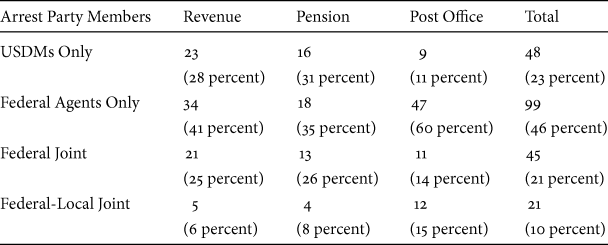
Because of the availability of citizen’s arrest and deputation, however, the actual occasion of federal arrest was frequently a joint effort on the part of multiple federal and local officials. In order to find out who, exactly, was involved in detaining suspects in nineteenth-century federal crimes, I collected information on 213 such arrest events from contemporary newspaper reports across the country from 1870 to 1900.Footnote 107 Table 1 outlines the composition of these “arrest parties.”
Composition of Arrest Parties for Federal Crimes (All Regions)

There are three striking trends in Table 1. First, law-enforcement officers—either in different federal agencies or in federal and local agencies—worked closely together in arresting suspects (this is evident in the two “Joint” rows, both of which involved cross-federal or federal-local collaboration). Approximately 31 percent of all arrest parties were composed of joint efforts of officials from multiple agencies, consistently outnumbering those performed by USDMs alone.
Second, overlaps in federal and local jurisdiction—particularly mail robbery, which, depending on the particular situation, could be considered a local property crime and a federal offense—facilitated rather than hindered federal-local cooperation in arrests. In the Post Office case column, for instance, inspectors remained the most active arresting agents, but local law officers participated in 15 percent of arrests, more than any other case type. This was less true for crimes like pension fraud, which was strictly a federal affair.
Finally, as indicated by the first two rows of Table 1, USDMs—those officials explicitly tasked with serving arrest warrants—were actually less likely than special investigative agents to be primarily responsible for arresting offenders. The practice of arrest was highly diffuse throughout institutions in the federal bureaucracy and, despite the supposed distinction between investigation and the serving of warrants, was not limited to cooperation by the U.S. Marshal.
However, there was an important exception to the marginalization of the Marshal’s office: the West, where territorial jurisdiction enabled USDMs to act, more or less, as local police.Footnote 108 In that region, the Marshal’s force was involved in 65 percent of arrests of suspects for federal crimes in the region, as opposed to only 41 percent of arrests elsewhere. Moreover, deputies were more likely to serve as general-purpose federal policing agents in the region: while only 18 percent of arrests outside the West were carried out by USDMs alone, 45 percent of arrests for postal, pension, or revenue violations in western states and territories were performed by deputies without the help of other federal agents.
In addition, cooperation between federal and local law officers and detectives was more common than in other regions: 20 percent of western arrests for involved joint activities between federal officers and local law enforcement, while this was true for only 11 percent of arrests elsewhere. In other words, USDMs were finding opportunities to police in western states and territories that were denied them in other regions. Despite the collapse of the core mission of voting enforcement and the fragmentation of policing throughout the federal bureaucracy, then, the DOJ was nevertheless able to secure its own place in an increasingly complex system of law enforcement.
Conclusion
In short, the boundary between those investigating federal crime and those involved in actual arrests was quite ambiguous. Moreover, while in the West, the U.S. Marshal’s force was able to gain a foothold, often with the cooperation of local law officers, in other regions federal investigators from a variety of departments were just as frequently involved in arrests, either as a result of special deputation or as a right reserved to all citizens to arrest certain kinds of offenses. The failures of the DOJ to develop a permanent, powerful autonomous bureaucracy during Reconstruction divided policing responsibilities both institutionally and geographically, permitting investigators and agents throughout the federal government to turn to traditional practices of deputation and citizens’ arrest. Federal policing in the nineteenth century was thus fragmented but functional, appearing not as a coordinated, well-orchestrated bureaucracy of coercion but rather as a differentiated, divided, and flexible operation built on well-established common-law principles.
Of course, in the context of national economic incorporation, it wasn’t always clear which “locals” actually benefited from this fragmented system. For instance, during one of the most significant disorders of the late nineteenth century, the violent labor actions of 1894 in Pullman, thousands of USDMs were employed against striking workers in addition to private detectives, the National Guard, and the U.S. Army. Many of these deputies were employees of the Pullman company or were themselves private guards and the companies involved in the strike secured their commissions through the cooperation of the AG. In the aftermath of the violence, unions and their congressional allies attacked the willingness of the DOJ to use deputation on behalf of capital, but a crucial court decision stemming from the strike—In re Debs in 1895—secured the rights of the federal government to intervene in local disorders in defense of interstate commerce.Footnote 109 The very flexibility of the fragmented national policing system, which had made deputation of private guards possible in the first place, also sustained the economic consolidation of the Gilded Age.
More important, the fragmented system also provided an opportunity for bureaucratic entrepreneurs to expand the extant investigative services system in order to carve out a more permanent, federal police presence. The ease of establishing investigative branches throughout the federal administration would prove vital in the creation of the Bureau of Investigation in 1909, which the Roosevelt administration established through executive action. Roosevelt had initially wanted to move the Secret Service out of the Treasury Department to the DOJ in order to consolidate investigative and policing activities, but this had met with congressional resistance, particularly in the wake of the indictments of Senator John Mitchell and Representative John Williamson on land fraud in 1905, which had been the result of Secret Service investigations. In response, the administration simply established its own investigative force within the DOJ, building on the traditional diffusion of investigative practices throughout the governmental bureaucracy.Footnote 110
For several decades this Bureau of Investigation functioned just as special agents elsewhere in the federal bureaucracy had since Reconstruction—it investigated intradepartmental corruption, gathered information on trafficking and other federal crimes, and, especially, attempted to root out “threats” from various enemies during the Great War and subsequent Red Scare.Footnote 111 While agents lacked official powers of arrest, as Kathleen Frydl has demonstrated, central administrators like J. Edgar Hoover—who took over the directorate of the bureau in 1924—built on rather than challenged the long-standing relationships between federal agents and local law officers.Footnote 112 Due largely to Hoover’s bureaucratic skill in defanging local opposition, Congress and a succession of presidents treated the bureau as a “natural” tool to be used in the fights not only against corruption and domestic disorder, but also against global threats like Communism and Fascism. By Roosevelt’s administration, the agency—in 1935, renamed the Federal Bureau of Investigation—was granted full policing powers, displacing the U.S. Marshal’s force as the primary enforcement body of the federal government.Footnote 113 But by this point, practices of citizens’ arrest and deputation had already permitted investigators to act as law enforcers by default, and the FBI’s new powers were simply a formalization of a long-standing set of practices.
In other words, the growth of the U.S. federal policing infrastructure in the twentieth century was more evolutionary than revolutionary. As efforts to consolidate policing efforts in the DOJ during Reconstruction failed to produce a powerful, autonomous bureaucracy, investigators and federal officers instead turned to traditional sources of enforcement authority, allowing actors throughout the federal bureaucracy to engage in arrests, while also providing new ties between those agents and local officers. Ironically, the very absence of a powerful police agency during Reconstruction—when opposition to voting enforcement severely undermined the DOJ’s mission—may have helped facilitate the rise of the vast and seemingly boundless contemporary federal police system, one marked not only by collaboration but also by an ever-growing number of agencies and bureaus.Footnote 114