Introduction
Suicidal ideation (SI), defined as the occurrence of suicidal thoughts or wishes, is one of the most relevant predictors of suicidal behavior.Reference Mann, Waternaux and Haas1 Suicidal behavior is among the most prominent public health problems worldwide, being responsible for approximately 800,000 deaths per year.Reference Vijayakumar, Phillips and Silverman2
To date, a relative wealth of data exists regarding brain abnormalities in individuals with a history of previous suicidal attempts, showing a dysregulation of connectivity between deep gray matter and different regions of the prefrontal cortex (PFC) such as medial and orbital PFC regions.Reference Ding, Lawrence and Olie3 However, not all people with SI go on to attempt suicide, and in some who attempted suicide the SI phase can be very brief. People with SI without any previous suicide attempt are somewhat less studied than those with previous suicide attempters. However, the available evidence suggests that the PFC could also play a role in SI development and maintenance.Reference Mann, Waternaux and Haas1 The PFC is involved in emotional regulation,Reference Soares and Mann4 abstract reasoning, and self-monitoring,Reference Serafini, Pardini and Pompili5 which are key cognitive and emotional correlates of SI.Reference Mann, Waternaux and Haas1 The PFC, moreover, plays a role in the modulationReference Sullivan and Gratton6 of the hypothalamic–pituitary–adrenal axis and the autonomic nervous system, which often are dysregulated in people with SI.Reference Braquehais, Picouto and Casas7 In line with these observations, people with SI and major depressive disorder have been shown to present functional alterations in a vast network, including parietal and prefrontal brain regions (i.e., rostrolateral PFC, dorsal PFC, and frontal pole).Reference Myung, Han and Fava8
In this study, we decided to investigate anatomical underpinnings of SI in a population of Vietnam War veterans who suffered a penetrating traumatic brain injury (pTBI) to the PFC. SI and suicidal behavior represent a significant problem in both war veterans and pTBI patients,Reference Fonda, Fredman and Brogly9 and this is an active focus of research in military medicine, neuropsychiatry, and neurorehabilitation. A quantitative analysis of focal lesion distribution (as we utilized in the current study with pTBI patients) enables identification of causal brain–behavior relationships by highlighting brain regions that when damaged impair specific behaviors, thereby indicating its necessary role in subserving those behaviors.Reference Kwok10, Reference Adolphs11 The pTBI approach has been shown to represent a suitable model to disentangle the effect of lesions in key brain regions from those of psychosocial factors in conditions such as pathological aggressiveness,Reference Pardini, Krueger and Hodgkinson12, Reference Pardini, Krueger and Hodgkinson13 major depression,Reference Koenigs, Huey and Calamia14 and post-traumatic stress disorder (PTSD).Reference Koenigs, Huey and Calamia14, Reference Pardini, Krueger and Koenigs15 Our pTBI population presents with some unique characteristics, including minimal possible confounding factors such as availability of a pre-injury intelligence measure, demographic homogeneity, lack of pre-injury comorbidities, and shared circumstances causing pTBI.Reference Raymont, Salazar and Krueger16 Here, we evaluated whether damage in PFC regions was associated with increased SI and whether this association was mediated by changes in cognitive performance.
Methods
Recruitment
Patients were drawn from the Vietnam Head Injury Study (VHIS) (Phase III).Reference Raymont, Salazar and Krueger16 Phase III (2003–2006) was conducted at the Bethesda National Naval Medical Center (36–39 years post-injury). They underwent neurologic and psychiatric examinations and a non-contrast CT brain scan. The patients’ pre-injury characteristics and clinical follow-up data were available from military and Veterans Administration records. Based on the goal of the study, only veterans with pTBI to PFC regions were included, whereas veterans with a history of anxiety or psychotic disorders, or personality disorders were excluded. Further, none of the eligible veterans had symptoms compatible with the clinical onset of a neurodegenerative disease. Based on those inclusion criteria, 142 male veterans (years of age at evaluation, 58.3 ± 0.3; years of education, 14.7 ± 0.2; handedness, 120 subjects right-handed, 22 non-right-handed) out of 197 veterans of VHIS were included. All patients gave informed consent to the study, which was approved by the Institutional Review Board at the Bethesda Naval Medical Center.
Psychopathological and cognitive evaluations
Depression was evaluated with the Beck Depression Inventory, II Edition (BDI-II), a 21-item self-report instrument for measuring the current severity of specific symptoms of depressive disorder in the previous 2 weeks.Reference Beck, Steer and Ball17 Patients rated each item on a scale ranging from 0 to 3, with higher scores indicating greater symptom severity. SI was evaluated with the ninth item of the BDI-II (9i-BDI-II) Patients with an 9th-BDI-II score of 0 were assigned to the SI negative (SI−) group, while participants with higher scores to the SI positive (SI+) group.
To quantify childhood traumatic experiences, patients completed the Early Trauma Inventory (ETI) scale.Reference Bremner, Vermetten and Mazure18 The presence of PTSD symptoms was assessed with the Clinician-Administered PTSD Scale (CAPS) – a structured interview previously used for the assessment of PTSD in individuals with pTBI.Reference Blake, Weathers and Nagy19 Global functioning was evaluated with the Global Assessment of Functioning (GAF) scale,Reference Hall20 providing a measure for the overall mental health and day-to-day functioning. The presence of current and/or lifetime alcohol dependence or mood disorder diagnoses was evaluated with the Structured Clinical Interview for DSM-IV-TR Axis I Disorders. Moreover, different facets of executive abilities were assessed with the Delis–Kaplan Executive Function System (DK) batteryReference Keifer and Tranel21: Trail Making Test (task switching), Verbal Fluency Test (phonemic verbal fluency), Sorting Test (abstract reasoning and conceptualization), Twenty Question Test (category formation and feedback acquisition), and Tower Test (spatial planning). Lastly, memory abilities were evaluated with the Wechsler Memory scale (III edition), focusing on the general memory and working memory scores.
Pre- and post-injury intelligence evaluation
Pre-injury intelligence was evaluated with the Armed Forces Qualification Test (AFQT-7A), which was administered upon entry into the military. The AFQT-7A is a standardized multiple choice test of cognitive aptitude, measuring verbal ability, visual–spatial organization, and arithmetic and functional associations via multiple choice questions that has been extensively standardized within the US military.Reference Grafman, Jonas and Martin22 The total score ranges from 0 to 100. Scores are reported as percentiles (1–99). Post-injury intelligence was evaluated with the Wechsler Adult Intelligence Scale (WAIS-3, 3rd edition) – a widely used intelligence test which comprises 14 subtests grouped in four first-order factors: verbal comprehension, perceptual organization, working memory, and processing speed. The AFQT-7A and the WAIS-3 are highly correlated.Reference Grafman, Jonas and Martin22
Lesion identification and voxel-based lesion-symptom mapping
Axial non-contrast CT scans were acquired on a GE Medical Systems Light Speed Plus CT scanner in helical mode. Images were reconstructed with an in-plane voxel size of 0.4mm × 0.4mm, overlapping slice thickness of 2.5mm, and a 1-mm slice interval. Lesion location and volume were determined from CT images by manual tracing using the Analysis of Brain Lesion (ABLe) software implemented in MEDx v3.44 (Medical Numerics) with enhancements to support the Automated Anatomical Labeling (AAL) atlas.Reference Solomon, Raymont and Braun23 A trained neuropsychiatrist (VR) performed the tracings which were then reviewed by an experienced observer (JG), who was blind to the results of the clinical evaluations. The skull and scalp components of the CT volume were then removed; each volume was spatially normalized to a de-skulled CT scan, which was previously spatially normalized to match the shape of the T1 Montreal Neurological Institute (MNI) brain (standard of the International Consortium for Brain Mapping). The ABLe program was used to exclude the manually delineated lesion from the spatial normalization process to improve registration accuracy. Spatial normalization was performed using an automated image registration algorithm using a 12-parameter affine model on de-skulled CT scans. Lesion distribution is represented in Supplementary Figure 1.
VLSM results. Voxel-wise binomial Liebermeister comparison of lesion distribution between the SI+ and SI− groups (p(FWE-permutations) < 0.05), showing greater damage in the rlPFC for the SI− group compared to the SI+ group. Values represent FWE-corrected z scores.

MRIcron (www.mccauslandcenter.sc.edu/mricro/mricron) was used to evaluate the difference in the pattern of brain damage between SI+ and SI− subjects using a voxel-wise, permutation-based analysis of the normalized lesion maps as reported below and extract regional values of volume loss as previously described.Reference Koenigs, Huey and Calamia14 Lesion distribution was compared between the SI+ and SI− groups using a voxel-wise binomial Liebermeister testReference Rorden, Karnath and Bonilha24 with a threshold of p < 0.05 permutation-family wise error (FWE) corrected (p(permutation-FWE)) for multiple comparisons (3000 permutations). The Liebermeister test is an alternative to the Fisher Chi-square test and is thought to better account for unconstrained marginals usually encountered in lesion studies.Reference Rorden, Karnath and Bonilha24 To reduce false-positive findings, the analysis was limited to those voxels in the PFC territories which were damaged in at least five patients. The same threshold was also used to correlate the presence of structural damage in any given voxel with performance on the Delis–Kaplan Executive Function System (D-KEFS) Sorting Test using the voxel-wise, permutation based Brunnel–Munzel test.Reference Rorden, Karnath and Bonilha24 The Brunnel–Munzel test is an alternative to the more widely used t test to perform voxel-based lesion-symptom mapping (VLSM) analysis, since it does not require a normal distribution, similar variance between groups, and an interval of target measures.
Behavioral statistical analysis
Statistical behavioral analyses were performed with SPSS 21 (www.ibm.com/software/analytics/spss/) and Stata 13.1 (www.stata.com). A p value lower than 0.05 (two-tailed) was considered as significant.
Differences between SI+ and SI− groups in cognitive and psychopathological tests and percentage of volume loss were evaluated with independent samples t tests. An analysis of covariance (ANCOVA) on volume loss was performed with group (SI+, SI−) as a between-subjects factor and PTSD symptoms, childhood psychological trauma, global functioning, and whole brain damage as covariates. Differences in the frequency of alcohol abuse or mood disorders diagnoses between the two groups were assessed with a Chi-Square test. Normal distributions of targets measures were confirmed using a nonparametric bias-corrected and accelerated bootstrap with 3000 replicates. Effect sizes were calculated using Cohen’s d for those measures with significant differences between groups.
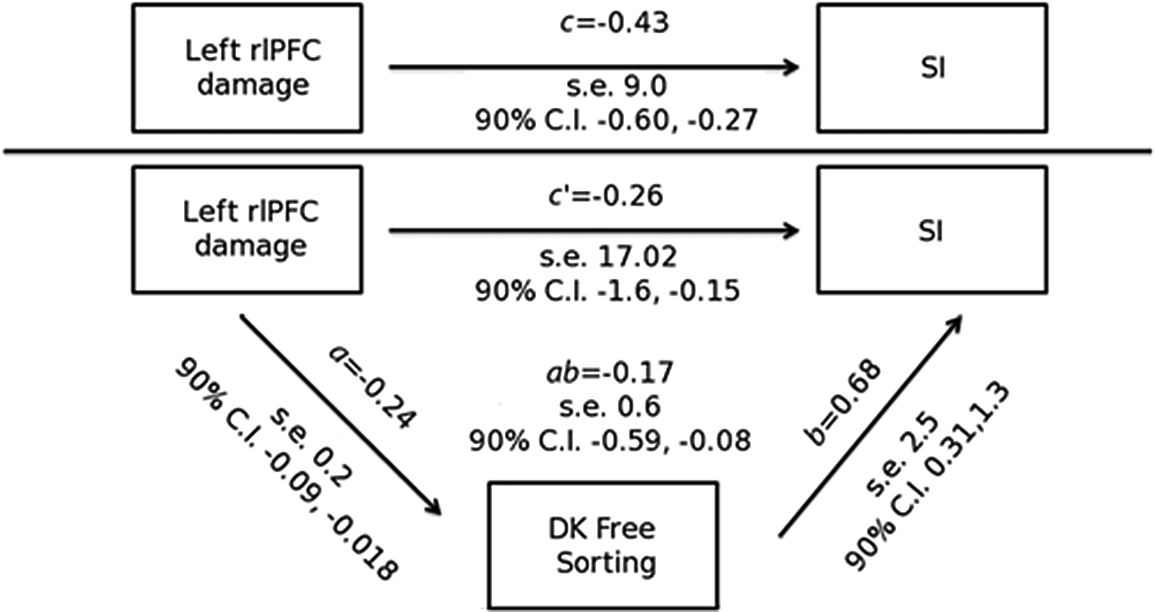
To link patients’ cognitive profile with brain damage, a bivariate correlation between left rlPFC damage and DK free sorting description score was performed, since those were the only measures that showed significant differences between the two groups (SI+, SI−). As a follow-up, a mediation analysis was performed to verify whether the influence of left rlPFC damage (independent variable) on SI (dependent variable) was mediated through free sorting description score (mediator variable). The model was adjusted for depressive symptoms, PTSD symptoms, childhood psychological trauma, and global functioning because of their impact on SI. Since our prediction was directional (i.e., pTBI impacts sorting performance and SI), 90% bootstrap confidence intervals (CIs) were constructed by resampling the data 10,000 times with replacement.Reference Coussons-Read, Lobel and Carey25 A significant evidence for mediation existed if the 90% CI for the indirect effect did not include zero.
Results
Sociodemographic, neurocognitive, and psychopathological measures
The sociodemographic, cognitive, and psychopathological measures for the SI+ group (n = 21) and SP− group (n = 121 veterans) are reported in Table 1.
Sociodemographic, neurocognitive and lesion measures for SI+ and SI− groups

AFQT, armed forces qualification test; WMS, Weshler Memory scale III edition; DK, Delis–Kaplan; rl, rostrolateral; dl, dorsolateral; dm, dorsomedial; vl, ventrolateral; vm, ventromedial; PFC, prefrontal cortex; BA, Brodmann area. Data reported as means (standard errors).
Significant results reported in bold font.
a All analyses adjusted for heteroskedasticity. Results confirmed using bootstrap (3000 permutations).
Abstract reasoning performance differences between SI+ and –SI− groups
The SI+ group demonstrated impaired abstract reasoning skills (as assessed with the DK free sorting description score) compared to the SI− group (d = 0.73, medium effect size), while performing similarly on other executive functions (Table 1).
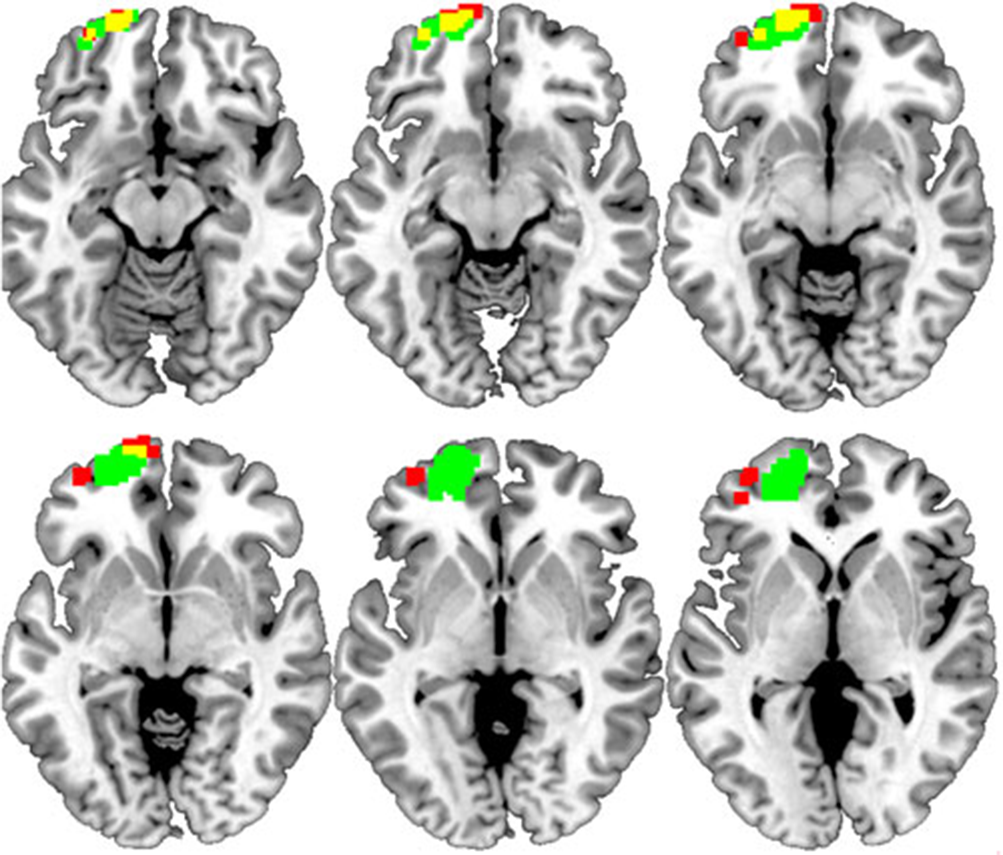
Lesion distribution differences between SI+ and SI− groups
The rostrolateral prefrontal cortex (rlPFC) was significantly more damaged in the SI− group compared to the SI+ group (peak at MNI coordinates: −26,54, −4) (Figure 1). No brain regions were more damaged in the SI+ than in the SI− group. Confirmatory analyses on regional volume loss showed that the SI− group had more damage to the left rlPFC than the SI+ group (11.1 ± 1.9 vs. 0.8 ± 0.5, t = 5.4, p < 0.001), but both groups showed similar damage across the entire brain and other brain regions (e.g., right rlPFC and other PFC regions) (Table 1). The difference in left rlPFC damage between the SI+ and SI− groups remained significant not only after controlling for differences in depressive symptoms, PTSD symptoms, childhood psychological trauma, and whole brain damage, but also after excluding participants with a history of mood disorders or alcohol-dependence disorder (see Supplementary Table 1).
Mediation of rlPFC damage on SI via abstract reasoning skills
A significant negative correlation was observed between left rlPFC damage and abstract reasoning (as assessed with the DK free sorting description score) (r = −0.247, p < 0.003), demonstrating that more damage in the left rlPFC leads to lower performance in abstract reasoning. A VLSM analysis confirmed a role of left rlPFC in abstract reasoning (p(FWE) < 0.05) (Figure 2). The impact of left rlPFC damage on SI was significantly mediated by changes in abstract reasoning abilities: 39% of the total impact of left PFC damage on SI was mediated by the role played by this region on abstract reasoning (Figure 3).
(Color online) Overlap (yellow area) between areas found to be associated with SI (green area, voxel-wise binomial Liebermeister test) and with abstract reasoning (red area, voxel-wise Brunnel–Munzel test). Statistical threshold set at p < 0.05 FWE-corrected for multiple comparisons after 3000 permutations. Image in neurological convention.

Mediation analysis results. All effects are significant as shown by the CIs. Upper panel: total effect (c) of rlPFC damage on SI. Lower panel: direct (c’) and mediated (ab; via free sorting performance) effects of rlPFC damage on SI. Model adjusted for depressive symptoms, post-traumatic stress disorder symptoms, childhood psychological trauma and global functioning. s.e., standard errors; SI, suicidal ideation; DK, Delis–Kaplan; rlPFC, rostrolateral PFC.

Discussion
The goal of the study was to evaluate the role of structural PFC damage on SI and its cognitive underpinnings in patients with pTBI. The results showed that left rlPFC damage was associated with reduced SI presence; this association was independent of depressive symptoms and global functioning and partly mediated by the role of left rlPFC for abstract reasoning.
An association between rlPFC and SI is in line with previous evidence. The rlPFC plays a relevant role in different psychological processes associated with SI, including guilt,Reference Pulcu, Zahn and Elliott26 ruminations,Reference Jacobs, Jenkins and Gabriel27 and performance monitoring.Reference Matthews, Spadoni and Knox28 Moreover, in patients with mood disorders, SI and suicidal behavior have been associated with long-range disconnections of rlPFC territories with other frontal and temporal regionsReference Myung, Han and Fava8 and with changes in rlPFC functional architecture.Reference Pu, Nakagome and Yamada29 Further, a recent study in patients with major depressive disorder has shown that the rlPFC is associated with an abnormal frontotemporal pattern of connectivity in patients with SI compared to those without SI. In particular, results from graph–theory analysis revealed that the severity of SI was associated with the strength of information crossing the rlPFC.Reference Myung, Han and Fava8 Finally, a diffuse increase in prefrontal activity (including rlPFC and medial/dorsal PFC territories) was observed during a functional MRI (fMRI) error-monitoring task in war veterans with SI compared to veterans without SI.Reference Matthews, Spadoni and Knox28
A protective effect of structural damage on SI – the association between rlPFC damage and reduced SI – seems unexpected at a first glance. However, the crucial role of rlPFC in abstract reasoning as reported in our study and in the literatureReference Fine, Delis and Dean30 could help to interpret this unexpected finding. Abstract reasoning abilities, such as deliberating the irreversibility of death, underlie some of the assumptions needed to develop SI.Reference Garfinkel, Froese and Hood31 Indeed, SI is uncommon in childrenReference Garfinkel, Froese and Hood31 and adolescents with learning disabilities,Reference Carlson, Asarnow and Orbach32 that is, before the maturation of abstract reasoning abilities. Moreover, SI has been reported to be associated with better cognitive abilities in subjects with schizophrenia, confirming the need for relatively preserved cognition to allow for the emergence of SI.Reference Delaney, McGrane and Cummings33 Thus, the reduction in abstract reasoning skills due to rlPFC damage could moderate SI. Although the mediation analysis was significant, only around a third of the observed impact of rlPFC damage on SI was mediated by abstract reasoning. This is not surprising given the multifaceted role played by rlPFC on executive functioning. Since a key role for the left hemisphere in SI has been reported in other mood disorder studies,Reference Myung, Han and Fava8, Reference Marchand, Lee and Johnson34 we argue that this lateralization could be due to the role played by the left hemisphere in some cognitive functions composing SI such as abstract reasoningReference Fine, Delis and Dean30 and emotion recognition.Reference Dal Monte, Schintu and Pardini35, Reference Leopold, Krueger and dal Monte36
We acknowledge that the relationship between cognitive functioning and SI is complex. In elderly subjects, for example, worse executive functions have been associated with an increased prevalence of SIReference Gujral, Dombrovski and Butters37; while in young subjects with major depression, SI has been associated with increased cognitive inflexibility and reduced executive performances.Reference Marzuk, Hartwell and Leon38 These differences are probably due to the heterogeneity in both the enrolled populations and the extent of cognitive deficits. Future studies using the same psychometric and cognitive measures across different age groups, as well as across neuropsychiatric diagnoses, are needed to better clarify the role of cognition on SI development in subjects with and without structural brain damage.
Regarding the relationship between SI and TBI, most of published studies report an increase in SI frequency after TBI. As in the general population, depressed mood, hopelessness, and low social support are thought to represent the more relevant risk factors for SI after TBI.Reference Tsaousides, Cantor and Gordon39, Reference Simpson and Tate40 Conversely, TBI severity has not been firmly associated with increased risk of SIReference Simpson and Tate40; however, published studies have been focused on overall severity rather than the role of regional damage.
This work expands on a previous research study using the VHIS database focused on the relationship between emotional competence and SI, showing a key role of emotional competence in reducing the risk of SI.Reference Paradiso, Beadle and Raymont41 Here we decided instead to focus on more basic cognitive functions (i.e., the different facets of executive abilities) to evaluate the cascade leading from prefrontal damage to cognitive functions to SI. These two points of view (i.e., a top–down method starting from higher-order cognitive constructs that influence SI and a bottom-up approach focused on regional damage associated with mental states) complement each other and help portray the complexity of the SI experience.
The present study needs to be considered in the light of the following limitations. First, a homogeneous population of male war veterans with pTBI was investigated, which reduces the generalizability of our findings. Second, no information was available on the nature of SI (e.g., degree of planning, possible lethality, and access to means) in our population. Therefore, future studies are needed to validate our results that focus on other clinical populations with discrete brain lesions (e.g., stroke and multiple sclerosis) and to associate psychopathological characteristics of SI with cognitive and lesion patterns in pTBI patients. Another limitation is represented by the use of a single item of the BDI to evaluate SI. While not available at the time of data collection, to date a number of new psychometric instruments have been developed to better probe the SI construct, such as the Columbia-suicide severity rating scale.Reference Posner, Brown and Stanley42 A positive replication of the present findings using these scales would strengthen the results reported in this work.
Overall, this study is not the first to report a paradoxical mitigating role of structural brain damage on a psychopathological construct. Using the same population, our group has shown previously that damage to the amygdala and the medial PFC is associated with reduced PTSDReference Koenigs, Huey and Calamia14 and risk for depressionReference Koenigs, Huey and Calamia14, respectively. Indeed, taking the results of these previous study into account, we have demonstrated an association between rlPFC and SI independently of depressive symptoms (total BDI scores), PTSD symptoms, and global functioning.
In summary, the results indicate that SI depends on the integrity of the left rlPFC and is at least partly dependent upon the cognitive and emotional processes required for complex ideational thinking. It may be that interventions designed to change and shape such deliberative thinking would be especially beneficial for people with SI.
Disclosures
Matteo Pardini receives research support from Novartis and fees from Merck for participation in advisory board activities. Jordan Grafman, Vanessa Raymont, Mario Amore, Gianluca Serafini, Michael Koenigs, and Frank Krueger do not have anything to disclose.
Supplementary materials
To view supplementary material for this article, please visit https://doi.org/10.1017/S1092852918001694.